check engine PONTIAC G8 2009 Owner's Guide
[x] Cancel search | Manufacturer: PONTIAC, Model Year: 2009, Model line: G8, Model: PONTIAC G8 2009Pages: 356, PDF Size: 1.83 MB
Page 225 of 356
If No Steam Is Coming From
The Engine Compartment
If an engine overheat warning is
displayed but no steam can be seen
or heard, the problem may not be too
serious. Sometimes the engine can
get a little too hot when the vehicle:
Climbs a long hill on a hot day.
Stops after high-speed driving.
Idles for long periods in traffic.
Tows a trailer.
If the overheat warning is displayed
with no sign of steam:
1. Turn the air off.
2. Turn the heater on to the highest
temperature and to the highest
fan speed. Open the windows as
necessary.
3. In heavy traffic, let the engine idle
in N (Neutral) while stopped. If it
is safe to do so, pull off the road,
shift to P (Park) or N (Neutral) and
let the engine idle.If the temperature overheat gage is
no longer in the overheat zone
or an overheat warning no longer
displays, the vehicle can be driven.
Continue to drive the vehicle
slow for about 10 minutes. Keep a
safe vehicle distance from the
car in front of you. If the warning
does not come back on, continue to
drive normally.
If the warning continues, pull over,
stop, and park the vehicle right away.
If there is no sign of steam, idle the
engine for three minutes while
parked. If the warning is still
displayed, turn off the engine until it
cools down. Also, see ‘‘Overheated
Engine Protection Operating Mode’’
later in this section.
Power Steering Fluid
Power Steering Fluid Level
Power steering uid is used in
all vehicles.
Check the level after the vehicle has
been driven for at least twenty
minutes so the uid is warm.
How to Check Power Steering
Fluid
To check the power steering uid,
do the following:
1. Turn the key off and let the engine
compartment cool down.
2. The power steering uid reservoir
is located on the driver side
toward the front of the engine
compartment. SeeEngine
Compartment Overview on
page 9-6.
Vehicle Service and Care 9-21
Page 273 of 356
Do a safety check before
proceeding. SeeIf a Tire
Goes Flat on page 9-66.
Inspect the damaged tire.
The sealant cannot seal sidewall
damage, large punctures, or a
tire that has unseated from
the wheel. SeeRoadside Assistance
Program on page 12-6.
Do not remove any objects that
have penetrated the tire.
1. Place the tire sealant and
compressor kit on the ground and
unwrap the sealant/air hose (E)
from the side of the compressor.
2. Remove the air compressor
accessory plug (B) from the unit.
Do not plug the plug in yet.3. Turn the tire valve stem cap
counterclockwise to remove.
4. Attach the sealant/air hose (E)
onto the tire valve stem.
Turn it clockwise until tight.
5. Make sure the sealant and
compressor kit on/off switch (A)
is in the O (off) position.
Plug the air compressor
accessory plug (B) into an
accessory power outlet in the
vehicle. SeeAccessory Power
Outlet(s) on page 4-9for
more information.
Do not slam door or close
window on the compressor
accessory plug cord.
{CAUTION
Idling the engine in a closed-in
place or with the climate control
system off can cause deadly
carbon monoxide (CO). See
Engine Exhaust on page 8-14.6. Start the vehicle. The vehicle
must be running while using
the air compressor.
{CAUTION
Overination could cause the tire
to rupture, and you or others
could be injured. Be sure to read
the inator instructions, and inate
the tire to its recommended
pressure. Do not exceed 36 psi
(248 kPa).
7. Push the On/Off switch (A) to the
I (on) position.
The kit will begin to inject sealant
into the tire. Sealant could leak
from the puncture hole until
the vehicle is driven and the hole
has sealed.
Vehicle Service and Care 9-69
Page 277 of 356
{CAUTION
Idling the engine in a closed-in
place or with the climate control
system off can cause deadly
carbon monoxide (CO). See
Engine Exhaust on page 8-14.
5. Start the vehicle. The vehicle
must be running while using
the air compressor.
{CAUTION
Overination could cause the tire
to rupture, and you or others could
be injured. Be sure to read the
inator instructions, and inate the
tire to its recommended pressure.
Do not exceed 36 psi (248 kPa).
6. Push the On/Off switch (G) to
the I (on) position.
Check the pressure gage (F).
If there is not a pressure reading
while the compressor isrunning, check for leaks at the
connection between the
hose and the tire valve stem.
7. Inate the tire up to the
recommended ination pressure
using the air pressure gage (F)
on the top of the unit. See
Inflation - Tire Pressure on
page 9-49.
The pressure gage (F) reads
slightly high while the compressor
is on. Turn the compressor off to
get an accurate reading. The
compressor may be turned on
and off until the correct pressure
is reached.
8. Push the On/Off switch (G) to
the O (off) position.
Be careful while handling the tire
sealant and compressor kit as
they could be hot after usage.
9. Unplug the air compressor
accessory plug (A) from the
accessory power outlet in
the vehicle and stow it in its
original location.10. Disconnect the air-only hose (E)
from the tire valve stem and
stow it back in its original
location.
11. Replace the tire valve
stem cap.
{CAUTION
Storing the tire sealant and
compressor kit or other equipment
in the passenger compartment of
the vehicle could cause injury. In
a sudden stop or collision, loose
equipment could strike someone.
Store the tire sealant and
compressor kit in its original
location.
12. Place the equipment in the
original location in the trunk
of your vehicle.
Vehicle Service and Care 9-73
Page 289 of 356
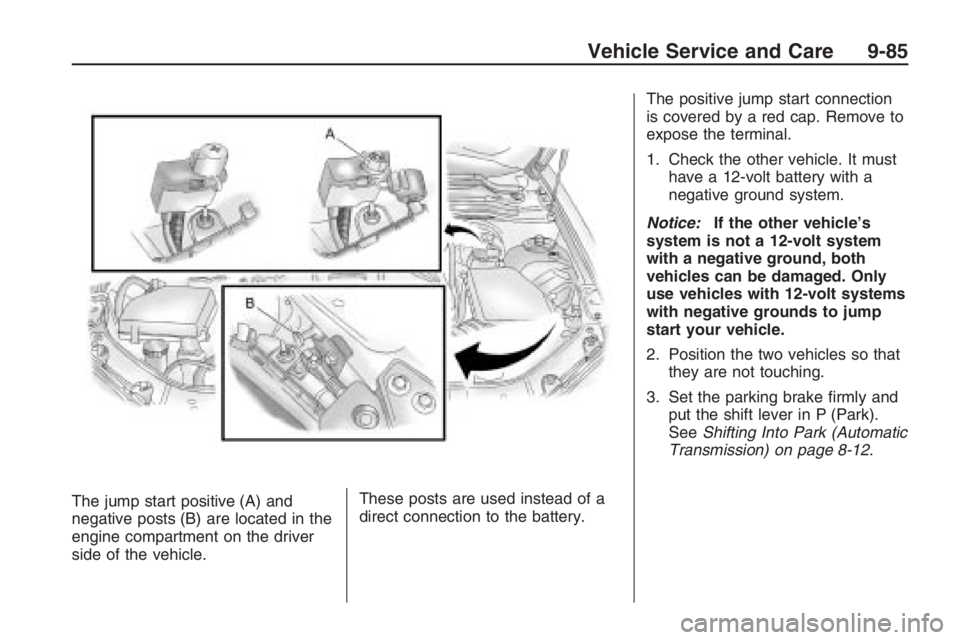
The jump start positive (A) and
negative posts (B) are located in the
engine compartment on the driver
side of the vehicle.These posts are used instead of a
direct connection to the battery.The positive jump start connection
is covered by a red cap. Remove to
expose the terminal.
1. Check the other vehicle. It must
have a 12-volt battery with a
negative ground system.
Notice: If the other vehicle’s
system is not a 12-volt system
with a negative ground, both
vehicles can be damaged. Only
use vehicles with 12-volt systems
with negative grounds to jump
start your vehicle.
2. Position the two vehicles so that they are not touching.
3. Set the parking brake rmly and put the shift lever in P (Park).
See Shifting Into Park (Automatic
Transmission) on page 8-12 .
Vehicle Service and Care 9-85
Page 298 of 356
Turn Signals When Towing a
Trailer
When you tow a trailer, your vehicle
may need a different turn signal
asher and/or extra wiring. Check
with your dealer/retailer. The arrows
on your instrument panel will ash
whenever you signal a turn or lane
change. Properly hooked up, the
trailer lamps will also ash, telling
other drivers you are about to turn,
change lanes or stop.
When towing a trailer, the arrows on
your instrument panel will ash
for turns even if the bulbs on the
trailer are burned out. Thus,
you may think drivers behind you
are seeing your signal when
they are not. It is important to check
occasionally to be sure the trailer
bulbs are still working.
Your vehicle has bulb warning
lights. When you plug a trailer
lighting system into your vehicle’s
lighting system, its bulb warning
lights may not let you know if one of
your lamps goes out. So, whenyou have a trailer lighting system
plugged in, be sure to check
your vehicle and trailer lamps from
time to time to be sure they are
all working. Once you disconnect the
trailer lamps, the bulb warning
lights again can tell you if one of
your vehicle lamps is out.
Driving On Grades
Reduce speed and shift to a lower
gearbeforeyou start down a long or
steep downgrade. If you do not shift
down, you might have to use your
brakes so much that they would get
hot and no longer work well.
On a long uphill grade, shift down to
a lower gear and reduce your
speed to around 45 mph (70 km/h)
to reduce the possibility of engine
and transmission overheating.
Parking on Hills
{CAUTION
Parking the vehicle on a hill with
the trailer attached can be
dangerous. If something goes
wrong, the rig could start to move.
People can be injured, and both
the vehicle and the trailer can be
damaged. When possible, always
park the rig on a at surface.
But if you ever have to park your rig
on a hill, here is how to do it:
1. Apply your regular brakes, but do
not shift into P (Park) yet.
2. Have someone place chocks
under the trailer wheels.
3. When the wheel chocks are in
place, release the regular brakes
until the chocks absorb the load.
4. Reapply the regular brakes.
Then apply your parking
brake, and then shift to P (Park).
5. Release the regular brakes.
9-94 Vehicle Service and Care
Page 299 of 356
When You Are Ready to Leave
After Parking on a Hill
1. Apply your regular brakes and
hold the pedal down while you:
Start your engine.
Shift into a gear.
Release the parking brake.
2. Let up on the brake pedal.
3. Drive slowly until the trailer is
clear of the chocks.
4. Stop and have someone pick up
and store the chocks.
Maintenance When Trailer
Towing
Your vehicle will need service more
often when you’re pulling a trailer.
See the Maintenance Schedule for
more on this. Things that are
especially important in trailer
operation are automatic transmission
uid (don’t overll), engine oil, drivebelt, cooling system and brake
system. Each of these is covered in
this manual, and the Index will help
you nd them quickly. If you’re
trailering, it’s a good idea to review
this information before you start
your trip.
Check periodically to see that all
hitch nuts and bolts are tight.
Engine Cooling When Trailer
Towing
Your cooling system may
temporarily overheat during severe
operating conditions. SeeEngine
Overheating on page 9-20.
Appearance Care
Interior Cleaning
Your vehicle’s interior will continue to
look its best if it is cleaned often.
Although not always visible, dust and
dirt can accumulate on your
upholstery. Dirt can damage carpet,
fabric, leather, and plastic surfaces.
Regular vacuuming is recommended
to remove particles from the
upholstery. It is important to keep
your upholstery from becoming and
remaining heavily soiled. Soils
should be removed as quickly as
possible. Your vehicle’s interior may
experience extremes of heat that
could cause stains to set rapidly.
Lighter colored interiors may require
more frequent cleaning. Use care
because newspapers and garments
that transfer color to your home
furnishings may also transfer color
to your vehicle’s interior.
Vehicle Service and Care 9-95
Page 311 of 356
Service and
Maintenance
Service and Maintenance
Introduction.......................11-1
Maintenance
Requirements..................11-2
Your Vehicle and the
Environment....................11-2
Using the Maintenance
Schedule.........................11-2
Scheduled Maintenance. . . .11-4
Additional Required
Services..........................11-6
Maintenance Footnotes.....11-7
Owner Checks and
Services..........................11-9
At Each Fuel Fill...............11-9
At Least Once a Month. . . .11-9
At Least Once a Year.....11-10
Recommended Fluids
and Lubricants...............11-12
Maintenance
Replacement Parts........11-13
Engine Drive Belt
Routing..........................11-14
Maintenance Record........11-15
Service and
Maintenance
Introduction
Important: Keep engine oil at the
proper level and change as
recommended.
Have you purchased the GM
Protection Plan? The Plan
supplements the vehicle warranties.
See the Warranty and Owner
Assistance booklet or your
dealer/retailer for details.
Service and Maintenance 11-1
Page 314 of 356
Scheduled Maintenance
When the Service Engine Oil
message comes on, it means that
service is required for your vehicle.
Have your vehicle serviced as soon
as possible within the next 600 miles
(1 000 km). It is possible that, if you
are driving under the best conditions,
the engine oil life system may not
indicate that vehicle service is
necessary for over a year. However,
your engine oil and lter must be
changed at least once a year and at
this time the system must be reset.
Your dealer/retailer has trained
service technicians who will perform
this work using genuine parts and
reset the system.If the engine oil life system is ever
reset accidentally, you must service
your vehicle within 3,000 miles
(5 000 km) since your last service.
Remember to reset the oil life system
whenever the oil is changed. See
Engine Oil Life System on page 9-10
for information on the Engine Oil Life
System and resetting the system.
When the Service Engine Oil
message appears, certain services,
checks, and inspections are
required. Required services
are described in the following
for “MaintenanceI” and
“MaintenanceII.” Generally, it is
recommended that your rst service
be MaintenanceI, your second
service be MaintenanceII, and that
you alternate MaintenanceIand
MaintenanceIIthereafter. However,
in some cases, MaintenanceIImay
be required more often.MaintenanceI—Use
MaintenanceIif the Service
Engine Oil message comes on
within 10 months since the vehicle
was purchased or MaintenanceII
was performed.
MaintenanceII—Use
MaintenanceIIif the previous
service performed was
MaintenanceI. Always use
MaintenanceIIwhenever the
Service Engine Oil message comes
on 10 months or more since the
last service or if the message
has not come on at all for one year.
11-4 Service and Maintenance
Page 315 of 356
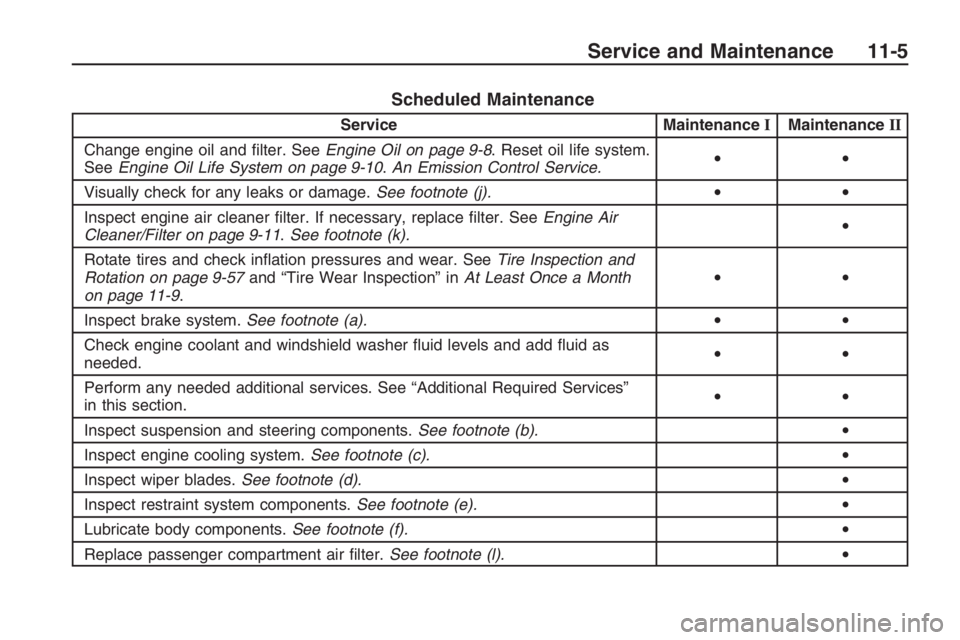
Scheduled Maintenance
Service MaintenanceIMaintenance II
Change engine oil and lter. See Engine Oil on page 9-8. Reset oil life system.
See Engine Oil Life System on page 9-10 .An Emission Control Service. ••
Visually check for any leaks or damage. See footnote (j). ••
Inspect engine air cleaner lter. If necessary, replace lter. See Engine Air
Cleaner/Filter on page 9-11 .See footnote (k). •
Rotate tires and check ination pressures and wear. See Tire Inspection and
Rotation on page 9-57 and “Tire Wear Inspection” in At Least Once a Month
on page 11-9 . ••
Inspect brake system. See footnote (a). ••
Check engine coolant and windshield washer uid levels and add uid as
needed. ••
Perform any needed additional services. See “Additional Required Services”
in this section. ••
Inspect suspension and steering components. See footnote (b). •
Inspect engine cooling system. See footnote (c). •
Inspect wiper blades. See footnote (d). •
Inspect restraint system components. See footnote (e). •
Lubricate body components. See footnote (f). •
Replace passenger compartment air lter. See footnote (l). •
Service and Maintenance 11-5
Page 318 of 356
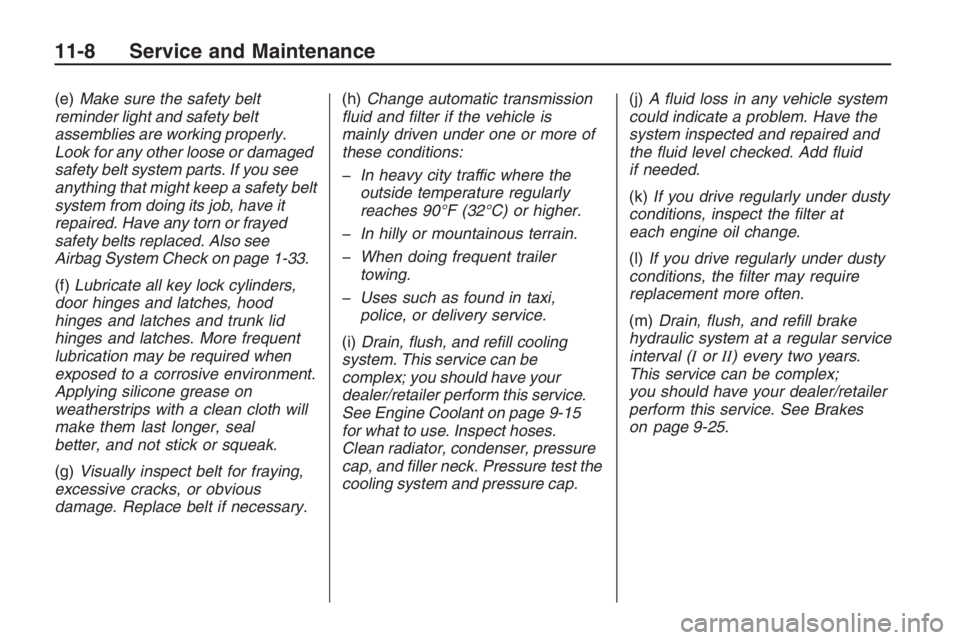
(e)Make sure the safety belt
reminder light and safety belt
assemblies are working properly.
Look for any other loose or damaged
safety belt system parts. If you see
anything that might keep a safety belt
system from doing its job, have it
repaired. Have any torn or frayed
safety belts replaced. Also see
Airbag System Check on page 1-33.
(f)Lubricate all key lock cylinders,
door hinges and latches, hood
hinges and latches and trunk lid
hinges and latches. More frequent
lubrication may be required when
exposed to a corrosive environment.
Applying silicone grease on
weatherstrips with a clean cloth will
make them last longer, seal
better, and not stick or squeak.
(g)Visually inspect belt for fraying,
excessive cracks, or obvious
damage. Replace belt if necessary.(h)Change automatic transmission
fluid and filter if the vehicle is
mainly driven under one or more of
these conditions:
In heavy city traffic where the
outside temperature regularly
reaches 90°F (32°C) or higher.
In hilly or mountainous terrain.
When doing frequent trailer
towing.
Uses such as found in taxi,
police, or delivery service.
(i)Drain, flush, and refill cooling
system. This service can be
complex; you should have your
dealer/retailer perform this service.
See Engine Coolant on page 9-15
for what to use. Inspect hoses.
Clean radiator, condenser, pressure
cap, and filler neck. Pressure test the
cooling system and pressure cap.(j)A fluid loss in any vehicle system
could indicate a problem. Have the
system inspected and repaired and
the fluid level checked. Add fluid
if needed.
(k)If you drive regularly under dusty
conditions, inspect the filter at
each engine oil change.
(l)If you drive regularly under dusty
conditions, the filter may require
replacement more often.
(m)Drain, flush, and refill brake
hydraulic system at a regular service
interval (IorII) every two years.
This service can be complex;
you should have your dealer/retailer
perform this service. See Brakes
on page 9-25.
11-8 Service and Maintenance