tire type PONTIAC G8 2009 Owners Manual
[x] Cancel search | Manufacturer: PONTIAC, Model Year: 2009, Model line: G8, Model: PONTIAC G8 2009Pages: 356, PDF Size: 1.83 MB
Page 189 of 356
Off-Road Recovery
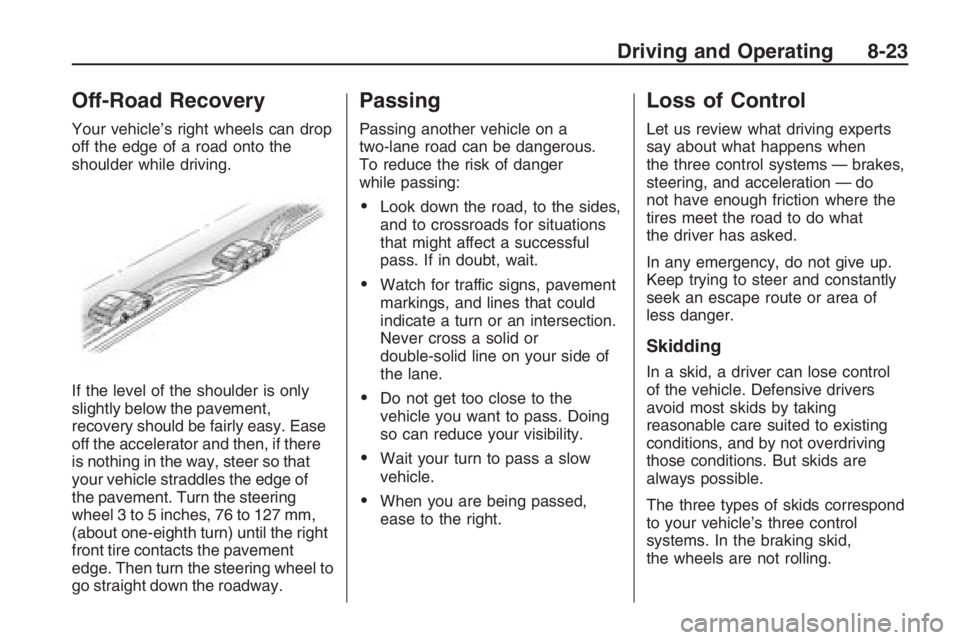
Your vehicle’s right wheels can drop
off the edge of a road onto the
shoulder while driving.
If the level of the shoulder is only
slightly below the pavement,
recovery should be fairly easy. Ease
off the accelerator and then, if there
is nothing in the way, steer so that
your vehicle straddles the edge of
the pavement. Turn the steering
wheel 3 to 5 inches, 76 to 127 mm,
(about one-eighth turn) until the right
front tire contacts the pavement
edge. Then turn the steering wheel to
go straight down the roadway.
Passing
Passing another vehicle on a
two-lane road can be dangerous.
To reduce the risk of danger
while passing:
Look down the road, to the sides,
and to crossroads for situations
that might affect a successful
pass. If in doubt, wait.
Watch for traffic signs, pavement
markings, and lines that could
indicate a turn or an intersection.
Never cross a solid or
double-solid line on your side of
the lane.
Do not get too close to the
vehicle you want to pass. Doing
so can reduce your visibility.
Wait your turn to pass a slow
vehicle.
When you are being passed,
ease to the right.
Loss of Control
Let us review what driving experts
say about what happens when
the three control systems — brakes,
steering, and acceleration — do
not have enough friction where the
tires meet the road to do what
the driver has asked.
In any emergency, do not give up.
Keep trying to steer and constantly
seek an escape route or area of
less danger.
Skidding
In a skid, a driver can lose control
of the vehicle. Defensive drivers
avoid most skids by taking
reasonable care suited to existing
conditions, and by not overdriving
those conditions. But skids are
always possible.
The three types of skids correspond
to your vehicle’s three control
systems. In the braking skid,
the wheels are not rolling.
Driving and Operating 8-23
Page 191 of 356
Driving in Rain and on
Wet Roads
Rain and wet roads can reduce
vehicle traction and affect your
ability to stop and accelerate.
Always drive slower in these types
of driving conditions and avoid
driving through large puddles and
deep-standing or owing water.
{CAUTION
Wet brakes can cause crashes.
They might not work as well in a
quick stop and could cause
pulling to one side. You could
lose control of the vehicle.
(Continued)
CAUTION (Continued)
After driving through a large
puddle of water or a car/vehicle
wash, lightly apply the brake pedal
until the brakes work normally.
Flowing or rushing water creates
strong forces. Driving through
owing water could cause your
vehicle to be carried away. If this
happens, you and other vehicle
occupants could drown. Do not
ignore police warnings and be very
cautious about trying to drive
through owing water.
Hydroplaning
Hydroplaning is dangerous. Water
can build up under your vehicle’s
tires so they actually ride on the
water. This can happen if the road iswet enough and you are going fast
enough. When your vehicle is
hydroplaning, it has little or no
contact with the road.
There is no hard and fast rule about
hydroplaning. The best advice is
to slow down when the road is wet.
Other Rainy Weather Tips
Besides slowing down, other wet
weather driving tips include:
Allow extra following distance.
Pass with caution.
Keep windshield wiping
equipment in good shape.
Keep the windshield washer uid
reservoir lled.
Have good tires with proper tread
depth. SeeTires on page 9-42.
Turn off cruise control, if
equipped.
Driving and Operating 8-25
Page 247 of 356
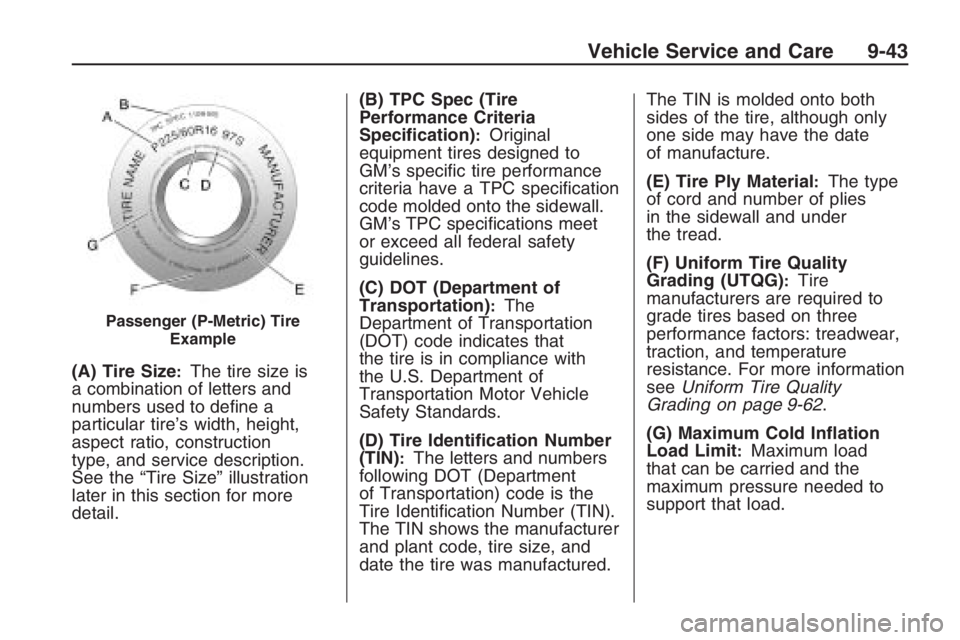
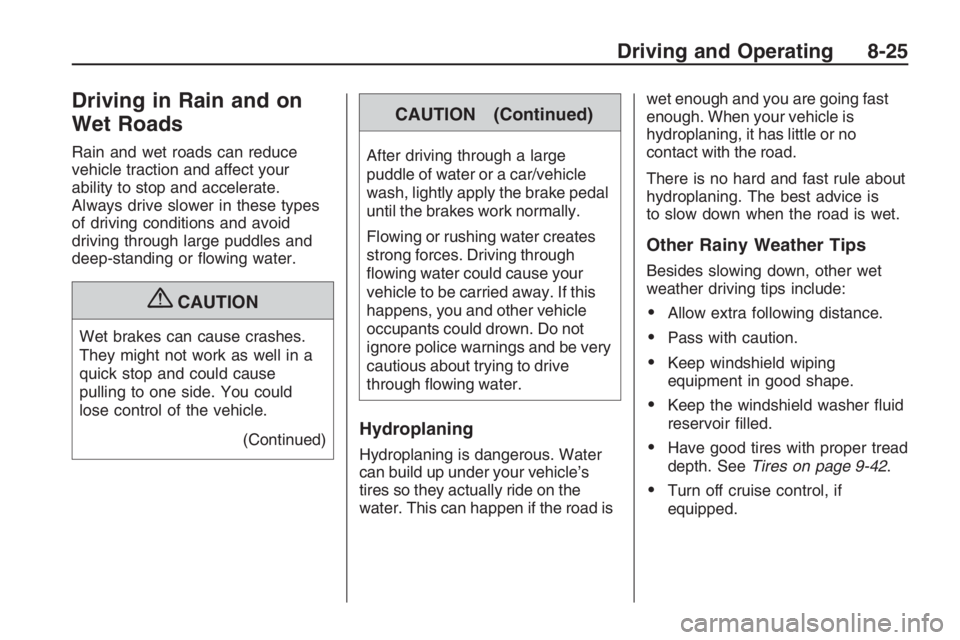
(A) Tire Size:The tire size is
a combination of letters and
numbers used to dene a
particular tire’s width, height,
aspect ratio, construction
type, and service description.
See the “Tire Size” illustration
later in this section for more
detail.(B) TPC Spec (Tire
Performance Criteria
Specication)
:Original
equipment tires designed to
GM’s specic tire performance
criteria have a TPC specication
code molded onto the sidewall.
GM’s TPC specications meet
or exceed all federal safety
guidelines.
(C) DOT (Department of
Transportation)
:The
Department of Transportation
(DOT) code indicates that
the tire is in compliance with
the U.S. Department of
Transportation Motor Vehicle
Safety Standards.
(D) Tire Identication Number
(TIN)
:The letters and numbers
following DOT (Department
of Transportation) code is the
Tire Identication Number (TIN).
The TIN shows the manufacturer
and plant code, tire size, and
date the tire was manufactured.The TIN is molded onto both
sides of the tire, although only
one side may have the date
of manufacture.
(E) Tire Ply Material
:The type
of cord and number of plies
in the sidewall and under
the tread.
(F) Uniform Tire Quality
Grading (UTQG)
:Tire
manufacturers are required to
grade tires based on three
performance factors: treadwear,
traction, and temperature
resistance. For more information
seeUniform Tire Quality
Grading on page 9-62.
(G) Maximum Cold Ination
Load Limit
:Maximum load
that can be carried and the
maximum pressure needed to
support that load.
Passenger (P-Metric) Tire
Example
Vehicle Service and Care 9-43
Page 248 of 356
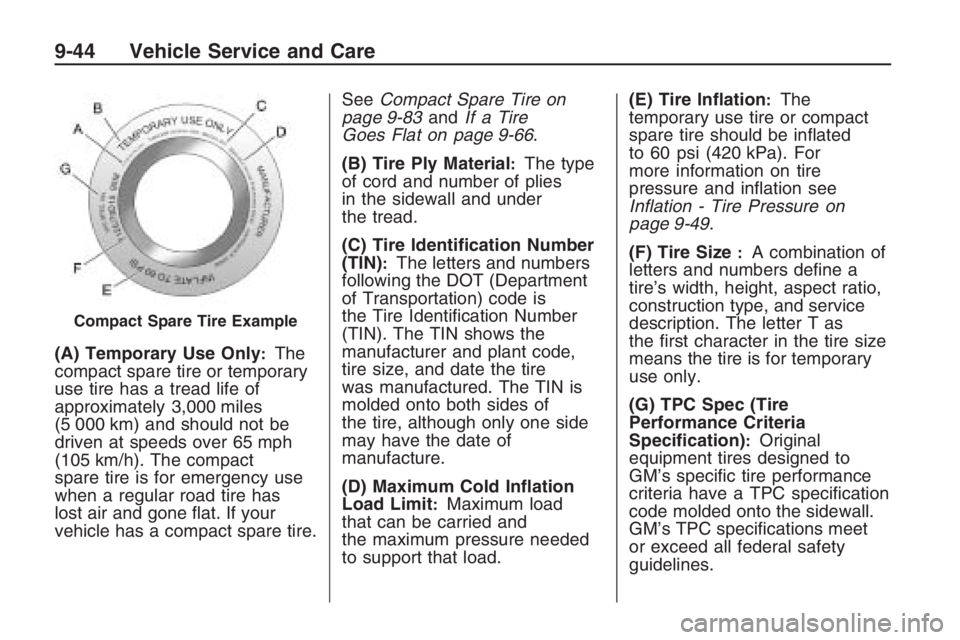
(A) Temporary Use Only:The
compact spare tire or temporary
use tire has a tread life of
approximately 3,000 miles
(5 000 km) and should not be
driven at speeds over 65 mph
(105 km/h). The compact
spare tire is for emergency use
when a regular road tire has
lost air and gone at. If your
vehicle has a compact spare tire.SeeCompact Spare Tire on
page 9-83andIf a Tire
Goes Flat on page 9-66.
(B) Tire Ply Material
:The type
of cord and number of plies
in the sidewall and under
the tread.
(C) Tire Identication Number
(TIN)
:The letters and numbers
following the DOT (Department
of Transportation) code is
the Tire Identication Number
(TIN). The TIN shows the
manufacturer and plant code,
tire size, and date the tire
was manufactured. The TIN is
molded onto both sides of
the tire, although only one side
may have the date of
manufacture.
(D) Maximum Cold Ination
Load Limit
:Maximum load
that can be carried and
the maximum pressure needed
to support that load.(E) Tire Ination
:The
temporary use tire or compact
spare tire should be inated
to 60 psi (420 kPa). For
more information on tire
pressure and ination see
Inflation - Tire Pressure on
page 9-49.
(F) Tire Size
:A combination of
letters and numbers dene a
tire’s width, height, aspect ratio,
construction type, and service
description. The letter T as
the rst character in the tire size
means the tire is for temporary
use only.
(G) TPC Spec (Tire
Performance Criteria
Specication)
:Original
equipment tires designed to
GM’s specic tire performance
criteria have a TPC specication
code molded onto the sidewall.
GM’s TPC specications meet
or exceed all federal safety
guidelines.
Compact Spare Tire Example
9-44 Vehicle Service and Care
Page 249 of 356
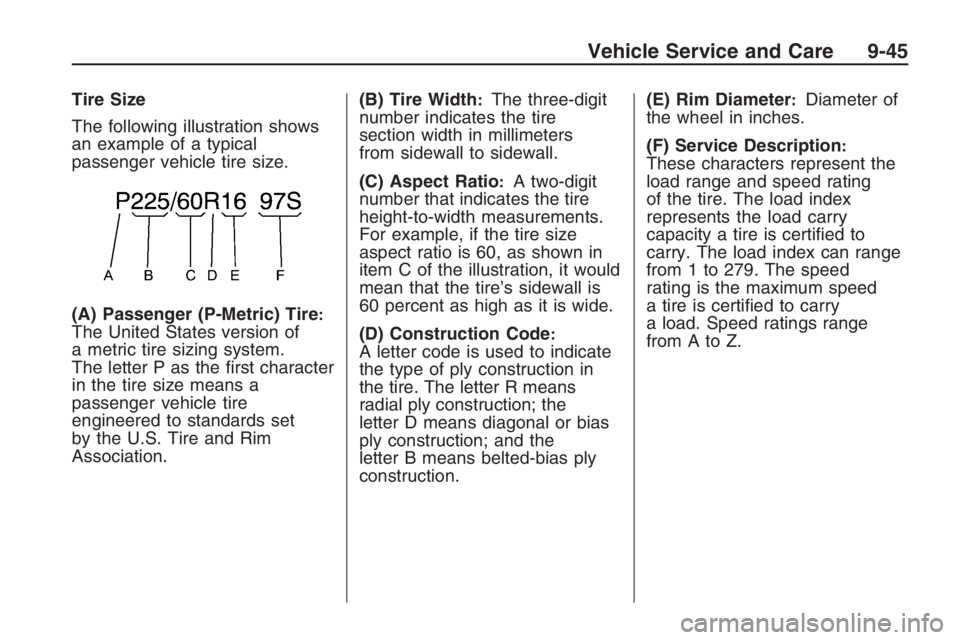
Tire Size
The following illustration shows
an example of a typical
passenger vehicle tire size.
(A) Passenger (P-Metric) Tire
:The United States version of
a metric tire sizing system.
The letter P as the rst character
in the tire size means a
passenger vehicle tire
engineered to standards set
by the U.S. Tire and Rim
Association.(B) Tire Width
:The three-digit
number indicates the tire
section width in millimeters
from sidewall to sidewall.
(C) Aspect Ratio
:A two-digit
number that indicates the tire
height-to-width measurements.
For example, if the tire size
aspect ratio is 60, as shown in
item C of the illustration, it would
mean that the tire’s sidewall is
60 percent as high as it is wide.
(D) Construction Code
:A letter code is used to indicate
the type of ply construction in
the tire. The letter R means
radial ply construction; the
letter D means diagonal or bias
ply construction; and the
letter B means belted-bias ply
construction.(E) Rim Diameter
:Diameter of
the wheel in inches.
(F) Service Description
:These characters represent the
load range and speed rating
of the tire. The load index
represents the load carry
capacity a tire is certied to
carry. The load index can range
from 1 to 279. The speed
rating is the maximum speed
a tire is certied to carry
a load. Speed ratings range
fromAtoZ.
Vehicle Service and Care 9-45
Page 254 of 356
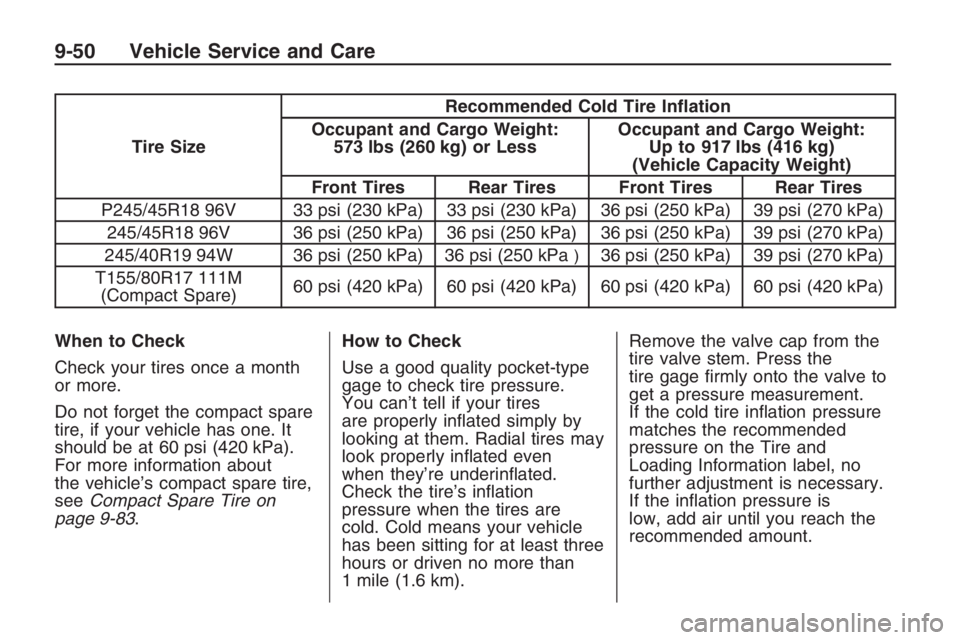
Tire SizeRecommended Cold Tire Ination
Occupant and Cargo Weight: 573 lbs (260 kg) or Less Occupant and Cargo Weight:
Up to 917 lbs (416 kg)
(Vehicle Capacity Weight)
Front Tires Rear Tires Front Tires Rear Tires
P245/45R18 96V 33 psi (230 kPa) 33 psi (230 kPa) 36 psi (250 kPa) 39 psi (270 kPa) 245/45R18 96V 36 psi (250 kPa) 36 psi (250 kPa) 36 psi (250 kPa) 39 psi (270 kPa)
245/40R19 94W 36 psi (250 kPa) 36 psi (250 kPa
)36 psi (250 kPa) 39 psi (270 kPa)
T155/80R17 111M (Compact Spare) 60 psi (420 kPa) 60 psi (420 kPa) 60 psi (420 kPa) 60 psi (420 kPa)
When to Check
Check your tires once a month
or more.
Do not forget the compact spare
tire, if your vehicle has one. It
should be at 60 psi (420 kPa).
For more information about
the vehicle’s compact spare tire,
see Compact Spare Tire on
page 9-83 . How to Check
Use a good quality pocket-type
gage to check tire pressure.
You can’t tell if your tires
are properly inated simply by
looking at them. Radial tires may
look properly inated even
when they’re underinated.
Check the tire’s ination
pressure when the tires are
cold. Cold means your vehicle
has been sitting for at least three
hours or driven no more than
1 mile (1.6 km). Remove the valve cap from the
tire valve stem. Press the
tire gage rmly onto the valve to
get a pressure measurement.
If the cold tire ination pressure
matches the recommended
pressure on the Tire and
Loading Information label, no
further adjustment is necessary.
If the ination pressure is
low, add air until you reach the
recommended amount.
9-50 Vehicle Service and Care
Page 264 of 356
GM’s exclusive TPC Spec system
considers over a dozen critical
specications that impact the overall
performance of your vehicle,
including brake system performance,
ride and handling, traction control,
and tire pressure monitoring
performance. GM’s TPC Spec
number is molded onto the tire’s
sidewall near the tire size. If the tires
have an all-season tread design,
the TPC Spec number will be
followed by an MS for mud and
snow. SeeTire Sidewall Labeling on
page 9-42for additional information.
GM recommends replacing tires
in sets of four. This is because
uniform tread depth on all tires will
help keep your vehicle performing
most like it did when the tires
were new. Replacing less than a full
set of tires can affect the braking
and handling performance of
your vehicle. SeeTire Inspection
and Rotation on page 9-57for
information on proper tire rotation.{CAUTION
Mixing tires could cause you
to lose control while driving. If
you mix tires of different sizes,
brands, or types (radial and
bias-belted tires), the vehicle
may not handle properly, and
you could have a crash. Using
tires of different sizes, brands,
or types may also cause
damage to the vehicle. Be
sure to use the correct size,
brand, and type of tires on all
wheels. It is all right to drive
with the compact spare
temporarily, as it was
developed for use on the
vehicle. SeeCompact Spare
Tire on page 9-83.{CAUTION
If you use bias-ply tires on the
vehicle, the wheel rim anges
could develop cracks after
many miles of driving. A tire
and/or wheel could fail
suddenly, causing a crash.
Use only radial-ply tires with
the wheels on the vehicle.
If you must replace your vehicle’s
tires with those that do not have
a TPC Spec number, make
sure they are the same size, load
range, speed rating, and
construction type (radial and
bias-belted tires) as your vehicle’s
original tires.
9-60 Vehicle Service and Care
Page 266 of 356
Uniform Tire Quality
Grading
Quality grades can be found
where applicable on the tire
sidewall between tread shoulder
and maximum section width. For
example:
Treadwear 200 Traction AA
Temperature A
The following information relates
to the system developed by the
United States National Highway
Traffic Safety Administration
(NHTSA), which grades tires by
treadwear, traction, and
temperature performance. This
applies only to vehicles sold in
the United States. The grades
are molded on the sidewalls ofmost passenger car tires. The
Uniform Tire Quality Grading
(UTQG) system does not apply to
deep tread, winter-type snow
tires, space-saver, or temporary
use spare tires, tires with nominal
rim diameters of 10 to 12 inches
(25 to 30 cm), or to some
limited-production tires.
While the tires available on
General Motors passenger cars
and light trucks may vary with
respect to these grades, they
must also conform to federal
safety requirements and
additional General Motors Tire
Performance Criteria (TPC)
standards.Treadwear
The treadwear grade is a
comparative rating based on the
wear rate of the tire when tested
under controlled conditions on a
specied government test
course. For example, a tire
graded 150 would wear one and
a half (1.5) times as well on the
government course as a tire
graded 100. The relative
performance of tires depends
upon the actual conditions of
their use, however, and may
depart signicantly from the norm
due to variations in driving habits,
service practices, and differences
in road characteristics and
climate.
9-62 Vehicle Service and Care
Page 269 of 356
Used Replacement Wheels
{CAUTION
Putting a used wheel on the
vehicle is dangerous. You cannot
know how it has been used or how
far it has been driven. It could fail
suddenly and cause a crash. If you
have to replace a wheel, use a
new GM original equipment wheel.
Tire Chains
{CAUTION
Do not use tire chains. There is
not enough clearance. Tire chains
used on a vehicle without the
proper amount of clearance can
cause damage to the brakes,
suspension or other vehicle parts.
The area damaged by the tire
chains could cause you to lose
control of the vehicle and you or
others may be injured in a crash.
(Continued)
CAUTION (Continued)
Use another type of traction
device only if its manufacturer
recommends it for use on the
vehicle and tire size combination
and road conditions. Follow that
manufacturer’s instructions. To
help avoid damage to the vehicle,
drive slowly, readjust or remove
the device if it is contacting the
vehicle, and do not spin the
vehicle’s wheels. If you do nd
traction devices that will t, install
them on the front tires.
Vehicle Service and Care 9-65
Page 296 of 356
Total Weight on Your Vehicle’s
Tires
Be sure your vehicle’s tires are
inated to the upper limit for cold
tires. You will nd these numbers on
the Tire-Loading Information label.
SeeLoading the Vehicle on
page 8-30. Then be sure you do not
go over the GVW limit for your
vehicle, including the weight of the
trailer tongue.
Hitches
It is important to have the correct
hitch equipment. Crosswinds,
large trucks going by and rough
roads are a few reasons why
you will need the right hitch. Here
are some rules to follow:
The rear bumper on your vehicle
is not intended for hitches. Do not
attach rental hitches or other
bumper-type hitches to it. Use
only a frame-mounted hitch that
does not attach to the bumper.
Will you have to make any holes
in the body of your vehicle when
you install a trailer hitch? If you
do, then be sure to seal the holes
later when you remove the hitch.
If you do not seal them, deadly
carbon monoxide (CO) from your
exhaust can get into your vehicle.
SeeEngine Exhaust on
page 8-14. Dirt and water can
also enter the vehicle.
Safety Chains
You should always attach chains
between your vehicle and your
trailer. Cross the safety chains under
the tongue of the trailer so that the
tongue will not drop to the road if it
becomes separated from the hitch.
Instructions about safety chains may
be provided by the hitch
manufacturer or by the trailer
manufacturer. Follow the
manufacturer’s recommendation for
attaching safety chains and do not
attach them to the bumper. Alwaysleave just enough slack so you can
turn with your rig. And, never allow
safety chains to drag on the ground.
Trailer Brakes
Does your trailer have its own
brakes? Be sure to read and follow
the instructions for the trailer
brakes so you will be able to install,
adjust and maintain them properly.
Because you have anti-lock brakes,
do not tap into your vehicle’s brake
system. If you do, both brake
systems will not work well, or at all.
Trailer Wiring Harness
All of the electrical circuits required
for your trailer lighting system can be
accessed at the driver’s side rear
lamp connector. This connector is
located under the carpet on the rear
corner of the trunk compartment.
9-92 Vehicle Service and Care