light PONTIAC GRAND-AM 1996 Repair Manual
[x] Cancel search | Manufacturer: PONTIAC, Model Year: 1996, Model line: GRAND-AM, Model: PONTIAC GRAND-AM 1996Pages: 356, PDF Size: 17.17 MB
Page 251 of 356
your brake system fixed, since a leak means that sooner
or later your brakes won’t work well,
or won’t work
at
all.
So, it isn’t a good idea to “top off’ your brake fluid.
Adding brake fluid won’t correct
a leak. If you add fluid
when your linings are worn, then you’ll have too much
fluid when you get new brake linings. You should add
(or remove) brake fluid, as necessary, only when work is
done on the brake hydraulic system.
enough. You or others could be burned, and your
vehicle could be damaged. Add brake fluid only
when work is done on the brake hydraulic
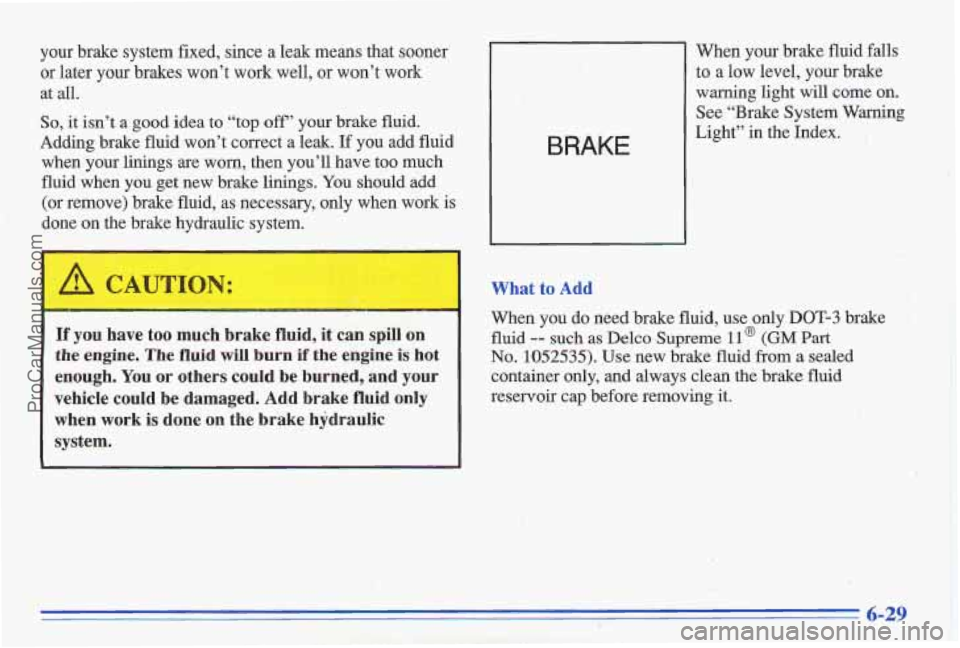
When your brake fluid falls
to a low level, your brake
warning light will come
on.
See “Brake System Warning
Light”
in the Index.
~~
What to Add
When you do need brake fluid, use only DOT-3 brake
fluid
-- such as Delco Supreme 11 @ (GM Part
No. 1052535). Use new brake fluid from a sealed
container only,
and always clean the brake fluid
reservoir cap before removing
it.
ProCarManuals.com
Page 253 of 356
NOTICE:
I I
Continuing to drive with worn-out brake pads
could result in costly brake repair.
Some driving conditions or climates may cause a brake
squeal when the brakes
are first applied or lightly
applied. This does not mean something
is wrong with
your brakes.
Free movement
of brake calipers and properly torqued
wheel nuts are necessary to help prevent brake
pulsation. When tires are rotated, inspect brake calipers
for movement, brake pads for wear, and evenly torque
wheel nuts in the proper sequence to
GM specifications.
Your rear drum brakes don't have wear indicators, but
if
you ever hear a rear brake rubbing noise, have the rear
brake linings inspected.
Also, the rear brake drums
should be removed and inspected each time the tires
are
removed for rotation or changing. When you have the
front brakes replaced, have the rear brakes inspected, too.
Brake linings should always be replaced as complete
Brake Pedal Travel
See your dealer if the brake pedal does not return to
normal height, or if there is a rapid increase in pedal
travel. This could be a sign
of brake trouble.
Brake Adjustment
Every time you make a moderate brake stop, your disc
brakes adjust for wear.
If you rarely make a moderate ar
heavier stop, then your brakes might not adjust correctly.
If you drive in that way, then -- very carefully -- make
a few moderate brake stops about every 1,000 miles
(1 600 km), so your brakes will adjust properly.
If your brake pedal goes down farther than normal, your
rear drum brakes may need adjustment. Adjust them by
backing up
'and firmly applying the brakes a few times.
Replacing Brake System Parts
The braking system on a modem vehicle is complex. Its
many parts have to be
of top quality and work well
together
if the vehicle is to have really good braking.
Vehicles we design and teSt have top-quality
GM brake
parts in them,
as your Pontiac does when it is new.
When you replace parts
of your 'braking system -- for
example, when your brake linings wear down and you
have to have new
ones put in -- be sure you get new
genuine
GM replacement parts. If you don't, your
6-31
ProCarManuals.com
Page 263 of 356
Mixing tires could cause you to lose control while
driving. If you mix tires of different sizes or types
(radial and bias-belted tires), the vehicle may not
handle properly, and you could.have
a crash.
Using tires of different sizes may also cause
damage to your vehicle. Be sure to use the same
size and type tires on all four wheels.
It's all right to drive with your compact spare,
though. It was developed for use on your vehicle.
Uniform Tire Quality Grading
The following information relates to the system
developed by the United States National Highway
Traffic Safety Administration, which grades tires by
treadwear, traction and temperature performance. (This applies only to'vehicles sold in the United States.)
The
grades are molded on the sidewalls of most passenger car tires. The Uniform Tire Quality Grading system does
not apply to deep tread, winter-type snow tires,
space-saver or temporqy use spare tires, tires with
nominal rim diameters of
10 to 12 inches (25 to 30 cm),
or to some limited-production tires.
While the tires available on General Motors passenger cars and light trucks may vary with respect to these
grades, they must also conform to Federal safety
requirements and additional General Motors Tire
Performance Criteria (TPC) standards.
Treadwear
The treadwear grade is a comparative rating based on
the wear rate
of the tire when tested under controlled
conditions on a specified government test course. For
example, a tire graded 150 would wear one and a half
(1 1/2) times as well on the government course as a tire
graded
100. The relative performance of'tires depends "
upon the actual conditions of their use, however, and
may depart significantly from the norm due to variations
in driving habits, service practices and differences in
road characteristics and climate.
ProCarManuals.com
Page 268 of 356

Using -Foam-Type Cleaner on Fabric
0
0
0
e
e
0
0
0
0
0
0
Vacuum and brush the area to remove any loose dirt.
Always clean a whole trim panel or section. Mask
surrounding
trim along stitch or welt lines.
Mix Multi-Purpose Powdered Cleaner following the
directions on the container label.
Use suds only and apply with a clean sponge.
Don’t saturate the material.
Don’t
rub it roughly.
As soon as you’ve cleaned the section, use a sponge
to remove the suds.
Rinse the section with
a clean, wet sponge.
Wipe
off what’s left with a slightly damp paper towel
or cloth.
Then dry it immediately with a blow dryer.
Wipe with a clean cloth.
Using Solvent-Type Cleaner on Fabric
First, see If you have to use solvent-type cleaner at all.
Some spots and stains will clean
off better vith just
water
and mild soap.
If you need to use a solvent:
Gently scrape excess soil from the ,trim material with
a clean, dull knife or scraper. Use
very little cleaner,
light pressure and clean cloths (preferably
cheesecloth). Cleaning should start at the outside
of
the stain, “feathering” toward the center. Keep
changing to a clean section
of the cloth.
0 when you clean a stain fi-om fabric, immediately dry the
area with a blow dryer to help prevent a cleaning ring.
-I
Special Cleaning Problems
Greasy or Oily Stains
Stains caused by grease, oil, butter, margarine, shoe
polish, coffee with cream, chewing gum, cosmetic creams, vegetable oils, wax crayon,
tar and asphalt can
be removed
as follows:
Carefully scrape off excess stain.
0 Follow the solvent-type instructions described
0 Shoe polish, wax crayon, tar and asphalt will stain
if left on a vehicle’s seat fabric. They should be
removed
as soon as pos,sible.,Be careful, because
the cleaner
will dissolve them and may cause them
to spread. earlier.
6-46
ProCarManuals.com
Page 269 of 356
Non-Greasy Stains
Stains caused by catsup, coffee (black), egg, fruit, fruit
juice,
milk, 'soft drinks, wine, vomit, urine and blood can
be removed as follows:
0
0
0
0
Carefully scrape off excess stain, then sponge the soiled area with cool water.
If a stain remains, follow the foam-type instructions
described earlier.
If'an odor lingers after cleaning vomit or urine,
treat the area with a' waterbaking soda solution:
1 teaspoon (5 ml) of baking soda to 1 cup (250 ml)
of lukewarm water.
If needed, clean lightly with solvent-type cleaner.
Combination Stains
Stains caused by candy, ice cream, mayonngtise, chili
sauce and unknown stains can be removed as follows:
0 Carefully scrape off excess stain, then clean with
0 If a stain remains, clean it with solvent-type cleaner.
cool water and allow to
dry.
Cleaning Vinyl
Use warm water and a clean cloth.
Rub with a clean, damp cloth to remove dirt. You
may have to do
it more than once.
0 Things like tar, asphalt and.shoe polish will stain if
you don't get them off quickly. Use a clean cloth and
a GM VinylLeather Cleaner or equivalent product.
Cleaning ,Leather
Use a soft cloth with lukewarm water and a mild soap or
saddle soap.
For stubborn stains, use a GM Vinyl/Leather Cleaner
or equivalent product.
Never use oils, varnishes, solvent-based or abrasive
cleaners, 'furniture polish or shoe polish on leather.
Soiled ieather should be cleaned iprnediately. If dirt
is allowed to work into the finish, it can harm the
leather.
6-47
ProCarManuals.com
Page 277 of 356
Fuses and Circuit Breakers
The wiring circuits in your vehicle are protected from short circuits by
a combination of fuses, circuit breakers
and fusible links. This greatly reduces the chance of
damage caused by electrical problems.
Look at the silver-colored band inside the fuse.
If the
band is broken or melted, replace the fuse. Be sure to
replace a bad fuse with
a new one of the identical size
and rating.
If
you ever have a problem on the road and don’t have a
spare fuse, you can borrow one that has the same
amperage. Just pick a feature of your vehicle that you
can get along without
-- like the radio or cigarette
lighter -- and use its fuse, if it is the correct amperage.
Replace it as soon as you can.
There are two fuse blocks in
your vehicle: the
instrument panel fuse block and the engine compartment
fuse block.
Instrument Panel Fuse Block
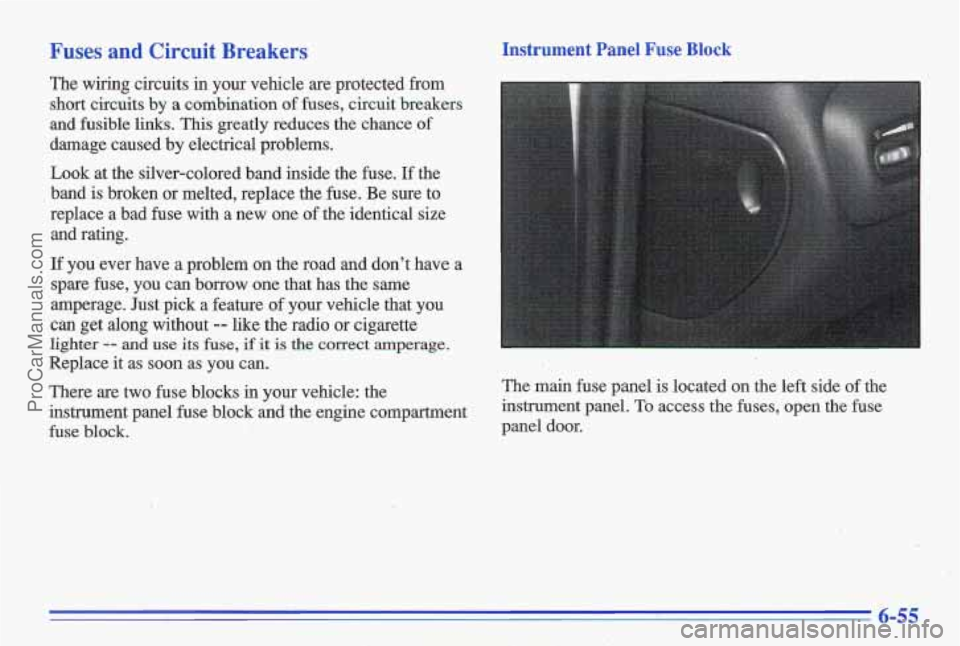
The main fuse panel is located on the left side of the
instrument panel. To access the fuses, open the fuse
panel door.
6-55
ProCarManuals.com
Page 278 of 356
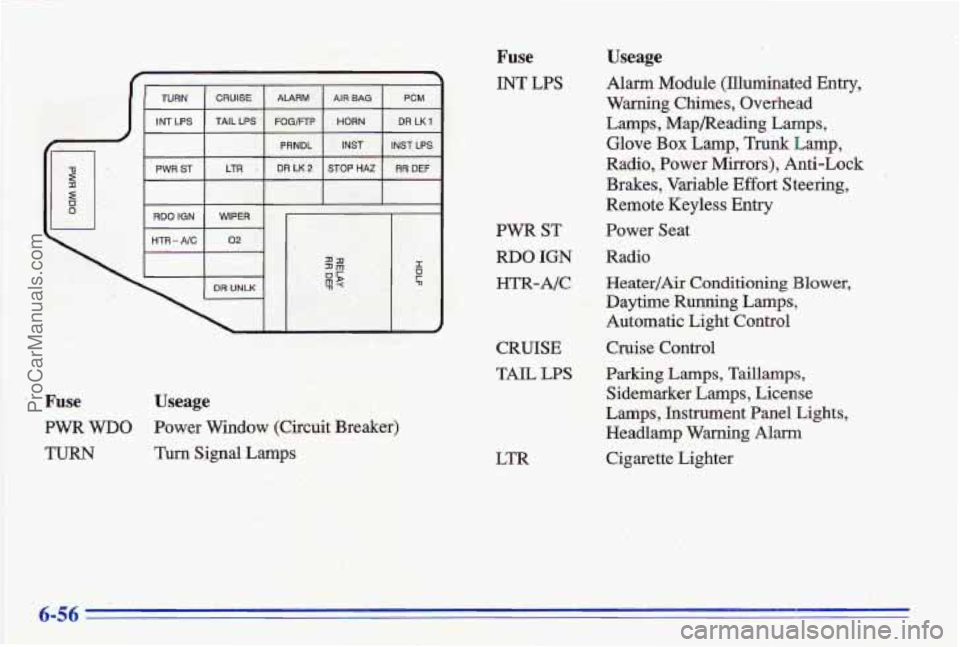
Fuse
INT LPS
PWR
ST
RDO IGN
HTR-A/C
CRUISE
TAIL LPS
a Fuse Useage
PWR WDO Power Window (Circuit Breaker)
TURN Turn Signal Lamps
Useage
Alarm Module (Illuminated Entry,
Warning Chimes, Overhead
Lamps., MapJReading Lamps,
Glove Box Lamp, Trunk Lamp,
Radio, Power Mirrors), Anti-Lock
Brakes, Variable
Effort Steering,
Remote Keyless
Entry
Power Seat ?,,,. :. . . .- . - . .. .. Radi&-<-'&'.: ?.>I' ?;~-,~:-~~~,(l ,;,* , ' _. . . I' . &-:.*& . : ' . . I 8.. .~ . . .I d&
Heater/Air Conditioning Blower,
Daytime Running Lamps, Automatic Light Control
Cruise Control
Parking Lamps, Taillamps,
Sidemarker Lamps, License
Lamps, Instrument Panel Lights,
Headlamp
Warning Alarm
Cigarette Lighter
6-56
ProCarManuals.com
Page 279 of 356
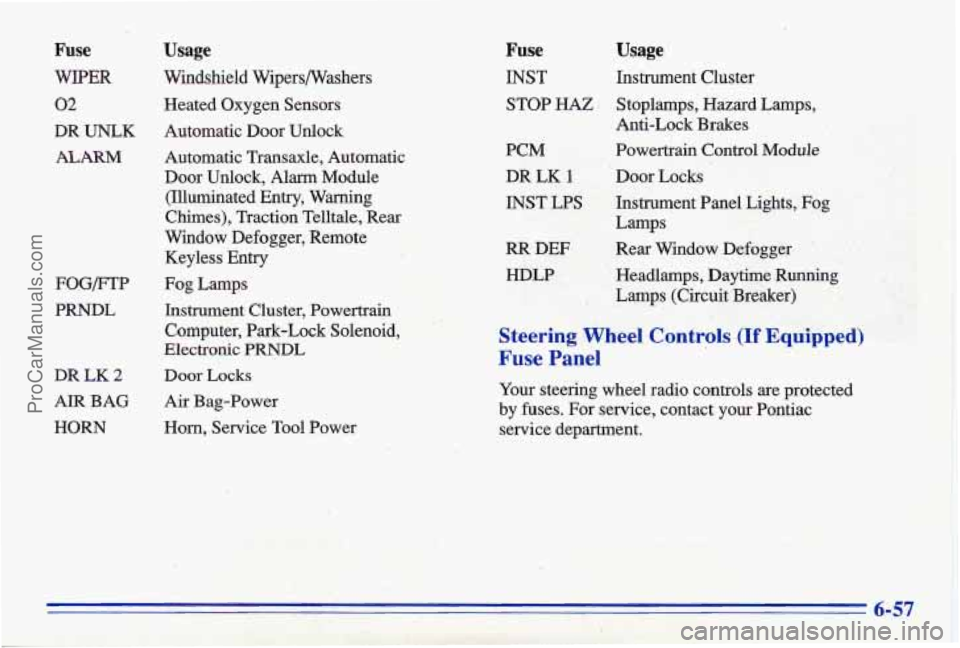
Fuse
WIPER
02
,DR UNLK
ALARM
FOG/FTP
PRNDL
BR LK 2
AIR BAG
HORN
Usage
Windshield Wipers/Washers
Heated Oxygen Sensors Automatic
Door Unlock
Automatic Transaxle, Automatic
Door Unlock, Alarm Module
(Illuminated Entry, Warning
Chimes), TraGtion Telltale, Rear
Window Defogger, Remote
Keyless Entry
Fog Lamps
Instrument Cluster, Powertrain Computer, Park-Lock Solenoid,
Electronic
PRNDL
Door Locks
Air Bag-Power
Horn, Service Tool Power
Fuse Usage
INST Instrument Cluster
STOP
HAZ Stoplamps, Hazard Lamps,
Anti-Lock Brakes
PCM Powertrain Control Module
DR LK
1 Door Locks
INST
LPS Instrument Panel Lights, Fog
Lamps
RR DEF Rear Window Defogger
HDLP Headlamps, Daytime Running Lamps (Circuit Breaker)
Steering Wheel Controls (If Equipped)
Fuse Panel .. - / , . . , ;';,,;'.[ -: .f-, .-.;'.A, Li-v. I , , ~ I , , .,$! ::.
Your steering wheel radio controls are protected
by fuses. For service, contact your Pontiac
service department.
. ._ .,~ \. ~, ' ' ~ .j_ . ,:: :?<. , x:'. -.
6-57
ProCarManuals.com
Page 280 of 356
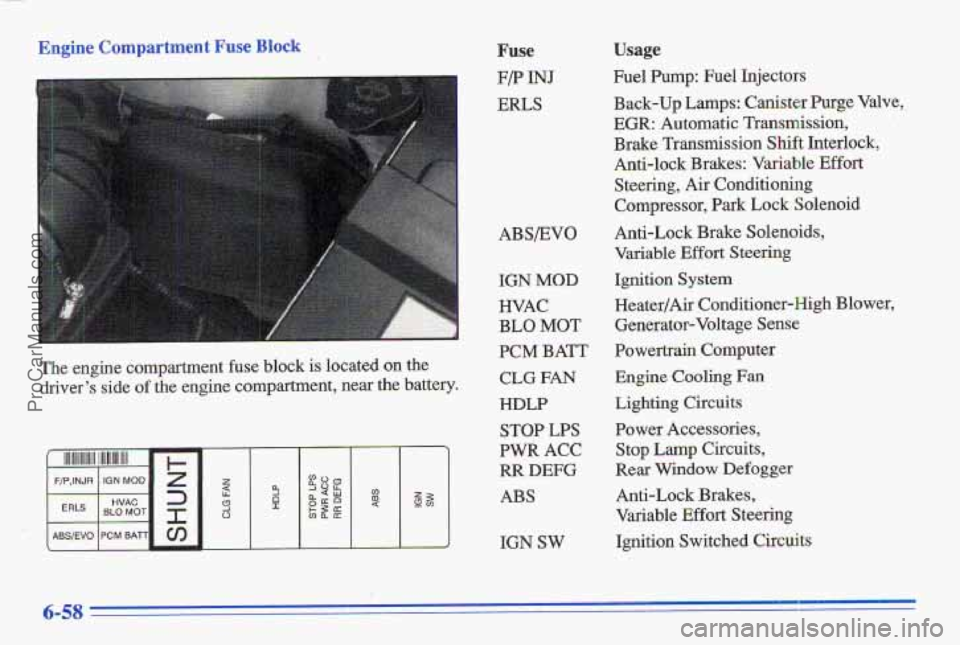
Engine Compartment Fuse Block Fuse
F/P INJ
ERLS
ABs/Evo
IGN MOD
HVAC
BLO MOT
PCM BATT
CLG FAN
HDLP
STOP LPS
PWR ACC
RR DEFG
ABS
Usage
Fuel Pump: Fuel Injectors
Back-up
Lamps: Canister Purge Valve,
EGR: Automatic Transmission,
Brake Transmission Shift Interlock,
Anti-lock Brakes: Variable
Effort
Steering, Air Conditioning
Compressor,
Park Lock Solenoid
Anti-Lock Brake Solenoids,
Variable Effort Steering
Ignition System
Heater/Ais Conditioner-High Blower, Generator-Voltage Sense
Powertrain Computer
Engine Cooling Fan
Lighting Circuits
Power Accessories,
Stop Lamp Circuits,
Rear Window Defogger
Anti-Lock Brakes,
Variable
Effort Steering
Ignition Switched Circuits
I , ^*^ >, .. ,.",
The engine compartment fuse block is located on the
driver's side
of the engine compartment, near the battery,
€GN sw
ProCarManuals.com
Page 321 of 356
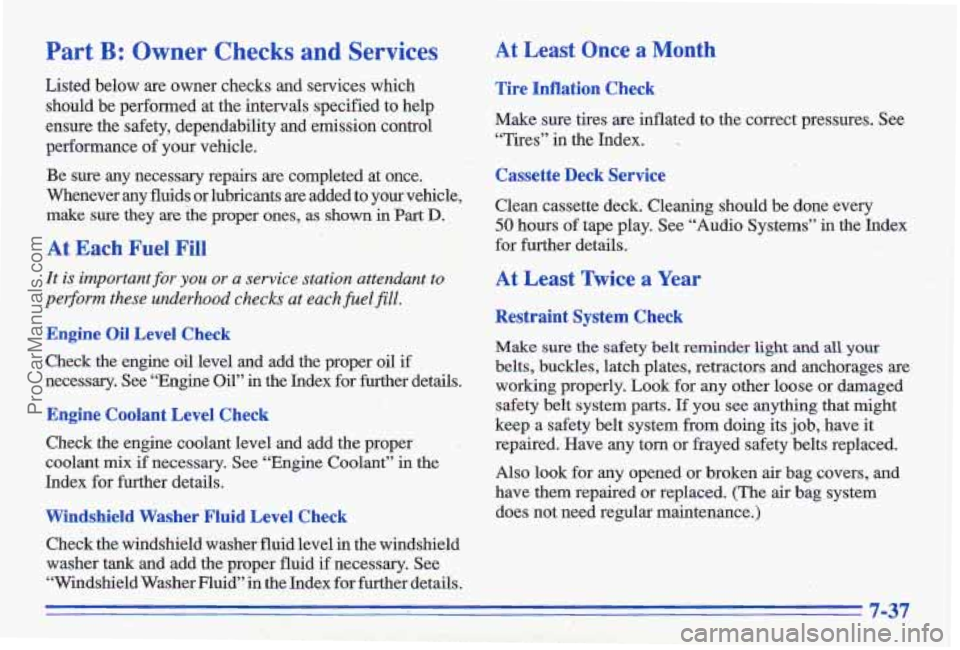
Part B: Owner Checks and Services
Listed below are owner checks and services which should be performed at the intervals, specified to help
ensure the safety, dependability and emission control
performance of your vehicle.
Be’sure any necessary repairs are completed at once.
Whenever any fluids or lubricants are added
to your vehicle,
make sure
they are the proper ones, as shown in Part D.
At Each Fuel Fill
It is important for you or a service station attendant to
pe$orm these underhood checks at each fuel
fill.
Engine Oil Level Check
Check the ‘engine oil level and add the proper oil if
necessary, See “Engine Oil“ in the Index for further details.
Engine Coolant Level Check
Check the engine ooolant level and add the proper r
coolant mix if necessary. See “Engine Coolant” in the
Index for further details.
Windshield Washer Fluid Level Check
Check the windshield wasner fluid level in the windshield
washer tank and add the proper fluid
if necessary. See
“Windshield Washer Fluid” in the Index for further details.
At Least Once a Month
Tire Inflation Check
Make sure tires are inflated to the correct pressures. See
“Tires”
in the Index.
Cassette Deck Service
Clean cassette deck. Cleaning should be done every
50 hours of tape play. See “Audio Systems” in the Index
for further details.
At Least Twice a Year
Restraint System Check
Make sure the safety belt remlnder light and all your
belts, buckles, latch plates, retractors and anchorages are
working properly.
Look for any other loose or damaged
safety belt system parts. If you see anything that might
keep a safety belt system from doing its job, have it
repaired. Have any torn or frayed safety belts replaced.
Also look for any opened or broken
air bag covers, and
have them repaired or replaced. (The air bag system
does not need regular maintenance.)
7-37
ProCarManuals.com