trunk PONTIAC GRAND AM 2003 User Guide
[x] Cancel search | Manufacturer: PONTIAC, Model Year: 2003, Model line: GRAND AM, Model: PONTIAC GRAND AM 2003Pages: 354, PDF Size: 16.3 MB
Page 215 of 354
And, if you do have a heavy load, you should spread
it
out. Don't carry more than 132 Ibs. (60 kg) in
your trunk.
Do not load your vehicle any heavier than the
GVWR, or either the maximum front or rear
GAWR.
If you do, parts on your vehicle can
break, and
it can change the way your vehicle
handles. These could cause you to lose
control and crash.
Also, overloading can
shorten the life of your vehicle.
"l, CAUTION:
Things you put inside your vehicle can strike
and injure people in a sudden stop or turn, or in a crash.
e
e
Put things in the trunk of your vehicle. In a
trunk, put them as far forward as you can.
Try to spread the weight evenly.
Never stack heavier things, like suitcases, inside the vehicle
so that some of them
are above the tops of the seats.
Don't leave an unsecured child restraint in
your vehicle.
When you carry something inside the
vehicle, secure
it whenever you can.
Don't leave a seat folded down unless you
need to.
4-36
Page 232 of 354
When you put the fuel cap back on, turn it to the right
(clockwise) until you hear
a clicking sound. Make
sure you fully install the cap. The diagnostic system can
determine
if the fuel cap has been left off or improperly
installed. This would allow fuel to evaporate into the
atmosphere. See
Malfunction Indicator Lamp on
page 3-3 1.
Notice: If you need a new fuel cap, be sure to get
the right type. Your dealer can get one for you.
If you get the wrong type,
it may not fit properly.
This may cause your malfunction indicator lamp
to
light and may damage your fuel tank and emissions
system. See “Malfunction Indicator Lamp” in
the Index.
Filling a Portable Fuel Container
Never fill a portable fuel container while it is in
your vehicle. Static electricity discharge from
the container can ignite the gasoline vapor. You can be badly burned and your vehicle
damaged
if this occurs. To help avoid injury to
you and others:
0 Dispense gasoline only into approved
containers.
0 Do not fill a container while it is inside a
vehicle, in a vehicle’s trunk, pickup bed or
on any surface other than the ground.
Bring the fill nozzle in contact with the
inside of the fill opening before operating
the nozzle. Contact should be maintained
until the filling
is complete.
0 Don’t smoke while pumping gasoline.
5-9
Page 273 of 354
2.
3.
4.
5.
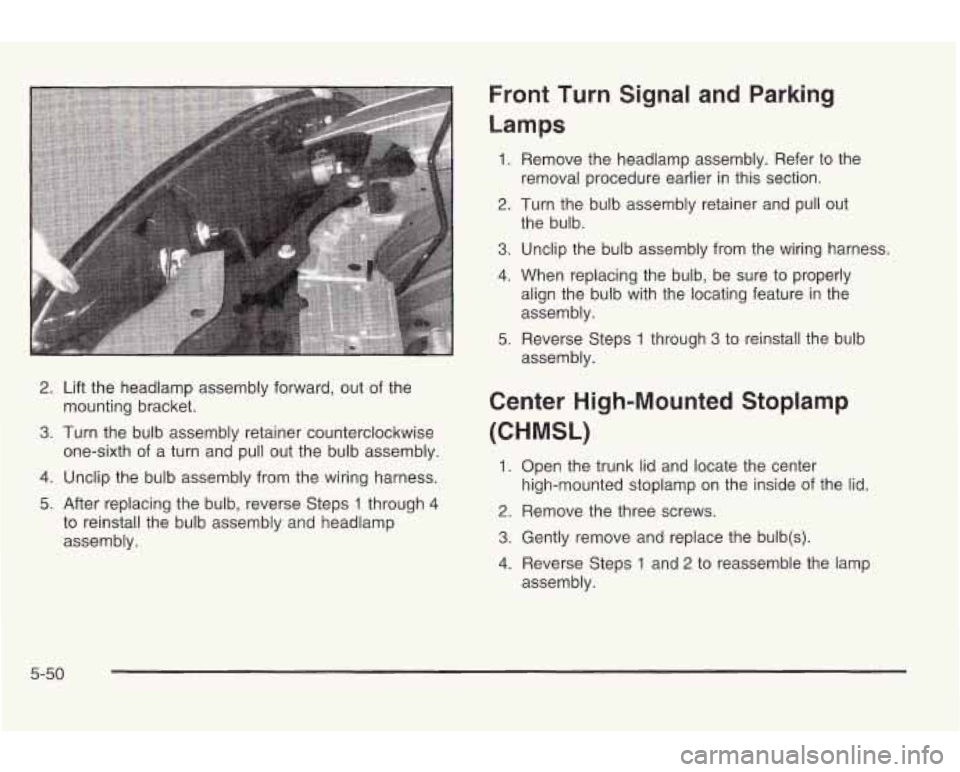
Lift the headlamp assembly forward, out of the
mounting bracket.
Turn the bulb assembly retainer counterclockwise
one-sixth of a turn and pull out the bulb assembly.
Unclip the bulb assembly from the wiring harness.
After replacing the bulb, reverse Steps
1 through 4
to reinstall the bulb assembly and headlamp
assembly.
Front Turn Signal and Parking
Lamps
1. Remove the headlamp assembly. Refer to the
removal procedure earlier in this section.
2. Turn the bulb assembly retainer and pull out
the bulb.
3. Unclip the bulb assembly from the wiring harness.
4. When replacing the bulb, be sure to properly
align the bulb with the locating feature in the
assembly.
5. Reverse Steps 1 through 3 to reinstall the bulb
assembly.
Center High-Mounted Stoplamp
(CHMSL)
1,
2,
3.
4
Open the trunk lid and locate the center
high-mounted stoplamp on the inside of the lid.
Remove the three screws.
Gently remove and replace the bulb(s).
Reverse Steps
1 and 2 to reassemble the lamp
assembly.
5-50
Page 274 of 354
Taillamps, Turn Signal, and
Stoplamps
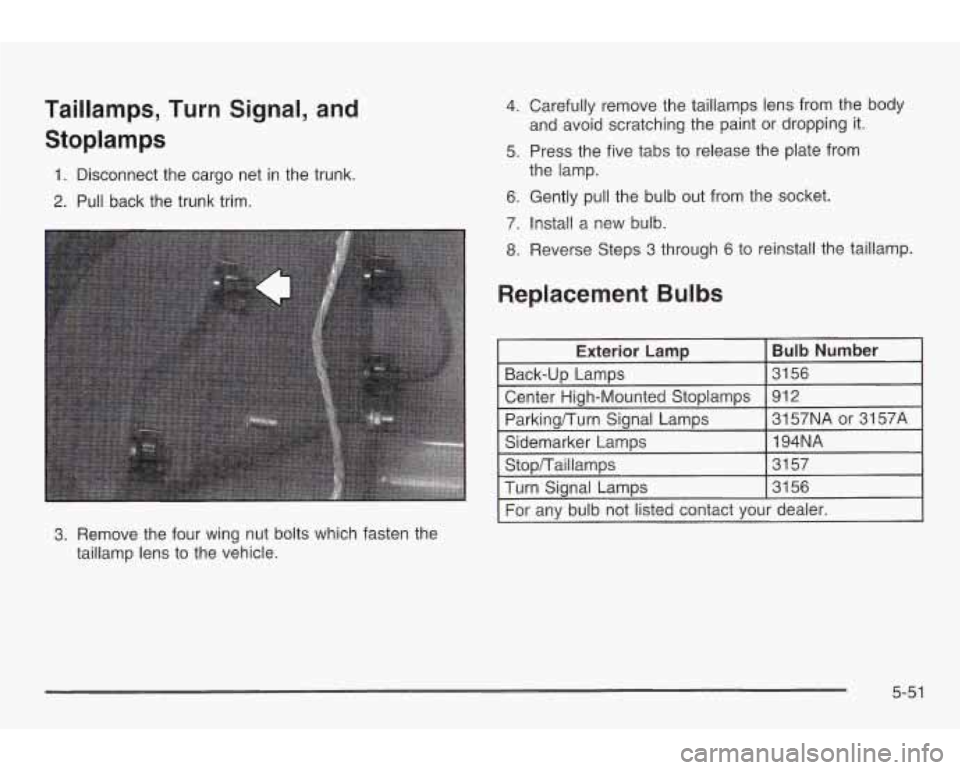
1. Disconnect the cargo net in the trunk.
2. Pull back the trunk trim.
3. Remove the four wing nut bolts which fasten the
taillamp lens to the vehicle.
4. Carefully remove the taillamps lens from the body
and avoid scratching the paint or dropping it.
5. Press the five tabs to release the plate from
the lamp.
6. Gently pull the bulb out from the socket.
7. Install a new bulb.
8. Reverse Steps 3 through 6 to reinstall the taillamp.
Replacement Bulbs
Stop/Taillamps 31 57
Turn Siunal Lamps 31 56 " -
For any bulb not listed contact your dealer.
5-51
Page 286 of 354
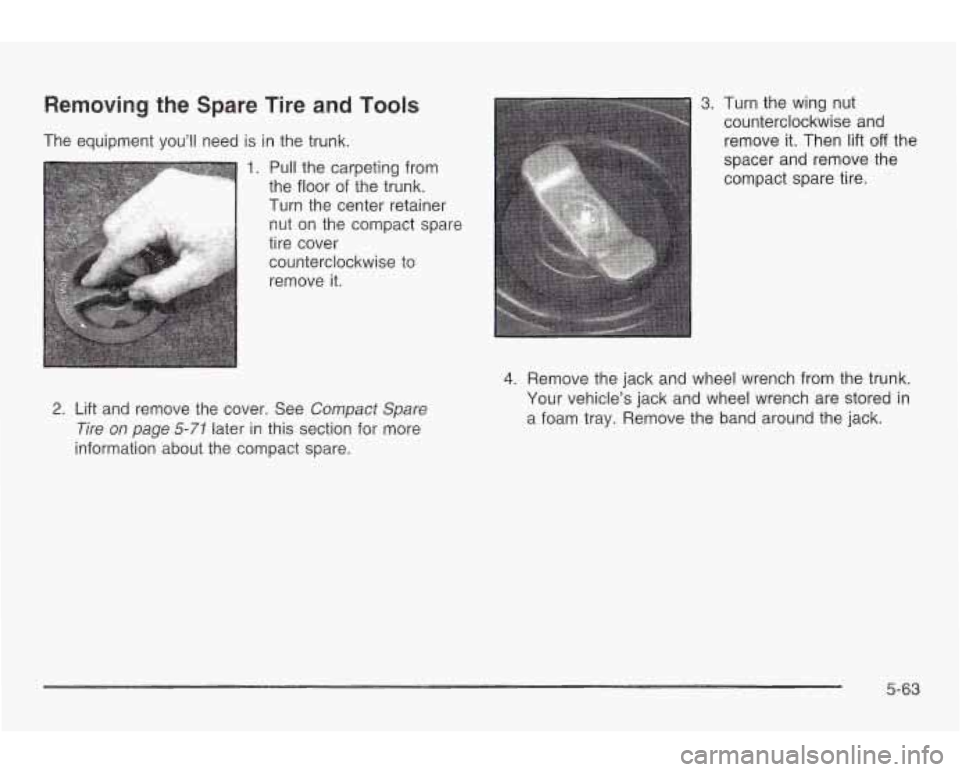
Removing the Spare Tire and Tools
The equipment you’ll need is in the trunk.
1. Pull the carpeting from
the floor of the trunk.
I Turn the center retainer
nut on the compact spare
tire cover
counterclockwise to
remove it.
2. Lift and remove the cover. See Compact Spare
Tire on page
5-71 later in this section for more
information about the compact spare.
3. Turn the wing nut
counterclockwise and
remove
it. Then lift off the
spacer and remove the
compact spare tire.
4. Remove the jack and wheel wrench from the trunk.
Your vehicle’s jack and wheel wrench are stored in
a foam tray. Remove the band around the jack.
5-63
Page 293 of 354
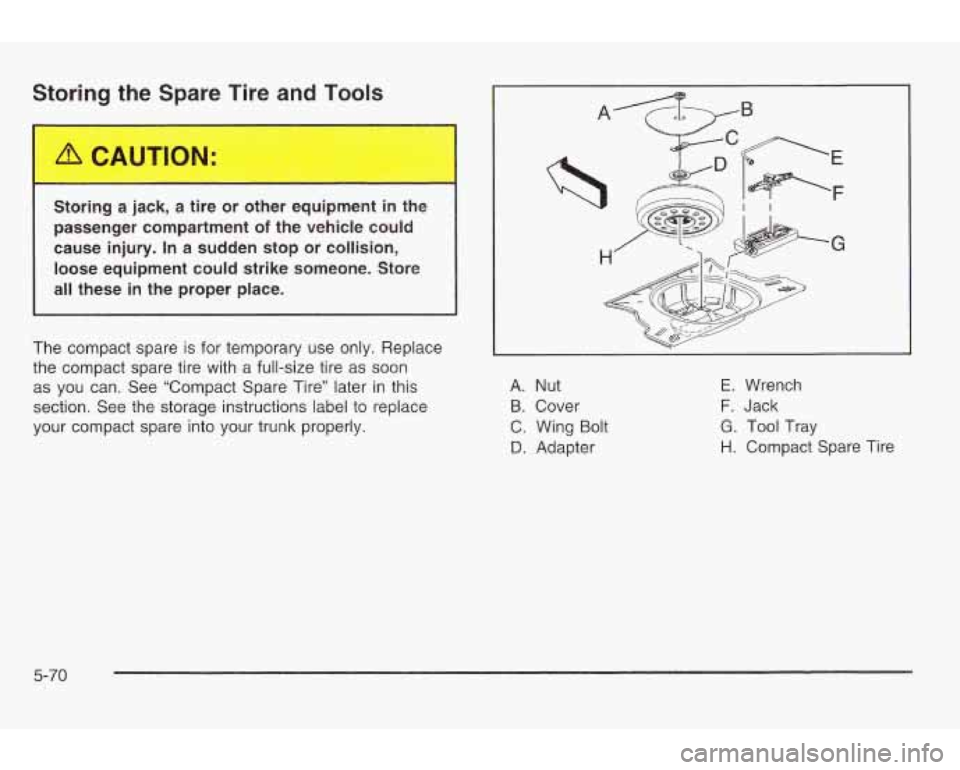
Storing the Spare Tire and Tools
I Storing a jack, a tire or other equipment in the
passenger compartment
of the vehicle could
cause injury.
In a sudden stop or collision,
loose equipment could strike someone. Store
all these in the proper place.
~~ ~~~ ~~~ ~~ ~
The compact spare is for temporary use only. Replace
the compact spare tire with a full-size tire as soon
as you can. See "Compact Spare Tire" later in this
section. See the storage instructions label to replace
your compact spare into your trunk properly.
E
F
G
A. Nut
B. Cover
C. Wing
Bolt
D. Adapter
E. Wrench
F. Jack
G. Tool Tray
H. Compact Spare Tire
5-70
Page 305 of 354

Instrument Panel Fuse Block
(Driver’s Side)
f
A) WIPER E) TRUNKREL RADIO AMP C) TURN LPS D) PWR MIRROR E) AIR BAG
G) PCMACC F) BFCBATT
H)
DRLOCK I) IPC/ BFC ACC J) STOP LPS
L) IPC / HVAC BATT
OIL
= H)n?I DR UNLOCK
El pq DR UNLOCK
Fuses Usage
WIPER Windshield Wiper Motor,
TRUNK REU Trunk Release
Relay/Motor,
RADIO AMP Audio AmplifiedRFA
TURN LPS Turn
Signal Lamps
Washer Pump Fuses
PWR MIRROR
AIR BAG
BFC BATT
PCM ACC
DR LOCK
I PC/BFC ACC
STOP LPS
HAZARD LPS
I PC/HVAC
BATT
Circuit Breakers
PWR SEAT
Relay
TRUNK REL
DR UNLOCK DR LOCK
DRIVER DR
UNLOCK Usage
Power Mirrors
Air Bags Body Computer (BFC)
Power Control Module (PCM)
Door Lock Motors
Cluster, Body Computer (BFC)
Stop Lamps Hazard Lamps HVAC Head, Cluster, Data Link
Connector
Usage Power Seats
Usage
Trunk Relay
Door Unlock Relay Door Lock Relay
Driver’s Door Unlock Relay
5-82
Page 307 of 354

Engine Compartment Fuse Block
The engine compartment fuse block is located on the
driver’s side
of the engine compartment, near the
battery.
.
Fuse
1
2
Usage
Ignition Switch
Right Electrical Center-Fog Lamps,
Radio, Body Function Control
Module, Interior Lamps Fuse
3
4
5
6
7
8
Relays
9
10
11
12
13
14
15 Usage
Left Electrical Center-Stop Lamps,
Hazard Lamps, Body Function
Control Module, Cluster, Climate
Control System
Anti-Lock Brakes
Left Electrical Center-Power Seats,
Power Mirrors, Door Locks, Trunk
Release, Audio Amplifier, Remote
Keyless Entry
Not Used Ignition Switch
Cooling Fan
#I
Usage
Rear Defog
Not Used
Starter
Cooling Fan #1
HVAC Blower (Climate Control)
Cooling Fan #2
Cooling Fan
5-84
Page 321 of 354
At Least Twice a Year
Restraint System Check
Make sure the safety belt reminder light and all your
belts, buckles, latch plates, retractors and anchorages
are working properly.
Look for any other loose or
damaged safety belt system parts. If you see anything
that might keep a safety belt system from doing its
job, have it repaired. Have any torn or frayed safety belts
replaced.
Also look for any opened or broken air bag coverings,
and have them repaired or replaced. (The air bag
system does not need regular maintenance.)
Wiper Blade Check
Inspect wiper blades for wear or cracking. Replace
blade inserts that appear worn or damaged or that
streak or miss areas of the windshield.
Also see
Cleaning the Outside of Your Vehicle on page 5-75.
Weatherstrip Lubrication
Silicone grease on weatherstrips will make them last
longer, seal better,' and not stick or squeak. Apply
silicone grease with a clean cloth. During very cold,
damp weather more frequent application may be required. See
Part D: Recommended Fluids and
Lubricants on page
6- 15.
Manual Transaxle Check
It is not necessary to check the transaxle fluid level.
Check for leaks. A fluid leak is the only reason for fluid
loss. Have the system inspected and repaired if
needed.
Automatic Transaxle Check
It is not necessary to check the transaxle fluid level. A
transaxle fluid leak is the only reason for fluid loss.
Check for leaks. If a leak occurs, take the vehicle to your
dealer and have
it repaired as soon as possible.
Hydraulic Clutch System Check
Check the fluid level in the clutch reservoir. See
Hydraulic Clutch on page 5-23. A fluid loss in this
system could indicate a problem. Have the system
inspected and repaired at once.
At Least Once a Year
Key Lock Cylinders Service
Lubricate the key lock cylinders with the lubricant
specified in Part
D.
Body Lubrication Service
Lubricate all the door hinges and latches, including
those for the hood and the trunk lid. Part D tells
you what to use. More frequent lubrication may be
required when exposed to a corrosive environment.
6-1 0
Page 343 of 354
DAB Radio .................................................... 3-70
Daytime Running Lamps (DRL)
......................... 3-13
Defensive Driving
............................................. 4-2
Defogging and Defrosting
................................. 3-1 9
Delayed Headlamps ........................................ 3-1 5
Delayed Locking ............................................... 2-8
Dinghy Towing
................................................ 4-33
Doing Your Own Service Work
........................... 5-3
Dolly Towing
.................................................. 4-34
Dome Lamp
................................................... 3-16
Door
Delayed Locking
........................................... 2-8
Power Door Locks
......................................... 2-8
Programmable Automatic Door Locks
............... 2-8
Rear Security Locks
..................................... 2-10
Position, Safety Belt
..................................... 1-14
Six-Way Power Seat
...................................... 1-3
At Night
..................................................... 4-17
City
........................................................... 4-21
Defensive
..................................................... 4-2
Drunken
....................................................... 4-2
Freeway
..................................................... 4-22
Hill and Mountain Roads
.............................. 4-25
In Rain and on Wet Roads
........................... 4-19
Winter
........................................................ 4-26
Locks
.......................................................... 2-7
Driver
Driving Driving
On Grades
.......................................... 4-42
Driving on Snow or Ice
.................................... 4-27
Driving Through Deep Standing Water
............... 4-20
Driving with
a Trailer ....................................... 4-40
Driving
Through Flowing Water
......................... 4-21
E
Easy Entry Seat ............................................... 1-6
Electrical System
Add-on Equipment
...................................... 5-81
Fuses and Circuit Breakers ........................... 5-81
Power Windows and Other Power Options
...... 5-81
Windshield Wiper Fuses
............................... 5-81
Emergency Trunk Release Handle
..................... 2-14
Emissions Inspection and Maintenance
Programs
................................................... 3-33
Engine
Air Cleaner/Filter
......................................... 5-21
Battery
....................................................... 5-42
Change Engine Oil Light
............................... 3-35
Check and Service Engine Soon Light
............ 3-31
Coolant
...................................................... 5-23
Coolant Heater
............................................ 2-22
Coolant Temperature Gage
........................... 3-30
Cooling System Inspection
............................ 6-14
Engine Compartment Overview
...................... 5-12
4