ignition PONTIAC GRAND AM 2003 Workshop Manual
[x] Cancel search | Manufacturer: PONTIAC, Model Year: 2003, Model line: GRAND AM, Model: PONTIAC GRAND AM 2003Pages: 354, PDF Size: 16.3 MB
Page 178 of 354
For best results, use a scrubbing action, non-abrasive
cleaning cassette with pads which scrub the tape
head as the hubs of the cleaner cassette turn. The
recommended cleaning cassette is available through
your dealership.
The broken tape detection feature of your cassette tape
player may identify the cleaning cassette as
a
damaged tape, in error. To prevent the cleaning cassette
from being ejected, use the following steps:
1. Turn the ignition on.
2. Turn the radio off.
3. Press and hold the CD TAPE button for five
seconds. READY
will appear on the display for five
seconds.
4. Insert the scrubbing action cleaning cassette.
5. Eject the cleaning cassette after the manufacturer’s
recommended cleaning time.
After the cleaning cassette is ejected, the broken tape
detection feature will be active again.
You may also choose a non-scrubbing action, wet-type
cleaner which uses a cassette with a fabric belt
to
clean the tape head. This type of cleaning cassette will not eject on
its own. A non-scrubbing action cleaner
may not clean as thoroughly as the scrubbing type
cleaner. The use
of a non-scrubbing action, dry-type
cleaning cassette is not recommended.
After you clean the player, press and hold the eject
button for five seconds
to reset the CLEAN PLAYER
indicator. The radio will display CLEANED
to show the
indicator was reset.
Cassettes are subject
to wear and the sound quality
may degrade over time. Always make sure the cassette
tape is in good condition before you have your tape
player serviced.
Care of Your CDs
Handle discs carefully. Store them in their original cases
or other protective cases and away from direct sunlight
and dust.
If the surface of a disc is soiled, dampen
a clean, soft cloth in a mild, neutral detergent solution
and clean it, wiping from the center
to the edge.
Be sure never
to touch the side without writing when
nanaiing aiscs. Pick up aiscs by grasping ihe ouier
edges or the edge of the hole and the outer edge.
3-71
Page 179 of 354
Care of Your CD Player
The use of CD lens cleaner discs is not advised, due to
the risk of contaminating the lens of the CD optics
with lubricants internal
to the CD mechanism.
Fixed Mast Antenna
The fixed mast antenna can withstand most car washes
without being damaged. If the mast should ever
become slightly bent, you can straighten it
out by hand.
If the mast is badly bent, as it might be by vandals,
you should replace it.
Check occasionally
to be sure the mast is still tightened
to the fender. If tightening is required, tighten by
hand, then with
a wrench one quarter turn.
XM Satellite Radio Antenna System
Your XMTM Satellite Radio antenna is located on the
roof of your vehicle. Keep this antenna clear of
snow and ice build up for clear radio reception.
The performance of your XM system may be affected
if
your sunroof is open.
DAB Radio Antenna System
Your DAB antenna is located on the roof of your
vehicle. Keep this antenna clear of snow and ice build
up for clear radio reception.
If your vehicle is purchased in Canada and driven
into the United Stated the DAB radio antenna system
will not function. DAB radio reception is available
in Canada only.
The performance of your DAB antenna may be affected
if your sunroof is open.
Chime Level Adjustment
Chime level adjustment is only available on RDS radios.
The volume level of the vehicle’s chimes can be
controlled by the radio. To change the volume level,
press and hold pushbutton
6 with the ignition on and the
radio power
off. The chime volume level will change
from the normal level
to loud, and LOUD will be
displayed on the radio. To change back
to the default or
normal setting, press and hold pushbutton
6 again.
The chime level will change from the loud level
to normal, and NORMAL will be displayed.
3-72
Page 204 of 354
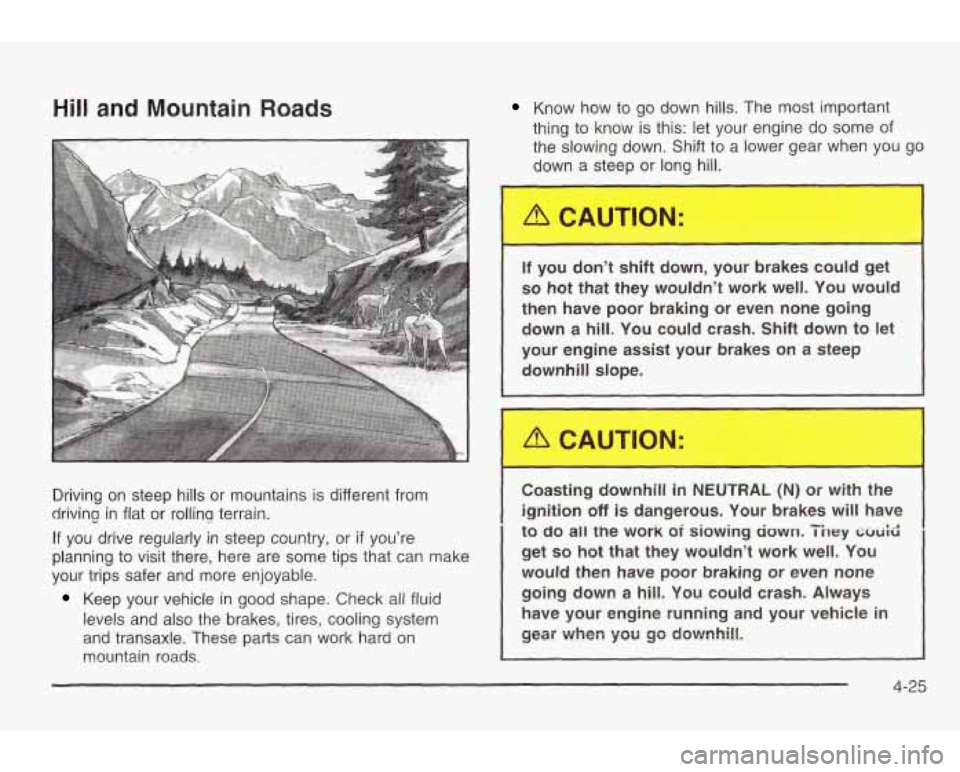
Hill and Mountain Roads
Driving on steep hills or mountains is different from
drivina
w in flat or rollinq terrain.
If you drive regularly in steep country, or if you’re
planning to visit there, here are some tips that can make
your trips safer and more enjoyable.
Keep your vehicle in good shape. Check all fluid
levels and
also the brakes, tires, cooling system
and transaxle. These parts can work hard on
mountain roads.
Know how to go down hills. The most important
thing
to know is this: let your engine do some of
the
slowing down. Shift to a lower gear when you go
down a steep or lom hill.
If you don’t shift down, your brakes could get
so hot that they wouldn’t work well. You would
then have poor braking or even none going
down a
hill. You could crash. Shift down to let
your engine assist your brakes
on a steep
downhill
slope.
i
Coasting downhill in NEUTRAL (N) or with the
ignition
off is dangerous. Your brakes will have
to
do all the work ai siowing down. I ney cwdd
get so hot that they wouldn’t work well. You
would then have poor braking or even none going down a hill. You could crash. Always have your engine running and your vehicle in
I.
4-25
Page 212 of 354
Dinghy Towing
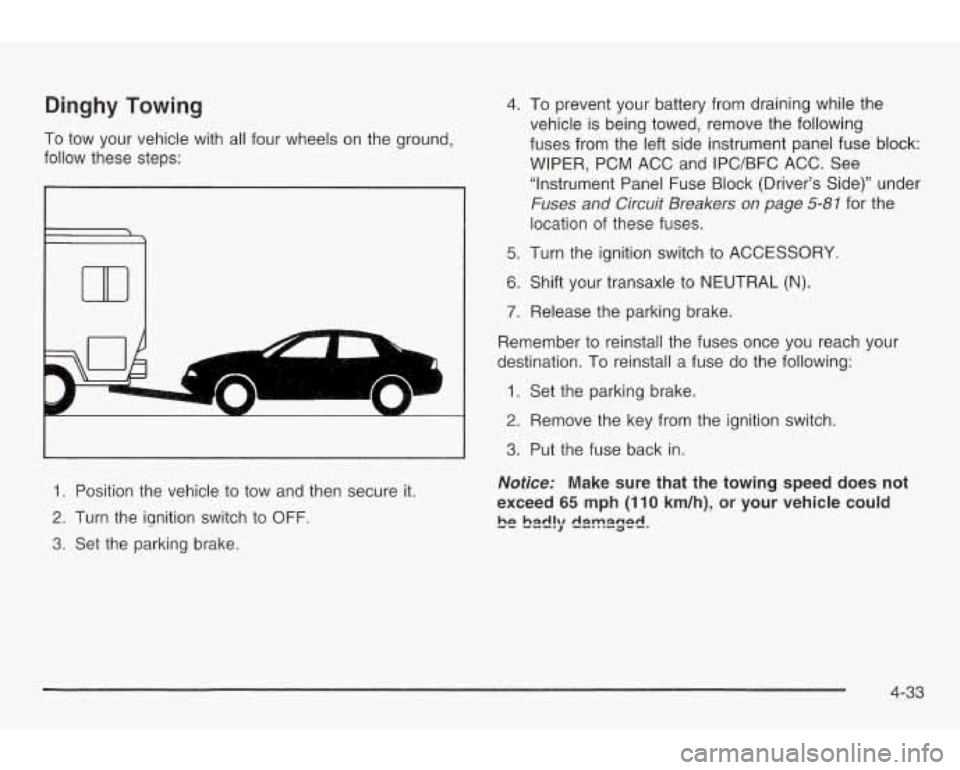
To low your vehicle with all four wheels on the ground,
follow these steps:
ti
11701
1. Position the vehicle to tow and then secure it.
2. Turn the ignition switch to OFF.
3. Set the parking brake. 4.
To prevent your battery from draining while the
vehicle is being towed, remove the following
fuses from the left side instrument panel fuse block:
WIPER, PCM ACC and IPC/BFC ACC. See
“Instrument Panel Fuse Block (Driver’s Side)” under
Fuses and Circuit Breakers on page 5-81 for the
location of these fuses.
5. Turn the ignition switch to ACCESSORY.
6. Shift your transaxle to NEUTRAL (N).
7. Release the parking brake.
Remember to reinstall the fuses once you reach your
destination. To reinstall
a fuse do the following:
1. Set the parking brake.
2. Remove the key from the ignition switch.
3. Put the fuse back in.
Notice: Make sure that the towing speed does not
exceed
65 mph (1 10 km/h), or your vehicle could
be b2d!y dm2ge.r.
4-33
Page 243 of 354
How to Reset the Change Oil Light
The GM Oil Life SystemTM calculates when to change
your engine oil and filter based on vehicle use. Anytime
your oil is changed, reset the system
so it can
calculate when the next oil change is required.
If a
situation occurs where you change your oil prior
to a
CHANGE OIL light being turned on, reset the system.
After changing the engine oil, the system must be reset.
To reset the oil life indicator, do the following steps:
1. With the ignition key in ON (a short time after
turning
off the engine), press the RESET button
located in the driver’s side instrument panel
fuse block. See “Instrument Panel Fuse Block”
under
Fuses and Circuit Breakers on page 5-81.
2. When the CHANGE OIL light starts to flash, press
and hold the RESET button again.
The reset is complete when you hear the chimes and
the CHANGE OIL light goes out.
If your vehicle is equipped with a 2.2L L4 ECOTEC
engine, it has a unique oil filter element. When
reinstalling the filter cap do not exceed
18 Ib ft (25 N*m ).
Inspect the condition of the O-ring and replace if
damaged.
What to Do with Used Oil
Used engine oil contains certain elements that may be
unhealthy for your skin and could even cause cancer.
Don’t let used oil stay on your skin for very long. Clean
your skin and nails with soap and water, or a
good
hand cleaner. Wash or properly dispose of clothing or
rags containing used engine oil. See the manufacturer’s
warnings about the use and disposal of oil products.
Used oil can be a threat
to the environment. If you
change your own oil, be sure to drain all the oil from the
filter before disposal. Never dispose of oil by putting it
in the trash, pouring it on the ground, into sewers, or into
streams or bodies of water. Instead, recycle it by
taking it to a place that collects used oil. If you have a
problem properly disposing of your used oil, ask
your dealer, a service station or a local recycling center
for help.
See your dealer for additional information.
5-20
Page 267 of 354
1. Check the other vehicle. It must have a 12-volt
battery with a negative ground system.
Notice: If the other system isn’t a 12-volt system
with a negative ground, both vehicles can be
damaged.
2. Get the vehicles close enough so the jumper cables
can reach, but be sure the vehicles aren’t touching
each other. If they are, it could cause a ground
connection you don’t want. You wouldn’t be able
to
start your vehicle, and the bad grounding could
damage the electrical systems.
To avoid the possibility of the vehicles rolling, set
the parking brake firmly on both vehicles involved in
the jump start procedure. Put an automatic
transaxle in PARK (P) or a manual transaxle in
NEUTRAL before setting the parking brake.
Notice: If you leave your radio on, it could be badly
damaged. The repairs wouldn’t be covered by
your warranty.
3. Turn off the ignition on both vehicles. Unplug
unnecessary accessories plugged into the cigarette
lighter. Turn
off the radio and all lamps that aren’t
needed. This will avoid sparks and help save
both batteries. And it could save your radio!
4. Open the hoods and locate the batteries. Find the
positive (+) and negative
(-) terminal locations on
each vehicle. See
Engine Compartment Overview
on page
5-12 for more information on location.
c
An electric fan can start up even when the
engine
is not running and can injure you. Keep
hands, clothing and tools away from any
underhood electric fan.
5-44
Page 307 of 354

Engine Compartment Fuse Block
The engine compartment fuse block is located on the
driver’s side
of the engine compartment, near the
battery.
.
Fuse
1
2
Usage
Ignition Switch
Right Electrical Center-Fog Lamps,
Radio, Body Function Control
Module, Interior Lamps Fuse
3
4
5
6
7
8
Relays
9
10
11
12
13
14
15 Usage
Left Electrical Center-Stop Lamps,
Hazard Lamps, Body Function
Control Module, Cluster, Climate
Control System
Anti-Lock Brakes
Left Electrical Center-Power Seats,
Power Mirrors, Door Locks, Trunk
Release, Audio Amplifier, Remote
Keyless Entry
Not Used Ignition Switch
Cooling Fan
#I
Usage
Rear Defog
Not Used
Starter
Cooling Fan #1
HVAC Blower (Climate Control)
Cooling Fan #2
Cooling Fan
5-84
Page 308 of 354

Relays 16
17
18
19
20
21 22
Fuses 23-32
33
34
35
36
37
3e
39
40 Usage
Air Conditioning Compressor
Not Used
Fuel Pump
Automatic Headlamp System
Automatic Headlamp System
Horn
Daytime Running Lamps (DRL)
Usage
Spare Fuse Holder
Rear Defog
Accessory Power Outlets,
Cigarette Lighter
Generator
Not Used
Air Conditioning Compressor, Body
Function Control Module
Powertrain Control Module (PCM)
Anti-Lock Brakes (ABS)
At Itnmatir- TrQncQvlo , l,..."l, IULIV I I UI I"cIt\I"
Fuses
41
42
43
44
45 46
47
48 49 50
51 52
53
54
55 56
57 Usage
Ignition
System
Back-up Lamps, Brake Transaxle
Shift Interlock
Horn PCM Parking Lamps
Climate Control System,
Air Conditioning
Canister Vent Valve, Exhaust
Oxygen Sensors
Fuel Pump, injectors
Not Used
Right Headlamp
Left Headlamp
Cooling Fan
#2
HVAC Blower (Climate Control)
Crank
Coolina Fan #2 Ground
Fuse Puller for Mini Fuses
Not Used
5-85
Page 323 of 354
Ignition Transaxle Lock Check
While parked, and with the parking brake set, try to turn
the ignition key to
OFF in each shift lever position.
* With an automatic transaxle, the key should turn to
OFF only when the shift lever is in PARK
(P).
With a manual transaxle, the key should turn to
OFF only when the shift lever
is in reverse.
On all vehicles, the key should come out only in
OFF.
Parking Brake and Automatic Transaxle
Park
(P) Mechanism Check
When you are doing this check, your vehicle
could begin to move. You
or others could be
injured and property could be damaged. Make
sure there is
room in front of your vehicle in
case it begins to roll.
Be ready to apply the
regular brake at once should the vehicle begin
to move. Park
on a fairly steep hill, with the vehicle facing
downhill. Keeping your foot on the regular brake, set the
parking brake.
To check the parking brake’s holding ability: With
the engine running and transaxle in NEUTRAL
(N), slowly remove foot pressure from the regular
brake pedal.
Do this until the vehicle is held by the
parking brake only.
ability: With the engine running, shift to PARK (P).
Then release the parking brake followed by the
regular brake.
* To check the PARK (P) mechanism’s holding
Underbody Flushing Service
At least every spring, use plain water to flush any
corrosive materials from the underbody. Take care to
clean thoroughly any areas where mud and other debris
can collect.
6-1
2
Page 345 of 354
G
Gage Engine Coolant Temperature
......................... 3-30
Fuel
.......................................................... 3-37
Speedometer
.............................................. 3-24
Tachometer
................................................. 3-24
Octane
........................................................ 5-5
Specifications ............................................... 5-5
Glass Surfaces ............................................... 5-74
Glove Box
..................................................... 2-37
GM Mobility Program for Persons with
Disabilities
.................................................... 7-5
Gasoline
H
Hazard
Warning Flashers .......................
Head Restraints ...................................
Headlamp High/Low-Beam Changer ........
Headlamps ..........................................
Bulb Replacement .............................
Halogen Bulbs ..................................
Headlamps Off in Park (P) .....................
Headlamps On Reminder .......................
Highway Hypnosis .................................
Hill and Mountain Roads ........................
Hitches ................................................
Hood Front
Turn Signal and Parking Lamps
...
........... 3-4
........... 1-5
........... 3-7
......... 5-49
......... 5-49
......... 5-50
......... 5-49
......... 3-15
........... 3-7
......... 4-24
......... 4-25
......... 4-39 Hood
(cont.)
Checking Things Under
................................ 5-10
Release ..................................................... 5-10
Horn
............................................................... 3-5
How to Add Coolant to the Coolant
Surge Tank
................................................. 5-31
How
to Check ................................................ 5-54
How to Check and Add Fluid
............................ 5-23
How to Check Power Steering Fluid
.................. 5-37
How
to Use This Manual ...................................... ii
How to Wear Safety Belts Properly ................... 1-14
Hydraulic Clutch
............................................. 5-23
Hydraulic Clutch System Check
........................ 6-10
Hydroplaning .................................................. 4-20
I
If No Steam Is Coming From Your Engine .......... 5-28
If Steam Is Coming From Your Engine ............... 5-27
If the Light Is Flashing ..................................... 3-32
If the Light Is On Steady ................................. 3-32
If You Are Stuck in Sand, Mud, Ice or Snow ....... 4-31
If You Do Decide To Pull A Trailer ..................... 4-37
If You’re Caught in a Blizzard ........................... 4-29
Ignition Positions
............................................. 2-18
Ignition Transaxle Lock Check
.......................... 6-12
Indicators
....................................................... 3-22
Inflation
-- Tire Pressure .................................. 5-54
Infants
and Young Children, Restraints
............... 1-34
6