axle PONTIAC GRAND AM 2003 Owners Manual
[x] Cancel search | Manufacturer: PONTIAC, Model Year: 2003, Model line: GRAND AM, Model: PONTIAC GRAND AM 2003Pages: 354, PDF Size: 16.3 MB
Page 70 of 354
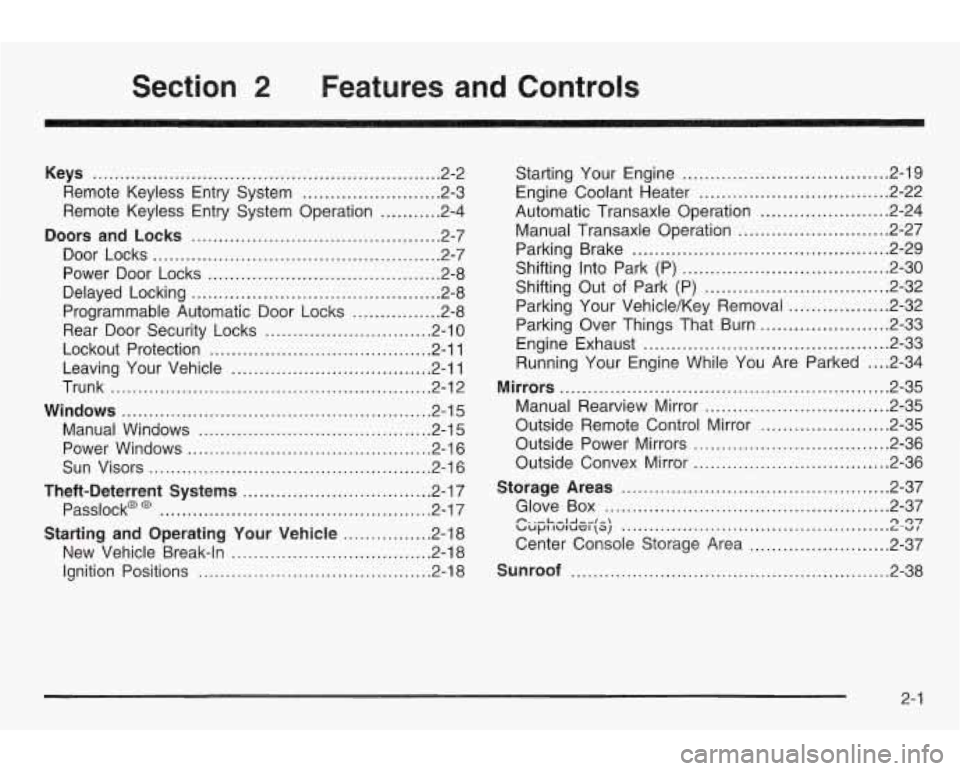
Section 2 Features and Controls
Keys .............................................................. -2-2
Remote Keyless Entry System
......................... 2.3
Remote Keyless Entry System Operation
.......... -2-4
Qoors and Locks ............................................. 2-7
Door Locks
.................................................... 2-7
Power Door Locks
.......................................... 2-8
Delayed Locking
............................................. 2-8
Programmable Automatic Door Locks
................ 2-8
Rear Door Security Locks
.............................. 2-10
Lockout Protection
........................................ 2-11
Leaving Your Vehicle
.................................... 2-1 1
Trunk .......................................................... 2-12
Windows
........................................................ 2-15
Manual Windows
.......................................... 2-15
Power Windows
............................................ 2-16
Sun Visors
................................................... 2-16
Theft-Deterrent Systems
.................................. 2-17
Passlock@
@ ................................................. 2-17
Starting and Operating Your Vehicle
................ 2-18
New Vehicle Break-In
.................................... 2-18
Ignition Positions
.......................................... 2-18 Starting
Your Engine
..................................... 2.19
Engine Coolant Heater
.................................. 2.22
Automatic Transaxle Operation
....................... 2.24
Manual Parking
Shifting
Shifting Parking Parking Transaxle Operation
.......................... -2-27
Brake
.............................................. 2.29
Into Park (P)
..................................... 2.30
Out
of Park (P) ................................. 2.32
Your VehiclelKey Removal
.................. 2.32
Over Things That Burn
....................... 2-33
Engine Exhaust
............................................ 2-33
Running Your Engine While You Are Parked
.... 2-34
Mirrors
........................................................... 2-35
Manual Rearview Mirror
................................. 2.35
Outside Remote Control Mirror
....................... 2.35
Outside Power Mirrors
................................... 2.36
Outside Convex Mirror
................................... 2.36
Storage Areas
................................................ 2.37
Glove Box
................................................... 2.37
Center Console Storage Area
......................... 2.37
n . .-L.IA.. f. UUpl IUIUGI (3) L.UI 137 ................................................
Sunroof ......................................................... 2-38
2-
1
Page 77 of 354
Power Door Locks
With the power door locks, you can lock or unlock all of
the doors on your vehicle using the driver’s or front
passenger’s door lock switch.
Press the bottom of the switch
to lock all of the doors.
Press the top of the switch
to unlock all of the doors.
Delayed Locking
This feature will allow the driver to delay the actual
locking of the vehicle. This feature will not operate
if the
key is left in the ignition. See
Lockout Protection on
page 2- I 1.
When LOCK on the driver’s power door lock switch is
pressed, with the key removed from the ignition and the
driver’s door open, three chimes will be heard. The
doors will
not lock. Seven seconds after the driver’s door
has been closed, all of the doors will lock and the
parking lamps will flash. The horn will also chirp
if the
horn chirp feature is enabled. See “Programmable Horn
Chirp” previously for more information.
If the driver opens another door before the seven
seconds, the doors will not lock until seven seconds
after the last door is closed. If
the power door lock switch is pressed
to LOCK twice
when leaving the vehicle, or the LOCK button on the
remote keyless entry transmitter is pressed, the
doors will lock immediately.
If the power door lock switch is pressed to unlock, the
doors will not lock automatically.
Programmable Automatic Door
Locks
Just close the doors and turn on the ignition. All of the
doors will lock when you move the shift lever
out of
PARK
(P) to REVERSE (R) on vehicles with an
automatic transaxle. All of the doors will lock when the
vehicle speed is greater than
5 mph (8 km/h) on
vehicles with a manual transaxle.
If someone needs to get out while the vehicle is
running, have that person use the door lock. When the
door is closed again, it will lock automatically when
the vehicle reaches about
5 mph (8 km/h).
All doors will automatically unlock when the shift lever is
moved
to PARK (P) on vehicles with an automatic
transaxle or to REVERSE (R) on vehicles with a manual
transaxle and the key is turned
to OFF.
2-8
Page 78 of 354
Customizing the Automatic Door Locks
One of four operating modes may be selected and
programmed by the driver on vehicles with an automatic
transaxle:
e Mode 1: All doors automatically lock when the
transaxle
is shifted out of PARK (P). The doors will
remain locked unless manually unlocked or the
lock button is pressed.
All doors will unlock when
the transaxle is shifted into PARK (P) and the key is
turned to
OFF.
* Mode 2: This mode is only available on vehicle’s
equipped with
a remote keyless entry transmitter.
All doors automatically lock when the transaxle
is shifted out of PARK (P). Only the driver’s door will
unlock when the transaxle is shifted into PARK
(P)
and the key is turned to OFF.
transaxle is shifted out of PARK (P). No automatic
door unlock.
e Mode 3: All doors automatically lock when the
e \dl& 4: !V\lrr g.~!t~mstic. dinr in& or I-rnlnck
One of the four operating modes may be selected and
programmed by the driver on vehicles with a manual
transaxle:
e
Mode 1: All doors automatically lock when the
vehicle speed is greater than
5 mph (8 km/h).
The doors will remain locked unless manually
unlocked or the lock button
is pressed. All doors will
unlock when the transaxle
is shifted into
REVERSE
(R) and the key is turned to OFF.
Mode 2: This mode is only available on vehicle’s
equipped with a remote keyless entry transmitter.
All doors automatically lock when the vehicle speed
is greater than
5 mph (8 km/h). Only the driver’s
door will unlock when the transaxle
is shifted
into REVERSE
(R) and the key is turned to OFF.
Mode 3: All doors automatically lock when
the vehicle speed
is greater than 5 mph (8 km/h
No automatic door unlock.
Mode
4: No automatic door lock or unlock.
2-9
Page 79 of 354
Before your vehicle was shipped from the factory it was
programmed in Mode
1. To determine the current
mode or
to change to a different mode, do the following:
1. Put an automatic transaxle in PARK (P) or a
manual transaxle
in REVERSE (R) with the parking
brake engaged and turn the ignition to
ON.
2. Press and hold LOCK on the power door lock
switch for
10 seconds. Release the switch when
you hear the chime.
3. Count the number of chimes you hear. The number
of chimes tells you which mode your vehicle is in.
You can change the mode by pressing and
holding LOCK on the power door lock switch (two
chimes for Mode
2, three chimes for Mode 3
and four chimes for Mode 4).
that matches the mode you want.
4. Repeat Step 2 until you hear the number of chimes
The mode you selected is now set.
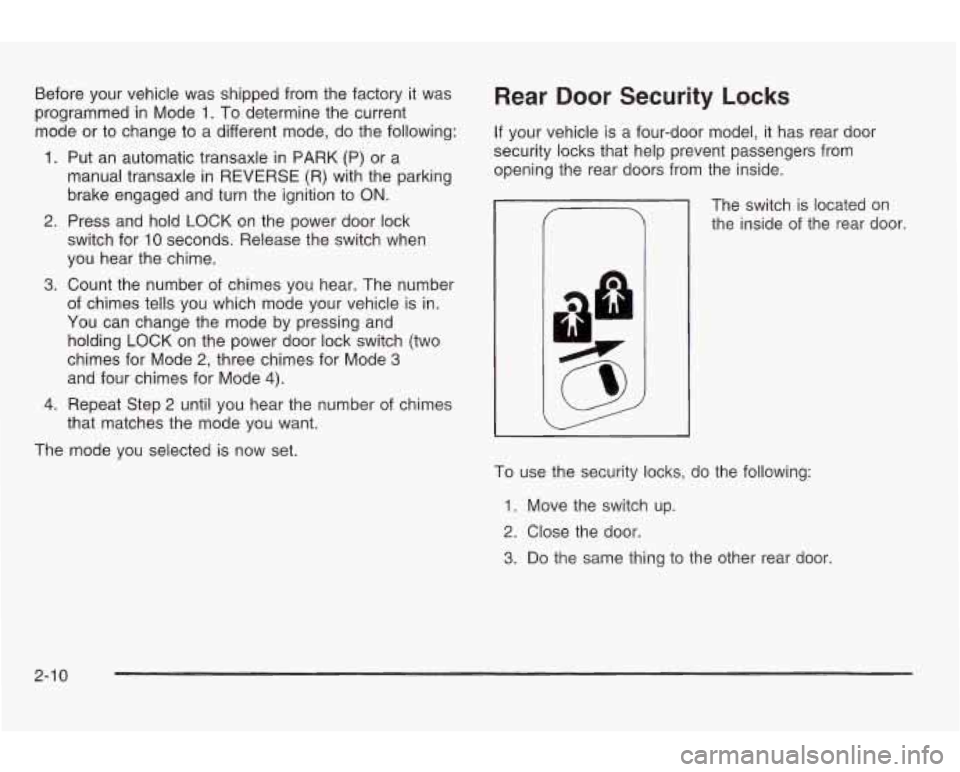
Rear Door Security Locks
If your vehicle is a four-door model, it has rear door
security locks that help prevent passengers from
opening the rear doors from
the inside.
The switch is located
on
the inside of the rear door.
To use the security locks, do the following:
1. Move the switch up.
2. Close the door.
3. Do the same thing to the other rear door.
2-1 0
Page 87 of 354
Starting and Operating Your
Vehicle
New Vehicle Break-In
Notice: Your vehicle doesn’t need an elaborate
“break-in.” But it will perform better in the long run
if you follow these guidelines:
Don’t drive at any one speed - fast or
slow
- for the first 500 miles (805 km).
Don’t make full-throttle starts.
Avoid making hard stops for the first 200 miles
(322 km) or so. During this time your new
brake linings aren’t yet broken in. Hard stops
with new linings can mean premature wear and
earlier replacement. Follow this breaking-in
guideline every time you get new brake linings.
Don’t tow a trailer during break-in. See “Towing
a Trailer” in the Index for more information.
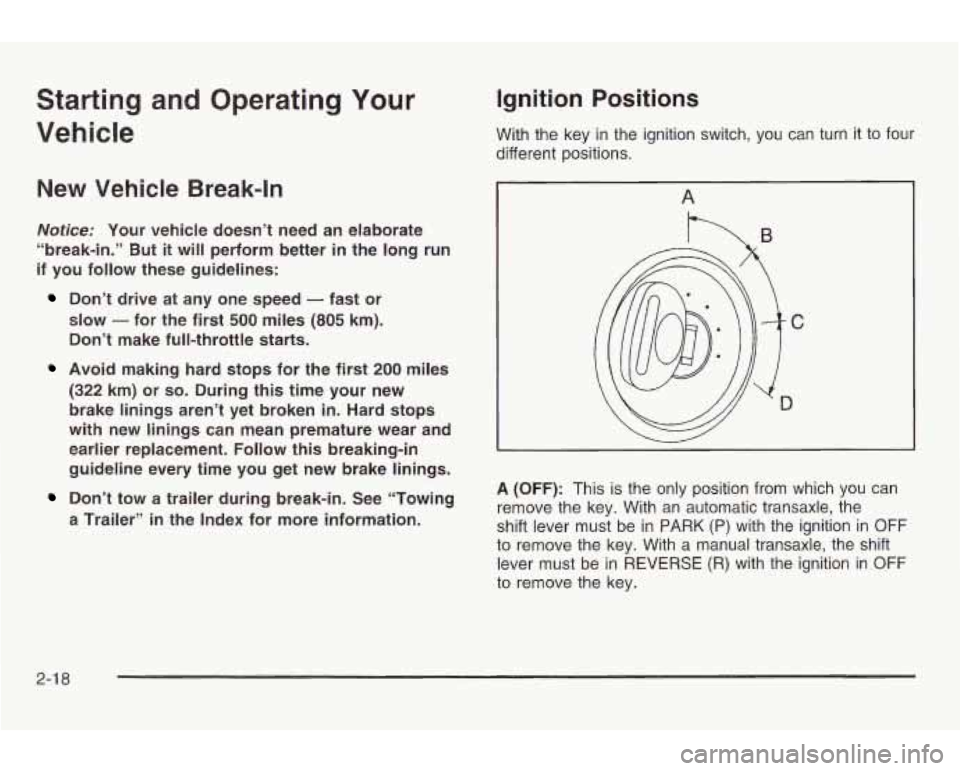
Ignition Positions
With the key in the ignition switch, you can turn it to four
different positions.
I A
A (OFF): This is the only position from which you can
remove the key. With an automatic transaxle, the
shift lever
must be in PARK (P) with the ignition in OFF
to remove the key. With a manual transaxle, the shift
lever must be in REVERSE (R) with the ignition
in OFF
to remove the key.
2-1 8
Page 88 of 354

A warning chime will sound if you open the driver’s door
when the ignition is
off and the key is in the ignition.
Notice: If your key seems stuck in OFF and
you can’t turn it, be sure you are using the correct
key; if
so, is it all the way in? Turn the key only
with your hand. Using
a tool to force it could break
the key or the ignition switch.
If none of this
works, then your vehicle needs service.
B (ACCESSORY): This position unlocks the transaxle.
It also lets you use things like the radio and windshield
wipers when the engine is not running. To use
ACCESSORY, turn the key clockwise to the first
position. Use this position
if your vehicle must be pushed
or towed, but never try to push-start your vehicle.
C (ON): This position is where the key returns to after
you start your engine and release the key. The
ignition switch stays in ON when the engine is running.
But even when the engine is not running, you can
use ON to operate your electrical accessories and to
display some instrument panel warning lights.
Retained Accessory Power (RAP)
Your vehicle is equipped with a Retained Accessory
Power (RAP) feature which will allow the radio to
continue to work up to
10 minutes after the ignition is
turned to
OFF.
Your radio will work when the ignition key is in ON or
ACCESSORY. Once the key is turned from ON to
OFF,
the radio will continue to work up to 10 minutes or
until the driver’s door is opened.
Starting Your Engine
Automatic Transaxle
Move your shift lever to PARK (P) or NEUTRAL (N).
Your engine won’t start in any other position
- that’s a
safety feature. To restart when you’re already moving,
use NEUTRAL (N) only.
Notice: Don’t try to shift to PARK (P) if your
vehicle
is moving. If you do, you could damage the
transaxie.
shift to PARK (Pj oniy when your
vehicle
is stopped.
D (START): This position starts the engine. When the
engine starts, release the key. The ignition switch
will return to ON for normal driving.
2-1 9
Page 89 of 354
Manual Transaxle
The gear selector should be in neutral and the parking
brake engaged. Hold the clutch pedal
to the floor
and start the engine. Your vehicle won’t start
if the clutch
pedal is not all the way down
- that’s a safety feature.
Starting Your 2.2L L4 ECOTECTM
Engine
1. With your foot off the accelerator pedal, turn your
ignition key
to START. When the engine starts, let
go of the key. The idle speed will
go down as
your engine gets warm.
Notice: Holding your key in START for longer than
15 seconds at a time will cause your battery to
be drained much sooner. And the excessive heat
can damage your starter motor. Wait about
15 seconds between each try to help avoid draining
your battery or damaging your starter.
2. If it doesn’t start, wait about 15 seconds and try
again to start the engine by turning the ignition
key to START. Wait about
15 seconds between
each
try.
When your engine has run about 10 seconds to
warm up, your vehicle is ready to be driven. Don’t
“race” your engine when it’s cold.
If the weather is below freezing (32°F or OOC), let
the engine run for a few minutes
to warm up.
3. If your engine still won’t start (or starts but then
stops),
it could be flooded with too much gasoline.
Try pushing your accelerator pedal all the way
to the
floor and holding
it there as you hold the key in
START for about three seconds. If the vehicle starts
briefly but then stops again, do the same thing,
but this time keep the pedal down for five or
six seconds. This clears the extra gasoline from
the engine.
Notice: Your engine is designed to work with the
electronics in your vehicle.
If you add electrical
parts or accessories, you could change the way
the
engine operates. Before adding electrical equipment,
check with your dealer.
If you don’t, your engine
might not perform properly.
2-20
Page 93 of 354
Automatic Transaxle Operation
2
1
I
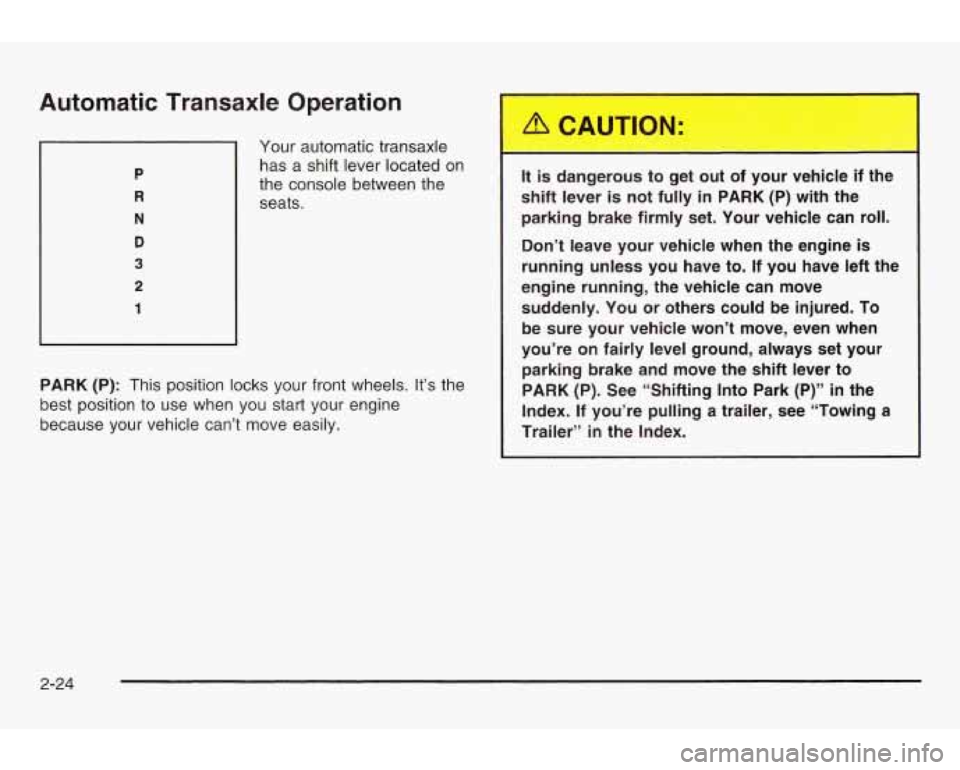
Your automatic transaxle has a shift lever located on
the console between the
seats.
PARK (P): This position locks your front wheels. It’s the
best position
to use when you start your engine
because your vehicle can’t move easily.
It is dangerous to get out of your vehicle if the
shift lever
is not fully in PARK (P) with the
parking brake firmly set. Your vehicle can roll.
Don’t leave your vehicle when the engine is
running unless you have to. If you have left the
engine running, the vehicle can move suddenly. You or others could
be injured. To
be sure your vehicle won’t move, even when
you’re on fairly level ground, always set your parking brake and move the shift lever to PARK
(P). See “Shifting Into Park (P)” in the
Index. If you’re pulling a trailer, see “Towing a
Traileryy
in the Index.
2-24
Page 94 of 354
Ensure the shift lever is fully in PARK (P) before starting
the engine. Your vehicle has an automatic transaxle
shift lock control system. You have to apply your regular
brake before you can shift from PARK (P) when the
ignition key is in
ON. If you cannot shift out of PARK (P),
ease pressure on the shift lever and push the shift
lever all the way into PARK (P) as you maintain brake
application. Then move the shift lever into the gear
you wish. Press the shift lever button before moving the
shift lever. See
Shifting Out of Park (P) on page 2-32
later in this section.
REVERSE (R): Use this gear
to back up.
Notice: Shifting to REVERSE (R) while your vehicle
is moving forward could damage your transaxle.
Shift to REVERSE (R) only after your vehicle
is stopped.
To rock your vehicle back and forth to get out of snow,
ice or sand without damaging your transaxle, see
If
You Are Stuck: In Sand, Mud, Ice or Snow on
page 4-3 1.
NEUTRAL (N): In this position, your engine doesn’t
connect with the wheels.
To restart when you’re already
moving, use NEUTRAL (N) only. Also, use
NEUTRAL (N) when your vehicle is being towed.
Shifting into
a drive gear while your engine is
“racing” (running at high speed) is dangerous. Unless your foot is firmly on the brake pedal,
your vehicle could move very rapidly. You could lose control and
hit people or objects.
Don’t shift into a drive gear while your engine
is racing.
~~
Notice: Damage to your transaxle caused by
shifting into a drive gear with the engine racing
isn’t
covered by your warranty.
2-25
Page 95 of 354

AUTOMATIC OVERDRIVE (D): This position is for
normal driving.
If you need more power for passing, and
you’re:
Going less than 35 mph (55 km/h), push your
Going about 35 mph (55 km/h) or more, push the
You’ll shift down to the next gear and have more power.
accelerator pedal about halfway
down.
accelerator all the way down.
Notice: If your vehicle seems to start up rather
slowly, or if
it seems not to shift gears as you go
faster, something may be wrong with a transaxle system sensor.
If you drive very far that way, your
vehicle can be damaged.
So, if this happens,
have your vehicle serviced right away. Until then,
you can use SECOND
(2) when you are driving less
than
35 mph (55 km/h) and AUTOMATIC
OVERDRIVE (D) for higher speeds. THIRD
(3): This position is also used
for normal driving.
However, it offers more power and lower fuel economy
than AUTOMATIC OVERDRIVE (D). Here are some
times you might choose THIRD
(3) instead of
AUTOMATIC OVERDRIVE (D):
When driving on hilly, winding roads.
0 When towing a trailer, so there is less shifting
between gears.
When going down a steep hill.
SECOND
(2): This position gives you more power but
lower fuel economy. You can use SECOND
(2) on
hills. It can help control your speed as you go down
steep mountain roads, but then you would also want to
use your brakes
off and on.
Notice: Don’t drive in SECOND (2) for more than
25 miles (40 km), or at speeds over 55 mph
(90 km/h), or you can damage your transaxle. Use
THIRD
(3) or AUTOMATIC OVERDRIVE (D) as
much as possible. Don’t shift into SECOND (2)
unless you are going slower than 65 mph (105 km/h)
or you can damage your engine.
2-26