door lock PONTIAC GRAND AM 2003 Owners Manual
[x] Cancel search | Manufacturer: PONTIAC, Model Year: 2003, Model line: GRAND AM, Model: PONTIAC GRAND AM 2003Pages: 354, PDF Size: 16.3 MB
Page 2 of 354
The 2003 Pontiac Grand Am Owner Manual
Seats and Restraint Systems ........................... 1-1
Front Seats ............................................... 1-2
Rear Seats ............................................... 1-8
Safety Belts .............................................. 1-9
Child Restraints ....................................... 1-32
Supplemental Restraint
System
(SRS) ...................................... 1-53
Restraint System Check ............................ 1-60
Keys ........................................................ 2-2
Doors and Locks ....................................... 2-7
Theft-Deterrent Systems ............................ 2-1 7
Starting and Operating Your Vehicle ........... 2-18
Mirrors .................................................... 2-35
Sunroof .................................................. 2-38
Instrument Panel Overview .......................... 3-2
Climate Controls ...................................... 3-1 8
\Warning Lights, Gages a.nd Indicators ......... 3-22
Audio System@) ....................................... 3-38
Features and Controls ..................................... 2-1
Windows ................................................. 2-1 5
Stcr3.g~ .A rean ~ ................... 2-37 ..........
Instrument Panel ............................................. 3-1
Driving Your Vehicle ....................................... 4-1
Your Driving, the Road, and Your Vehicle ..... 4-2
Towing ................................................... 4-32
Service ..................................................... 5-3
Fuel ......................................................... 5-5
Checking Things Under
Service
and Appearance
Care .......................... 5-1
the Hood ............................................. 5-10
Bulb Replacement .................................... 5-49
Windshield Wiper Blade Replacement ......... 5-52
Tires ...................................................... 5-53
Appearance Care ..................................... 5-72
Vehicle Identification ................................. 5-80
Electrical System ...................................... 5-81
Capacities and Specifications ..................... 5-86
Normai iviainienance Fiepiawl I 1t.1-1; F&iJiS ...... 5-00 nn
Maintenance Schedule ..................................... 6-1
bhintenance Schedule ................................ 6-2
Customer Assistance Information .................... 7-1
Customer Assistance Information .................. 7-2
Index ............................................................... ..I
Page 6 of 354
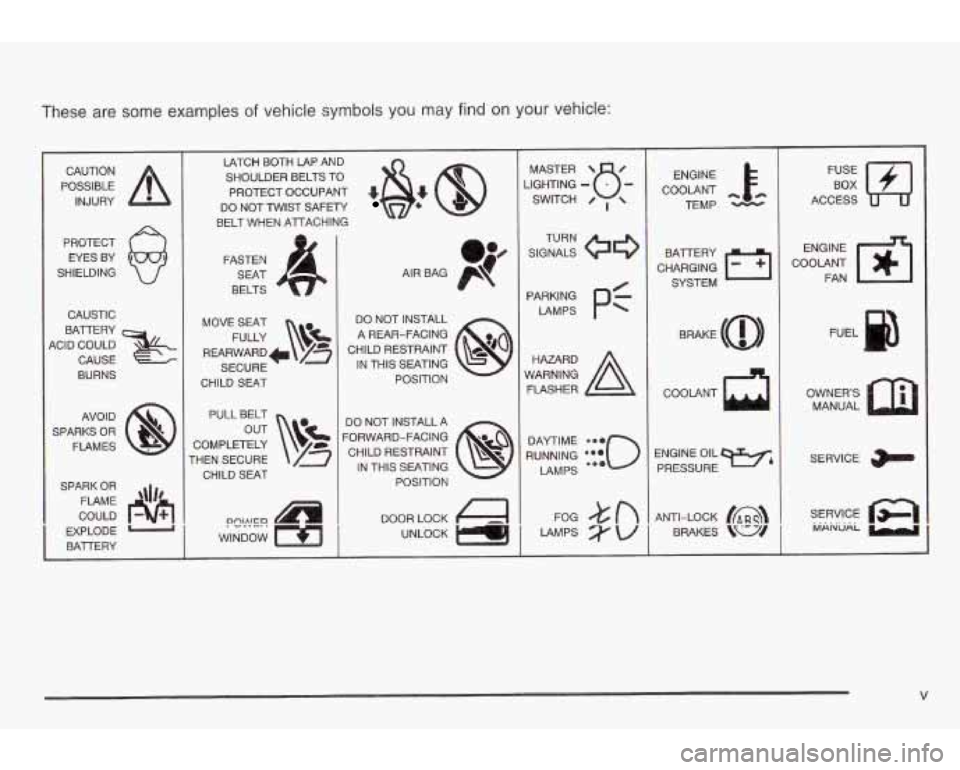
These are some examples of vehicle symbols you may find on your vehicle:
POSSIBLE A
CAUTION
INJURY
PROTECT EYES BY
SHIELDING
CAUSTIC
BATTERY
4CID COULD CAUSE
BURNS
AVOID
SPARKS
OR
FLAMES
SPARK
OR
FLAME 'lb'
COULD
EXPLODE
-
BATTERY
1
I
LATCH BOTH LAP AND
SHOULDER BELTS TO
PROTECT OCCUPANT
4
DO NOT TWIST SAFETY
BELT WHEN ATTACHING
FASTEN SEAT
BELTS
MOVE SEAT FULLY
\!&
REARWARD+ /z
SECURE
CHILD SEAT
PULL BELT
COMPLETELY
-HEN SECURE
CHILD SEAT
?"!"!E?
WINDOW DO
NOT INSTALL
A REAR-FACING
CHILD RESTRAINT IN THIS SEATING
POSITION
DO NOT INSTALL A
FORWARD-FACING CHILD RESTRAINT IN THIS SEATING POSITION
DOOR LOCK UNLOCK LIGHTING
-
PARKING PC
LAMPS
FOG n LAMPS w
ENGINE
COOLANT TEMP
CHARGING
1-1
BAlTERY SYSTEM
COOLANT
a
ENGINE OIL
PRESSURE
Wb
ANTI-LOCK fm)
BRAKES \u/
FJ
ACCESS
ENGINE
COOLANT FAN
FUEL
OWNER'S MANUAL
SERVICE
SERVICE
iviAi\iuWi
V
Page 12 of 354

Head Restraints
Slide the head restraint up or down so that the top of
position reduces the chance of a neck injury in a crash.
+L- r--+r-:n+ :m mlnr.nmt tn +hn tnn nf \/n~tr hnad Thic LIIC IG3LIUtIIl la blkJaba& bu LI IW rwp VI y vu- I IVCIU. a I ~IY
Seatback Latches
For two-door model vehicles, the front seatbacks fold
forward
to let people get into the back seat. The
seatback latch
is designed for one-handed operation.
To fold a front seatback forward, lift the seatback
latch fully without pushing forward on the seatback to
unlock it. Then the seatback will fold forward.
Push the seatback to
its original position, and the
seatback will lock.
forward in a sudden stop or crash. That could
cause injury to the person sitting there. Always
press rearward
on the seatback to be sure it is
1-5
Page 13 of 354

Easy Entry Seat
For two-door model vehicles, the right front seat of your
vehicle makes it easy for people to get in and out
of
the rear seat.
1. Fold the right front seatback forward by lifting the
2. The seat will slide forward to allow someone to get
seatback
latch fully.
into the rear seat area.
3. Push the seatback upright to lock it and slide the
seat fully rearward to lock it.
4. Adjust the seat to the desired position.
4b CAUTION:
If the easy entry right front seat isn't locked, it
can move. In a sudden stop or crash, the
person sitting there could be injured. After
you've used it, be sure to push rearward on an
easy entry seat to be sure it
is locked.
5. The front passenger should try to move the seat to
make sure the seat
is locked into place.
I -6
Page 21 of 354

Q: If I’m a good driver, and I never drive far from
home, why should
I wear safety belts?
A: You may be an excellent driver, but if you’re in an
accident
- even one that isn’t your fault - you and
your passengers can be hurt. Being
a good
driver doesn’t protect you from things beyond your
control, such as bad drivers.
Most accidents occur within 25 miles (40 km)
of home. And the greatest number of serious
injuries and deaths occur at speeds of less than
40 mph (65 km/h).
Safety belts are for everyone.
How to Wear Safety Belts Properly
This part is only for people of adult size.
Be aware that there are special things
to know about
safety belts and children. And there are different
rules for smaller children and babies.
If a child will be
riding in your vehicle, see
Older Children on page 1-32
or lnfants and Young Children on page 1-34. Follow
those rules for everyone’s protection. First,
you’ll want
to know which restraint systems your
vehicle has.
We’ll start with the driver position.
Driver Position
This part describes the driver’s restraint system.
Lap-Shsulder Belt
The driver has a lap-shoulder belt. Here’s how to wear it
properly.
1. Close and lock the door.
2. Adjust the seat so you can sit up straight. To see
how, see
Manual Seats on page 1-2 or Six-Way
Power Driver Seat on page 1-3.
1-14
Page 24 of 354

Shoulder Belt Height Adjuster
(Four-Door Models)
Before you begin to drive, move the shoulder belt
adjuster to the height that is right for you.
-
To move it down, squeeze the release button and move
the height adjuster to the desired position. You can
move the adjuster up just by pushing on the shoulder
belt guide. After you move the adjuster to where
you want it, try to move it down without squeezing the
release button to make sure it has locked into position.
Adjust the height
so that the shoulder portion of the
belt is centered on your shoulder. The belt should
be away from your face and neck, but not falling
off
your shoulder.
1-17
Page 70 of 354
Section 2 Features and Controls
Keys .............................................................. -2-2
Remote Keyless Entry System
......................... 2.3
Remote Keyless Entry System Operation
.......... -2-4
Qoors and Locks ............................................. 2-7
Door Locks
.................................................... 2-7
Power Door Locks
.......................................... 2-8
Delayed Locking
............................................. 2-8
Programmable Automatic Door Locks
................ 2-8
Rear Door Security Locks
.............................. 2-10
Lockout Protection
........................................ 2-11
Leaving Your Vehicle
.................................... 2-1 1
Trunk .......................................................... 2-12
Windows
........................................................ 2-15
Manual Windows
.......................................... 2-15
Power Windows
............................................ 2-16
Sun Visors
................................................... 2-16
Theft-Deterrent Systems
.................................. 2-17
Passlock@
@ ................................................. 2-17
Starting and Operating Your Vehicle
................ 2-18
New Vehicle Break-In
.................................... 2-18
Ignition Positions
.......................................... 2-18 Starting
Your Engine
..................................... 2.19
Engine Coolant Heater
.................................. 2.22
Automatic Transaxle Operation
....................... 2.24
Manual Parking
Shifting
Shifting Parking Parking Transaxle Operation
.......................... -2-27
Brake
.............................................. 2.29
Into Park (P)
..................................... 2.30
Out
of Park (P) ................................. 2.32
Your VehiclelKey Removal
.................. 2.32
Over Things That Burn
....................... 2-33
Engine Exhaust
............................................ 2-33
Running Your Engine While You Are Parked
.... 2-34
Mirrors
........................................................... 2-35
Manual Rearview Mirror
................................. 2.35
Outside Remote Control Mirror
....................... 2.35
Outside Power Mirrors
................................... 2.36
Outside Convex Mirror
................................... 2.36
Storage Areas
................................................ 2.37
Glove Box
................................................... 2.37
Center Console Storage Area
......................... 2.37
n . .-L.IA.. f. UUpl IUIUGI (3) L.UI 137 ................................................
Sunroof ......................................................... 2-38
2-
1
Page 73 of 354
Changes or modifications to this system by other than
an authorized service facility could void authorization to
use this equipment.
At times you may notice a decrease in range. This is
normal for any remote keyless entry system. If the
transmitter does not work or
if you have to stand closer
to your vehicle for the transmitter to work, try this:
e
e
Check the distance. You may be too far from your
vehicle. You may need to stand closer during
rainy or snowy weather.
Check the location. Other vehicles or objects may
be blocking the signal. Take a few steps to the
left or right, hold the transmitter higher, and
try again.
Check to determine
if battery replacement is
necessary. See
“Battery Replacement” under
Remote Keyless Entry System Operation on
page
2-4.
If you are still having trouble, see your dealer or a
qualified technician for service.
Remote Keyless Entry System
Operation
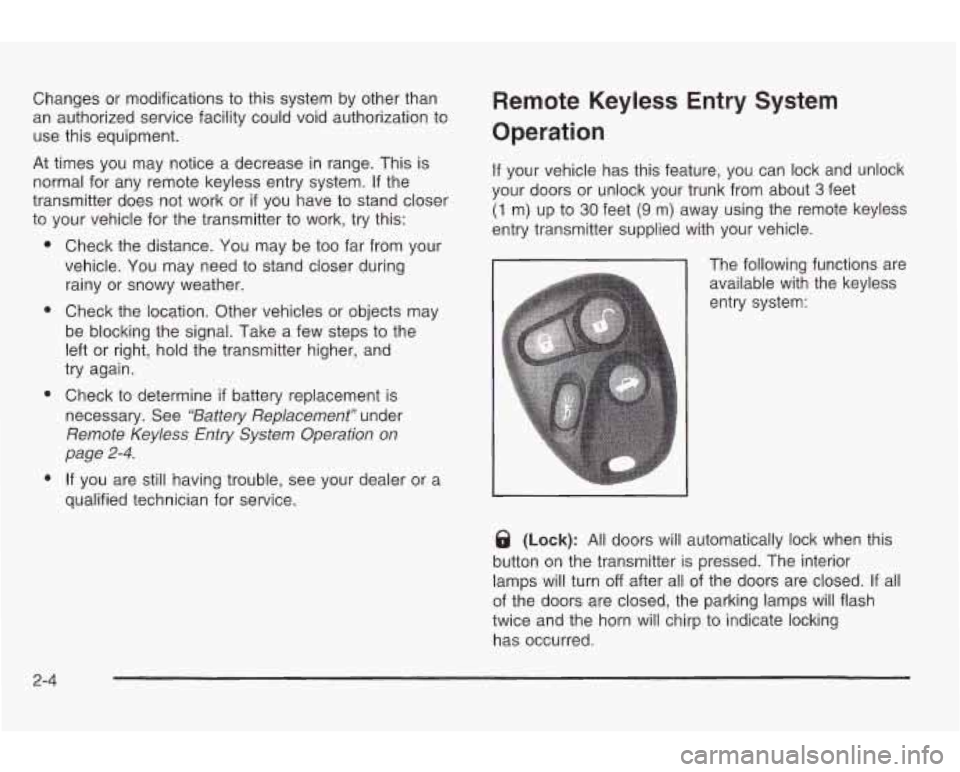
If your vehicle has this feature, you can lock and unlock
your doors or unlock your trunk from about
3 feet
(1 m) up to 30 feet (9 m) away using the remote keyless
entry transmitter supplied with your vehicle.
The following functions are
available with the keyless
entry system:
8 (Lock): All doors will automatically lock when this
button on the transmitter is pressed. The interior
lamps will turn
off after all of the doors are closed. If all
of the doors are closed, the parking lamps will flash
twice and the horn will chirp to indicate locking
has occurred.
2-4
Page 74 of 354

gf (Unlock): The driver's door will unlock
automatically when this button on the transmitter is
pressed. If the button
is pressed again within five
seconds, all remaining doors will unlock. The interior
lamps will stay on for
10 seconds or until the ignition is
turned on. The parking lamps will flash twice to
indicate unlocking has occurred.
(Remote Trunk Release): The trunk will unlock
when the vehicle symbol on the transmitter is pressed,
as long as the trunk lockout is not engaged. You
can open the trunk with the transmitter when the vehicle
speed is less than
2 mph (3 km/h), when the parking
brake is engaged, or when the ignition is
off. The interior
lamps will come on for
10 seconds or until the ignition
switch is turned to
ON.
& (Horn): The horn will sound and the headlamps
and the parking lamps will flash for up to two minutes
when the horn symbol on the transmitter is pressed. The
interior lamps will come on and remain on while the
horn is sounding and the lamps are flashing. The horn
and lamps can be turned
off by pressing the horn
symbol button again or by turning the ignition to
ON.
Programmable Horn Chirp
When you use the remote keyless entry transmitter to
lock the doors or use the delayed locking feature
the parking lamps will flash and the horn will chirp.
The programmable horn chirp can be disabled by
pressing and holding either of the door lock switches in
the unlock position for
10 seconds with the ignition
ON and all of the doors closed. When you hear the horn
chirp, programming is complete.
To reactivate the horn chirp feature, repeat the above
procedure.
Matching Transmitter(s) to Your
Vehicle
Each remote keyless entry transmitter is coded to
prevent another transmitter from unlocking your vehicle.
If a transmitter is lost or stolen, a replacement can
be purchased through your dealer. Remember to bring
your dealer. When the dealer matches the replacement
transmitter to your vehicle, any remaining transmitters
must also be matched. Once your dealer has coded the
new transmitter, the lost transmitter will not unlock
your vehicle. Each vehicle can have a maximum of four
transmitters matched to it.
-n rnrn-ininm tmncmittnrc with \In1 I wh@n \In[ 1 nn 10 ully IUIII~ll'llly La-, lY I,,,.. .,.- ..., , I-- I--' J-
2-5
Page 76 of 354
Doors and Locks
Unlocked doors can be dangerous. Passengers
- especially children - can
easily open the doors and fall out of a
moving vehicle. When a door is locked, the
handle won’t open
it. You increase the
chance of being thrown out of the vehicle
in a crash
if the doors aren’t locked. So,
wear safety belts properly and lock the
doors whenever you drive.
Young children who get into unlocked
vehicles may be unable to get out.
A child
can be overcome by extreme heat and can
SIJffer permanent injuries or even death
from heat stroke. Always lock your vehicle
whenever you leave
it.
Outsiders can easily enter through an
unlocked door when you slow down or
stop your vehicle. Locking your doors can heip
prevent this from happening.
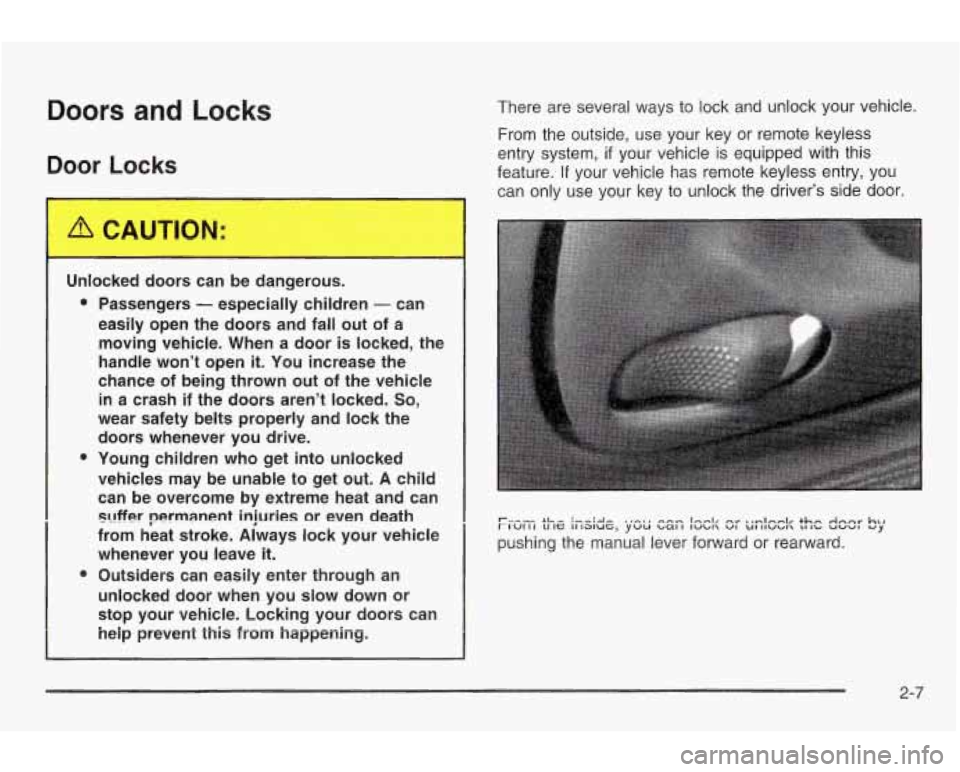
There are several ways to lock and unlock your vehicle.
From the outside, use your key or remote keyless
entry system,
if your vehicle is equipped with this
feature. If your vehicle
has remote keyless entry, you
can only use your key
to unlock the driver’s side door
2-7