fuel PONTIAC GRAND AM 2003 Owners Manual
[x] Cancel search | Manufacturer: PONTIAC, Model Year: 2003, Model line: GRAND AM, Model: PONTIAC GRAND AM 2003Pages: 354, PDF Size: 16.3 MB
Page 2 of 354
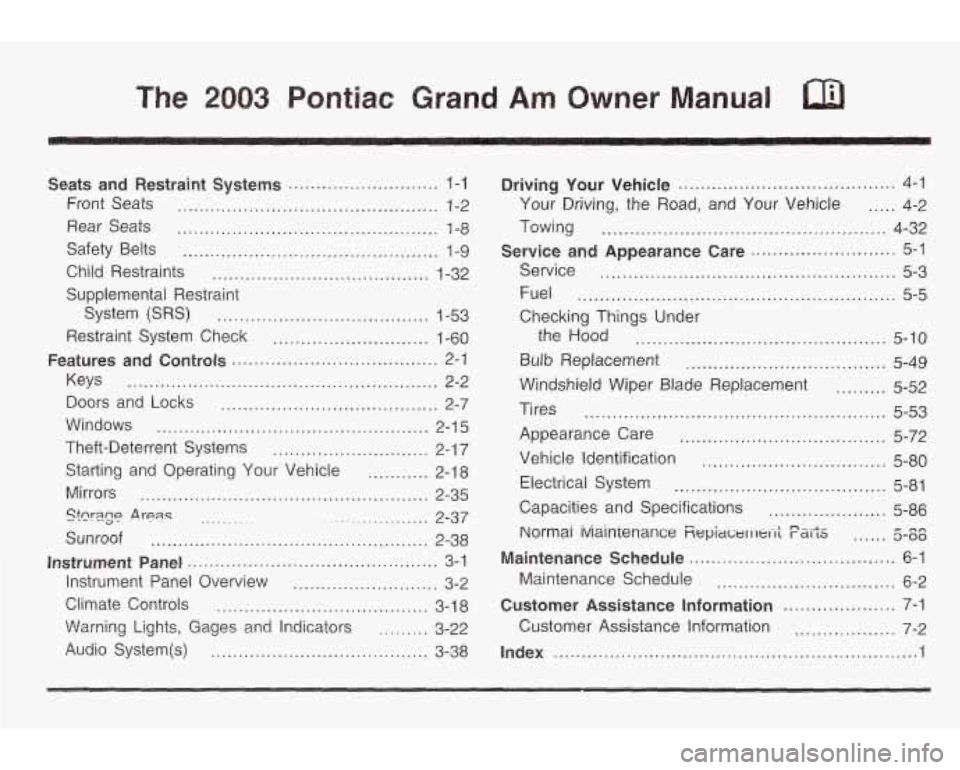
The 2003 Pontiac Grand Am Owner Manual
Seats and Restraint Systems ........................... 1-1
Front Seats ............................................... 1-2
Rear Seats ............................................... 1-8
Safety Belts .............................................. 1-9
Child Restraints ....................................... 1-32
Supplemental Restraint
System
(SRS) ...................................... 1-53
Restraint System Check ............................ 1-60
Keys ........................................................ 2-2
Doors and Locks ....................................... 2-7
Theft-Deterrent Systems ............................ 2-1 7
Starting and Operating Your Vehicle ........... 2-18
Mirrors .................................................... 2-35
Sunroof .................................................. 2-38
Instrument Panel Overview .......................... 3-2
Climate Controls ...................................... 3-1 8
\Warning Lights, Gages a.nd Indicators ......... 3-22
Audio System@) ....................................... 3-38
Features and Controls ..................................... 2-1
Windows ................................................. 2-1 5
Stcr3.g~ .A rean ~ ................... 2-37 ..........
Instrument Panel ............................................. 3-1
Driving Your Vehicle ....................................... 4-1
Your Driving, the Road, and Your Vehicle ..... 4-2
Towing ................................................... 4-32
Service ..................................................... 5-3
Fuel ......................................................... 5-5
Checking Things Under
Service
and Appearance
Care .......................... 5-1
the Hood ............................................. 5-10
Bulb Replacement .................................... 5-49
Windshield Wiper Blade Replacement ......... 5-52
Tires ...................................................... 5-53
Appearance Care ..................................... 5-72
Vehicle Identification ................................. 5-80
Electrical System ...................................... 5-81
Capacities and Specifications ..................... 5-86
Normai iviainienance Fiepiawl I 1t.1-1; F&iJiS ...... 5-00 nn
Maintenance Schedule ..................................... 6-1
bhintenance Schedule ................................ 6-2
Customer Assistance Information .................... 7-1
Customer Assistance Information .................. 7-2
Index ............................................................... ..I
Page 6 of 354
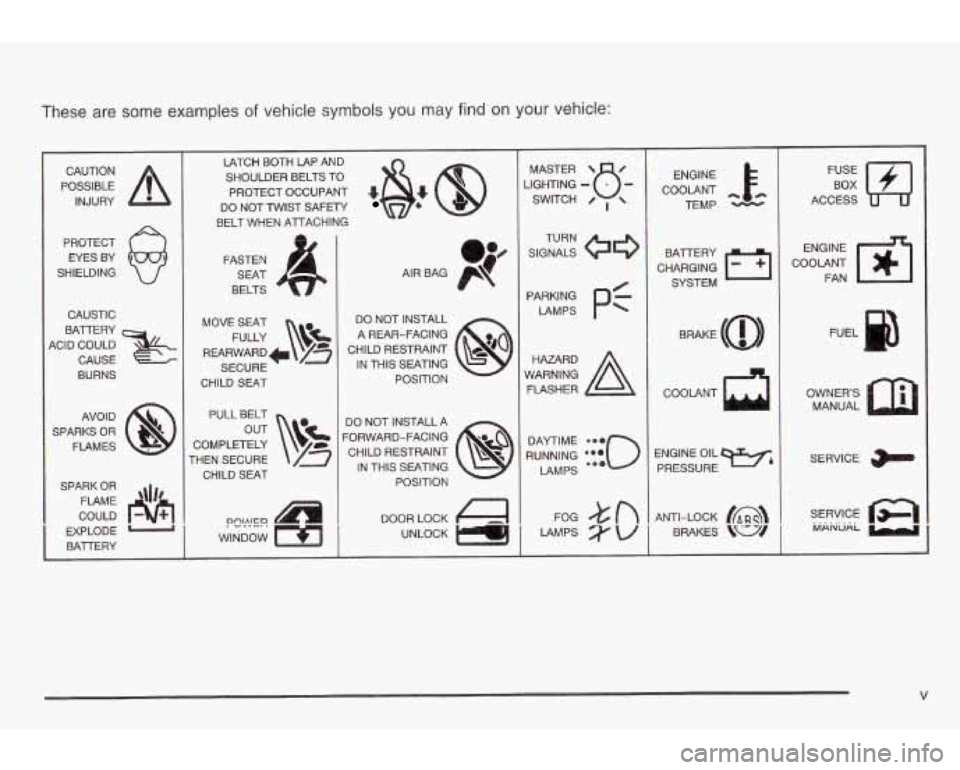
These are some examples of vehicle symbols you may find on your vehicle:
POSSIBLE A
CAUTION
INJURY
PROTECT EYES BY
SHIELDING
CAUSTIC
BATTERY
4CID COULD CAUSE
BURNS
AVOID
SPARKS
OR
FLAMES
SPARK
OR
FLAME 'lb'
COULD
EXPLODE
-
BATTERY
1
I
LATCH BOTH LAP AND
SHOULDER BELTS TO
PROTECT OCCUPANT
4
DO NOT TWIST SAFETY
BELT WHEN ATTACHING
FASTEN SEAT
BELTS
MOVE SEAT FULLY
\!&
REARWARD+ /z
SECURE
CHILD SEAT
PULL BELT
COMPLETELY
-HEN SECURE
CHILD SEAT
?"!"!E?
WINDOW DO
NOT INSTALL
A REAR-FACING
CHILD RESTRAINT IN THIS SEATING
POSITION
DO NOT INSTALL A
FORWARD-FACING CHILD RESTRAINT IN THIS SEATING POSITION
DOOR LOCK UNLOCK LIGHTING
-
PARKING PC
LAMPS
FOG n LAMPS w
ENGINE
COOLANT TEMP
CHARGING
1-1
BAlTERY SYSTEM
COOLANT
a
ENGINE OIL
PRESSURE
Wb
ANTI-LOCK fm)
BRAKES \u/
FJ
ACCESS
ENGINE
COOLANT FAN
FUEL
OWNER'S MANUAL
SERVICE
SERVICE
iviAi\iuWi
V
Page 86 of 354
Theft-Deterrent Systems
Vehicle theft is big business, especially in some cities.
Although your vehicle has a number of theft-deterrent
features, we know that nothing we put on it can make it
impossible to steal.
Your vehicle has the Passlock@ theft-deterrent system.
Passlock@ is a passive theft-deterrent system.
Passlock@ enables fuel
if the ignition lock cylinder has
not been tampered with. During normal operation, the SECURITY light will
go
off
approximately five seconds after the ignition key is
turned to
ON and the engine is started.
After attempting to start the engine,
if the SECURITY
light flashes or stays on, wait ten minutes with the key in
ON until the light goes off. Then turn the ignition to
OFF before attempting to start the engine again.
See
Roadside Assistance Program on page 7-5 for
more information.
2-1 7
Page 91 of 354
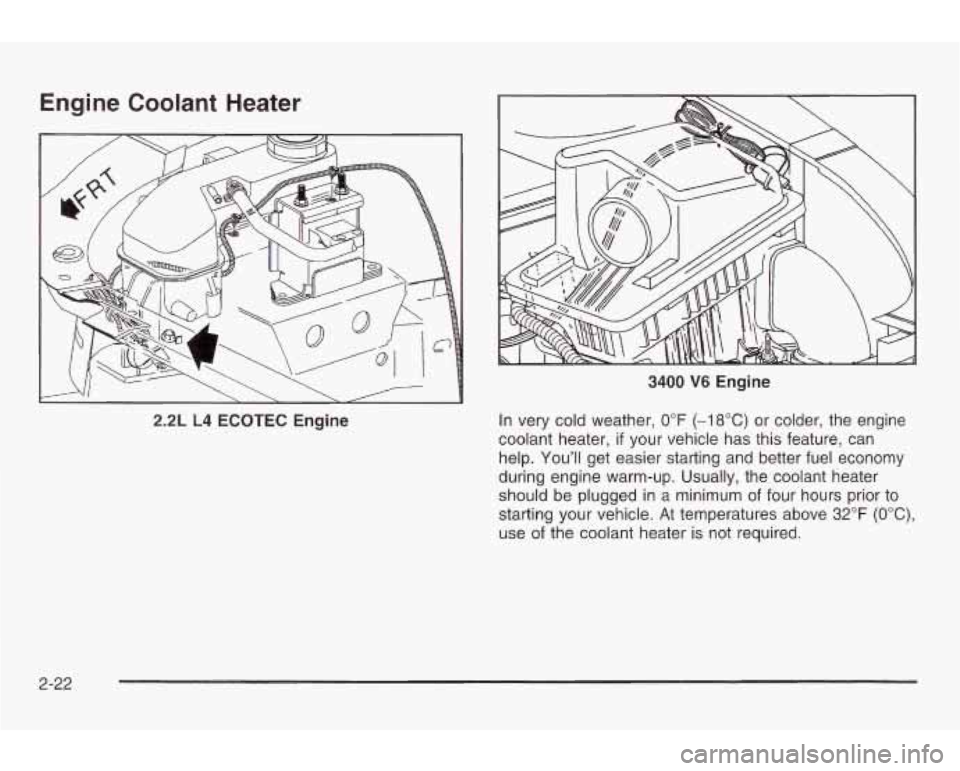
Engine Coolant Heater
3400 V6 Engine
2.2L L4 ECOTEC Engine In very cold weather, 0°F (-18°C) or colder, the engine
coolant heater,
if your vehicle has this feature, can
help.
You'll get easier starting and better fuel economy
during engine warm-up. Usually, the coolant heater
should be plugged in a minimum of four hours prior to
starting your vehicle. At temperatures above
32°F (OOC),
use of the coolant heater is not required.
2-22
Page 95 of 354

AUTOMATIC OVERDRIVE (D): This position is for
normal driving.
If you need more power for passing, and
you’re:
Going less than 35 mph (55 km/h), push your
Going about 35 mph (55 km/h) or more, push the
You’ll shift down to the next gear and have more power.
accelerator pedal about halfway
down.
accelerator all the way down.
Notice: If your vehicle seems to start up rather
slowly, or if
it seems not to shift gears as you go
faster, something may be wrong with a transaxle system sensor.
If you drive very far that way, your
vehicle can be damaged.
So, if this happens,
have your vehicle serviced right away. Until then,
you can use SECOND
(2) when you are driving less
than
35 mph (55 km/h) and AUTOMATIC
OVERDRIVE (D) for higher speeds. THIRD
(3): This position is also used
for normal driving.
However, it offers more power and lower fuel economy
than AUTOMATIC OVERDRIVE (D). Here are some
times you might choose THIRD
(3) instead of
AUTOMATIC OVERDRIVE (D):
When driving on hilly, winding roads.
0 When towing a trailer, so there is less shifting
between gears.
When going down a steep hill.
SECOND
(2): This position gives you more power but
lower fuel economy. You can use SECOND
(2) on
hills. It can help control your speed as you go down
steep mountain roads, but then you would also want to
use your brakes
off and on.
Notice: Don’t drive in SECOND (2) for more than
25 miles (40 km), or at speeds over 55 mph
(90 km/h), or you can damage your transaxle. Use
THIRD
(3) or AUTOMATIC OVERDRIVE (D) as
much as possible. Don’t shift into SECOND (2)
unless you are going slower than 65 mph (105 km/h)
or you can damage your engine.
2-26
Page 96 of 354
FIRST (1): This position gives you even more power
but lower fuel economy than SECOND
(2). You can use
it on very steep hills, or in deep snow or mud.
If the
shift lever is put in FIRST
(I), the transaxle won’t shift
into first gear until the vehicle
is going slowly enough.
Notice: If your front wheels won’t turn, don’t
try to drive. This might happen
id you were stuck in
very deep sand or mud or were up against a solid
object. You could damage your transaxle.
Also,
if you stop when going uphill, don’t hold your
vehicle there with only the accelerator pedal. This
could overheat and damage the transaxle. Use your
brakes to hold your vehicle in position on a hill.
Manual Transaxle Operation
Here’s how to operate your transaxle:
FIRST
(1): Press the clutch pedal and shift into
FIRST
(1). Then, slowly let up on the clutch pedal as
you press the accelerator pedal.
You can shift into FIRST
(1) when you are going less
that
20 mph (32 km/h). If you have come to a complete
stop and it
is hard to shift into FIRST (I), put the
shift lever into NEUTRAL and let up on the clutch. Press
the clutch pedal back down. Then shift into FIRST
(1).
SECOND (2): Press the clutch pedal as you let up
on the accelerator pedal and shift into SECOND
(2).
Then, slowly let up on the clutch pedal as you press the
accelerator pedal.
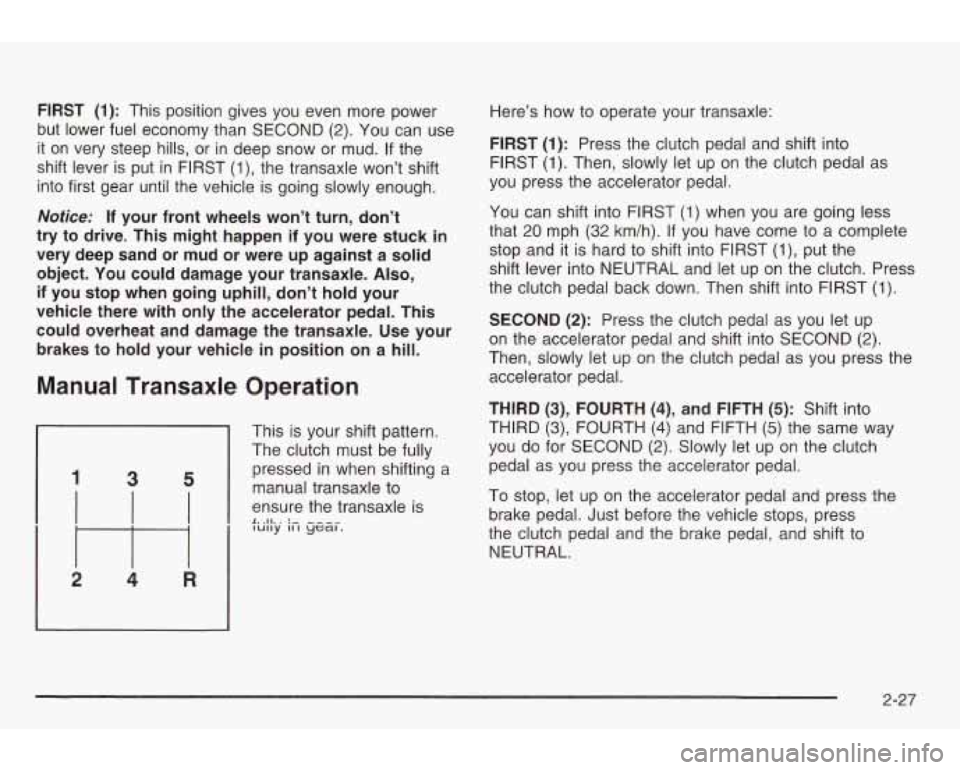
1 3 5
THIRD (3), FOURTH (4), and FIFTH (5): Shift into
This
is your shift pattern. THIRD (3), FOURTH (4) and FIFTH (5) the same way
The clutch must be fully you do for SECOND
(2). Slowly let up on the clutch
manual transaxle
to
ensure the transaxle is
pressed
in when shifting a pedal as
YOU press the accelerator pedal.
To stop, let up on the accelerator pedal and press the
the clutch pedal and the brake pedal, and shift to
NEUTRAL.
L. .II. I :- -^^“ brake pedal. Just before the vehicle stops, press lully Ill ycal.
2-27
Page 97 of 354
NEUTRAL: Use this position when you start or idle
your engine.
REVERSE (R): To back up, press down the clutch
pedal and
lift up on the ring on the shift lever to shift into
REVERSE
(R). Let up on the clutch pedal slowly
while pressing the accelerator pedal.
Notice: Shift into REVERSE (R) only after your
vehicle
is stopped. Shifting into REVERSE (R) while
your vehicle is moving could damage your
transaxle. The repairs would not be covered by your
warranty.
Also, use REVERSE (R), along with the parking brake,
for parking your vehicle.
Once the shift lever is in REVERSE (R), the ignition can
be turned to OFF and the key removed.
S ft Speec'
If you skip a gear when you downshift, you
could lose control
of your vehicle. You could
injure yourself or others. Don't shift down
more than one gear
at a time when you
downshift.
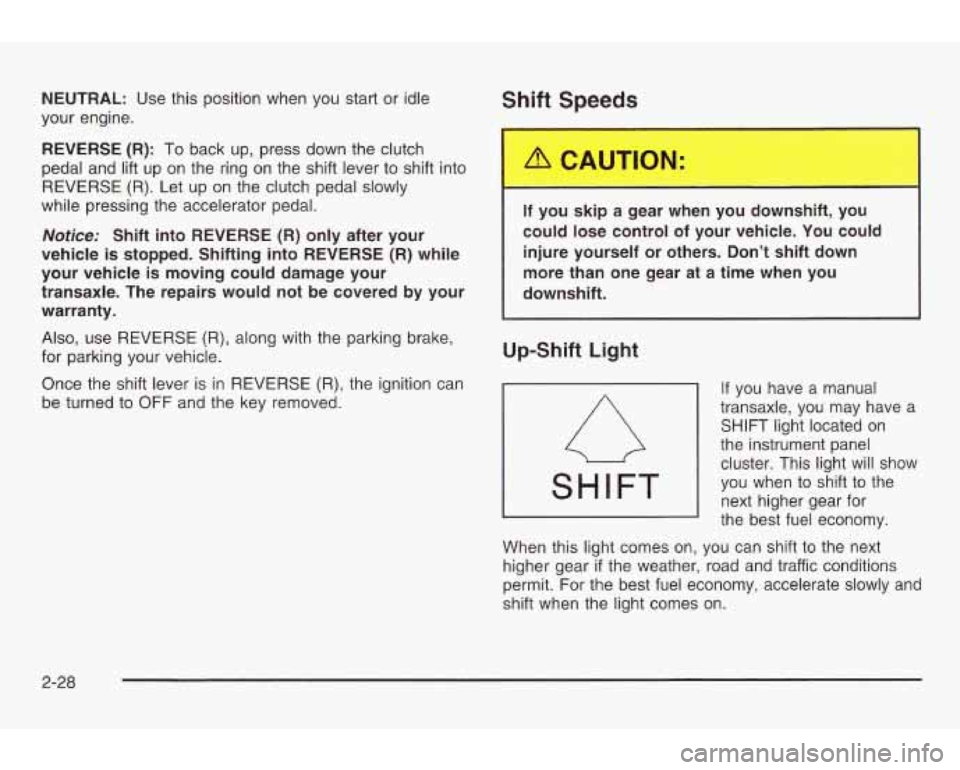
Up-Shift Light
If you have a manual
transaxle, you may have a
SHIFT light located on
the instrument panel
cluster. This light will show
you when to shift to the
next higher gear for
the best fuel economy.
When this light comes
on, you can shift to the next
higher gear
if the weather, road and traffic conditions
permit. For the best fuel economy, accelerate slowly and
shift when the light comes on.
2-28
Page 108 of 354
Section 3 Instrument Panel
Instrument Panel Overview ............................... 3.2
Hazard Warnin Flashers
................................ 3.4
Other Warning !bevices
................................... 3.5
Horn
............................................................. 3.5
Tilt Wheel
..................................................... 3.5
Turn Signal/Multifunction Lever
......................... 3.6
Exterior Lamps
............................................. 3.13
Interior Lamps
.............................................. 3.16
Ashtrays and Cigarette Lighter
........................ 3.17
Climate Controls
............................................ 3.18
Climate Control System
................................. 3.18
Outlet Adjustment
......................................... 3.21
Warning Lights, Gages and Indicators
............. 3-22
Instrument Panel Cluster
................................ 3.23
Speedometer and Odometer
........................... 3.24
Tachometer
................................................. 3.24
Safety Belt Reminder Light
............................. 3.25
Air Bag Readiness Light ................................ 3.25
Charging System Light
.................................. 3.26
Up-Shift Light
............................................... 3.26
Erake QlQtT! -J -.-. !n!=lrning Light ........................ ~ 3-76 .
Warnin Light ........................................... 3-28
Warning Light
........................................... 3.28
Active Light
.............................................. 3.29
Low Coolant Warning Light
............................ 3.30
Anti-Lock
Brake System
Enhance
c? Traction System
Enhanced Traction System
Engine Coolant Temperature Gage
3.3~ rl on ..................
Malfunction Indicator Lamp ............................. 3.31
Oil Pressure Light
......................................... 3.34
Low Oil Level Li ht
....................................... 3.35
Securit Light:
............................................... 3-36
Service Vehicle Soon Light
............................ 3-36
Fuel Gage
................................................... 3-37
Audio System(s)
............................................. 3-38
Data Systems RDS)
.................................. 3-38
Change Engine
ail Light ................................ 3-35
Low dsher Fluid Warning Light
..................... 3-36
Setting the Time for Radios without Radio
Setting the Time
1 or Radios with Radio 3-39
........................... 3-39
.............................. 3-43
Radio with Cassette and CD
.......................... 3-55
Theft-Deterrent Feature
Theft-Deterrent Feature (Non-RDS Radios)
..................................... 3-68
(RDS Radios)
........................................... 3-68
MUUIW ULCCI II ly VVI IGGI VU1 ILI WIG v vv A . .A .- C'&-A~;~~ \Alhnnl Pnmtrnlrr Qxa .......................
Understanding Radio Reception ...................... 3-70
Care of Your Cassette Tape Player
................. 3-70
Care of Your CDs ......................................... 3-71
Care of Your CD Player
................................ 3-72
Fixed Mast Antenna ...................................... 3-72
XM Satellite Radio Antenna System
................ 3-72
DAB Radio Antenna System 3-11 Chime Level Adjustment ................................ 3-72
n Tn ...........................
3- 1
Page 125 of 354
Climate Controls
Climate Control System
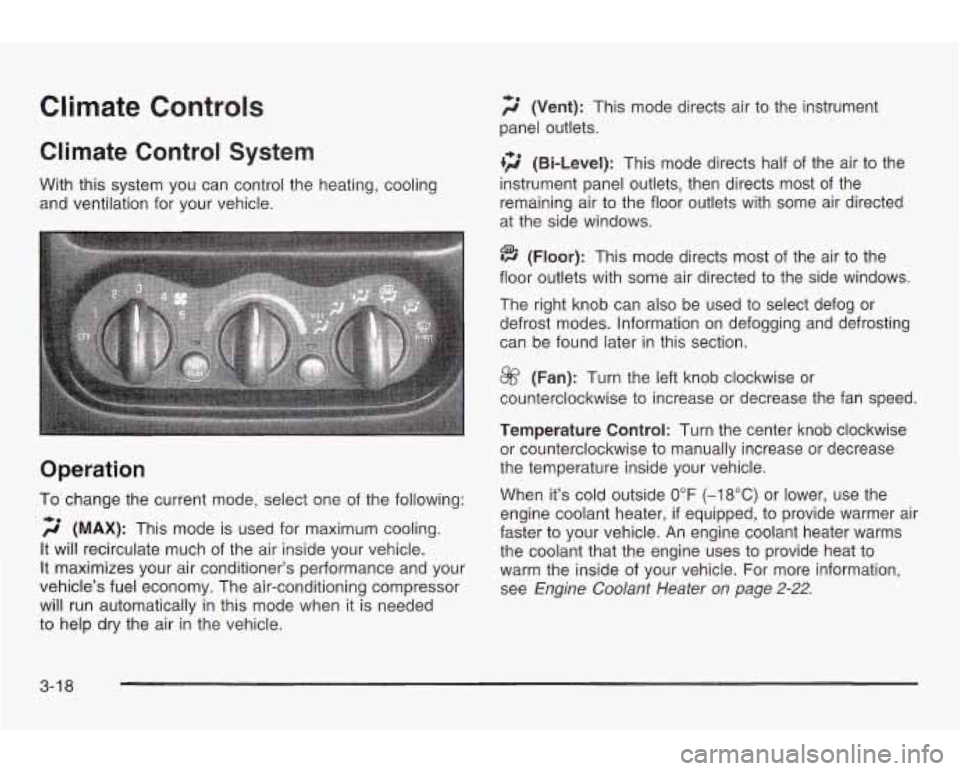
With this system you can control the heating, cooling
and ventilation for your vehicle.
Operation
To change the current mode, select one of the following:
f;’ (MAX): This mode is used for maximum cooling.
It will recirculate much of the air inside your vehicle.
It maximizes your air conditioner’s performance and your
vehicle’s fuel economy. The air-conditioning compressor
will run automatically in this mode when it is needed
to help dry the air in the vehicle.
2 (Vent): This mode directs air to the instrument
panel outlets.
tf;’ (Bi-Level): This mode directs half of the air to the
instrument panel outlets, then directs most of the
remaining air
to the floor outlets with some air directed
at the side windows.
@ (Floor): This mode directs most of the air to the
floor outlets with some air directed to the side windows.
The right knob can
also be used to select defog or
defrost modes. Information on defogging
and defrosting
can be found later in this section.
@ (Fan): Turn the left knob clockwise or
counterclockwise
to increase or decrease the fan speed.
Temperature Control: Turn the center knob clockwise
or counterclockwise to manually increase or decrease
the temperature inside your vehicle.
When it’s cold outside
0°F (-18°C) or lower, use the
engine coolant heater,
if equipped, to provide warmer air
faster to your vehicle. An engine coolant heater warms
the coolant that the engine uses
to provide heat to
warm the inside of your vehicle. For more information,
see Engine
Coolant Heater on page 2-22.
3-1 8
Page 130 of 354
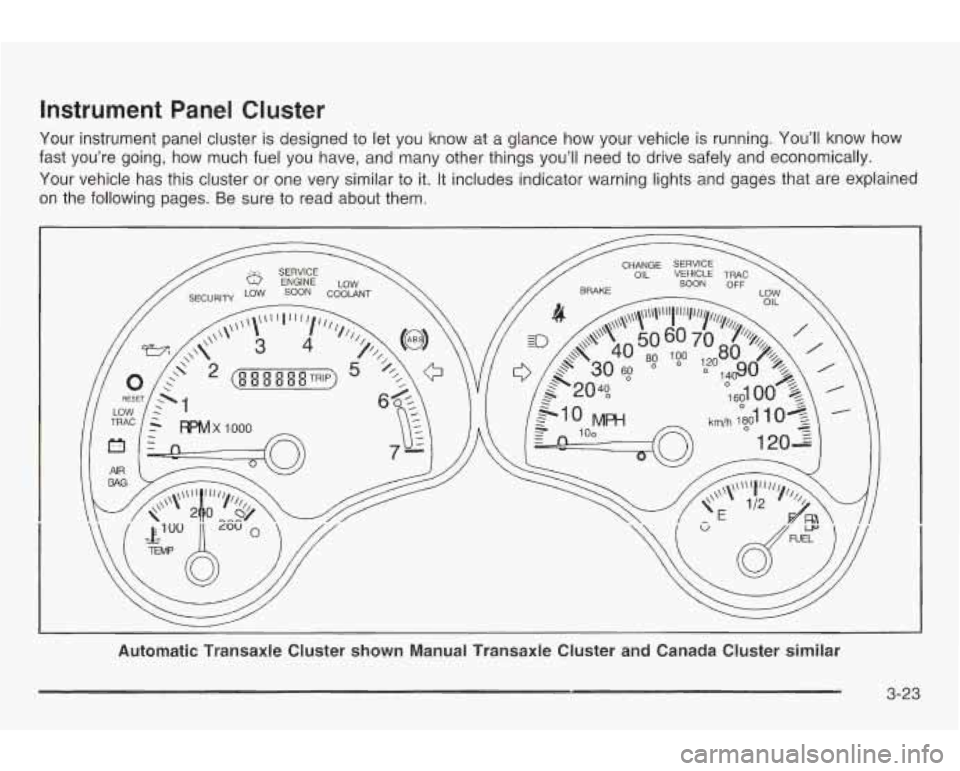
Instrument Panel Cluster
Your instrument panel cluster is designed to let you know at a glance how your vehicle is running. You’ll know how
fast you’re going, how much fuel you have, and many other things you’ll need
to drive safely and economically.
Your vehicle has this cluster
or one very similar to it. It includes indicator warning lights and gages that are explained
on the following pages. Be sure to read about them.
3-23