oil temperature PONTIAC GRAND AM 2003 Owners Manual
[x] Cancel search | Manufacturer: PONTIAC, Model Year: 2003, Model line: GRAND AM, Model: PONTIAC GRAND AM 2003Pages: 354, PDF Size: 16.3 MB
Page 92 of 354

To Use the Engine Coolant Heater
1. Turn off the engine.
2. Open the hood and unwrap the electrical cord. On
the 2.2L L4 ECOTECTM engine, the engine coolant
heater cord is located in front of the coolant
surge tank on the passenger’s side of the engine
compartment. On the 3400
V6 engine, the
engine coolant heater cord is located near the
engine air cleaner/filter. See
Engine Compartment
Overview
on page 5-12 for more information on
location.
3. Plug it into a normal, grounded 1 IO-volt AC outlet.
4. Before starting the engine, be sure to unplug and
store the cord as
it was before to keep it away
from moving engine parts. If you don’t, it could be
damaged.
How long should
you keep the coolant heater plugged
in? The answer depends on the outside temperature, the
kind of
oil you have, and some other things. Instead
of trying to list everything here, we ask that you contact
your dealer in the area where you’ll be parking your
vehicle. The dealer can give
you the best advice for that
particular area.
Plugging the cord into an ungrounded outlet
could cause an electrical shock. Also, the
wrong kind of extension cord could overheat
and cause a fire. You could be seriouslv
injured. Plug the cord into a properly grounded
three-prong
1 IO-volt AC outlet. If the cord
won’t reach, use a heavy-duty three-prong
extension cord rated for at least
15 amps.
2-23
Page 108 of 354
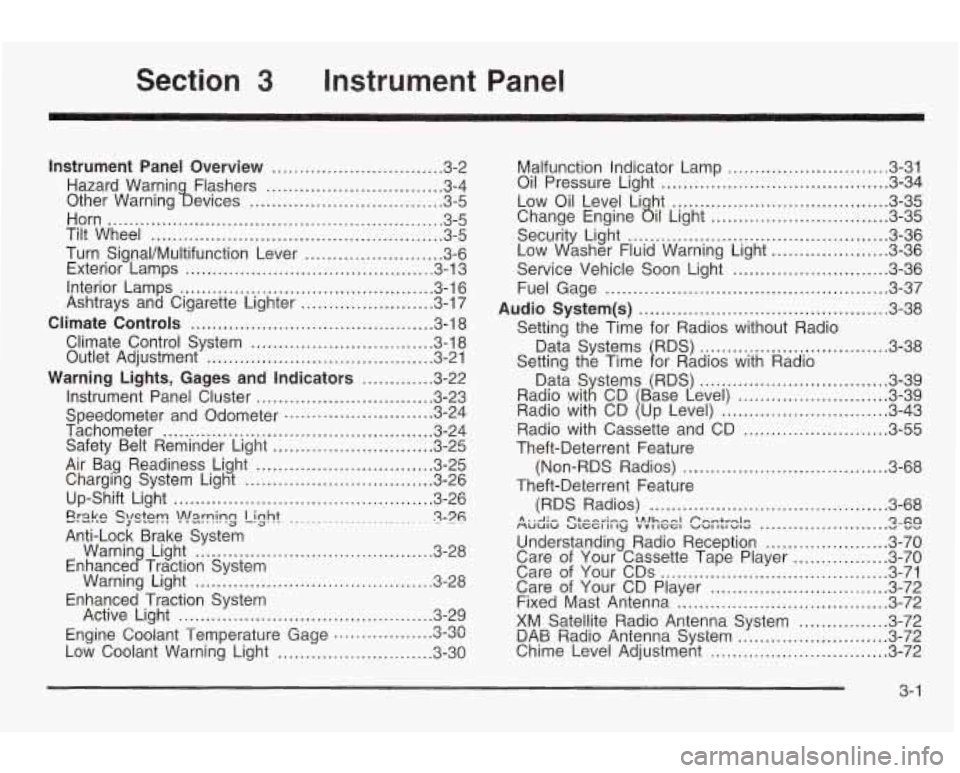
Section 3 Instrument Panel
Instrument Panel Overview ............................... 3.2
Hazard Warnin Flashers
................................ 3.4
Other Warning !bevices
................................... 3.5
Horn
............................................................. 3.5
Tilt Wheel
..................................................... 3.5
Turn Signal/Multifunction Lever
......................... 3.6
Exterior Lamps
............................................. 3.13
Interior Lamps
.............................................. 3.16
Ashtrays and Cigarette Lighter
........................ 3.17
Climate Controls
............................................ 3.18
Climate Control System
................................. 3.18
Outlet Adjustment
......................................... 3.21
Warning Lights, Gages and Indicators
............. 3-22
Instrument Panel Cluster
................................ 3.23
Speedometer and Odometer
........................... 3.24
Tachometer
................................................. 3.24
Safety Belt Reminder Light
............................. 3.25
Air Bag Readiness Light ................................ 3.25
Charging System Light
.................................. 3.26
Up-Shift Light
............................................... 3.26
Erake QlQtT! -J -.-. !n!=lrning Light ........................ ~ 3-76 .
Warnin Light ........................................... 3-28
Warning Light
........................................... 3.28
Active Light
.............................................. 3.29
Low Coolant Warning Light
............................ 3.30
Anti-Lock
Brake System
Enhance
c? Traction System
Enhanced Traction System
Engine Coolant Temperature Gage
3.3~ rl on ..................
Malfunction Indicator Lamp ............................. 3.31
Oil Pressure Light
......................................... 3.34
Low Oil Level Li ht
....................................... 3.35
Securit Light:
............................................... 3-36
Service Vehicle Soon Light
............................ 3-36
Fuel Gage
................................................... 3-37
Audio System(s)
............................................. 3-38
Data Systems RDS)
.................................. 3-38
Change Engine
ail Light ................................ 3-35
Low dsher Fluid Warning Light
..................... 3-36
Setting the Time for Radios without Radio
Setting the Time
1 or Radios with Radio 3-39
........................... 3-39
.............................. 3-43
Radio with Cassette and CD
.......................... 3-55
Theft-Deterrent Feature
Theft-Deterrent Feature (Non-RDS Radios)
..................................... 3-68
(RDS Radios)
........................................... 3-68
MUUIW ULCCI II ly VVI IGGI VU1 ILI WIG v vv A . .A .- C'&-A~;~~ \Alhnnl Pnmtrnlrr Qxa .......................
Understanding Radio Reception ...................... 3-70
Care of Your Cassette Tape Player
................. 3-70
Care of Your CDs ......................................... 3-71
Care of Your CD Player
................................ 3-72
Fixed Mast Antenna ...................................... 3-72
XM Satellite Radio Antenna System
................ 3-72
DAB Radio Antenna System 3-11 Chime Level Adjustment ................................ 3-72
n Tn ...........................
3- 1
Page 137 of 354
Engine Coolant Temperature Gage
L
United States Canada
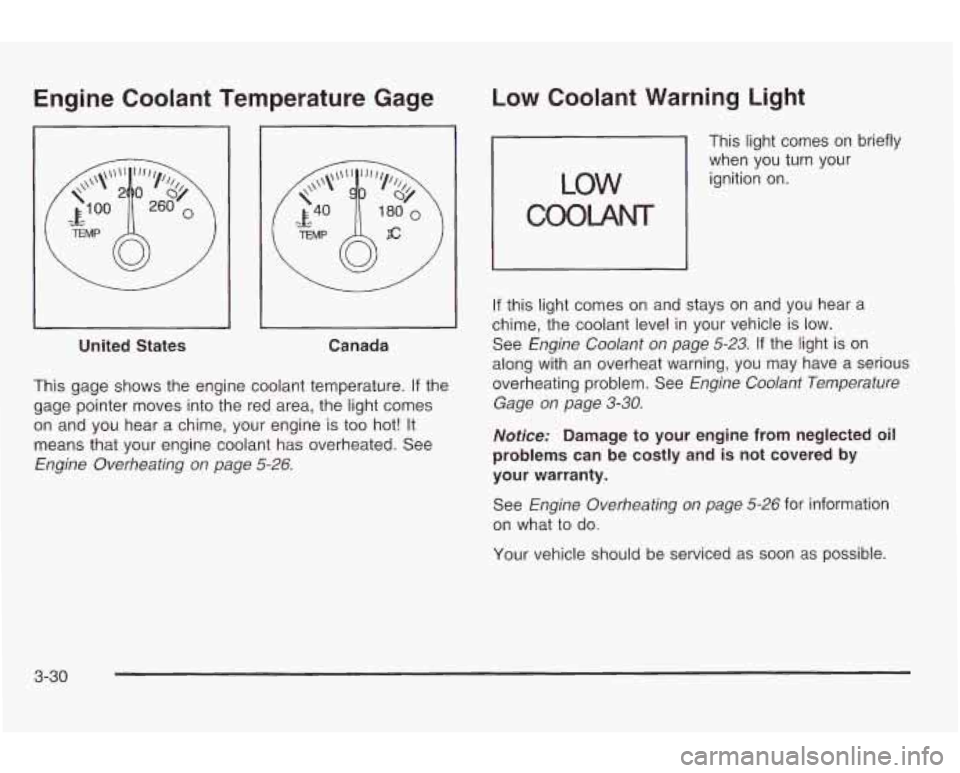
This gage shows the engine coolant temperature.
If the
gage pointer moves into the red area, the light comes
on and you hear a chime, your engine is
too hot! It
means that your engine coolant has overheated. See
Engine Overheating on page 5-26.
Low Coolant Warning Light
This light comes on briefly
when you turn your
ignition on.
COOLANT
If this light comes on and stays on and you hear a
chime, the coolant level in your vehicle is
low.
See Engine Coolant on page 5-23. If the light is on
along with an overheat warning, you may have a serious
overheating problem. See
Engine Coolant Temperature
Gage on page
3-30.
Notice: Damage to your engine from neglected oil
problems can be costly and is not covered by
your warranty.
See
Engine Overheating on page 5-26 for information
on what
to do.
Your vehicle should be serviced as soon as possible.
3-30
Page 242 of 354
As in the chart shown previously, SAE 5W-30 is the
only viscosity grade recommended for your vehicle. You
should look for and use only oils which have the API
Starburst symbol and which are also identified as
SAE 5W-30. If you cannot find such SAE 5W-30 oils,
you can use an SAE IOW-30 oil which has the API
Starburst symbol,
if it's going to be 0°F (-18°C)
or above. Do not use other viscosity grade oils, such as
SAE
IOW-40 or SAE 20W-50 under any conditions.
Notice: Use only engine oil with the American
Petroleum Institute Certified For Gasoline Engines
starburst symbol. Failure to use the recommended
oil can result in engine damage not covered by
your warranty.
GM Goodwrench@ oil meets all the requirements for
your vehicle.
If you are in an area of extreme cold, where the
temperature falls below -20°F
(-29"C), it is
recommended that you use either an SAE 5W-30
synthetic oil or an SAE OW-30 oil. Both will provide
easier cold starting and better protection for your engine
at extremely low temperatures.
Engine Oil Additives
Don't add anything to your oil. The recommended oils
with the starburst symbol are ail you will need for
good performance and engine protection.
When to Change Engine Oil (GNI Oil
Life SystemTM)
Your vehicle has a computer system that lets you know
when to change the engine oil and filter. This is
based on engine revolutions and engine temperature,
and not on mileage. Based on driving conditions,
the mileage at which an oil change will be indicated can
vary considerably. For the oil life system
to work
properly, you must reset the system every time the oil
is
changed.
When the system has calculated that oil life has been
diminished, it will indicate that an oil change is
necessary. A CHANGE OIL light will come on. Change
your oil as soon as possible within the next two
times you stop for fuel.
It is possible that, if you are
driving under the best conditions, the
oil life system may
not indicate that an
oil change is necessary for over a
year. However, your engine oil and filter must be
changed at least once a year and at this time the system
must be reset. It is also important to check vour oil
regularly and keep
it at the proper level.
If the system is ever reset accidentally, you must
change your oil at 3,000 miles
(5 000 km) since your
last oil change. Remember
to reset the oil life system
whenever the oil
is changed.
5-1 9
Page 245 of 354
Automatic Transaxle Fluid
It is not necessary to check the transaxle fluid level. A
transaxle fluid leak is the only reason for fluid loss.
If a leak occurs, take the vehicle to the dealership
service department and have it repaired as soon as
possible. You may also have your fluid level checked by
your dealer or service center when you have your oil
changed.
Change both the fluid and filter every
50,000 miles
(83 000 km) if the vehicle is mainly driven under one or
more of these conditions:
In heavy city traffic where the outside temperature
In hilly or mountainous terrain.
When doing frequent trailer towing.
0 Uses such as found in taxi, police or delivery
regularly reaches
90°F (32°C) or
higher.
service. If
you do not use your vehicle under any of these
conditions, the fluid and filter do not require changing.
Notice: We recommend you use only fluid labeled
DEXRON@-Ill, because fluid with that label
is
made especially for your automatic transaxle.
Damage caused by fluid other than DEXRON@-Ill is
not covered
by your new vehicle warranty.
Manual Transaxle Fluid
It is not necessary to check the transaxle fluid level. A
transaxle fluid leak is the only reason for fluid loss.
If a leak occurs, take the vehicle to the dealership
service department and have it repaired as soon as
possible. You may also have your fluid level checked by
your dealer or service center when you have your oil
changed. See
Part D: Recommended Fluids and
Lubricants
on page 6-15 for the proper fluid to use.
5-22
Page 247 of 354
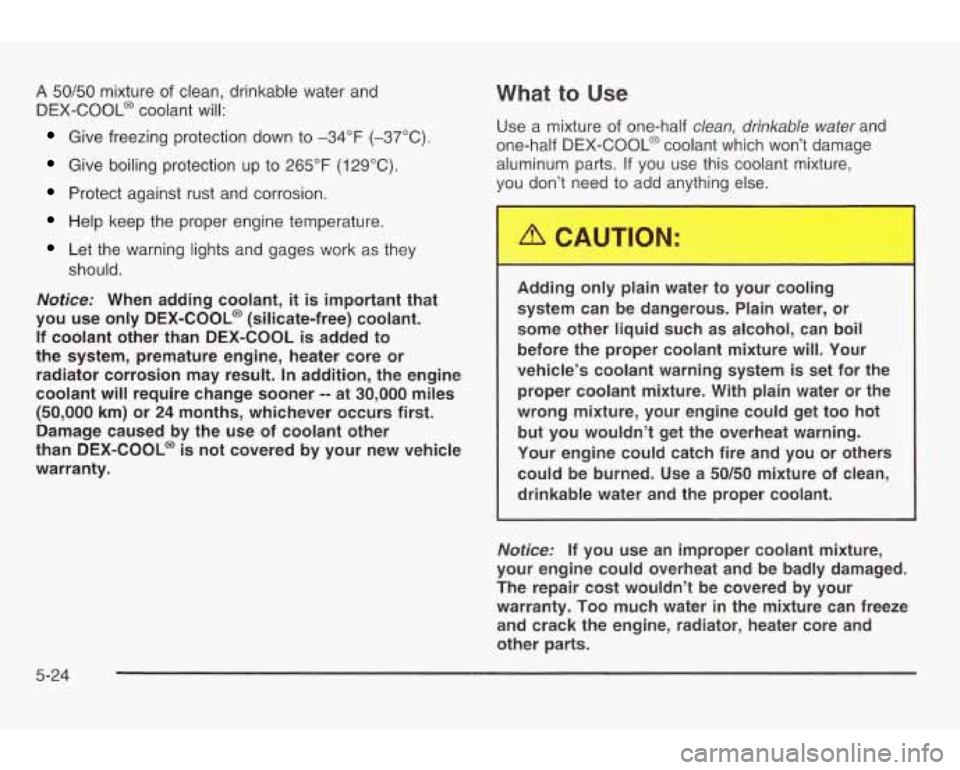
A 50/50 mixture of clean, drinkable water and
DEX-COOL@ coolant will:
Give freezing protection down to -34°F (-37°C).
Give boiling protection up to 265°F (129°C).
Protect against rust and corrosion.
Help keep the proper engine temperature.
Let the warning lights and gages work as they
should.
Notice: When adding coolant, it is important that
you use only DEX-COOL@ (silicate-free) coolant.
If coolant other than DEX-COOL
is added to
the system, premature engine, heater core or radiator corrosion may result.
In addition, the engine
coolant will require change sooner
-- at 30,000 miles
(50,000 km) or 24 months, whichever occurs first.
Damage caused by the use of coolant other
than DEX-COOL@ is not covered by your new vehicle
warranty.
What to Use
Use a mixture of one-half clean, drinkable water and
one-half DEX-COOL@ coolant which won’t damage
aluminum
parts. If you use this coolant mixture,
you don’t need to add anything else.
Adding only plain water to your cooling
system can be dangerous. Plain water, or
some other liquid such as alcohol, can boil
before the proper coolant mixture will. Your
vehicle’s coolant warning system is set for the
proper coolant mixture. With plain water or the
wrong mixture, your engine could get too hot
but you wouldn’t get the overheat warning.
Your engine could catch fire and you or others could be burned. Use a
50/50 mixture of clean,
drinkable water and the proper coolant.
Notice: If you use an improper coolant mixture,
your engine could overheat and be badly damaged.
The repair cost wouldn’t be covered by your
warranty.
Too much water in the mixture can freeze
and crack the engine, radiator, heater core and
other parts.
5-24
Page 316 of 354
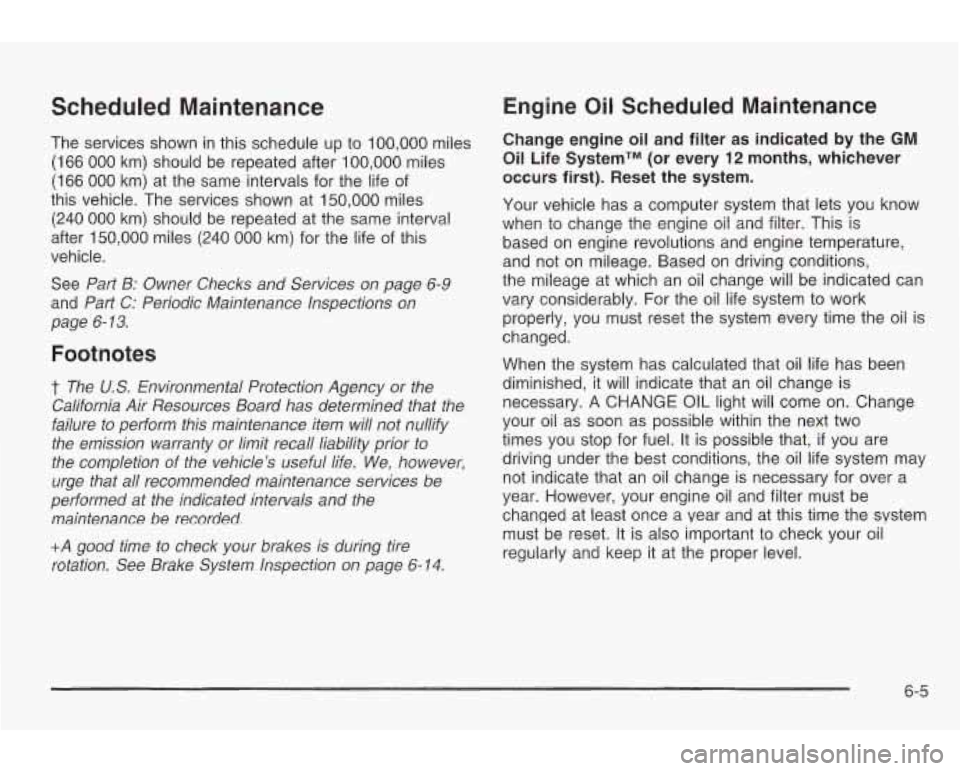
Scheduled Maintenance
The services shown in this schedule up to 100,000 miles
(1 66 000 km) should be repeated after 100,000 miles
(1 66 000 km) at the same intervals for the life of
this vehicle. The services shown at 150,000 miles
(240
QQO km) should be repeated at the same interval
after
150,000 miles (240 000 km) for the life of this
vehicle.
See
Part B: Owner Checks and Services on page 6-9
and Part C: Periodic Maintenance Inspections on
page
6- 13.
Footnotes
t The U.S. Environmental Protection Agency or the
California Air Resources Board has determined that the
failure to perform this maintenance item will not nullify
the emission warranty or limit recall liability prior to
the completion
of the vehicle's useful life. We, however,
urge that all recommended maintenance services be
performed at the indicated intervals and the
maintenance be recorded.
+A good time to check your brakes is during tire
rotation. See Brake System Inspection on page
6- 14.
Engine Oil Scheduled Maintenance
Change engine oil and filter as indicated by the GM
Oil Life SystemTM (or every 12 months, whichever
occurs first). Reset the system.
Your vehicle has a computer system that lets you know
when
to change the engine oil and filter. This is
based on engine revolutions and engine temperature,
and not on mileage. Based on driving conditions,
the mileage at which an oil change will be indicated can
vary considerably. For the oil life system
to work
properly, you must reset the system every time the oil is
changed.
When the system has calculated that oil life has been
diminished,
it will indicate that an oil change is
necessary.
A CHANGE OIL light will come on. Change
your
oil as soon as possible within the next two
times you stop for fuel.
It is possible that, if you are
driving under the best conditions, the oil life system may
not indicate that an oil change is necessary for over a
year. However, your engine oil and filter must be
changed at least once a year and at this time the svstem
must be reset.
It is also important to check your oil
regularly and keep it at the proper level.
6-5
Page 343 of 354
DAB Radio .................................................... 3-70
Daytime Running Lamps (DRL)
......................... 3-13
Defensive Driving
............................................. 4-2
Defogging and Defrosting
................................. 3-1 9
Delayed Headlamps ........................................ 3-1 5
Delayed Locking ............................................... 2-8
Dinghy Towing
................................................ 4-33
Doing Your Own Service Work
........................... 5-3
Dolly Towing
.................................................. 4-34
Dome Lamp
................................................... 3-16
Door
Delayed Locking
........................................... 2-8
Power Door Locks
......................................... 2-8
Programmable Automatic Door Locks
............... 2-8
Rear Security Locks
..................................... 2-10
Position, Safety Belt
..................................... 1-14
Six-Way Power Seat
...................................... 1-3
At Night
..................................................... 4-17
City
........................................................... 4-21
Defensive
..................................................... 4-2
Drunken
....................................................... 4-2
Freeway
..................................................... 4-22
Hill and Mountain Roads
.............................. 4-25
In Rain and on Wet Roads
........................... 4-19
Winter
........................................................ 4-26
Locks
.......................................................... 2-7
Driver
Driving Driving
On Grades
.......................................... 4-42
Driving on Snow or Ice
.................................... 4-27
Driving Through Deep Standing Water
............... 4-20
Driving with
a Trailer ....................................... 4-40
Driving
Through Flowing Water
......................... 4-21
E
Easy Entry Seat ............................................... 1-6
Electrical System
Add-on Equipment
...................................... 5-81
Fuses and Circuit Breakers ........................... 5-81
Power Windows and Other Power Options
...... 5-81
Windshield Wiper Fuses
............................... 5-81
Emergency Trunk Release Handle
..................... 2-14
Emissions Inspection and Maintenance
Programs
................................................... 3-33
Engine
Air Cleaner/Filter
......................................... 5-21
Battery
....................................................... 5-42
Change Engine Oil Light
............................... 3-35
Check and Service Engine Soon Light
............ 3-31
Coolant
...................................................... 5-23
Coolant Heater
............................................ 2-22
Coolant Temperature Gage
........................... 3-30
Cooling System Inspection
............................ 6-14
Engine Compartment Overview
...................... 5-12
4