power steering PONTIAC GRAND AM 2003 Owners Manual
[x] Cancel search | Manufacturer: PONTIAC, Model Year: 2003, Model line: GRAND AM, Model: PONTIAC GRAND AM 2003Pages: 354, PDF Size: 16.3 MB
Page 188 of 354
Remember: Anti-lock doesn’t change the time you need
to get your foot up to the brake pedal or always
decrease stopping distance. If you get
too close to the
vehicle in front of you, you won’t have time to apply
your brakes
if that vehicle suddenly slows or stops.
Always leave enough room up ahead
to stop, even
though you have anti-lock brakes.
Using Anti-Lock
Don’t pump the brakes. Just hold the brake pedal down
firmly and let anti-lock work for you. You may feel a
slight brake pedal pulsation or notice some noise, but
this is normal.
Braking in Emergencies
At some time, nearly every driver gets into a situation
that requires hard braking.
If you have anti-lock, you can steer and brake at the
same time. However,
if you don’t have anti-lock,
your first reaction
- to hit the brake pedal hard and hold
it down
- may be the wrong thing to do. Your wheels
can stop rolling. Once they do, the vehicle can’t respond
to your steering. Momentum will carry it in whatever
direction it was headed when the wheels stopped rolling.
That could be
off the road, into the very thing you
LAtara tnrinn tn 9 rni VGI G 11 yll ILJ 1W ,\,Id, Gr intG traffic. If
you don’t have anti-lock, use a “squeeze” braking
technique. This will give you maximum braking while
maintaining steering control. You can do this by pushing
on the brake pedal with steadily increasing pressure.
In an emergency, you will probably want
to squeeze the
brakes hard without locking the wheels. If you hear or
feel the wheels sliding, ease
off the brake pedal.
This will help you retain steering control. If you
do have
anti-lock,
it’s different. See “Anti-Lock Brakes.’’
In many emergencies, steering can help you more than
even the very best braking.
Enhanced Traction System (ETS)
Your vehicle may have an Enhanced Traction System
(ETS) that limits wheel spin. This is especially useful in
slippery road conditions. The system operates only
if
it senses that one or both of the front wheels are
spinning or beginning
to lose traction. When this
happens, the system reduces engine power and may
aiso upshiii ihe iransaxie io iirrlii wheei spirl.
4-9
Page 190 of 354
To limit wheel spin, especially in slippery road
conditions, you should always leave the Enhanced
Traction System on. But you can turn the system
off if
you prefer.
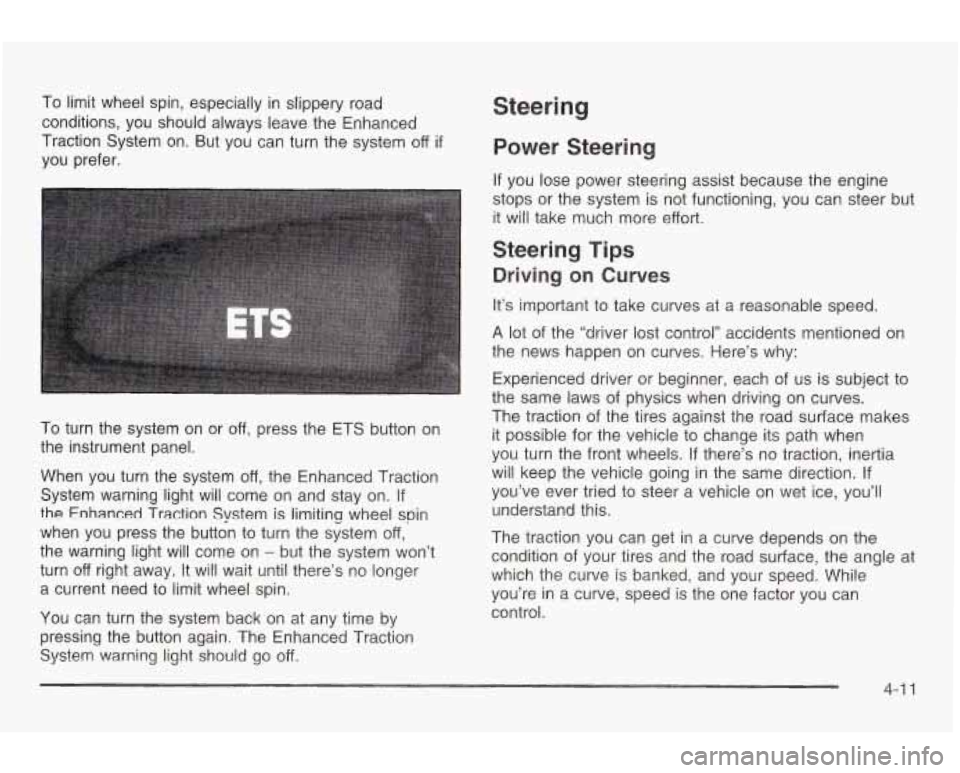
To turn the system on or off, press the ETS button on
the instrument panel.
When you turn the system
off, the Enhanced Traction
System warning light will come on and stay on.
If
the Enhanced Traction System is limiting wheel spin
when you press the button
to turn the system off,
the warning light will come on
- but the system won’t
turn
off right away. It will wait until there’s no longer
a current need
to limit wheel spin.
You can turn the system back on at any time by
pressing the button again. The Enhanced Traction
System warning light should go off.
Steering
Power Steerin
If you lose power steering assist because the engine
stops or the system is not functioning, you can steer but
it will take much more effort.
Steering Tips
Driving on Curves
It’s important to take curves at a reasonable speed.
A lot of the “driver lost control” accidents mentioned on
the news happen on curves. Here’s why:
Experienced driver or beginner, each of us is subject
to
the same laws of physics when driving on curves.
The traction of the tires against the road surface makes
it possible
for the vehicle to change its path when
you turn the front wheels.
If there’s no traction, inertia
will keep the vehicle going in the same direction. If
you’ve ever tried to steer a vehicle on wet ice, you’ll
understand this.
The traction you can get in a curve depends on the
condition of your tires and the road surface, the angle at
which the curve
is banked, and your speed. While
you’re in a curve, speed
is the one factor you can
control.
4-1 1
Page 224 of 354
Section 5 Service and Appearance Care
Service ............................................................ 5.3
Doing Your Own Service Work
......................... 5.3
Adding Equipment to the Outside of Your
Vehicle
...................................................... 5.4
Fuel ................................................................ 5.5
Gasoline Octane
............................................ 5.5
Gasoline Specifications
.................................... 5.5
California Fuel
............................................... 5-6
Additives
....................................................... 5-6
Fuels in Foreign Countries
............................... 5-7
Filling
a Portable Fuel Container ..................... -5-9
Filling Your Tank
............................................ 5-7
Checking Things Under the Hood
.................................................... 5-10
Hood Release
.............................................. 5-10
Engine Compartment Overview
....................... 5-12
Engine Oil
................................................... 5.15
Engine Air CleanedFilter
................................ 5-21
Manual Transaxle Fluid
.................................. 5-22
Hydraulic Clutch
........................................... 5-23
Engine Coolant
............................................. 5-23
Engine Overheating
....................................... 5-26
Cooling System
............................................ 5-29
Power Steering Fiuia
~1-36
I~~ULWIII~LIW I 1ulIaUAlG I lulu J-LL An ntnmntie Trnnr.r-.vln Cln #;PI r on ..............................
- -- ....................................
Windshield Washer Fluid ................................ 5-37
Brakes
........................................................ 5.39
Battery
........................................................ 5.42
Jump Starting
............................................... 5-43
Bulb Replacement .......................................... 5.49
Halogen Bulbs
.............................................. 5.49
Headlamps
.................................................. 5.49
Front Turn Signal and Parking Lamps
.............. 5-50
Center High-Mounted Stoplamp (CHMSL)
......... 5.50
Taillamps, Turn Signal, and Stoplamps
............ 5.51
Replacement Bulbs
....................................... 5.51
Windshield Wiper Blade Replacement
.............. 5.52
Tires
.............................................................. 5.53
Inflation
.. Tire Pressure ................................ 5-54
Tire Inspection and Rotation
........................... 5-55
When It
Is Time for New Tires ....................... 5-56
Buying New Tires
......................................... 5-56
Uniform Tire Quality Grading
......................... 5-57
Wheel Alignment and Tire Balance
.................. 5-59
Wheel Replacement
...................................... 5-59
Tire Chains
.................................................. 5-60
If a Tire Goes Flat ........................................ 5-61
Changing
a Flat Tire ..................................... 5-62
Compact Spare Tire
...................................... 5-71
5-
1
Page 236 of 354
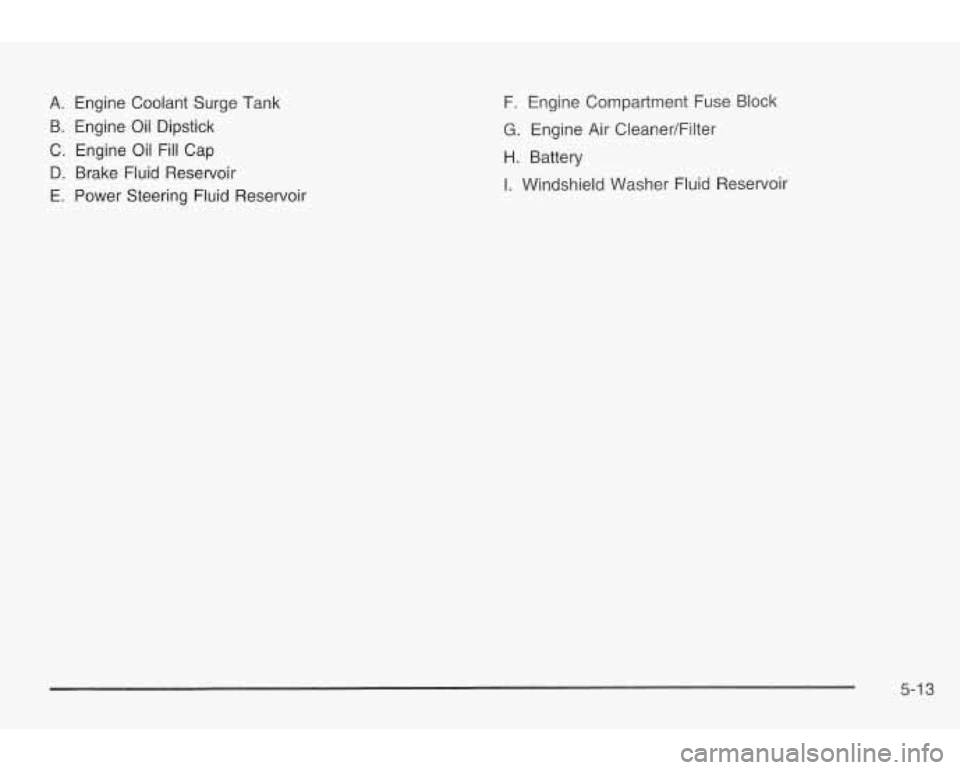
A. Engine Coolant Surge Tank
B. Engine Oil Dipstick
C. Engine
Oil Fill Cap
D. Brake Fluid Reservoir
E. Power Steering Fluid Reservoir F. Engine Compartment Fuse
Block
G. Engine Air Cleaner/Filter
H. Battery
I. Windshield Washer Fluid Reservoir
5-1 3
Page 237 of 354
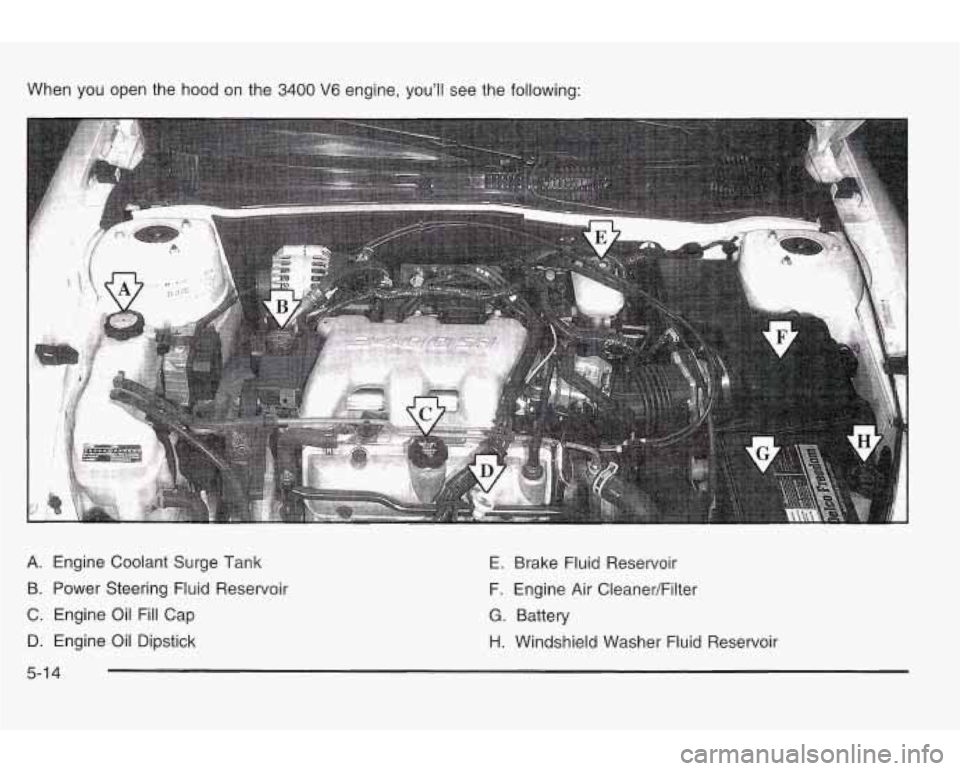
When you open the hood on the 3400 V6 engine, you’ll see the following:
A. Engine Coolant Surge Tank
E. Brake Fluid Reservoir
B. Power Steering Fluid Reservoir F. Engine Air CleanedFilter
C. Engine Oil Fill Cap G. Battery
D. Engine Oil Dipstick H. Windshield Washer Fluid Reservoir
5-1 4
Page 259 of 354
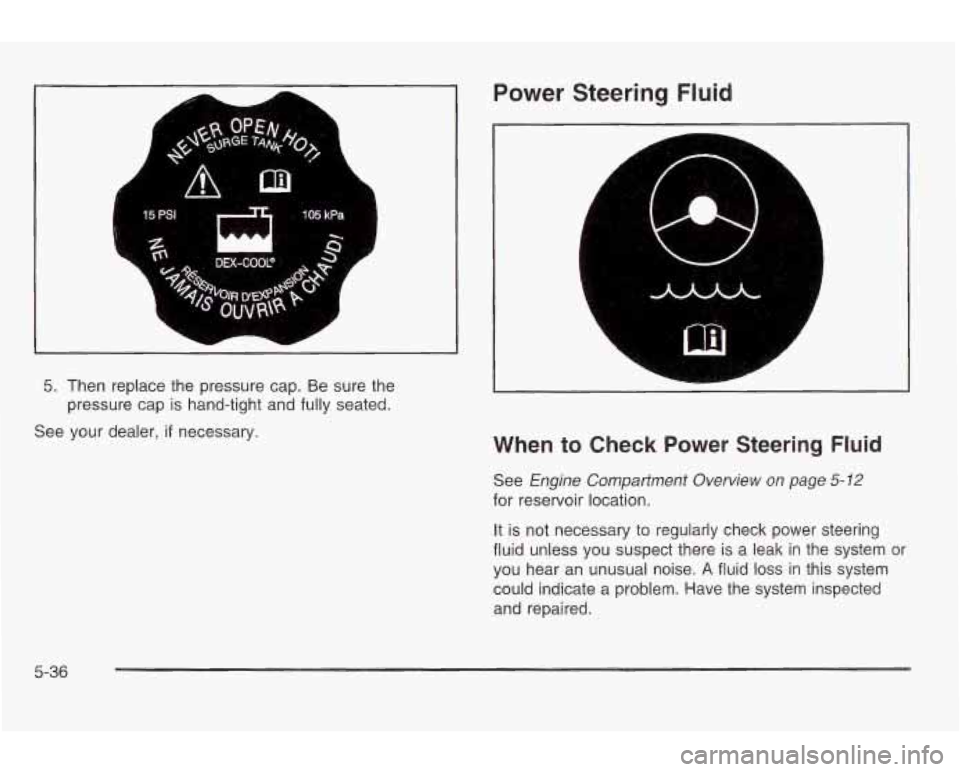
5. Then replace the pressure cap. Be sure the
pressure cap is hand-tight and fully seated.
See your dealer,
if necessary.
Power Steering Fluid
A
L- A
When to Check Power Steering Fluid
See Engine Compartment Overview on page 5-12
for reservoir location.
It is not necessary to regularly check power steering
fluid unless you suspect there is a leak in the system or
you hear an unusual noise.
A fluid loss in this system
could indicate a problem. Have the system inspected
and repaired.
5-36
Page 260 of 354
How to Check Power Steering Fluid
Turn the key off, let the engine compartment cool down,
wipe the cap and the top of the reservoir clean, then
unscrew the cap and wipe the dipstick with a clean rag.
Replace the cap and completely tighten it. Then
remove the cap again and look at the fluid level on the
dipstick.
The level should be at the
FULL COLD mark. If
necessary, add only enough fluid to bring the level up to
the mark.
What to Use
To determine what kind of fluid to use, see Part D:
Recommended Fluids and lubricants on page 6- 15.
Always use the proper fluid. Failure to use the proper
fluid can cause leaks and damage hoses and seals.
Windshield Washer Fluid
What to Use
When you need windshield washer fluid, be sure to read
the manufacturer's instructions before use. If you
will
be operating your vehicle in an area where the
temperature may fall below freezing, use a fluid that has
sufficient protection against freezing. See
Engine
Compartment Overview on page
5-12 for reservoir
location.
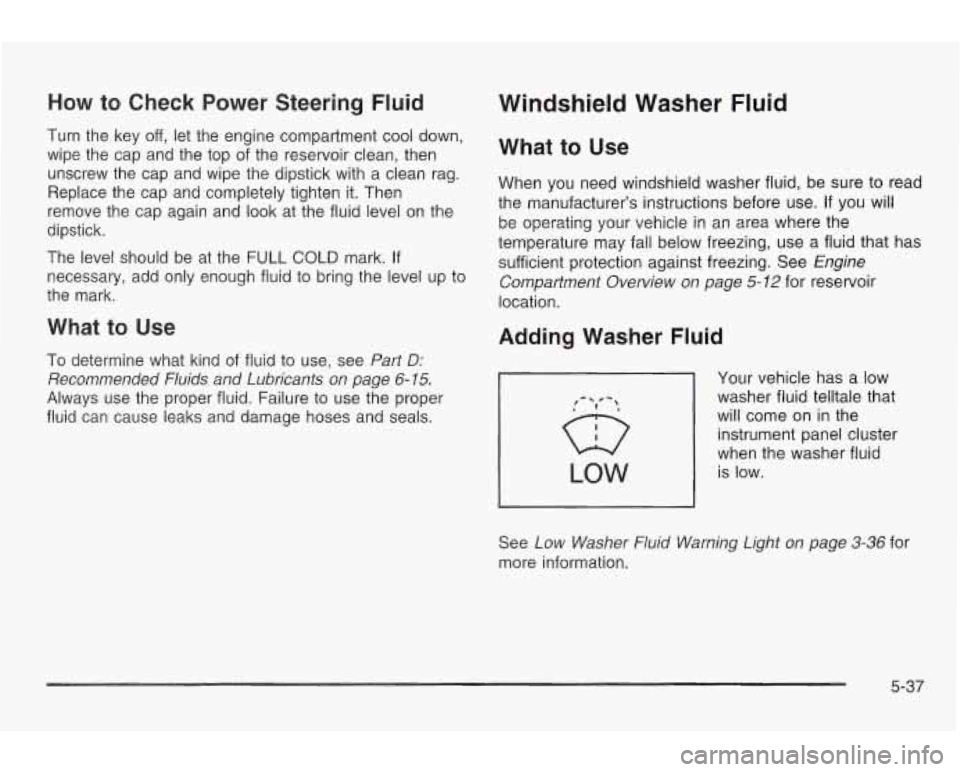
Adding Washer Fluid
.1. ,- 5 * -,
LOW
Your vehicle has a low
washer fluid telltale that
will come on in the
instrument panel cluster
when the washer fluid
is low.
See
low Washer Fluid Warning light on page 3-36 for
more information.
5-37
Page 306 of 354

Instrument Panel Fuse Block
(Passenger’s Side)
SEE OTHER END CAI
FOR FUSE PULLER
& SPARE FUSES
A) INST LPS
C) CRUISE SW B) CRUISE SW LPS
D) HVAC BLOWER E) CRUISE F) FOG LPS G) INT LPS H) RADIO BATT I) SUNROOF
*SEE OWNERS MANUAL /
Fuse
INST LPS
CRUISE
sw LPS
CRUISE SW
HVAC
BLOWER
CRUISE FOG LPS
INT LPS RADIO
BATT
SUNROOF Usage
Interior Lamp Dimming
Steering Wheel Cruise Control
Switch Lamps
Steering Wheel Cruise
Control Switches
HVAC Blower Motor
Cruise Control Fog Lamps
Interior Courtesy Lamps
Radio, XMTM Satellite Radio/DAB
Power Sunroof
Circuit Breaker Usage
PWR WNDW Power Windows
Relay
FOG LPS
Usage
Fog Lamps
5-83
Page 324 of 354

Part C: Periodic Maintenance
Inspections
Listed in this part are inspections and services which
should be performed at least twice a year (for instance,
each spring and fall).
You should /et your dealer’s
service department or other qualified service center do
these
jobs. Make sure any necessary repairs are
completed at once.
Proper procedures to perform these services may be
found in a service manual. See
Service Publications
Ordering hformation on page
7-9.
Steering, Suspension and Front
Drive Axle Boot and Seal Inspection
Inspect the front and rear suspension and steering
system for damaged, loose or missing parts, signs of
wear or lack of lubrication. Inspect the power steering
cracks, chafing, etc. Clean and then inspect the drive
axle boot seals for damage, tears or leakage. Replace
seals
if necessary.
!ines 2nd hQSPS fcr pper hcnk-L!p, hinrlinf& !e=lks,
Exhaust System Inspection
Inspect the complete exhaust system. Inspect the body
near the exhaust system. Look for broken, damaged,
missing or out-of-position parts as well as open seams,
holes, loose connections or other conditions which
could cause a heat build-up in the floor pan or could let
exhaust fumes into the vehicle. See
Engine Exhaust
on page
2-33.
ystem Inspection
Inspect the complete fuel system for damage or leaks.
6-1 3
Page 326 of 354
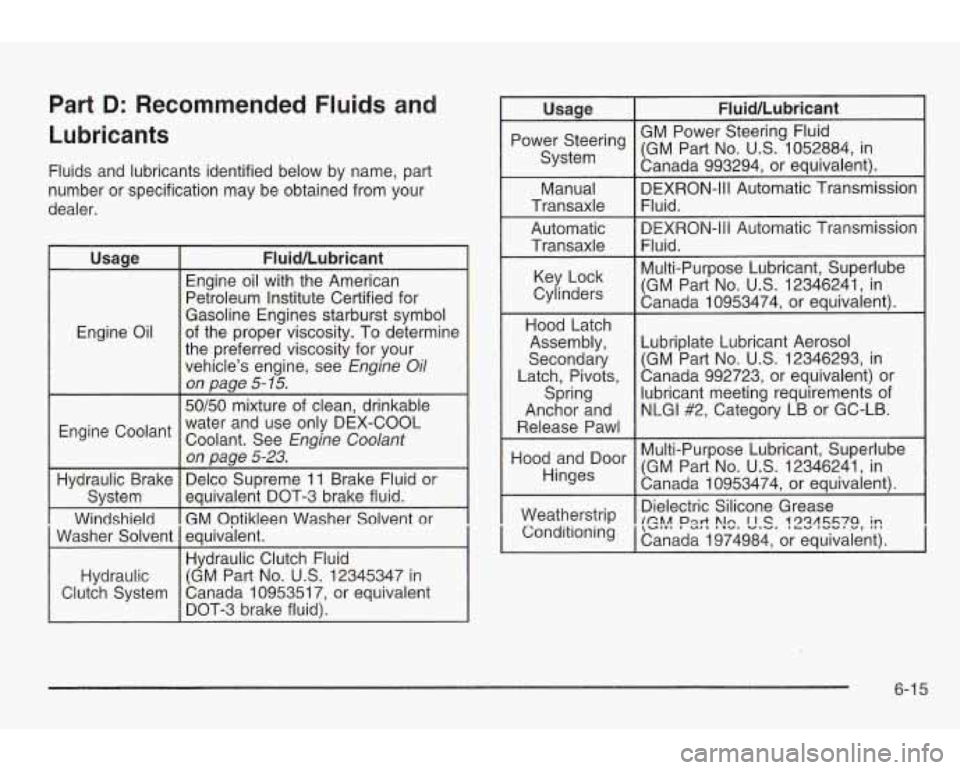
Part D: Recommended Fluids and
Lubricants
Fluids and lubricants identified below by name, part
number or specification may be obtained from your
dealer.
Usage
Engine Oil Fluid/Lubricant
Engine oil with the American
Petroleum Institute Certified for
Gasoline Engines starburst symbol
of the proper viscosity.
To determine
the preferred viscosity for your
vehicle’s engine, see
Engine Oil
on page 5-15.
Engine Coolant
Hydraulic Brake Svstem
Windshield
Washer Solvent
Hydraulic
Clutch System 50/50
mixture of clean, drinkable
water and use only DEX-COOL
Coolant. See Engine Coolant
on page
5-23.
Delco Supreme 11 Brake Fluid or
equivalent DOT-3 brake fluid.
GM Optikleen Washer Solvent or
equivalent.
Hydraulic Clutch Fluid
(GM Part No.
U.S. 12345347 in
Canada 1095351 7, or equivalent
DOT-3 brake fluid). Usage
Power Steering System
Manual
Transaxle
Automatic Transaxle
Key Lock
Cylinders
Hood Latch Assembly,
Secondary
Latch, Pivots,
Spring
Anchor and
Release Pawl
Hood and Door Hinges
Weatherstrip Conditioning Fluid/Lubricant
GM Power Steering Fluid
(GM Part No.
U.S. 1052884, in
Canada 993294, or equivalent).
DEXRON-Ill Automatic Transmission
Fluid.
DEXRON-Ill Automatic Transmission
Fluid.
Multi-Purpose Lubricant, Superlube
(GM Part No.
US. 12346241, in
Canada 10953474, or equivalent).
Lubriplate Lubricant Aerosol
(GM Part No.
US. 12346293, in
Canada 992723, or equivalent) or
lubricant meeting requirements of
NLGl
#2, Category LB or GC-LB.
Multi-Purpose Lubricant, Superlube
(GM Part No.
U.S. 12346241, in
Canada 10953474, or equivalent).
Dielectric Silicone Grease
Canada 1974984, or equivalent).
(a! Part ?!e. V.S. 123?557S, Ir!
6-1 5