service schedule PONTIAC GRAND PRIX 2003 Owners Manual
[x] Cancel search | Manufacturer: PONTIAC, Model Year: 2003, Model line: GRAND PRIX, Model: PONTIAC GRAND PRIX 2003Pages: 378, PDF Size: 17.64 MB
Page 2 of 378
The 2003 Pontiac Grand Prix Owner Manual a
Seats and Restpaint Systems ........................... ? -1
Front Seats ............................................... 1-2
Safety Belts
.............................................. 1-7
Child Restraints
....................................... 1-29
Supplemental Restraint System
(SRS) ......... 1-51
Restraint System Check
............................ 1-58
Keys
........................................................ 2-3
Doors and Locks
....................................... 2-8
Windows
................................................. 2-1 3
Theft-Deterrent Systems
............................ 2-1 5
Starting and Operating Your Vehicle
........... 2-19
Mirrors
.................................................... 2-33
Onstar@ System
...................................... 2-38
Storage Areas
......................................... 2-40
Sunroof
.................................................. 2-42
Vehicle Personalization
............................. 2-43
Instrument Panel Overview
.......................... 3-2
Climate Controls
...................................... 3-20
Warning Lights, Gages and Indicators
......... 3-23
Driver Information Center (DIC)
.................. 3-38
Trip Computer
......................................... 3-40
Audio System(s)
....................................... 3-44
Features and Controls ..................................... 2-1
Instrument Panel ............................................. 3-1
~rivingi yoerr Vehicle ....................................... 4-1
Your Driving, the Road, and Your Vehicle
..... 4-2
Towing
................................................... 4-33
Service
..................................................... 5-3
Fuel
......................................................... 5-5
Checking Things Under the Hood
............... 5-10
Headlamp Aiming
..................................... 5-59
Bulb Replacement
.................................... 5-60
Windshield Wiper Blade Replacement
......... 5-67
Tires
...................................................... 5-68
Appearance Care
..................................... 5-88
Vehicle Identification
................................. 5-96
Electrical System
...................................... 5-97
Capacities and Specifications
................... 5-1 02
Normal Maintenance Replacement Parts .... 5-1 04
Maintenance Schedule ........................... ,6-1 ..
Maintenance Schedule ................................ 6-2
Customer Assistance Information .................... 7-1
Customer Assistance Information
.................. 7-2
Service and Appearance Care .......................... 5-1
Reporting Safety Defects
......................... 7-9
Index ........................................ ..... 1
Page 224 of 378
But if you ever have to park your rig on a hill, here’s
how to do it:
1.
2.
3.
4.
5.
Apply your regular brakes, but don’t shift into
PARK
(P) yet.
Have someone place chocks under the trailer
wheels.
When the wheel chocks are in place, release the
regular brakes until the chocks absorb the load.
Reapply the regular brakes. Then apply your
parking brake, and then shift to PARK
(P).
Release the regular brakes.
When You Are Ready to Leave After
Parking on a
Hill
1. Apply your regular brakes and hold the pedal down
while you:
start your engine,
0 shift into a gear, and
0 release the parking brake. 2. Let
up on the brake pedal.
3. Drive slowly until the trailer is clear of the chocks.
4. Stop and have someone pick up and store the
chocks.
Maintenance When Trailer Towing
Your vehicle will need service more often when you’re
pulling a trailer. See Part
A: Scheduled Maintenance
Services on page
6-4 for more information. Things that
are especially important in trailer operation are
automatic transaxle fluid (don’t overfill), engine oil, drive
belts, cooling system and brake system. Each of
these is covered in this manual, and the Index will help
you find them quickly.
If you’re trailering, it’s a good
idea to review this information before you start your trip.
Check periodically
to see that all hitch nuts and bolts
are tight.
Engine Cooling When Trailer Towing
Your cooling system may temporarily overheat during
severe operating conditions. See Engine Overheating
on page
5-33.
4-43
Page 251 of 378
3. Pull out the filter.
4. Check or install a new engine air cleanerbiker. See
Normal Maintenance Replacement Parts on
page
5- 104.
5. To reinstall the cover, position the tabs through the
slots on the housing.
A notch on the sides of the
filter cover will indicate the correct engagement.
Reinstall the two clips on the top of the housing
when you are finished.
Refer to the Maintenance Schedule to determine when
to replace the air filter.
See Part A: Scheduled Maintenance Services on
page
6-4.
Operating t--. engine with the air cleaner/filter
off can cause you or others to be burned. The
air cleaner not only cleans the air,
it stops
flame if the engine backfires. If
it isn’t there
and the engine backfires, you could be burned. Don’t drive with
it off, and be careful working
on the engine with the air cleanedfilter
off.
Nofice: If the air cleaner/filter is off, a backfire can
cause a damaging engine fire. And, dirt can easily get
into your engine, which will damage
it. Always have
the air cleanedfilter in place when you’re driving.
5-26
Page 252 of 378
Automatic Transaxle Fluid
When to Check and Change
A good time to check your automatic transaxle fluid
level is when the engine oil is changed.
Change both the fluid and filter every 50,000 miles
(83
000 km) if the vehicle is mainly driven under one or
more of these conditions:
In heavy city traffic where the outside temperature
0 In hilly or mountainous terrain.
0 When doing frequent trailer towing.
0 Uses such as found in taxi, police or delivery service.
regularly reaches
90°F (32°C)
or higher.
If you do not use your vehicle under any of these
conditions, change the fluid and filter at
100,000 miles (166 000 km).
See Part
A: Scheduled Maintenance Services on
page
6-4.
How to Cheek
Because this operation can be a little difficult, you may
choose to have this done at the dealership service
department.
If you do it yourself, be sure to follow all the instructions
here, or you could get a false reading on the dipstick.
Nofice: Too much or too little fluid can damage
your transaxle.
Too much can mean that some of the
fluid could come out and fall on hot engine or
exhaust system parts, starting a fire.
Too little fluid
could cause the transaxle to overheat. Be sure
to get an accurate reading
if you check your
transaxle fluid.
Wait at least 30 minutes before checking the transaxle
fluid level
if you have been driving:
When outside temperatures are above
90°F (32°C).
At high speed for quite a while.
In heavy traffic
- especially in hot weather.
While pulling a trailer.
5-27
Page 294 of 378
Bad wear
0 Bad handling
Bad fuel economy
If your tires have too much air (overinflation),
you can get the following:
Unusual wear
Bad handling
Rough ride
Needless damage from road hazards
When to Check
Check your tires once a month or more.
Don’t forget your compact spare tire. It should be
at
60 psi (420 kPa).
How to Check
Use a good quality pocket-type gage to check tire
pressure. You can’t tell
if your tires are properly inflated
simply by looking at them. Radial tires may look
properly inflated even when they’re underinflated.
Be sure to put the valve caps back on the valve stems.
They help prevent leaks by keeping out dirt and
moisture.
Tire Inspection and Rotation
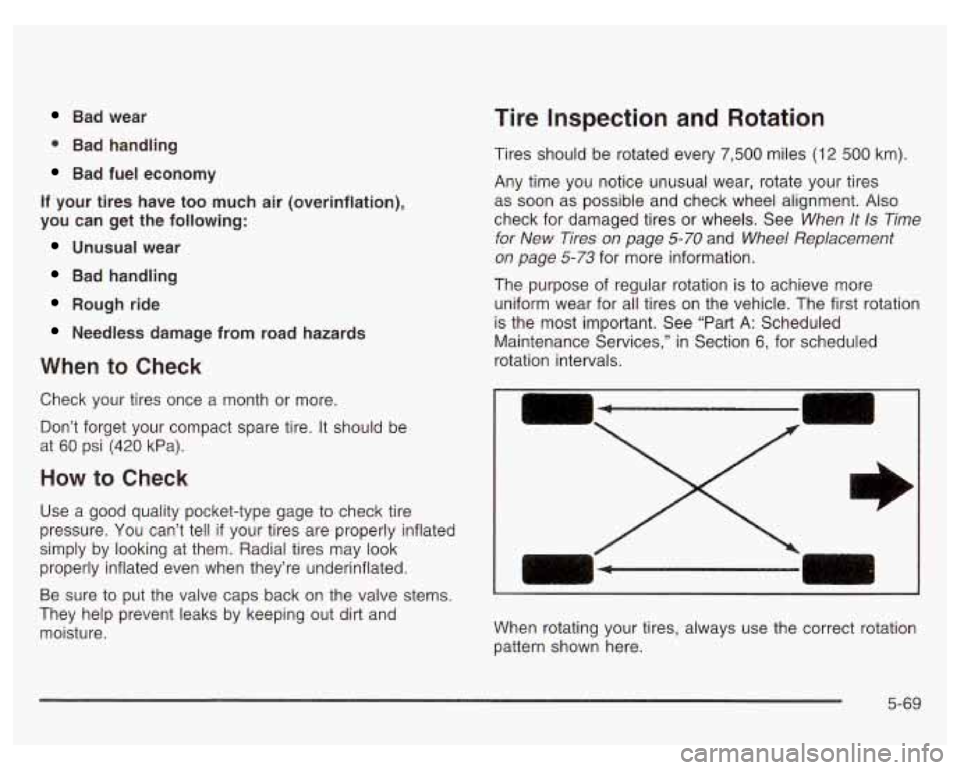
Tires should be rotated every 7,500 miles (1 2 500 km).
Any time you notice unusual wear, rotate your tires
as soon as possible and check wheel alignment.
Also
check for damaged tires or wheels. See When It Is Time
for New Tires on page
5-70 and Wheel Replacement
on page 5-73 for more information.
The purpose of regular rotation is to achieve more
uniform wear for all tires on the vehicle. The first rotation
is the most important. See “Part A: Scheduled
Maintenance Services,’’ in Section
6, for scheduled
rotation intervals.
1
When rotating your tires, always use the correct rotation
pattern shown here.
5-69
Page 330 of 378
Section 6 Maintenance Schedule
Maintenance Schedule ...................................... 6-2
Introduction
................................................... 6-2
Your Vehicle and the Environment
.................... 6-2
Maintenance Requirements
.............................. 6-2
How This Section is Organized
......................... 6-3
Part A: Scheduled Maintenance Services
........... 6-4
Using Your Maintenance Schedule
.................... 6.4
Scheduled Maintenance
.................. ......... 6.5
Part B: Owner Checks and Services
.... ..... 6.9
At Each Fuel Fill
........................................ 6-9
At Least Once a Month
................................... 6.9
At Least Twice a Year
................................... 6.10 At
Least Once a Year
................................... 6.10
Pari C: Periodic
Maintenance inspections ......... 6.13
Steering, Suspension and Front Drive Axle
Boot and Seal Inspection
............................ 6-13
Exhaust System Inspection
............................ 6.13
Fuel System Inspection
.................................. 6.13
Engine Cooling System Inspection
................... 6.13
Throttle System Inspection
............................ -6-14
Brake System Inspection
................................ 6.14
Part D: Recommended Fluids and Lubricants
.... 6-15
Part
E: Maintenance Record ........................... 6.16
6- 1
Page 332 of 378
How This Section is Organized
This maintenance schedule is divided into five parts:
“Part
A: Scheduled Maintenance Services” explains
what to have done and how often. Some of these
services can be complex,
so unless you are technically
qualified and have the necessary equipment, you
should let your dealer’s service department or another
qualified service center do these jobs.
Perl_______ lg maintenance work on a vehic.- can
be dangerous. In trying to do some
jobs, you
can be seriously injured.
Do your own
maintenance work only if you have the
required know-how and the proper tools and
equipment
for the job. If you have any doubt,
have a qualified technician
do the work.
If you want to get the service information, see Service
Publications Ordering Information on page
7- 10.
“Part B: Owner Checks and Services” tells you what
should be checked and when. It also explains what
you can easiiy
do to help keep your vehicle in good
condition.
“Part
C: Periodic Maintenance Inspections” explains
important inspections that your dealer’s service
department or another qualified service center should
perform.
“Part
D: Recommended Fluids and Lubricants”
lists some recommended products necessary to help
keep your vehicle properly maintained. These products,
or their equivalents, should be used whether you do
the work yourself or have it done.
“Part
E: Maintenance Record” is a place for you to
record and keep track of the maintenance performed
on your vehicle. Keep your maintenance receipts.
They may be needed to qualify your vehicle for
warranty repairs.
6-3
Page 333 of 378
Part A: Scheduled Maintenance
Services
This part contains engine oil scheduled maintenance
which explains the engine oil life system and how
it indicates when to change the engine oil and filter.
Also, listed are scheduled maintenance services which
are to be performed at the mileage intervals specified.
Using Your Maintenance Schedule
We at General Motors want to keep your vehicle in good
working condition. But we don’t know exactly how
you’ll drive it. You may drive short distances only a few
times a week. Or you may drive long distances all
the time in very hot, dusty weather. You may use your
vehicle
in making deliveries. Or you may drive it to
work, to do errands or in many other ways.
Because of the different ways people use their vehicles,
maintenance needs may vary. You may need more
frequent checks and replacements.
So please read the
following and note how you drive.
If you have
questions on how to keep your vehicle in good condition,
see your dealer. This part tells
you the maintenance services you
should have done and when you should schedule them.
When you go to your dealer for your service needs,
you’ll know that GM-trained and supported service
people will perform the work using genuine GM parts.
The proper fluids and lubricants to use are listed in
Part D. Make sure whoever services your vehicle uses
these.
All parts should be replaced and all necessary
repairs done before you or anyone else drives the
vehicle.
This schedule is for vehicles that:
carry passengers and cargo within recommended
limits. You will find these on your vehicle’s
Tire-Loading Information label. See Loading
Your
Vehicle on page 4-35.
are driven on reasonable road surfaces within legal
use the recommended fuel. See Gasoline Octane
driving limits.
on page 5-5.
6-4
Page 334 of 378
Scheduled Maintenance
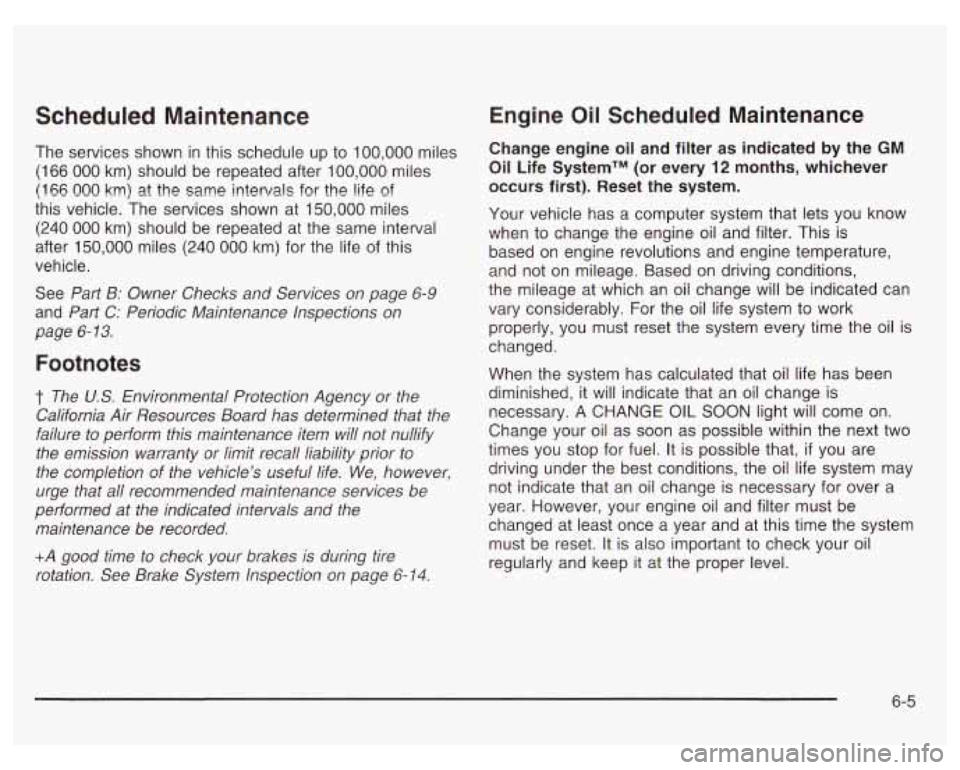
The services shown in this schedule up to 100,000 miles
(1 66
000 km) should be repeated after 100,000 miles
(1 66 000 km) at the same intervals for the life of
this vehicle. The services shown at 150,000 miles
(240
000 km) should be repeated at the same interval
after 150,000 miles
(240 000 km) for the life of this
vehicle.
See Part B: Owner Checks and Services on page
6-9
and Part C: Periodic Maintenance Inspections on
page
6- 13.
Footnotes
t The U.S. Environmental Protection Agency or the
California Air Resources Board has determined that the
failure to perform this maintenance item will not nullify
the emission warranty or limit recall liability prior to
the completion of the vehicle’s useful life. We, however,
urge that all recommended maintenance services be
performed at the indicated intervals and the
maintenance be recorded.
+A good time to check your brakes is during tire
rotation. See Brake System Inspection on page
6-14,
Engine Oil Scheduled Maintenance
Change engine oil and filter as indicated by the GM
Oil Life SystemTM (or every 12 months, whichever
occurs first). Reset the system.
Your vehicle has a computer system that lets you know
when to change the engine oil and filter. This is
based on engine revolutions and engine temperature,
and not on mileage. Based on driving conditions,
the mileage at which an oil change will be indicated can
vary considerably. For the oil life system to work
properly, you must reset the system every time the oil is
changed.
When the system has calculated that oil life has been
diminished,
it will indicate that an oil change is
necessary.
A CHANGE OIL SOON light will come on.
Change your oil as soon as possible within the next two
times you stop for fuel. It is possible that,
if you are
driving under the best conditions, the oil life system may
not indicate that an oil change is necessary for over a
year. However, your engine oil and filter must be
changed at least once a year and at this time the system
must be reset.
It is also important to check your oil
regularly and keep it at the proper level.
6-5
Page 335 of 378
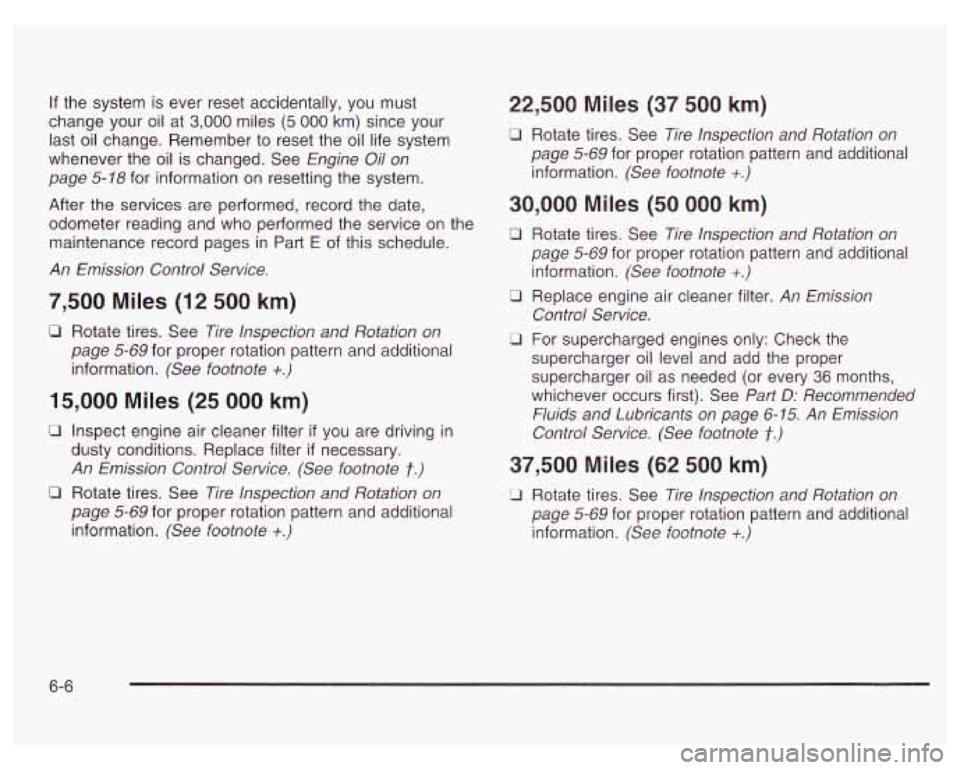
If the system is ever reset accidentally, you must
change your oil at
3,000 miles (5 000 km) since your
last oil change. Remember
to reset the oil life system
whenever the oil is changed. See Engine Oil on
page 5-18 for information on resetting the system.
After the services are performed, record the date,
odometer reading and who performed the service on the
maintenance record pages in Part
E of this schedule.
An Emission Control Service.
7,500 Miles (12 500 km)
LI Rotate tires. See Tire Inspection and Rotation on
page 5-69 for proper rotation pattern and additional
information. (See footnote
+.)
15,000 Miles (25 000 km)
0 Inspect engine air cleaner filter if you are driving in
dusty conditions. Replace filter
if necessary.
An Emission Control Service. (See footnote
f.)
Cl Rotate tires. See Tire Inspection and Rotation on
page 5-69 for proper rotation pattern and additional
information. (See footnote
+.)
22,500 Miles (37 500 km)
U Rotate tires. See Tire Inspection and Rotation on
page 5-69 for proper rotation pattern and additional
information. (See footnote
+.)
30,000 Miles (50 000 km)
0 Rotate tires. See Tire Inspection and Rotation on
page 5-69 for proper rotation pattern and additional
information. (See footnote
+.)
Control Service.
0 Replace engine air cleaner filter. An Emission
U For supercharged engines only: Check the
supercharger oil level and add the proper
supercharger oil as needed (or every
36 months,
whichever occurs first). See Part
D: Recommended
Fluids and Lubricants on page 6-15. An Emission
Control Service. (See footnote
f.)
37,500 Miles (62 500 km)
U Rotate tires. See Tire Inspection and Rotation on
page 5-69 for proper rotation pattern and additional
information. (See footnote
+.)
6-6