lock PONTIAC GRAND PRIX 2007 Owners Manual
[x] Cancel search | Manufacturer: PONTIAC, Model Year: 2007, Model line: GRAND PRIX, Model: PONTIAC GRAND PRIX 2007Pages: 526, PDF Size: 2.92 MB
Page 343 of 526
{CAUTION:
If you spill fuel and then something
ignites it, you could be badly burned. Fuel
can spray out on you if you open the fuel
cap too quickly. This spray can happen if
your tank is nearly full, and is more likely
in hot weather. Open the fuel cap slowly
and wait for any hiss noise to stop. Then
unscrew the cap all the way.
Be careful not to spill fuel. Do not top off or overll
the tank and wait a few seconds after you have
nished pumping before removing the nozzle.
Clean fuel from painted surfaces as soon
as possible. SeeWashing Your Vehicle on
page 453.
When replacing the fuel cap, turn it clockwise until
it clicks. Make sure the cap is fully installed.
The diagnostic system can determine if the fuel
cap has been left off or improperly installed.
This would allow fuel to evaporate into the
atmosphere. SeeMalfunction Indicator Lamp on
page 180.The CHECK GAS CAP message will be displayed
on the Driver Information Center (DIC) if the
fuel cap is not properly installed. SeeDIC
Warnings and Messages on page 200for more
information.
{CAUTION:
If a re starts while you are refueling, do
not remove the nozzle. Shut off the ow of
fuel by shutting off the pump or by
notifying the station attendant. Leave the
area immediately.
Notice:If you need a new fuel cap, be sure to
get the right type. Your dealer can get one
for you. If you get the wrong type, it may not
t properly. This may cause your malfunction
indicator lamp to light and may damage
your fuel tank and emissions system. See
Malfunction Indicator Lamp on page 180.
343
Page 347 of 526
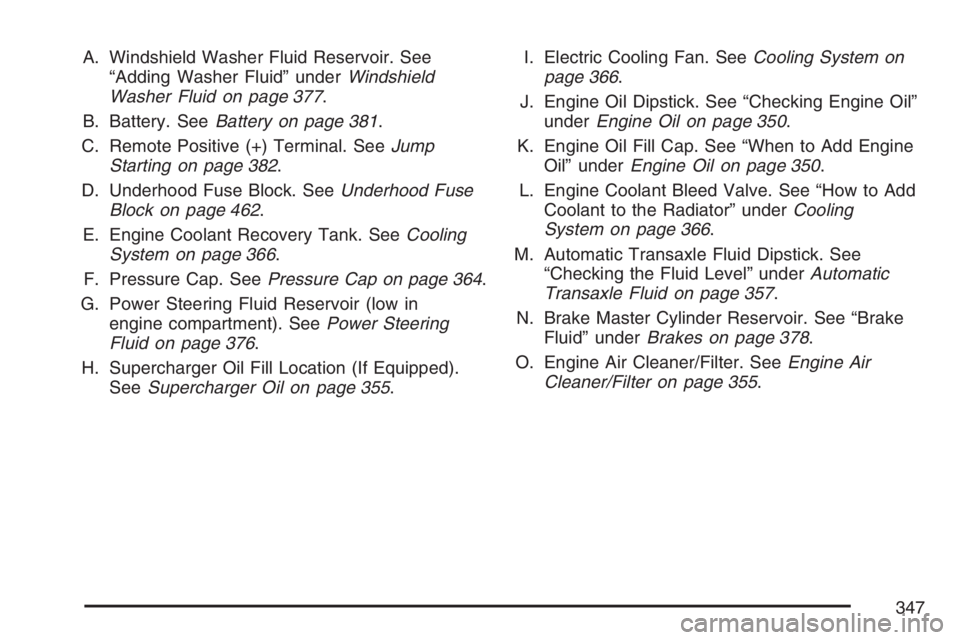
A. Windshield Washer Fluid Reservoir. See
“Adding Washer Fluid” underWindshield
Washer Fluid on page 377.
B. Battery. SeeBattery on page 381.
C. Remote Positive (+) Terminal. SeeJump
Starting on page 382.
D. Underhood Fuse Block. SeeUnderhood Fuse
Block on page 462.
E. Engine Coolant Recovery Tank. SeeCooling
System on page 366.
F. Pressure Cap. SeePressure Cap on page 364.
G. Power Steering Fluid Reservoir (low in
engine compartment). SeePower Steering
Fluid on page 376.
H. Supercharger Oil Fill Location (If Equipped).
SeeSupercharger Oil on page 355.I. Electric Cooling Fan. SeeCooling System on
page 366.
J. Engine Oil Dipstick. See “Checking Engine Oil”
underEngine Oil on page 350.
K. Engine Oil Fill Cap. See “When to Add Engine
Oil” underEngine Oil on page 350.
L. Engine Coolant Bleed Valve. See “How to Add
Coolant to the Radiator” underCooling
System on page 366.
M. Automatic Transaxle Fluid Dipstick. See
“Checking the Fluid Level” underAutomatic
Transaxle Fluid on page 357.
N. Brake Master Cylinder Reservoir. See “Brake
Fluid” underBrakes on page 378.
O. Engine Air Cleaner/Filter. SeeEngine Air
Cleaner/Filter on page 355.
347
Page 349 of 526
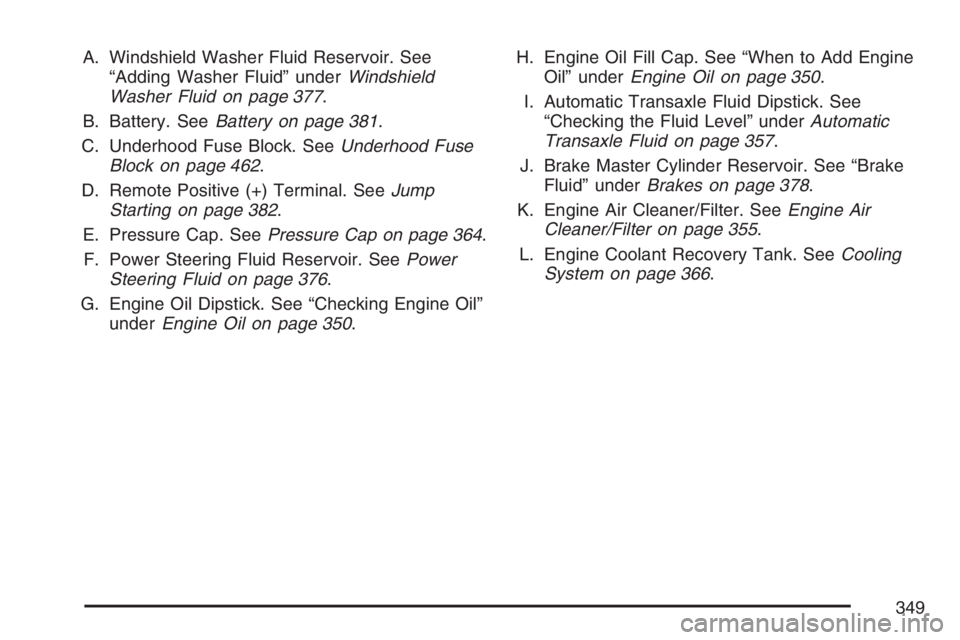
A. Windshield Washer Fluid Reservoir. See
“Adding Washer Fluid” underWindshield
Washer Fluid on page 377.
B. Battery. SeeBattery on page 381.
C. Underhood Fuse Block. SeeUnderhood Fuse
Block on page 462.
D. Remote Positive (+) Terminal. SeeJump
Starting on page 382.
E. Pressure Cap. SeePressure Cap on page 364.
F. Power Steering Fluid Reservoir. SeePower
Steering Fluid on page 376.
G. Engine Oil Dipstick. See “Checking Engine Oil”
underEngine Oil on page 350.H. Engine Oil Fill Cap. See “When to Add Engine
Oil” underEngine Oil on page 350.
I. Automatic Transaxle Fluid Dipstick. See
“Checking the Fluid Level” underAutomatic
Transaxle Fluid on page 357.
J. Brake Master Cylinder Reservoir. See “Brake
Fluid” underBrakes on page 378.
K. Engine Air Cleaner/Filter. SeeEngine Air
Cleaner/Filter on page 355.
L. Engine Coolant Recovery Tank. SeeCooling
System on page 366.
349
Page 357 of 526
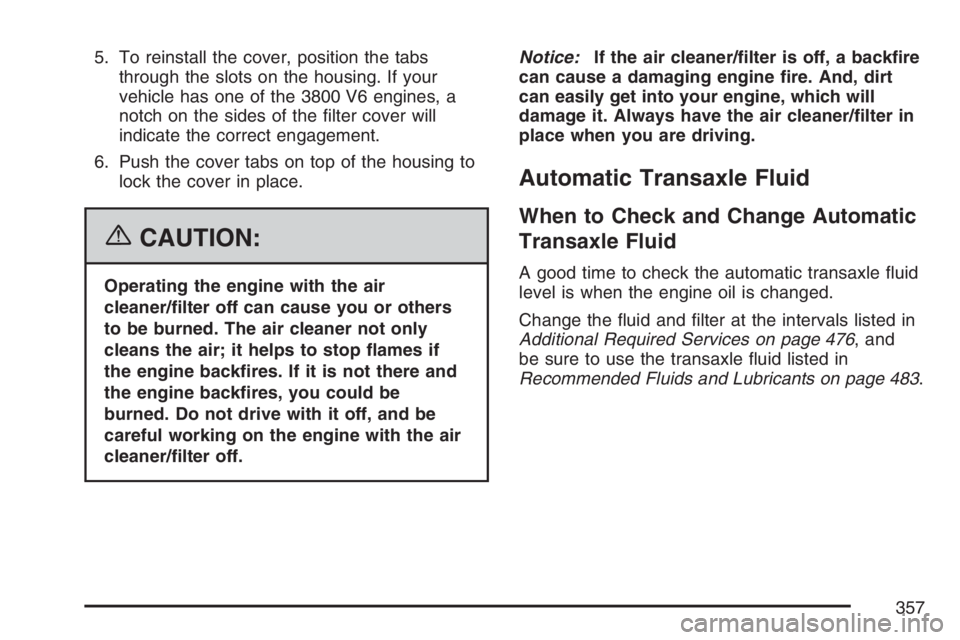
5. To reinstall the cover, position the tabs
through the slots on the housing. If your
vehicle has one of the 3800 V6 engines, a
notch on the sides of the lter cover will
indicate the correct engagement.
6. Push the cover tabs on top of the housing to
lock the cover in place.
{CAUTION:
Operating the engine with the air
cleaner/lter off can cause you or others
to be burned. The air cleaner not only
cleans the air; it helps to stop ames if
the engine backres. If it is not there and
the engine backres, you could be
burned. Do not drive with it off, and be
careful working on the engine with the air
cleaner/lter off.Notice:If the air cleaner/lter is off, a backre
can cause a damaging engine re. And, dirt
can easily get into your engine, which will
damage it. Always have the air cleaner/lter in
place when you are driving.
Automatic Transaxle Fluid
When to Check and Change Automatic
Transaxle Fluid
A good time to check the automatic transaxle uid
level is when the engine oil is changed.
Change the uid and lter at the intervals listed in
Additional Required Services on page 476, and
be sure to use the transaxle uid listed in
Recommended Fluids and Lubricants on page 483.
357
Page 370 of 526
When the coolant level in the coolant recovery
tank is at the cold ll line, start the vehicle.
If the overheat warning continues, there is one
more thing you can try. You can add the proper
coolant mixture directly to the radiator, but be sure
the system is cool before you do it.
{CAUTION:
Steam and scalding liquids from a hot
cooling system can blow out and burn
you badly. They are under pressure, and if
you turn the pressure cap — even a
little — they can come out at high speed.
Never turn the cap when the cooling
system, including the pressure cap, is hot.
Wait for the cooling system and pressure
cap to cool if you ever have to turn the
pressure cap.
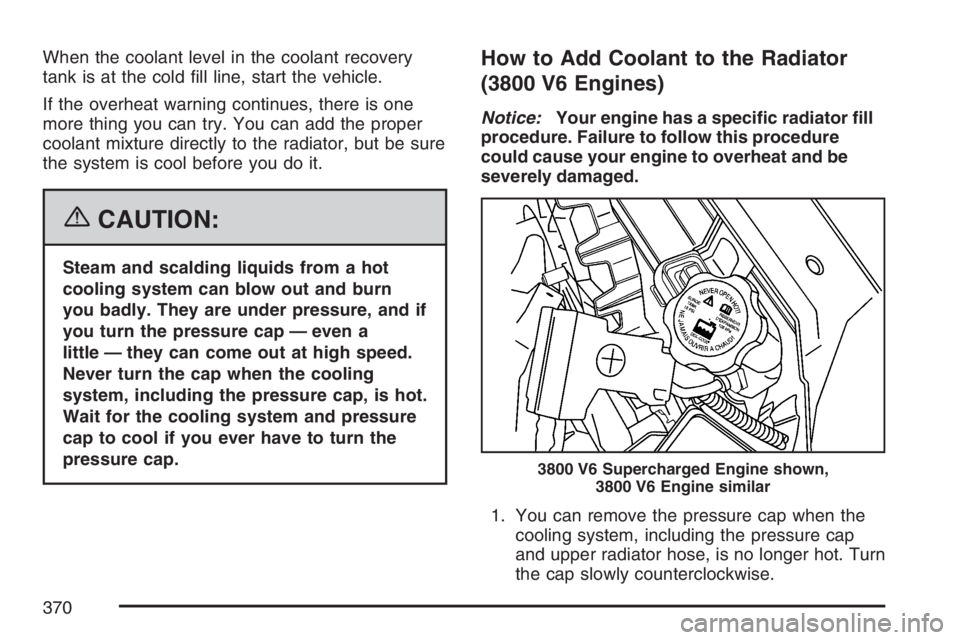
How to Add Coolant to the Radiator
(3800 V6 Engines)
Notice:Your engine has a specic radiator ll
procedure. Failure to follow this procedure
could cause your engine to overheat and be
severely damaged.
1. You can remove the pressure cap when the
cooling system, including the pressure cap
and upper radiator hose, is no longer hot. Turn
the cap slowly counterclockwise.
3800 V6 Supercharged Engine shown,
3800 V6 Engine similar
370
Page 371 of 526
If you hear a hiss, wait for that to stop. A hiss
means there is still some pressure left.
2. Then keep turning the pressure cap and
remove it.
{CAUTION:
You can be burned if you spill coolant on
hot engine parts. Coolant contains
ethylene glycol and it will burn if the
engine parts are hot enough. Do not spill
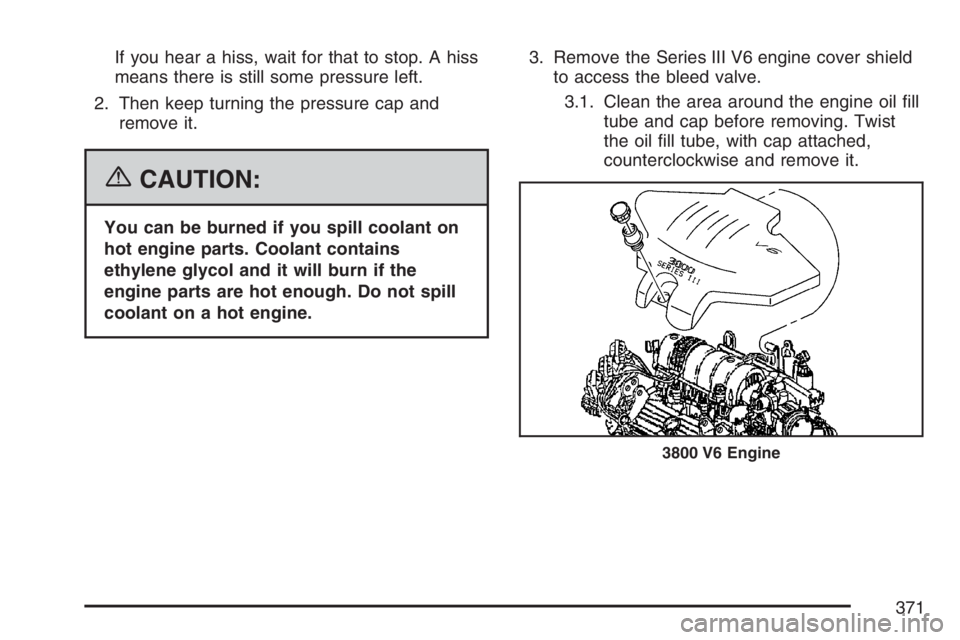
coolant on a hot engine.3. Remove the Series III V6 engine cover shield
to access the bleed valve.
3.1. Clean the area around the engine oil ll
tube and cap before removing. Twist
the oil ll tube, with cap attached,
counterclockwise and remove it.
3800 V6 Engine
371
Page 373 of 526
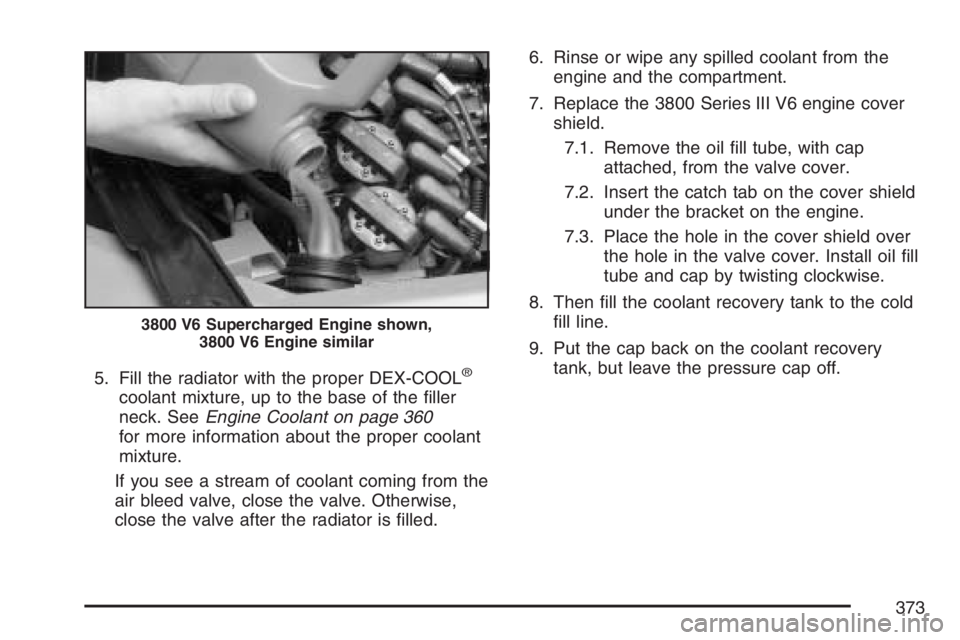
5. Fill the radiator with the proper DEX-COOL®
coolant mixture, up to the base of the ller
neck. SeeEngine Coolant on page 360
for more information about the proper coolant
mixture.
If you see a stream of coolant coming from the
air bleed valve, close the valve. Otherwise,
close the valve after the radiator is lled.6. Rinse or wipe any spilled coolant from the
engine and the compartment.
7. Replace the 3800 Series III V6 engine cover
shield.
7.1. Remove the oil ll tube, with cap
attached, from the valve cover.
7.2. Insert the catch tab on the cover shield
under the bracket on the engine.
7.3. Place the hole in the cover shield over
the hole in the valve cover. Install oil ll
tube and cap by twisting clockwise.
8. Then ll the coolant recovery tank to the cold
ll line.
9. Put the cap back on the coolant recovery
tank, but leave the pressure cap off.
3800 V6 Supercharged Engine shown,
3800 V6 Engine similar
373
Page 375 of 526
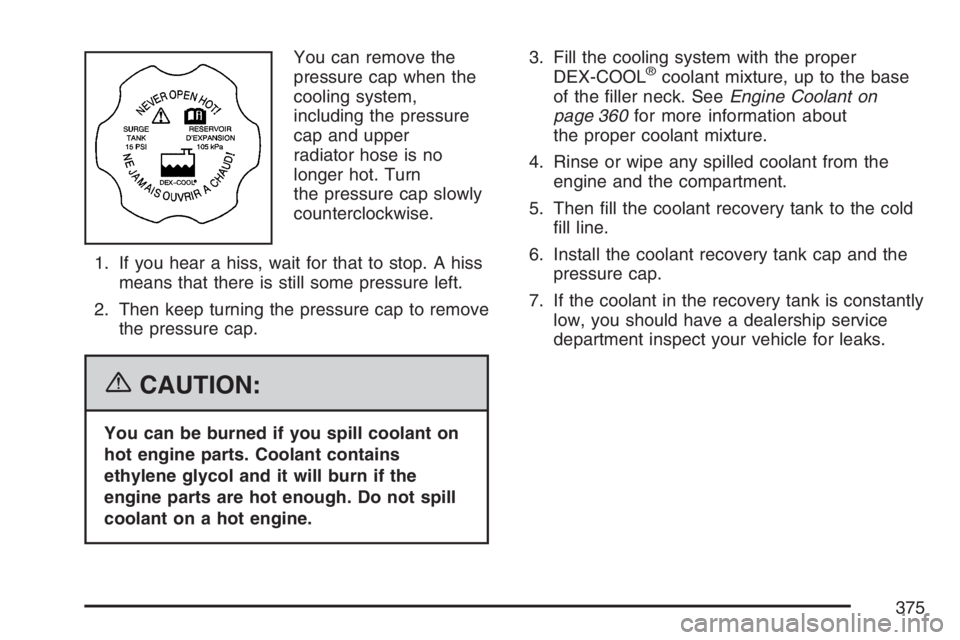
You can remove the
pressure cap when the
cooling system,
including the pressure
cap and upper
radiator hose is no
longer hot. Turn
the pressure cap slowly
counterclockwise.
1. If you hear a hiss, wait for that to stop. A hiss
means that there is still some pressure left.
2. Then keep turning the pressure cap to remove
the pressure cap.
{CAUTION:
You can be burned if you spill coolant on
hot engine parts. Coolant contains
ethylene glycol and it will burn if the
engine parts are hot enough. Do not spill
coolant on a hot engine.3. Fill the cooling system with the proper
DEX-COOL
®coolant mixture, up to the base
of the ller neck. SeeEngine Coolant on
page 360for more information about
the proper coolant mixture.
4. Rinse or wipe any spilled coolant from the
engine and the compartment.
5. Then ll the coolant recovery tank to the cold
ll line.
6. Install the coolant recovery tank cap and the
pressure cap.
7. If the coolant in the recovery tank is constantly
low, you should have a dealership service
department inspect your vehicle for leaks.
375
Page 383 of 526
Notice:If you leave your radio or other
accessories on during the jump starting
procedure, they could be damaged. The repairs
would not be covered by your warranty.
Always turn off your radio and other
accessories when jump starting your vehicle.
3. Turn off the ignition on both vehicles.
Unplug unnecessary accessories plugged into
the cigarette lighter or the accessory power
outlet. Turn off the radio and all lamps that are
not needed. This will avoid sparks and help
save both batteries. And it could save
the radio!
4. Open the hood on the other vehicle and
locate the positive (+) and negative (−)
terminal locations on that vehicle.
You will not use your vehicle’s battery for jump
starting. It has a remote positive (+) jump
starting terminal, located on the underhood
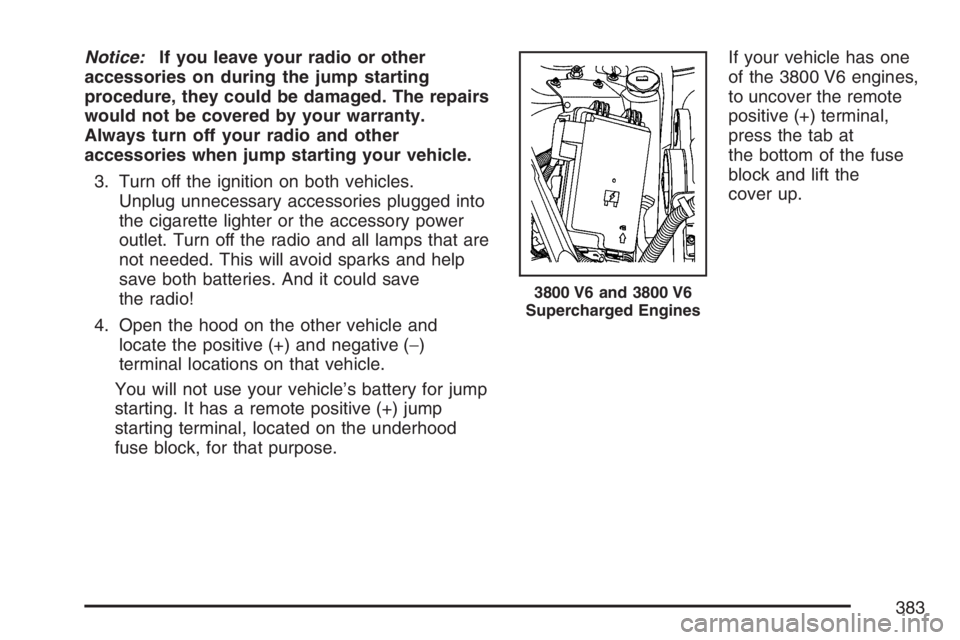
fuse block, for that purpose.If your vehicle has one
of the 3800 V6 engines,
to uncover the remote
positive (+) terminal,
press the tab at
the bottom of the fuse
block and lift the
cover up.
3800 V6 and 3800 V6
Supercharged Engines
383
Page 384 of 526
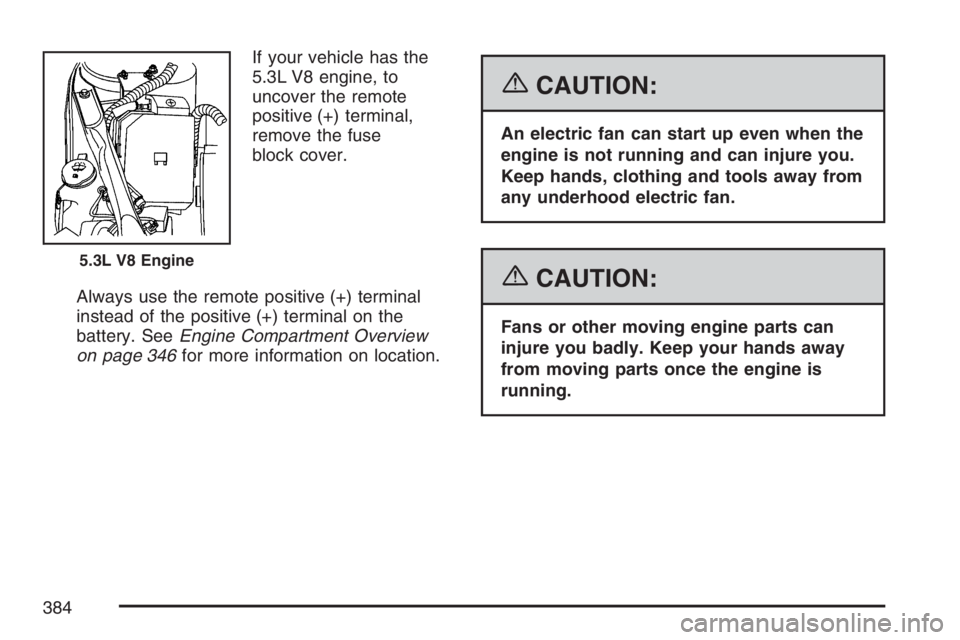
If your vehicle has the
5.3L V8 engine, to
uncover the remote
positive (+) terminal,
remove the fuse
block cover.
Always use the remote positive (+) terminal
instead of the positive (+) terminal on the
battery. SeeEngine Compartment Overview
on page 346for more information on location.
{CAUTION:
An electric fan can start up even when the
engine is not running and can injure you.
Keep hands, clothing and tools away from
any underhood electric fan.
{CAUTION:
Fans or other moving engine parts can
injure you badly. Keep your hands away
from moving parts once the engine is
running.
5.3L V8 Engine
384