engine PONTIAC GRAND PRIX 2007 Owner's Manual
[x] Cancel search | Manufacturer: PONTIAC, Model Year: 2007, Model line: GRAND PRIX, Model: PONTIAC GRAND PRIX 2007Pages: 526, PDF Size: 2.92 MB
Page 119 of 526
Engine Exhaust
{CAUTION:
Engine exhaust can kill. It contains the
gas carbon monoxide (CO), which you
cannot see or smell. It can cause
unconsciousness and death.
You might have exhaust coming in if:
Your exhaust system sounds strange
or different.
Your vehicle gets rusty underneath.
Your vehicle was damaged in a
collision.
CAUTION: (Continued)
CAUTION: (Continued)
Your vehicle was damaged when
driving over high points on the road
or over road debris.
Repairs were not done correctly.
Your vehicle or exhaust system has
been modied improperly.
If you ever suspect exhaust is coming into
your vehicle:
Drive it only with all the windows
down to blow out any CO; and
Have your vehicle xed immediately.
119
Page 120 of 526
Running the Engine While Parked
It is better not to park with the engine running. But if
you ever have to, here are some things to know.
{CAUTION:
Idling the engine with the climate control
system off could allow dangerous exhaust
into your vehicle. See the earlier caution
underEngine Exhaust on page 119.
Also, idling in a closed-in place can let
deadly carbon monoxide (CO) into your
vehicle even if the climate control fan is at
the highest setting. One place this can
happen is a garage. Exhaust — with
CO — can come in easily. NEVER park in
a garage with the engine running.
Another closed-in place can be a blizzard.
SeeWinter Driving on page 311.
{CAUTION:
It can be dangerous to get out of your
vehicle if the shift lever is not fully in
PARK (P) with the parking brake rmly
set. Your vehicle can roll. Do not leave
your vehicle when the engine is running
unless you have to. If you have left the
engine running, the vehicle can move
suddenly. You or others could be injured.
To be sure your vehicle will not move,
even when you are on fairly level ground,
always set your parking brake and move
the shift lever to PARK (P).
Follow the proper steps to be sure your vehicle
will not move. SeeShifting Into Park (P) on
page 116.
If you are parking on a hill and if you are pulling a
trailer, also seeTowing a Trailer on page 324.
120
Page 130 of 526
Traction Control System (TCS)
Warning Light........................................ 178
Enhanced Traction System
Warning Light........................................ 179
Engine Coolant Temperature
Warning Light........................................ 179
Engine Coolant Temperature Gage............ 180
Malfunction Indicator Lamp........................ 180
Oil Pressure Light..................................... 184
Fog Lamp Light......................................... 185
Cruise Control Light.................................. 185
Highbeam On Light................................... 185
Fuel Gage................................................. 185
Driver Information Center (DIC).................. 186
DIC Controls and Displays
(Base Level DIC)................................... 186
DIC Controls and Displays
(Uplevel DIC with Trip Computer)........... 190
DIC Compass (Uplevel DIC)...................... 198
DIC Warnings and Messages.................... 200
DIC Vehicle Customization........................ 226Audio System(s)......................................... 233
Setting the Time........................................ 234
Radio with CD (Base Level)...................... 235
Radio with CD (MP3)................................ 245
Radio with Six-Disc CD............................. 255
Using an MP3........................................... 269
XM Radio Messages................................. 275
Theft-Deterrent Feature............................. 277
Audio Steering Wheel Controls.................. 277
Radio Reception........................................ 278
Care of Your CDs..................................... 279
Care of the CD Player.............................. 279
Backglass Antenna.................................... 280
XM™ Satellite Radio Antenna System....... 281
Chime Level Adjustment............................ 281
Section 3 Instrument Panel
130
Page 144 of 526
Exterior Lamps
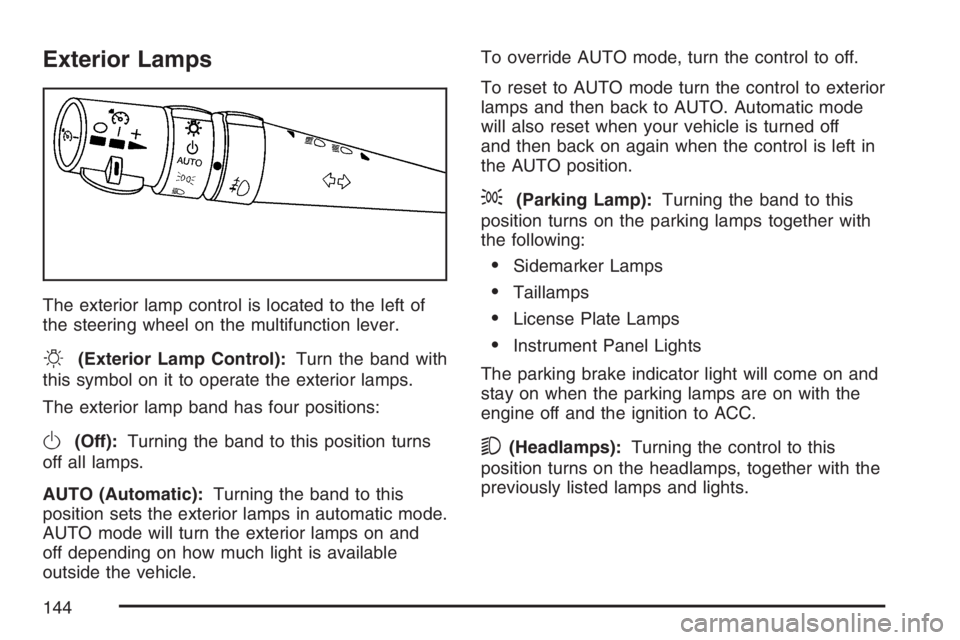
The exterior lamp control is located to the left of
the steering wheel on the multifunction lever.
O(Exterior Lamp Control):Turn the band with
this symbol on it to operate the exterior lamps.
The exterior lamp band has four positions:
O(Off):Turning the band to this position turns
off all lamps.
AUTO (Automatic):Turning the band to this
position sets the exterior lamps in automatic mode.
AUTO mode will turn the exterior lamps on and
off depending on how much light is available
outside the vehicle.To override AUTO mode, turn the control to off.
To reset to AUTO mode turn the control to exterior
lamps and then back to AUTO. Automatic mode
will also reset when your vehicle is turned off
and then back on again when the control is left in
the AUTO position.
;(Parking Lamp):Turning the band to this
position turns on the parking lamps together with
the following:
Sidemarker Lamps
Taillamps
License Plate Lamps
Instrument Panel Lights
The parking brake indicator light will come on and
stay on when the parking lamps are on with the
engine off and the ignition to ACC.
5(Headlamps):Turning the control to this
position turns on the headlamps, together with the
previously listed lamps and lights.
144
Page 150 of 526
Electric Power Management
The vehicle has Electric Power Management
(EPM) that estimates the battery’s temperature and
state of charge. It then adjusts the voltage for
best performance and extended life of the battery.
When the battery’s state of charge is low, the
voltage is raised slightly to quickly put the charge
back in. When the state of charge is high, the
voltage is lowered slightly to prevent overcharging.
If the vehicle has a voltmeter gage or voltage
display on the Driver Information Center (DIC), you
may see the voltage move up or down. This is
normal. If there is a problem, an alert will be
displayed.
The battery can be discharged at idle if the
electrical loads are very high. This is true for all
vehicles. This is because the generator (alternator)
may not be spinning fast enough at idle to
produce all the power that is needed for very high
electrical loads.A high electrical load occurs when several of the
following loads are on: headlamps, high beams,
fog lamps, rear window defogger, climate
control fan at high speed, heated seats, engine
cooling fans, trailer loads, and loads plugged into
accessory power outlets.
EPM works to prevent excessive discharge of the
battery. It does this by balancing the generator’s
output and the vehicle’s electrical needs. It
can increase engine idle speed to generate more
power, whenever needed. It can temporarily
reduce the power demands of some accessories.
Normally, these actions occur in steps or levels,
without being noticeable. In rare cases at the
highest levels of corrective action, this action may
be noticeable to the driver. If so, a Driver
Information Center (DIC) message might be
displayed, such as Battery Saver Active. If this
message is displayed, it is recommended that the
driver reduce the electrical loads as much as
possible. SeeDIC Warnings and Messages on
page 200.
150
Page 153 of 526
The HUD will temporarily display CHECK TRIP
COMPUTER when there are messages on the DIC
trip computer.
The HUD will also display the following messages
when these systems, if the vehicle has them,
are active:
TRACTION CONTROL ACTIVE
STABILITY CONTROL ACTIVE
The HUD will temporarily display the TRACTION
CONTROL OFF message when the traction
control system is turned off.
The HUD will temporarily display the CRUISE SET
message when cruise control is activated or
cruise speed is increased.
Notice:If you try to use the HUD image as a
parking aid, you may misjudge the distance
and damage your vehicle. Do not use the HUD
image as a parking aid.
When the HUD is on, the speedometer reading
will continually be displayed. The current radio
station or CD track number will display for a short
period of time after the radio or CD track status
changes. This will happen whenever one of
the radio controls is pressed.The speedometer size will be reduced when radio,
CD information, warnings, or turn-by-turn
guidance information are displayed on the HUD.
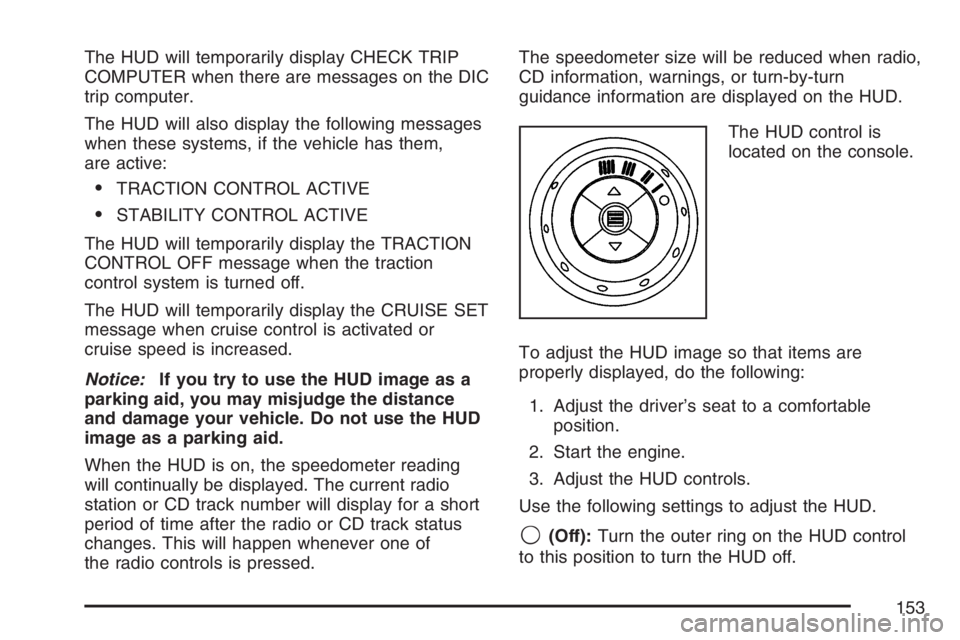
The HUD control is
located on the console.
To adjust the HUD image so that items are
properly displayed, do the following:
1. Adjust the driver’s seat to a comfortable
position.
2. Start the engine.
3. Adjust the HUD controls.
Use the following settings to adjust the HUD.
9(Off):Turn the outer ring on the HUD control
to this position to turn the HUD off.
153
Page 160 of 526
Air Conditioning
#
(Air Conditioner):Press this button to turn
the air conditioning compressor on or off. An
indicator light to the right of the button will come
on. This button has no control over the air
conditioning compressor when in Floor/Defog and
Defrost modes. The instrument panel brightness
control may have to be adjusted to the highest
setting in order to see the indicator. See
Instrument Panel Brightness on page 147for
additional information.
On hot days during the vehicle’s initial start-up,
open the windows to let hot inside air escape; then
close them. This helps to reduce the time it
takes for the vehicle to cool down. It also helps
the system to operate more efficiently.
For quicker cool down on hot days, do the
following:
1. Select any mode setting between vent and
the setting before defrost.
2. Select the air conditioner.
3. Select the coolest temperature.
4. Select the highest climate control fan speed.Using these settings will set recirculation for quicker
cool down (the light indicator will not turn on).
If outside air is desired, press the recirculation
button twice.
Using these settings together for long periods of
time may cause the air inside the vehicle to
become too dry. To prevent this from happening,
after ve minutes the recirculation door will
open slightly to allow some outside air into the
vehicle.
The air conditioning system removes moisture
from the air, so sometimes there may be a small
amount of water dripping underneath the
vehicle while it is idling or after the engine is
turned off. This is normal.
Recirculation
h
(Recirculation):Press this button to
activate the recirculation mode. With this selection,
inside air is recirculated into the vehicle. This
mode reduces outside air and odors from entering
the vehicle. It may also help to heat or cool the
air inside the vehicle more quickly.
160
Page 161 of 526
An indicator light to the right of the button will
come on to show that the recirculation button has
been pressed. The instrument panel brightness
control may have to be adjusted to the highest
setting to see the indicator.
The recirculation mode has a timer. After
ve minutes, the system’s air inlet door will move
slightly to allow for ten percent fresh outside
air to maintain interior air quality. The only way to
reset the system to full recirculation is to restart
the ve minute timer by selecting vent/outside air
and recirculation again.
Rear Window Defogger
The rear window defogger uses a warming grid to
remove fog or frost from the rear window. Be
sure to clear as much snow from the rear window
as possible.
Notice:Do not use a razor blade or sharp
object to clear the inside rear window. Do not
adhere anything to the defogger grid lines
in the rear glass. These actions may damage
the rear defogger. Repairs would not be
covered by your warranty.
=(Rear Window Defogger):Press this button
to turn the rear window defogger on or off.
An indicator light to the right of the button will
come on to show that the rear window defogger is
on. The instrument panel brightness control
may have to be adjusted to the highest setting
during the daytime in order to see the indicator
light.
The rear window defogger will turn off about
20 minutes after the button is pressed. If the button
is pressed again, it will run another 20 minutes.
The defogger can be turned off by pressing
the button again or by turning off the engine.
Do not drive the vehicle until all windows are clear.
z(Heated Seats):Press this button to turn
the heated seats on and off. The button on the left
controls the driver’s seat and the button on the
right controls the passenger’s seat. SeeHeated
Seats on page 10for additional information.
161
Page 165 of 526
Defogging and Defrosting
Fog on the inside of windows is a result of high
humidity (moisture) condensing on the cool window
glass. This can be minimized if the climate
control system is used properly. There are
two modes to clear fog or frost from your
windshield. Use the oor/defog mode to clear the
windows of fog or moisture and warm the
passengers. Use the defrost mode to remove fog
or frost from the windshield more quickly.
-(Floor/Defog):This mode directs the air
between the windshield, oor outlets and side
windows. When you select this mode, the system
turns off recirculation and runs the air-conditioning
compressor unless the outside temperature is near
or below freezing. Pressing the recirculation button,
while in this mode, will have no effect other than
turning on the indicator light.
1(Defrost):This mode directs most of the air to
the windshield, with some air directed to the side
windows. In this mode, the system will
automatically turn off the recirculation and run the
air conditioning compressor, unless the outside
temperature is near or below freezing. Pressing the
recirculation button, while in this mode, will have no
affect other than turning on the indicator light.
Rear Window Defogger
The rear window defogger uses a warming grid to
remove fog or frost from the rear window.
The rear window defogger will only work when the
engine is running.
=(Rear Window Defogger):Press this button
to turn the rear window defogger on and off. Be
sure to clear as much snow from the rear window
as possible.
The rear window defogger will turn off about
20 minutes after the button is pressed. If turned
on again, the defogger will only run for about
20 minutes before turning off. The defogger can
also be turned off by pressing the button again or
by turning off the engine.
Do not drive the vehicle until all the windows are
clear.
Notice:Do not use anything sharp on the
inside of the rear window. If you do, you could
cut or damage the warming grid, and the repairs
would not be covered by your warranty. Do not
attach a temporary vehicle license, tape, a decal
or anything similar to the defogger grid.
165
Page 166 of 526
Outlet Adjustment
Turn the air outlets, located in the middle and at
each outboard side of the instrument panel,
to adjust the direction of the airow.
Operation Tips
Clear away any ice, snow, or leaves from the
air inlets at the base of the windshield that
may block the ow of air into the vehicle.
Use of non-GM approved hood deectors may
adversely affect the performance of the
system.
Keep the path under the front seats clear of
objects to help circulate the air inside of the
vehicle more effectively.
If the airow seems low when the fan is at the
highest setting, the passenger compartment
air lter may need to be replaced. See
“Passenger Compartment Air Filter” following,
for more information.
Passenger Compartment Air Filter
The passenger compartment air lter is located
near the passenger’s side windshield wiper
arm, under the inlet grille.
The lter traps most of the pollen from entering
the climate control system. Similar to the engine’s
air lter, it may need to be changed periodically
to insure system performance. SeeScheduled
Maintenance on page 473for more information.
To change the passenger compartment air
lter, do the following:
1. Turn the ignition to ACC and the windshield
wipers on.
2. Turn the ignition to OFF when the windshield
wipers are in the upright position.
3. Raise the hood.
4. Disconnect the windshield washer pump hose
from the fender rail and the air inlet grille.
5. Remove the hood weather-strip from the
passenger’s side of the vehicle, peeling it
back halfway.
166