warning PONTIAC GRAND PRIX 2007 Workshop Manual
[x] Cancel search | Manufacturer: PONTIAC, Model Year: 2007, Model line: GRAND PRIX, Model: PONTIAC GRAND PRIX 2007Pages: 526, PDF Size: 2.92 MB
Page 302 of 526
Learn to recognize warning clues — such as
enough water, ice, or packed snow on the road to
make a mirrored surface — and slow down when
you have any doubt.
If you have the Anti-Lock Brake System (ABS),
remember: It helps avoid only the braking skid. If
you do not have ABS, then in a braking skid,
where the wheels are no longer rolling, release
enough pressure on the brakes to get the wheels
rolling again. This restores steering control.
Push the brake pedal down steadily when you
have to stop suddenly. As long as the wheels are
rolling, you will have steering control.
Driving at Night
Night driving is more dangerous than day driving.
One reason is that some drivers are likely to
be impaired — by alcohol or drugs, with night
vision problems, or by fatigue.
Here are some tips on night driving.
Drive defensively.
Do not drink and drive.
Adjust the inside rearview mirror to reduce the
glare from headlamps behind you.
Since you cannot see as well, you may need
to slow down and keep more space between
you and other vehicles.
Slow down, especially on higher speed roads.
Your vehicle’s headlamps can light up only so
much road ahead.
In remote areas, watch for animals.
If you are tired, pull off the road in a safe
place and rest.
No one can see as well at night as in the daytime.
But as we get older these differences increase.
A 50-year-old driver may require at least twice as
much light to see the same thing at night as a
20-year-old.
What you do in the daytime can also affect your
night vision. For example, if you spend the
day in bright sunshine you are wise to wear
sunglasses. Your eyes will have less trouble
adjusting to night. But if you are driving, do not
wear sunglasses at night. They may cut down on
glare from headlamps, but they also make a
lot of things invisible.
302
Page 305 of 526
Driving Through Deep Standing Water
Notice:If you drive too quickly through deep
puddles or standing water, water can come in
through your engine’s air intake and badly
damage your engine. Never drive through water
that is slightly lower than the underbody of your
vehicle. If you cannot avoid deep puddles or
standing water, drive through them very slowly.
Driving Through Flowing Water
{CAUTION:
Flowing or rushing water creates strong
forces. If you try to drive through owing
water, as you might at a low water
crossing, your vehicle can be carried away.
CAUTION: (Continued)
CAUTION: (Continued)
As little as six inches of owing water
can carry away a smaller vehicle. If this
happens, you and other vehicle occupants
could drown. Do not ignore police warning
signs, and otherwise be very cautious
about trying to drive through owing water.
Some Other Rainy Weather Tips
Besides slowing down, allow some extra
following distance. And be especially careful
when you pass another vehicle. Allow yourself
more clear room ahead, and be prepared to
have your view restricted by road spray.
Have good tires with proper tread depth.
SeeTires on page 400.
305
Page 306 of 526
City Driving
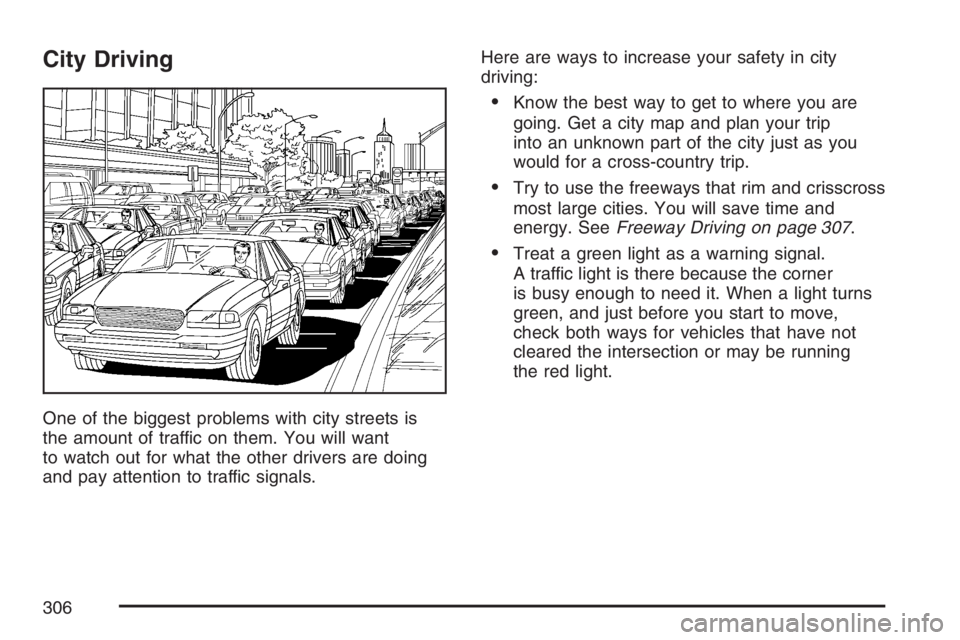
One of the biggest problems with city streets is
the amount of traffic on them. You will want
to watch out for what the other drivers are doing
and pay attention to traffic signals.Here are ways to increase your safety in city
driving:
Know the best way to get to where you are
going. Get a city map and plan your trip
into an unknown part of the city just as you
would for a cross-country trip.
Try to use the freeways that rim and crisscross
most large cities. You will save time and
energy. SeeFreeway Driving on page 307.
Treat a green light as a warning signal.
A traffic light is there because the corner
is busy enough to need it. When a light turns
green, and just before you start to move,
check both ways for vehicles that have not
cleared the intersection or may be running
the red light.
306
Page 312 of 526
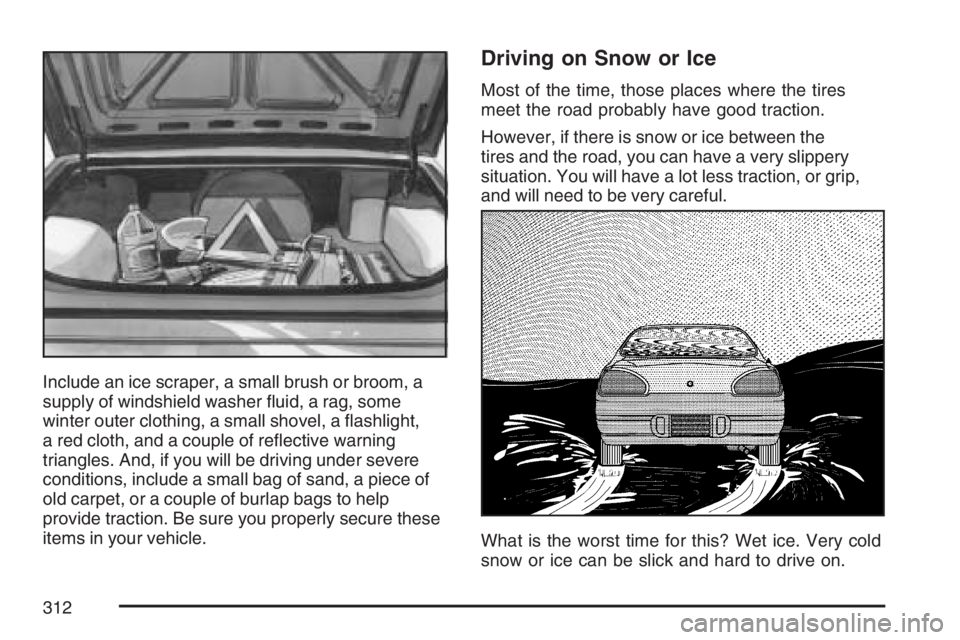
Include an ice scraper, a small brush or broom, a
supply of windshield washer uid, a rag, some
winter outer clothing, a small shovel, a ashlight,
a red cloth, and a couple of reective warning
triangles. And, if you will be driving under severe
conditions, include a small bag of sand, a piece of
old carpet, or a couple of burlap bags to help
provide traction. Be sure you properly secure these
items in your vehicle.
Driving on Snow or Ice
Most of the time, those places where the tires
meet the road probably have good traction.
However, if there is snow or ice between the
tires and the road, you can have a very slippery
situation. You will have a lot less traction, or grip,
and will need to be very careful.
What is the worst time for this? Wet ice. Very cold
snow or ice can be slick and hard to drive on.
312
Page 329 of 526
Passing
More passing distance is needed up ahead when
towing a trailer. And, because the vehicle and
trailer are a good deal longer, distances between
any vehicles that are passed must be greater,
before returning to the proper lane.
Backing Up
Hold the bottom of the steering wheel with one
hand. Then, to move the trailer to the left, move that
hand to the left. To move the trailer to the right,
move that hand to the right. Always back up slowly
and, if possible, have someone guide you.
Making Turns
Notice:Making very sharp turns while
trailering could cause the trailer to come in
contact with the vehicle. Your vehicle could
be damaged. Avoid making very sharp
turns while trailering.
When turning with a trailer, make wider turns than
normal. Do this so the trailer will not strike soft
shoulders, curbs, road signs, trees, or other
objects. Avoid jerky or sudden maneuvers.
Signal well in advance.
Turn Signals When Towing a Trailer
When towing a trailer, the vehicle may need a
different turn signal asher and/or extra wiring.
Check with your dealer. The arrows on the
instrument panel will ash whenever signaling a
turn or lane change. Properly hooked up, the trailer
lamps will also ash, telling other drivers the vehicle
and trailer are about to turn, change lanes, or stop.
When towing a trailer, the arrows on the instrument
panel will ash for turns even if the bulbs on the
trailer are burned out. You may think drivers behind
you are seeing the turn signal when they are not. It
is important to check occasionally to be sure the
trailer bulbs are still working.
The vehicle has bulb warning lights. When a trailer
lighting system is plugged into the vehicle’s lighting
system, its bulb warning lights may not indicate if
one of the lamps goes out. So, when a trailer
lighting system is plugged in, be sure to check the
vehicle and trailer lamps from time to time to be
sure they are all working. Once the trailer lamps
have been disconnected, the bulb warning lights
can once again indicate if one of the vehicle lamps
is out.
329
Page 333 of 526
Service........................................................ 336
Accessories and Modications................... 336
California Proposition 65 Warning.............. 337
Doing Your Own Service Work.................. 337
Adding Equipment to the Outside of
Your Vehicle.......................................... 338
Fuel............................................................. 338
Gasoline Octane........................................ 338
Gasoline Specications.............................. 339
California Fuel........................................... 340
Additives................................................... 340
Fuels in Foreign Countries........................ 341
Filling the Tank......................................... 342
Filling a Portable Fuel Container............... 344
Checking Things Under the Hood.............. 344
Hood Release........................................... 345
Engine Compartment Overview.................. 346
Engine Oil................................................. 350
Engine Oil Life System.............................. 353
Supercharger Oil....................................... 355
Engine Air Cleaner/Filter............................ 355
Automatic Transaxle Fluid......................... 357Engine Coolant.......................................... 360
Pressure Cap............................................ 364
Engine Overheating................................... 364
Overheated Engine Protection
Operating Mode..................................... 366
Cooling System......................................... 366
Power Steering Fluid ................................. 376
Windshield Washer Fluid........................... 377
Brakes...................................................... 378
Battery...................................................... 381
Jump Starting............................................ 382
Headlamp Aiming........................................ 388
Bulb Replacement....................................... 391
Halogen Bulbs........................................... 391
Headlamps and Sidemarker Lamps........... 391
Front Turn Signal, Parking and
Fog Lamps............................................ 394
Taillamps, Turn Signal, and Stoplamps...... 395
Back-Up Lamps......................................... 397
License Plate Lamp................................... 398
Replacement Bulbs................................... 398
Windshield Replacement............................ 399
Section 5 Service and Appearance Care
333
Page 337 of 526
California Proposition 65 Warning
Most motor vehicles, including this one, contain
and/or emit chemicals known to the State of
California to cause cancer and birth defects or other
reproductive harm. Engine exhaust, many parts and
systems (including some inside the vehicle), many
uids, and some component wear by-products
contain and/or emit these chemicals.
Doing Your Own Service Work
{CAUTION:
You can be injured and your vehicle could
be damaged if you try to do service work
on a vehicle without knowing enough
about it.
Be sure you have sufficient knowledge,
experience, the proper replacement
parts, and tools before you attempt any
vehicle maintenance task.
CAUTION: (Continued)
CAUTION: (Continued)
Be sure to use the proper nuts, bolts,
and other fasteners. English and
metric fasteners can be easily
confused. If you use the wrong
fasteners, parts can later break or fall
off. You could be hurt.
If you want to do some of your own service work,
you will want to use the proper service manual.
It tells you much more about how to service your
vehicle than this manual can. To order the
proper service manual, seeService Publications
Ordering Information on page 511.
Your vehicle has an airbag system. Before
attempting to do your own service work, see
Servicing Your Airbag-Equipped Vehicle on
page 78.
You should keep a record with all parts receipts
and list the mileage and the date of any service
work you perform. SeeMaintenance Record
on page 487.
337
Page 343 of 526
{CAUTION:
If you spill fuel and then something
ignites it, you could be badly burned. Fuel
can spray out on you if you open the fuel
cap too quickly. This spray can happen if
your tank is nearly full, and is more likely
in hot weather. Open the fuel cap slowly
and wait for any hiss noise to stop. Then
unscrew the cap all the way.
Be careful not to spill fuel. Do not top off or overll
the tank and wait a few seconds after you have
nished pumping before removing the nozzle.
Clean fuel from painted surfaces as soon
as possible. SeeWashing Your Vehicle on
page 453.
When replacing the fuel cap, turn it clockwise until
it clicks. Make sure the cap is fully installed.
The diagnostic system can determine if the fuel
cap has been left off or improperly installed.
This would allow fuel to evaporate into the
atmosphere. SeeMalfunction Indicator Lamp on
page 180.The CHECK GAS CAP message will be displayed
on the Driver Information Center (DIC) if the
fuel cap is not properly installed. SeeDIC
Warnings and Messages on page 200for more
information.
{CAUTION:
If a re starts while you are refueling, do
not remove the nozzle. Shut off the ow of
fuel by shutting off the pump or by
notifying the station attendant. Leave the
area immediately.
Notice:If you need a new fuel cap, be sure to
get the right type. Your dealer can get one
for you. If you get the wrong type, it may not
t properly. This may cause your malfunction
indicator lamp to light and may damage
your fuel tank and emissions system. See
Malfunction Indicator Lamp on page 180.
343
Page 350 of 526
Engine Oil
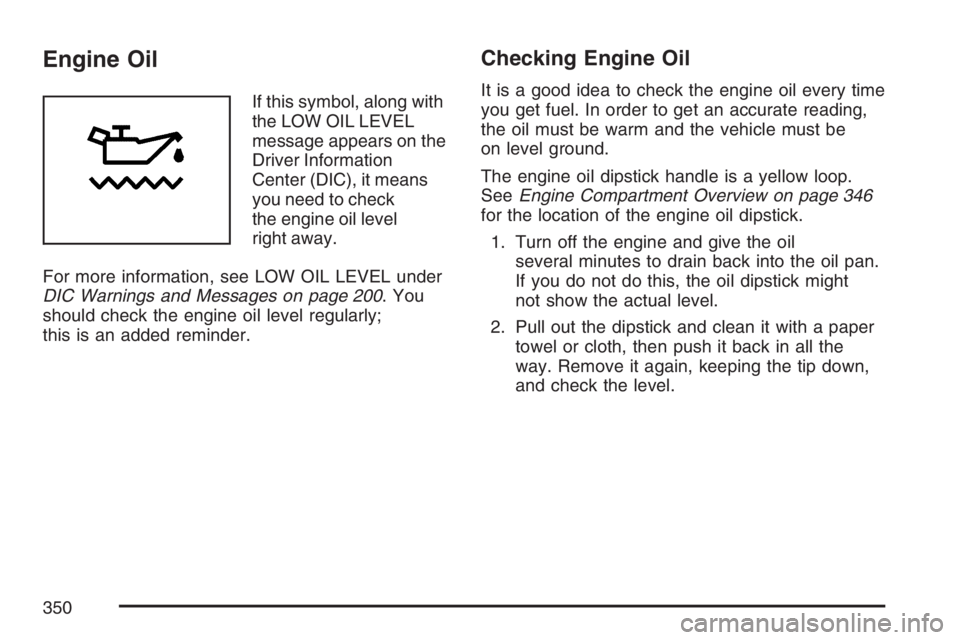
If this symbol, along with
the LOW OIL LEVEL
message appears on the
Driver Information
Center (DIC), it means
you need to check
the engine oil level
right away.
For more information, see LOW OIL LEVEL under
DIC Warnings and Messages on page 200. You
should check the engine oil level regularly;
this is an added reminder.
Checking Engine Oil
It is a good idea to check the engine oil every time
you get fuel. In order to get an accurate reading,
the oil must be warm and the vehicle must be
on level ground.
The engine oil dipstick handle is a yellow loop.
SeeEngine Compartment Overview on page 346
for the location of the engine oil dipstick.
1. Turn off the engine and give the oil
several minutes to drain back into the oil pan.
If you do not do this, the oil dipstick might
not show the actual level.
2. Pull out the dipstick and clean it with a paper
towel or cloth, then push it back in all the
way. Remove it again, keeping the tip down,
and check the level.
350
Page 353 of 526
If you are in an area of extreme cold, where the
temperature falls below−20°F (−29°C), it is
recommended that you use either an SAE 5W-30
synthetic oil or an SAE 0W-30 oil. Both will
provide easier cold starting and better protection
for the engine at extremely low temperatures.
Engine Oil Additives
Do not add anything to the engine oil. The
recommended oils with the starburst symbol that
meet GM Standard GM6094M are all you will need
for good performance and engine protection.
Engine Oil Life System
When to Change Engine Oil
Your vehicle has a computer system that lets you
know when to change the engine oil and lter.
This is based on engine revolutions and engine
temperature, and not on mileage. Based on driving
conditions, the mileage at which an oil change
will be indicated can vary considerably. For the oil
life system to work properly, you must reset the
system every time the oil is changed.When the system has calculated that oil life has
been diminished, it will indicate that an oil change
is necessary. A CHANGE OIL SOON message
will come on. SeeDIC Warnings and Messages on
page 200. Change the oil as soon as possible
within the next 600 miles (1 000 km). It is possible
that, if you are driving under the best conditions,
the oil life system may not indicate that an oil
change is necessary for over a year. However, the
engine oil and lter must be changed at least
once a year and at this time the system must be
reset. Your dealer has GM-trained service
people who will perform this work using genuine
GM parts and reset the system. It is also important
to check the oil regularly and keep it at the
proper level.
If the system is ever reset accidentally, you must
change the oil at 3,000 miles (5 000 km) since
the last oil change. Remember to reset the oil life
system whenever the oil is changed.
353