light PONTIAC GTO 2005 Repair Manual
[x] Cancel search | Manufacturer: PONTIAC, Model Year: 2005, Model line: GTO, Model: PONTIAC GTO 2005Pages: 318, PDF Size: 2.06 MB
Page 203 of 318

If the system is ever reset accidentally, you must
change the oil at 3,000 miles (5 000 km) since your last
oil change. Remember to reset the oil life system
whenever the oil is changed.
After changing the engine oil, reset the system by
performing the following steps:
How to Reset the Engine Oil Life
System
The Engine Oil Life System calculates when to change
the engine oil and filter based on vehicle use. Anytime
engine oil is changed, reset the system so it can
calculate when the next oil change is required. If a
situation occurs where you change your oil prior to
the Service Engine Oil light being turned on, reset
the system.
1. With the engine off, turn the ignition key to ON.
2. Fully press and release the accelerator pedal slowly
two times within five seconds.
3. Turn the key to LOCK.
If the Service Engine Oil light comes back on when
you start your vehicle, the engine oil life system
has not reset. Repeat the procedure.
What to Do with Used Oil
Used engine oil contains certain elements that may be
unhealthy for your skin and could even cause cancer.
Do not let used oil stay on your skin for very long. Clean
your skin and nails with soap and water, or a good
hand cleaner. Wash or properly dispose of clothing or
rags containing used engine oil. See the manufacturer’s
warnings about the use and disposal of oil products.
Used oil can be a threat to the environment. If you
change your own oil, be sure to drain all the oil from the
filter before disposal. Never dispose of oil by putting it
in the trash, pouring it on the ground, into sewers, or into
streams or bodies of water. Instead, recycle it by
taking it to a place that collects used oil. If you have a
problem properly disposing of used oil, ask your
dealer, a service station, or a local recycling center
for help.
5-17
Page 204 of 318

Engine Air Cleaner/Filter
SeeEngine Compartment Overview on page 5-12for
more information on the location of the engine air
cleaner/filter.
When to Inspect the Engine Air
Cleaner/Filter
Inspect the air cleaner/filter at every oil change and
replace at the first oil change after 25,000 miles
(41 500 km). SeeScheduled Maintenance on page 6-4
for more information.
How to Inspect the Engine Air
Cleaner/Filter
To inspect the air cleaner/filter, remove the filter from
the vehicle and lightly shake the filter to release
loose dust and dirt. If the filter remains caked with dirt, a
new filter is required.
To inspect or replace the engine air cleaner/filter, do the
following:
1. Remove the screws that hold the cover on.
2. Lift off the cover.
3. Inspect or replace the engine air cleaner/filter.
4. Put the cover back on tightly.
5-18
Page 207 of 318
The level should never read over the HOT mark, so be
careful not to add too much. It does not take much
fluid, generally less than 0.6 pints (0.3 L). Do not overfill.
Notice:Use of the incorrect automatic transmission
uid may damage your vehicle, and the damages
may not be covered by your warranty. Always
use the automatic transmission uid listed in
Recommended Fluids and Lubricants on page 6-12.
•After adding fluid, recheck the fluid level as
described under “How to Check,” earlier in
this section.
•When the correct fluid level is obtained, push the
dipstick back in all the way.
Remember to always replace the dipstick and lock
the handle down.
•If fluid has to be added often, there may be a
problem or leak and you should see your dealer.
Manual Transmission Fluid
When to Check
A good time to have your manual transmission fluid
checked is when the engine oil is changed. However,
the fluid in your manual transmission does not
require changing.
How to Check
Because this operation can be difficult, you may choose
to have this done at your dealership service department.
If you do it yourself, be sure to follow all the instructions
here, or you could get a false reading.
Notice:Too much or too little uid can damage
your transmission. Too much can mean that some
of the uid could come out and fall on hot engine
part or exhaust system parts, starting a re.
Too little uid could cause the transmission to
overheat. Be sure to get an accurate reading if you
check your transmission uid.
Check the fluid level only when your engine is off, the
vehicle is parked on a level place and the transmission
is cool enough for you to rest your fingers on the
transmission case.
Then, follow these steps:
1. Remove the reverse light switch.
2. Check that the lubricant level is up to the bottom of
the switch hole.
3. If the fluid level is good, install the switch and be
sure it is fully seated. If the fluid level is low, add
more fluid as described in the next steps.
5-21
Page 208 of 318
How to Add Fluid
Here is how to add fluid. Refer to the Maintenance
Schedule to determine what kind of fluid to use. See
Recommended Fluids and Lubricants on page 6-12.
1. Remove the reverse light switch.
2. Add fluid at the switch hole. Add only enough
fluid to bring the fluid level up to the bottom of
the switch hole.
3. Install the reverse light switch. Be sure the switch is
fully seated.
Hydraulic Clutch
The clutch fluid level should be checked weekly. A fluid
loss in this system could indicate a problem. If the
clutch fluid requires constant filling it could indicate a
leak. Have the system inspected and repaired by
your dealer. Adding fluid will not correct a leak.
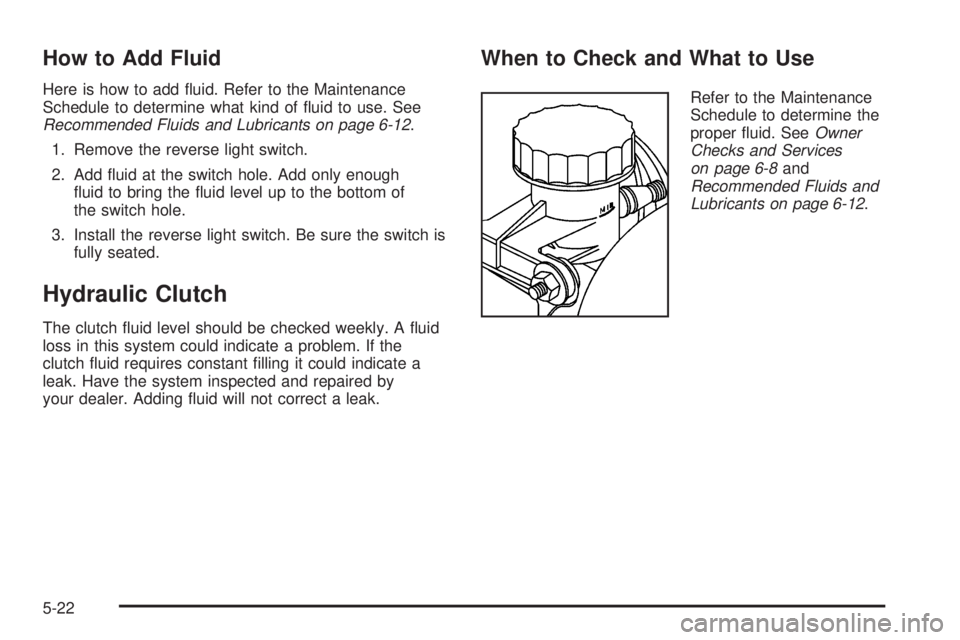
When to Check and What to Use
Refer to the Maintenance
Schedule to determine the
proper fluid. SeeOwner
Checks and Services
on page 6-8and
Recommended Fluids and
Lubricants on page 6-12.
5-22
Page 209 of 318
How to Check and Add Fluid
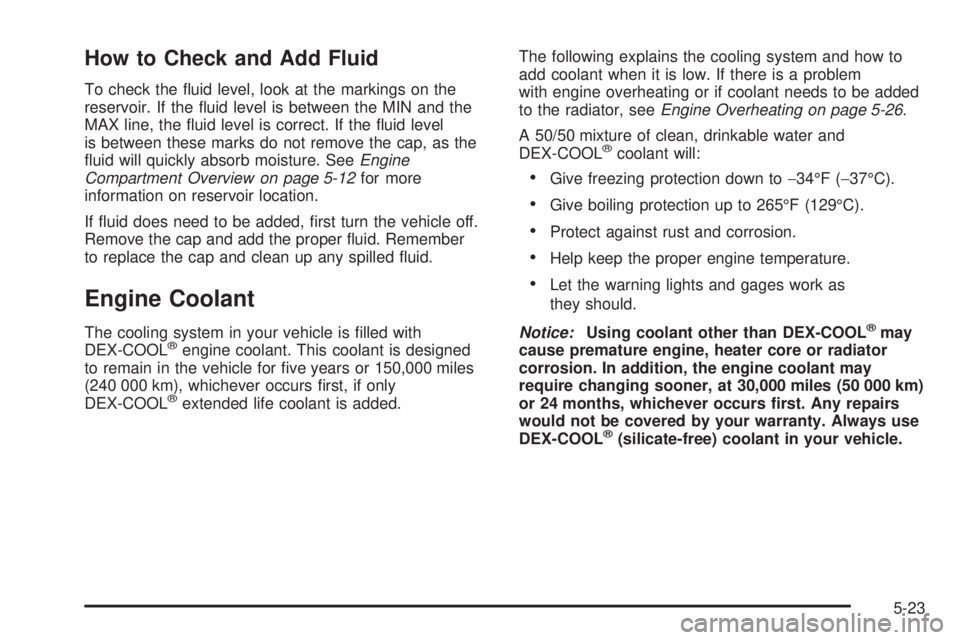
To check the fluid level, look at the markings on the
reservoir. If the fluid level is between the MIN and the
MAX line, the fluid level is correct. If the fluid level
is between these marks do not remove the cap, as the
fluid will quickly absorb moisture. SeeEngine
Compartment Overview on page 5-12for more
information on reservoir location.
If fluid does need to be added, first turn the vehicle off.
Remove the cap and add the proper fluid. Remember
to replace the cap and clean up any spilled fluid.
Engine Coolant
The cooling system in your vehicle is filled with
DEX-COOL®engine coolant. This coolant is designed
to remain in the vehicle for five years or 150,000 miles
(240 000 km), whichever occurs first, if only
DEX-COOL
®extended life coolant is added.The following explains the cooling system and how to
add coolant when it is low. If there is a problem
with engine overheating or if coolant needs to be added
to the radiator, seeEngine Overheating on page 5-26.
A 50/50 mixture of clean, drinkable water and
DEX-COOL
®coolant will:
•Give freezing protection down to−34°F (−37°C).
•Give boiling protection up to 265°F (129°C).
•Protect against rust and corrosion.
•Help keep the proper engine temperature.
•Let the warning lights and gages work as
they should.
Notice:Using coolant other than DEX-COOL
®may
cause premature engine, heater core or radiator
corrosion. In addition, the engine coolant may
require changing sooner, at 30,000 miles (50 000 km)
or 24 months, whichever occurs rst. Any repairs
would not be covered by your warranty. Always use
DEX-COOL
®(silicate-free) coolant in your vehicle.
5-23
Page 222 of 318

Brakes
Brake Fluid
Your brake master cylinder
reservoir is filled with
DOT-4 brake fluid. See
Engine Compartment
Overview on page 5-12for
the location of the
reservoir.
There are only two reasons why the brake fluid level in
the reservoir might go down. The first is that the
brake fluid goes down to an acceptable level during
normal brake lining wear. When new linings are put in,
the fluid level goes back up. The other reason is
that fluid is leaking out of the brake system. If it is, you
should have your brake system fixed, since a leak
means that sooner or later your brakes will not work
well, or will not work at all.So, it is not a good idea to top off your brake fluid.
Adding brake fluid will not correct a leak. If you add fluid
when your linings are worn, then you will have too
much fluid when you get new brake linings. You should
add or remove brake fluid, as necessary, only when
work is done on the brake hydraulic system.
{CAUTION:
If you have too much brake uid, it can spill on
the engine. The uid will burn if the engine is
hot enough. You or others could be burned,
and your vehicle could be damaged. Add brake
uid only when work is done on the brake
hydraulic system. See “Checking Brake Fluid”
in this section.
When your brake fluid falls to a low level, your brake
warning light will come on. SeeBrake System Warning
Light on page 3-27.
5-36
Page 224 of 318

Brake Wear
Your vehicle has four-wheel disc brakes.
Some driving conditions or climates may cause a brake
squeal when the brakes are first applied or lightly
applied. This does not mean something is wrong with
your brakes.
Properly torqued wheel nuts are necessary to help
prevent brake pulsation. When tires are rotated, inspect
brake pads for wear and evenly tighten wheel nuts in
the proper sequence to GM torque specifications.
Brake linings should always be replaced as complete
axle sets.
Brake Pedal Travel
See your dealer if the brake pedal does not return to
normal height, or if there is a rapid increase in
pedal travel. This could be a sign of brake trouble.
Brake Adjustment
Every time you make a moderate brake stop, your disc
brakes adjust for wear. If you rarely make a moderate
or heavier stop, then your brakes might not adjust
correctly. If you drive in that way, then — very
carefully — make a few moderate brake stops about
every 1,000 miles (1 600 km), so your brakes will
adjust properly.
Replacing Brake System Parts
The braking system on a vehicle is complex. Its many
parts have to be of top quality and work well together if
the vehicle is to have really good braking. Your
vehicle was designed and tested with top-quality
GM brake parts. When you replace parts of your braking
system — for example, when your brake linings wear
down and you need new ones put in — be sure you get
new approved GM replacement parts. If you do not,
your brakes may no longer work properly. For example,
if someone puts in brake linings that are wrong for
your vehicle, the balance between your front and rear
brakes can change — for the worse. The braking
performance you have come to expect can change in
many other ways if someone puts in the wrong
replacement brake parts.
5-38
Page 227 of 318

Notice:If you leave your radio or other accessories
on during the jump starting procedure, they could
be damaged. The repairs would not be covered
by your warranty. Always turn off your radio and
other accessories when jump starting your vehicle.
3. Turn off the ignition on both vehicles. Unplug
unnecessary accessories plugged into the cigarette
lighter. Turn off the radio and all lamps that are
not needed. This will avoid sparks and help save
both batteries. And it could save the radio!
4. Open the hoods and locate the batteries. Find the
positive (+) and negative (−) terminal locations on
each vehicle. SeeEngine Compartment Overview
on page 5-12for more information on location.
{CAUTION:
An electric fan can start up even when the
engine is not running and can injure you. Keep
hands, clothing and tools away from any
underhood electric fan.
{CAUTION:
Using a match near a battery can cause battery
gas to explode. People have been hurt doing
this, and some have been blinded. Use a
ashlight if you need more light. Be sure the
battery has enough water. You do not need to
add water to the battery installed in your new
vehicle. But if a battery has ller caps, be sure
the right amount of uid is there. If it is low,
add water to take care of that rst. If you don’t,
explosive gas could be present.
Battery uid contains acid that can burn you.
Do not get it on you. If you accidentally get it
in your eyes or on your skin, ush the place
with water and get medical help immediately.
5-41
Page 231 of 318
Headlamp Aiming
The vehicle has a visual optical headlamp aiming
system. The aim has been preset at the factory and
should need no further adjustment
However, if the vehicle is damaged in an accident, the
headlamp aim may be affected and adjustment may
be necessary.
If oncoming vehicles flash their high beams at you, this
may also mean the vertical aim needs to be adjusted.
It is recommended that the vehicle is taken to your
dealer for service if the headlamps need to be re-aimed.
It is possible however, to re-aim the headlamps as
described in the following procedure.
The vehicle should be properly prepared as follows:
•The vehicle should be placed so the headlamps
are 15 ft. (4.6 m) from a light colored wall or
other flat surface.
•The vehicle must have all four tires on a perfectly
level surface which is level all the way to the wall
or other flat surface.
•The vehicle should be placed so it is perpendicular
to the wall or other flat surface.
•The vehicle should not have any snow, ice, or mud
on it.
•The vehicle should be fully assembled and all other
work stopped while headlamp aiming is being
performed.
•The vehicle should be normally loaded with a full
tank of fuel and one person or 160 lbs (75 kg)
sitting on the driver’s seat.
•Tires should be properly inflated.
•The spare tire is in its original location in
the vehicle.
Headlamp aiming is done with the vehicle’s low-beam
headlamps. The high-beam headlamps will be correctly
aimed if the low-beam headlamps are aimed properly.
5-45
Page 232 of 318

To adjust the vertical aim on the headlamps, do the
following:
1. Open the hood. SeeHood Release on page 5-11
for more information.
2. Find the aim dot on the lens of the low-beam
headlamp.
3. Measure the distance from the ground to the aim
dot on the low-beam headlamp. Record the
distance.
4. At the wall or other flat surface, measure from the
ground upward the recorded distance from Step 2
and mark it.
5. Draw or tape a horizontal line the width of the
vehicle at the wall or other flat surface where it
was marked it Step 4.Notice:Do not cover a headlamp to improve beam
cut-off when aiming. Covering a headlamp may
cause excessive heat build-up which may cause
damage to the headlamp.
6. Turn on the low-beam headlamps and place a
piece of cardboard or equivalent in front of the
headlamp not being aimed. This should allow only
the beam of light from the headlamp being
aimed to be seen on the flat surface.
7. Locate the vertical headlamp aiming screws, which
are under the hood near each headlamp assembly.
The adjustment screw can be turned with a
No. 2 Phillips head screwdriver.
5-46