run flat PONTIAC PONTIAC 1995 Owners Manual
[x] Cancel search | Manufacturer: PONTIAC, Model Year: 1995, Model line: PONTIAC, Model: PONTIAC PONTIAC 1995Pages: 354, PDF Size: 17.27 MB
Page 2 of 354
1995 Pontiac Grand Prix Owner’s Manual
Seats and Restraint Systems ...... F.-c-.,. ............................................... 1-1
This section tells you how to use your seats and safety belts prop\
erly. It also explains the “SRS” system.
Features and Controls ............................................................... 2-1
This section explains how to start and operate your Pontiac.
Comfort Controls and Audio Systems .................................................. 3-1
This section tells you how to adjust the ventilation and comfort controls and how to operate your
audio system.
YourDrivingandtheRoad ........................................................... 4-1
ProblernsontheRoad ............................................................... 5-1
Here you’ll find helpful information and tips about the road\
and how to drive under different conditions.
This section tells you what to
do if you have a problem while driving, such as a flat tire or engine
overheating, etc.
Here the manual tells you how to keep your Pontiac running properly and looking good.
This section tells you when to perform vehicle maintenance and \
what fluids and lubricants
to use.
This section tells you how to contact Pontiac for assistance and how to get service publications.
It
also gives you information on “Reporting Safety Defects” on pag\
e 8-4.
Here’s an alphabetical listing of almost every subject in this manual. You can use it to quickly find
something you want to read.
Service and Appearance Care.. ....................................................... 6-1
Maintenanceschedule ............................................................... 7-1
Customer Assistance Information ..................................................... 8-1
Index ........................................................................\
..... 9-1
i
ProCarManuals.com
Page 102 of 354
Put small loads, like grocery bags, behind the net. It can
help keep them from falling over during sharp turns or
quick starts and stops.
The net isn’t for larger, heavier loads. Store them in the
trunk as far forward as you can.
You can unhook the net so that it will lie flat when
you’re not using it. On two-door models, push the net
down and hook
it under the plastic hooks.
Storage and Compartments
Storage Armrest
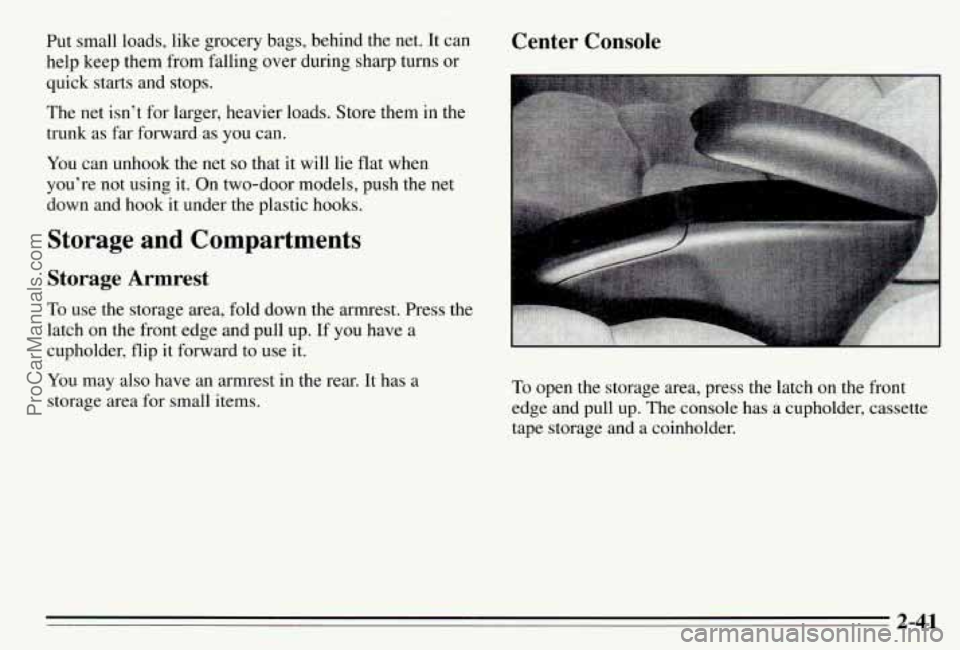
To use the storage area, fold down the armrest. Press the
latch on the front edge and pull up.
If you have a
cupholder, flip it forward to use it.
You may also have an armrest in the rear. It has
a
storage area for small items. To open the storage area, press the latch on the front
edge and pull up. The console has a cupholder, cassette
tape storage and a coinholder.
2-41
ProCarManuals.com
Page 170 of 354
Then, shut the engine off and close the window almost
all the
way to preserve the heat, Start the engine again
and repeat this only when
you feel really uncomfortable
from the cold. But do
it as little as possible. Preserve the
he1 as long as you can. To help keep warm, you can get
out
of the vehicle and do sume fairly vigorous exercises
every half hour
or so until help comes.
Loading Your Vehicle
/bI OCCUPANTS
VEHICLE CAP. WT.
TIRE-LOADING INFORMATION
FRT.
CTR. RR. TOTAL LBS. KG
MAX. LOADING & GVWR SAME AS VEHICLE I
CAPACITY WEIGHT XXX COLD TIRE
TIRE
SIZE SPEED PRESSURE
RTG PSI/KPa
FRT.
RR.
SPA.
IF TIRES ARE HOT, ADD 4PS1/28KPa
SEE OWNER’S MANUAL
FOR ADDITIONAL
INFORMATiON
/
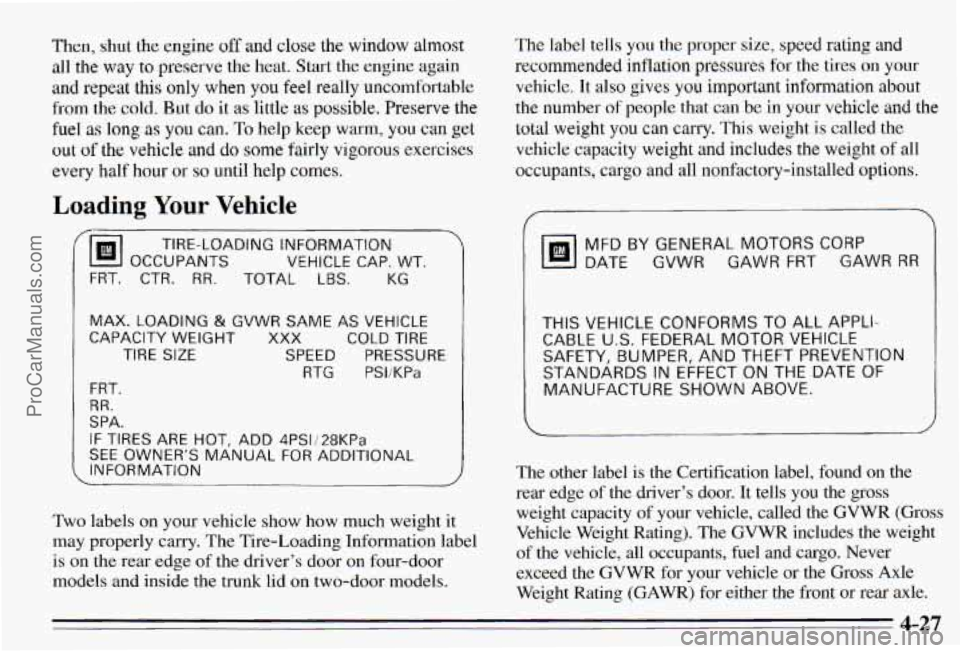
Two labels on your vehicle show how much weight it
may properly carry. The Tire-Loading Information label
is on
the rear edge of the driver’s door on four-door
models and inside the trunk lid on two-door models. The label tells you the proper
size, speed rating and
recommended inflation pressures
for the tires on your
vehicle.
It also gives you important information about
the number of people that can be in your vehicle and the
total weight
you can carry. This weight is called the
vehicle capacity weight and includes the weight
of all
occupants, cargo and all nonfactory-installed options.
MFD BY GENERAL MOTORS CORP
DATE GVWR GAWR FRT GAWR RR
THIS VEHICLE CONFORMS TO ALL APPLI-
CABLE
U.S. FEDERAL MOTOR VEHICLE
SAFETY, BUMPER, AND THEFT PREVENTION
STANDARDS IN EFFECT ON
THE DATE OF
MANUFACTURE SHOWN ABOVE.
The other label is the Certification label, found on the
rear edge of the driver’s door. It tells you the
gross
weight capacity of your vehicle, called the GVWR (Gross
Vehicle Weight Rating). The GVWR includes the weight of
the vehicle, all occupants, fuel and cargo. Never
exceed the GVWR for your vehicle or the Gross
Axle
Weight Rating (GAWR) for either the front or rear axle.
4-27
ProCarManuals.com
Page 174 of 354
Weight of the Trailer Tongue
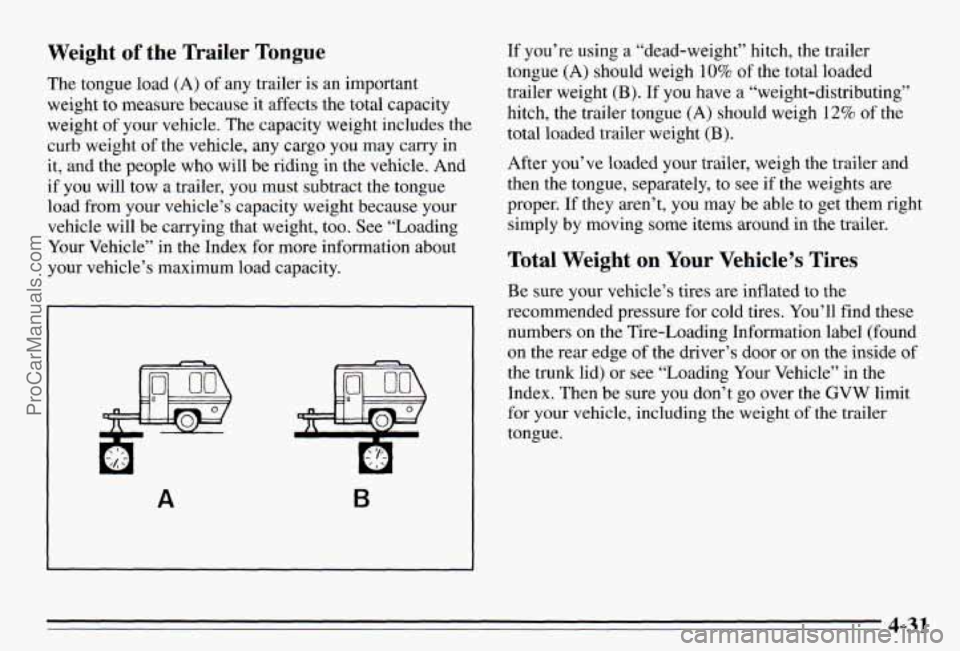
The tongue load (A) of any trailer is an important
weight to measure because it affects the total capacity
weight of your vehicle. The capacity weight includes the
curb weight of the velucle, any cargo you
may carry in
it, and the people who will be riding in the vehicle. And
if you will tow a trailer, you must subtract the tongue
load from your vehicle’s capacity weight because your
vehicle will be carrying that weight, too. See “Loading
Your Vehicle” in the Index for more information about
your vehicle’s maximum load capacity.
A B
If you’re using a “dead-weight” hitch, the trailer
tongue
(A) should weigh 10% of the total loaded
trailer weight
(B). If you have a “weight-distributing”
hitch, the trailer tongue
(A) should weigh 12% of the
total loaded trailer weight
(B).
After you’ve loaded your trailer, weigh the trailer and
then the tongue, separately, to see if the weights
are
proper. If they aren’t, you may be able to get them right \
simply
by moving some items around in the trailer.
Total Weight on Your Vehicle’s Tires
Be sure your vehicle’s tires are inflated to the
recommended pressure for cold tires. You’ll find these
numbers on the Tire-Loading Information label (found
on the rear edge of the driver’s door or on the inside
of
the trunk lid) or see “Loading Your Vehicle” in the
Index. Then be sure you don’t go over the
GVW limit
for your vehicle, including the weight of the trailer
tongue.
4-31
ProCarManuals.com
Page 209 of 354
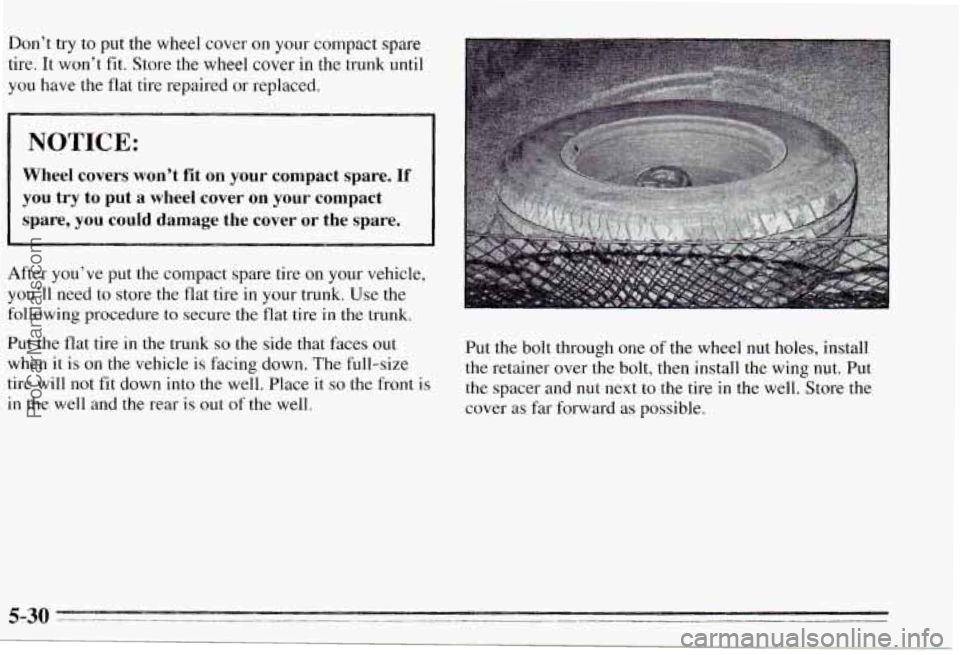
Don’t try to put the wheel cover on your compact spare
tire. It won‘t fit. Store the wheel cover in the trunk until
you have the flat tire repaired or replaced.
I NOTICE:
Wheel covers won’t fit on your compact spare. If
you try to put a wheel cover on your compact
spare, you could damage the cover or the spare.
After you’ve put the compact spare tire on your vehicle,
you’ll need
to store the flat tire in your trunk. Use the
following procedure to secure the flat tire in the trunk.
Put the flat tire in the trunk
so the side that faces out
Put the bolt through one of the wheel nut holes, install
when it
is on the vehicle is facing down. The full-size
the retainer over the bolt, then install the wing nut. Put
tire will not
fit down into the well. Place it SO the front is the spacer and nut next to the tire in the well. Store the
in the well and the rear is out of the well.
cover as far forward as possible.
ProCarManuals.com
Page 260 of 354
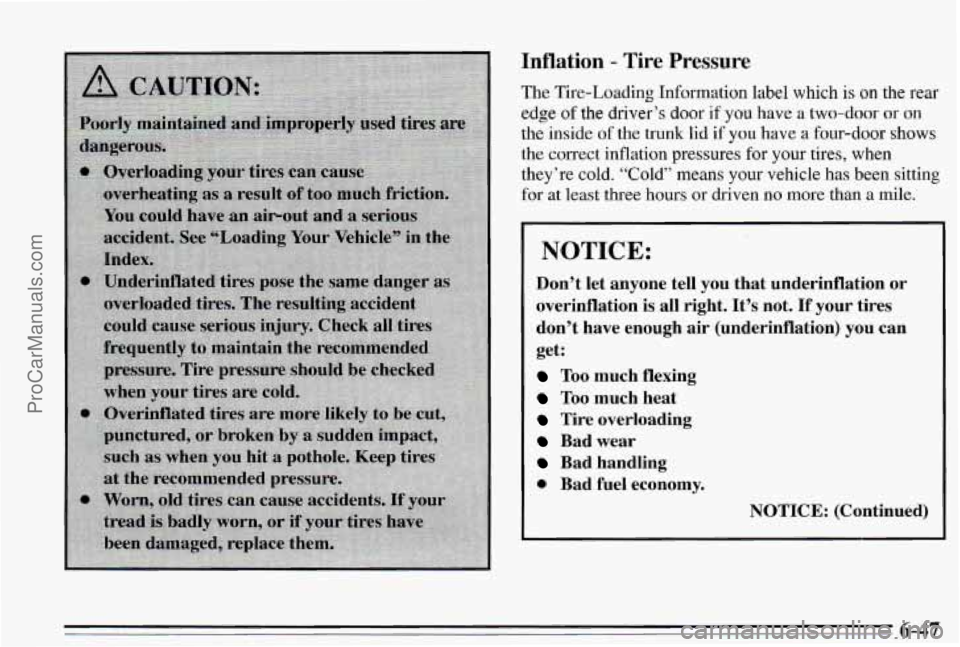
Mation - Tire Pressure
The Tire-Loading Information label which is on the rear
edge of the driver’s door if you have a two-door or on
the inside of the trunk lid if you have a four-door shows
the correct inflation pressures for your tires, when
they’re cold. “Cold” means your vehicle has been
sitting
for at least three hours or driven no more than a mile.
NOTICE:
Don’t let anyone tell you that underinflation or
overinflation is all right. It’s not. If your tires
don’t have enough air (underinflation) you can
get:
Too much flexing
Too much heat
Tire overloading
Bad wear
Bad handling
0 Bad fuel economy.
NOTICE: (Continued)
6-47 ProCarManuals.com
Page 347 of 354
Ignition Key Positions .......................... 2-12
Ignition Switch
................................. 2- 12
Inflation
- Tire Pressure .......................... 6-47
Inside Daymight Rearview Mirror ................. 2-39
Brake System
............................... 7-39
Exhaust Systems
............................. 7-39
Restraint Systems
............................ 7-39
Axle Boot and Seal
......................... 7-39
Instrument Panel
............................... 2-42
Instrument Panel Intensity Control
................. 2-35
Instrument Panel, Cleaning
....................... 6-57
Interior Lamps
................................. 2-36
Jack, Tire
.................................... 5-24
Jump Starting
................................... 5-2
Key Lock Cylinders, Maintenance
................ 7-37
Key Reminder Warning
.......................... 2- 13
Lamp, Dome
................................. 2-38
Inspections
Steering. Suspension and Front-Wheel-Drive
ThrottleLinkage
............................. 7-39
Keys
.......................................... 2-1
Lamp, Malfunction Indicator
...................... 2-56
Daytime Running
............................ 2-35
Lamps
........................................ 2-34
Battery Saver
............................... 2-36
Interior
.................................... 2-36 OnReminder
................................ 2-35
Sustained Interior Illumination
.................. 2-37
Lane Change Indicator
........................... 2-29
Larger Children. Safety Belt Use
................... 1-51
Latches, Front Seatback
........................... 1-4
Leaving Your Vehicle
............................. 2-4
Air Bag Readiness
...................... 1-24, 2-51
Anti-Lock Brake System Active
................ 2-54
Brake System Warning
........................ 2-52
Charging System
............................. 2-50
Engine Coolant Temperature
................... 2-54
Low Coolant
........................... 2-55, 6-20
Low Oil Level
.......................... 2-58, 6- 11
Oil Warning
................................. 2-57
Safety Belt Reminder
..................... 1-5, 2-50
Second Gear Start
............................ 2-20
Service Engine Soon
.......................... 2-56
Loading Your Vehicle ........................... 4-27
Automatic Door
.............................. 2-4
PowerDoor
.................................. 2-4
Steering Column
............................. 7-38
Torque
..................................... 2-24
Window
.................................... 2-27
...................................... Panel 2-35
Leaving Your Vehicle with the Engine Running
....... 2-23
Lights
Anti-Lock Brake System Warning
........... 2-53, 4-7
LowFuel
................................... 2-49
Security
.................................... 2-58
Lighter
....................................... 2-45
Locks Door
....................................... 2-3
Trunk
....................................... 2-8
9-6 ProCarManuals.com