axle PONTIAC VIBE 2004 User Guide
[x] Cancel search | Manufacturer: PONTIAC, Model Year: 2004, Model line: VIBE, Model: PONTIAC VIBE 2004Pages: 370, PDF Size: 2.68 MB
Page 93 of 370

Leaving Your Vehicle With the Engine
Running
{CAUTION:
It can be dangerous to leave your vehicle with
the engine running. Your vehicle could move
suddenly if the shift lever is not fully in
PARK (P) with the parking brake ®rmly set.
And, if you leave the vehicle with the engine
running, it could overheat and even catch ®re.
You or others could be injured. Don't leave
your vehicle with the engine running.If you have to leave your automatic transaxle vehicle
with the engine running, be sure your vehicle is in
PARK (P) and your parking brake is ®rmly set before
you leave it. After you've moved the shift lever into
PARK (P), hold the regular brake pedal down. Then, see
if you can move the shift lever away from PARK (P)
without ®rst pulling it toward you. If you can, it means
that the shift lever wasn't fully locked into PARK (P).
2-29
Page 94 of 370
Torque Lock
If you are parking on a hill and you don't shift your
automatic transaxle into PARK (P) properly, the weight
of the vehicle may put too much force on the parking
pawl in the transaxle. You may ®nd it difficult to pull the
shift lever out of PARK (P). This is called ªtorque
lock.º To prevent torque lock, set the parking brake and
then shift into PARK (P) properly before you leave
the driver's seat. To ®nd out how, see
Shifting Into Park
(P) on page 2-28.
When you are ready to drive, move the shift lever out of
PARK (P)
beforeyou release the parking brake.
If torque lock does occur, you may need to have another
vehicle push yours a little uphill to take some of the
pressure from the parking pawl in the transaxle, so you
can pull the shift lever out of PARK (P).
Shifting Out of Park (P)
If your vehicle has an automatic transaxle it has an
automatic transaxle shift lock control system. You have
to fully apply your regular brakes before you can
shift from PARK (P) when the ignition is in ON. See
Automatic Transaxle Operation on page 2-20.
If you cannot shift out of PARK (P), ease pressure on the
shift lever ± push the shift lever all the way into PARK (P)
and release the shift lever button as you maintain brake
application. Then press the shift lever button and move
the shift lever into the gear you wish.
2-30
Page 117 of 370
Reducing Speed While Using Cruise
Control
There are two ways to reduce your speed while using
cruise control:
·Push and hold the lever to SET/COAST until you
reach the lower speed you want, then release it.
·To slow down in very small amounts, push the lever
down brie¯y. Each time you do this, you'll go about
1 mph (1.6 km/h) slower.
Passing Another Vehicle While Using
Cruise Control
Use the accelerator pedal to increase your speed.
When you take your foot off the pedal, your vehicle will
slow down to the cruise control speed you set earlier.
Using Cruise Control on Hills
How well your cruise control will work on hills depends
upon your speed, load and the steepness of the hills.
When going up steep hills, you may have to step on the
accelerator pedal to maintain your speed.When going downhill, you may have to brake or shift to
a lower gear to keep your speed down. Of course,
applying the brake or downshifting to SECOND (2) or
LOW (L) takes you out of cruise control. Many
drivers ®nd this to be too much trouble and don't use
cruise control on steep hills.
Ending Cruise Control
There are several ways to turn off the cruise control:
·Step lightly on the brake pedal or push the
clutch pedal, if you have a manual transaxle.
·Press the CRUISE ON-OFF button again.
·Pull the cruise control lever toward you.
Erasing Speed Memory
When you turn off the cruise control or the ignition, your
cruise control set speed memory is erased. The set
speed memory is also erased when the vehicle speed is
less than 25 mph (40 km/h).
3-11
Page 141 of 370
Notice:Modi®cations made to the engine,
transaxle, exhaust, intake or fuel system of your
vehicle or replacement tires that do not match your
vehicle's original tires can affect your vehicle's
emission controls and may cause this light to come
on. Modi®cations to these systems could lead to
costly repairs not covered by your warranty.
This may also result in a failure to pass a required
Emission Inspection/Maintenance test.
This light should come on, as a check to show you it is
working, when the ignition is on and the engine is
not running. If the light doesn't come on, have it
repaired. This light will also come on during a
malfunction in one of two ways:
·Light FlashingÐ A mis®re condition has been
detected. A mis®re increases vehicle emissions
and may damage the emission control system on
your vehicle. Diagnosis and service may be
required.
·Light On SteadyÐ An emission control system
malfunction has been detected on your vehicle.
Diagnosis and service may be required.
If the Light Is Flashing
The following may prevent more serious damage to
your vehicle:
·Reducing vehicle speed.
·Avoiding hard accelerations.
·Avoiding steep uphill grades.
·If you are towing a trailer, reduce the amount of
cargo being hauled as soon as it is possible.
If the light stops ¯ashing and remains on steady, see
ªIf the Light Is On Steadyº following.
If the light continues to ¯ash, when it is safe to do so,
stop the vehicle.Find a safe place to park your vehicle.
Turn the key off, wait at least 10 seconds and restart
the engine. If the light remains on steady, see ªIf
the Light Is On Steadyº following. If the light is still
¯ashing, follow the previous steps, and see your dealer
for service as soon as possible.
3-35
Page 145 of 370
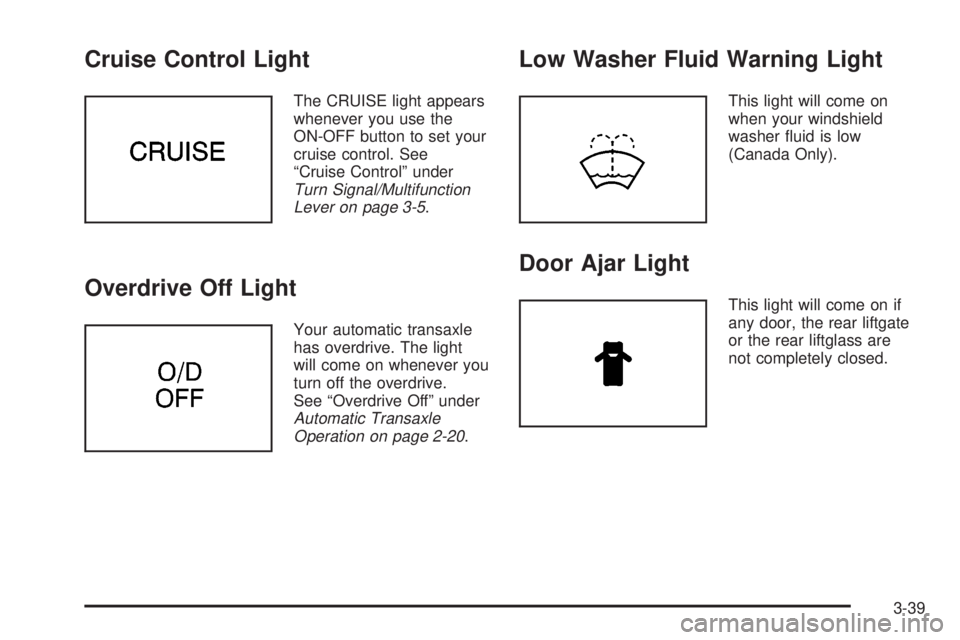
Cruise Control Light
The CRUISE light appears
whenever you use the
ON-OFF button to set your
cruise control. See
ªCruise Controlº under
Turn Signal/Multifunction
Lever on page 3-5.
Overdrive Off Light
Your automatic transaxle
has overdrive. The light
will come on whenever you
turn off the overdrive.
See ªOverdrive Offº under
Automatic Transaxle
Operation on page 2-20.
Low Washer Fluid Warning Light
This light will come on
when your windshield
washer ¯uid is low
(Canada Only).
Door Ajar Light
This light will come on if
any door, the rear liftgate
or the rear liftglass are
not completely closed.
3-39
Page 192 of 370

Highway Hypnosis
Is there actually such a condition as ªhighway
hypnosisº? Or is it just plain falling asleep at the wheel?
Call it highway hypnosis, lack of awareness, or
whatever.
There is something about an easy stretch of road with
the same scenery, along with the hum of the tires on the
road, the drone of the engine, and the rush of the
wind against the vehicle that can make you sleepy. Don't
let it happen to you! If it does, your vehicle can leave
the road in
less than a second,and you could crash and
be injured.
What can you do about highway hypnosis? First, be
aware that it can happen.
Then here are some tips:
·Make sure your vehicle is well ventilated, with a
comfortably cool interior.
·Keep your eyes moving. Scan the road ahead and
to the sides. Check your rearview mirrors and your
instruments frequently.
·If you get sleepy, pull off the road into a rest,
service or parking area and take a nap, get some
exercise, or both. For safety, treat drowsiness
on the highway as an emergency.
Hill and Mountain Roads
Driving on steep hills or mountains is different from
driving in ¯at or rolling terrain.
If you drive regularly in steep country, or if you're
planning to visit there, here are some tips that can make
your trips safer and more enjoyable.
·Keep your vehicle in good shape. Check all ¯uid
levels and also the brakes, tires, cooling system
and transaxle. These parts can work hard on
mountain roads.
4-22
Page 193 of 370
·Know how to go down hills. The most important
thing to know is this: let your engine do some of
the slowing down. Shift to a lower gear when you
go down a steep or long hill.
{CAUTION:
If you do not shift down, your brakes could get
so hot that they would not work well. You
would then have poor braking or even none
going down a hill. You could crash. Shift down
to let your engine assist your brakes on a
steep downhill slope.
{CAUTION:
Coasting downhill in NEUTRAL (N) or with the
ignition off is dangerous. Your brakes will have
to do all the work of slowing down.
CAUTION: (Continued)
CAUTION: (Continued)
They could get so hot that they would not
work well. You would then have poor braking
or even none going down a hill. You could
crash. Always have your engine running and
your vehicle in gear when you go downhill.
·Know how to go uphill. You may want to shift down
to a lower gear. The lower gears help cool your
engine and transaxle, and you can climb the
hill better.
·Stay in your own lane when driving on two-lane
roads in hills or mountains. Don't swing wide or
cut across the center of the road. Drive at speeds
that let you stay in your own lane.
·As you go over the top of a hill, be alert. There
could be something in your lane, like a stalled car or
an accident.
·You may see highway signs on mountains that
warn of special problems. Examples are long
grades, passing or no-passing zones, a falling rocks
area or winding roads. Be alert to these and take
appropriate action.
4-23
Page 198 of 370

If You Are Stuck: In Sand, Mud, Ice
or Snow
In order to free your vehicle when it is stuck, you will
need to spin the wheels, but you don't want to spin your
wheels too fast. The method known as ªrockingº can
help you get out when you're stuck, but you must
use caution.
{CAUTION:
If you let your tires spin at high speed, they
can explode, and you or others could be
injured. And, the transaxle or other parts of the
vehicle can overheat. That could cause an
engine compartment ®re or other damage.
When you are stuck, spin the wheels as little
as possible. Do not spin the wheels above
35 mph (55 km/h) as shown on the
speedometer.
Notice:Spinning your wheels can destroy parts of
your vehicle as well as the tires. If you spin the
wheels too fast while shifting your transaxle back
and forth, you can destroy your transaxle. See
ªRocking Your Vehicle To Get It Out.º
For information about using tire chains on your vehicle,
see
Tire Chains on page 5-75.
Rocking Your Vehicle To Get It Out
First, turn your steering wheel left and right. That will
clear the area around your front wheels. Then shift back
and forth between REVERSE (R) and a forward gear
(or with a manual transaxle, between FIRST (1) or
SECOND (2) and REVERSE (R)), spinning the wheels
as little as possible. Release the accelerator pedal
while you shift, and press lightly on the accelerator pedal
when the transaxle is in gear. By slowly spinning your
wheels in the forward and reverse directions, you
will cause a rocking motion that may free your vehicle.
If that doesn't get you out after a few tries, you may
need to be towed out. Or, you can use your recovery
hook. If you do need to be towed out, see
Towing Your
Vehicle on page 4-30.
4-28
Page 201 of 370

Dinghy Towing
For front-wheel-drive vehicles with manual transaxles
only do the following:
When dinghy towing, be sure to follow the posted legal
speed limit.
1. Put the shift lever in neutral.
2. Turn the ignition to ACC to avoid locking the
steering wheel. Make sure the audio system is
turned off and that nothing is plugged into the
power outlets.
3. Release the parking brake.After dinghy towing, let the engine idle for more than
three minutes before driving the vehicle.
Do not tow your vehicle from the rear. Your vehicle
could be badly damaged and the repairs would not be
covered by your warranty.
Notice:Towing an all-wheel-drive vehicle with all
four wheels on the ground, or even with only two of
its wheels on the ground, will damage drivetrain
components. Do not tow an all-wheel-drive vehicle if
any of its wheels will be on the ground.
4-31
Page 202 of 370
Dolly Towing
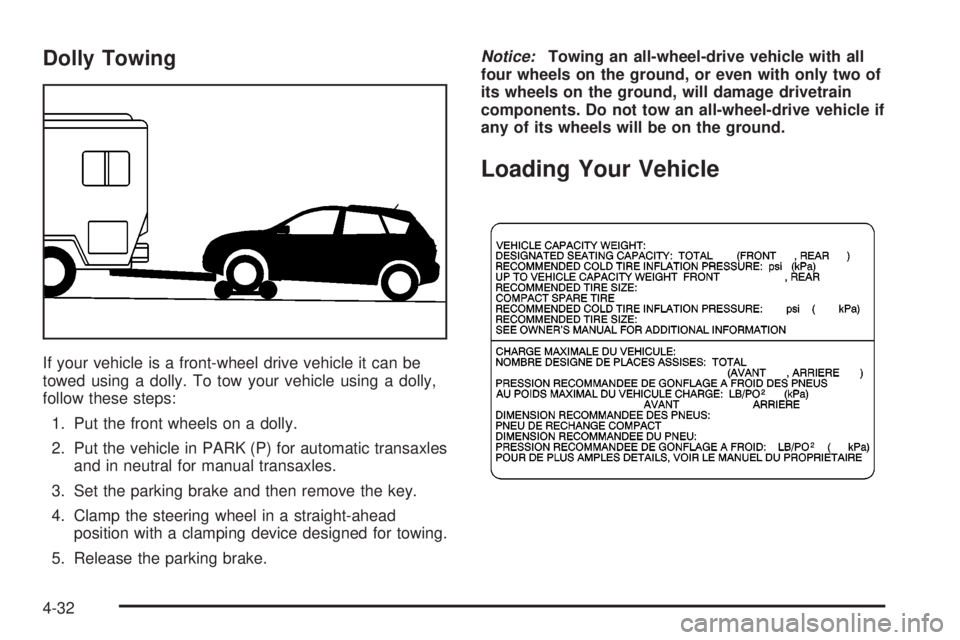
If your vehicle is a front-wheel drive vehicle it can be
towed using a dolly. To tow your vehicle using a dolly,
follow these steps:
1. Put the front wheels on a dolly.
2. Put the vehicle in PARK (P) for automatic transaxles
and in neutral for manual transaxles.
3. Set the parking brake and then remove the key.
4. Clamp the steering wheel in a straight-ahead
position with a clamping device designed for towing.
5. Release the parking brake.
Notice:Towing an all-wheel-drive vehicle with all
four wheels on the ground, or even with only two of
its wheels on the ground, will damage drivetrain
components. Do not tow an all-wheel-drive vehicle if
any of its wheels will be on the ground.
Loading Your Vehicle
4-32