axle PONTIAC VIBE 2004 Owner's Guide
[x] Cancel search | Manufacturer: PONTIAC, Model Year: 2004, Model line: VIBE, Model: PONTIAC VIBE 2004Pages: 370, PDF Size: 2.68 MB
Page 253 of 370

Brake Wear
The GT series has four-wheel disc brakes. All other
models have front disc brakes and rear drum brakes.
Disc brake pads have built-in wear indicators that make
a high-pitched warning sound when the brake pads
are worn and new pads are needed. The sound
may come and go or be heard all the time your vehicle
is moving (except when you are pushing on the
brake pedal ®rmly).
{CAUTION:
The brake wear warning sound means that
soon your brakes will not work well. That
could lead to an accident. When you hear the
brake wear warning sound, have your vehicle
serviced.
Notice:Continuing to drive with worn-out brake
pads could result in costly brake repair.
Some driving conditions or climates may cause a brake
squeal when the brakes are ®rst applied or lightly
applied. This does not mean something is wrong with
your brakes.Properly torqued wheel nuts are necessary to help
prevent brake pulsation. When tires are rotated, inspect
brake pads for wear and evenly tighten wheel nuts in
the proper sequence to GM torque speci®cations.
If you have rear drum brakes, they do not have wear
indicators, but if you ever hear a rear brake rubbing
noise, have the rear brake linings inspected immediately.
Also, the rear brake drums should be removed and
inspected each time the tires are removed for rotation or
changing. When you have the front brake pads
replaced, have the rear brakes inspected, too.
Brake linings should always be replaced as complete
axle sets.
See
Brake System Inspection on page 6-25.
Brake Pedal Travel
See your dealer if the brake pedal does not return to
normal height, or if there is a rapid increase in
pedal travel. This could be a sign of brake trouble.
Brake Adjustment
Every time you make a moderate brake stop, your disc
brakes adjust for wear. If you rarely make a moderate
or heavier stop, then your brakes might not adjust
correctly. If you drive in that way, then Ð very
carefully Ð make a few moderate brake stops about
every 1,000 miles (1 600 km), so your brakes will
adjust properly.
5-43
Page 255 of 370
Jump Starting
If your battery has run down, you may want to use
another vehicle and some jumper cables to start your
vehicle. Be sure to follow the steps below to do it safely.
{CAUTION:
Batteries can hurt you. They can be dangerous
because:
·They contain acid that can burn you.
·They contain gas that can explode or
ignite.
·They contain enough electricity to
burn you.
If you do not follow these steps exactly, some
or all of these things can hurt you.
Notice:Ignoring these steps could result in costly
damage to your vehicle that wouldn't be covered
by your warranty.
Trying to start your vehicle by pushing or pulling it
won't work, and it could damage your vehicle.
1. Check the other vehicle. It must have a
12-volt battery with a negative ground system.
Notice:If the other system isn't a 12-volt system
with a negative ground, both vehicles can be
damaged.
2. Get the vehicles close enough so the jumper cables
can reach, but be sure the vehicles aren't touching
each other. If they are, it could cause a ground
connection you don't want. You wouldn't be able to
start your vehicle, and the bad grounding could
damage the electrical systems.
To avoid the possibility of the vehicles rolling, set
the parking brake ®rmly on both vehicles involved in
the jump start procedure. Put an automatic
transaxle in PARK (P) or a manual transaxle in
neutral before setting the parking brake.
5-45
Page 275 of 370

Tire Terminology and De®nitions
Air Pressure:The amount of air inside the tire pressing
outward on each square inch of the tire. Air pressure
is expressed in pounds per square inch (psi) or
kilopascal (kPa).
Accessory Weight:This means the combined weight
of optional accessories, for example, automatic
transmission, power steering, power brakes, power
windows, power seats, radio and air conditioning.
Aspect Ratio:The relationship of a tire's height to
its width.
Belt:A rubber coated layer of cords that is located
between the plies and the tread. Cords may be made
from steel or other reinforcing materials.
Bead:The tire bead contains steel wires that hold the
tire onto the rim.
Bias Ply Tire:A pneumatic tire in which the ply cords
that extend to the beads are laid at alternate angles
substantially less than 90 degrees to the centerline of
the tread.
Cold In¯ation Pressure:The amount of air pressure in
a tire, measured in pounds per square inch (psi) or
kilopascal (kPa), before a tire has built up heat
from driving. See
In¯ation -- Tire Pressure on page 5-67.Curb Weight:This means the weight of a motor
vehicle with standard and optional equipment including
the maximum capacity of fuel, oil and coolant, without
passengers and cargo.
DOT Markings:A code molded into the sidewall of a
tire signifying that the tire is in compliance with the
U.S. Department of Transportation motor vehicle safety
standards. The DOT code includes the Tire Identi®cation
Number (TIN), an alphanumeric designator which can
also identify the tire manufacturer, production plant,
brand and date of production.
GVWR:Gross Vehicle Weight Rating, see
Loading
Your Vehicle on page 4-32.
GAWR FRT:Gross Axle Weight Rating for the front
axle, see
Loading Your Vehicle on page 4-32.
GAWR RR:Gross Axle Weight Rating for the rear axle,
see
Loading Your Vehicle on page 4-32.
Intended Outboard Sidewall:The side of an
asymmetrical tire that must always face outward when
mounted on a vehicle.
Kilopascal (kPa):The metric unit for air pressure.
There are 6.9 kPa's to one psi.
Light Truck (LT-Metric) Tire:A tire used on light duty
trucks and some multipurpose passenger vehicles.
5-65
Page 287 of 370
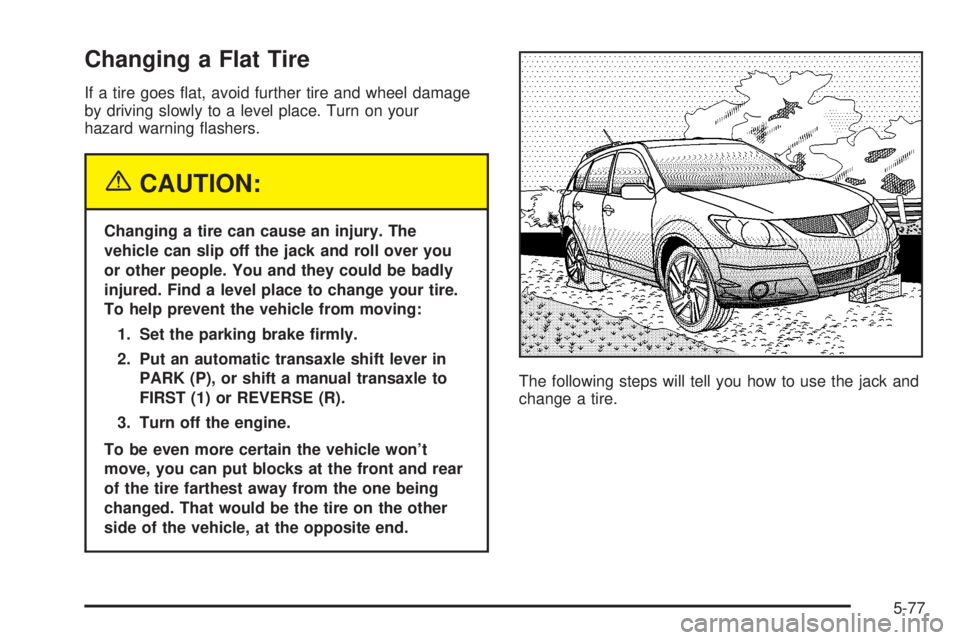
Changing a Flat Tire
If a tire goes ¯at, avoid further tire and wheel damage
by driving slowly to a level place. Turn on your
hazard warning ¯ashers.
{CAUTION:
Changing a tire can cause an injury. The
vehicle can slip off the jack and roll over you
or other people. You and they could be badly
injured. Find a level place to change your tire.
To help prevent the vehicle from moving:
1. Set the parking brake ®rmly.
2. Put an automatic transaxle shift lever in
PARK (P), or shift a manual transaxle to
FIRST (1) or REVERSE (R).
3. Turn off the engine.
To be even more certain the vehicle won't
move, you can put blocks at the front and rear
of the tire farthest away from the one being
changed. That would be the tire on the other
side of the vehicle, at the opposite end.The following steps will tell you how to use the jack and
change a tire.
5-77
Page 309 of 370
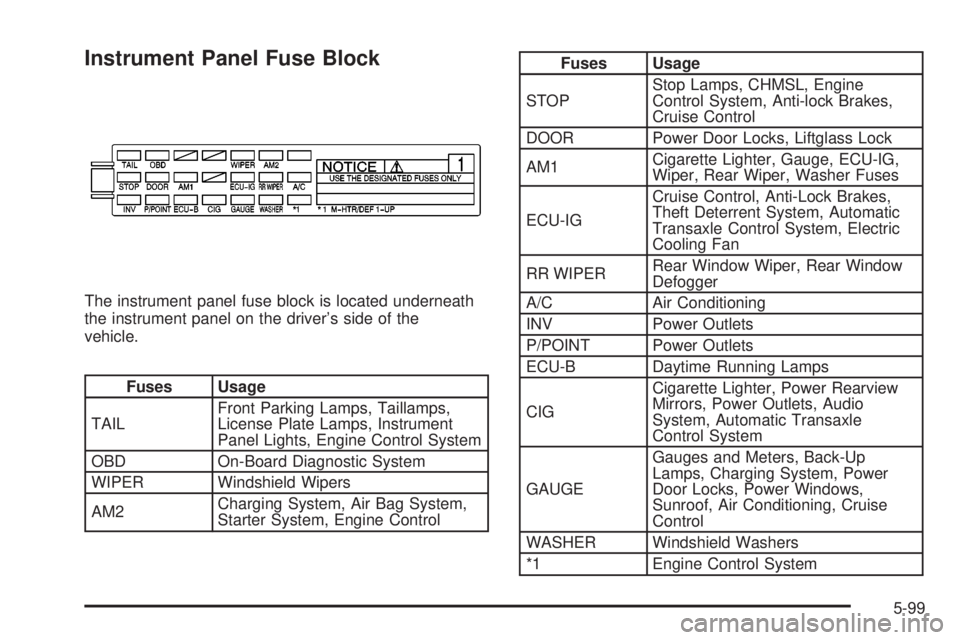
Instrument Panel Fuse Block
The instrument panel fuse block is located underneath
the instrument panel on the driver's side of the
vehicle.
Fuses Usage
TAILFront Parking Lamps, Taillamps,
License Plate Lamps, Instrument
Panel Lights, Engine Control System
OBD On-Board Diagnostic System
WIPER Windshield Wipers
AM2Charging System, Air Bag System,
Starter System, Engine Control
Fuses Usage
STOPStop Lamps, CHMSL, Engine
Control System, Anti-lock Brakes,
Cruise Control
DOOR Power Door Locks, Liftglass Lock
AM1Cigarette Lighter, Gauge, ECU-IG,
Wiper, Rear Wiper, Washer Fuses
ECU-IGCruise Control, Anti-Lock Brakes,
Theft Deterrent System, Automatic
Transaxle Control System, Electric
Cooling Fan
RR WIPERRear Window Wiper, Rear Window
Defogger
A/C Air Conditioning
INV Power Outlets
P/POINT Power Outlets
ECU-B Daytime Running Lamps
CIGCigarette Lighter, Power Rearview
Mirrors, Power Outlets, Audio
System, Automatic Transaxle
Control System
GAUGEGauges and Meters, Back-Up
Lamps, Charging System, Power
Door Locks, Power Windows,
Sunroof, Air Conditioning, Cruise
Control
WASHER Windshield Washers
*1 Engine Control System
5-99
Page 311 of 370
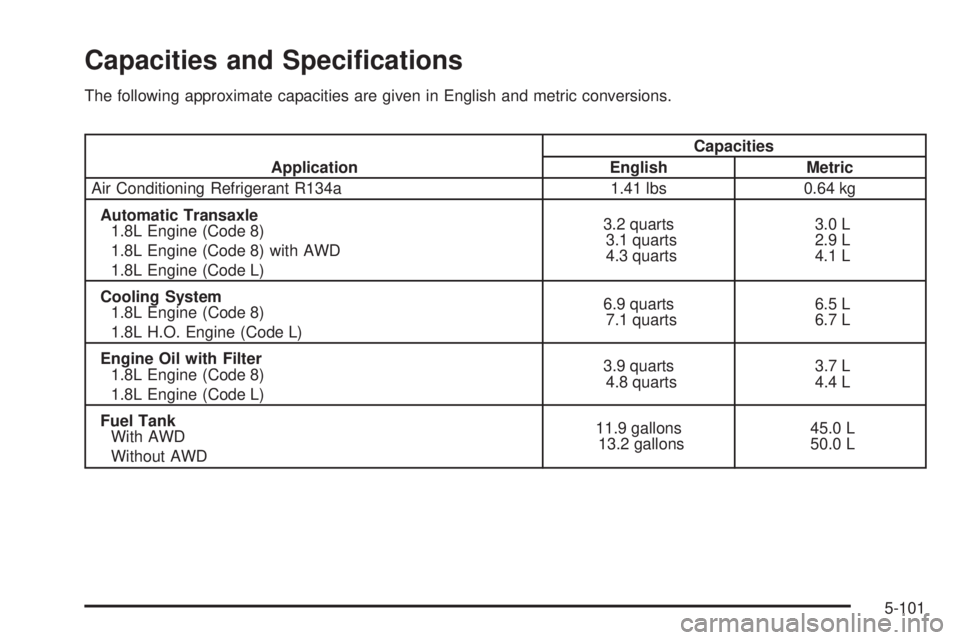
Capacities and Speci®cations
The following approximate capacities are given in English and metric conversions.
ApplicationCapacities
English Metric
Air Conditioning Refrigerant R134a 1.41 lbs 0.64 kg
Automatic Transaxle
1.8L Engine (Code 8)
1.8L Engine (Code 8) with AWD
1.8L Engine (Code L)3.2 quarts
3.1 quarts
4.3 quarts3.0 L
2.9 L
4.1 L
Cooling System
1.8L Engine (Code 8)
1.8L H.O. Engine (Code L)6.9 quarts
7.1 quarts6.5 L
6.7 L
Engine Oil with Filter
1.8L Engine (Code 8)
1.8L Engine (Code L)3.9 quarts
4.8 quarts3.7 L
4.4 L
Fuel Tank
With AWD
Without AWD11.9 gallons
13.2 gallons45.0 L
50.0 L
5-101
Page 312 of 370

ApplicationCapacities
English Metric
Manual Transaxle
Five-Speed
Six-Speed2.0 quarts
2.4 quarts1.9 L
2.3 L
Rear Differential 0.5 quarts 0.5 L
Transfer Case 0.8 quarts 0.8 L
Wheels and Tires
Wheel Nut Torque76 lb-ft 103Y
All capacities are approximate. When adding, be sure to ®ll to the approximate level, as recommended in this
manual. See
Part D: Recommended Fluids and Lubricants on page 6-26.
Engine Speci®cations
Engine VIN Code Transaxle Spark Plug Gap
L4
1.8L Engine8 Automatic and Manual 0.043 inch (1.1 mm)
L4
1.8L H.O. DOHC EngineL Automatic and Manual 0.043 inch (1.1 mm)
5-102
Page 315 of 370

Maintenance Schedule......................................6-2
Introduction...................................................6-2
Maintenance Requirements..............................6-2
Your Vehicle and the Environment....................6-2
How This Section is Organized.........................6-3
Part A: Scheduled Maintenance Services...........6-4
Using Your Maintenance Schedule....................6-4
Selecting the Right Schedule...........................6-5
Short Trip/City Scheduled Maintenance..............6-7
Long Trip/Highway Scheduled Maintenance......6-14
Part B: Owner Checks and Services................6-19
At Each Fuel Fill..........................................6-19
At Least Once a Month.................................6-19At Least Twice a Year...................................6-20
At Least Once a Year...................................6-21
Part C: Periodic MaintenanceInspections.........6-24
Steering, Suspension and Front Drive Axle
Boot and Seal Inspection............................6-24
Exhaust System Inspection............................6-24
Fuel System Inspection..................................6-24
Engine Cooling System Inspection...................6-25
Throttle System Inspection.............................6-25
Brake System Inspection................................6-25
Part D: Recommended Fluids and Lubricants. . . .6-26
Part E: Maintenance Record...........................6-28
Section 6 Maintenance Schedule
6-1
Page 319 of 370
Selecting the Right Schedule
First you'll need to decide which of the two schedules is
right for your vehicle. Here's how to decide which
schedule to follow:
Short Trip/City De®nition
Follow the Short Trip/City Scheduled Maintenance if any
one of these conditions is true for your vehicle:
·Most trips are less than 5 miles (8 km). This is
particularly important when outside temperatures
are below freezing.
·Most trips include extensive idling (such as frequent
driving in stop-and-go traffic).
·You frequently tow a trailer or use a carrier on top
of your vehicle.
·If the vehicle is used for delivery service, police,
taxi or other commercial application.
One of the reasons you should follow this schedule if
you operate your vehicle under any of these conditions
is that these conditions cause engine oil to break
down sooner.
Short Trip/City Intervals
Every 3,000 Miles (5 000 km):Engine Oil and Filter
Change (or 3 months, whichever occurs ®rst).
Every 6,000 Miles (10 000 km):Tire Rotation. Engine
Air Cleaner Filter Inspection, if driving in dusty
conditions.
Every 15,000 Miles (25 000 km):Passenger
Compartment Air Filter Replacement. Transfer Case
Fluid Change (when trailer towing). Rear Differential
Fluid Change (when trailer towing).
Every 30,000 Miles (50 000 km):Engine Air Cleaner
Filter Replacement. Fuel Tank, Cap, Cap Gasket and
Lines Inspection (or every 24 months, whichever occurs
®rst). Automatic Transaxle Check. Manual Transaxle
Fluid Change (severe conditions only) (or every
24 months, whichever occurs ®rst). Cooling System
Service (or every 24 months, whichever occurs ®rst).
Every 60,000 Miles (100 000 km):Automatic Transaxle
Fluid Change (severe conditions only). Valve Clearance
Inspection, adjust if necessary (or every 48 months,
whichever occurs ®rst).
6-5
Page 320 of 370
At 60,000 Miles (100 000 km) (Or 48 Months,
Whichever Occurs First) Ð Then Every 15,000 Miles
(25 000 km) (or 12 Months, Whichever Occurs
First):Engine Accessory Drive Belt Inspection.
Every 120,000 Miles (200 000 km):Spark Plug
Replacement.
These intervals only summarize maintenance services.
Be sure to follow the complete scheduled maintenance
on the following pages.
Long Trip/Highway De®nition
Follow this scheduled maintenanceonlyif none of the
conditions from the Short Trip/City Scheduled
Maintenance are true. Do not use this schedule if the
vehicle is used for trailer towing, driven in a dusty area
or used off paved roads. Use the Short Trip/City
schedule for these conditions
Driving a vehicle with a fully warmed engine under
highway conditions will cause engine oil to break down
slower.
Long Trip/Highway Intervals
Every 7,500 Miles (12 500 km):Engine Oil and Filter
Change (or every 12 months, whichever occurs
®rst). Tire Rotation.Every 15,000 Miles (25 000 km):Passenger
Compartment Air Filter Replacement.
Every 30,000 Miles (50 000 km):Engine Air Cleaner
Filter Replacement. Fuel Tank, Cap, Cap Gasket and
Lines Inspection (or every 24 months, whichever occurs
®rst). Automatic Transaxle Fluid Check. Manual
Transaxle Fluid Change (severe conditions only) (or
every 24 months, whichever occurs ®rst). Cooling System
Service (or every 24 months, whichever occurs ®rst).
Every 60,000 Miles (100 000 km):Automatic Transaxle
Fluid Change (severe conditions only). Valve Clearance
Inspection, adjust if necessary (or every 48 months,
whichever occurs ®rst).
At 60,000 Miles (100 000 km) (or 48 Months,
Whichever Occurs First) Ð Then Every 15,000 Miles
(25 000 km) (or 12 Months, Whichever Occurs
First):Engine Accessory Drive Belt Inspection.
Every 120,000 Miles (200 000 km):Spark Plug
Replacement.
These intervals only summarize maintenance services.
Be sure to follow the complete scheduled maintenance
on the following pages.
6-6