axle PONTIAC VIBE 2005 Workshop Manual
[x] Cancel search | Manufacturer: PONTIAC, Model Year: 2005, Model line: VIBE, Model: PONTIAC VIBE 2005Pages: 374, PDF Size: 2.49 MB
Page 338 of 374
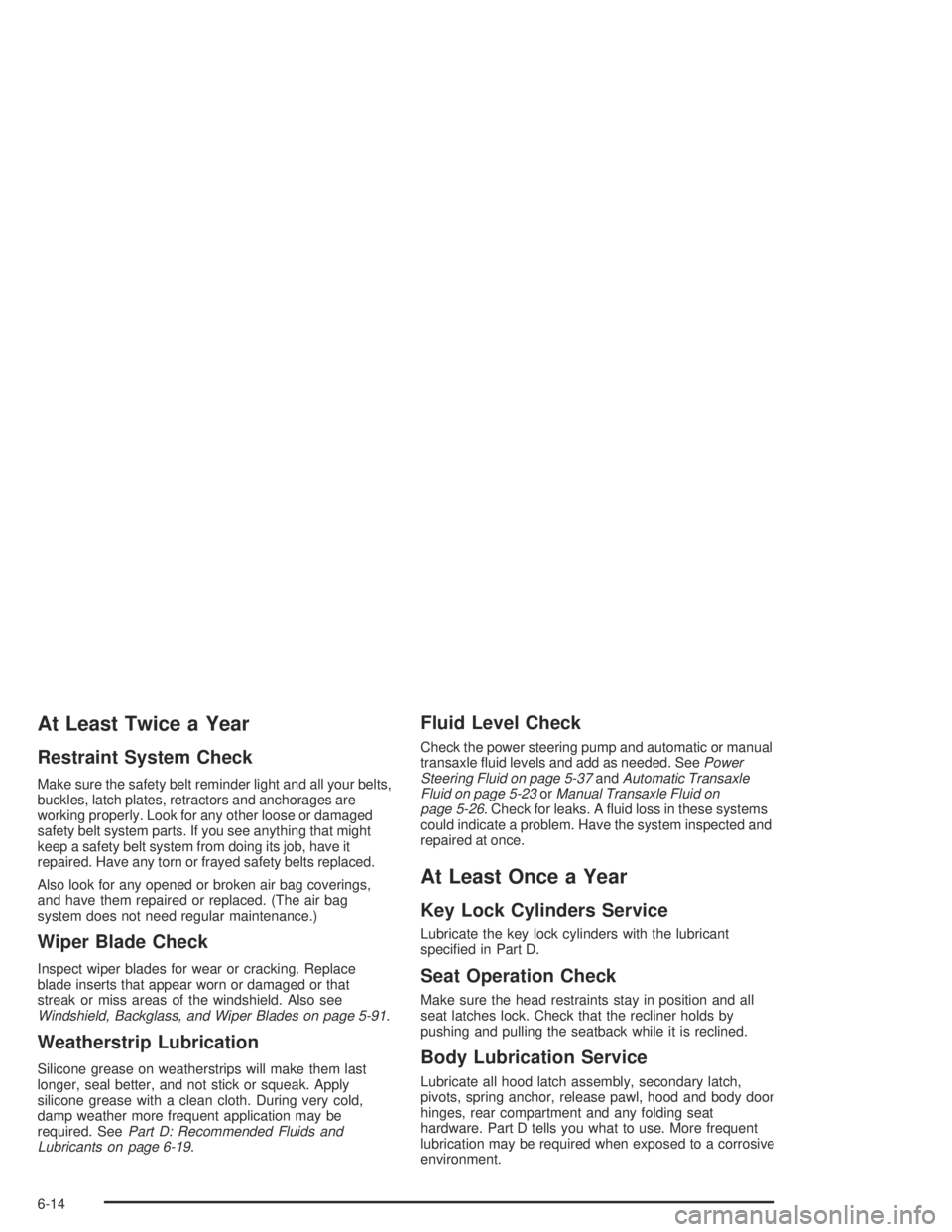
At Least Twice a Year
Restraint System Check
Make sure the safety belt reminder light and all your belts,
buckles, latch plates, retractors and anchorages are
working properly. Look for any other loose or damaged
safety belt system parts. If you see anything that might
keep a safety belt system from doing its job, have it
repaired. Have any torn or frayed safety belts replaced.
Also look for any opened or broken air bag coverings,
and have them repaired or replaced. (The air bag
system does not need regular maintenance.)
Wiper Blade Check
Inspect wiper blades for wear or cracking. Replace
blade inserts that appear worn or damaged or that
streak or miss areas of the windshield. Also see
Windshield, Backglass, and Wiper Blades on page 5-91.
Weatherstrip Lubrication
Silicone grease on weatherstrips will make them last
longer, seal better, and not stick or squeak. Apply
silicone grease with a clean cloth. During very cold,
damp weather more frequent application may be
required. SeePart D: Recommended Fluids and
Lubricants on page 6-19.
Fluid Level Check
Check the power steering pump and automatic or manual
transaxle uid levels and add as needed. SeePower
Steering Fluid on page 5-37andAutomatic Transaxle
Fluid on page 5-23orManual Transaxle Fluid on
page 5-26. Check for leaks. A uid loss in these systems
could indicate a problem. Have the system inspected and
repaired at once.
At Least Once a Year
Key Lock Cylinders Service
Lubricate the key lock cylinders with the lubricant
specied in Part D.
Seat Operation Check
Make sure the head restraints stay in position and all
seat latches lock. Check that the recliner holds by
pushing and pulling the seatback while it is reclined.
Body Lubrication Service
Lubricate all hood latch assembly, secondary latch,
pivots, spring anchor, release pawl, hood and body door
hinges, rear compartment and any folding seat
hardware. Part D tells you what to use. More frequent
lubrication may be required when exposed to a corrosive
environment.
6-14
Page 339 of 374

Starter Switch Check
{CAUTION:
When you are doing this inspection, the
vehicle could move suddenly. If the vehicle
moves, you or others could be injured.
1. Before you start, be sure you have enough room
around the vehicle.
2. Firmly apply both the parking brake and the regular
brake. SeeParking Brake on page 2-28if necessary.
Do not use the accelerator pedal, and be ready to
turn off the engine immediately if it starts.
3. On automatic transaxle vehicles, try to start the
engine in each gear. The starter should work only in
PARK (P) or NEUTRAL (N). If the starter works in
any other position, your vehicle needs service.
On manual transaxle vehicles, put the shift lever in
NEUTRAL (N), push the clutch down halfway and try
to start the engine. The starter should work only
when the clutch is pushed down all the way to the
oor. If the starter works when the clutch is not
pushed all the way down, your vehicle needs service.
Automatic Transaxle Shift Lock Control
System Check
{CAUTION:
When you are doing this inspection, the
vehicle could move suddenly. If the vehicle
moves, you or others could be injured.
1. Before you start, be sure you have enough room
around the vehicle. It should be parked on a level
surface.
2. Firmly apply the parking brake. SeeParking Brake
on page 2-28if necessary.
Be ready to apply the regular brake immediately if
the vehicle begins to move.
3. With the engine off, turn the ignition to ON, but do
not start the engine. Without applying the regular
brake, try to move the shift lever out of PARK (P)
with normal effort. If the shift lever moves out
of PARK (P), your vehicle needs service.
6-15
Page 340 of 374

Ignition Transaxle Lock Check
While parked, and with the parking brake set, try to turn
the ignition to LOCK in each shift lever position.
With an automatic transaxle, the ignition should turn
to LOCK only when the shift lever is in PARK (P).
With a manual transaxle, the ignition should turn to
LOCK only if you push the key in farther, while
turning it toward LOCK.
Parking Brake and Automatic Transaxle
Park (P) Mechanism Check
{CAUTION:
When you are doing this check, your vehicle
could begin to move. You or others could be
injured and property could be damaged. Make
sure there is room in front of your vehicle in
case it begins to roll. Be ready to apply the
regular brake at once should the vehicle begin
to move.Park on a fairly steep hill, with the vehicle facing
downhill. Keeping your foot on the regular brake, set the
parking brake.
To check the parking brake’s holding ability: With
the engine running and transaxle in NEUTRAL (N),
slowly remove foot pressure from the regular
brake pedal. Do this until the vehicle is held by the
parking brake only.
To check the PARK (P) mechanism’s holding
ability: With the engine running, shift to PARK (P).
Then release the parking brake followed by the
regular brake.
Underbody Flushing Service
At least every spring, use plain water to ush any
corrosive materials from the underbody. Take care to
clean thoroughly any areas where mud and other debris
can collect.
6-16
Page 341 of 374
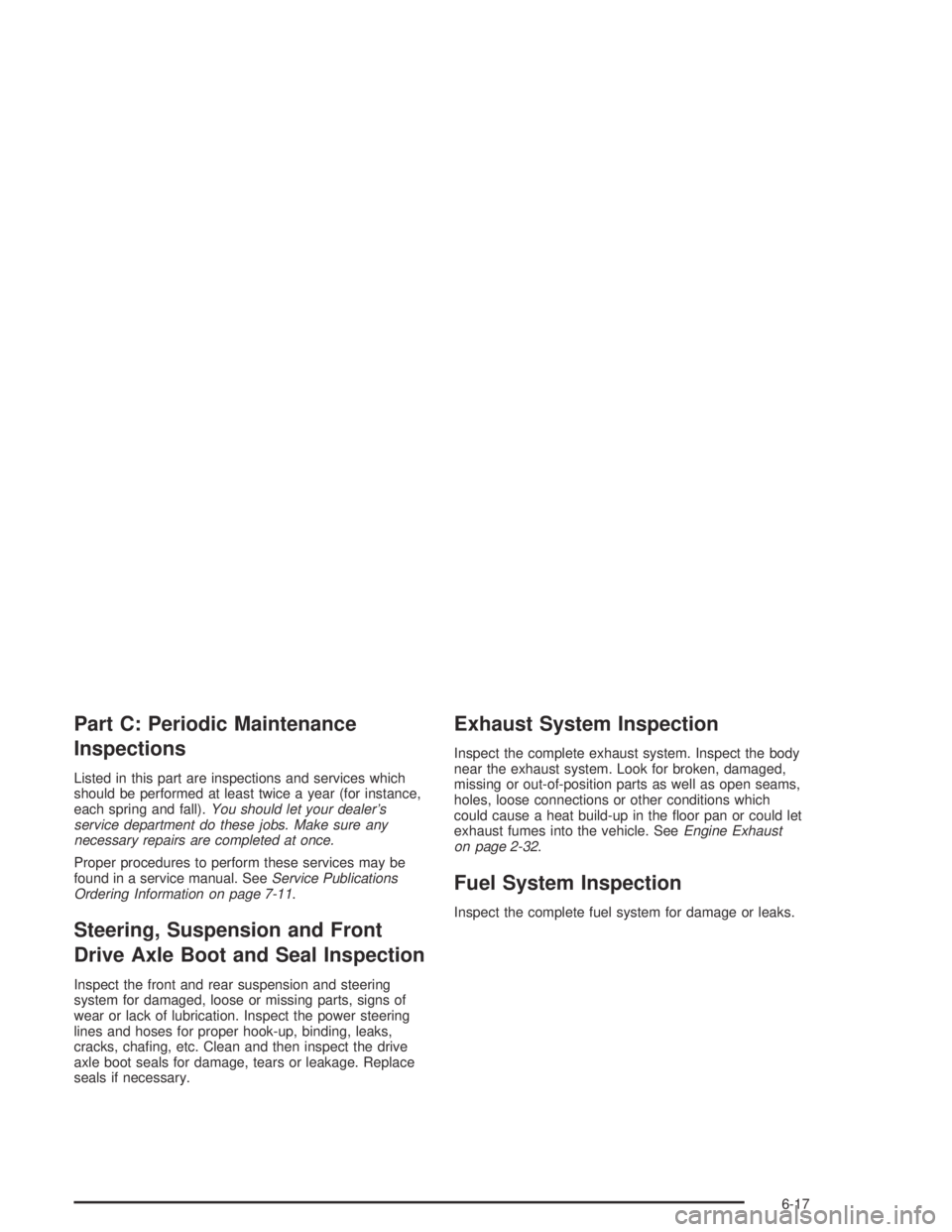
Part C: Periodic Maintenance
Inspections
Listed in this part are inspections and services which
should be performed at least twice a year (for instance,
each spring and fall).You should let your dealer’s
service department do these jobs. Make sure any
necessary repairs are completed at once.
Proper procedures to perform these services may be
found in a service manual. SeeService Publications
Ordering Information on page 7-11.
Steering, Suspension and Front
Drive Axle Boot and Seal Inspection
Inspect the front and rear suspension and steering
system for damaged, loose or missing parts, signs of
wear or lack of lubrication. Inspect the power steering
lines and hoses for proper hook-up, binding, leaks,
cracks, chang, etc. Clean and then inspect the drive
axle boot seals for damage, tears or leakage. Replace
seals if necessary.
Exhaust System Inspection
Inspect the complete exhaust system. Inspect the body
near the exhaust system. Look for broken, damaged,
missing or out-of-position parts as well as open seams,
holes, loose connections or other conditions which
could cause a heat build-up in the oor pan or could let
exhaust fumes into the vehicle. SeeEngine Exhaust
on page 2-32.
Fuel System Inspection
Inspect the complete fuel system for damage or leaks.
6-17
Page 343 of 374
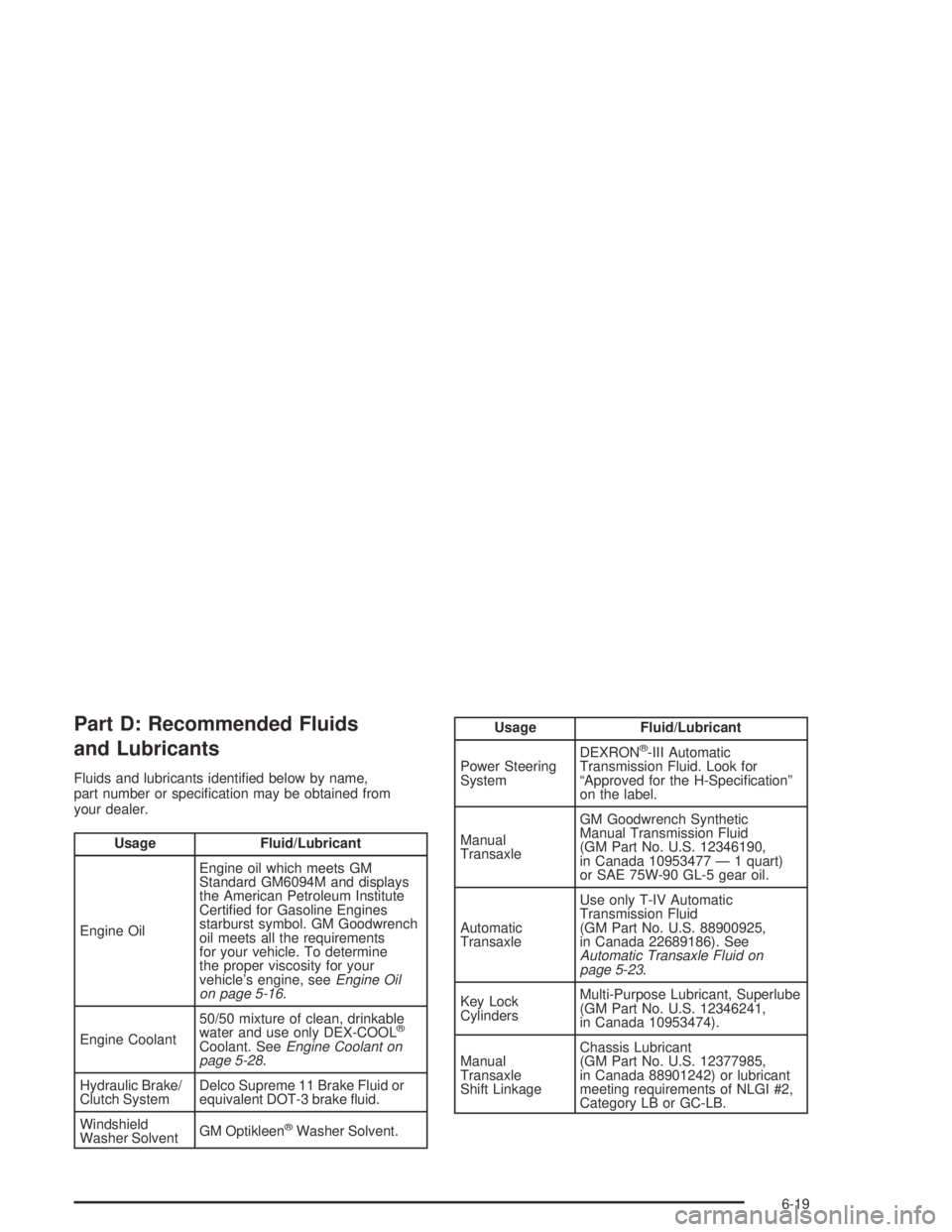
Part D: Recommended Fluids
and Lubricants
Fluids and lubricants identied below by name,
part number or specication may be obtained from
your dealer.
Usage Fluid/Lubricant
Engine OilEngine oil which meets GM
Standard GM6094M and displays
the American Petroleum Institute
Certied for Gasoline Engines
starburst symbol. GM Goodwrench
oil meets all the requirements
for your vehicle. To determine
the proper viscosity for your
vehicle’s engine, seeEngine Oil
on page 5-16.
Engine Coolant50/50 mixture of clean, drinkable
water and use only DEX-COOL
®
Coolant. SeeEngine Coolant on
page 5-28.
Hydraulic Brake/
Clutch SystemDelco Supreme 11 Brake Fluid or
equivalent DOT-3 brake uid.
Windshield
Washer SolventGM Optikleen
®Washer Solvent.
Usage Fluid/Lubricant
Power Steering
SystemDEXRON
®-III Automatic
Transmission Fluid. Look for
“Approved for the H-Specication”
on the label.
Manual
TransaxleGM Goodwrench Synthetic
Manual Transmission Fluid
(GM Part No. U.S. 12346190,
in Canada 10953477 — 1 quart)
or SAE 75W-90 GL-5 gear oil.
Automatic
TransaxleUse only T-IV Automatic
Transmission Fluid
(GM Part No. U.S. 88900925,
in Canada 22689186). See
Automatic Transaxle Fluid on
page 5-23.
Key Lock
CylindersMulti-Purpose Lubricant, Superlube
(GM Part No. U.S. 12346241,
in Canada 10953474).
Manual
Transaxle
Shift LinkageChassis Lubricant
(GM Part No. U.S. 12377985,
in Canada 88901242) or lubricant
meeting requirements of NLGI #2,
Category LB or GC-LB.
6-19
Page 344 of 374
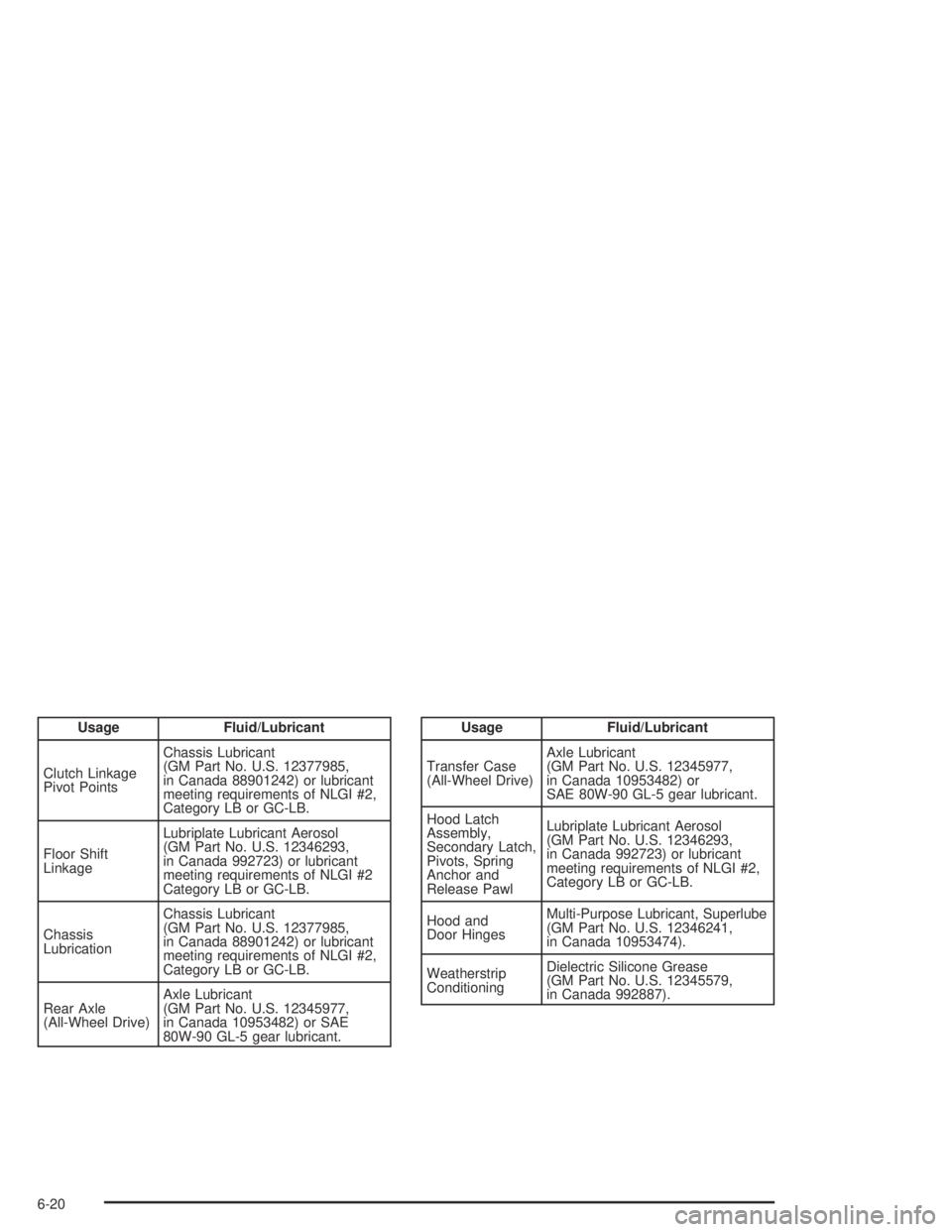
Usage Fluid/Lubricant
Clutch Linkage
Pivot PointsChassis Lubricant
(GM Part No. U.S. 12377985,
in Canada 88901242) or lubricant
meeting requirements of NLGI #2,
Category LB or GC-LB.
Floor Shift
LinkageLubriplate Lubricant Aerosol
(GM Part No. U.S. 12346293,
in Canada 992723) or lubricant
meeting requirements of NLGI #2
Category LB or GC-LB.
Chassis
LubricationChassis Lubricant
(GM Part No. U.S. 12377985,
in Canada 88901242) or lubricant
meeting requirements of NLGI #2,
Category LB or GC-LB.
Rear Axle
(All-Wheel Drive)Axle Lubricant
(GM Part No. U.S. 12345977,
in Canada 10953482) or SAE
80W-90 GL-5 gear lubricant.Usage Fluid/Lubricant
Transfer Case
(All-Wheel Drive)Axle Lubricant
(GM Part No. U.S. 12345977,
in Canada 10953482) or
SAE 80W-90 GL-5 gear lubricant.
Hood Latch
Assembly,
Secondary Latch,
Pivots, Spring
Anchor and
Release PawlLubriplate Lubricant Aerosol
(GM Part No. U.S. 12346293,
in Canada 992723) or lubricant
meeting requirements of NLGI #2,
Category LB or GC-LB.
Hood and
Door HingesMulti-Purpose Lubricant, Superlube
(GM Part No. U.S. 12346241,
in Canada 10953474).
Weatherstrip
ConditioningDielectric Silicone Grease
(GM Part No. U.S. 12345579,
in Canada 992887).
6-20
Page 359 of 374
Reporting Safety Defects to the
Canadian Government
If you live in Canada, and you believe that your vehicle
has a safety defect, you should immediately notify
Transport Canada, in addition to notifying General
Motors of Canada Limited. You may write to:
Transport Canada
330 Sparks Street
Tower C
Ottawa, Ontario K1A 0N5
Reporting Safety Defects to
General Motors
In addition to notifying NHTSA (or Transport Canada) in
a situation like this, we certainly hope you’ll notify us.
Please call us at 1-800-762-2737, or write:
Pontiac Customer Assistance Center
P.O. Box 33172
Detroit, MI 48232-5172
In Canada, please call us at 1-800-263-3777 (English)
or 1-800-263-7854 (French). Or, write:
General Motors of Canada Limited
Customer Communication Centre, 163-005
1908 Colonel Sam Drive
Oshawa, Ontario L1H 8P7
Service Publications Ordering
Information
Service Manuals
Service Manuals have the diagnosis and repair
information on engines, transmission, axle, suspension,
brakes, electrical, steering, body, etc.
RETAIL SELL PRICE: $120.00
Transmission, Transaxle, Transfer
Case Unit Repair Manual
This manual provides information on unit repair service
procedures, adjustments, and specications for GM
transmissions, transaxles, and transfer cases.
RETAIL SELL PRICE: $50.00
Service Bulletins
Service Bulletins give technical service information
needed to knowledgeably service General Motors cars
and trucks. Each bulletin contains instructions to
assist in the diagnosis and service of your vehicle.
In Canada, information pertaining to Product Service
Bulletins can be obtained by contacting your General
Motors dealer or by calling 1-800-GM-DRIVE
(1-800-463-7483).
7-11
Page 362 of 374

Audio System(s).............................................3-42
Care of Your CD Player...............................3-65
Care of Your CDs........................................3-64
Fixed Mast Antenna.....................................3-65
Navigation/Radio System..............................3-64
Radio with CD............................................3-43
Radio with Six-Disc CD................................3-53
Setting the Time..........................................3-42
Understanding Radio Reception.....................3-64
XM™ Satellite Radio Antenna System............3-65
Automatic Headlamp System............................3-15
Automatic Transaxle
Fluid..........................................................5-23
Operation...................................................2-22
B
Battery..........................................................5-42
Before Leaving on a Long Trip.........................4-23
Brake
Anti-Lock Brake System (ABS)........................ 4-7
Emergencies................................................ 4-9
Panic Assist................................................4-11
Parking......................................................2-28
System Inspection.......................................6-18
System Warning Light..................................3-32Brakes..........................................................5-39
Braking........................................................... 4-6
Braking in Emergencies..................................... 4-9
Break-In, New Vehicle.....................................2-17
Bulb Replacement...........................................5-49
Back-Up Lamps...........................................5-54
Center High-Mounted Stoplamp (CHMSL)........5-51
Halogen Bulbs............................................5-49
Headlamps, Front Turn Signal, and
Parking Lamps.........................................5-49
Replacement Bulbs......................................5-55
Taillamps, Turn Signal, and Stoplamps............5-53
Buying New Tires...........................................5-70
C
California Fuel.................................................. 5-6
Canadian Owners................................................ ii
Capacities and Specications..........................5-100
Carbon Monoxide...................2-11, 2-32, 4-26, 4-40
Care of
Safety Belts................................................5-90
Your CD Player...........................................3-65
Your CDs ...................................................3-64
Cargo Cover..................................................2-39
2
Page 365 of 374

E
Electrical System
Add-On Equipment......................................5-95
Engine Compartment Fuse Block...................5-98
Fuses and Circuit Breakers...........................5-96
Headlamp Wiring.........................................5-96
Instrument Panel Fuse Block.........................5-97
Power Windows and Other Power Options......5-96
Windshield Wiper Fuses...............................5-96
Engine
Air Cleaner/Filter.........................................5-21
Battery.......................................................5-42
Check and Service Engine Soon Light............3-35
Coolant......................................................5-28
Coolant Heater............................................2-21
Coolant Temperature Gage...........................3-35
Cooling System Inspection............................6-18
Engine Compartment Overview......................5-12
Exhaust.....................................................2-32
Oil .............................................................5-16
Overheating................................................5-30
Starting......................................................2-19
Entry Lighting.................................................3-16
Event Data Recorders (EDR)............................. 7-9
Extender, Safety Belt.......................................1-25
Exterior Lamps...............................................3-13
F
Filter
Engine Air Cleaner......................................5-21
Finish Damage...............................................5-93
Fixed Mast Antenna........................................3-65
Flash-to-Pass................................................... 3-8
Flat Tire........................................................5-74
Flat Tire, Changing.........................................5-75
Flat Tire, Storing.............................................5-84
Floor Mats.....................................................2-38
Fluid
Automatic Transaxle.....................................5-23
Manual Transaxle........................................5-26
Power Steering...........................................5-37
Windshield Washer......................................5-38
Fog Lamps....................................................3-15
Folding Seatback, Passenger............................. 1-5
Fuel............................................................... 5-5
Additives...................................................... 5-6
California Fuel.............................................. 5-6
Filling a Portable Fuel Container..................... 5-9
Filling Your Tank........................................... 5-7
Fuels in Foreign Countries.............................. 5-7
Gage.........................................................3-41
Gasoline Octane........................................... 5-5
5
Page 367 of 374
I
Ignition Positions.............................................2-18
Infants and Young Children, Restraints...............1-28
Ination -- Tire Pressure..................................5-64
Inspection
Brake System.............................................6-18
Engine Cooling System................................6-18
Exhaust System..........................................6-17
Fuel System...............................................6-17
Part C - Periodic Maintenance.......................6-17
Steering, Suspension and Front Drive Axle
Boot and Seal.........................................6-17
Throttle System...........................................6-18
Instrument Panel
Brightness..................................................3-15
Cluster.......................................................3-26
Overview..................................................... 3-4
Storage Area..............................................2-37
Interior Lamps Control.....................................3-16
J
Jump Starting.................................................5-43
K
Keyless Entry System....................................... 2-4
Keys............................................................... 2-2
L
Labelling, Tire Sidewall....................................5-58
Lamps
Exterior......................................................3-13
Fog ...........................................................3-15
Interior Control............................................3-16
Reading.....................................................3-17
LATCH System
Child Restraints...........................................1-38
Securing a Child Restraint Designed for
the LATCH System...................................1-39
Liftgate/Liftglass..............................................2-11
Liftglass/Liftgate..............................................2-11
Light
Airbag Readiness........................................3-29
Anti-Lock Brake System Warning...................3-33
Brake System Warning.................................3-32
Charging System.........................................3-31
Cruise Control.............................................3-39
Door Ajar...................................................3-40
7