audio PONTIAC VIBE 2007 User Guide
[x] Cancel search | Manufacturer: PONTIAC, Model Year: 2007, Model line: VIBE, Model: PONTIAC VIBE 2007Pages: 432, PDF Size: 2.54 MB
Page 180 of 432
XM™ Satellite Radio Service
XM™ is a satellite radio service that is based in
the 48 contiguous United States and Canada.
XM™ offers a large variety of coast-to-coast
channels including music, news, sports, talk,
traffic/weather (U.S. subscribers), and children’s
programming. XM™ provides digital quality
audio and text information that includes song title
and artist name. A service fee is required in
order to receive the XM™ service. For more
information, contact XM™; In the U.S. at
www.xmradio.com or call 1-800-852-XMXM (9696)
or in Canada at www.xmradio.ca or call
1-877-GET-XMSR (438-9677).
Playing the Radio
PWR (Power):Push this knob to turn the system
on and off.
VOL (Volume):Turn this knob clockwise or
counterclockwise to increase or to decrease the
volume.RCL (Recall):Push this button to display the time
with the ignition off.
For RDS, push the RCL button to change what
displays while using RDS. The display options are
station, RDS station frequency, PTY (program
type), and the name of the program (if available).
For XM™ (if equipped), push the RCL button
while in XM™ mode to retrieve four different
categories of information related to the current
song or channel: Artist, Song Title, Category
or PTY, Channel Number/Channel Name.
To change the default on the display, push the
RCL button until the desired option displays, then
hold the button until the display ashes. The
selected display becomes the default.Finding a Station
BAND:Press this button to switch between FM1,
FM2, AM, or XM1 or XM2 (if equipped). The
display shows the selection.
TUNE:Turn this knob to select radio stations.
180
Page 185 of 432
TRAF (Traffic):If TRAF displays, the tuned
station broadcasts traffic announcements. Press
this button to receive the traffic announcement
from the station. TRAF inside brackets displays.
When a traffic announcement broadcasts on
the tuned radio station, you will hear it.
If the station does not broadcast traffic
announcements, press the TRAF button and the
radio seeks to a station that does. When a station
that broadcasts traffic announcements is found,
the radio stops seeking and TRAF inside brackets
displays. If no station is found that broadcasts
traffic announcements, NO TRAFFIC displays.
If the brackets are on the display and TRAF is not,
press the TRAF button to remove the brackets
or use the TUNE knob or the SEEK arrows to go
to a station that broadcasts traffic announcements.
If no station is found that broadcasts traffic
announcements, NO TRAFFIC displays.
The radio plays the traffic announcement if the
volume is low. The radio interrupts the play
of a CD if the last tuned station broadcasts traffic
announcements and the brackets are displayed.
This function does not apply to XM™ Satellite
Radio Service.Radio Messages
If any error occurs repeatedly or if an error cannot
be corrected, contact your dealer.
Radio Messages for XM™ Only
SeeXM Radio Messages on page 216later in this
section for further detail.
Playing a CD
Insert a CD partway into the slot, label side up.
The player pulls it in and the CD should begin
playing. If you insert a CD with the radio off and
the ignition on, it starts to play.
If the ignition or radio is turned off with a CD in
the player, it stays in the player. When the ignition
or radio is turned on, the CD starts playing
where it stopped, if it was the last selected audio
source.
When the CD is inserted, the CD symbol displays
on the CD. As each new track starts to play,
the track number displays.
The CD player can play the smaller 3 inch (8 cm)
single CDs with an adapter ring. Full-size CDs
and the smaller CDs are loaded in the same
manner.
185
Page 189 of 432
Radio Data System (RDS)
The audio system has a Radio Data System
(RDS). RDS features are available for use only on
FM stations that broadcast RDS information.
With RDS, the radio can do the following:
Seek to stations broadcasting the selected
type of programming
Receive announcements concerning local and
national emergencies
Display messages from radio stations
Seek to stations with traffic announcements
This system relies upon receiving specic
information from these stations and only works
when the information is available. In rare cases, a
radio station can broadcast incorrect information
that causes the radio features to work improperly.
If this happens, contact the radio station.
While the radio is tuned to an RDS station, the
station name or the call letters display instead of
the frequency. RDS stations can also provide
the time of day, a program type (PTY) for current
programming, and the name of the program
being broadcast.
Playing the Radio
PWR (Power):Push this knob to turn the system
on and off.
VOL (Volume):Turn this knob clockwise or
counterclockwise to increase or to decrease the
volume.
RCL (Recall):Push this button to switch the
display between the radio station frequency and
the time. When the ignition is turned off, push this
button to display the time.
To change the default on the display, push the
RCL button until the desired option displays, then
hold the button until the display ashes. The
selected display becomes the default.
Finding a Station
BAND:Press this button to switch between FM1,
FM2, AM, or XM1 or XM2 (if equipped). The
display shows the selection.
TUNE:Turn this knob to select radio stations.
189
Page 194 of 432
TRAF (Traffic):If TRAF displays, the tuned
station broadcasts traffic announcements.
To receive the traffic announcement from the
tuned station, press this button. Brackets
are displayed around TRAF and when a traffic
announcement broadcasts on the tuned radio
station, you will hear it.
If the station does not broadcast traffic
announcements, press the TRAF button and the
radio seeks to a station that does. When a station
that broadcasts traffic announcements is found,
the radio stops seeking and brackets are displayed
around TRAF. If no station is found that
broadcasts traffic announcements, NO TRAFFIC
displays.
If the brackets are on the display and TRAF is not,
press the TRAF button to remove the brackets
or use the TUNE knob or the SEEK arrows to go
to a station that supports traffic announcements.
If no station is found that broadcasts traffic
announcements, NO TRAFFIC displays.
The radio plays the traffic announcement if the
volume is low. The radio interrupts the play
of a CD if the last tuned station broadcasts traffic
announcements and the brackets display.Playing a CD
Insert a CD partway into the slot, label side up.
The player pulls it in and READING DISC and the
CD symbol displays. If you want to insert a CD
with the ignition off, rst press the eject button or
push the RCL button.
If the ignition or radio is turned off with a CD in
the player it stays in the player. When the ignition
or radio is turned on, the CD starts to play
where it stopped, if it was the last selected audio
source.
When the CD is inserted, the CD symbol displays.
As each new track starts to play, the track
number displays.
The CD player can play the smaller 3 inch (8 cm)
single CDs with an adapter ring. Full-size CDs
and the smaller CDs are loaded in the same
manner.
194
Page 198 of 432
Radio with Six-Disc CD
If your vehicle has the Monsoon audio system, it
includes seven speakers. The radio displays
MONSOON while the radio or the ignition is turned
on. See your dealer for details.
The radio has a theft-deterrent feature. A red light
blinks while the engine is off to indicate the
radio is protected. It will not operate if it is installed
in a different vehicle.
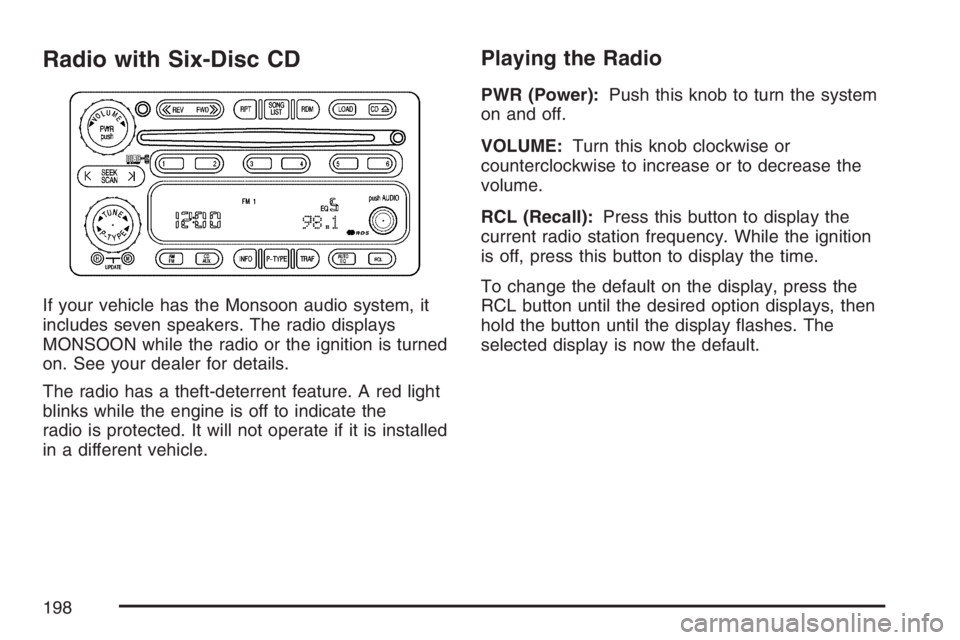
Playing the Radio
PWR (Power):Push this knob to turn the system
on and off.
VOLUME:Turn this knob clockwise or
counterclockwise to increase or to decrease the
volume.
RCL (Recall):Press this button to display the
current radio station frequency. While the ignition
is off, press this button to display the time.
To change the default on the display, press the
RCL button until the desired option displays, then
hold the button until the display ashes. The
selected display is now the default.
198
Page 200 of 432
Setting the Tone
(Bass/Midrange/Treble)
AUDIO:Push and release the AUDIO knob until
BASS, MID (midrange), or TREB (treble)
displays. Turn the knob to increase or to decrease
the tone. If a station is weak or has static,
decrease the treble.
To adjust bass, midrange, or treble to the middle
position, select BASS, MID, or TREB and push
and hold the AUDIO knob. The radio beeps once
and adjusts the display level to the middle
position.
To adjust all tone and speaker controls to the
middle position, push and hold the AUDIO knob
when no tone or speaker controls display.
CENTERED displays and a beep sounds.
AUTO EQ (Automatic Equalization):Press this
button to select customized equalization settings
designed for country, jazz, talk, pop, rock, and
classical.
To return to the manual mode, press the AUTO
EQ button until CUSTOM displays. Then manually
adjust the bass, midrange, and treble using the
AUDIO knob.
Adjusting the Speakers (Balance/Fade)
AUDIO:To adjust the balance between the
right and the left speakers, push and release the
AUDIO knob until BAL (balance) displays.
Turn the knob to move the sound toward the right
or the left speakers.
To adjust the fade between the front and rear
speakers, push and release the AUDIO knob until
FAD (fade) displays. Turn the knob to move
the sound toward the front or the rear speakers.
To adjust the balance and the fade to the
middle position, select balance or fade and push
and hold the AUDIO knob. The radio beeps
once and adjusts the display level to the middle
position.
To adjust all tone and speaker controls to the
middle position, push and hold the AUDIO knob
when no tone or speaker controls display.
CENTERED displays and a beep sounds.
200
Page 201 of 432
Radio Data System (RDS)
The audio system has a Radio Data System
(RDS). RDS features are available for use only on
FM stations that broadcast RDS information.
With RDS, the radio can do the following:
Seek to stations broadcasting the selected
type of programming
Receive announcements concerning local and
national emergencies
Display messages from radio stations
Seek to stations with traffic announcements
This system relies upon receiving specic
information from these stations and only works
when the information is available. In rare cases, a
radio station can broadcast incorrect information
that causes the radio features to work improperly.
If this happens, contact the radio station.
While the radio is tuned to an RDS station, the
station name or call letters display instead of the
frequency. RDS stations can also provide the
time of day, a program type (PTY) for current
programming, and the name of the program being
broadcast.
Finding a Program Type (PTY) Station
To select and nd a desired PTY perform the
following:
1. Press the P-TYPE button to activate program
type select mode. P-TYPE and the last
selected PTY displays.
2. Turn the P-TYPE knob to select a PTY.
3. Once the desired PTY displays, press either
SEEK arrow to select and to go to the PTY’s
rst station.
4. To go to another station within that PTY and
the PTY displays, press either SEEK arrow
once. If the PTY does not display, press either
SEEK arrow twice to display the PTY and
then to go to another station.
5. Press the P-TYPE button to exit program type
select mode.
If PTY times out and is no longer on the
display, go back to Step 1.
If both PTY and TRAF are on, the radio searches
for stations with the selected PTY and traffic
announcements.
201
Page 204 of 432
Playing a CD
If the ignition or radio is turned off, with a CD in the
player, it stays in the player. When the ignition or
radio is turned on, the CD starts playing where it
stopped, if it was the last selected audio source.
When a CD is inserted, the CD symbol displays on
the CD. As each new track starts to play, the
track number displays.
The CD player can play the smaller 3 inch (8 cm)
single CDs with an adapter ring. Full-size CDs
and the smaller CDs are loaded in the same
manner.
If playing a CD-R, the sound quality can be reduced
due to CD-R quality, the method of recording, the
quality of the music that has been recorded, and the
way the CD-R has been handled. There can be an
increase in skipping, difficulty in nding tracks,
and/or difficulty in loading and ejecting. If these
problems occur, check the bottom surface of the
CD. If the surface of the CD is damaged, such as
cracked, broken, or scratched, the CD will not play
properly. If the surface of the CD is soiled, seeCare
of Your CDs on page 219for more information.
If there is no apparent damage, try a known
good CD.Do not add any label to a CD, it could get caught
in the CD player. If a CD is recorded on a
personal computer and a description label is
needed, try labeling the top of the recorded CD
with a marking pen.
Notice:If a label is added to a CD, or more
than one CD is inserted into the slot at a time,
or an attempt is made to play scratched or
damaged CDs, the CD player could be
damaged. While using the CD player, use only
CDs in good condition without any label,
load one CD at a time, and keep the CD player
and the loading slot free of foreign materials,
liquids, and debris.
If an error displays, see “CD Messages” later in
this section.
LOAD CD
Z:Press the LOAD side of this
button to load CDs into the CD player. This CD
player holds up to six CDs.
To insert one CD, do the following:
1. Turn the ignition on.
2. Press and release the LOAD button.
3. Wait for the indicator light, located to the right
of the slot, to turn green.
204
Page 210 of 432
Using an MP3
MP3 CD-R Disc
MP3 Format
If you burn your own MP3 disc on a personal
computer:
Make sure the MP3 les are recorded on a
CD-R disc.
Make sure to nalize the disc when burning
an MP3 disc, using multiple sessions. It is
usually better to burn the disc all at once.
Files can be recorded with a variety of xed or
variable bit rates. Song title, artist name, and
album are available for display by the radio
when recorded using ID3 tags version 1 and 2.
Do not mix standard audio and MP3 les
on one disc.
Make sure playlists have a .mp3 or .wpl
extension, other le extensions might not work.
Create a folder structure that makes it easy to
nd songs while driving. Organize songs by
albums using one folder for each album. Each
folder or album should contain 18 songs
or less.The player is able to read and play a maximum
of 50 folders, 50 playlists, 10 sessions, and
255 les. Long le names, folder names, or playlist
names can use more disc memory space than
necessary. To conserve space on the disc,
minimize the length of the le, folder, or playlist
names. You can also play an MP3 CD that
was recorded using no le folders. The system
can support up to 11 folders in depth, though, keep
the depth of the folders to a minimum in order
to keep down the complexity and confusion
in trying to locate a particular folder during
playback. If a CD contains more than the
maximum of 50 folders, 50 playlists, 10 sessions,
and 255 les the player lets you access and
navigate up to the maximum, but all items over
the maximum are ignored.
Root Directory
The root directory is treated as a folder. If the
root directory has compressed audio les,
the directory is displayed as F1 ROOT. All les
contained directly under the root directory
are accessed prior to any root directory folders.
However, playlists (Px) are always be accessed
before root folders or les.
210
Page 211 of 432
Empty Directory or Folder
If a root directory or a folder exists somewhere in
the le structure that contains only folders/
subfolders and no compressed les directly
beneath them, the player advances to the next
folder in the le structure that contains compressed
audio les. The empty folder does not display.
No Folder
When the CD contains only compressed les, the
les are located under the root folder. The next
and previous folder functions do not function on a
CD that was recorded without folders or playlists.
When displaying the name of the folder the
radio displays ROOT.
When the CD contains only playlists and
compressed audio les, but no folders, all les
are located under the root folder. The folder down
and the folder up buttons searches playlists (Px)
rst and then go to the root folder. When the radio
displays the name of the folder the radio
displays ROOT.
Order of Play
Tracks are played in the following order:
Play begins from the rst track in the rst
playlist and continues sequentially through
all tracks in each playlist. When the last track
of the last playlist has played, play continues
from the rst track of the rst playlist.
If the CD does not contain any playlists, then
play begins from the rst track under the root
directory. When all tracks from the root
directory have played, play continues from
les according to their numerical listing. After
playing the last track from the last folder,
play begins again at the rst track of the rst
folder or root directory.
When play enters a new folder, the display does
not automatically show the new folder name unless
you have chosen the folder mode as the default
display. See RCL later in this section for more
information. The new track name displays.
211