tow PONTIAC VIBE 2009 Owner's Guide
[x] Cancel search | Manufacturer: PONTIAC, Model Year: 2009, Model line: VIBE, Model: PONTIAC VIBE 2009Pages: 318, PDF Size: 1.53 MB
Page 163 of 318

To save fuel, run the engine for only
short periods as needed to warm the
vehicle and then shut the engine off
and close the window most of the
way to save heat. Repeat this until
help arrives but only when you feel
really uncomfortable from the cold.
Moving about to keep warm also
helps.
If it takes some time for help to
arrive, now and then when you run
the engine, push the accelerator
pedal slightly so the engine runs
faster than the idle speed. This
keeps the battery charged to restart
the vehicle and to signal for help with
the headlamps. Do this as little as
possible to save fuel.If Your Vehicle is Stuck
in Sand, Mud, Ice,
or Snow
Slowly and cautiously spin the
wheels to free the vehicle when
stuck in sand, mud, ice, or snow.
SeeRocking Your Vehicle to Get It
Out on page 8-31.
{CAUTION
If you let your vehicle’s tires spin
at high speed, they can explode,
and you or others could be
injured. The vehicle can overheat,
causing an engine compartment
re or other damage. Spin the
wheels as little as possible and
avoid going above 35 mph
(55 km/h) as shown on the
speedometer.
For information about using tire
chains on the vehicle, seeTire
Chains on page 9-60.
Rocking Your Vehicle to
Get It Out
Turn the steering wheel left and right
to clear the area around the front
wheels. Turn off any traction or
stability system. Shift back and forth
between R (Reverse) and a forward
gear, or with a manual transmission,
between 1 (First) or 2 (Second) and
R (Reverse), spinning the wheels
as little as possible. To prevent
transmission wear, wait until the
wheels stop spinning before shifting
gears. Release the accelerator pedal
while shifting, and press lightly on
the accelerator pedal when the
transmission is in gear. Slowly
spinning the wheels in the forward
and reverse directions causes a
rocking motion that could free the
vehicle. If that does not get the
vehicle out after a few tries, it might
need to be towed out. If the vehicle
does need to be towed out, see
Towing Your Vehicle on page 9-75.
Driving and Operating 8-31
2009 - Pontiac Vibe Owner Manual
Page 165 of 318
Steps for Determining Correct
Load Limit
1.Locate the statement
“The combined weight
of occupants and cargo
should never exceed XXX kg
or XXX lbs” on your vehicle’s
placard.
2.Determine the combined
weight of the driver and
passengers that will be
riding in your vehicle.
3.Subtract the combined weight
of the driver and passengers
from XXX kg or XXX lbs.
4.The resulting gure equals
the available amount of cargo
and luggage load capacity.
For example, if the “XXX”
amount equals 1400 lbs
and there will be ve 150 lb
passengers in your vehicle,
the amount of available
cargo and luggage
load capacity is 650 lbs
(1400−750 (5 x 150) =
650 lbs).
5.Determine the combined
weight of luggage and
cargo being loaded on the
vehicle. That weight may not
safely exceed the available
cargo and luggage load
capacity calculated in Step 4.
6.If your vehicle will be towing
a trailer, the load from your
trailer will be transferred to
your vehicle. Consult this
manual to determine how this
reduces the available cargo
and luggage load capacity of
your vehicle.
If your vehicle can tow a
trailer, seeTowing a Trailer
on page 9-77for important
information on towing a trailer,
towing safety rules and
trailering tips.
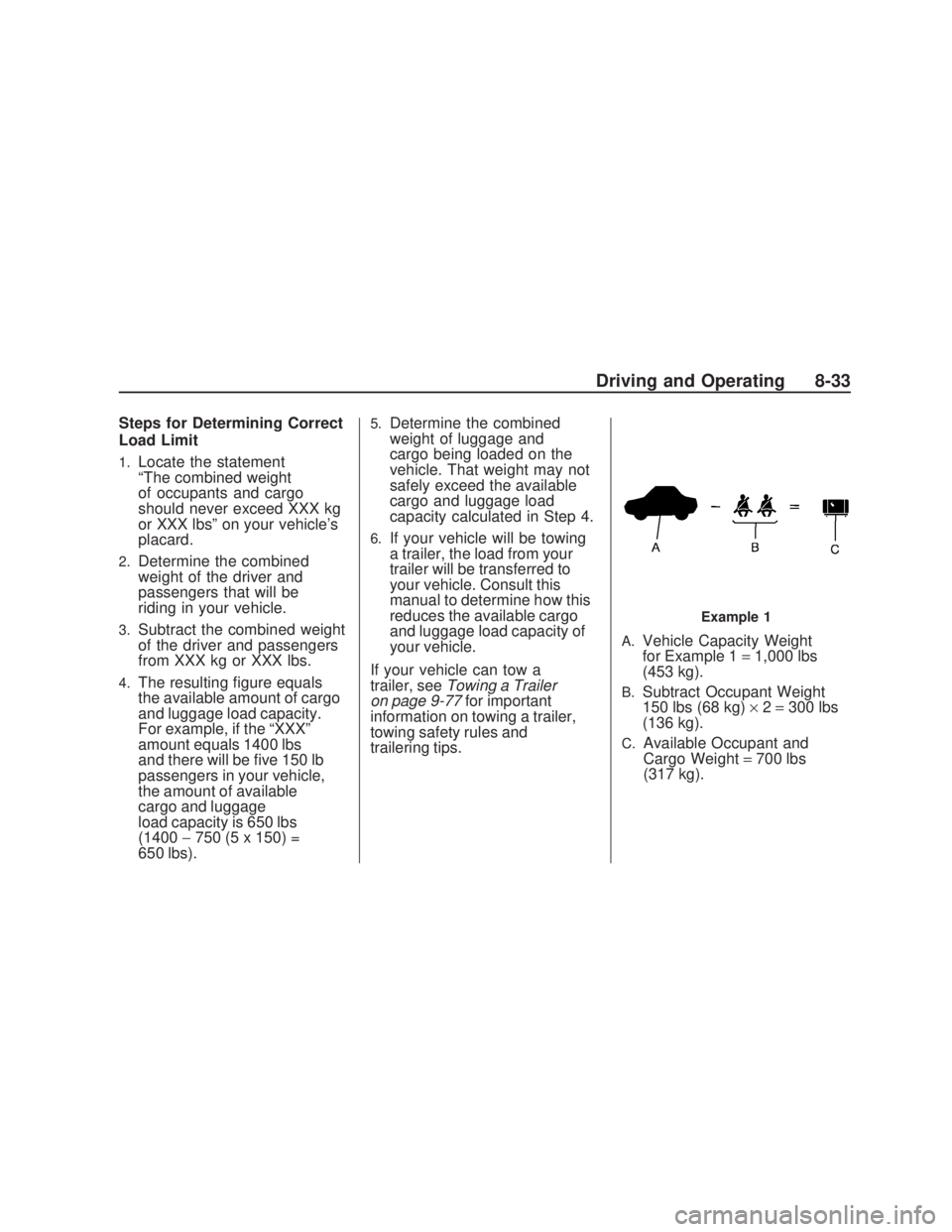
A.Vehicle Capacity Weight
for Example 1=1,000 lbs
(453 kg).
B.Subtract Occupant Weight
150 lbs (68 kg)×2=300 lbs
(136 kg).
C.Available Occupant and
Cargo Weight=700 lbs
(317 kg).
Example 1
Driving and Operating 8-33
2009 - Pontiac Vibe Owner Manual
Page 174 of 318
Buying New Tires.............9-54
Different Size Tires and
Wheels............................9-56
Uniform Tire Quality
Grading...........................9-56
Wheel Alignment and
Tire Balance....................9-58
Wheel Replacement..........9-59
Tire Chains.......................9-60
Tire Changing
If a Tire Goes Flat............9-61
Changing a Flat Tire.........9-62
Removing the Spare
Tire and Tools.................9-63
Removing the Flat Tire
and Installing the
Spare Tire
.......................9-64
Storing a Flat or Spare
Tire and Tools.................9-68
Compact Spare Tire..........9-70
Jump Starting
Jump Starting...................9-71
Towing
Towing Your Vehicle.........9-75
Recreational Vehicle
Towing............................9-75
Towing a Trailer................9-77
Appearance Care
Interior Cleaning................9-83
Exterior Cleaning..............9-86
Sheet Metal Damage........9-89
Finish Damage..................9-89
Underbody Maintenance. . . .9-90
Chemical Paint Spotting. . . .9-90
Service
For service and parts needs, visit
your dealer/retailer. You will receive
genuine GM parts and GM-trained
and supported service people.
Genuine GM parts have one
of these marks:
9-2 Vehicle Service and Care
2009 - Pontiac Vibe Owner Manual
Page 177 of 318
Owner Checks
{CAUTION
An electric fan under the hood
can start up and injure you even
when the engine is not running.
Keep hands, clothing, and tools
away from any underhood
electric fan.
{CAUTION
Things that burn can get on hot
engine parts and start a re. These
include liquids like fuel, oil, coolant,
brake uid, windshield washer and
other uids, and plastic or rubber.
You or others could be burned.
Be careful not to drop or spill
things that will burn onto a hot
engine.
Hood Release
To open the hood:
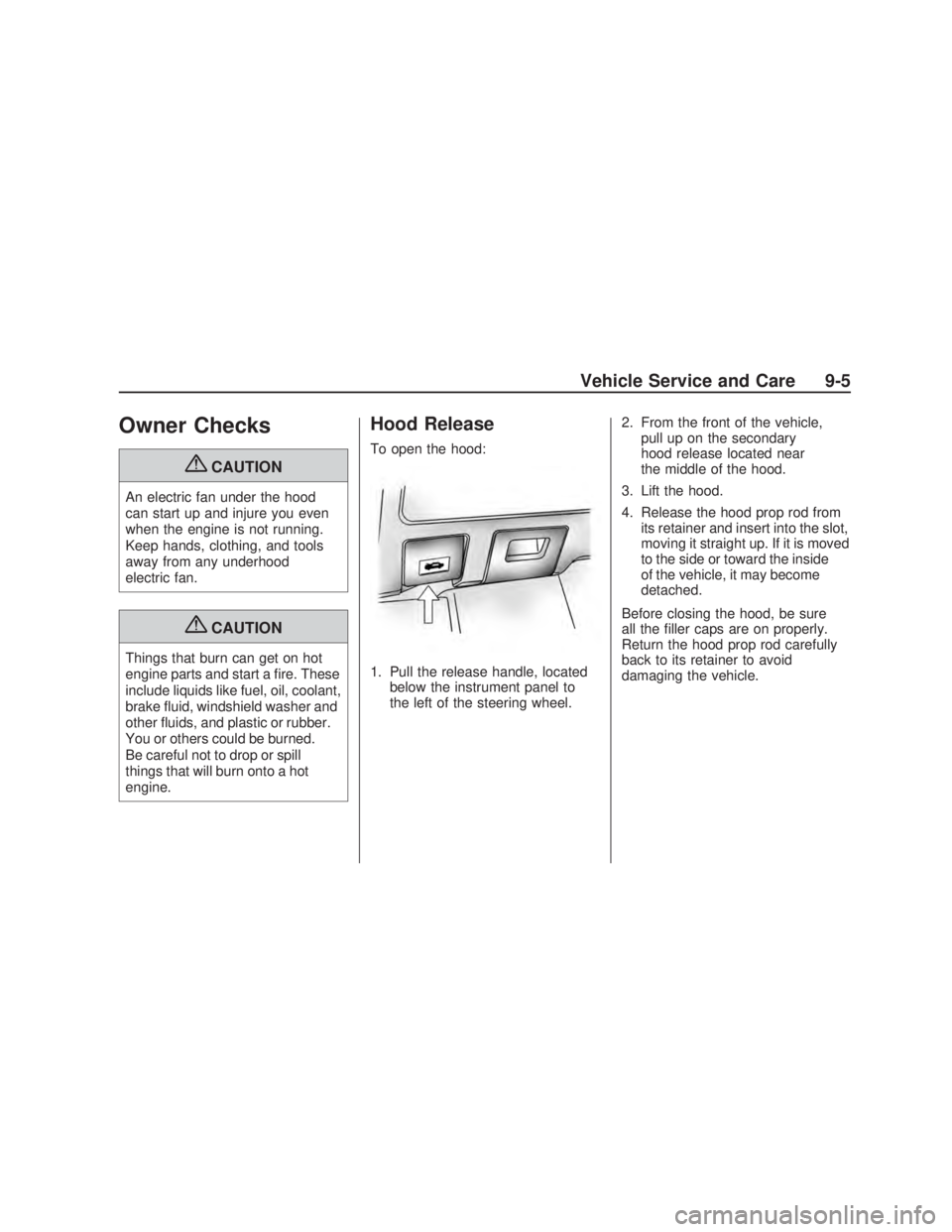
1. Pull the release handle, located
below the instrument panel to
the left of the steering wheel.2. From the front of the vehicle,
pull up on the secondary
hood release located near
the middle of the hood.
3. Lift the hood.
4. Release the hood prop rod from
its retainer and insert into the slot,
moving it straight up. If it is moved
to the side or toward the inside
of the vehicle, it may become
detached.
Before closing the hood, be sure
all the ller caps are on properly.
Return the hood prop rod carefully
back to its retainer to avoid
damaging the vehicle.
Vehicle Service and Care 9-5
2009 - Pontiac Vibe Owner Manual
Page 181 of 318
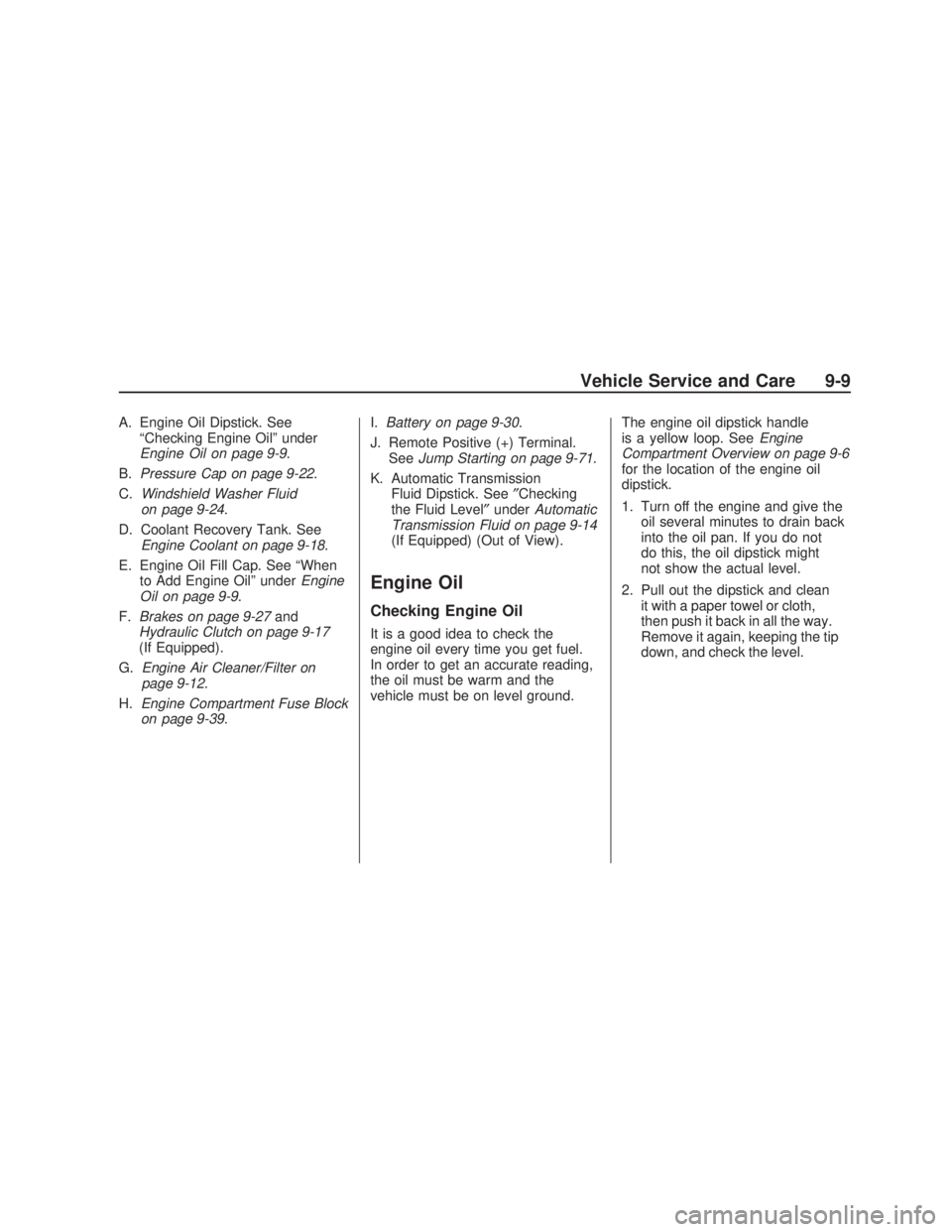
A. Engine Oil Dipstick. See
“Checking Engine Oil” under
Engine Oil on page 9-9.
B.Pressure Cap on page 9-22.
C.Windshield Washer Fluid
on page 9-24.
D. Coolant Recovery Tank. See
Engine Coolant on page 9-18.
E. Engine Oil Fill Cap. See “When
to Add Engine Oil” underEngine
Oil on page 9-9.
F.Brakes on page 9-27and
Hydraulic Clutch on page 9-17
(If Equipped).
G.Engine Air Cleaner/Filter on
page 9-12.
H.Engine Compartment Fuse Block
on page 9-39.I.Battery on page 9-30.
J. Remote Positive (+) Terminal.
SeeJump Starting on page 9-71.
K. Automatic Transmission
Fluid Dipstick. See″Checking
the Fluid Level″underAutomatic
Transmission Fluid on page 9-14
(If Equipped) (Out of View).
Engine Oil
Checking Engine Oil
It is a good idea to check the
engine oil every time you get fuel.
In order to get an accurate reading,
the oil must be warm and the
vehicle must be on level ground.The engine oil dipstick handle
is a yellow loop. SeeEngine
Compartment Overview on page 9-6
for the location of the engine oil
dipstick.
1. Turn off the engine and give the
oil several minutes to drain back
into the oil pan. If you do not
do this, the oil dipstick might
not show the actual level.
2. Pull out the dipstick and clean
it with a paper towel or cloth,
then push it back in all the way.
Remove it again, keeping the tip
down, and check the level.
Vehicle Service and Care 9-9
2009 - Pontiac Vibe Owner Manual
Page 187 of 318
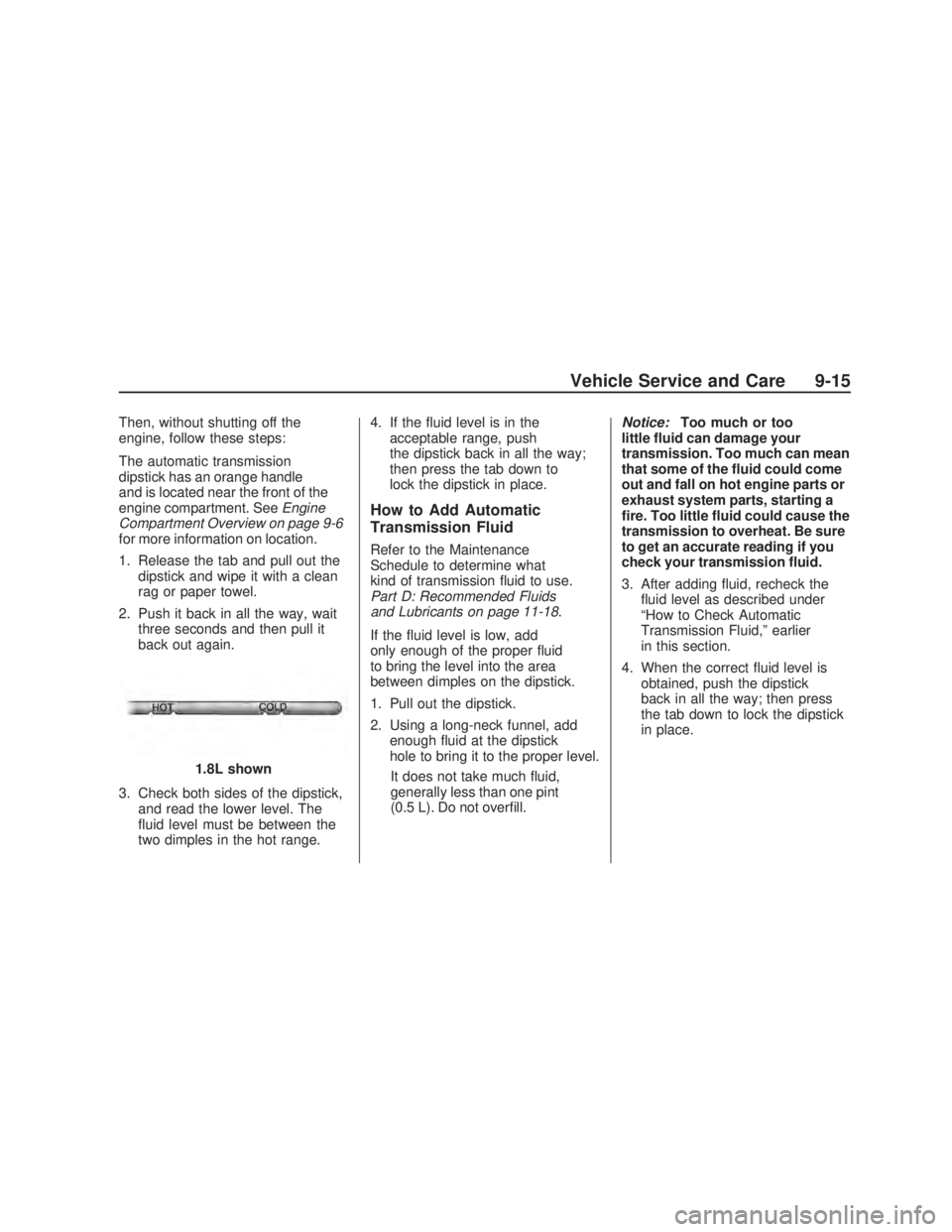
Then, without shutting off the
engine, follow these steps:
The automatic transmission
dipstick has an orange handle
and is located near the front of the
engine compartment. SeeEngine
Compartment Overview on page 9-6
for more information on location.
1. Release the tab and pull out the
dipstick and wipe it with a clean
rag or paper towel.
2. Push it back in all the way, wait
three seconds and then pull it
back out again.
3. Check both sides of the dipstick,
and read the lower level. The
uid level must be between the
two dimples in the hot range.4. If the uid level is in the
acceptable range, push
the dipstick back in all the way;
then press the tab down to
lock the dipstick in place.
How to Add Automatic
Transmission Fluid
Refer to the Maintenance
Schedule to determine what
kind of transmission uid to use.
Part D: Recommended Fluids
and Lubricants on page 11-18.
If the uid level is low, add
only enough of the proper uid
to bring the level into the area
between dimples on the dipstick.
1. Pull out the dipstick.
2. Using a long-neck funnel, add
enough uid at the dipstick
hole to bring it to the proper level.
It does not take much uid,
generally less than one pint
(0.5 L). Do not overll.Notice:Too much or too
little uid can damage your
transmission. Too much can mean
that some of the uid could come
out and fall on hot engine parts or
exhaust system parts, starting a
re. Too little uid could cause the
transmission to overheat. Be sure
to get an accurate reading if you
check your transmission uid.
3. After adding uid, recheck the
uid level as described under
“How to Check Automatic
Transmission Fluid,” earlier
in this section.
4. When the correct uid level is
obtained, push the dipstick
back in all the way; then press
the tab down to lock the dipstick
in place.
1.8L shown
Vehicle Service and Care 9-15
2009 - Pontiac Vibe Owner Manual
Page 195 of 318
If Steam Is Coming From Your
Engine
{CAUTION
Steam from an overheated engine
can burn you badly, even if you
just open the hood. Stay away
from the engine if you see or hear
steam coming from it. Just turn it
off and get everyone away from
the vehicle until it cools down. Wait
until there is no sign of steam or
coolant before you open the hood.
If you keep driving when your
engine is overheated, the liquids
in it can catch re. You or others
could be badly burned. Stop your
engine if it overheats, and get out
of the vehicle until the engine
is cool.Notice:If the engine catches re
because of being driven with no
coolant, your vehicle can be badly
damaged. The costly repairs
would not be covered by the
vehicle warranty.
If No Steam Is Coming From
Your Engine
If an engine overheat warning is
displayed but steam is not heard or
seen escaping, the problem may
not be too serious. Sometimes
the engine can get a little too
hot when the vehicle:
Climbs a long hill on a hot day.
Stops after high-speed driving.
Idles for long periods in traffic.
Tows a trailer.If the overheat warning is displayed
with no sign of steam, try this for
a minute or so:
1. In heavy traffic, let the engine
idle in N (Neutral) while stopped.
If it is safe to do so, pull off
the road, shift to P (Park)
or N (Neutral) and let the
engine idle.
2. Turn on the heater to full hot at
the highest fan speed and open
the windows as necessary.
If the overheat warning is no longer
displayed, the vehicle can be driven.
Just to be safe, drive slower for about
10 minutes. If the warning does not
come back on, continue to drive.
If the warning continues, pull over,
stop, and park the vehicle right away.
If there is still no sign of steam, idle
the engine for three minutes while
the vehicle is parked. If the warning
is still displayed, turn off the engine
and get everyone out of the vehicle
until it cools down.
Vehicle Service and Care 9-23
2009 - Pontiac Vibe Owner Manual
Page 197 of 318
Notice:
When using concentrated
washer uid, follow the
manufacturer’s instructions
for adding water.
Do not mix water with
ready-to-use washer uid.
Water can cause the solution
to freeze and damage your
washer uid tank and other
parts of the washer system.
Also, water does not clean
as well as washer uid.
Fill the washer uid tank only
three-quarters full when it is
very cold. This allows for uid
expansion if freezing occurs,
which could damage the tank
if it is completely full.
Do not use engine coolant
(antifreeze) in your windshield
washer. It can damage the
vehicle’s windshield washer
system and paint.
Windshield Wiper Blade
Replacement
Front Windshield Wiper
Windshield wiper blades should be
inspected at least twice a year for
wear or cracking. SeeAt Least
Twice a Year on page 11-13.
Replacement blades come in
different types and are removed
in different ways. To remove
the wiper blade:
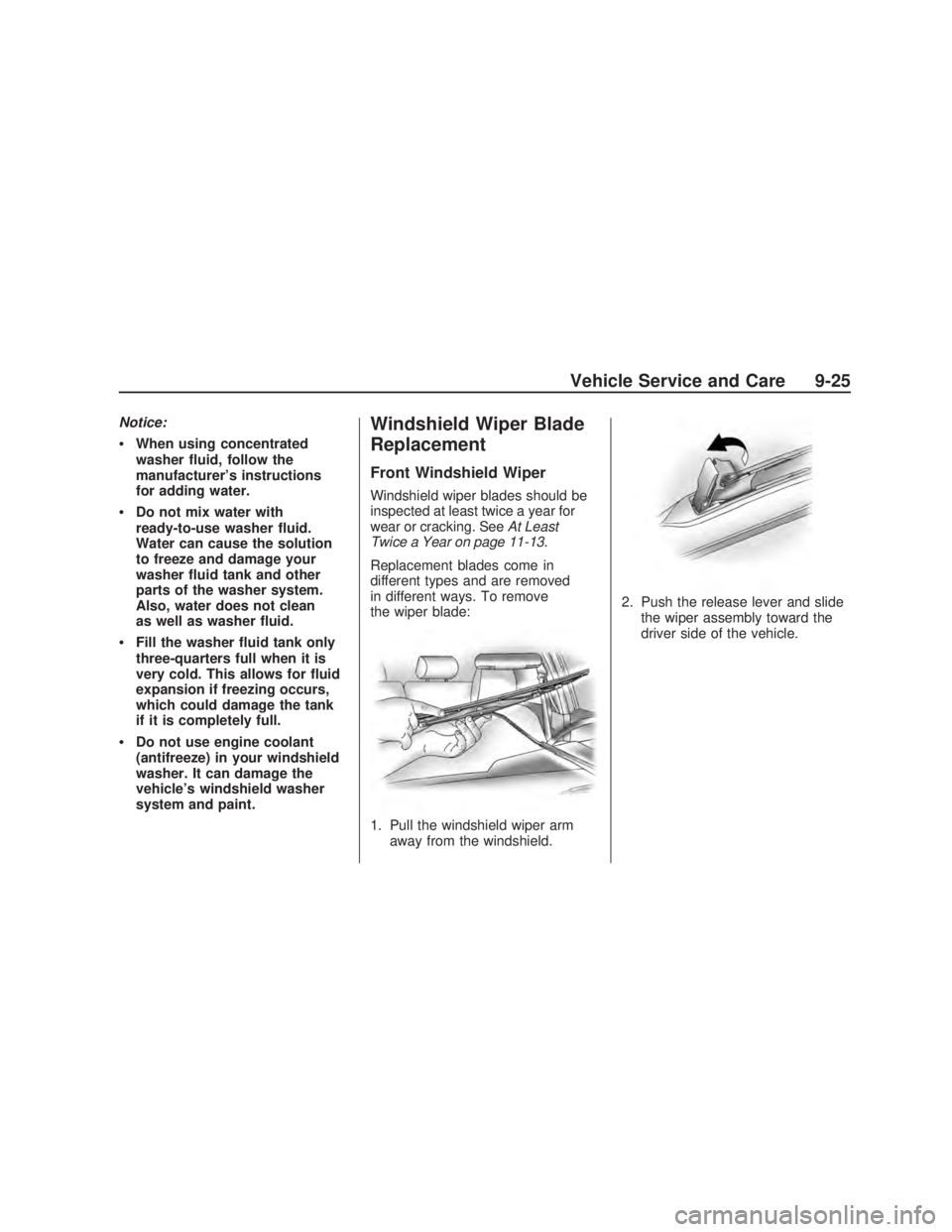
1. Pull the windshield wiper arm
away from the windshield.2. Push the release lever and slide
the wiper assembly toward the
driver side of the vehicle.
Vehicle Service and Care 9-25
2009 - Pontiac Vibe Owner Manual
Page 225 of 318
Tire Inspection and
Rotation
We recommend that you
regularly inspect the vehicle’s
tires, including the spare tire, for
signs of wear or damage. See
When It Is Time for New Tires on
page 9-54for more information.
Tires should be rotated every
5,000 to 8,000 miles (8 000 to
13 000 km). SeePart A:
Scheduled Maintenance
Services on page 11-3.
The purpose of a regular tire
rotation is to achieve a uniform
wear for all tires on the vehicle.
This will ensure that the vehicle
continues to perform most like it
did when the tires were new.
Any time you notice unusual
wear, rotate the tires as soon
as possible and check wheel
alignment. Also check for
damaged tires or wheels.
SeeWhen It Is Time for NewTires on page 9-54andWheel
Replacement on page 9-59for
more information.
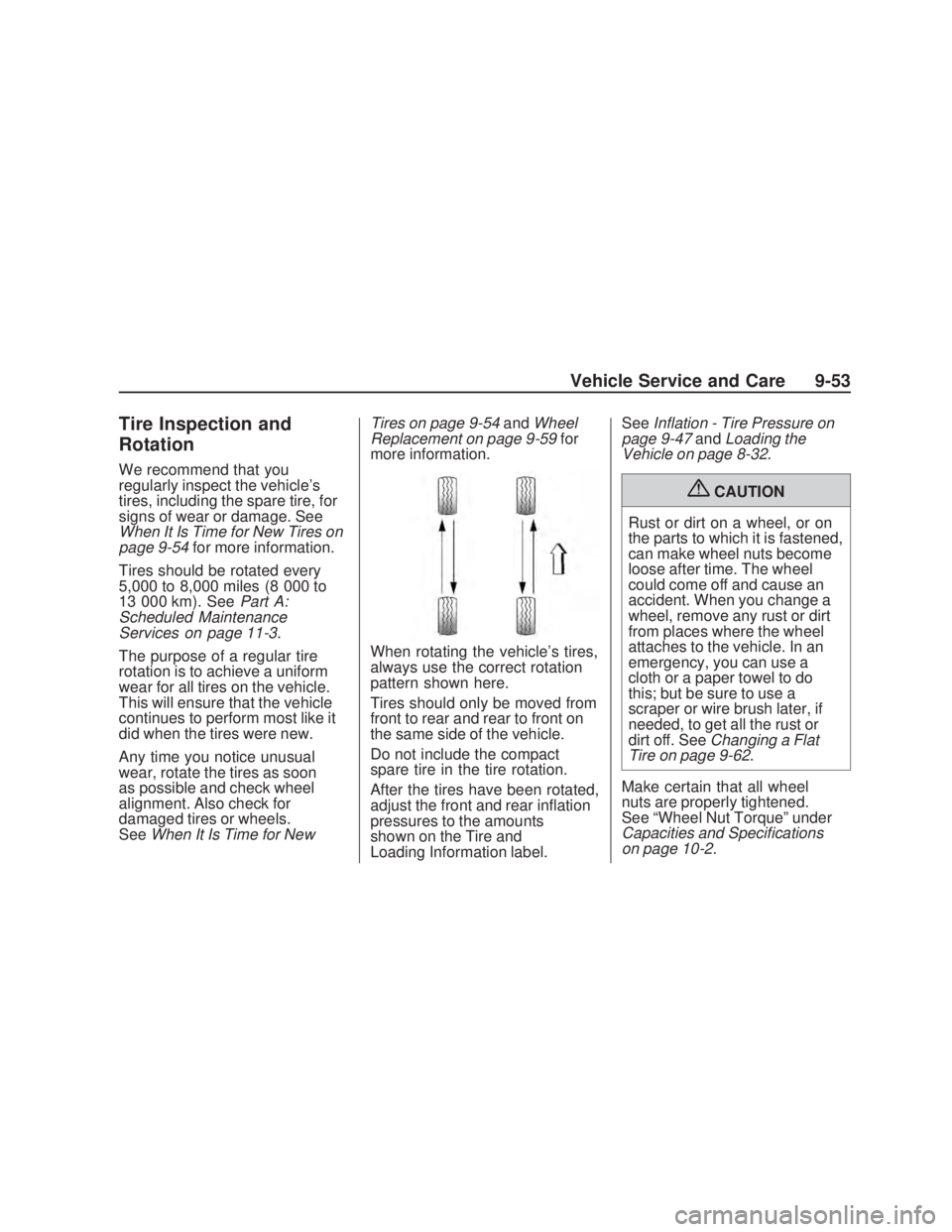
When rotating the vehicle’s tires,
always use the correct rotation
pattern shown here.
Tires should only be moved from
front to rear and rear to front on
the same side of the vehicle.
Do not include the compact
spare tire in the tire rotation.
After the tires have been rotated,
adjust the front and rear ination
pressures to the amounts
shown on the Tire and
Loading Information label.SeeInflation - Tire Pressure on
page 9-47andLoading the
Vehicle on page 8-32.
{CAUTION
Rust or dirt on a wheel, or on
the parts to which it is fastened,
can make wheel nuts become
loose after time. The wheel
could come off and cause an
accident. When you change a
wheel, remove any rust or dirt
from places where the wheel
attaches to the vehicle. In an
emergency, you can use a
cloth or a paper towel to do
this; but be sure to use a
scraper or wire brush later, if
needed, to get all the rust or
dirt off. SeeChanging a Flat
Tire on page 9-62.
Make certain that all wheel
nuts are properly tightened.
See “Wheel Nut Torque” under
Capacities and Specifications
on page 10-2.
Vehicle Service and Care 9-53
2009 - Pontiac Vibe Owner Manual
Page 233 of 318
Tire Changing
If a Tire Goes Flat
It is unusual for a tire to blowout
while you are driving, especially if
you maintain your vehicle’s tires
properly. If air goes out of a tire, it is
much more likely to leak out slowly.
But if you should ever have a
blowout, here are a few tips about
what to expect and what to do:
If a front tire fails, the at tire
creates a drag that pulls the vehicle
toward that side. Take your foot off
the accelerator pedal and grip thesteering wheel rmly. Steer to
maintain lane position, and then
gently brake to a stop well out of
the traffic lane.
A rear blowout, particularly on a
curve, acts much like a skid and
may require the same correction
you would use in a skid. In any
rear blowout remove your foot
from the accelerator pedal. Get the
vehicle under control by steering the
way you want the vehicle to go. It
may be very bumpy and noisy, but
you can still steer. Gently brake to a
stop, well off the road if possible.
{CAUTION
Lifting a vehicle and getting under
it to do maintenance or repairs is
dangerous without the appropriate
safety equipment and training. If a
jack is provided with the vehicle, it
is designed only for changing a
at tire. If it is used for anything
else, you or others could be badly
injured or killed if the vehicle slips
off the jack. If a jack is provided
with the vehicle, only use it for
changing a at tire.
If a tire goes at, the next part
shows how to use the jacking
equipment to change a at tire
safely.
Vehicle Service and Care 9-61
2009 - Pontiac Vibe Owner Manual