Idle PONTIAC VIBE 2009 Owners Manual
[x] Cancel search | Manufacturer: PONTIAC, Model Year: 2009, Model line: VIBE, Model: PONTIAC VIBE 2009Pages: 318, PDF Size: 1.53 MB
Page 136 of 318

Retained Accessory
Power (RAP)
These vehicle accessories may be
used for less than a minute after
the engine is turned off.
Power Windows, if equipped
Sunroof, if equipped
The power windows and sunroof
will continue to work for less than a
minute or until either front door is
opened. The radio will work when
the key is in ON/RUN or ACC/
ACCESSORY.
Starting the Engine
Automatic Transmission
Move the shift lever to P (Park) or
N (Neutral). The engine will not start
in any other position. To restart
when you are already moving,
use N (Neutral) only.
Notice:Shifting into P (Park)
with the vehicle moving could
damage the transmission.
Shift into P (Park) only when
your vehicle is stopped.
Manual Transmission
The shift lever should be in
NEUTRAL and the parking brake
engaged. Hold the clutch pedal
to the oor and start the engine.
The vehicle will not start if the clutch
pedal is not all the way down.
Starting Procedure
1. With your foot off the accelerator
pedal, turn the ignition to START.
When the engine starts, let go of
the key. The idle speed will go
down as the engine gets warm.
Vehicles equipped with
the 1.8L engine have a
Computer-Controlled Cranking
System. This feature assists in
starting the engine and protects
components. If the ignition key is
turned to the START position,
and then released when the
engine begins cranking, the
engine will continue cranking for
a about 30 seconds or until the
vehicle starts. If the engine doesnot start and the key is held in
START for many seconds,
cranking will be stopped after
25 seconds to prevent cranking
motor damage. To prevent gear
damage, this system also
prevents cranking if the engine is
already running. Engine cranking
can be stopped by turning
the ignition switch to ACC/
ACCESSORY or LOCK/OFF.
Vehicles equipped with the
2.4L engine should not be
cranked for more than
30 seconds at a time.
This may overheat the
starter and wiring systems.
Notice:Holding the key in
START for longer than 15 seconds
at a time will cause the battery to
be drained much sooner. And
the excessive heat can damage
the starter motor. Wait about
15 seconds between each try to
help avoid draining the battery
or damaging the starter.
8-4 Driving and Operating
2009 - Pontiac Vibe Owner Manual
Page 143 of 318

Manual Transmission
Operation
1 (First):Press the clutch pedal and
shift into 1 (First). Then, slowly let
up on the clutch pedal as you press
the accelerator pedal.You can shift into 1 (First) when
you are going less than 20 mph
(32 km/h). If you have come to a
complete stop and it is hard to shift
into 1 (First), put the shift lever in
NEUTRAL and let up on the clutch.
Press the clutch pedal back down.
Then shift into 1 (First).
2 (Second):Press the clutch pedal
as you let up on the accelerator
pedal and shift into 2 (Second).
Then, slowly let up on the clutch
pedal as you press the accelerator
pedal.
3 (Third), 4 (Fourth), 5 (Fifth):
Shift into 3 (Third), 4 (Fourth)
and 5 (Fifth) the same way you
do for 2 (Second). Slowly let up
on the clutch pedal as you press
the accelerator pedal.To stop, let up on the accelerator
pedal and press the brake pedal.
Just before the vehicle stops, press
the clutch pedal and the brake pedal,
and shift to NEUTRAL.
Neutral:Use this position when
you start or idle the engine.
R (Reverse):To back up, press
down on the clutch pedal and shift
into R (Reverse). Let up on the
clutch pedal slowly while pressing
the accelerator pedal.
Notice:Shifting to R (Reverse)
while the vehicle is moving
forward could damage the
transmission. The repairs would
not be covered by the vehicle
warranty. Shift to R (Reverse)
only after the vehicle is stopped.
Also, use R (Reverse) along with
the parking brake for parking
your vehicle.
Driving and Operating 8-11
2009 - Pontiac Vibe Owner Manual
Page 148 of 318

Parking Over Things
That Burn
{CAUTION
Things that can burn could touch
hot exhaust parts under the
vehicle and ignite. Do not park
over papers, leaves, dry grass,
or other things that can burn.
Engine Exhaust
{CAUTION
Engine exhaust contains Carbon
Monoxide (CO) which cannot be
seen or smelled. Exposure to CO
can cause unconsciousness and
even death.
(Continued)
CAUTION (Continued)
Exhaust may enter the vehicle if:
The vehicle idles in areas
with poor ventilation (parking
garages, tunnels, deep snow
that may block underbody
airow or tail pipes).
The exhaust smells or
sounds strange or different.
The exhaust system leaks
due to corrosion or damage.
The vehicle’s exhaust system
has been modied, damaged
or improperly repaired.
There are holes or openings
in the vehicle body from
damage or after-market
modications that are not
completely sealed.
(Continued)
CAUTION (Continued)
If unusual fumes are detected or
if it is suspected that exhaust is
coming into the vehicle:
Drive it only with the windows
completely down.
Have the vehicle repaired
immediately.
Never park the vehicle with the
engine running in an enclosed
area such as a garage or a
building that has no fresh air
ventilation.
8-16 Driving and Operating
2009 - Pontiac Vibe Owner Manual
Page 163 of 318

To save fuel, run the engine for only
short periods as needed to warm the
vehicle and then shut the engine off
and close the window most of the
way to save heat. Repeat this until
help arrives but only when you feel
really uncomfortable from the cold.
Moving about to keep warm also
helps.
If it takes some time for help to
arrive, now and then when you run
the engine, push the accelerator
pedal slightly so the engine runs
faster than the idle speed. This
keeps the battery charged to restart
the vehicle and to signal for help with
the headlamps. Do this as little as
possible to save fuel.If Your Vehicle is Stuck
in Sand, Mud, Ice,
or Snow
Slowly and cautiously spin the
wheels to free the vehicle when
stuck in sand, mud, ice, or snow.
SeeRocking Your Vehicle to Get It
Out on page 8-31.
{CAUTION
If you let your vehicle’s tires spin
at high speed, they can explode,
and you or others could be
injured. The vehicle can overheat,
causing an engine compartment
re or other damage. Spin the
wheels as little as possible and
avoid going above 35 mph
(55 km/h) as shown on the
speedometer.
For information about using tire
chains on the vehicle, seeTire
Chains on page 9-60.
Rocking Your Vehicle to
Get It Out
Turn the steering wheel left and right
to clear the area around the front
wheels. Turn off any traction or
stability system. Shift back and forth
between R (Reverse) and a forward
gear, or with a manual transmission,
between 1 (First) or 2 (Second) and
R (Reverse), spinning the wheels
as little as possible. To prevent
transmission wear, wait until the
wheels stop spinning before shifting
gears. Release the accelerator pedal
while shifting, and press lightly on
the accelerator pedal when the
transmission is in gear. Slowly
spinning the wheels in the forward
and reverse directions causes a
rocking motion that could free the
vehicle. If that does not get the
vehicle out after a few tries, it might
need to be towed out. If the vehicle
does need to be towed out, see
Towing Your Vehicle on page 9-75.
Driving and Operating 8-31
2009 - Pontiac Vibe Owner Manual
Page 186 of 318

Automatic Transmission
Fluid
When to Check and Change
Automatic Transmission Fluid
Check the uid in the transmission
and differential at the intervals listed
inPart A: Scheduled Maintenance
Services on page 11-3, and be
sure to use the transmission uid
listed inPart D: Recommended
Fluids and Lubricants on
page 11-18.
How to Check Automatic
Transmission Fluid
This operation can be difficult, you
may choose to have this done at the
dealer/retailer service department.
If you do it yourself, be sure to follow
all the instructions here, or you
could get a false reading on
the dipstick.Notice:Use of the incorrect
automatic transmission uid may
damage your vehicle, and the
damages may not be covered by
your warranty. Always use the
automatic transmission uid
listed inPart D: Recommended
Fluids and Lubricants on
page 11-18.
Wait at least 30 minutes before
checking the transmission uid level
if you have been driving:
When outside temperatures are
above 90°F (32°C).
At high speed for quite a while.
In heavy traffic — especially
in hot weather.
While pulling a trailer.
To get the right reading, the uid
should be at normal operating
temperature, which is 158°F to
176°F (70°C to 80°C).Get the vehicle warmed up by
driving about 15 miles (24 km)
when outside temperatures are
above 50°F (10°C). If it is colder
than 50°F (10°C), you may have
to drive longer.
Checking the Fluid Level
Prepare your vehicle as follows:
1. Park your vehicle on a level
place. Keep the engine running.
2. With the parking brake applied,
place the shift lever in P (Park).
3. With your foot on the brake
pedal, move the shift lever
through each gear range,
pausing for about three seconds
in each range. Then, position
the shift lever in P (Park).
4. Let the engine run at idle for
three to ve minutes.
9-14 Vehicle Service and Care
2009 - Pontiac Vibe Owner Manual
Page 195 of 318
If Steam Is Coming From Your
Engine
{CAUTION
Steam from an overheated engine
can burn you badly, even if you
just open the hood. Stay away
from the engine if you see or hear
steam coming from it. Just turn it
off and get everyone away from
the vehicle until it cools down. Wait
until there is no sign of steam or
coolant before you open the hood.
If you keep driving when your
engine is overheated, the liquids
in it can catch re. You or others
could be badly burned. Stop your
engine if it overheats, and get out
of the vehicle until the engine
is cool.Notice:If the engine catches re
because of being driven with no
coolant, your vehicle can be badly
damaged. The costly repairs
would not be covered by the
vehicle warranty.
If No Steam Is Coming From
Your Engine
If an engine overheat warning is
displayed but steam is not heard or
seen escaping, the problem may
not be too serious. Sometimes
the engine can get a little too
hot when the vehicle:
Climbs a long hill on a hot day.
Stops after high-speed driving.
Idles for long periods in traffic.
Tows a trailer.If the overheat warning is displayed
with no sign of steam, try this for
a minute or so:
1. In heavy traffic, let the engine
idle in N (Neutral) while stopped.
If it is safe to do so, pull off
the road, shift to P (Park)
or N (Neutral) and let the
engine idle.
2. Turn on the heater to full hot at
the highest fan speed and open
the windows as necessary.
If the overheat warning is no longer
displayed, the vehicle can be driven.
Just to be safe, drive slower for about
10 minutes. If the warning does not
come back on, continue to drive.
If the warning continues, pull over,
stop, and park the vehicle right away.
If there is still no sign of steam, idle
the engine for three minutes while
the vehicle is parked. If the warning
is still displayed, turn off the engine
and get everyone out of the vehicle
until it cools down.
Vehicle Service and Care 9-23
2009 - Pontiac Vibe Owner Manual
Page 248 of 318
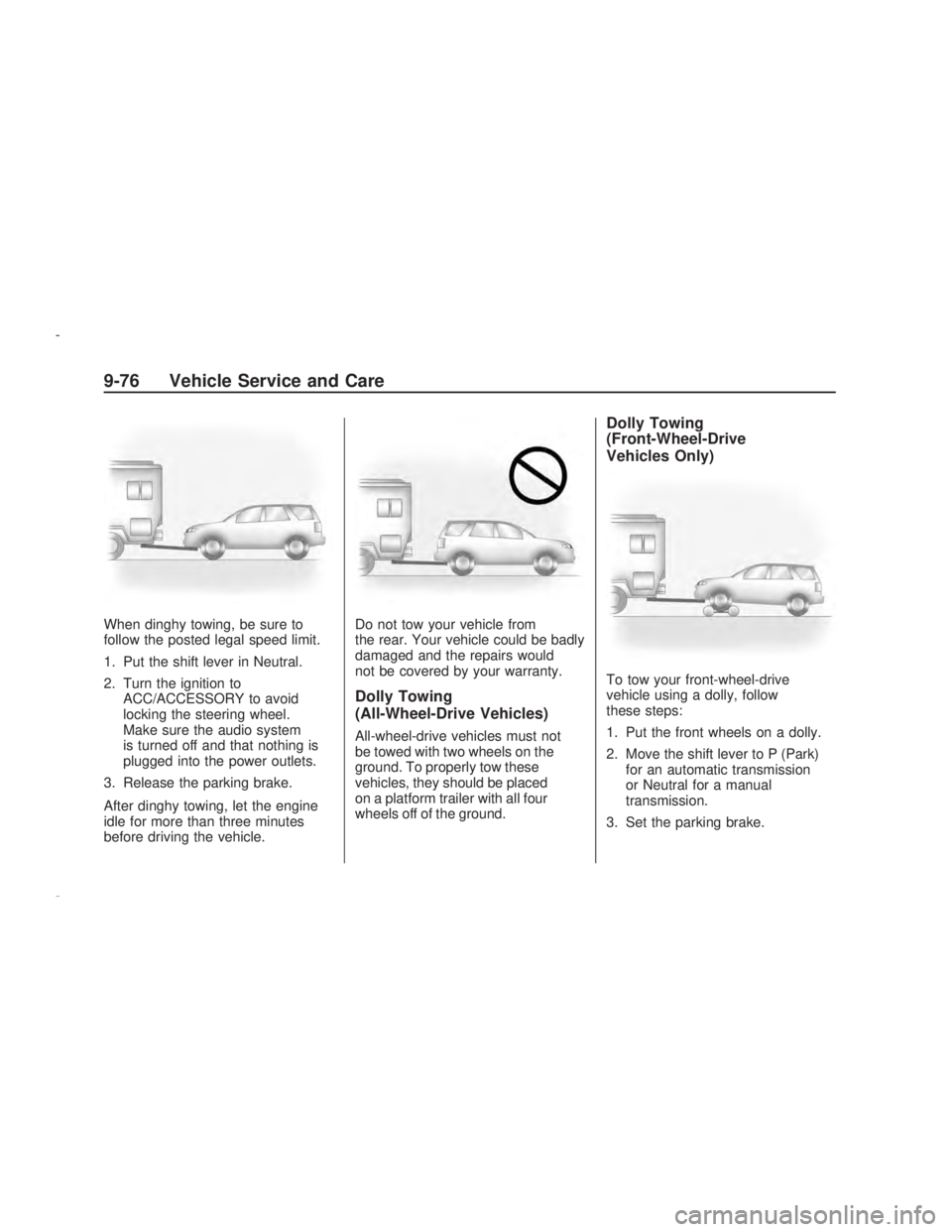
When dinghy towing, be sure to
follow the posted legal speed limit.
1. Put the shift lever in Neutral.
2. Turn the ignition to
ACC/ACCESSORY to avoid
locking the steering wheel.
Make sure the audio system
is turned off and that nothing is
plugged into the power outlets.
3. Release the parking brake.
After dinghy towing, let the engine
idle for more than three minutes
before driving the vehicle.Do not tow your vehicle from
the rear. Your vehicle could be badly
damaged and the repairs would
not be covered by your warranty.
Dolly Towing
(All-Wheel-Drive Vehicles)
All-wheel-drive vehicles must not
be towed with two wheels on the
ground. To properly tow these
vehicles, they should be placed
on a platform trailer with all four
wheels off of the ground.
Dolly Towing
(Front-Wheel-Drive
Vehicles Only)
To tow your front-wheel-drive
vehicle using a dolly, follow
these steps:
1. Put the front wheels on a dolly.
2. Move the shift lever to P (Park)
for an automatic transmission
or Neutral for a manual
transmission.
3. Set the parking brake.
9-76 Vehicle Service and Care
2009 - Pontiac Vibe Owner Manual