belt PONTIAC VIBE 2010 Service Manual
[x] Cancel search | Manufacturer: PONTIAC, Model Year: 2010, Model line: VIBE, Model: PONTIAC VIBE 2010Pages: 318, PDF Size: 1.7 MB
Page 73 of 318
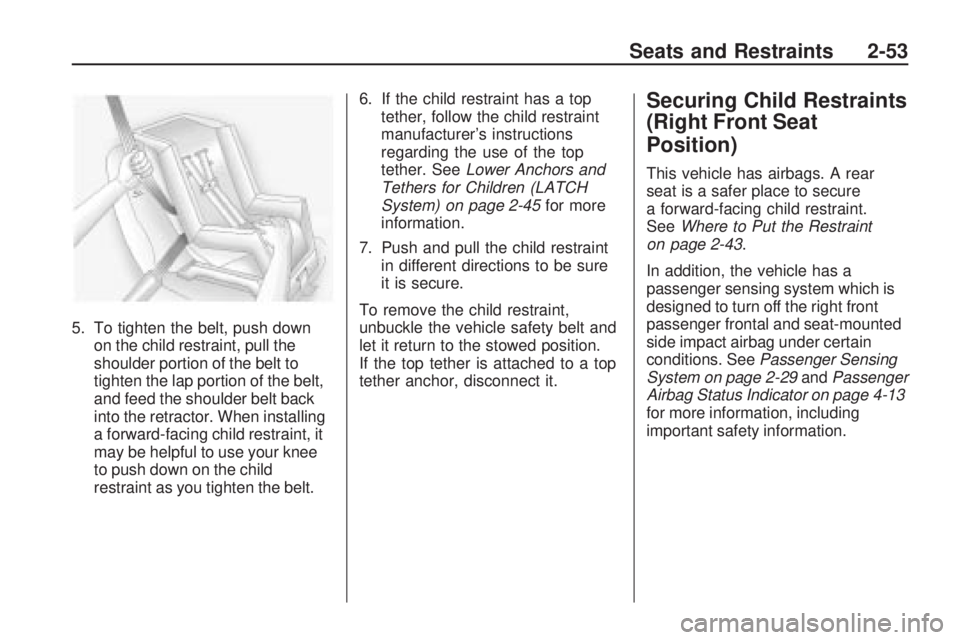
5. To tighten the belt, push downon the child restraint, pull the
shoulder portion of the belt to
tighten the lap portion of the belt,
and feed the shoulder belt back
into the retractor. When installing
a forward-facing child restraint, it
may be helpful to use your knee
to push down on the child
restraint as you tighten the belt. 6. If the child restraint has a top
tether, follow the child restraint
manufacturer’s instructions
regarding the use of the top
tether. See Lower Anchors and
Tethers for Children (LATCH
System) on page 2-45 for more
information.
7. Push and pull the child restraint in different directions to be sure
it is secure.
To remove the child restraint,
unbuckle the vehicle safety belt and
let it return to the stowed position.
If the top tether is attached to a top
tether anchor, disconnect it.
Securing Child Restraints
(Right Front Seat
Position)
This vehicle has airbags. A rear
seat is a safer place to secure
a forward-facing child restraint.
See Where to Put the Restraint
on page 2-43.
In addition, the vehicle has a
passenger sensing system which is
designed to turn off the right front
passenger frontal and seat-mounted
side impact airbag under certain
conditions. See Passenger Sensing
System on page 2-29 andPassenger
Airbag Status Indicator on page 4-13
for more information, including
important safety information.
Seats and Restraints 2-53
Page 74 of 318
A label on the sun visor says,
“Never put a rear-facing child seat
in the front.” This is because the risk
to the rear-facing child is so great,
if the airbag deploys.
{CAUTION
A child in a rear-facing child
restraint can be seriously injured or
killed if the right front passenger
airbag inflates. This is because
the back of the rear-facing child
restraint would be very close to
the inflating airbag. A child in a
forward-facing child restraint can
be seriously injured or killed if
the right front passenger airbag
inflates and the passenger seat
is in a forward position.(Continued)
CAUTION (Continued)
Even if the passenger sensing
system has turned off the right
front passenger frontal airbag, no
system is fail-safe. No one can
guarantee that an airbag will not
deploy under some unusual
circumstance, even though it
is turned off.
Secure rear-facing child restraints
in a rear seat, even if the airbag is
off. If you secure a forward-facing
child restraint in the right front seat,
always move the front passenger
seat as far back as it will go. It is
better to secure the child restraint
in a rear seat.
SeePassenger Sensing System
on page 2-29 for additional
information. If the child restraint has the LATCH
system, see
Lower Anchors and
Tethers for Children (LATCH
System) on page 2-45 for how and
where to install the child restraint
using LATCH. If a child restraint is
secured in the seating position using
a safety belt and it uses a top tether,
see Lower Anchors and Tethers
for Children (LATCH System) on
page 2-45 for top tether anchor
locations.
Do not secure a child seat in a
position without a top tether anchor
if a national or local law requires
that the top tether be anchored,
or if the instructions that come
with the child restraint say that
the top strap must be anchored.
In Canada, the law requires
that forward-facing child restraints
have a top tether, and that the tether
be attached.
2-54 Seats and Restraints
Page 75 of 318
You will be using the lap-shoulder
belt to secure the child restraint in
this position. Follow the instructions
that came with the child restraint.
1. Move the seat as far back asit will go before securing the
forward-facing child restraint.
When the passenger sensing
system has turned off the right
front passenger frontal and
seat-mounted side impact airbag,
the off indicator on the passenger
airbag status indicator should
light and stay lit when you start
the vehicle. See Passenger
Airbag Status Indicator on
page 4-13.
2. Put the child restraint on the seat.
3. Pick up the latch plate, and run the lap and shoulder portions of
the vehicle’s safety belt through
or around the restraint. The child
restraint instructions will show
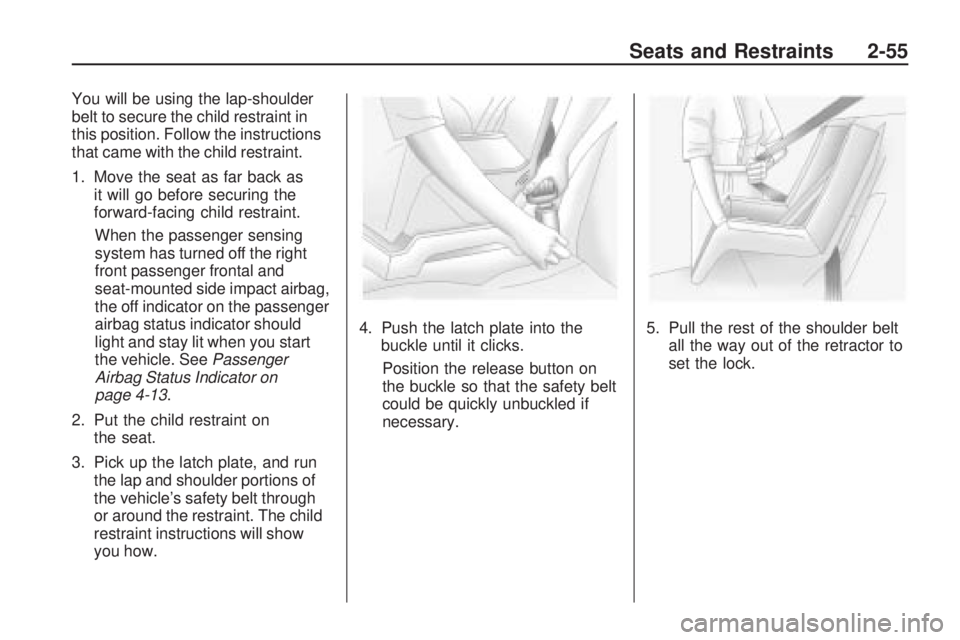
you how. 4. Push the latch plate into the
buckle until it clicks.
Position the release button on
the buckle so that the safety belt
could be quickly unbuckled if
necessary. 5. Pull the rest of the shoulder belt
all the way out of the retractor to
set the lock.
Seats and Restraints 2-55
Page 76 of 318
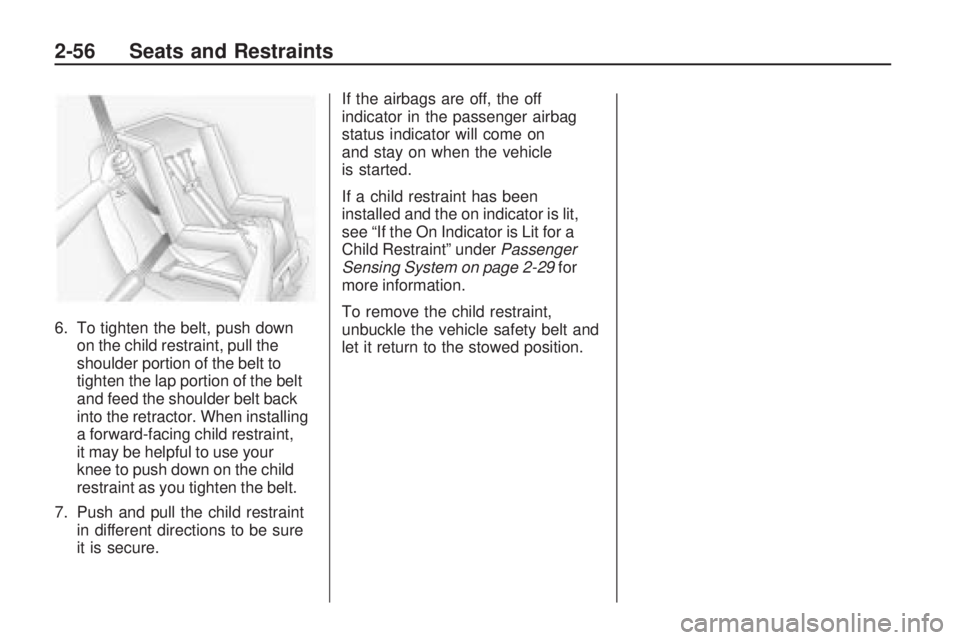
6. To tighten the belt, push downon the child restraint, pull the
shoulder portion of the belt to
tighten the lap portion of the belt
and feed the shoulder belt back
into the retractor. When installing
a forward-facing child restraint,
it may be helpful to use your
knee to push down on the child
restraint as you tighten the belt.
7. Push and pull the child restraint in different directions to be sure
it is secure. If the airbags are off, the off
indicator in the passenger airbag
status indicator will come on
and stay on when the vehicle
is started.
If a child restraint has been
installed and the on indicator is lit,
see “If the On Indicator is Lit for a
Child Restraint” under
Passenger
Sensing System on page 2-29 for
more information.
To remove the child restraint,
unbuckle the vehicle safety belt and
let it return to the stowed position.
2-56 Seats and Restraints
Page 83 of 318

Instruments and
Controls
Instrument Panel OverviewInstrument Panel Overview.....4-2
ControlsSteering Wheel Adjustment.....4-4
Steering Wheel Controls .........4-4
Horn ...................................
.4-5
Windshield Wiper/Washer .......4-5
Rear Window Wiper/Washer . . . .4-6
Power Outlets (Accessory Power Outlets) ....................
.4-6
Power Outlets (115 Volt Alternating Current) .............
.4-7
Cigarette Lighter ..................
.4-8
Ashtrays .............................
.4-8
Warning Lights, Gages, and
Indicators
Warning Lights, Gages, and
Indicators ..........................
.4-8
Instrument Cluster ................
.4-9
Speedometer .....................
.4-10
Odometer ..........................
.4-10
Trip Odometer ....................
.4-10
Tachometer .......................
.4-10
Fuel Gage .........................
.4-10
Engine Coolant Temperature Gage .............4-11
Safety Belt Reminders ..........4-11
Airbag Readiness Light .........4-12
Passenger Airbag Status Indicator ..........................
.4-13
Charging System Light .........4-14
Malfunction Indicator Lamp .................
.4-14
Brake System Warning Light ...............................
.4-17
Antilock Brake System (ABS) Warning Light ...........4-17
Service All-Wheel Drive Light ...............................
.4-18Speed Sensitive Power
Steering (SSPS) Warning
Light ...............................
.4-18
StabiliTrak®Indicator Light . . . .4-18
Traction Control System (TCS) Warning Light ...........4-19
Tire Pressure Light .............
.4-19
Engine Oil Pressure Light .....4-19
Low Fuel Warning Light ........4-20
Security Light .....................
.4-20
High-Beam on Light .............4-20
Fog Lamp Light ..................
.4-20
Lamps on Reminder .............4-20
Taillamp Indicator Light .........4-21
Low Washer Fluid Warning Light ...............................
.4-21
Cruise Control Light .............4-21
Door Ajar Light ...................
.4-21
Vehicle PersonalizationVehicle Personalization .........4-21
OnStar SystemOnStar®System.................
.4-23
Instruments and Controls 4-1
Page 93 of 318
that the fuel filler door is on the driver
side of the vehicle. The fuel gage
works only when the ignition switch is
turned to ON/RUN. When the gage
first indicates E or empty, there is still
about 2 gallons ( 7.6 L) of fuel left,
but more needs to be added right
away. When the vehicle is low on fuel
the low fuel warning light, located
below the empty mark, comes on.
Five things that do not indicate a
problem with the fuel gage:
•At the gas station, the fuel pump
shuts off before the gage reads
F or full.
•It takes a little more or less fuel
to fill up than the gage indicated.
For example, the gage may have
indicated the tank was half full,
but it actually took more or less
than half the tank’s capacity to
fill it.
•It takes the gage several minutes
to read F or full after filling the
vehicle with fuel.
•The gage moves a little when you
turn, stop or speed up.
•The gage does not go back to E
or empty when you turn off the
ignition.
Engine Coolant
Temperature Gage
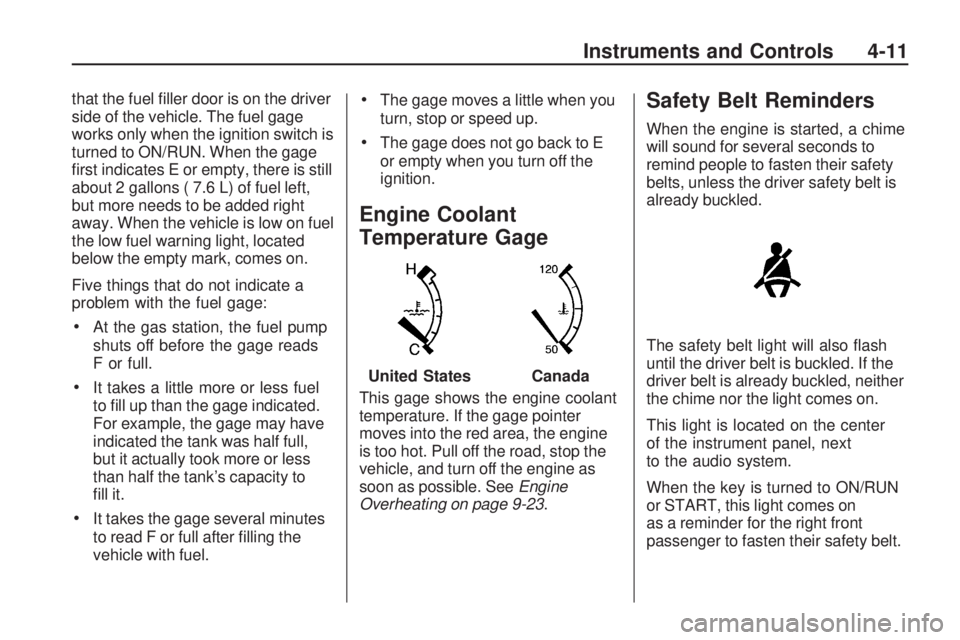
This gage shows the engine coolant
temperature. If the gage pointer
moves into the red area, the engine
is too hot. Pull off the road, stop the
vehicle, and turn off the engine as
soon as possible. SeeEngine
Overheating on page 9-23 .
Safety Belt Reminders
When the engine is started, a chime
will sound for several seconds to
remind people to fasten their safety
belts, unless the driver safety belt is
already buckled.
The safety belt light will also flash
until the driver belt is buckled. If the
driver belt is already buckled, neither
the chime nor the light comes on.
This light is located on the center
of the instrument panel, next
to the audio system.
When the key is turned to ON/RUN
or START, this light comes on
as a reminder for the right front
passenger to fasten their safety belt.
United States
Canada
Instruments and Controls 4-11
Page 94 of 318
This light flashes until the right front
passenger safety belt is buckled.
The passenger safety belt reminder
light will not come on if the right front
passenger belt is already buckled or
if a sensor does not detect the weight
of a passenger in that seat.
If something is placed on the right
front passenger seat, the sensors
in the seat may detect that object
and cause the right front passenger
safety belt reminder light to come on.
If this happens, remove the object.Airbag Readiness Light
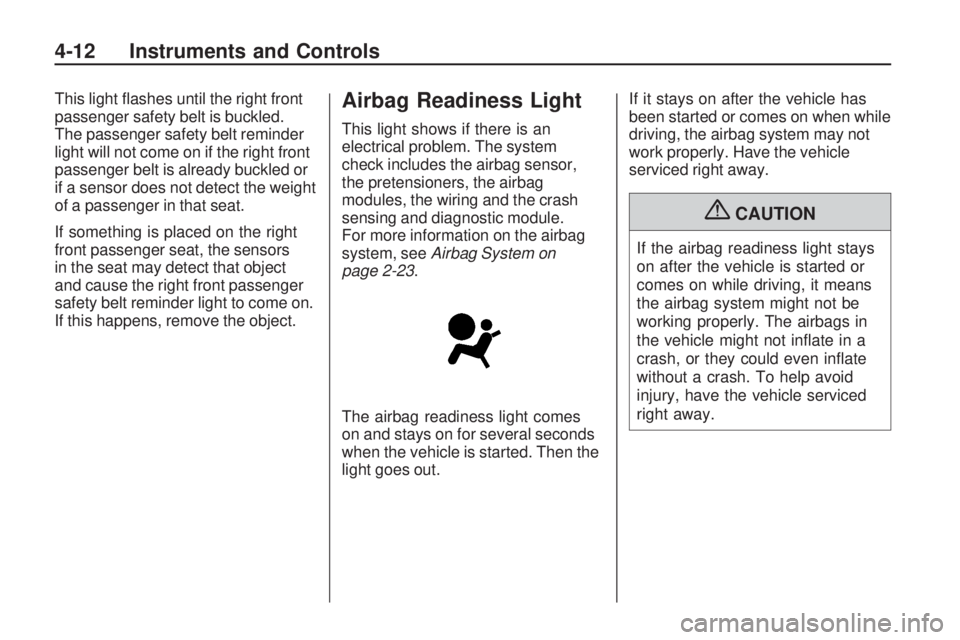
This light shows if there is an
electrical problem. The system
check includes the airbag sensor,
the pretensioners, the airbag
modules, the wiring and the crash
sensing and diagnostic module.
For more information on the airbag
system, seeAirbag System on
page 2-23.
The airbag readiness light comes
on and stays on for several seconds
when the vehicle is started. Then the
light goes out. If it stays on after the vehicle has
been started or comes on when while
driving, the airbag system may not
work properly. Have the vehicle
serviced right away.
{CAUTION
If the airbag readiness light stays
on after the vehicle is started or
comes on while driving, it means
the airbag system might not be
working properly. The airbags in
the vehicle might not inflate in a
crash, or they could even inflate
without a crash. To help avoid
injury, have the vehicle serviced
right away.
4-12 Instruments and Controls
Page 136 of 318
Driving Information
Driving for Better
Fuel Economy
Driving habits can affect fuel
mileage. Here are some driving
tips to get the best fuel economy
possible.
•Avoid fast starts and accelerate
smoothly.
•Brake gradually and avoid abrupt
stops.
•Avoid idling the engine for long
periods of time.
•When road and weather
conditions are appropriate, use
cruise control, if equipped.
•Always follow posted speed limits
or drive more slowly when
conditions require.
•Keep vehicle tires properly
inflated.
•Combine several trips into a
single trip.
•Replace the vehicle’s tires with
the same TPC Spec number
molded into the tire’s sidewall
near the size.
•Follow recommended scheduled
maintenance.
Defensive Driving
Defensive driving means “always
expect the unexpected.” The first
step in driving defensively is to wear
your safety belt, seeSafety Belts on
page 2-8.
{CAUTION
Assume that other road users
(pedestrians, bicyclists, and other
drivers) are going to be careless
and make mistakes. Anticipate
what they might do and be ready.
In addition:
•Allow enough following
distance between you and
the driver in front of you.
•Focus on the task of driving.
Driver distraction can cause
collisions resulting in injury or
possible death. These simple
defensive driving techniques
could save your life.
8-2 Driving and Operating
Page 140 of 318
An emergency like this requires
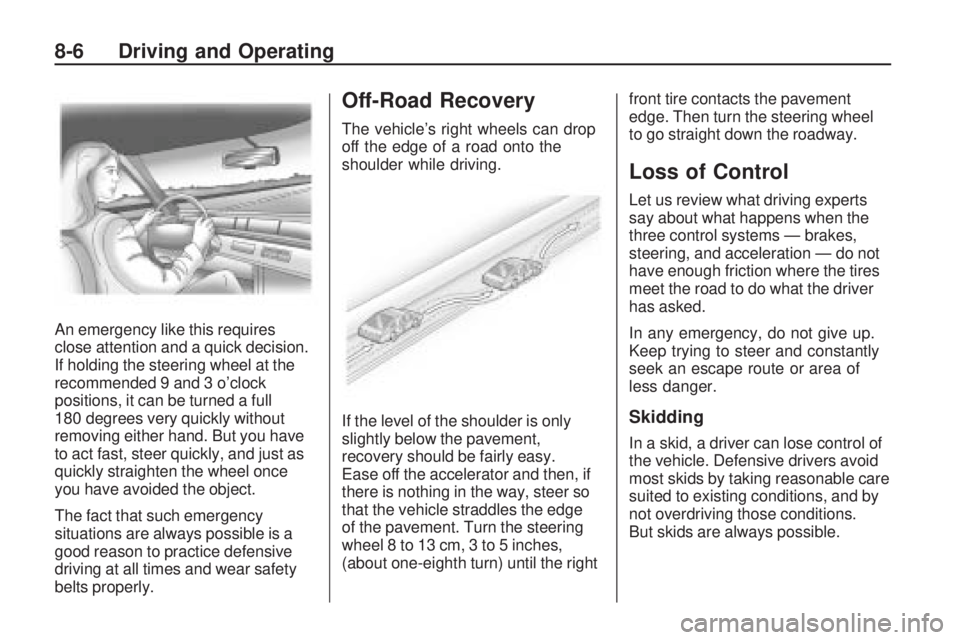
close attention and a quick decision.
If holding the steering wheel at the
recommended 9 and 3 o’clock
positions, it can be turned a full
180 degrees very quickly without
removing either hand. But you have
to act fast, steer quickly, and just as
quickly straighten the wheel once
you have avoided the object.
The fact that such emergency
situations are always possible is a
good reason to practice defensive
driving at all times and wear safety
belts properly.
Off-Road Recovery
The vehicle’s right wheels can drop
off the edge of a road onto the
shoulder while driving.
If the level of the shoulder is only
slightly below the pavement,
recovery should be fairly easy.
Ease off the accelerator and then, if
there is nothing in the way, steer so
that the vehicle straddles the edge
of the pavement. Turn the steering
wheel 8 to 13 cm, 3 to 5 inches,
(about one-eighth turn) until the rightfront tire contacts the pavement
edge. Then turn the steering wheel
to go straight down the roadway.
Loss of Control
Let us review what driving experts
say about what happens when the
three control systems — brakes,
steering, and acceleration — do not
have enough friction where the tires
meet the road to do what the driver
has asked.
In any emergency, do not give up.
Keep trying to steer and constantly
seek an escape route or area of
less danger.
Skidding
In a skid, a driver can lose control of
the vehicle. Defensive drivers avoid
most skids by taking reasonable care
suited to existing conditions, and by
not overdriving those conditions.
But skids are always possible.
8-6 Driving and Operating
Page 181 of 318
Parking on Hills
{CAUTION
Parking the vehicle on a hill with
the trailer attached can be
dangerous. If something goes
wrong, the rig could start to move.
People can be injured, and both
the vehicle and the trailer can be
damaged. When possible, always
park the rig on a flat surface.
If parking the rig on a hill:
1. Press the brake pedal, but do not shift into P (Park) yet for vehicles
with an automatic transmission,
or into gear for vehicles with a
manual transmission. Turn the
wheels into the curb if facing
downhill or into traffic if facing
uphill.
2. Have someone place chocks under the trailer wheels. 3. When the wheel chocks are in
place, release the brake pedal
until the chocks absorb the load.
4. Reapply the brake pedal. Then apply the parking brake and
shift into P (Park) for vehicles
with an automatic transmission
or into gear for vehicles with
a manual transmission.
5. Release the brake pedal.
Leaving After Parking on
a Hill
1. Apply and hold the brake pedal while you:
•start the engine,
•shift into a gear, and
•release the parking brake.
2. Let up on the brake pedal.
3. Drive slowly until the trailer is clear of the chocks.
4. Stop and have someone pick up and store the chocks.
Maintenance When Trailer
Towing
The vehicle needs service more
often when pulling a trailer. See this
manual’s Maintenance Schedule or
Index for more information. Things
that are especially important in trailer
operation are automatic transmission
fluid, engine oil, axle lubricant, belts,
cooling system and brake system.
It is a good idea to inspect these
before and during the trip.
Check periodically to see that all
hitch nuts and bolts are tight.
Engine Cooling When Trailer
Towing
The cooling system may temporarily
overheat during severe operating
conditions. See Engine Overheating
on page 9-23.
Driving and Operating 8-47