belt PONTIAC VIBE 2010 Workshop Manual
[x] Cancel search | Manufacturer: PONTIAC, Model Year: 2010, Model line: VIBE, Model: PONTIAC VIBE 2010Pages: 318, PDF Size: 1.7 MB
Page 187 of 318
California Perchlorate
Materials Requirements
Certain types of automotive
applications, such as airbag
initiators, seat belt pretensioners,
and lithium batteries contained
in remote keyless transmitters,
may contain perchlorate materials.
Special handling may be necessary.
For additional information, see
www.dtsc.ca.gov/hazardouswaste/
perchlorate.
Accessories and
Modications
When non-dealer/non-retailer
accessories are added to the vehicle,
they can affect vehicle performance
and safety, including such things
as airbags, braking, stability, ride
and handling, emissions systems,
aerodynamics, durability, and
electronic systems like antilock
brakes, traction control, and stability
control. Some of these accessories
could even cause malfunction or
damage not covered by the vehicle
warranty.Damage to vehicle components
resulting from the installation or use
of non-GM certified parts, including
control module modifications, are
not covered under the terms of the
vehicle warranty and may affect
remaining warranty coverage for
affected parts.
GM Accessories are designed
to complement and function with
other systems on the vehicle.
Your GM dealer/retailer can
accessorize the vehicle using
genuine GM Accessories.
Vehicle Care 9-3
Page 230 of 318
Tire Designations
Tire Size
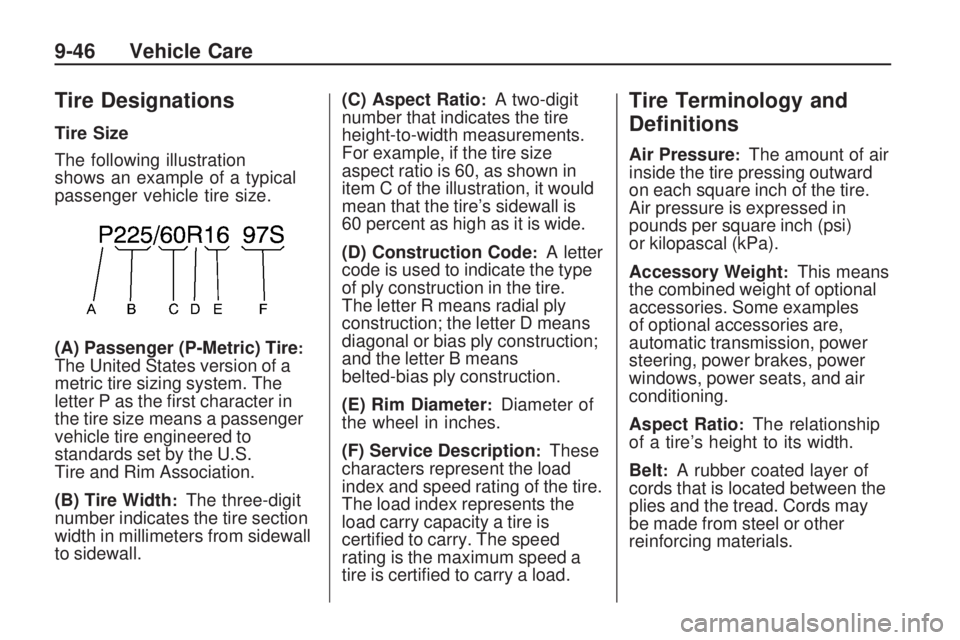
The following illustration
shows an example of a typical
passenger vehicle tire size.
(A) Passenger (P-Metric) Tire
:The United States version of a
metric tire sizing system. The
letter P as the first character in
the tire size means a passenger
vehicle tire engineered to
standards set by the U.S.
Tire and Rim Association.
(B) Tire Width
:The three-digit
number indicates the tire section
width in millimeters from sidewall
to sidewall. (C) Aspect Ratio
:A two-digit
number that indicates the tire
height-to-width measurements.
For example, if the tire size
aspect ratio is 60, as shown in
item C of the illustration, it would
mean that the tire’s sidewall is
60 percent as high as it is wide.
(D) Construction Code
:A letter
code is used to indicate the type
of ply construction in the tire.
The letter R means radial ply
construction; the letter D means
diagonal or bias ply construction;
and the letter B means
belted-bias ply construction.
(E) Rim Diameter
:Diameter of
the wheel in inches.
(F) Service Description
:These
characters represent the load
index and speed rating of the tire.
The load index represents the
load carry capacity a tire is
certified to carry. The speed
rating is the maximum speed a
tire is certified to carry a load.
Tire Terminology and
Denitions
Air Pressure:The amount of air
inside the tire pressing outward
on each square inch of the tire.
Air pressure is expressed in
pounds per square inch (psi)
or kilopascal (kPa).
Accessory Weight
:This means
the combined weight of optional
accessories. Some examples
of optional accessories are,
automatic transmission, power
steering, power brakes, power
windows, power seats, and air
conditioning.
Aspect Ratio
:The relationship
of a tire’s height to its width.
Belt
:A rubber coated layer of
cords that is located between the
plies and the tread. Cords may
be made from steel or other
reinforcing materials.
9-46 Vehicle Care
Page 240 of 318
When It Is Time for New
Tires
Various factors, such as
maintenance, temperatures,
driving speeds, vehicle loading,
and road conditions influence
when you need new tires.
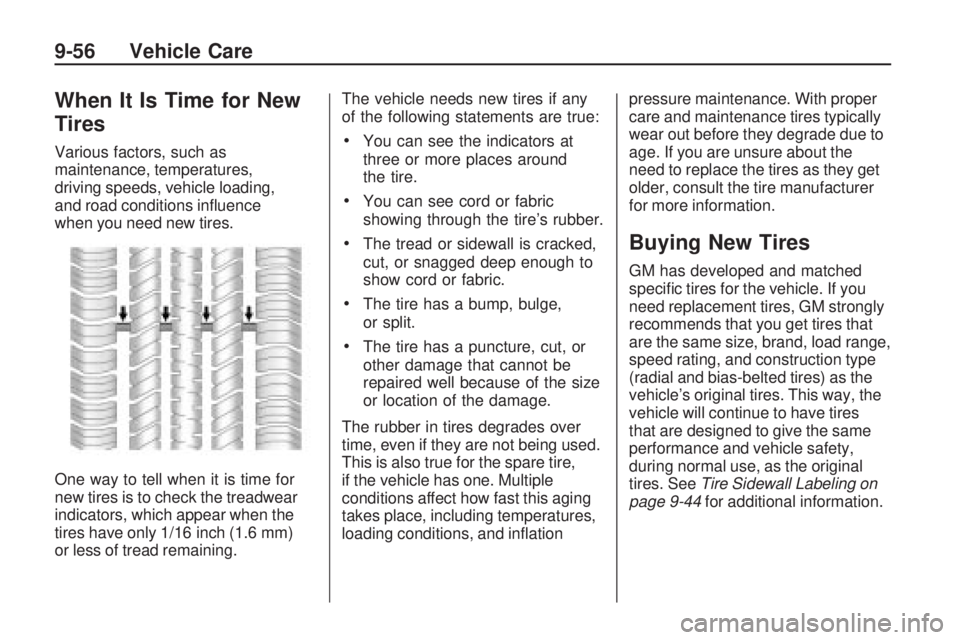
One way to tell when it is time for
new tires is to check the treadwear
indicators, which appear when the
tires have only 1/16 inch (1.6 mm)
or less of tread remaining.The vehicle needs new tires if any
of the following statements are true:•You can see the indicators at
three or more places around
the tire.
•You can see cord or fabric
showing through the tire’s rubber.
•The tread or sidewall is cracked,
cut, or snagged deep enough to
show cord or fabric.
•The tire has a bump, bulge,
or split.
•The tire has a puncture, cut, or
other damage that cannot be
repaired well because of the size
or location of the damage.
The rubber in tires degrades over
time, even if they are not being used.
This is also true for the spare tire,
if the vehicle has one. Multiple
conditions affect how fast this aging
takes place, including temperatures,
loading conditions, and inflation pressure maintenance. With proper
care and maintenance tires typically
wear out before they degrade due to
age. If you are unsure about the
need to replace the tires as they get
older, consult the tire manufacturer
for more information.
Buying New Tires
GM has developed and matched
specific tires for the vehicle. If you
need replacement tires, GM strongly
recommends that you get tires that
are the same size, brand, load range,
speed rating, and construction type
(radial and bias-belted tires) as the
vehicle’s original tires. This way, the
vehicle will continue to have tires
that are designed to give the same
performance and vehicle safety,
during normal use, as the original
tires. See
Tire Sidewall Labeling on
page 9-44 for additional information.
9-56 Vehicle Care
Page 241 of 318
GM recommends replacing tires in
sets of four. This is because uniform
tread depth on all tires will help keep
the vehicle performing most like it did
when the tires were new. Replacing
less than a full set of tires can
affect the braking and handling
performance of the vehicle. SeeTire
Inspection on page 9-54 andTire
Rotation on page 9-55 .
{CAUTION
Mixing tires could cause you
to lose control while driving.
If you mix tires of different
sizes, brands, or types (radial
and bias-belted tires), the
vehicle may not handle
properly, and you could have
a crash. Using tires of different
sizes, brands, or types may
also cause damage to your
(Continued)
CAUTION (Continued)
vehicle. Be sure to use the
correct size, brand, and type
of tires on all wheels. It is
all right to drive with your
compact spare temporarily,
as it was developed for use
on your vehicle. See Compact
Spare Tire on page 9-68.
{CAUTION
If you use bias-ply tires on the
vehicle, the wheel rim flanges
could develop cracks after
many miles of driving. A tire
and/or wheel could fail
suddenly, causing a crash.
Use only radial-ply tires with
the wheels on the vehicle.
Vehicles that have a tire pressure
monitoring system could give an
inaccurate low-pressure warning
if tires not recommended for the
vehicle are installed. Tires that do
not match the original equipment
tires could give a low-pressure
warning that is higher or lower than
the proper warning level you would
get with original equipment tires.
See Tire Pressure Monitor System
on page 9-50.
The vehicle’s original equipment
tires are listed on the Tire and
Loading Information Label. See
Vehicle Load Limits on page 8-12 ,
for more information about the Tire
and Loading Information label and
its location on the vehicle.
Vehicle Care 9-57
Page 267 of 318
Some commercial products may
increase gloss on the instrument
panel. The increase in gloss may
cause annoying reflections in the
windshield and even make it difficult
to see through the windshield under
certain conditions.
Care of Safety Belts
Keep belts clean and dry.
{CAUTION
Do not bleach or dye safety belts.
It may severely weaken them.
In a crash, they might not be able
to provide adequate protection.
Clean safety belts only with mild
soap and lukewarm water.
Floor Mats
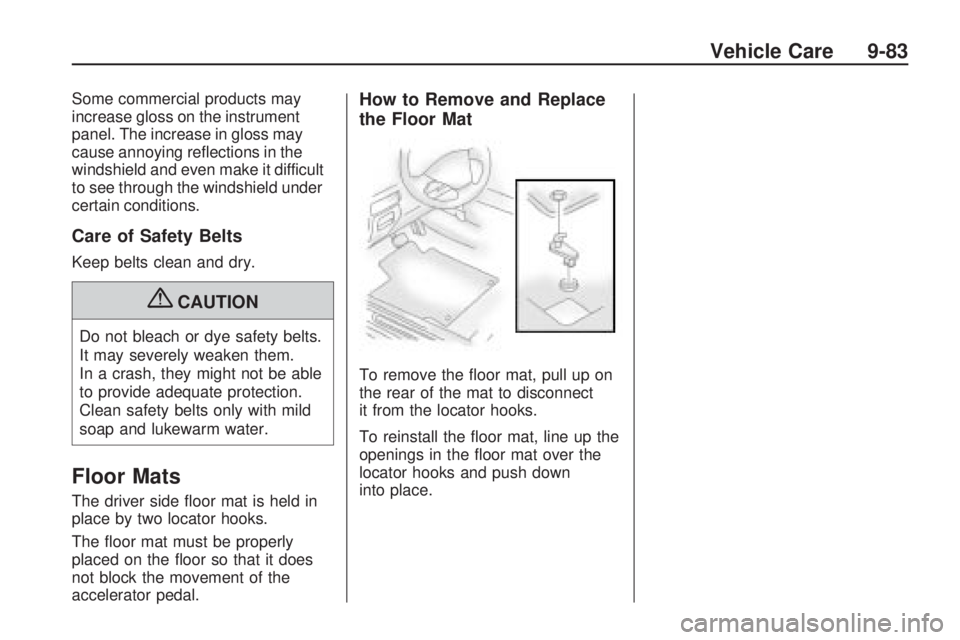
The driver side floor mat is held in
place by two locator hooks.
The floor mat must be properly
placed on the floor so that it does
not block the movement of the
accelerator pedal.
How to Remove and Replace
the Floor Mat
To remove the floor mat, pull up on
the rear of the mat to disconnect
it from the locator hooks.
To reinstall the floor mat, line up the
openings in the floor mat over the
locator hooks and push down
into place.
Vehicle Care 9-83
Page 272 of 318
32 000 km (20,000 Miles)
❑Change engine oil and filter
(or every 3 months, whichever
occurs first). An Emission Control
Service.
❑ Rotate tires. See Tire Rotation
on page 9-55 for proper rotation
pattern and additional information.
(See footnote +.)
❑ Inspect engine air cleaner filter
if vehicle is driven in dusty
conditions. Replace filter if
necessary.
40 000 km (25,000 Miles)
❑ Change engine oil and filter
(or every 3 months, whichever
occurs first). An Emission Control
Service.
❑ Rotate tires. See Tire Rotation
on page 9-55 for proper rotation
pattern and additional information.
(See footnote +.)
❑ Inspect engine air cleaner filter
if vehicle is driven in dusty
conditions. Replace filter if
necessary.
48 000 km (30,000 Miles)
❑ Change engine oil and filter
(or every 3 months, whichever
occurs first). An Emission Control
Service.
❑ Rotate tires. See Tire Rotation
on page 9-55 for proper rotation
pattern and additional information.
(See footnote +.)
❑ Replace engine air cleaner filter
(or every 24 months, whichever
occurs first). See Engine Air
Cleaner/Filter on page 9-16 for
more information.
❑ Check restraint system. Make
sure the safety belt reminder light
and safety belt assemblies are
working properly. Look for any
other loose or damaged safety
belt system parts. If you see
anything that might keep a safety
belt system from doing its job,
have it repaired. Have any torn
or frayed safety belts replaced.
Also see Safety System Check
on page 2-21. ❑
Replace passenger compartment
air filter.
❑ Change transfer case fluid when
doing frequent trailer towing.
❑ Change rear differential fluid when
doing frequent trailer towing.
❑ Inspect fuel tank, cap, cap gasket,
and lines for damage or leaks
(or every 24 months, whichever
occurs first). Replace parts as
needed. An Emission Control
Service. (See footnote †.)
❑ Change manual transmission fluid
every 48 000 km (30,000 miles)
only if your vehicle is used to tow
a trailer.
10-4 Service and Maintenance
Page 274 of 318
96 000 km (60,000 Miles)
❑Change engine oil and filter
(or every 3 months, whichever
occurs first). An Emission Control
Service.
❑ Rotate tires. See Tire Rotation
on page 9-55 for proper rotation
pattern and additional
information. (See footnote +.)
❑ Replace engine air cleaner filter
(or every 24 months, whichever
occurs first). See Engine Air
Cleaner/Filter on page 9-16 for
more information.
❑ Check restraint system. Make
sure the safety belt reminder light
and safety belt assemblies are
working properly. Look for any
other loose or damaged safety
belt system parts. If you see
anything that might keep a safety
belt system from doing its job,
have it repaired. Have any torn
or frayed safety belts replaced.
Also see Safety System Check
on page 2-21. ❑
Replace passenger compartment
air filter.
❑ Change transfer case fluid when
doing frequent trailer towing.
❑ Change rear differential fluid when
doing frequent trailer towing.
❑ Inspect engine accessory drive
belts (or every 48 months,
whichever occurs first). Visually
inspect belt for fraying, excessive
cracks, or obvious damage.
Replace belt if necessary.
An Emission Control Service.
❑ Inspect for tappet noise and
engine vibration. Adjust valve
clearance to factory specifications
if necessary (or every 48 months,
whichever occurs first). An
Emission Control Service.
❑ Inspect fuel tank, cap, cap gasket,
and lines for damage or leaks
(or every 24 months, whichever
occurs first). Replace parts as
needed. An Emission Control
Service. (See footnote †.) ❑
Change manual transmission fluid
every 48 000 km (30,000 miles)
only if your vehicle is used to tow
a trailer.
❑ Change automatic
transmission fluid every
96 000 km (60,000 miles) if the
vehicle is mainly driven under one
or more of these conditions:
- In heavy city traffic where the outside temperature regularly
reaches 32°C (90°F) or higher.
- In hilly or mountainous terrain.
- When doing frequent trailer towing.
- Uses such as found in taxi, police, or delivery service.
If you do not use your vehicle under
any of these conditions, the uid
does not require changing.
See Recommended Fluids and
Lubricants on page 10-15 for
the proper uid to use.
10-6 Service and Maintenance
Page 275 of 318
104 000 km (65,000 Miles)
❑Change engine oil and filter
(or every 3 months, whichever
occurs first). An Emission Control
Service.
❑ Rotate tires. See Tire Rotation
on page 9-55 for proper rotation
pattern and additional
information. (See footnote +.)
❑ Inspect engine air cleaner filter
if vehicle is driven in dusty
conditions. Replace filter if
necessary.
112 000 km (70,000 Miles)
❑ Change engine oil and filter
(or every 3 months, whichever
occurs first). An Emission Control
Service.
❑ Rotate tires. See Tire Rotation
on page 9-55 for proper rotation
pattern and additional
information. (See footnote +.)
❑ Inspect engine air cleaner filter
if vehicle is driven in dusty
conditions. Replace filter if
necessary.
120 000 km (75,000 Miles)
❑ Change engine oil and filter
(or every 3 months, whichever
occurs first). An Emission Control
Service.
❑ Rotate tires. See Tire Rotation
on page 9-55 for proper rotation
pattern and additional information.
(See footnote +.)
❑ Inspect engine air cleaner filter
if vehicle is driven in dusty
conditions. Replace filter if
necessary.
❑ Inspect passenger compartment
air filter.
❑ Change transfer case fluid when
doing frequent trailer towing.
❑ Change rear differential fluid when
doing frequent trailer towing.
❑ Inspect engine accessory drive
belts (or 12 months since last
inspection). An Emission Control
Service.
128 000 km (80,000 Miles)
❑ Change engine oil and filter
(or every 3 months, whichever
occurs first). An Emission Control
Service.
❑ Rotate tires. See Tire Rotation
on page 9-55 for proper rotation
pattern and additional
information. (See footnote +.)
❑ Inspect engine air cleaner filter
if vehicle is driven in dusty
conditions. Replace filter if
necessary.
136 000 km (85,000 Miles)
❑ Change engine oil and filter
(or every 3 months, whichever
occurs first). An Emission Control
Service.
❑ Rotate tires. See Tire Rotation
on page 9-55 for proper rotation
pattern and additional information.
(See footnote +.)
❑ Inspect engine air cleaner filter
if vehicle is driven in dusty
conditions. Replace filter if
necessary.
Service and Maintenance 10-7
Page 276 of 318
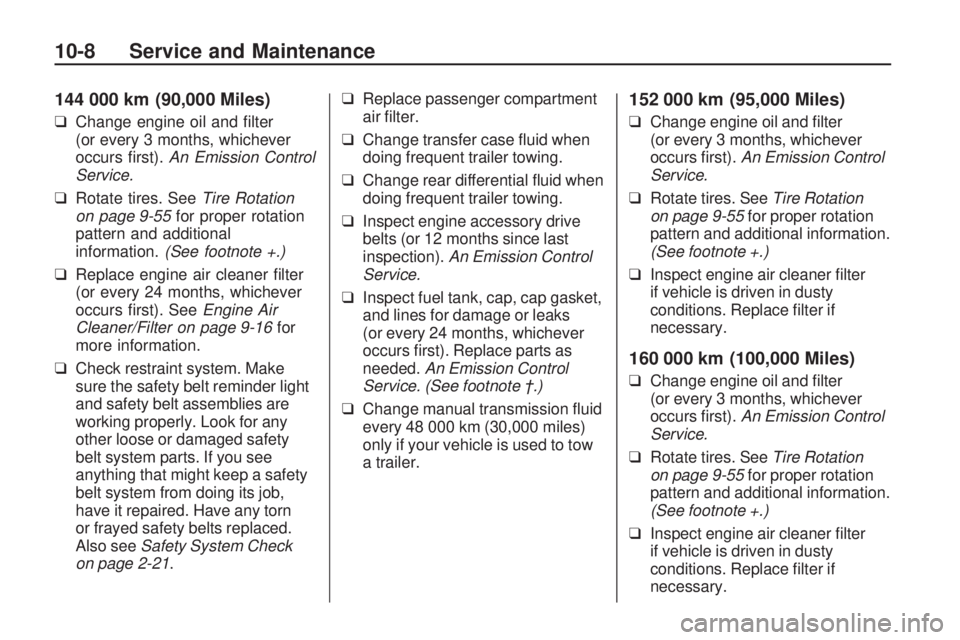
144 000 km (90,000 Miles)
❑Change engine oil and filter
(or every 3 months, whichever
occurs first). An Emission Control
Service.
❑ Rotate tires. See Tire Rotation
on page 9-55 for proper rotation
pattern and additional
information. (See footnote +.)
❑ Replace engine air cleaner filter
(or every 24 months, whichever
occurs first). See Engine Air
Cleaner/Filter on page 9-16 for
more information.
❑ Check restraint system. Make
sure the safety belt reminder light
and safety belt assemblies are
working properly. Look for any
other loose or damaged safety
belt system parts. If you see
anything that might keep a safety
belt system from doing its job,
have it repaired. Have any torn
or frayed safety belts replaced.
Also see Safety System Check
on page 2-21. ❑
Replace passenger compartment
air filter.
❑ Change transfer case fluid when
doing frequent trailer towing.
❑ Change rear differential fluid when
doing frequent trailer towing.
❑ Inspect engine accessory drive
belts (or 12 months since last
inspection). An Emission Control
Service.
❑ Inspect fuel tank, cap, cap gasket,
and lines for damage or leaks
(or every 24 months, whichever
occurs first). Replace parts as
needed. An Emission Control
Service. (See footnote †.)
❑ Change manual transmission fluid
every 48 000 km (30,000 miles)
only if your vehicle is used to tow
a trailer.
152 000 km (95,000 Miles)
❑ Change engine oil and filter
(or every 3 months, whichever
occurs first). An Emission Control
Service.
❑ Rotate tires. See Tire Rotation
on page 9-55 for proper rotation
pattern and additional information.
(See footnote +.)
❑ Inspect engine air cleaner filter
if vehicle is driven in dusty
conditions. Replace filter if
necessary.
160 000 km (100,000 Miles)
❑ Change engine oil and filter
(or every 3 months, whichever
occurs first). An Emission Control
Service.
❑ Rotate tires. See Tire Rotation
on page 9-55 for proper rotation
pattern and additional information.
(See footnote +.)
❑ Inspect engine air cleaner filter
if vehicle is driven in dusty
conditions. Replace filter if
necessary.
10-8 Service and Maintenance
Page 277 of 318
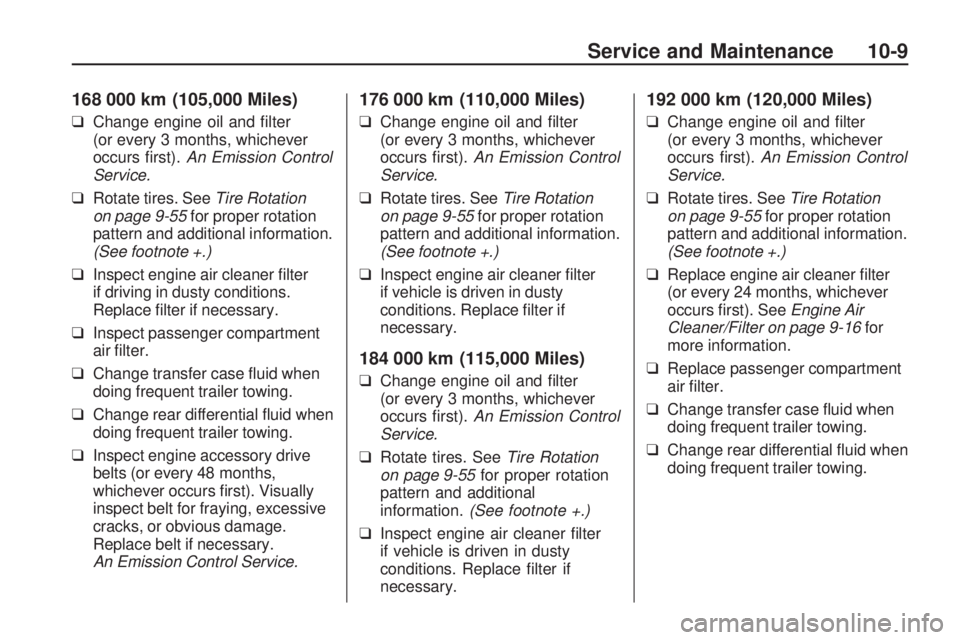
168 000 km (105,000 Miles)
❑Change engine oil and filter
(or every 3 months, whichever
occurs first). An Emission Control
Service.
❑ Rotate tires. See Tire Rotation
on page 9-55 for proper rotation
pattern and additional information.
(See footnote +.)
❑ Inspect engine air cleaner filter
if driving in dusty conditions.
Replace filter if necessary.
❑ Inspect passenger compartment
air filter.
❑ Change transfer case fluid when
doing frequent trailer towing.
❑ Change rear differential fluid when
doing frequent trailer towing.
❑ Inspect engine accessory drive
belts (or every 48 months,
whichever occurs first). Visually
inspect belt for fraying, excessive
cracks, or obvious damage.
Replace belt if necessary.
An Emission Control Service.
176 000 km (110,000 Miles)
❑ Change engine oil and filter
(or every 3 months, whichever
occurs first). An Emission Control
Service.
❑ Rotate tires. See Tire Rotation
on page 9-55 for proper rotation
pattern and additional information.
(See footnote +.)
❑ Inspect engine air cleaner filter
if vehicle is driven in dusty
conditions. Replace filter if
necessary.
184 000 km (115,000 Miles)
❑ Change engine oil and filter
(or every 3 months, whichever
occurs first). An Emission Control
Service.
❑ Rotate tires. See Tire Rotation
on page 9-55 for proper rotation
pattern and additional
information. (See footnote +.)
❑ Inspect engine air cleaner filter
if vehicle is driven in dusty
conditions. Replace filter if
necessary.
192 000 km (120,000 Miles)
❑ Change engine oil and filter
(or every 3 months, whichever
occurs first). An Emission Control
Service.
❑ Rotate tires. See Tire Rotation
on page 9-55 for proper rotation
pattern and additional information.
(See footnote +.)
❑ Replace engine air cleaner filter
(or every 24 months, whichever
occurs first). See Engine Air
Cleaner/Filter on page 9-16 for
more information.
❑ Replace passenger compartment
air filter.
❑ Change transfer case fluid when
doing frequent trailer towing.
❑ Change rear differential fluid when
doing frequent trailer towing.
Service and Maintenance 10-9