light PORSCHE 911 CARRERA 2006 5.G Owners Manual
[x] Cancel search | Manufacturer: PORSCHE, Model Year: 2006, Model line: 911 CARRERA, Model: PORSCHE 911 CARRERA 2006 5.GPages: 308, PDF Size: 3.69 MB
Page 224 of 308

224
Maintenance, Car Care
Light alloy wheels fPlease observe the chapter “WASHING” on
Page 219.
Warning!
Danger of accident if cleaning agents (e.g.
wheel cleaning agents) come into contact
with the brake discs. The resulting film on the
brake discs can impair braking perform-
ance.
fMake sure that no cleaning agent comes into
contact with the brake discs.
fIf cleaning agent has come into contact with
the brake discs, thoroughly clean the brake
discs with a strong jet of water.
fPaying attention to any road users behind you,
dry the brake discs by applying the brakes at short intervals.Pitting may occur if metallic particles which cause
contact corrosion (e.g. brass or copper in brake
dust) are allowed to remain on the aluminum for
too long.
fIf possible, wash the wheels with a sponge or
wash brush about every two weeks. In areas
where salt is spread on winter roads or there is
a lot of airborne industrial dust, it is best to
clean the wheels weekly.
The Porsche Light Alloy Wheel Cleaner
(ph-value 9.5) can be used for this pur-
pose.
If the ph-value of the detergent is incor-
rect, the protective coating on the wheels
will be destroyed.
Polishes which dissolve oxides, such as those
frequently used for other metals, or abrasive
tools or agents are unsuitable because they
break down the oxide film of the protective
coating and will cause discoloration of the
wheel.
fEvery three months, after cleaning, coat the
wheels with a car wax or non-corrosive grease
(vaseline).
Using a clean cloth thoroughly rub the grease
into the surface.
Door, roof, lid and window seals fWash dirt (e.g. abrasion, dust, road salts) from
all seals regularly using warm soapy water. Do
not use any chemical cleaning agents or sol-
vents.
When there is a frost hazard, the outer door seals
and the front and rear lid seals can be protected
against freezing into place by a suitable care prod-
uct.
In order to prevent damage to the anti-
friction coating, the inner door seals, the
convertible top seals and hardtop seals must
not be treated with care products. Headlights, lights, interior and exterior
plastic parts fUse only clean water and a little dishwashing
detergent to clean light lenses, plastic head-
light lenses, plastic parts and surfaces.
Do not clean when dry.
Use a soft sponge or a soft, lint-free cloth. Gen-
tly wipe the surface without applying too much
pressure.
The Porsche inside window cleaner is also suit-
able for cleaning plastic surfaces. Follow the
cleaning instructions on the container.
Never use other chemical cleaners or
solvents.
fRinse cleaned surfaces with clear water.
Page 225 of 308

Maintenance, Car Care
225
Leather Characteristics and special features
The natural surface markings of leather, e.g.
creases, healed scars, insect sting marks, struc-
tural differences and slight variations in shade and
grain add to the attractiveness of the natural leath-
er product.
A special mention must be made here of natural
leather.
For natural leather, carefully selected hides of the
highest quality are used. It is not covered com-
pletely with dye on production.
“Nature’s signature” is therefore easily recogniza-
ble.
This fine material is distinguished by an outstand-
ing seating comfort, special suppleness and a typ-
ical patina. Leather care and treatment
fClean all types of leather regularly to remove
fine dust using a soft, damp, white woollen
cloth or a commercially available microfibre
cloth.
fRemove heavy contamination with Porsche
leather cleaner.
Please always follow the instructions for use
given on the containers.
Caustic cleaners and hard cleaning objects
must not be used.
Perforated leather must under no circum-
stances get wet on its reverse side.
Once cleaned, leather (particularly the heavily
stressed leather seats) must be treated only with
Porsche leather care liquid.
Fabric, upholstery, carpets and
floor-mats fUse only a vacuum cleaner or a medium stiff
brush.
fRemove stains and spots with Porsche stain
remover.
The Porsche range of accessories includes non-
skid floor-mats to protect the carpets in summer
and winter.
Warning!
Risk of an accident.
fAlways check the movement of the pedals be-
fore driving and make sure that they are not ob-
structed by a floor-mat or any other object.
fSecure the floor-mat to prevent it from sliding
into positions that could interfere with the safe
operation of your vehicle - do not install them
loosely in the vehicle.
Your Porsche dealer will be glad to offer you nonskid floor-mats of the correct size.
Page 226 of 308

226
Maintenance, Car Care
Alcantara fDo not use a leather care product to clean
Alcantara.
For regular care it is sufficient to clean the cover
with a soft brush.
Heavy abrasion or rubbing when cleaning causes
a lasting change in the surface.
Cleaning when lightly soiled
fWet a soft cloth with water or a neutral soap
solution and wipe off the dirt.
Cleaning when heavily soiled
fWet a soft cloth with lukewarm water or
thinned white spirit and dab the dirt from the
outside in. Safety belts If it becomes necessary to clean the belts, you
can use any mild washing agent.
Allow the belts to dry prior to retracting, but avoid
direct sunlight.
fOnly use suitable cleaners.
If unsuitable cleaners are used or any attempt
is made to dye or bleach the belts, the web-
bing may be weakened and thus constitute a
safety risk.
Storing your Porsche If you intend to store your Porsche for a prolonged
period, please consult your authorized Porsche
dealer. The staff will be glad to advise you on the
most suitable and necessary methods.
fClean your vehicle thoroughly inside and out-
side.
Clean the engine compartment.
The under carriage and chassis components
should be free of dirt and salt deposits.
fFill up the fuel tank.
fChange the oil and oil filter, and run the engine
for several minutes.
fIncrease the tire pressure to 58 psi (4 bar).
It is not recommended to lift the vehicle, due to
the possibility of corrosion on shock absorber
piston shafts.
The vehicle should be moved slightly, approxi-
mately every four weeks, to prevent flat spot
on the tires. Climate control
The air conditioning system should be in good
working condition and fully charged.
Windshield/Headlight washer
fCheck and correct antifreeze/cleaning solution
level as necessary.
Electrical system
fRemove the battery from the vehicle and store
it in a cool dry place, not on a cement floor.
When the battery is disconnected, the
alarm system is deactivated.
fRecharge the battery every 3 months. If the
battery remains in the vehicle with the cables
connected, it is necessary to check, remove
and recharge the battery every 2-3 weeks.
Do not fast charge the battery.
fPlease observe the chapter “BATTERY” on
Page 258.
Vehicle interior
The interior must be dry, especially in the area of
the floor carpets. The use of drying agents (Silica-
Gel) is recommended in vehicles with leather inte-
rior and in areas with high humidity. The recom-
mended amount is 3 fabric bags of 1.1 lbs.
(500 grams) each placed on the floor carpets.
Windows, doors and lids must be closed. The air
vents should be opened.
Page 227 of 308

Practical Tips, Emergency Service
227 Practical Tips, Emergency Service
Exercise Extreme Caution
when Working on your Vehicle .................... 228
Tires/Wheels ............................................ 229
Loading Information................................... 242
Lifting the Vehicle with a Lifting Platform
or Garage Lift ........................................... 244
Flat Tire .................................................... 245
Wheel Bolts .............................................. 248
Spacers ................................................... 249
Changing a wheel ...................................... 250
Electrical System ...................................... 254
Battery ..................................................... 258
Emergency Starting with Jumper Cables ..... 264
Lights, Replacing Bulbs.............................. 266
Headlights ................................................ 268
Tail Light .................................................. 276
License Plate Light .................................... 277
Luggage Compartment/
Engine Compartment/Footwell Light ........... 277
Door Guard/Curb Light .............................. 277
Interior Light, Reading Lights...................... 278
Adjusting Headlights .................................. 279
Towing ..................................................... 281
Page 232 of 308

232
Practical Tips, Emergency Service
Tire pressures
Warning!
Incorrect tire pressure causes increased tire
wear and adversely affects road handling.
fAlways use an accurate tire pressure gauge
when checking inflation pressures.
fDo not exceed the maximum tire pressure list-
ed on the tire sidewall.
Please observe the chapter “TIRE PRESSURE
PLATE” on Page 285.
fCold tire inflation pressure means: all tires
must be cold, ambient temperature maximum
(68°F/20°C)
, when adjusting the inflation pres-
sure.
Avoid sunlight striking the tires before measur-
ing cold pressures, since the pressures would
rise from temperature influence.
fValve caps protect the valve from dust and dirt,
and thus from leakage.
Always screw caps tightly down.
Replace missing caps immediately.
fUse only plastic valve caps.
fDo not use commercially available sealant or
tire inflating bottles. Only use Porsche approved tire sealant.Each tire, including the spare (if provided), should
be checked every 2 weeks when cold (68°F/20°C)
and inflated to the inflation pressure recommend-
ed in this Owner's Manual or on the tire-pressure
plate.
If your vehicle has tires of a different size than the
size indicated in this Owner's Manual or on the tire-
pressure plate, you should determine the proper
tire inflation pressure for those tires.
As an added safety feature, your vehicle has been
equipped with a tire pressure monitoring (TPC)
that illuminates a low tire pressure message when
one or more of your tires is significantly under-in-
flated. Accordingly, when the low tire pressure
message illuminates, you should stop and check
your tires as soon as possible, and inflate them to
the proper pressure. Driving on a significantly un-
der-inflated tire causes the tire to overheat and
can lead to tire failure. Under-inflation also reduc-
es fuel efficiency and tire tread life, and may affect
the vehicle’s handling and stopping ability.
Please note that the TPC is not a substitute for
proper tire maintenance, and it is the driver’s re-
sponsibility to maintain correct tire pressure, even
if under-inflation has not reached the level to trig-
ger illumination of the TPC low tire pressure mes-
sage.
fOn vehicles with tire pressure monitoring:
Please observe the chapter “TPC TIRE
PRESSURE MONITORING” on Page 109.
When tires are warm, the tire pressure is
increased.fNever let air out of hot tires.
This could cause the tire pressure to fall below
the prescribed value.
Insufficient tire filling pressure can cause tires to
overheat and thus be damaged – even invisibly.
Hidden tire damage is not eliminated by subse-
quently correcting the tire pressure.
Overloading
Danger!
Risk of personal injury, loss of control and
damage to vehicle parts.
fDo not overload your vehicle. Be careful about
the roof load.
fIf loading the vehicle also correct the tire pres-
sure. Tire pressure for loaded vehicle can be
found on the tire pressure plate and in the
chapter technical data.
fNever exceed the specified axle load.
Overloading can shorten the service life of the
tires and car, as well as lead to dangerous ve-
hicle reactions and long braking distances.
Damage due to overloading is not covered by the vehicle warranty.
fPlease observe the chapter “LOADING INFOR-
MATION” on Page 242.
fPlease observe the chapter “TIRE PRESSURES
FOR COLD TIRES” on Page 290.
Page 241 of 308
Practical Tips, Emergency Service
241
E Maximum Load rating
The maximum load in kilograms and pounds can
be carried by the tire. If you replace tires always
use a tire that has the same maximum load rating
as the factory installed tire.
FRadial
The identification indicates if the tire has radial
structure.
G Term of tubeless or tube tire
Identification for tubeless tires.Speed code letterThe speed code letter indicates the maximum per-
missible speed for the tire.
This code letter is shown on the tire sidewall.
T = up to 118 mph (190 km/h)
H = up to 131 mph (210 km/h)
V = up to 150 mph (240 km/h)
W = up to 167 mph (270 km/h)
Y = up to 186 mph (300 km/h)Tip on driving
Tires with a maximum speed rating that is lower
than the specified maximum vehicle speed may be
mounted only if they bear an M+S identification on
the tire sidewall.
fPlease note that in addition to the winter tires,
all-season and all-terrain tires are also subject
to speed limits and bear this identification.
Inscription on light alloy wheelsMaintenance note
fProtect the valve inserts against soiling with
valve caps.
Use only plastic valve caps.
Soiled valve inserts can cause a gradual loss
of air.
Note on operation
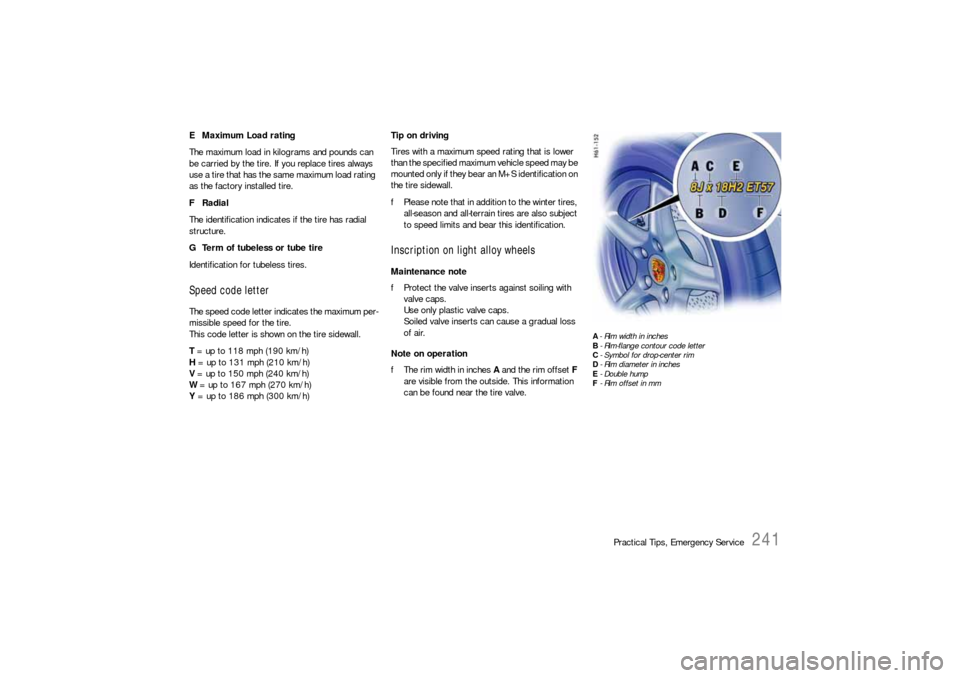
fThe rim width in inches A and the rim offset F
are visible from the outside. This information
can be found near the tire valve.
A-Rim width in inches
B- Rim-flange contour code letter
C- Symbol for drop-center rim
D- Rim diameter in inches
E-Double hump
F- Rim offset in mm
Page 247 of 308
Practical Tips, Emergency Service
247
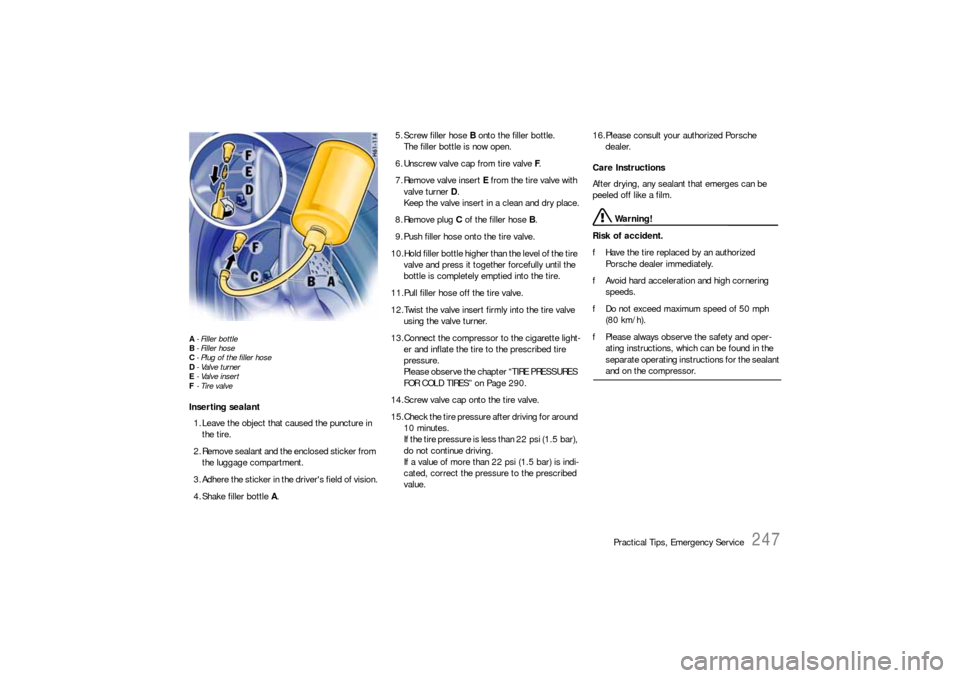
A- Filler bottle
B- Filler hose
C- Plug of the filler hose
D-Valve turner
E-Valve insert
F- Tire valveInserting sealant
1. Leave the object that caused the puncture in
the tire.
2. Remove sealant and the enclosed sticker from
the luggage compartment.
3. Adhere the sticker in the driver's field of vision.
4. Shake filler bottle A.5. Screw filler hose B onto the filler bottle.
The filler bottle is now open.
6. Unscrew valve cap from tire valve F.
7. Remove valve insert E from the tire valve with
valve turner D.
Keep the valve insert in a clean and dry place.
8. Remove plug C of the filler hose B.
9. Push filler hose onto the tire valve.
10.Hold filler bottle higher than the level of the tire
valve and press it together forcefully until the
bottle is completely emptied into the tire.
11.Pull filler hose off the tire valve.
12.Twist the valve insert firmly into the tire valve
using the valve turner.
13.Connect the compressor to the cigarette light-
er and inflate the tire to the prescribed tire
pressure.
Please observe the chapter “TIRE PRESSURES
FOR COLD TIRES” on Page 290.
14.Screw valve cap onto the tire valve.
15.Check the tire pressure after driving for around
10 minutes.
If the tire pressure is less than 22 psi (1.5 bar),
do not continue driving.
If a value of more than 22 psi (1.5 bar) is indi-
cated, correct the pressure to the prescribed
value.16.Please consult your authorized Porsche
dealer.
Care Instructions
After drying, any sealant that emerges can be
peeled off like a film.
Warning!
Risk of accident.
fHave the tire replaced by an authorized
Porsche dealer immediately.
fAvoid hard acceleration and high cornering
speeds.
fDo not exceed maximum speed of 50 mph
(80 km/h).
fPlease always observe the safety and oper-
ating instructions, which can be found in the
separate operating instructions for the sealant and on the compressor.
Page 250 of 308
250
Practical Tips, Emergency Service
Changing a wheel
Warning!
Risk of injury. The car may slip off the jack.
fMake sure that no one is in the vehicle when
jacking up and changing a wheel.
fAlways place the car on stable supports if work
has to be carried out under the car.
Risk of damage to the brake discs of the
Porsche Ceramic Composite Brake (PCCB).
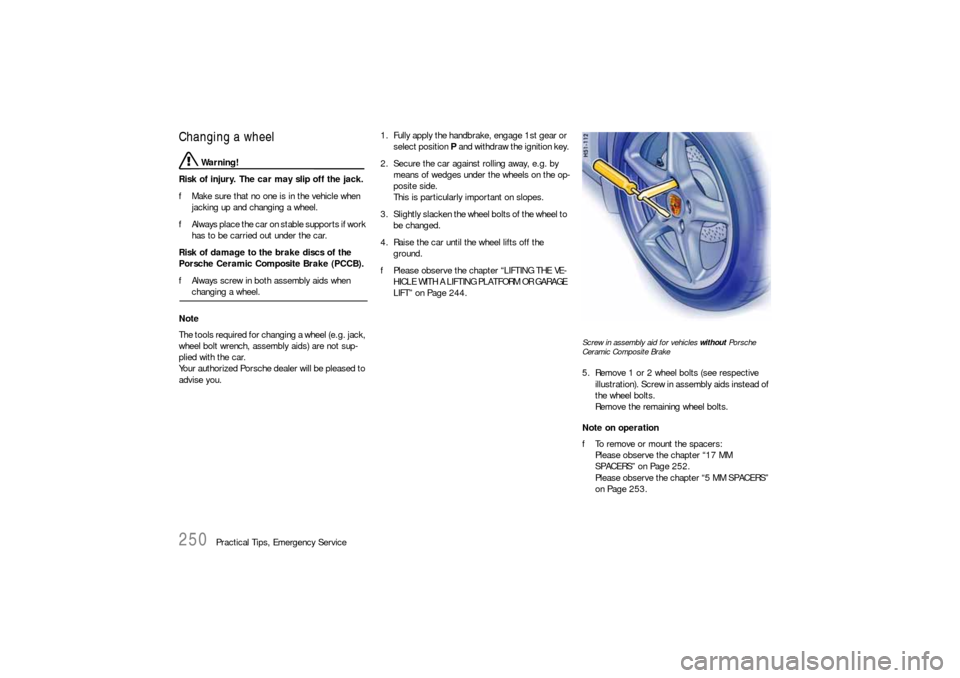
fAlways screw in both assembly aids when changing a wheel.
Note
The tools required for changing a wheel (e.g. jack,
wheel bolt wrench, assembly aids) are not sup-
plied with the car.
Your authorized Porsche dealer will be pleased to
advise you.1. Fully apply the handbrake, engage 1st gear or
select position P and withdraw the ignition key.
2. Secure the car against rolling away, e.g. by
means of wedges under the wheels on the op-
posite side.
This is particularly important on slopes.
3. Slightly slacken the wheel bolts of the wheel to
be changed.
4. Raise the car until the wheel lifts off the
ground.
fPlease observe the chapter “LIFTING THE VE-
HICLE WITH A LIFTING PLATFORM OR GARAGE
LIFT” on Page 244.
Screw in assembly aid for vehicles without Porsche
Ceramic Composite Brake5. Remove 1 or 2 wheel bolts (see respective
illustration). Screw in assembly aids instead of
the wheel bolts.
Remove the remaining wheel bolts.
Note on operation
fTo remove or mount the spacers:
Please observe the chapter “17 MM
SPACERS” on Page 252.
Please observe the chapter “5 MM SPACERS”
on Page 253.
Page 252 of 308
252
Practical Tips, Emergency Service
17 mm spacers
911 Carrera 4, 911 Carrera 4S
Danger!
Risk of accident.
17 mm spacers must only be mounted on the
rear axle together with 11.5 J x 19 (67 mm
rim offset) wheels.
fAlways remove 17 mm spacers before
mounting other wheel sizes or an emergency
spare wheel because the wheel cannot be mounted correctly.
fFor information on the spacers: Please
observe the chapter “SPACERS” on Page 249.
Removing the spacers
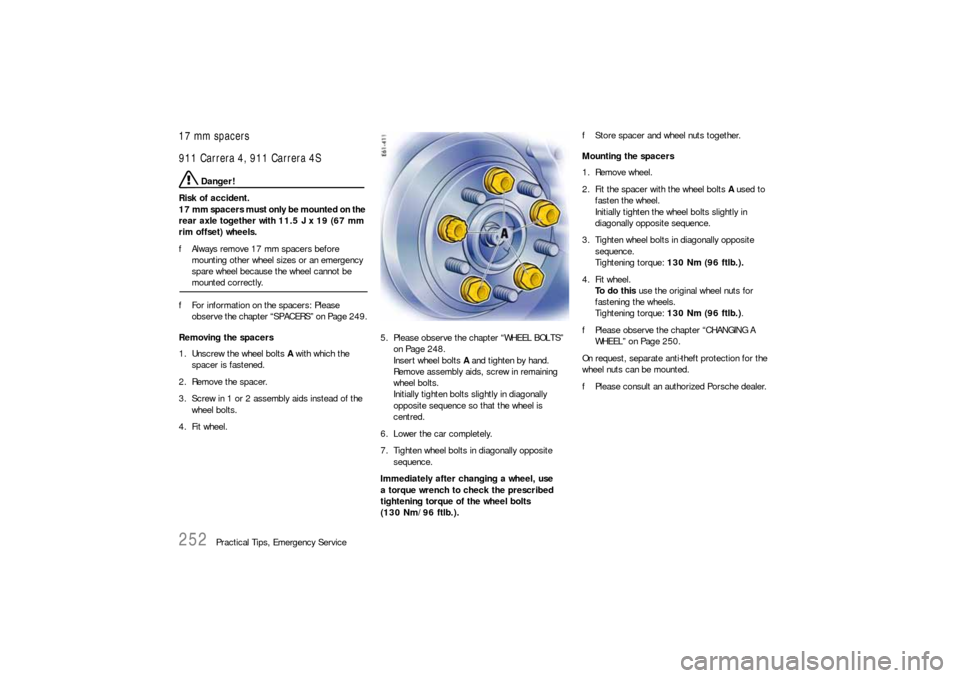
1. Unscrew the wheel bolts A with which the
spacer is fastened.
2. Remove the spacer.
3. Screw in 1 or 2 assembly aids instead of the
wheel bolts.
4. Fit wheel. 5. Please observe the chapter “WHEEL BOLTS”
on Page 248.
Insert wheel bolts A and tighten by hand.
Remove assembly aids, screw in remaining
wheel bolts.
Initially tighten bolts slightly in diagonally
opposite sequence so that the wheel is
centred.
6. Lower the car completely.
7. Tighten wheel bolts in diagonally opposite
sequence.
Immediately after changing a wheel, use
a torque wrench to check the prescribed
tightening torque of the wheel bolts
(130 Nm/96 ftlb.).fStore spacer and wheel nuts together.
Mounting the spacers
1. Remove wheel.
2. Fit the spacer with the wheel bolts A used to
fasten the wheel.
Initially tighten the wheel bolts slightly in
diagonally opposite sequence.
3. Tighten wheel bolts in diagonally opposite
sequence.
Tightening torque: 130 Nm (96 ftlb.).
4. Fit wheel.
To d o t h i s use the original wheel nuts for
fastening the wheels.
Tightening torque: 130 Nm (96 ftlb.).
fPlease observe the chapter “CHANGING A
WHEEL” on Page 250.
On request, separate anti-theft protection for the
wheel nuts can be mounted.
fPlease consult an authorized Porsche dealer.
Page 254 of 308
254
Practical Tips, Emergency Service
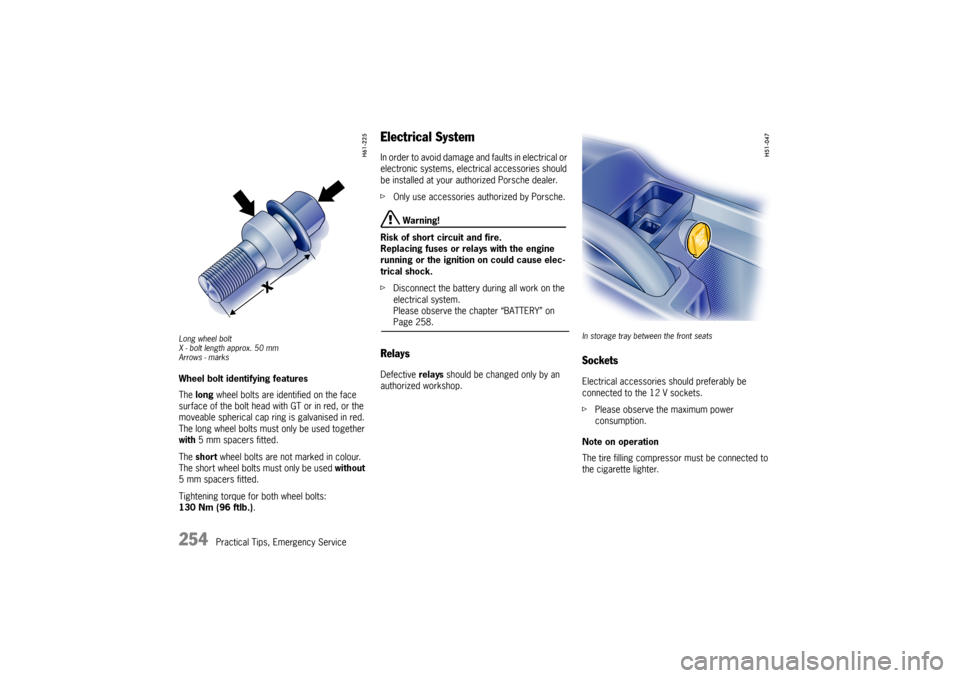
Long wheel bolt
X - bolt length approx. 50 mm
Arrows - marksWheel bolt identifying features
The long wheel bolts are identified on the face
surface of the bolt head with GT or in red, or the
moveable spherical cap ring is galvanised in red.
The long wheel bolts must only be used together
with 5 mm spacers fitted.
The short wheel bolts are not marked in colour.
The short wheel bolts must only be used without
5 mm spacers fitted.
Tightening torque for both wheel bolts:
130 Nm (96 ftlb.).
Electrical System In order to avoid damage and faults in electrical or
electronic systems, electrical accessories should
be installed at your authorized Porsche dealer.
fOnly use accessories authorized by Porsche.
Warning!
Risk of short circuit and fire.
Replacing fuses or relays with the engine
running or the ignition on could cause elec-
trical shock.
fDisconnect the battery during all work on the
electrical system.
Please observe the chapter “BATTERY” on Page 258.
Relays Defective relays should be changed only by an
authorized workshop.
In storage tray between the front seatsSocketsElectrical accessories should preferably be
connected to the 12 V sockets.
fPlease observe the maximum power
consumption.
Note on operation
The tire filling compressor must be connected to
the cigarette lighter.