ESP PORSCHE 911 CARRERA 2006 5.G User Guide
[x] Cancel search | Manufacturer: PORSCHE, Model Year: 2006, Model line: 911 CARRERA, Model: PORSCHE 911 CARRERA 2006 5.GPages: 308, PDF Size: 3.69 MB
Page 58 of 308
58
Controls, Instruments
Parking Aids Parking assistantWhen the driver backs up, the parking assistant
system indicates the distance between the car
and a large obstacle behind it, by means of signal
tones.
Warning!
Risk of serious personal injury or death.
Parking assistant cannot detect small ob-
jects such as children and pets.
Despite use of the parking assistant system,
the driver is still responsible for taking due
care and assessing obstacles when backing
up.
fMake sure that no persons, especially small
children, animals or obstacles are within the maneuvring area.
The parking assistant system is activated auto-
matically when reverse gear is selected and the ig-
nition is on.
Note
Be aware that the parking assistant system is
not switched on if the car rolls backward without
reverse gear being engaged.
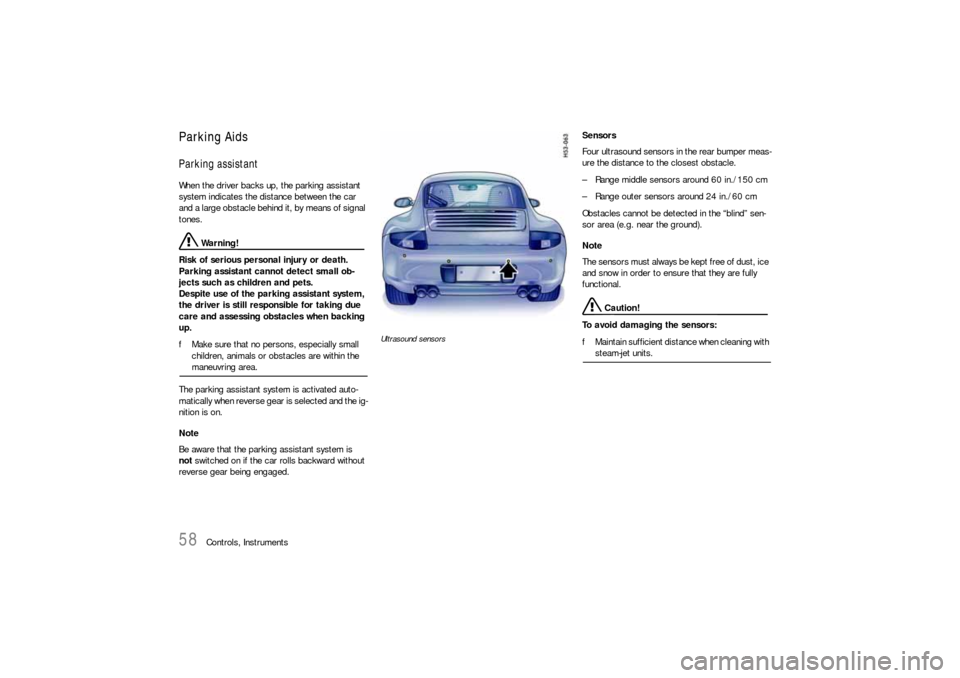
Ultrasound sensors
Sensors
Four ultrasound sensors in the rear bumper meas-
ure the distance to the closest obstacle.
– Range middle sensors around 60 in./150 cm
– Range outer sensors around 24 in./60 cm
Obstacles cannot be detected in the “blind” sen-
sor area (e.g. near the ground).
Note
The sensors must always be kept free of dust, ice
and snow in order to ensure that they are fully
functional.
Caution!
To avoid damaging the sensors:
fMaintain sufficient distance when cleaning with steam-jet units.
Page 61 of 308

Controls, Instruments
61
Four-Wheel Drive With the four-wheel drive of the 911 Carrera 4 and
911 Carrera 4S, the engine power is variably dis-
tributed to the front and rear wheels.
Power distribution and wheel speed compensation
between the front and rear axles is realised with a
viscous multiple-disc clutch.
Distribution of the engine power is dependent
upon the wheel speed difference between the two
axles.
The viscous multiple-disc clutch always delivers
sufficient drive power to the front wheels (approx.
5% to 40%) to ensure optimum traction even on a
poor road surface.
In combination with the Porsche Stability Manage-
ment (PSM), four-wheel drive improves handling
and increases driving stability.
Warning!
The increased control that is provided should
not induce you to take greater risks with your
safety. The limits dictated by the laws of phy-
sics cannot be overcome, even with four-
wheel drive.
The risk of accidents due to inappropriate
speed cannot be reduced, even by four-
wheel drive.
The driver bears the responsibility for all dri-
ving maneuvers.
fAdapt your driving style to the prevailing road
and weather conditions.
fObey all traffic laws.
Dynamometer testing procedure Some U.S. states and Canadian provinces con-
duct emissions inspection/maintenance testing in-
volving the use of two-wheel dynamometer.
A two-wheeled dynamometer is a treadmill type
device upon which a single axle of the car, the dri-
ving axle of the vehicle, rotates to simulate vehicle
operation on the road while the vehicle remains
stationary.
Your 911 Carrera 4 or 911 Carrera 4S has a full-
time four-wheel drive system which cannot be
disabled. Severe damage to the powertrain can
result if tested on a two-wheel dynamometer.
Warning!
To avoid severe powertrain damage and a
possible unexpected movement of the vehic-
le.
fYour 911 Carrera 4 or 911 Carrera 4S vehicle
must never be tested on a two-wheel dynamo-
meter.
fAdvise the emission station of this warning be-fore testing the vehicle.
Power measurement
Power measurements on dynamometers are not
approved by Porsche.
Page 63 of 308

Controls, Instruments
63
Retractable Rear SpoilerThe rear spoiler improves driving stability,
especially at higher speeds.
Warning!
Risk of accident. If the rear spoiler cannot be
extended, driving stability will be adversely
affected by increased rear axle lift, which
could lead to loss of control.
fAdapt your driving style and speed to the
changed driving behaviour.
fHave the fault remedied at an authorized
Porsche dealer.
Risk of injury during manual retraction or
extension of the rear spoiler with the vehicle
stationary.
fMake sure that no persons or objects are
within the range of movement of the rear
spoiler.
Risk of damage from pushing the vehicle by
the spoiler.
fDo not push the vehicle at the spoiler.
Automatic modeThe limits for automatic extension and retraction
of the spoiler depend on various circumstances
(e.g. driving speed, engine compartment temper-
ature).
Engine compartment temperature
under 122°F/55°C
Spoiler extends at 75 mph/120 km/h and
retracts at 37 mph/60 km/h.
Engine compartment temperature
over 140°F/60°C
Spoiler extends at 50 mph/80 km/h and retracts
at 19 mph/30 km/h.
If automatic control fails, a warning message is
displayed by the on-board computer.
Page 69 of 308

Controls, Instruments
69
ABS Brake System
(Antilock Brake System)The ABS system represents a major contribution
to the enhancement of active safety in your vehi-
cle. This system prevents the wheels from locking
in a panic stop on almost all road surfaces. With the ABS system in your vehicle, the
following areas are enhanced:
Steering, vehicle remains steerable under all
braking forces when ABS is engaged.
Good directional control, no swerving caused
by locking of wheels under braking conditions.
Shorter stopping distance, stopping distances
are usually reduced because controlled braking is
maximized.
Prevention of wheel lock up, no brake- induced
sliding and thus no localized tire wear from emer-
gency braking.
The crucial advantage of the ABS system over a
conventional brake system is in the area of main-
taining directional control and maneuverability of
the car in emergency situations during normal driv-
ing, including panic braking in turns.
Warning!
The increased control that is provided should
not induce you to take greater risks with your
safety. The limits dictated by the laws of
physics cannot be overcome, even with ABS.
The risk of accidents due to inappropriate
speed cannot be reduced, even by the ABS.
The driver bears the responsibility for all
driving maneuvers.
fAdapt your driving style to the prevailing road
and weather conditions.
fObey all traffic laws.
Other vehicles not equipped with the ABS
system may not be able to maintain control,
especially on wet or poor road surfaces and
thus may be more likely to impact you from
behind.
fTo minimize that risk, use your ABS system to
increase your ability to maneuver to avoid dan-
gerous situations and not merely to try to stop in the shortest distance possible.
Page 71 of 308
Controls, Instruments
71
Sport ModeA sportier car set-up is obtained when Sport mode
is switched on. Interventions by the Porsche
control systems are intentionally shifted towards
greater agility and driving performance.
– PASM (Porsche Active Suspension Manage-
ment) is automatically changed to Sport mode,
resulting in a stiffer suspension setup.
– The Tiptronic S switches to a sporty gear-
changing map and shortens the gear shifting
periods. Gear changes take place faster.
– PSM (Porsche Stability Management) control is
sporty. PSM interventions take place later than
in Normal mode. The driver can maneuver the
vehicle with greater agility at its performance
limits, without having to dispense with the
assistance of PSM in emergency situations.
– The electronic accelerator pedal reacts
sooner, and the engine is more responsive to
throttle inputs. When Sport mode is switched
on, this function is activated only after the
driver has floored the accelerator pedal or
released it briefly.
– The rpm limiter characteristic is “harder”, i.e.
the engine is immediately throttled when the
performance limits are reached (only in manual
selection mode for vehicles with Tiptronic S).
fPlease observe the appropriate chapters of
this Manual.
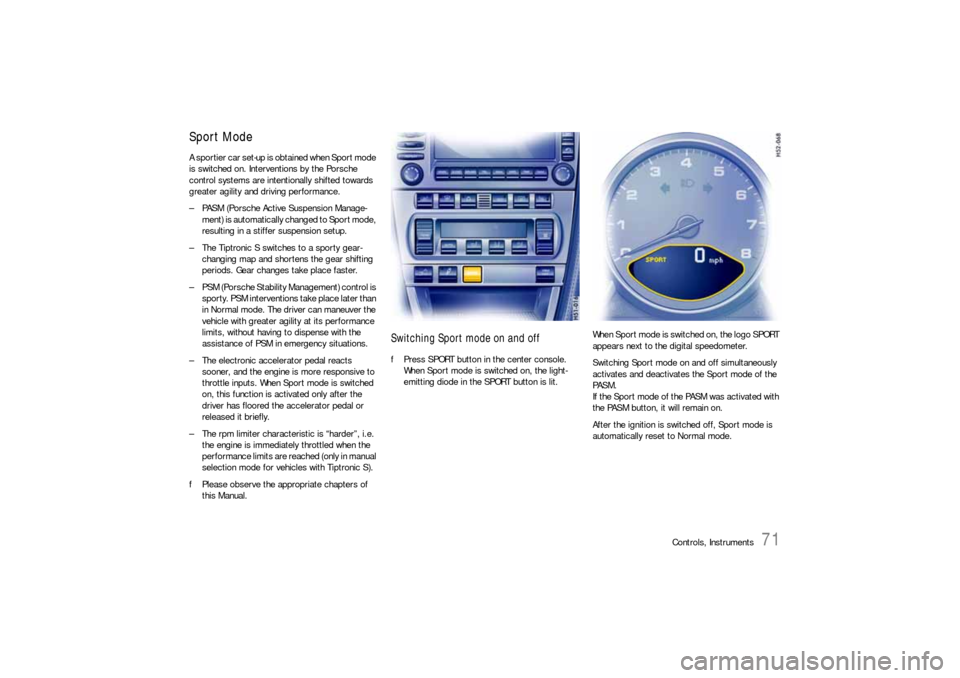
Switching Sport mode on and offfPress SPORT button in the center console.
When Sport mode is switched on, the light-
emitting diode in the SPORT button is lit.When Sport mode is switched on, the logo SPORT
appears next to the digital speedometer.
Switching Sport mode on and off simultaneously
activates and deactivates the Sport mode of the
PA S M .
If the Sport mode of the PASM was activated with
the PASM button, it will remain on.
After the ignition is switched off, Sport mode is
automatically reset to Normal mode.
Page 72 of 308

72
Controls, Instruments
Porsche Stability Management
(PSM)PSM is an active control system for stabilization of
the vehicle during extreme driving manoeuvres.
The most recent version of PSM (only on vehicles
with four-wheel drive) improves the brake system
functionality.
Warning!
The increased control that is provided should
not induce you to take greater risks with your
safety. The limits dictated by the laws of
physics cannot be overcome, even with PSM.
The risk of accidents due to inappropriate
speed cannot be reduced, even by PSM.
The driver bears the responsibility for all
driving maneuvers.
fAdapt your driving style to the prevailing road
and weather conditions.
fObey all traffic laws. Advantages of PSM – Superior traction and lane-holding ability in all
driving situations – even on road surfaces with
varying friction.
– PSM actively stabilizes the vehicle during dy-
namic driving maneuvers (e.g. rapid steering
movements, during lane changes or on alter-
nating curves). – Improved braking stability in curves and on dif-
ferent or varying road surfaces.
– It improves the braking functions and shortens
the stopping distance if emergency braking is
needed (only vehicles with four-wheel drive).
Readiness for operationPSM is switched on automatically every time you
start the engine.FunctionSensors at the wheels, brakes, steering system
and engine continuously measure:
– Speed
– Steering angle
– Lateral acceleration
– Rate of turn about the vertical axis
– Brake pressure
PSM uses these values to determine the direction
of travel desired by the driver.
PSM intervenes and corrects the course if the
actual direction of motion deviates from the
desired course (steering-wheel position):
It brakes individual wheels as needed. In addition,
the engine power may be manipulated in order to
stabilize the vehicle.The events below inform the driver of PSM control
operations and warn him to adapt his driving style
to the road conditions:
– The multi-functional information light on the
instrument panel lights up.
– Hydraulic noises can be heard.
– The vehicle decelerates and steering-wheel
forces are altered as the PSM controls the
brakes.
– Reduced engine power.
– The brake pedal pulsates and its position is
changed during braking.
In order to achieve full vehicle deceleration,
foot pressure must be increased after begin-
ning of the brake pedal pulsing.
Page 84 of 308

84
Controls, Instruments
Instrument Panel USA Models Also refer to the corresponding chapters in
the Owner’s Manual.
1. Engine oil temperature gauge
2. Speedometer with analogue display
3. Tire pressure warning light
4. Turn signal indicator light, left
5. Tachometer
6. High beam indicator light
7. Turn signal indicator light, right
8. ABS warning light
9. Cooling system
Temperature gauge, warning light
10.Fuel
Level gauge, warning light
11.Engine oil pressure gauge
12.Adjustment button for instrument illumination
and trip counter
13.Odometer and daily trip mileage display
14.Automatic speed control indicator light15.Light sensor for instrument illumination
16.Airbag warning light
17.Emission control warning light
(Check Engine)
18.Central warning light
19.On-board computer display
20.Porsche Stability Management
Multifunctional PSM light
21.Brake warning light
22.Safety belt warning light
23.Tiptronic indicator
24.Clock and outside temperature display
25 Adjustment button for clockWhen the ignition is switched on, the warning
lights light up for a lamp check.
Note
Warnings that have been given are stored in the
appropriate control unit memory and can be read
out at an authorized Porsche dealer.
This information can help to warn you about situa-
tions which may be hazardous to you or your car.
Page 86 of 308

86
Controls, Instruments
Instrument Panel Canada Models Also refer to the corresponding chapters in
the Owner’s Manual.
1. Engine oil temperature gauge
2. Speedometer with analogue display
3. Tire pressure warning light
4. Turn signal indicator light, left
5. Tachometer
6. High beam indicator light
7. Turn signal indicator light, right
8. ABS warning light
9. Cooling system
Temperature gauge, warning light
10.Fuel
Level gauge, warning light
11.Engine oil pressure gauge
12.Adjustment button for instrument illumination
and trip counter
13.Odometer and daily trip mileage display
14.Automatic speed control indicator light15.Light sensor for instrument illumination
16.Airbag warning light
17.Emission control warning light
(Check Engine)
18.Central warning light
19.On-board computer display
20.Porsche Stability Management
Multifunctional PSM light
21.Brake warning light
22.Safety belt warning light
23.Tiptronic indicator
24.Clock and outside temperature display
25 Adjustment button for clockWhen the ignition is switched on, the warning
lights light up for a lamp check.
Note
Warnings that have been given are stored in the
appropriate control unit memory and can be read
out at an authorized Porsche dealer.
This information can help to warn you about situa-
tions which may be hazardous to you or your car.
Page 93 of 308
Controls, Instruments
93
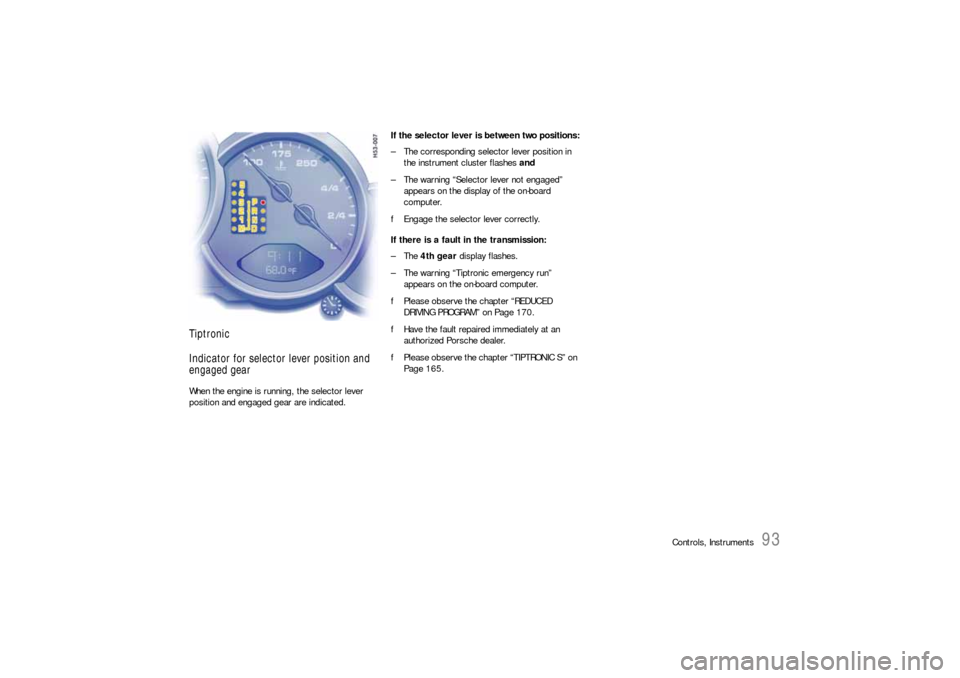
Tiptronic
Indicator for selector lever position and
engaged gearWhen the engine is running, the selector lever
position and engaged gear are indicated.If the selector lever is between two positions:
– The corresponding selector lever position in
the instrument cluster flashes and
– The warning “Selector lever not engaged”
appears on the display of the on-board
computer.
fEngage the selector lever correctly.
If there is a fault in the transmission:
–The 4th gear display flashes.
– The warning “Tiptronic emergency run”
appears on the on-board computer.
fPlease observe the chapter “REDUCED
DRIVING PROGRAM” on Page 170.
fHave the fault repaired immediately at an
authorized Porsche dealer.
fPlease observe the chapter “TIPTRONIC S” on
Page 165.
Page 109 of 308

Controls, Instruments
109
TPC
Tire pressure monitoringPlease observe the chapter “TIRE PRESSURES” on
Page 232.
The tire pressure monitoring continuously
monitors tire pressure and tire temperature on all
four wheels and warns the driver when the tire
pressure is too low.
The display as well as the settings for the tire
pressure monitoring take place on the on-board
computer.
However, you must still adjust the tire pressure on
the wheel.
fThe driver is responsible for filling the tires
correctly and making the correct settings on
the on-board computer.
The tire pressure monitoring offers the following
functions:
– Display of the actual tire pressure while the
vehicle is in motion
– Display of the deviation from the required
pressure (refilling pressure)
– Display of currently set tire size and type
– Tire pressure warnings in two stages
Safety notes!
Despite the advantages offered by the tire
pressure monitoring, it is still the driver’s
responsibility to update the corresponding
settings in the on-board computer and
maintain the pressure in the tires. Low tire
pressure reduces the road safety of the
vehicle and destroys the tire and wheel.
fWhen a flat tire has been displayed, immedi-
ately stop in a suitable place and check the
tires for damage. If necessary, remedy the
damage with a tire sealant.
fDo not by any means continue to drive with
damaged tires.
fSealing the tire with tire sealant is only an
emergency repair, so you can drive to the next
authorized Porsche dealer. The maximum per-
mitted speed is 50 mph (80 km/h).
fDo not drive with tires whose tire pressure
drops again in a short period of time. In cases
of doubt, have tires checked by an authorized
Porsche dealer.
fDamaged tires must be immediately replaced
by an authorized Porsche dealer.
Tire repairs are not permissible under any
circumstances.fIf the tire pressure monitoring is defective (e.g.
defective wheel transmitter), contact an
authorized Porsche dealer immediately and
have the damage repaired.
The tire pressure will not be monitored by a
defective tire pressure monitoring.
fTires lose air over time without a tire defect
being present. A tire pressure warning will then
appear in the on-board computer display.
Correct the tire pressure at the next oppor-
tunity.
fThe tire pressure monitoring gives a warning
about tire damage due to natural pressure loss
as well as about a gradual loss of pressure due
to foreign objects.
The tire pressure monitoring cannot warn you
about tire damage that occurs suddenly (e.g.
flat tire due to abrupt external effects).