ESP PORSCHE 911 CARRERA 2006 5.G Service Manual
[x] Cancel search | Manufacturer: PORSCHE, Model Year: 2006, Model line: 911 CARRERA, Model: PORSCHE 911 CARRERA 2006 5.GPages: 308, PDF Size: 3.69 MB
Page 228 of 308

228
Practical Tips, Emergency Service
Exercise Extreme Caution when
Working on your Vehicle
Danger!
Ignoring the following instructions may
cause serious personal injury or death.
fThe engine compartment of any motor vehicle
is a potentially hazardous area. If you are not
fully familiar with proper repair procedures, do
not attempt the adjustments described on the
following pages.
This caution also applies to the entire vehicle.
fO n l y w o r k o n y o u r v e h i c l e o u t d o o r s o r i n a w e l l
ventilated area.
fEnsure that there are no open flames in the
area of your vehicle at any time when fuel
fumes might be present. Be especially cau-
tious of such devices such as hot water heat-
ers which ignite a flame intermittently.
fBefore working on any part in the engine com-
partment, turn the engine off and let it cool
down sufficiently. Hot engine compartment
components can burn skin on contact.
fBe alert and cautious around engine at all
times while the engine is running.
If work has to be performed with the engine
running, always set the parking brake, and
make sure the shift lever is in neutral position
or the selector lever in position P.fIn particular, be very careful to ensure that
items of clothing (ties, shirt, sleeves etc.), jew-
elry, long hair, hand or fingers cannot get
caught in the engine-compartment blower, fan,
belts or other moving parts.
The radiator and radiator fans are in the front
of the car.
The engine-compartment blower is mounted
on the engine-compartment lid.
The engine-compartment blower can start or
continue running as a function of temperature,
even with the engine switched off.
Carry out work in these areas only with the en-
gine off, the ignition switched off, and exercise
extreme caution.
fYour Porsche is equipped with an electronic ig-
nition system. When the ignition is on, high volt-
age is present in all wires connected with the
ignition system; therefore, exercise extreme
caution when working on any part of the engine
while the ignition is on or the engine is running.
fAlways support your car with safety stands if it
is necessary to work under the car.
fWhen working under the car without safety
stands but with the wheels on the ground,
make sure the car is on level ground, the
wheels are blocked, and that the engine
cannot be started.
Remove the ignition key.fDo not smoke or allow an open flame around
the battery or fuel.
Keep a fire extinguisher in close reach.
fIncomplete or improper servicing may cause
problems in the operation of the car. If in doubt
about any servicing, have it done by your au-
thorized Porsche dealer.
Improper maintenance during the warranty pe-
riod may affect your Porsche warranty cover-
age.
fSupplies of fluids, e.g. engine oil, brake fluid or
coolant, are hazardous to your health.
Keep these fluids out of children’s reach and
dispose of them in accordance with the appro-
priate regulations.
fSome countries require additional tools and
special spare parts to be carried.
Please make enquiries before driving abroad.
Page 231 of 308

Practical Tips, Emergency Service
231
Traction AA, A, B, C
The traction grades, from highest to lowest, are
AA, A, B, and C and they represent the tire’s ability
to stop on wet pavement as measured under con-
trolled conditions on specified government test
surfaces of asphalt and concrete.
A tire marked C may have poor traction perform-
ance.
Warning!
The traction grade assigned to this is based on
braking (straight-ahead) traction tests and does
not include cornering (turned) traction, accelera-
tion, hydroplaning or peak traction characteris-
tics. Temperature A, B, C
The temperature grades are A (the highest), B and
C, representing the tire’s resistance to the gener-
ation of heat and its ability to dissipate heat when
tested under controlled conditions on a specified
indoor laboratory test wheel.
Sustained high temperatures can cause the mate-
rial of the tire to degenerate and reduce tire life,
and excessive temperature can lead to sudden
tire failure.
The grade C corresponds to a level of perform-
ance which all passenger car tires must meet un-
der the Federal Motor Vehicle Safety Standard No.
109.
Grades B and A represent higher levels of per-
formance on the laboratory test wheel than the
minimum required by law.
Warning!
The temperature grade for this tire is established
for a tire that is properly inflated and not overload-
ed.
Excessive speed, underinflation, or excessive
loading, either separately or in combination, can
cause heat buildup and possible tire failure.
Page 236 of 308

236
Practical Tips, Emergency Service
Tire replacements If in doubt, contact your Porsche dealer.
Use only tire makes and types approved by
Porsche.
If you do not use a Porsche recommended
replacement tire, make sure that you
purchase your new tires from a reputable tire
dealer and that the dealer complies with all
manufacturers warnings for those tires.
Only tires with the same make and with the
same specification code (e.g. “N0”, “N1”...)
can be mounted.
Before mounting new tires, check with your
Porsche dealer about the current release
status.
Use tires with “ZR” quality standards. There
are currently no standards concerning tire
strength at speeds above 150 mph (240 km/h).
Tires should be replaced no less than on one axle
at the time.
Only tires of the same make and type must be
used. Mixed tires are not permissible.
Initially, new tires do not have their full traction.
You should therefore drive at moderate speeds
during the first 60 - 120 miles (100 - 200 km). If new tires are installed only on one axle, a notice-
able change in handling occurs due to the different
tread depth of the other tires.
This happens especially if only rear tires are re-
placed. However, this condition disappears as the
new tires are broken in.
fPlease adjust your driving style accordingly.
Installation of new tires should only be done by a
qualified tire technician.
Valves
Rubber valve stems must be replaced every time
a tire is replaced.
For metal valves, the installation and replacement
instructions must be observed.
fUse only genuine Porsche metal valves.
fProtect the valve inserts against soiling with
valve caps.
Soiled valve inserts can cause a gradual loss
of air.
fUse only plastic valve caps.
Parking at the curb
Warning!
Hard impacts against curbs (or traffic
islands) are dangerous and may cause hid-
den tire damage which is not noticeable until
later. Such damage can result in accidents at
high speeds causing severe personal injury.
Depending on the force of impact, the edge
of the rim can also be damaged.
fIf you are in doubt, have the wheel checked by
an expert, particularly if you suspect damage
on the inside.
fIf you must drive over a curb or other obstacle,
drive slowly and at an obtuse angle. Exercise care when parking along curbs.
Page 246 of 308
246
Practical Tips, Emergency Service
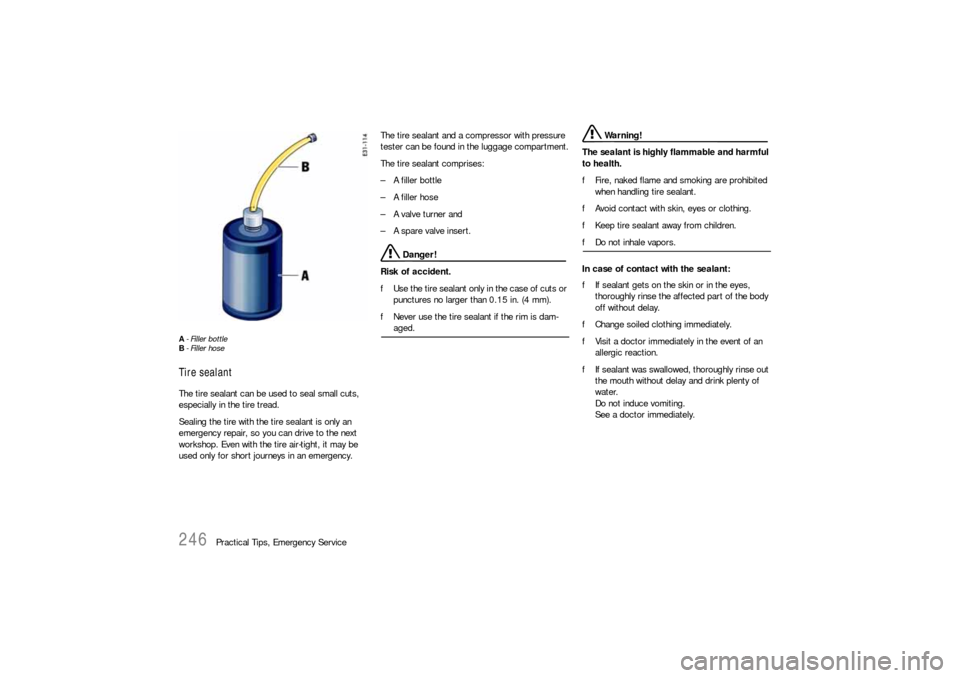
A- Filler bottle
B- Filler hoseTire sealantThe tire sealant can be used to seal small cuts,
especially in the tire tread.
Sealing the tire with the tire sealant is only an
emergency repair, so you can drive to the next
workshop. Even with the tire air-tight, it may be
used only for short journeys in an emergency.The tire sealant and a compressor with pressure
tester can be found in the luggage compartment.
The tire sealant comprises:
– A filler bottle
– A filler hose
– A valve turner and
– A spare valve insert.
Danger!
Risk of accident.
fUse the tire sealant only in the case of cuts or
punctures no larger than 0.15 in. (4 mm).
fNever use the tire sealant if the rim is dam-aged.
Warning!
The sealant is highly flammable and harmful
to health.
fFire, naked flame and smoking are prohibited
when handling tire sealant.
fAvoid contact with skin, eyes or clothing.
fKeep tire sealant away from children.
fDo not inhale vapors.
In case of contact with the sealant:
fIf sealant gets on the skin or in the eyes,
thoroughly rinse the affected part of the body
off without delay.
fChange soiled clothing immediately.
fVisit a doctor immediately in the event of an
allergic reaction.
fIf sealant was swallowed, thoroughly rinse out
the mouth without delay and drink plenty of
water.
Do not induce vomiting.
See a doctor immediately.
Page 250 of 308
250
Practical Tips, Emergency Service
Changing a wheel
Warning!
Risk of injury. The car may slip off the jack.
fMake sure that no one is in the vehicle when
jacking up and changing a wheel.
fAlways place the car on stable supports if work
has to be carried out under the car.
Risk of damage to the brake discs of the
Porsche Ceramic Composite Brake (PCCB).
fAlways screw in both assembly aids when changing a wheel.
Note
The tools required for changing a wheel (e.g. jack,
wheel bolt wrench, assembly aids) are not sup-
plied with the car.
Your authorized Porsche dealer will be pleased to
advise you.1. Fully apply the handbrake, engage 1st gear or
select position P and withdraw the ignition key.
2. Secure the car against rolling away, e.g. by
means of wedges under the wheels on the op-
posite side.
This is particularly important on slopes.
3. Slightly slacken the wheel bolts of the wheel to
be changed.
4. Raise the car until the wheel lifts off the
ground.
fPlease observe the chapter “LIFTING THE VE-
HICLE WITH A LIFTING PLATFORM OR GARAGE
LIFT” on Page 244.
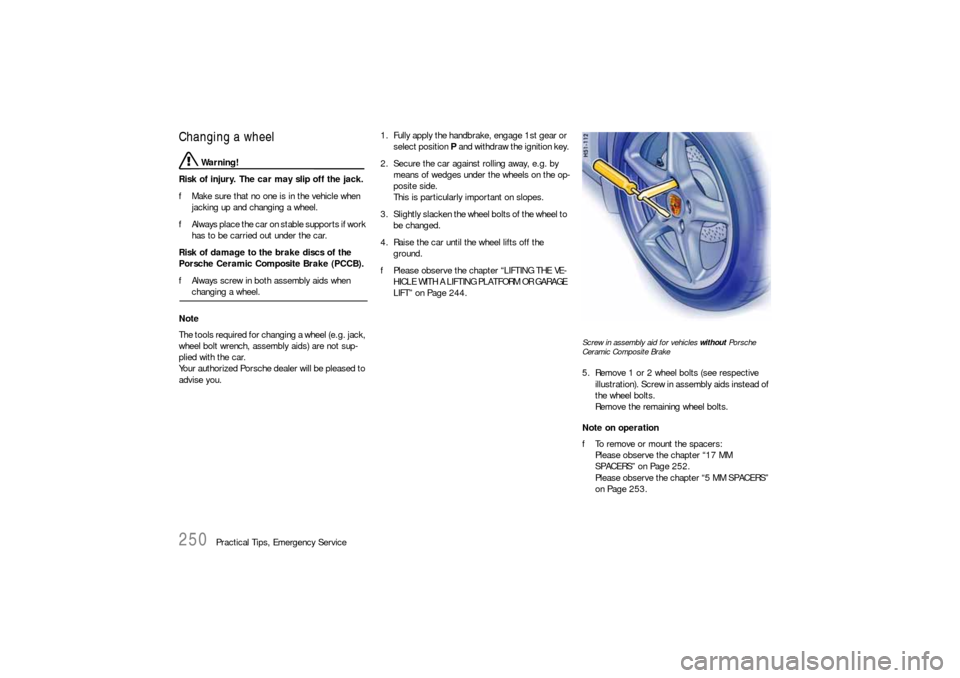
Screw in assembly aid for vehicles without Porsche
Ceramic Composite Brake5. Remove 1 or 2 wheel bolts (see respective
illustration). Screw in assembly aids instead of
the wheel bolts.
Remove the remaining wheel bolts.
Note on operation
fTo remove or mount the spacers:
Please observe the chapter “17 MM
SPACERS” on Page 252.
Please observe the chapter “5 MM SPACERS”
on Page 253.
Page 256 of 308
256
Practical Tips, Emergency Service
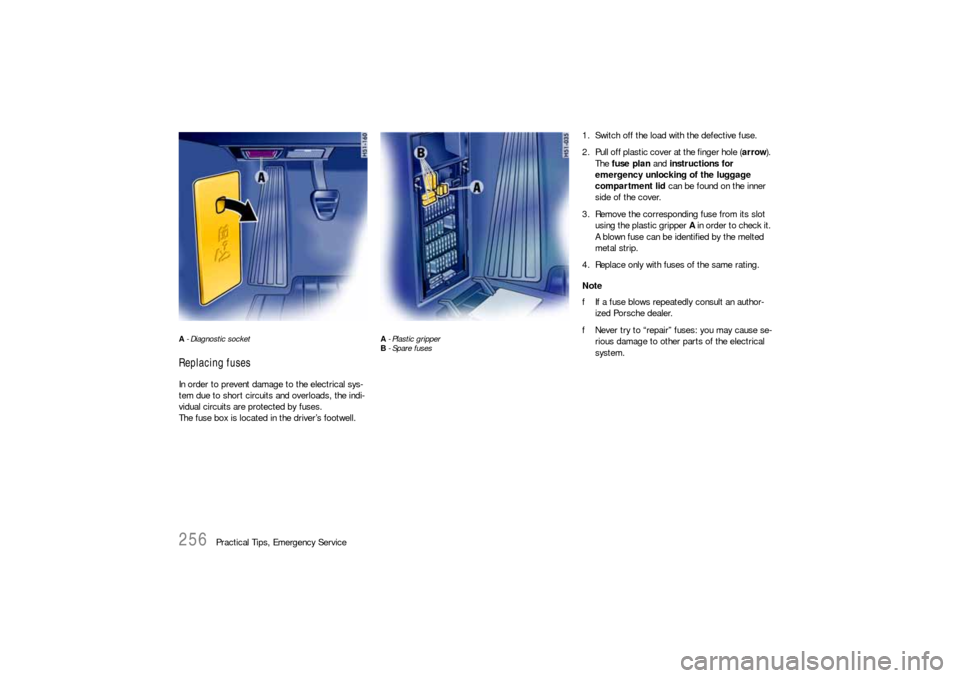
A - Diagnostic socket Replacing fuses In order to prevent damage to the electrical sys-
tem due to short circuits and overloads, the indi-
vidual circuits are protected by fuses.
The fuse box is located in the driver’s footwell.
A - Plastic gripper
B - Spare fuses
1. Switch off the load with the defective fuse.
2. Pull off plastic cover at the finger hole (arrow).
The fuse plan and instructions for
emergency unlocking of the luggage
compartment lid can be found on the inner
side of the cover.
3. Remove the corresponding fuse from its slot
using the plastic gripper A in order to check it.
A blown fuse can be identified by the melted
metal strip.
4. Replace only with fuses of the same rating.
Note
fIf a fuse blows repeatedly consult an author-
ized Porsche dealer.
fNever try to “repair” fuses: you may cause se-
rious damage to other parts of the electrical
system.
Page 292 of 308

292
Technical Data
Weights Coupé911 Carrera Manual transmission Tiptronic S
Empty weight (depending on equipment)1395 kg to 1495 kg 1435 kg to 1535 kg
3075 lbs. to 3296 lbs. 3164 lbs. to 3384 lbs.
Maximum gross weight 3990 lbs./1810 kg 4090 lbs./1855 kg
Maximum axle load, front* 1709 lbs./775 kg 1709 lbs./775 kg
Maximum axle load, rear* 2601 lbs./1180 kg 2601 lbs./1180 kg
Maximum useful load, Roof Transport System** 165 lbs./75 kg 165 lbs./75 kg
911 Carrera S Manual transmission Tiptronic S
Empty weight (depending on equipment)1420 kg to 1510 kg 1460 kg to 1550 kg
3131 lbs. to 3329 lbs. 3219 lbs. to 3417 lbs.
Maximum gross weight 4012 lbs./1820 kg 4112 lbs./1865 kg
Maximum axle load, front* 1709 lbs./775 kg 1709 lbs./775 kg
Maximum axle load, rear* 2601 lbs./1180 kg 2601 lbs./1180 kg
Maximum useful load, Roof Transport System** 165 lbs./75 kg 165 lbs./75 kg
* The maximum gross weight must not be exceeded.
Note: If additional accessories are installed, the useful load will be correspondingly less.
** Use only Original Porsche Roof Transport System.
Page 293 of 308

Technical Data
293
Weights Coupé911 Carrera 4 Manual transmission Tiptronic S
Empty weight (depending on equipment) 1450 kg to 1550 kg 1490 kg to 1590 kg
3197 lbs. to 3417 lbs.3285 lbs. to 3505 lbs.
Maximum gross weight 4112 lbs./1865 kg 4211 lbs./1910 kg
Maximum axle load, front* 1819 lbs./825 kg 1819 lbs./825 kg
Maximum axle load, rear* 2690 lbs./1220 kg 2690 lbs./1220 kg
Maximum useful load, Roof Transport System** 165 lbs./75 kg 165 lbs./75 kg
911 Carrera 4S Manual transmission Tiptronic S
Empty weight (depending on equipment) 1475 kg to 1565 kg 1515 kg to 1605 kg
3252 lbs. to 3450 lbs.3340 lbs. to 3538 lbs.
Maximum gross weight 4134 lbs./1875 kg 4233 lbs./1920 kg
Maximum axle load, front* 1819 lbs./825 kg 1819 lbs./825 kg
Maximum axle load, rear* 2690 lbs./1220 kg 2690 lbs./1220 kg
Maximum useful load, Roof Transport System** 165 lbs./75 kg 165 lbs./75 kg
* The maximum gross weight must not be exceeded.
Note: If additional accessories are installed, the useful load will be correspondingly less.
** Use only Original Porsche Roof Transport System.
Page 294 of 308

294
Technical Data
Weights Cabriolet911 Carrera Manual transmission Tiptronic S
Empty weight (depending on equipment)1480 kg to 1560 kg 1520 kg to 1600 kg
3263 lbs. to 3439 lbs. 3351 lbs. to 3527 lbs.
Maximum gross weight 4134 lbs./1875 kg 4233 lbs./1920 kg
Maximum axle load, front* 1709 lbs./775 kg 1709 lbs./775 kg
Maximum axle load, rear* 2690 lbs./1220 kg 2690 lbs./1220 kg
911 Carrera S Manual transmission Tiptronic S
Empty weight (depending on equipment)1505 kg to 1575 kg 1545 kg to 1615 kg
3318 lbs. to 3472 lbs. 3406 lbs. to 3560 lbs.
Maximum gross weight 4156 lbs./1885 kg 4255 lbs./1930 kg
Maximum axle load, front* 1709 lbs./775 kg 1709 lbs./775 kg
Maximum axle load, rear* 2690 lbs./1220 kg 2690 lbs./1220 kg
* The maximum gross weight must not be exceeded.
Note: If additional accessories are installed, the useful load will be correspondingly less.
Page 295 of 308

Technical Data
295
Weights Cabriolet911 Carrera 4 Manual transmission Tiptronic S
Empty weight (depending on equipment) 1535 kg to 1610 kg 1575 kg to 1650 kg
3384 lbs. to 3549 lbs.3472 lbs. to 3638 lbs.
Maximum gross weight 4233 lbs./1920 kg 4332 lbs./1965 kg
Maximum axle load, front* 1819 lbs./825 kg 1819 lbs./825 kg
Maximum axle load, rear* 2690 lbs./1220 kg 2690 lbs./1220 kg
911 Carrera 4S Manual transmission Tiptronic S
Empty weight (depending on equipment) 1560 kg to 1620 kg 1600 kg to 1660 kg
3439 lbs. to 3571 lbs.3527 lbs. to 3660 lbs.
Maximum gross weight 4255 lbs./1930 kg 4354 lbs./1975 kg
Maximum axle load, front* 1819 lbs./825 kg 1819 lbs./825 kg
Maximum axle load, rear* 2690 lbs./1220 kg 2690 lbs./1220 kg
* The maximum gross weight must not be exceeded.
Note: If additional accessories are installed, the useful load will be correspondingly less.