lock PORSCHE 911 CARRERA 2006 5.G Manual PDF
[x] Cancel search | Manufacturer: PORSCHE, Model Year: 2006, Model line: 911 CARRERA, Model: PORSCHE 911 CARRERA 2006 5.GPages: 308, PDF Size: 3.69 MB
Page 221 of 308

Maintenance, Car Care
221
Automatic car washes
Optional add-on parts or parts which project
beyond the contours of the vehicle may be
damaged by design features (e.g. brushes) of au-
tomatic car washes.
The following parts are particularly
susceptible to damage:
– Convertible top (hot wax treatment cannot be
used, as the wax attacks the convertible top
material)
– Windshield wipers (always switch them off to
prevent them wiping unintentionally in intermit-
tent or sensor operation)
– External antennas (always unscrew)
– Roof Transport System (always remove com-
pletely)
–Rear spoiler
– Wheels (the wider the rim and the lower the tire
height, the greater the risk of damage)
– High-gloss wheels (to prevent these from get-
ting scratched, do not clean with the wheel-
cleaning brushes of the car wash).
fPlease consult the operator before using auto-
matic car washes.
fWash and dry by hand all points not reached by
a car wash, such as door and lid seams or
door sills. Note
Automatic car washes spray water at odd angles
and high pressures, which are not seen in normal
driving. Therefore, water can sometimes find its
way into the passengers compartment during or
shortly after the car wash.
Door lock fTo prevent the door lock from freezing during
the cold season, the lock cylinder should be
covered during a wash.
fShould the lock freeze, use an ordinary de-icer.
In many cases, a well warmed key can help.
Never use excessive force.
Page 228 of 308

228
Practical Tips, Emergency Service
Exercise Extreme Caution when
Working on your Vehicle
Danger!
Ignoring the following instructions may
cause serious personal injury or death.
fThe engine compartment of any motor vehicle
is a potentially hazardous area. If you are not
fully familiar with proper repair procedures, do
not attempt the adjustments described on the
following pages.
This caution also applies to the entire vehicle.
fO n l y w o r k o n y o u r v e h i c l e o u t d o o r s o r i n a w e l l
ventilated area.
fEnsure that there are no open flames in the
area of your vehicle at any time when fuel
fumes might be present. Be especially cau-
tious of such devices such as hot water heat-
ers which ignite a flame intermittently.
fBefore working on any part in the engine com-
partment, turn the engine off and let it cool
down sufficiently. Hot engine compartment
components can burn skin on contact.
fBe alert and cautious around engine at all
times while the engine is running.
If work has to be performed with the engine
running, always set the parking brake, and
make sure the shift lever is in neutral position
or the selector lever in position P.fIn particular, be very careful to ensure that
items of clothing (ties, shirt, sleeves etc.), jew-
elry, long hair, hand or fingers cannot get
caught in the engine-compartment blower, fan,
belts or other moving parts.
The radiator and radiator fans are in the front
of the car.
The engine-compartment blower is mounted
on the engine-compartment lid.
The engine-compartment blower can start or
continue running as a function of temperature,
even with the engine switched off.
Carry out work in these areas only with the en-
gine off, the ignition switched off, and exercise
extreme caution.
fYour Porsche is equipped with an electronic ig-
nition system. When the ignition is on, high volt-
age is present in all wires connected with the
ignition system; therefore, exercise extreme
caution when working on any part of the engine
while the ignition is on or the engine is running.
fAlways support your car with safety stands if it
is necessary to work under the car.
fWhen working under the car without safety
stands but with the wheels on the ground,
make sure the car is on level ground, the
wheels are blocked, and that the engine
cannot be started.
Remove the ignition key.fDo not smoke or allow an open flame around
the battery or fuel.
Keep a fire extinguisher in close reach.
fIncomplete or improper servicing may cause
problems in the operation of the car. If in doubt
about any servicing, have it done by your au-
thorized Porsche dealer.
Improper maintenance during the warranty pe-
riod may affect your Porsche warranty cover-
age.
fSupplies of fluids, e.g. engine oil, brake fluid or
coolant, are hazardous to your health.
Keep these fluids out of children’s reach and
dispose of them in accordance with the appro-
priate regulations.
fSome countries require additional tools and
special spare parts to be carried.
Please make enquiries before driving abroad.
Page 255 of 308
Practical Tips, Emergency Service
255
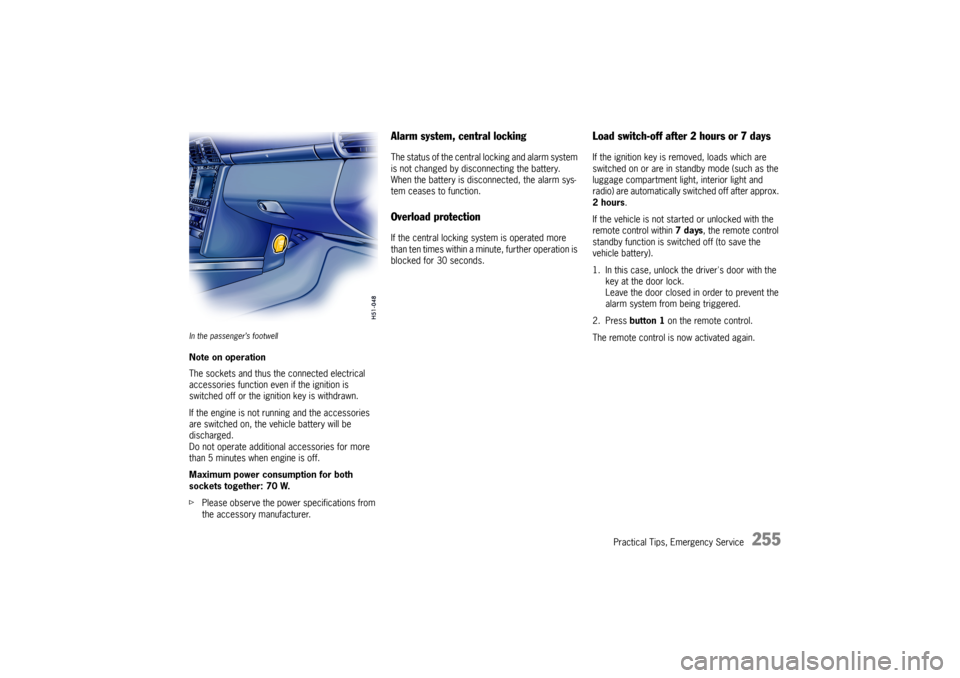
In the passenger’s footwellNote on operation
The sockets and thus the connected electrical
accessories function even if the ignition is
switched off or the ignition key is withdrawn.
If the engine is not running and the accessories
are switched on, the vehicle battery will be
discharged.
Do not operate additional accessories for more
than 5 minutes when engine is off.
Maximum power consumption for both
sockets together: 70 W.
fPlease observe the power specifications from
the accessory manufacturer.
Alarm system, central lockingThe status of the central locking and alarm system
is not changed by disconnecting the battery.
When the battery is disconnected, the alarm sys-
tem ceases to function. Overload protectionIf the central locking system is operated more
than ten times within a minute, further operation is
blocked for 30 seconds.
Load switch-off after 2 hours or 7 daysIf the ignition key is removed, loads which are
switched on or are in standby mode (such as the
luggage compartment light, interior light and
radio) are automatically switched off after approx.
2hours.
If the vehicle is not started or unlocked with the
remote control within 7days, the remote control
standby function is switched off (to save the
vehicle battery).
1. In this case, unlock the driver's door with the
key at the door lock.
Leave the door closed in order to prevent the
alarm system from being triggered.
2. Press button 1 on the remote control.
The remote control is now activated again.
Page 256 of 308
256
Practical Tips, Emergency Service
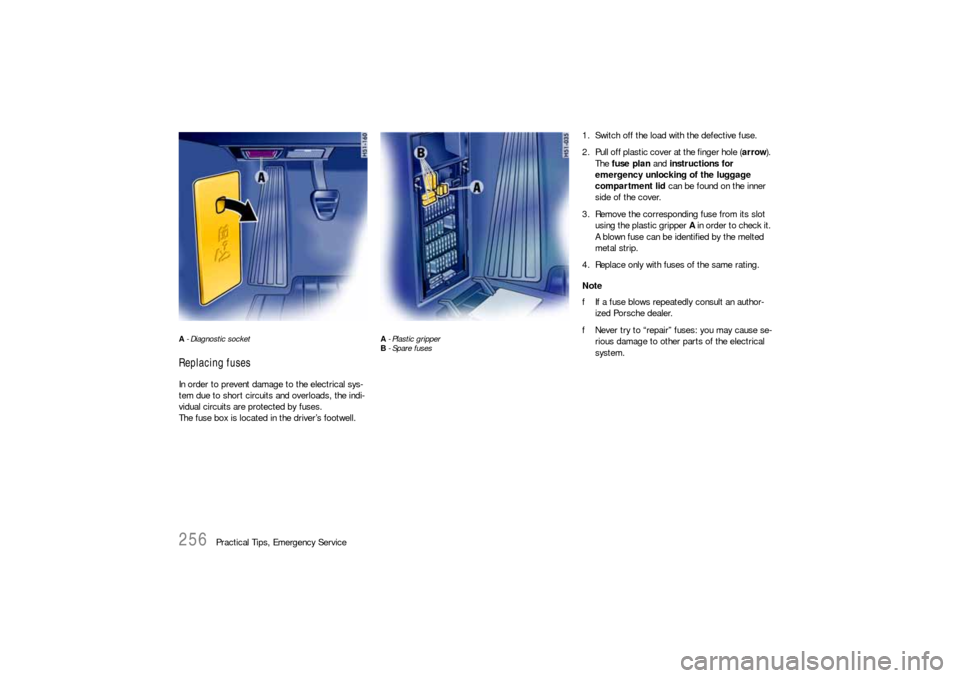
A - Diagnostic socket Replacing fuses In order to prevent damage to the electrical sys-
tem due to short circuits and overloads, the indi-
vidual circuits are protected by fuses.
The fuse box is located in the driver’s footwell.
A - Plastic gripper
B - Spare fuses
1. Switch off the load with the defective fuse.
2. Pull off plastic cover at the finger hole (arrow).
The fuse plan and instructions for
emergency unlocking of the luggage
compartment lid can be found on the inner
side of the cover.
3. Remove the corresponding fuse from its slot
using the plastic gripper A in order to check it.
A blown fuse can be identified by the melted
metal strip.
4. Replace only with fuses of the same rating.
Note
fIf a fuse blows repeatedly consult an author-
ized Porsche dealer.
fNever try to “repair” fuses: you may cause se-
rious damage to other parts of the electrical
system.
Page 257 of 308
Practical Tips, Emergency Service
257
Emergency unlocking of the luggage
compartment lidIf the battery is discharged, the lid can be opened
only with the aid of a donor battery.
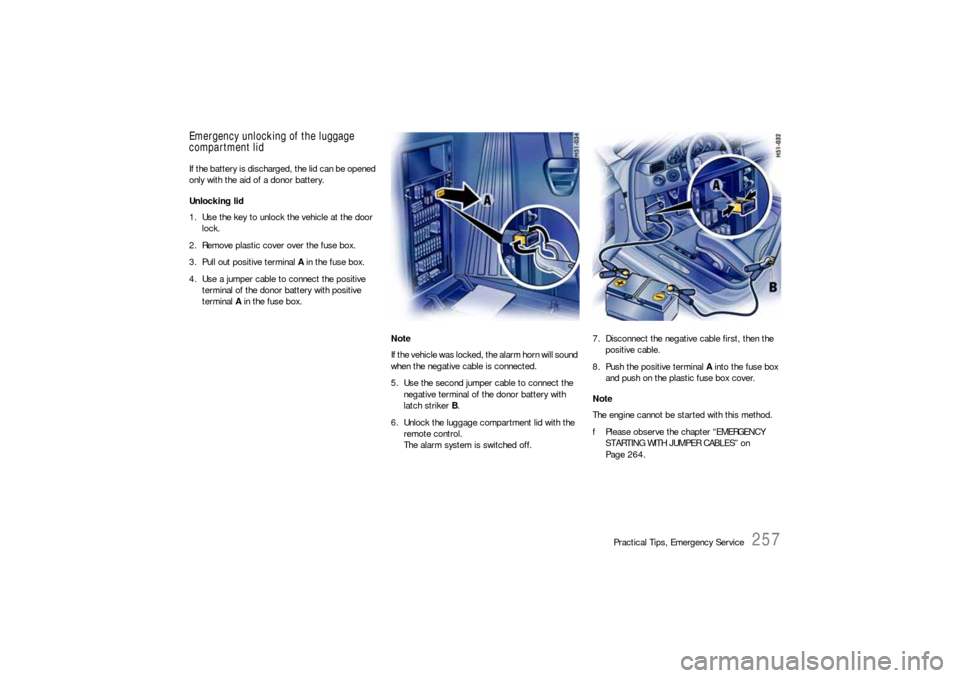
Unlocking lid
1. Use the key to unlock the vehicle at the door
lock.
2. Remove plastic cover over the fuse box.
3. Pull out positive terminal A in the fuse box.
4. Use a jumper cable to connect the positive
terminal of the donor battery with positive
terminal A in the fuse box.
Note
If the vehicle was locked, the alarm horn will sound
when the negative cable is connected.
5. Use the second jumper cable to connect the
negative terminal of the donor battery with
latch striker B.
6. Unlock the luggage compartment lid with the
remote control.
The alarm system is switched off.7. Disconnect the negative cable first, then the
positive cable.
8. Push the positive terminal A into the fuse box
and push on the plastic fuse box cover.
Note
The engine cannot be started with this method.
fPlease observe the chapter “EMERGENCY
STARTING WITH JUMPER CABLES” on
Page 264.
Page 261 of 308

Practical Tips, Emergency Service
261
Replacing battery The service life of the battery is subject to normal
wear; it depends greatly on care, climatic condi-
tions, and driving conditions (distances, loads).
fOnly use an original Porsche battery, with the
correct part number, as a replacement.
fPlease observe the disposal instructions for
batteries.
Putting vehicle into operationAfter the battery is connected or after an exhaus-
tively discharged battery is charged, the multi-
functional PSM light lights up on the instrument
panel and a message appears on the on-board
computer to indicate a fault.
This fault can be remedied with a few simple
steps:
1. Start the engine.
2. With the vehicle stationary, perform a few
steering movements to the left and right and
then drive a short distance in a straight line
until the multifunctinal PSM light goes out and
the message on the on-board computer
disappears.
3. If the warnings do not disappear, then:
Drive carefully to the nearest authorized
Porsche dealer.
Have the fault remedied.
4. After the warnings disappear:
Stop the vehicle in a suitable place.
fPerform adaptation of the power windows:
Please observe the chapter “STORING END
POSITION OF THE WINDOWS” on Page 29.Ignition key/ignition lock
fDo not insert the ignition key into the ignition
lock if the vehicle battery is discharged.
The ignition key can no longer be removed.
The key cannot be removed until the vehicle elec-
trical system is supplied with power again.
fPlease observe the chapter “EMERGENCY UN-
LOCKING OF THE LUGGAGE COMPARTMENT
LID” on Page 257.
fPlease observe the chapter “EMERGENCY
STARTING WITH JUMPER CABLES” on
Page 264.
f f f
Page 262 of 308
262
Practical Tips, Emergency Service
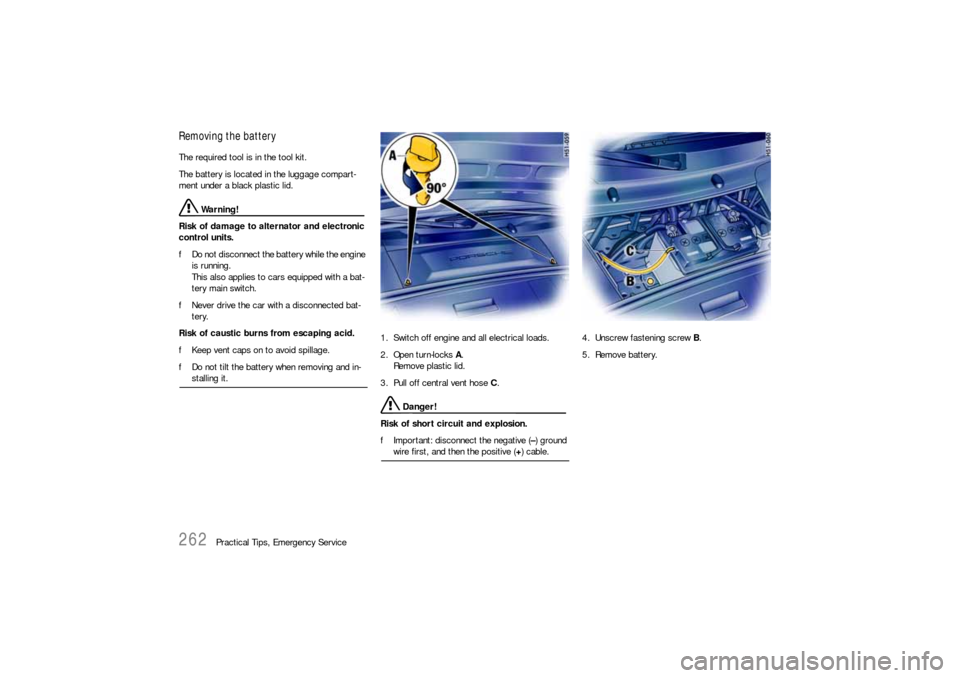
Removing the battery The required tool is in the tool kit.
The battery is located in the luggage compart-
ment under a black plastic lid.
Warning!
Risk of damage to alternator and electronic
control units.
fDo not disconnect the battery while the engine
is running.
This also applies to cars equipped with a bat-
tery main switch.
fNever drive the car with a disconnected bat-
tery.
Risk of caustic burns from escaping acid.
fKeep vent caps on to avoid spillage.
fDo not tilt the battery when removing and in-stalling it. 1. Switch off engine and all electrical loads.
2. Open turn-locks A.
Remove plastic lid.
3. Pull off central vent hose C.
Danger!
Risk of short circuit and explosion.
fImportant: disconnect the negative (–) ground wire first, and then the positive (+) cable.4. Unscrew fastening screw B.
5. Remove battery.
Page 263 of 308
Practical Tips, Emergency Service
263
Installing the battery 1. Put battery in and push it all the way to the
stop.
2. Screw in fastening screw B.
Danger!
Risk of short circuit and explosion.
fImportant: connect the positive (+) cable first, and then the negative (–) ground wire.
3. Push on central vent hose C.
4. Fit plastic lid. Lock turn-locks A.
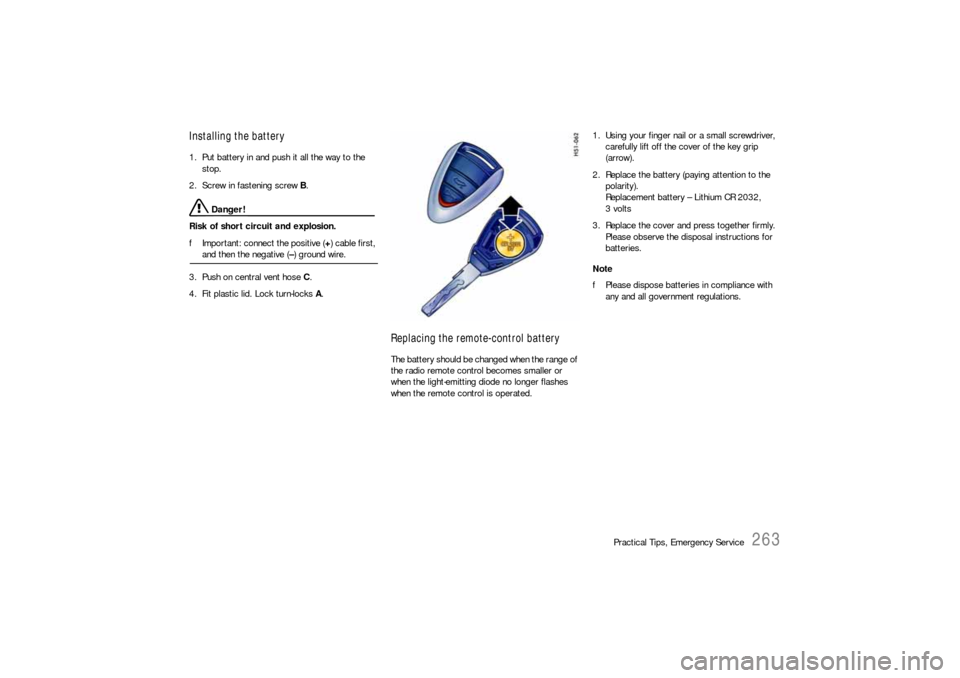
Replacing the remote-control battery The battery should be changed when the range of
the radio remote control becomes smaller or
when the light-emitting diode no longer flashes
when the remote control is operated.1. Using your finger nail or a small screwdriver,
carefully lift off the cover of the key grip
(arrow).
2. Replace the battery (paying attention to the
polarity).
Replacement battery – Lithium CR 2032,
3volts
3. Replace the cover and press together firmly.
Please observe the disposal instructions for
batteries.
Note
fPlease dispose batteries in compliance with
any and all government regulations.
Page 264 of 308

264
Practical Tips, Emergency Service
Emergency Starting with Jumper
Cables If the battery is discharged, e.g. in winter or after
the car has been parked for a long time, the bat-
tery of another car can be used for starting with
the help of jumper cables.
Make sure the voltage of both batteries is the
same. Both batteries must be 12 volt types.
The capacity (Ampere hours, Ah) of the booster
battery must not be substantially less than that of
the discharged battery.
The discharged battery must be correctly con-
nected to the vehicle’s electrical system.
fPlease observe the chapter “BATTERY” on
Page 258.
fPlease observe the chapter “EMERGENCY UN-
LOCKING OF THE LUGGAGE COMPARTMENT
LID” on Page 257.
Note
fDo not try to start the car by pushing or tow-
ing. Damage to the catalytic converters and
other components of the car may result.
Warning!
Risk of damage and serious personal injury
due to short circuit.
fUse only jumper cables of adequate diameter
cross-section and fitted with completely insu-
lated alligator clips.
fFollow all warnings and instructions of the
jumper cable manufacturer.
fWhen connecting jumper cables, make sure
that they cannot get caught in any moving
parts in the engine compartment.
The jumper cables must be long enough so
that neither vehicles nor cables touch another.
fThe vehicles must not be in contact, otherwise
current might flow as soon as the positive ter-
minals are connected.
fThe cable clamps must not be allowed to con-
tact each other when one end of the jumper ca-
bles are connected to a battery.
fEnsure that tools or conductive jewelery (rings,
chains, watch straps) do not come into contact
with the positive jumper cable or the positive
battery post.
fImproper hook-up of jumper cables can ruin
the alternator. Danger of caustic burns.
fDo not lean over the battery.
Danger of gas explosion.
fImproper use of booster battery to start a
vehicle may cause an explosion, resulting in
severe personal injuries.
fKeep sources of ignition away from the bat-
tery, e.g. open flame, burning cigarettes or
sparking due to cable contact or welding work.
fA discharged battery can freeze even at
23°F/–5°C.
Before connecting jumper cables, a frozen bat-
tery must be thawed out.
Page 265 of 308

Practical Tips, Emergency Service
265
Connect jumper cables in the following
sequence:
Always observe the sequence below:
1. Connect the positive lead (red) to the
positive terminal of the discharged battery
first, then connect it to the positive terminal of
the donor battery.
2. First connect the negative cable (black) to
the negative terminal of the donor battery, then
connect it to a suitable grounding point on the
vehicle with the discharged battery.
This grounding point must lie as far as possible
from the battery.
For example, a solid metal part or the engine
block are suitable grounding points.
If no suitable grounding points are to be found
on either vehicle, the negative cable must
carefully be connected directly to the negative
terminal of the battery.
If a suitable grounding point is to be found only
on the donor vehicle, the negative cable must
first be connected to the terminal of the
discharged battery, then to the grounding point
of the donor vehicle.
3. Run the engine of the donor car at a higher
speed.4. Start the engine.
An attempted start using jumper cables should
not last more than 15 seconds. Then allow a
waiting period of at least one minute.
Note
Before disconnecting the jumper cables, electrical
loads such as the heated rear window and the
heating fan blower should be switched on (the ve-
hicle’s lights must not be switched on). This reduc-
es voltage peaks which may occur when discon-
necting the jumper cables.
With the engine running, remove both jumper ca-
bles in reverse order.