lock PORSCHE 911 CARRERA 2006 5.G Repair Manual
[x] Cancel search | Manufacturer: PORSCHE, Model Year: 2006, Model line: 911 CARRERA, Model: PORSCHE 911 CARRERA 2006 5.GPages: 308, PDF Size: 3.69 MB
Page 190 of 308
190
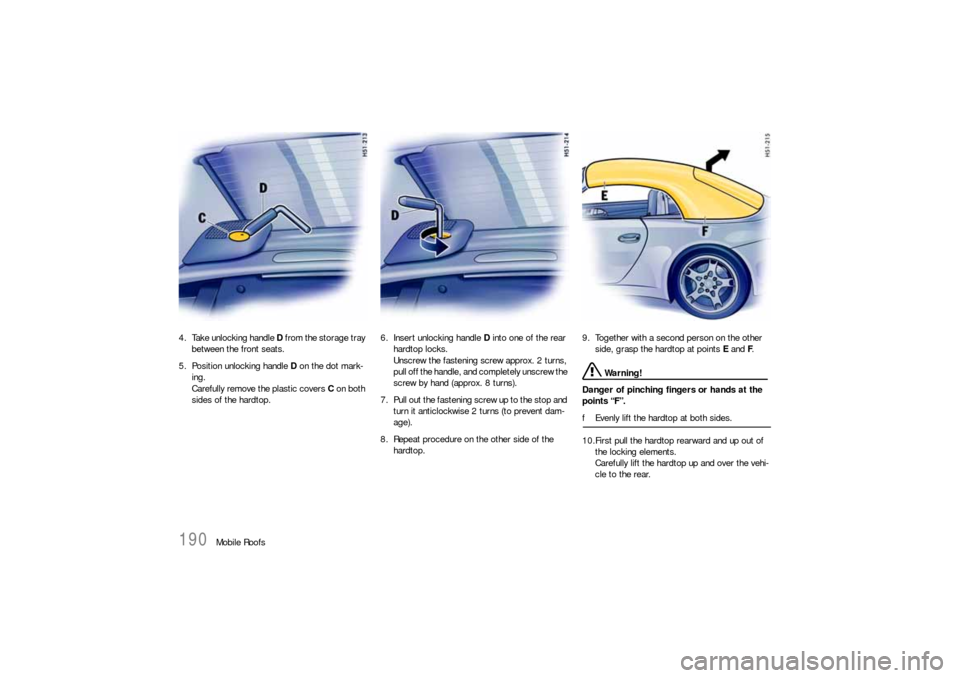
Mobile Roofs 4. Take unlocking handle D from the storage tray
between the front seats.
5. Position unlocking handle D on the dot mark-
ing.
Carefully remove the plastic covers C on both
sides of the hardtop. 6. Insert unlocking handle D into one of the rear
hardtop locks.
Unscrew the fastening screw approx. 2 turns,
pull off the handle, and completely unscrew the
screw by hand (approx. 8 turns).
7. Pull out the fastening screw up to the stop and
turn it anticlockwise 2 turns (to prevent dam-
age).
8. Repeat procedure on the other side of the
hardtop. 9. Together with a second person on the other
side, grasp the hardtop at points E and F.
Warning!
Danger of pinching fingers or hands at the
points “F”.
fEvenly lift the hardtop at both sides.
10.First pull the hardtop rearward and up out of
the locking elements.
Carefully lift the hardtop up and over the vehi-
cle to the rear.
Page 191 of 308
Mobile Roofs
191
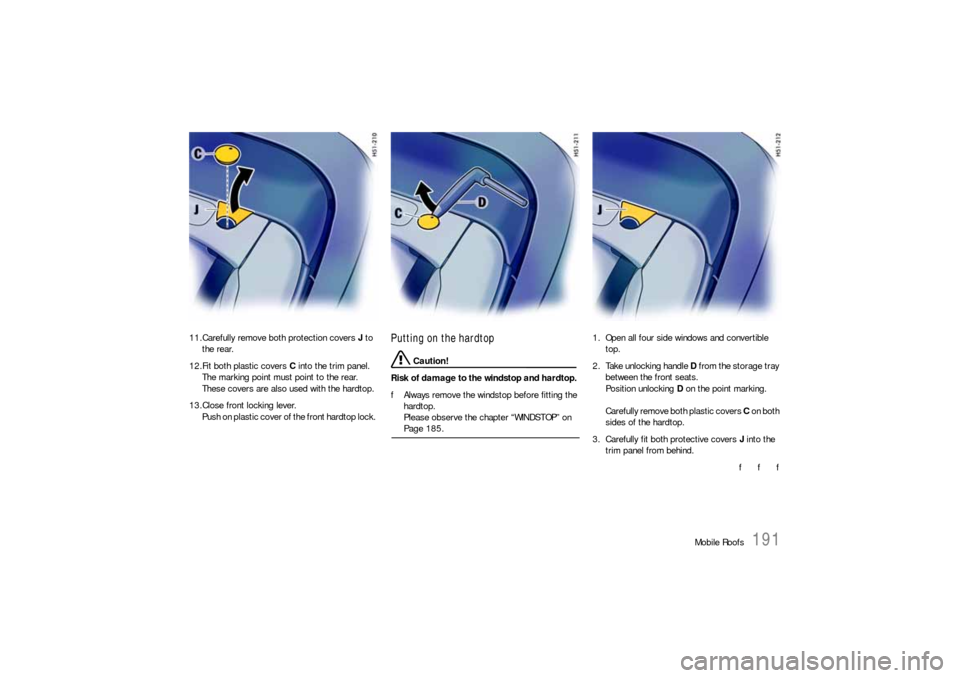
11.Carefully remove both protection covers J to
the rear.
12.Fit both plastic covers C into the trim panel.
The marking point must point to the rear.
These covers are also used with the hardtop.
13.Close front locking lever.
Push on plastic cover of the front hardtop lock.
Putting on the hardtop
Caution!
Risk of damage to the windstop and hardtop.
fAlways remove the windstop before fitting the
hardtop.
Please observe the chapter “WINDSTOP” on Page 185.1. Open all four side windows and convertible
top.
2. Take unlocking handle D from the storage tray
between the front seats.
Position unlocking D on the point marking.
Carefully remove both plastic covers C on both
sides of the hardtop.
3. Carefully fit both protective covers J into the
trim panel from behind.
f f f
Page 192 of 308
192
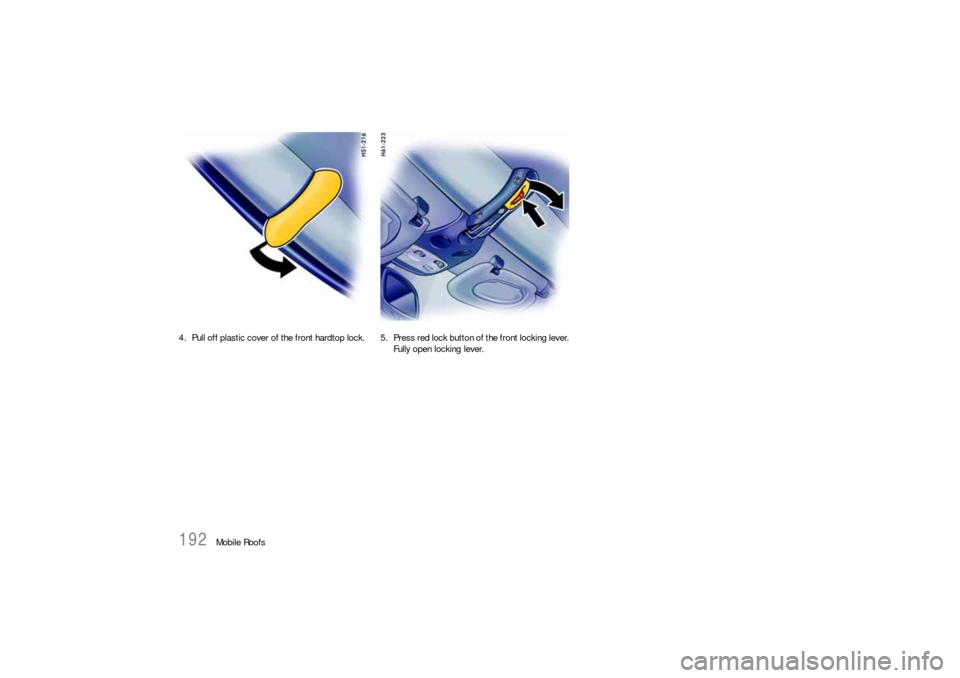
Mobile Roofs 4. Pull off plastic cover of the front hardtop lock. 5.Press red lock button of the front locking lever.
Fully open locking lever.
Page 193 of 308
Mobile Roofs
193
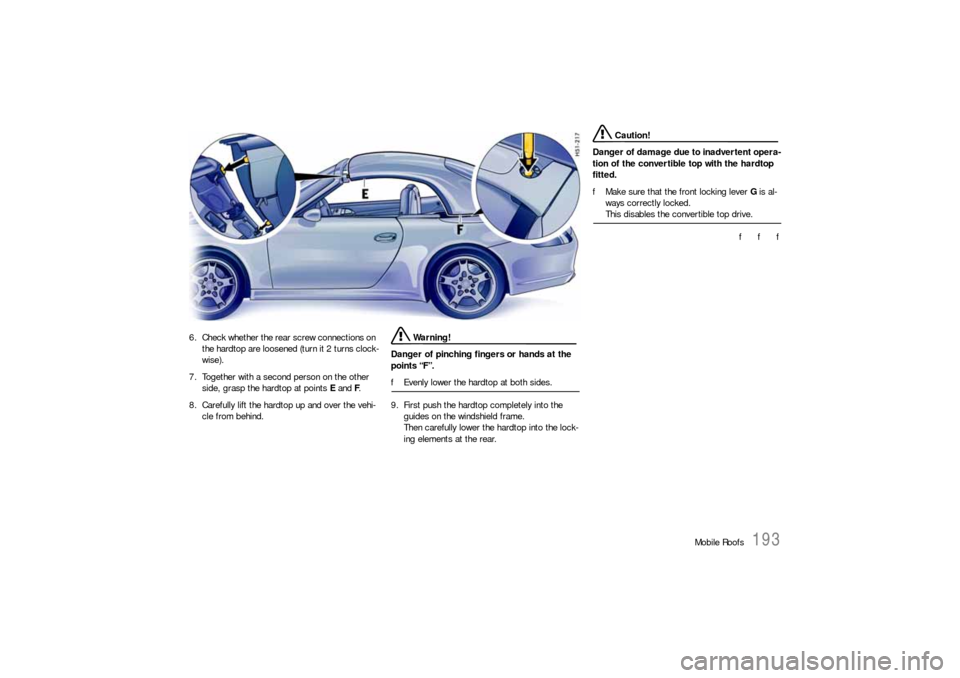
6.Check whether the rear screw connections on
the hardtop are loosened (turn it 2 turns clock-
wise).
7. Together with a second person on the other
side, grasp the hardtop at points E and F.
8. Carefully lift the hardtop up and over the vehi-
cle from behind.
Warning!
Danger of pinching fingers or hands at the
points “F”.
fEvenly lower the hardtop at both sides.
9. First push the hardtop completely into the
guides on the windshield frame.
Then carefully lower the hardtop into the lock-
ing elements at the rear.
Caution!
Danger of damage due to inadvertent opera-
tion of the convertible top with the hardtop
fitted.
fMake sure that the front locking lever G is al-
ways correctly locked.This disables the convertible top drive.
f f f
Page 194 of 308
194
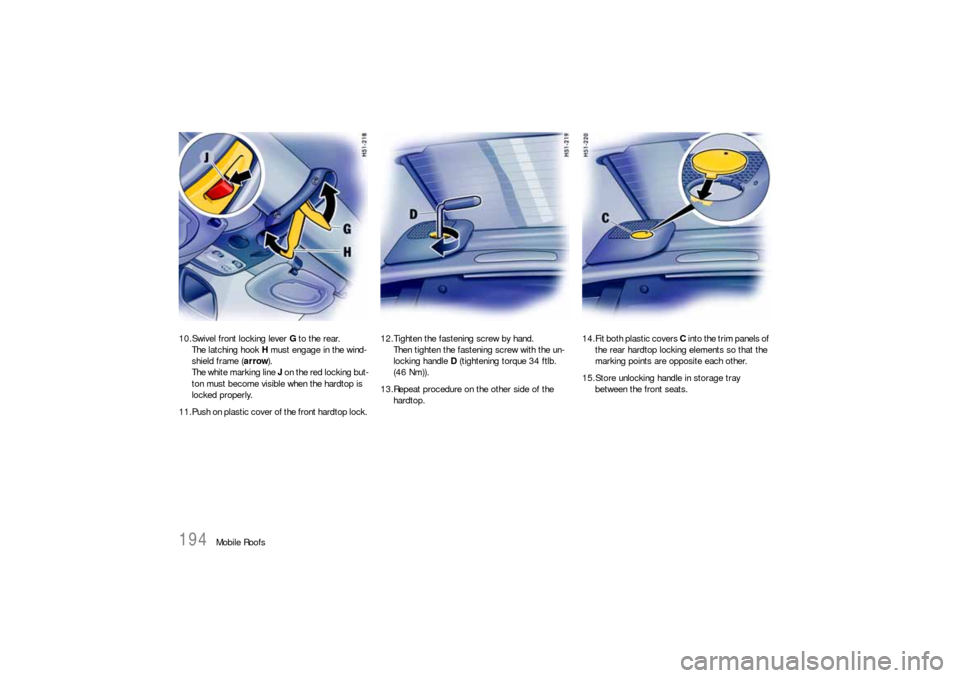
Mobile Roofs 10.Swivel front locking lever G to the rear.
The latching hook H must engage in the wind-
shield frame (arrow).
The white marking line J on the red locking but-
ton must become visible when the hardtop is
locked properly.
11.Push on plastic cover of the front hardtop lock.12.Tighten the fastening screw by hand.
Then tighten the fastening screw with the un-
locking handle D (tightening torque 34 ftlb.
(46 Nm)).
13.Repeat procedure on the other side of the
hardtop. 14.Fit both plastic covers C into the trim panels of
the rear hardtop locking elements so that the
marking points are opposite each other.
15.Store unlocking handle in storage tray
between the front seats.
Page 195 of 308

Mobile Roofs
195
Roof Transport System(Coupé only)
fPlease follow the separate instructions for fit-
ting the Roof Transport System.
fOnly use Roof Transport Systems from the
Porsche Tequipment product range or Roof
Transport Systems which have been tested
and approved for your car by Porsche.
Fitting normal commercially available luggage
racks is not possible.
The Porsche Roof Transport System allows you
to carry various sports and hobby equipment.
Your authorized Porsche dealer will be pleased to
tell you about the various different uses of the
Roof Transport System.
Safety notes!
fCompletely remove the Roof Transport System
before using an automatic car wash – risk of
damage to the vehicle!
fDo not exceed the maximum permitted pay-
load, the maximum permitted gross weight
and the maximum permitted axle loads.
Please observe the chapter “WEIGHTS COU-
PÉ” on Page 292.
fDistribute load evenly, with heavy items as low
as possible.
Items of luggage must not project beyond the
side of the load area.
fFix and secure every item to the basic carrier
with a rope or lashing strap (do not use elastic
rubber tensioners).
fBefore every journey, and at regular intervals
during long trips, check that Roof Transport
System and load are secure. Re-tighten if nec-
essary and secure additionally by locking.When the Roof Transport System is loaded, the
maximum speed depends on the nature, size and
weight of the load being carried.
Driving, braking and steering behavior change due
to the higher center of gravity and the greater
wind-resistant area. You should adapt your driving
style appropriately.
Since fuel consumption and noise are increased
with the Roof Transport System fitted, it should
not remain on the vehicle if not in use.
Page 198 of 308

198
Maintenance, Car Care
Exercise Extreme Caution when
Working on your Vehicle
Danger!
Ignoring the following instructions may
cause serious personal injury or death.
fThe engine compartment of any motor vehicle
is a potentially hazardous area. If you are not
fully familiar with proper repair procedures, do
not attempt the adjustments described on the
following pages.
This caution also applies to the entire vehicle.
fO n l y w o r k o n y o u r v e h i c l e o u t d o o r s o r i n a w e l l
ventilated area.
fEnsure that there are no open flames in the
area of your vehicle at any time when fuel
fumes might be present. Be especially cau-
tious of such devices such as hot water heat-
ers which ignite a flame intermittently.
fBefore working on any part in the engine com-
partment, turn the engine off and let it cool
down sufficiently. Hot engine compartment
components can burn skin on contact.
fBe alert and cautious around engine at all
times while the engine is running.
If work has to be performed with the engine
running, always set the parking brake, and
make sure the shift lever is in neutral position
or the selector lever in position P.fIn particular, be very careful to ensure that
items of clothing (ties, shirt, sleeves etc.),
jewelry, long hair, hand or fingers cannot get
caught in the engine-compartment blower, fan,
belts or other moving parts.
The radiator and radiator fans are in the front
of the car.
The engine-compartment blower is mounted
on the engine-compartment lid.
The engine-compartment blower can start or
continue running as a function of temperature,
even with the engine switched off.
Carry out work in these areas only with the en-
gine off, the ignition switched off, and exercise
extreme caution.
fYour Porsche is equipped with an electronic ig-
nition system. When the ignition is on, high
voltage is present in all wires connected with
the ignition system; therefore, exercise ex-
treme caution when working on any part of the
engine while the ignition is on or the engine is
running.
fAlways support your car with safety stands if it
is necessary to work under the car.
fWhen working under the car without safety
stands but with the wheels on the ground,
make sure the car is on level ground, the
wheels are blocked, and that the engine
cannot be started.
Remove the ignition key. fDo not smoke or allow an open flame around
the battery or fuel.
Keep a fire extinguisher in close reach.
fIncomplete or improper servicing may cause
problems in the operation of the car. If in doubt
about any servicing, have it done by your
authorized Porsche dealer.
Improper maintenance during the warranty
period may affect your Porsche warranty cov-
erage.
fSupplies of fluids, e.g. engine oil, brake fluid or
coolant, are hazardous to your health.
Keep these fluids out of children’s reach and
dispose of them in accordance with the appro-
priate regulations.
fSome countries require additional tools and
special spare parts to be carried.
Please make enquiries before driving abroad.
Power measurements Power measurements on dynamometers are not
approved by Porsche.
Page 208 of 308
208
Maintenance, Car Care
Fuel
Warning!
Fuel is highly flammable and harmful to
health.
fFire, open flame and smoking are prohibited
when handling fuel.
fAvoid contact with skin or clothing.
fDo not inhale fuel vapors.
To prevent damage to the emission control
system and engine:
fNever drive the tank completely out of fuel.
fAvoid high cornering speeds after the warning lights have come on.
fPlease observe the chapter “EMISSION CONT-
ROL SYSTEM” on Page 211.
Please observe the chapter “FUEL ECONOMY”
on Page 207.
Please observe the chapter “LEVEL GAUGE”
on Page 94.
Check engine warning light
If the warning lights in the instrument panel and on-
board computer come on and remain on while
driving, it suggests:
– an improperly fastened tank cap or
– refuelling with engine running.
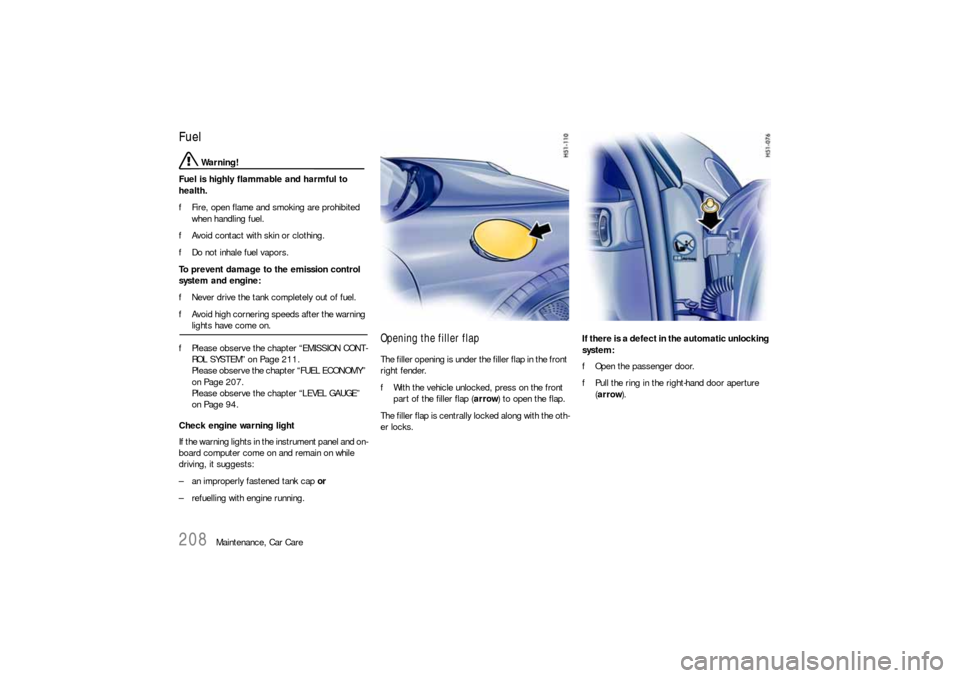
Opening the filler flap The filler opening is under the filler flap in the front
right fender.
fWith the vehicle unlocked, press on the front
part of the filler flap (arrow) to open the flap.
The filler flap is centrally locked along with the oth-
er locks. If there is a defect in the automatic unlocking
system:
fOpen the passenger door.
fPull the ring in the right-hand door aperture
(arrow).
Page 210 of 308

210
Maintenance, Car Care Unleaded fuels may not be available outside the
continental U.S. and Canada. Therefore, we rec-
ommend you do not take your car to areas or
countries where unleaded fuel may not be availa-
ble.
Octane ratings Octane rating indicates a fuel’s ability to resist det-
onation. Therefore, buying the correct octane gas
is important to prevent engine “damage”.
The RON octane rating is based on the research
method. The CLC (U.S. Cost of Living Council oc-
tane rating) or AKI (antiknock index) octane rating
usually displayed on U.S. fuel pumps is calculated
as research octane number plus motor octane
number, divided by 2, that is written as:
The CLC or AKI octane rating is usually lower than
the RON rating:
For example: 95 RON equals 90 CLC or AKI
Fuels containing alcohol and ether Some areas of the U.S. require oxygenated fuels
during certain portions of the year. Oxygenated fu-
els are fuels which contain alcohols (such as meth-
anol or ethanol) or ether (such as MTBE).
Under normal conditions, the amount of these
compounds in the fuel will not affect driveability.
You may use oxygenated fuels in your Porsche,
provided the octane requirements for your vehicle
are met. We recommend, however, to change to a
different fuel or station if any of the following prob-
lems occur with your vehicle:
– Deterioration of driveability and performance.
– Substantially reduced fuel economy.
– Vapor lock and non-start problems, especially
at high altitude or at high temperature.
– Engine malfunction or stalling.
Fuels containing MMT Some North American fuels contain an octane en-
hancing additive called methylcyclopentadienyl
manganese tricarbonyl (MMT).
If such fuels are used, your emission control sys-
tem performance may be negatively affected.
The check engine warning light on your instrument
panel may turn on.
If this occurs, Porsche recommends you stop us-
ing fuels containing MMT.Portable Fuel Containers
Danger!
Portable fuel containers, full or partially
empty, may leak causing an explosion, or re-
sult in fire in case of an accident.
fNever carry additional fuel in portable contain-ers in your vehicle. RON+MON
2R+M
2 or
Page 214 of 308
214
Maintenance, Car Care
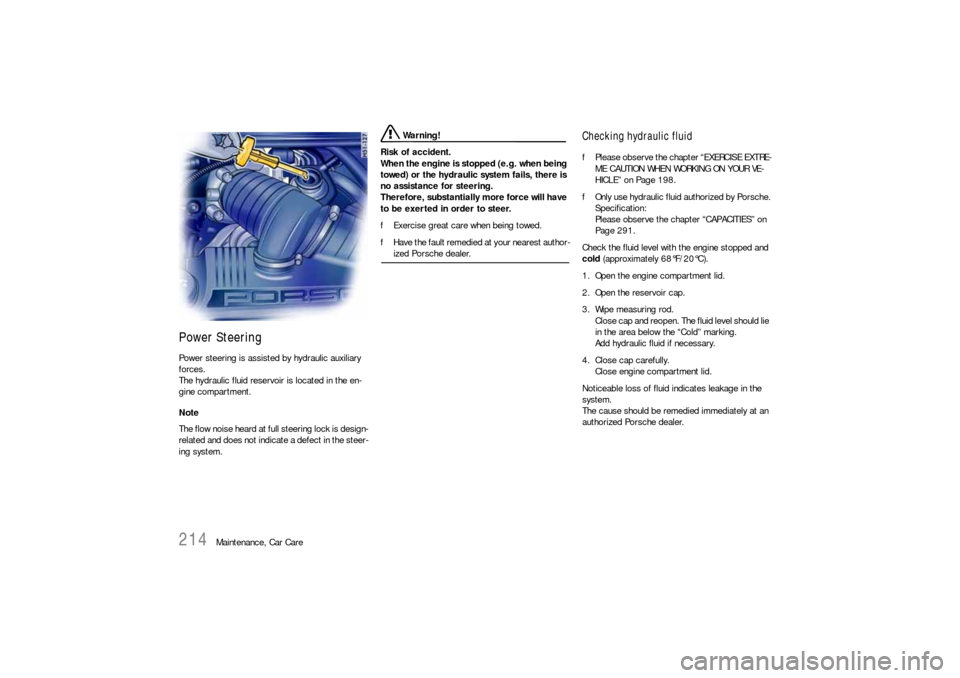
Power Steering Power steering is assisted by hydraulic auxiliary
forces.
The hydraulic fluid reservoir is located in the en-
gine compartment.
Note
The flow noise heard at full steering lock is design-
related and does not indicate a defect in the steer-
ing system.
Warning!
Risk of accident.
When the engine is stopped (e.g. when being
towed) or the hydraulic system fails, there is
no assistance for steering.
Therefore, substantially more force will have
to be exerted in order to steer.
fExercise great care when being towed.
fHave the fault remedied at your nearest author-ized Porsche dealer.
Checking hydraulic fluid fPlease observe the chapter “EXERCISE EXTRE-
ME CAUTION WHEN WORKING ON YOUR VE-
HICLE” on Page 198.
fOnly use hydraulic fluid authorized by Porsche.
Specification:
Please observe the chapter “CAPACITIES” on
Page 291.
Check the fluid level with the engine stopped and
cold (approximately 68°F/20°C).
1. Open the engine compartment lid.
2. Open the reservoir cap.
3. Wipe measuring rod.
Close cap and reopen. The fluid level should lie
in the area below the “Cold” marking.
Add hydraulic fluid if necessary.
4. Close cap carefully.
Close engine compartment lid.
Noticeable loss of fluid indicates leakage in the
system.
The cause should be remedied immediately at an
authorized Porsche dealer.