engine PORSCHE 911 CARRERA 2011 6.G Information Manual
[x] Cancel search | Manufacturer: PORSCHE, Model Year: 2011, Model line: 911 CARRERA, Model: PORSCHE 911 CARRERA 2011 6.GPages: 63, PDF Size: 9.45 MB
Page 16 of 63

3233
DFI delivers fuel directly into the combustion
chamber with millisecond precision. The
spray and cone angles of the new multi-
hole injectors have been optimised for
torque, power output, fuel consumption,
emissions and ef ficient combustion.
With direct injection, the engine manage-
ment system regulates injection timing
individually for each cylinder as well as
the injection rate for each cylinder bank.
This optimises the combustion process
and fuel economy. The system first dif ferentiates
bet ween driver inputs that t ypify normal,
everyday driving and those inputs
that demand maximum performance.
The electronic engine management
system then seamlessly adapts valve
operation to the prevailing conditions.
This results in instant acceleration,
extremely smooth running and an
extraordinary level of tractive power,
but with a comparatively low level of
fuel consumption.
For faster heating of the catalytic converters
after a cold start and optimum torque in
the upper load range, up to three injection
pulses take place per combustion cycle.
DFI improves the internal cooling of
the combustion chamber by having the
mixture prepared directly in the cylinder.
This allows for a higher compression
ratio, which helps to deliver more output
at the same time as enhanced engine
efficiency. Injection is regulated by the
electronic engine management system
Temperament | Engines
and emissions are monitored by the
Lambda sensors, thus helping to protect
the environment.
VarioCam Plus System.
VarioCam Plus is a two-in-one engine
concept for adjusting the intake
camshafts and switching the lift of the
intake valves.
What lies between your home and Le Mans?
Advanced engineering as standard.
Direct fuel injection (DFI).
Page 17 of 63
3435
Temperament
|
Engines
Integrated dry-sump lubrication.
Integrated dr y-sump lubrication ensures
a reliable supply of oil even when a
sport y driving st yle is adopted. It also
has additional cooling functions.
The oil tank is located in the engine,
thereby eliminating the need for an
external oil tank, which saves both space
and weight. To reduce power loss and
increase efficiency, an electronically con -
trolled oil pump supplies the lubricating
points inside the engine as and when
required. This results in optimum supply
of oil, low fuel consumption and, there -
fore, lower exhaust emissions.
Air intake system.
The resonance intake system increases
the intake volume by exploiting the fact
that air oscillates as it passes through
the intake manifold. The system can
adjust to engine speed. Benefits of this
include higher torque at low engine
speeds and a flat ter torque curve.
The
911 Carrera S operates a t wo -stage
system.
The entire intake system is made from
light weight plastic. In the new 911 Carrera,
the resonator volume of the air filter
housing varies with engine speed to bring
added character to the engine sound,
which becomes much more powerful at
higher rpm.
Exhaust system.
The exhaust system of the new 911
models has been completely redesigned,
acoustics included.
The stainless-steel exhaust system com -
prises t wo distinctive and independent
exhaust tracts. The cataly tic converters
heat up rapidly for effective emissions
reduction.
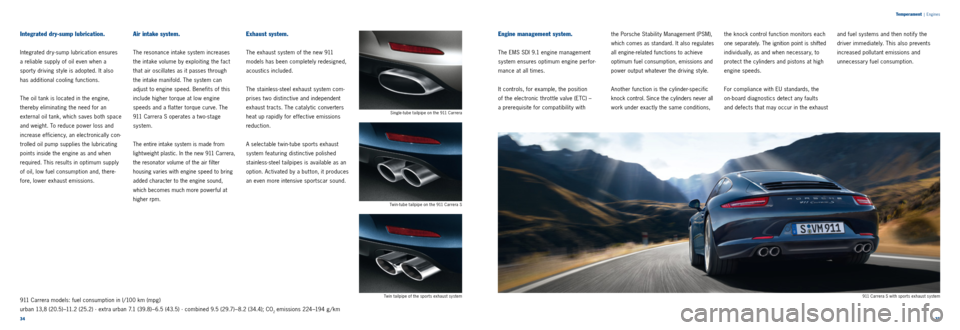
A selectable t win -tube sports exhaust
system featuring distinctive polished
stainless-steel tailpipes is available as an
option. Activated by a but ton, it produces
an even more intensive sportscar sound.
911 Carrera S with sports exhaust system
Engine management system.
The EMS SDI 9.1 engine management
system ensures optimum engine perfor -
mance at all times.
It controls, for example, the position
of the electronic throt tle valve (ETC) –
a prerequisite for compatibility with the Porsche Stabilit y Management (PSM),
which comes as standard. It also regulates
all engine-related functions to achieve
optimum fuel consumption, emissions and
power output whatever the driving st yle.
Another function is the cylinder-specific
knock control. Since the cylinders never all
work under exactly the same conditions, the knock control function monitors each
one separately. The ignition point is shifted
individually, as and when necessary, to
protect the cylinders and pistons at high
engine speeds.
For compliance with EU standards, the
on - board diagnostics detect any faults
and defects that may occur in the exhaust and fuel systems and then notify the
driver immediately. This also prevents
increased pollutant emissions and
unnecessary fuel consumption.
Twin tailpipe of the sports exhaust system Single-tube tailpipe on the 911 Carrera
Twin-tube tailpipe on the 911 Carrera S911 Carrera models: fuel consumption in l/100 km (mpg)
urban 13,8 (20.5) –11.2 (25.2) · extra urban 7.1 (39.8) – 6.5 (43.5) · combined 9.5 (29.7) –8.2 (34.4); CO
2 emissions 224–194 g / km
Page 18 of 63
3637
Temperament
|
Transmission
The long and winding road is where you’d like to be.
Sometimes, it pays to take the direct route.
Transmission.
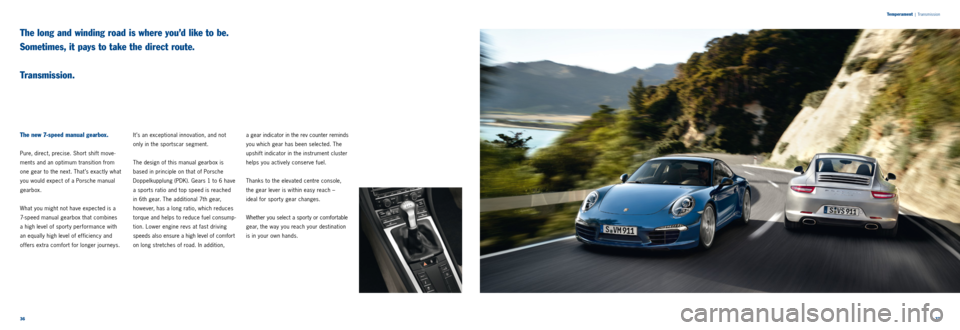
The new 7-speed manual gearbox.
Pure, direct, precise. Short shif t move -
ments and an optimum transition from
one gear to the next. That ’s exactly what
you would expect of a Porsche manual
gearbox.
What you might not have expected is a
7-speed manual gearbox that combines
a high level of sport y performance with
an equally high level of efficiency and
offers extra comfort for longer journeys. It’s an exceptional innovation, and not
only in the sportscar segment.
The design of this manual gearbox is
based in principle on that of Porsche
Doppelkupplung (PDK). Gears 1 to 6 have
a sports ratio and top speed is reached
in 6th gear. The additional 7th gear,
however, has a long ratio, which reduces
torque and helps to reduce fuel consump -
tion. Lower engine revs at fast driving
speeds also ensure a high level of com
fort
on long stretches of road. In addition
, a gear indicator in the rev counter reminds
you which gear has been selected. The
upshift indicator in the instrument cluster
helps you actively conserve fuel.
Thanks to the elevated centre console,
the gear lever is within easy reach –
ideal for sport y gear changes.
Whether you select a sporty or comfortable
gear, the way you reach your destination
is in your own hands.
Page 19 of 63

462135
7R
3839
Porsche Doppelkupplung (PDK).
Available as an option for the new 911
models is 7-speed PDK, featuring manual
and automatic modes. This double - clutch
transmission has been further refined and
enables extremely fast gear changes with
no interruption in the flow of power, which vastly improves acceleration at the
same time as reducing fuel consumption.
In total, PDK has seven gears at its disposal.
Gears 1 to 6 have a sports ratio and top
speed is reached in 6th gear. 7th gear has
a long ratio and helps to reduce fuel
consumption by keeping engine revs low.
Porsche Doppelkupplung (PDK)
PDK is essentially t wo gearboxes in one
and thus requires t wo clutches. This
double-clutch arrangement provides an
alternating, non-positive connection
bet ween the t wo half gearboxes and the
engine by means of t wo separate input
shafts.The flow of power from the engine is
transmit ted through one half gearbox and
one clutch at a time, while the next gear
is preselected in the second half gearbox.
During a gear change, therefore, one
clutch simply opens and the other closes
at the same time, enabling gear changes
to take place within milliseconds.
Temperament | Transmission
The effect is instant. Driving feels even
sportier and more dynamic, and agility
is increased. Depending on the gearshift
programme (SPORT button activated
or deactivated), the gear change is opti -
mised for comfort or for sport y driving.With the optional Sport Chrono Package,
PDK is enhanced by the ‘Launch Control’
and ‘motorsport- derived gearshif t strategy’
functions (p. 50). In this way, optimum use is made of the
vehicle’s momentum, allowing it to coast
for longer distances.
For example, you may want to slow down
from 100 km/ h (62 mph) to 80 km/ h
(49 mph) in anticipation of the change of
speed limit ahead. As soon as you release
the accelerator pedal, PDK deselects
the current gear automatically and you
begin to coast in neutral until you have
reached your desired speed. The moment
you engage the accelerator or brake
pedal, PDK selects the appropriate gear
smoothly and seamlessly within a fraction
of a second.
Another way to reduce fuel consumption is
to utilise the coasting function on downhill
gradients that are gentle enough for you
to maintain a constant speed. Efficient on
long journeys, such as on the motorway,
PDK remains ready to respond as swiftly
and precisely as you would expect.
In short, driving in coasting mode makes
a real impact on fuel consumption without
any need for compromise on comfort or
sporty performance.
Coasting.
The ‘coasting’ function available with
Porsche Doppelkupplung (PDK) enables
you to save even more fuel where the
situation allows. The engine is decoupled
from the transmission to prevent
deceleration caused by engine braking.
Page 20 of 63
4041
Temperament
| Chassis and body
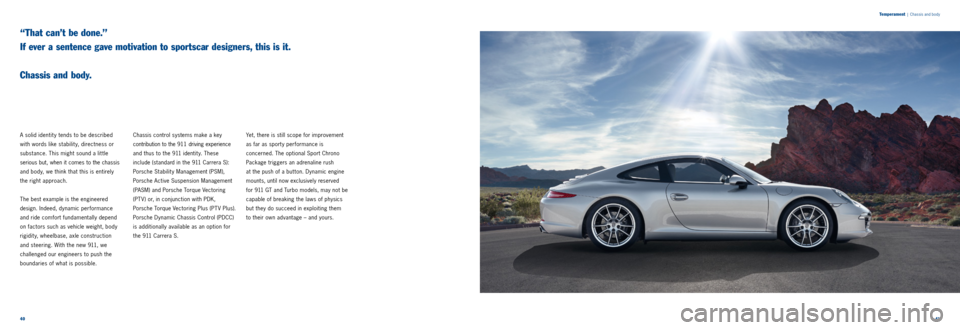
“That can’t be done.”
If ever a sentence gave motivation to sportscar designers, this is it.
Chassis and body.
A solid identit y tends to be described
with words like stability, directness or
substance. This might sound a lit tle
serious but, when it comes to the chassis
and body, we think that this is entirely
the right approach.
The best example is the engineered
design. Indeed, dynamic per formance
and ride comfort fundamentally depend
on factors such as vehicle weight, body
rigidity, wheelbase, axle construction
and steering. With the new 911, we
challenged our engineers to push the
boundaries of what is possible. Chassis control systems make a key
contribution to the 911 driving experience
and thus to the 911 identit y. These
include (standard in the 911 Carrera S):
Porsche Stability Management (PSM),
Porsche Active Suspension Management
(PASM) and Porsche Torque Vectoring
(PTV) or, in conjunction with PDK,
Porsche Torque Vectoring Plus (PTV Plus).
Porsche Dynamic Chassis Control (PDCC)
is additionally available as an option for
the 911 Carrera S. Yet, there is still scope for improvement
as far as sport y performance is
concerned. The optional Sport Chrono
Package triggers an adrenaline rush
at the push of a but ton. Dynamic engine
mounts, until now exclusively reserved
for 911 GT and Turbo models, may not be
capable of breaking the laws of physics
but they do succeed in exploiting them
to their own advantage – and yours.
Page 21 of 63
4243
Temperament
| Chassis and body
Engineered design.
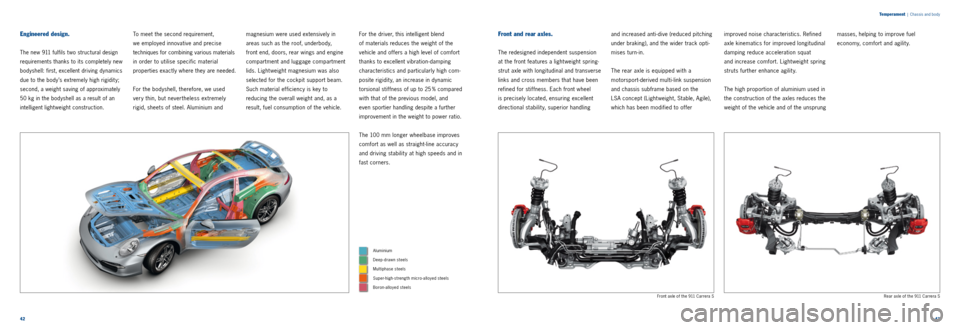
The new 911 fulfils two structural design
requirements thanks to its completely new
bodyshell: first, excellent driving dynamics
due to the body’s extremely high rigidit y;
second, a weight saving of approximately
50 kg in the bodyshell as a result of an
intelligent lightweight construction.
To meet the second requirement,
we employed innovative and precise
techniques for combining various materials
in order to utilise specific material
properties exactly where they are needed.
For the bodyshell, therefore, we used
very thin, but nevertheless extremely
rigid, sheets of steel. Aluminium and magnesium were used extensively in
areas such as the roof, underbody,
front end, doors, rear wings and engine
compartment and luggage compartment
lids. Light weight magnesium was also
selected for the cockpit support beam.
Such material efficiency is key to
reducing the overall weight and, as a
result, fuel consumption of the vehicle. For the driver, this intelligent blend
of materials reduces the weight of the
vehicle and offers a high level of comfort
thanks to excellent vibration-damping
characteristics and particularly high com -
posite rigidit y, an increase in dynamic torsional stiffness of up to 25 % compared
with that of the previous model, and
even
sportier handling despite a further
improvement in the weight to power ratio.
The 100 mm longer wheelbase improves
comfort as well as straight-line accuracy
and driving stabilit y at high speeds and in
fast corners.
Front and rear axles.
The redesigned independent suspension
at the front features a light weight spring-
strut axle with longitudinal and transverse
links and cross members that have been
refined for stiffness. Each front wheel
is precisely located, ensuring excellent
directional stability, superior handling and increased anti-dive (reduced pitching
under braking), and the wider track opti
-
mises turn-in.
The rear axle is equipped with a
motorsport-derived multi-link suspension
and chassis subframe based on the
LSA concept (Lightweight, Stable, Agile),
which has been modified to offer improved noise characteristics. Refined
axle kinematics for improved longitudinal
damping reduce acceleration squat
and increase comfort. Light weight spring
struts further enhance agilit y.
The high proportion of aluminium used in
the construction of the axles reduces the
weight of the vehicle and of the unsprung masses, helping to improve fuel
economy, comfort and agility.
Rear axle of the 911 Carrera S
Front axle of the 911 Carrera S
Aluminium
Deep-drawn steels
Multiphase steels
Super-high-strength micro-alloyed steels
Boron-alloyed steels
Page 24 of 63

4849
Temperament
| Chassis and body
Power steering.
Another possible definition of efficiency
is a system that works only when it is
needed, and then does so in a particularly
effective way.
This was the guiding principle for our
engineers in the development of the new electromechanical power steering.
Statistics show that a car drives in a
straight line 90
% of the time. Unlike
conventional hydraulic pumps, the electric
motor uses energy only when the steering
wheel is actually turned. The absence
of hydraulic fluid also makes the system
more beneficial to the environment.
As far as the other 10 % is concerned, we’re
optimally prepared as the steering system
is t ypically Porsche. It features a variable
steering ratio and responds sensitively
and directly at the same time as providing
customary agility, a high level of comfort
and precisely selected feedback from the
road. Our definition of efficient.Power steering Plus.
Power steering Plus, the speed -sensitive
power-steering system, is available
as an option for the 911 Carrera models.
At high speeds, the steering is as firm
as you would expect and responds with
extreme precision while steering comfort
remains as high. At low speeds, the
steering ratio of Power steering Plus
adjusts for much easier manoeuvring
and parking.
SPORT button.
Fit ted as standard, the new SPORT
but ton enables you to select a suspension
setup where the emphasis is on either
comfort or sport y performance. At the
push of a button, the electronic engine
management system switches the engine
mapping to offer an even sharper
response and engine dynamics that are
more direct.
In vehicles with Porsche Doppelkupplung
(PDK), upshifts take place at higher
engine speeds and downshifts happen sooner. In addition, coasting mode and
the auto start/stop function are automati
-
cally deactivated. If fitted, the optional
sports exhaust system is also activated
automatically.
Sport Chrono Package.
The Sport Chrono Package including
dynamic engine mounts is available
as an option. This integrated system
provides simultaneous enhancement for
the chassis, engine and transmission.
Every day can be sports day.
Additional performance enhancement systems.
Page 25 of 63

5051
Temperament
| Chassis and body
Included in the package are a performance
display, a digital and an analogue stop -
watch and the SPORT PLUS but ton. An
additional display in the steering wheel
and instrument cluster indicates whether
the SPORT but tons and Launch Control
have been activated.
On activation of SPORT PLUS mode,
Porsche Active Suspension Management
(PASM) and, in the S model, optional
Porsche Dynamic Chassis Control (PDCC)
switch to a harder damping set ting
and offer more direct steering and,
therefore, better road holding.
In SPORT PLUS mode, the trigger thresh -
old for PSM is raised. Agilit y is perceptibly
enhanced when braking for corners with
PSM, allowing sportier braking and exit
acceleration. For maximum dexterit y,
PSM can be set to standby while the car
is still in SPORT PLUS mode. For safet y,
it is set to intervene automatically only
when ABS assistance is required on both
the front wheels.
In combination with PDK, the Sport
Chrono Package has t wo additional functions for a sport y drive that borders
on a motorsport experience. The first
is ‘Launch Control’, which can be used
on the track to achieve the best possible
standing start – a racing start.
The second function is the ‘motorsport-
derived gearshif t strategy’. Using this,
Porsche Doppelkupplung (PDK) is geared
up for extremely short shift times and optimum shift points for the maximum
acceleration available. This combination
of uncompromising and involving perfor
-
mance is ideal for the racetrack.
A key component of the Sport Chrono
Package is the stopwatch mounted on
the dashboard. In conjunction with the
optional PCM, a special performance
display enables you to view store and evaluate lap times or other driving
times. It shows the total driving time,
lap distance, lap number and lap times
re c o rde d s o f a r.
A feature of the Sport Chrono Package
borrowed from motorsport is the dynamic
engine mounts. These exploit the laws
of physics for your own driving pleasure.
Dynamic engine mounts.
You don’t have to take the new 911 onto
the racetrack. But you can, more so
than ever, because dynamic engine
mounts are now included as part of the
Sport Chrono Package. Based on the
engine mounts of the 911 GT3 and
911 Turbo models, it is the first time that they have been available for the
911 Carrera. Even if track racing is
not for you, dynamic engine mounts
make a decisive contribution to dynamic
performance on the road, too.
The electronically controlled system mini -
mises the oscillations and vibrations of the
entire drive train, especially the engine.
The engine is bolted to the body by t wo
mounts. Like any mass, it obeys the law
of inertia. This means that it will continue
moving in a uniformly straight line unless
some force causes it to change direction.
Put more simply: when you are driving
into a bend, the vehicle will follow your
steering but, at first, the mass of the
engine will not. This means that the rear
of the vehicle will ultimately be pushed
out wards as a result of the engine’s
force of inertia.
Dynamic engine mounts minimise
this effect. Steering angle and both
longitudinal and lateral acceleration
are constantly recorded by sensors. The stiffness and damping performance
of the engine mounts adapt to changes
in driving st yle and road surface condi
-
tions, which is achieved by use of a fluid
magnetised in an electrically generated
field. This results in greater traction
and perceptibly more stable handling
under load change conditions and in
fast corners.
Page 26 of 63

5253
Wheels.
On the new 911, the wheels have been
enlarged by one inch over the previous
model. Not only do the larger wheels
improve dynamic performance, they
also look more imposing.
The new 911 Carrera is equipped with
19-inch Carrera wheels as standard. These are light weight alloys featuring
a classic sport y design. Tyre sizes are
235/40 ZR 19 and 285/35 ZR 19 at
the front and rear respectively.
The S model is equipped with light-alloy
20 -inch Carrera S wheels as standard.
The visual effect is sport y and dynamic.
The t yres are slightly wider to cope
with the increased power output of this model: 245/35 ZR 20 at the front,
295/30 ZR 20 at the rear.
The larger t yre size improves both ride
comfort and track performance. The
rolling resistance of the summer t yres
has been reduced by up to 7 % to improve
fuel economy, while t yre weight and dry
braking distances have also been
reduced. A selection of 20-inch wheels is available in
our range of options.
Tyre Pressure Monitoring (TPM).
Tyre Pressure Monitoring (TPM) is available
on request. This safet y system sends
warnings to the on-board computer’s
display screen in the event of low t yre
pressure or a gradual or sudden loss
of pressure. The individual pressures
in all four t yres can be displayed in the
instrument cluster.
Porsche Stability Management (PSM).
As standard, the new 911 models
are equipped with enhanced Porsche
Stabilit y Management (PSM), which
maintains stability even at the limits of
dynamic driving performance. Sensors
continuously monitor the direction,
speed, yaw velocity and lateral acceleration
of the car. Using this information, PSM is able to calculate the actual direction
of travel at any given moment. If the car
begins to oversteer or understeer, PSM
applies selective braking on individual
wheels to restore stabilit y.
Under acceleration on wet or low-grip
road surfaces, PSM improves traction
using the automatic brake differential
(ABD), anti-slip regulation (ASR) and
engine drag torque control (EDC) function.
When the SPORT PLUS mode of the
optional Sport Chrono Package is selected,
the PSM threshold is raised to allow a
sportier driving st yle.
For an even more dynamic experience,
you always have the option to deactivate
PSM. It is automatically reactivated,
for your safet y, only if you brake harder
and either of the front wheels (in SPORT
PLUS mode, both of the front wheels)
requires ABS assistance. ABS and ABD,
however, remain active at all times.
PSM therefore offers a high level of
driving stability and safety combined
with extraordinary agilit y. It ’s an
apparent contradiction in terms, but an
intrinsic part of the Porsche identit y.
19-inch Carrera wheel (standard on the 911 Carrera)
20-inch Carrera S wheel (standard on the 911 Carrera S)911 Carrera S with 20-inch Carrera Classic wheels
Temperament | Chassis and body
Page 29 of 63
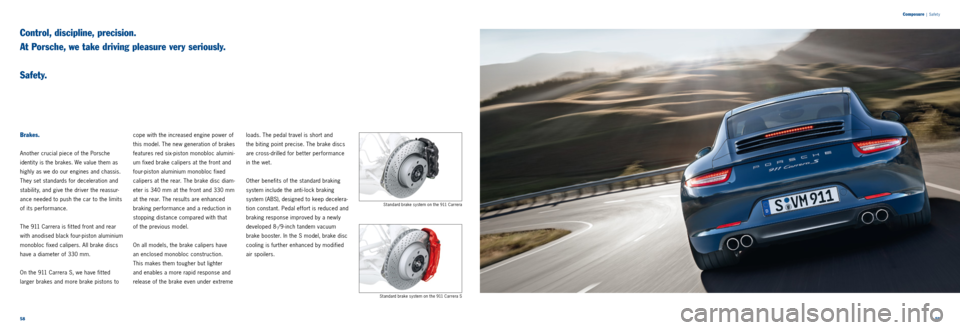
5859
Composure
| Safet y
Control, discipline, precision.
At Porsche, we take driving pleasure very seriously.
S a f e t y.
Brakes.
Another crucial piece of the Porsche
identit y is the brakes. We value them as
highly as we do our engines and chassis.
They set standards for deceleration and
stabilit y, and give the driver the reassur -
ance needed to push the car to the limits
of its performance.
The 911 Carrera is fit ted front and rear
with anodised black four-piston aluminium
monobloc fixed calipers. All brake discs
have a diameter of 330 mm.
On the 911 Carrera S, we have fit ted
larger brakes and more brake pistons to cope with the increased engine power of
this model. The new generation of brakes
features red six-piston monobloc alumini
-
um fixed brake calipers at the front and
four-piston aluminium monobloc fixed
calipers at the rear. The brake disc diam -
eter is 340 mm at the front and 330 mm
at the rear. The results are enhanced
braking performance and a reduction in
stopping distance compared with that
of the previous model.
On all models, the brake calipers have
an enclosed monobloc construction.
This makes them tougher but lighter
and enables a more rapid response and
release of the brake even under extreme loads. The pedal travel is short and
the biting point precise. The brake discs
are cross-drilled for better performance
in the wet.
Other benefits of the standard braking
system include the anti-lock braking
system (ABS), designed to keep decelera -
tion constant. Pedal effort is reduced and
braking response improved by a newly
developed 8-/9-inch tandem vacuum
brake booster. In the S model, brake disc
cooling is further enhanced by modified
air spoilers.
Standard brake system on the 911 Carrera
Standard brake system on the 911 Carrera S