cooling PORSCHE 911 CARRERA 2011 6.G Information Manual
[x] Cancel search | Manufacturer: PORSCHE, Model Year: 2011, Model line: 911 CARRERA, Model: PORSCHE 911 CARRERA 2011 6.GPages: 72, PDF Size: 13.67 MB
Page 14 of 72
3031
Switchbacks, hairpins, zigzags, S-bends...
There are countless reasons for having intelligent all-wheel drive.
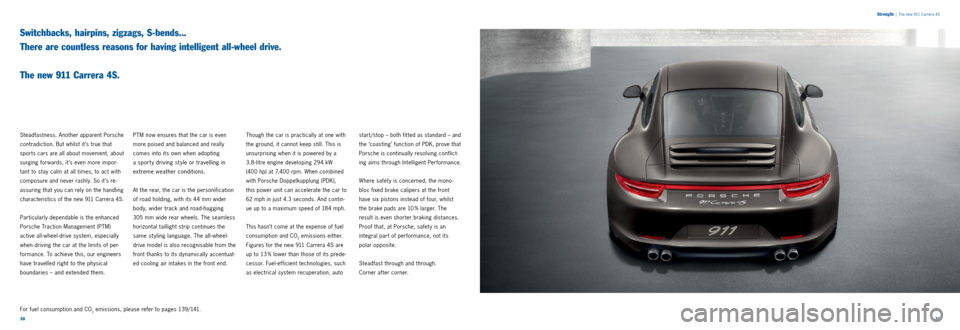
The new 911 Carrera 4S.
Steadfastness. Another apparent Porsche
contradiction. But whilst it ’s true that
sports cars are all about movement, about
surging forwards, it ’s even more impor
tant to stay calm at all times, to act with
composure and never rashly. So it ’s re
assuring that you can rely on the handling
characteristics of the new 911 Carrera 4S.
Particularly dependable is the enhanced
Porsche Traction Management (PTM)
active allwheeldrive system, especially
when driving the car at the limits of per
formance. To achieve this, our engineers
have travelled right to the physical
boundaries – and extended them.
PTM now ensures that the car is even
more poised and balanced and really
comes into its own when adopting
a sport y driving st yle or travelling in
extreme weather conditions.
At the rear, the car is the personification
of road holding, with its 44 mm wider
body, wider track and roadhugging
305 mm wide rear wheels. The seamless
horizontal taillight strip continues the
same st yling language. The allwheel
drive model is also recognisable from the
front thanks to its dynamically accentuat
ed cooling air intakes in the front end. Though the car is practically at one with
the ground, it cannot keep still. This is
unsurprising when it is powered by a
3.8litre engine developing 294 kW
(400 hp) at 7,400 rpm. When combined
with Porsche Doppelkupplung (PDK),
this power unit can accelerate the car to
62 mph in just 4.3 seconds. And contin
ue up to a maximum speed of 184 mph.
This hasn’t come at the expense of fuel
consumption and CO
2 emissions either.
Figures for the new 911 Carrera 4S are
up to 13 % lower than those of its prede
cessor. Fuelefficient technologies, such
as electrical system recuperation, auto
start /stop – both fit ted as standard – and
the ‘coasting’ function of PDK, prove that
Porsche is continually resolving conflict
ing aims through Intelligent Performance.
Where safety is concerned, the mono
bloc fixed brake calipers at the front
have six pistons instead of four, whilst
the brake pads are 10 % larger. The
result is even shorter braking distances.
Proof that, at Porsche, safet y is an
integral part of performance, not its
polar opposite.
Steadfast through and through.
Corner after corner.
For fuel consumption and CO
2 emissions, please refer to pages 139/141.
Strength | The new 911 Carrera 4S
Page 21 of 72
4445
DFI delivers fuel directly into the combustion
chamber with millisecond precision. The
spray and cone angles of the multihole
injectors have been optimised for torque,
power output, fuel consumption, emissions
and ef ficient combustion.
With direct injection, the engine manage
ment system regulates injection timing
individually for each cylinder as well as
the injection rate for each cylinder bank.
This improves the combustion process
and fuel economy. operation to the prevailing conditions.
This results in instant acceleration,
extremely smooth running and an
extraordinary level of tractive power,
but with a comparatively low level of
fuel consumption.
For faster heating of the catalytic converters
after a cold start and optimum torque in
the upper load range, up to three injection
pulses take place per combustion cycle.
DFI improves the internal cooling of
the combustion chamber by having the
mixture prepared directly in the cylinder.
This allows for a higher compression
ratio, which helps to deliver more output
at the same time as enhanced engine
efficiency. Injection is regulated by the
electronic engine management system
and emissions are monitored by the
Lambda sensors.
Temperament | Engines
VarioCam Plus System.
VarioCam Plus is a two in one engine
concept for adjusting the intake
camshafts and switching the lift of the
intake valves.
The system first dif ferentiates bet ween
driver inputs that typify normal,
everyday driving and those inputs
that demand maximum performance.
The electronic engine management
system then seamlessly adapts valve
What lies between your home and Le Mans?
Advanced engineering as standard.
Direct fuel injection (DFI).
For fuel consumption and CO2 emissions, please refer to pages 139/141.
Page 22 of 72
4647
Temperament
|
Engines
Integrated dry-sump lubrication.
Integrated dr y sump lubrication ensures
a reliable supply of oil even when a
sport y driving st yle is adopted. It also
has additional cooling functions.
The oil tank is located in the engine,
thereby eliminating the need for an
external oil tank, which saves both space
and weight. To reduce power loss and
increase efficiency, an electronically
controlled oil pump supplies the lubricat
ing points inside the engine as and
when required. When demand is low, the
oil pump is operated at reduced power,
thereby saving fuel.
Air intake system.
The resonance intake system increases
the intake volume by exploiting the fact
that air oscillates as it passes through
the intake manifold. The system can
adjust to engine speed. Benefits of this
include higher torque at low engine
speeds and a flat ter torque curve.
The
9 11 Carrera S models operate a t wo
stage
system.
The entire intake system is made from
light weight plastic. In the 9 11 Carrera
model range, the resonator volume of
the air filter housing varies with engine
speed to bring added character to the
engine sound, which becomes much
more powerful at higher rpm.
Exhaust system.
The exhaust system of the 911 Carrera
models has been redesigned, acoustics
included.
The stainless steel exhaust system com
prises t wo distinctive and independent
exhaust tracts. The cataly tic converters
heat up rapidly for effective emissions
reduction.
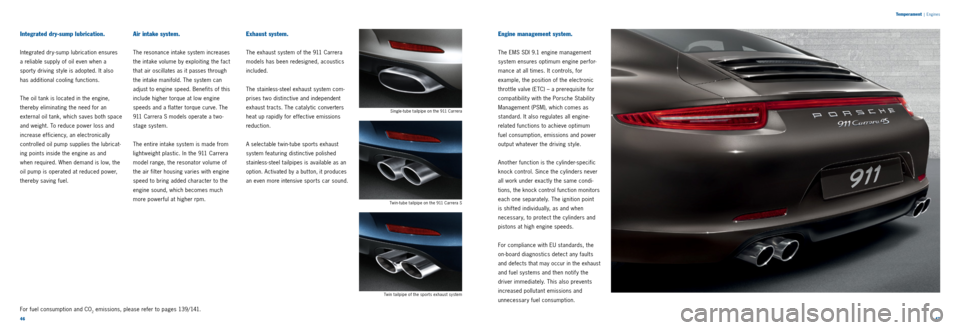
A selectable t win tube sports exhaust
system featuring distinctive polished
stainless steel tailpipes is available as an
option. Activated by a but ton, it produces
an even more intensive sports car sound.
Engine management system.
The EMS SDI 9.1 engine management
system ensures optimum engine perfor
mance at all times. It controls, for
example, the position of the electronic
throt tle valve (ETC) – a prerequisite for
compati bility with the Porsche Stability
Management (PSM), which comes as
standard. It also regulates all engine
related functions to achieve optimum
fuel consumption, emissions and power
output whatever the driving st yle.
Another function is the cylinder specific
knock control. Since the cylinders never
all work under exactly the same condi
tions, the knock control function monitors
each one separately. The ignition point
is shifted individually, as and when
necessary, to protect the cylinders and
pistons at high engine speeds.
For compliance with EU standards, the
on board diagnostics detect any faults
and defects that may occur in the exhaust
and fuel systems and then notify the
driver immediately. This also prevents
increased pollutant emissions and
unnecessary fuel consumption.
Twin tailpipe of the sports exhaust system Single
tube tailpipe on the 911 Carrera
Twin tube tailpipe on the 911 Carrera S
For fuel consumption and CO2 emissions, please refer to pages 139/141.
Page 37 of 72
7677
Composure
| Safet y
Control, discipline, precision.
At Porsche, we take driving pleasure very seriously.
S a f e t y.
Brakes.
Another crucial piece of the Porsche
identit y is the brakes. We value them as
highly as we do our engines and chassis.
They set standards for deceleration and
stabilit y, and give the driver the reassur
ance needed to push the car to the limits
of its performance.
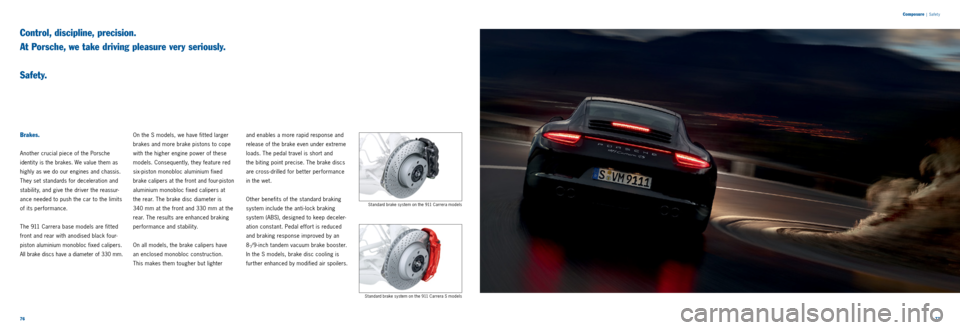
The 911 Carrera base models are fit ted
front and rear with anodised black four
piston aluminium monobloc fixed calipers.
All brake discs have a diameter of 330 mm.
On the S models, we have fit ted larger
brakes and more brake pistons to cope
with the higher engine power of these
models. Consequently, they feature red
sixpiston monobloc aluminium fixed
brake calipers at the front and four piston
aluminium monobloc fixed calipers at
the rear. The brake disc diameter is
340 mm at the front and 330 mm at the
rear. The results are enhanced braking
performance and stability.
On all models, the brake calipers have
an enclosed monobloc construction.
This makes them tougher but lighter and enables a more rapid response and
release of the brake even under extreme
loads. The pedal travel is short and
the biting point precise. The brake discs
are cross drilled for better performance
in the wet.
Other benefits of the standard braking
system include the anti lock braking
system (ABS), designed to keep deceler
ation constant. Pedal effort is reduced
and braking response improved by an
8 /9 inch tandem vacuum brake booster.
In the S models, brake disc cooling is
further enhanced by modified air spoilers.
Standard brake system on the 911 Carrera models
Standard brake system on the 911 Carrera S models