ignition PORSCHE 911 GT3 2010 5.G Repair Manual
[x] Cancel search | Manufacturer: PORSCHE, Model Year: 2010, Model line: 911 GT3, Model: PORSCHE 911 GT3 2010 5.GPages: 251, PDF Size: 14.33 MB
Page 160 of 251

Maintenance, Car Care
159
Engine-compartment blower, radiator fan The radiator and radiator fan are in the front of the
car.
The engine-compartment blower is mounted on
the engine compartment lid.
Warning!
Risk of injury.
After the engine is switched off, the engine-
compartment temperature is monitored for
approx. 30 minutes.
During this period, and depending on tempe-
rature, the engine-compartment blower may
continue to run or start to run.
fCarry out work in these areas only with the
engine off, the ignition off, and exercise
extreme caution.
Risk of injury. The radiator fan in the front
end of the car may be operating or unexpec-
tedly start operating when the engine is
switched on.
fCarry out work in these areas only with the engine switched off.
Engine Oil It is important to perform oil changes regularly in
accordance with the intervals specified in the
“Maintenance” booklet.Engine oil consumption It is normal for your engine to consume oil.
The rate of oil consumption depends on the quality
and viscosity of oil, the speed at which the engine
is operated, the climate, road conditions as well
as the amount of dilution and oxidation of the
lubricant.
If the vehicle is used for repeated short trips, and
consumes a normal amount of oil, the engine oil
measurement may not show any drop in the oil
level at all, even after 600 miles (1,000 km) or
more. This is because the oil is gradually
becoming diluted with fuel or moisture, making it
appear that the oil level has not changed.
The diluting ingredients evaporate out when the
vehicle is driven at high speeds, as on an
expressway, making it then appear that oil is
excessively consumed after driving at high
speeds.
If the conditions you drive your vehicle in are
dusty, humid, or hot, the frequency of the oil
change intervals should be greater. If the vehicle is driven at a high rate of speed,
climatic conditions are warm, and the load is high,
the oil should be checked more frequently, as
driving conditions will determine the rate of oil
consumption.
– The engine in your vehicle depends on oil to
lubricate and cool all of its moving parts.
Therefore, the engine oil should be checked
regularly and kept at the required level.
– Make it a habit to have the engine oil level
checked at every refueling.
– The oil pressure warning light is not an oil level
indicator.
The oil pressure warning light indicates serious
engine damage may be occuring when lit, if
engine rpm is above idle speed.
10_GT3_21.book Seite 159 Donnerstag, 4. Juni 2009 12:48 12
Page 167 of 251
166
Maintenance, Car Care
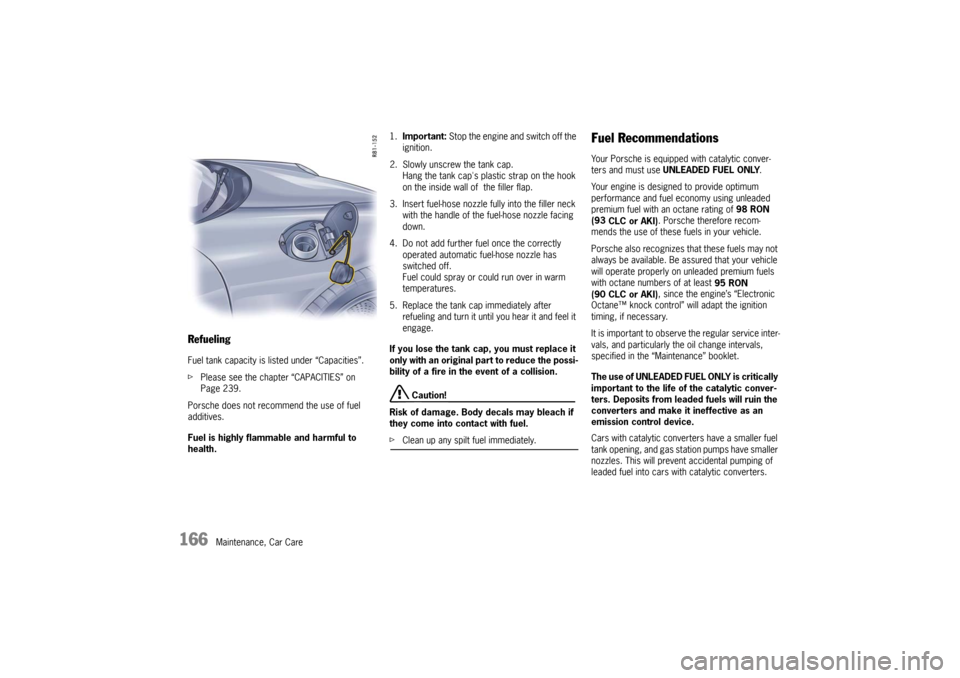
Refueling Fuel tank capacity is listed under “Capacities”.
fPlease see the chapter “CAPACITIES” on
Page 239.
Porsche does not recommend the use of fuel
additives.
Fuel is highly flammable and harmful to
health.1.Important: Stop the engine and switch off the
ignition.
2. Slowly unscrew the tank cap.
Hang the tank cap's plastic strap on the hook
on the inside wall of the filler flap.
3. Insert fuel-hose nozzle fully into the filler neck
with the handle of the fuel-hose nozzle facing
down.
4. Do not add further fuel once the correctly
operated automatic fuel-hose nozzle has
switched off.
Fuel could spray or could run over in warm
temperatures.
5. Replace the tank cap immediately after
refueling and turn it until you hear it and feel it
engage.
If you lose the tank cap, you must replace it
only with an original part to reduce the possi-
bility of a fire in the event of a collision.
Caution!
Risk of damage. Body decals may bleach if
they come into contact with fuel.
fClean up any spilt fuel immediately.
Fuel Recommendations Your Porsche is equipped with catalytic conver-
ters and must use UNLEADED FUEL ONLY.
Your engine is designed to provide optimum
performance and fuel economy using unleaded
premium fuel with an octane rating of 98 RON
(93
CLC or AKI). Porsche therefore recom-
mends the use of these fuels in your vehicle.
Porsche also recognizes that these fuels may not
always be available. Be assured that your vehicle
will operate properly on unleaded premium fuels
with octane numbers of at least
95 RON
(90 CLC or AKI), since the engine’s “Electronic
Octane™ knock control” will adapt the ignition
timing, if necessary.
It is important to observe the regular service inter-
vals, and particularly the oil change intervals,
specified in the “Maintenance” booklet.
The use of UNLEADED FUEL ONLY is critically
important to the life of the catalytic conver-
ters. Deposits from leaded fuels will ruin the
converters and make it ineffective as an
emission control device.
Cars with catalytic converters have a smaller fuel
tank opening, and gas station pumps have smaller
nozzles. This will prevent accidental pumping of
leaded fuel into cars with catalytic converters.
10_GT3_21.book Seite 166 Donnerstag, 4. Juni 2009 12:48 12
Page 169 of 251

168
Maintenance, Car Care
Emission Control SystemIn the interest of clean air Pollution of our environment has become a
problem that is of increasing concern to all of us.
We urge you to join us in our efforts for cleaner air
in controlling the pollutants emitted from the
automobile.
Porsche has developed an emission control
system that controls or reduces those parts of the
emission that can be harmful to our environment.
Your Porsche is equipped with such a system.
Porsche warrants the Emission Control System in
your new car under the terms and conditions set
forth in the Warranty Booklet.
You, as the owner of the vehicle, have the
responsibility to provide regular maintenance
service for the vehicle and to keep a record of all
maintenance work performed. To facilitate record
keeping, have the service performed by autho-
rized Porsche dealers. They have Porsche trained
technicians and special tools to provide fast and
efficient service. To assure efficient operation of the Emission
Control System:
fHave your vehicle maintained properly and in
accordance with the recommendations
described in your Maintenance Booklet.
Lack of proper maintenance, as well as
improper use of the vehicle, will impair the
function of the emission control system and
could lead to damage.
fDo not alter or remove any component of the
emission control system.
fDo not alter or remove any device, such as
heat shields, switches, ignition wires, valves,
etc., which are designed to protect your
vehicle’s emission control system.
In addition to serious engine damage, this can
result in a fire if excess raw fuel reaches the
exhaust system.
fDo not continue to operate your vehicle if you
detect engine misfire or other unusual opera-
ting conditions.
Parking
Warning!
Danger of fire resulting in serious personal
injury or death.
fDo not park or operate the vehicle in areas
where the hot exhaust system may come in
contact with dry grass, brush, fuel spill or
other flammable material.
fIf your car catches on fire for any reason, call
the fire department.
Do not endanger your life by attempting to put out the fire.
Undercoating
Danger!
Danger of fire resulting in serious personal
injury or death.
fDo not apply additional undercoating or rust-
proofing on or near the exhaust manifold,
exhaust pipes, catalytic converters or heat
shields. During driving the substance used for undercoating could overheat and ignite.
10_GT3_21.book Seite 168 Donnerstag, 4. Juni 2009 12:48 12
Page 170 of 251

Maintenance, Car Care
169
How Emission Control Works When an automobile engine is running, it uses
energy generated through the combustion of a
mixture of air and fuel. Depending on whether a
car is driven fast or slowly or whether the engine
is cold or hot, some of the fuel (hydrocarbons)
may not be burned completely, but may be
discharged into the engine crankcase or exhaust
system. Additonal hydrocarbons may enter the
atmosphere through evaporation of fuel from the
fuel tank. These hydrocarbons (HC), when
released into the air, contribute to undesirable
pollution.
In addition, carbon monoxide (CO) and oxides of
nitrogen (NOx) contribute to engine emissions.
They, too, are formed during the combustion
process and discharged into the exhaust system.
To reduce these pollutants, your Porsche is
equipped with a precisely calibrated fuel injection
system to assure a finely balanced air/fuel mixture
under all operating conditions.
Oxygen sensor The oxygen sensor, installed in the exhaust pipe
continuously senses the oxygen content of the
exhaust and signals the information to an
electronic control unit. The control unit corrects
the air/fuel ratio, so the engine always receives an
accurately metered air/fuel mixture. Crankcase ventilation Through crankcase ventilation, undesirable
emissions from the engine crankcase are not
permitted to reach the outside atmosphere. These
emissions are recirculated from the crankcase to
the air intake system. From here the emissions
mix with the intake air and are later burned in the
engine. Catalytic converters The catalytic converters are efficient “clean-up”
devices built into the exhaust system of the
vehicle. The catalytic converters burn the undesi-
rable pollutants in the exhaust gas before it is
released into the atmosphere.
The exclusive use of unleaded fuel is criti-
cally important for the life of the catalytic
converters. Therefore, only unleaded fuel
must be used.The catalytic converters will be damaged by:
– push or tow starting the vehicle
– misfiring of the engine
– turning off the ignition while the vehicle is
moving or
– driving until the fuel tank is completely empty
– by other unusual operating conditions.
fDo not continue to operate your vehicle under
these conditions, since raw fuel might reach
the catalytic converters. This could result in
overheating of the converters. Federal law
prohibits use of leaded fuel in this car.
10_GT3_21.book Seite 169 Donnerstag, 4. Juni 2009 12:48 12
Page 184 of 251

Practical Tips, Emergency Service
183
Exercise Extreme Caution when
Working on your Vehicle
Danger!
Ignoring the following instructions may
cause serious personal injury or death.
fThe engine compartment of any motor vehicle
is a potentially hazardous area. If you are not
fully familiar with proper repair procedures, do
not attempt the adjustments described on the
following pages.
This caution also applies to the entire vehicle.
fO n l y w o r k o n y o u r v e h i c l e o u t d o o r s o r i n a w e l l
ventilated area.
fEnsure that there are no open flames in the
area of your vehicle at any time when fuel
fumes might be present. Be especially
cautious of such devices such as hot water
heaters which ignite a flame intermittently.
fBefore working on any part in the engine
compartment, turn the engine off and let it cool
down sufficiently. Hot engine compartment
components can burn skin on contact.
fBe alert and cautious around engine at all
times while the engine is running.
If work has to be performed with the engine
running, always set the parking brake, and
make sure the shift lever is in neutral position.fIn particular, be very careful to ensure that
items of clothing (ties, shirt, sleeves etc.),
jewelry, long hair, hand or fingers cannot get
caught in the engine-compartment blower, fan,
belts or other moving parts.
The radiator and radiator fan are in the front of
the car.
The engine-compartment blower is mounted
on the engine-compartment lid.
The engine-compartment blower can start or
continue running as a function of temperature,
even with the engine switched off.
Carry out work in these areas only with the
engine off, the ignition switched off, and
exercise extreme caution.
fYour Porsche is equipped with an electronic
ignition system. When the ignition is on, high
voltage is present in all wires connected with
the ignition system; therefore, exercise
extreme caution when working on any part of
the engine while the ignition is on or the engine
is running.
fAlways support your car with safety stands if it
is necessary to work under the car.
Jacks are not suitable for this kind of work.
fWhen working under the car without safety
stands but with the wheels on the ground,
make sure the car is on level ground, the
wheels are blocked, and that the engine
cannot be started.
Remove the ignition key.fDo not smoke or allow an open flame around
the battery or fuel.
Keep a fire extinguisher in close reach.
fIncomplete or improper servicing may cause
problems in the operation o f t h e c a r. I f i n d o u b t
about any servicing, have it done by your
authorized Porsche dealer.
Improper maintenance during the warranty
period may affect your Porsche warranty
coverage.
fSupplies of fluids, e.g. engine oil, brake fluid or
coolant, are hazardous to your health.
Keep these fluids out of children’s reach and
dispose of them in accordance with the appro-
priate regulations.
fSome countries require additional tools and
special spare parts to be carried.
Please make enquiries before driving abroad.
10_GT3_21.book Seite 183 Donnerstag, 4. Juni 2009 12:48 12
Page 199 of 251
198
Practical Tips, Emergency Service
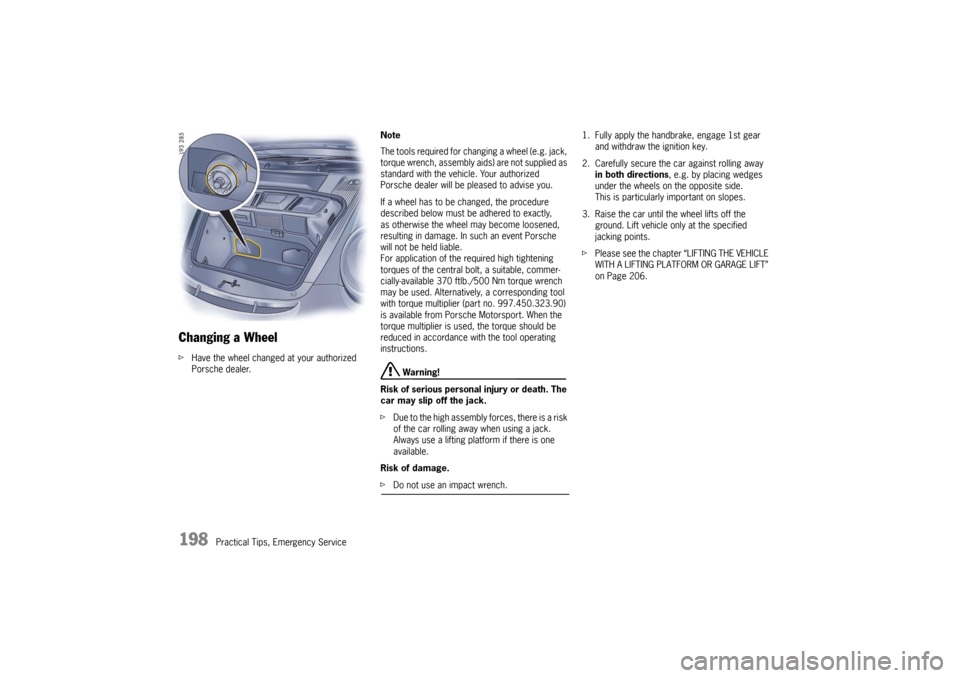
Changing a WheelfHave the wheel changed at your authorized
Porsche dealer.Note
The tools required for changing a wheel (e.g. jack,
torque wrench, assembly aids) are not supplied as
standard with the vehicle. Your authorized
Porsche dealer will be pleased to advise you.
If a wheel has to be changed, the procedure
described below must be adhered to exactly,
as otherwise the wheel may become loosened,
resulting in damage. In such an event Porsche
will not be held liable.
For application of the required high tightening
torques of the central bolt, a suitable, commer-
cially-available 370 ftlb./500 Nm torque wrench
may be used. Alternatively, a corresponding tool
with torque multiplier (part no. 997.450.323.90)
is available from Porsche Motorsport. When the
torque multiplier is used, the torque should be
reduced in accordance with the tool operating
instructions.
Warning!
Risk of serious personal injury or death. The
car may slip off the jack.
fDue to the high assembly forces, there is a risk
of the car rolling away when using a jack.
Always use a lifting platform if there is one
available.
Risk of damage.
fDo not use an impact wrench.1. Fully apply the handbrake, engage 1st gear
and withdraw the ignition key.
2. Carefully secure the car against rolling away
in both directions, e.g. by placing wedges
under the wheels on the opposite side.
This is particularly important on slopes.
3. Raise the car until the wheel lifts off the
ground. Lift vehicle only at the specified
jacking points.
fPlease see the chapter “LIFTING THE VEHICLE
WITH A LIFTING PLATFORM OR GARAGE LIFT”
on Page 206.
10_GT3_21.book Seite 198 Donnerstag, 4. Juni 2009 12:48 12
Page 208 of 251
Practical Tips, Emergency Service
207
Electrical System In order to avoid damage and faults in electrical or
electronic systems, electrical accessories should
be installed at your authorized Porsche dealer.
fOnly use accessories authorized by Porsche.
Warning!
Risk of short circuit and fire, resulting in
serious personal injury or death.
Replacing fuses or relays with the engine
running or the ignition on could cause
electrical shock.
fDisconnect the negative terminal on the
battery during all work on the electrical
system.
Please see the chapter “BATTERY” on Page 211.
RelaysDefective relays should be changed only by an
authorized workshop.
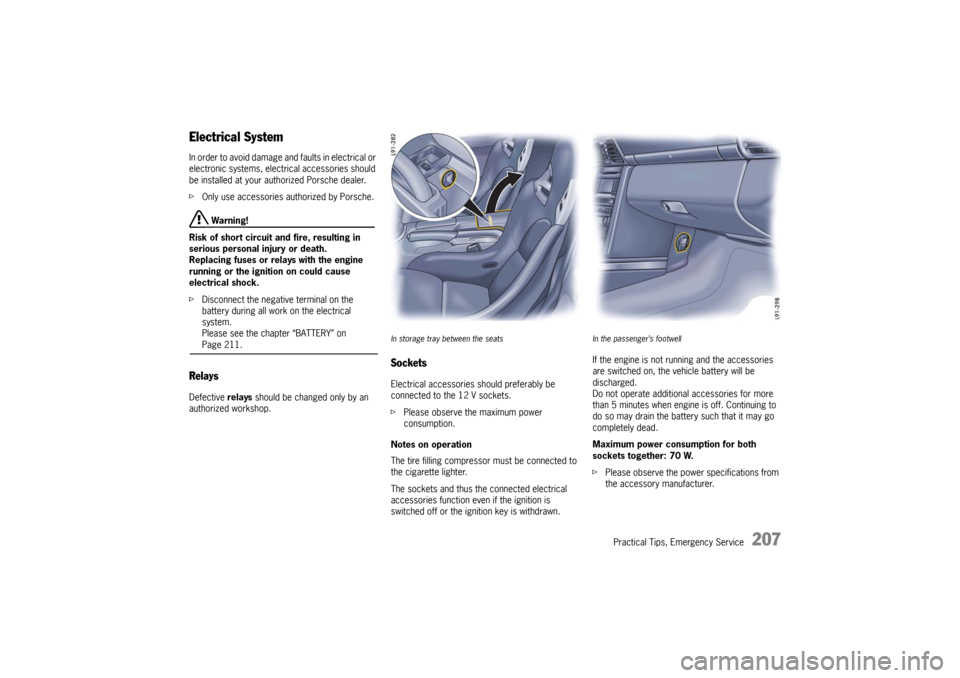
In storage tray between the seatsSocketsElectrical accessories should preferably be
connected to the 12 V sockets.
fPlease observe the maximum power
consumption.
Notes on operation
The tire filling compressor must be connected to
the cigarette lighter.
The sockets and thus the connected electrical
accessories function even if the ignition is
switched off or the ignition key is withdrawn.
In the passenger’s footwellIf the engine is not running and the accessories
are switched on, the vehicle battery will be
discharged.
Do not operate additional accessories for more
than 5 minutes when engine is off. Continuing to
do so may drain the battery such that it may go
completely dead.
Maximum power consumption for both
sockets together: 70 W.
fPlease observe the power specifications from
the accessory manufacturer.
10_GT3_21.book Seite 207 Donnerstag, 4. Juni 2009 12:48 12
Page 209 of 251

208
Practical Tips, Emergency Service
Alarm system, central lockingThe status of the central locking and alarm system
is not changed by disconnecting the battery.
When the battery is disconnected, the alarm
system ceases to function.Central locking overload protectionIf the central locking system is operated more
than ten times within a minute, further operation is
blocked for 30 seconds.
Load switch-off after 2 hours or 7 daysIf the ignition key is removed, loads which are
switched on or are in standby mode (such as the
luggage compartment light, interior light and
radio) are automatically switched off after approx.
2hours.
If the vehicle is not started or unlocked with the
remote control within 7days, the remote control
standby function is switched off (to save the
vehicle battery).
1. In this case, unlock the driver’s door with the
key at the door lock.
Leave the door closed in order to prevent the
alarm system from being triggered.
2. Press button 1 on the remote control.
The remote control is now activated again.
10_GT3_21.book Seite 208 Donnerstag, 4. Juni 2009 12:48 12
Page 212 of 251

Practical Tips, Emergency Service
211
Battery fPlease see the chapter “EMERGENCY OPERA-
TION – PULLING OUT THE IGNITION KEY” on
Page 69.
fPlease see the chapter “EMERGENCY
UNLOCKING OF THE LUGGAGE COMPART-
MENT LID” on Page 210.
Warning!
Risk of short circuit and fire, resulting in
serious personal injury or death.
fObserve all warning notes on the battery.
fDisconnect the negative terminal on the
battery during all work on the electrical
system.
fDo not lay tools or other metal objects on the
battery as they could cause a short circuit
across the battery terminal.
Hydrogen gas generated by the battery
could cause an explosion, resulting in
serious personal injury or death.
fDo not expose the battery to an open flame,
electrical spark or a lit cigarette.
fDo not wipe battery with a dry cloth.
Risk of serious personal injury or death and
damage to the fabric, metal or paint.
fWear eye protection. fDo not allow battery acid to come in contact
with your skin, eyes, fabric or painted
surfaces.
fIf you get electrolyte, which is an acid, in your
eyes or on your skin, immediately rinse with
cold water for several minutes and call a
doctor.
fSpilled electrolyte must be rinsed off at once
with a solution of baking soda and water to
neutralize the acid.
Battery posts, terminals and related acces-
sories contain lead and lead compounds,
chemicals known to the State of California to
cause cancer and reproductive harm.
fAlways protect your skin by washing
thoroughly with soap and water.
Risk of explosion as a result of static charge,
resulting in serious personal injury or death.
fDo not wipe the battery with a dry cloth.
fEliminate potential electrostatic charge by
touching the vehicle before touching the
battery.
Charge state A well charged battery will not only prevent
starting problems but will also last longer.
In order to avoid discharging the battery
unintentionally:
fSwitch off unnecessary electrical loads in city
traffic, on short trips or in a line or traffic.
fAlways remove the ignition key from the
ignition switch when leaving the car.
fAvoid frequent operation of the convertible top
and operation of the Porsche Communication
Management system when the engine is not
running.
In the cold season in particular or if the vehicle is
used primarily for short trips, it may be necessary
to recharge the battery from time to time.
Porsche recommends the use of a charger, partic-
ularly during extended immobilization periods.
Please see your authorized Porsche dealer
for relevant information.
10_GT3_21.book Seite 211 Donnerstag, 4. Juni 2009 12:48 12
Page 218 of 251

Practical Tips, Emergency Service
217
Emergency Starting with Jumper
Cables If the battery is discharged, e.g. in winter or after
the car has been parked for a long time, the
battery of another car can be used for starting
with the help of jumper cables.
Make sure the voltage of both batteries is the
same. Both batteries must be 12 volt types.
The capacity (Ampere hours, Ah) of the booster
battery must not be substantially less than that of
the discharged battery.
The discharged battery must be correctly
connected to the vehicle’s electrical system.
fPlease see the chapter “BATTERY” on
Page 211.
fPlease see the chapter “EMERGENCY
UNLOCKING OF THE LUGGAGE COMPART-
MENT LID” on Page 210.
Note
fDo not try to start the car by pushing or
towing. Damage to the catalytic converters
and other components of the car may result.
Warning!
Risk of short circuit, damage and explosion,
resulting in serious personal injury or death.
fUse only jumper cables of adequate diameter
cross-section and fitted with completely
insulated alligator clips.
fFollow all warnings and instructions of the
jumper cable manufacturer.
fWhen connecting jumper cables, make sure
that they cannot get caught in any moving
parts in the engine compartment.
The jumper cables must be long enough so
that neither vehicles nor cables touch another.
fThe vehicles must not be in contact, otherwise
current might flow as soon as the positive
terminals are connected.
fThe cable clamps must not be allowed to
contact each other when one end of the
jumper cables are connected to a battery.
fEnsure that tools or conductive jewelery (rings,
chains, watch straps) do not come into contact
with the positive jumper cable or the positive
battery post.
fImproper hook-up of jumper cables can ruin
the alternator. Danger of caustic burns.
fDo not lean over the battery.
Danger of gas explosion.
fImproper use of booster battery to start a
vehicle may cause an explosion, resulting in
serious personal injury or death.
fKeep sources of ignition away from the
battery, e.g. open flame, burning cigarettes or
sparking due to cable contact or welding work.
fA discharged battery can freeze even at 23 °F/
–5 °C.
Before connecting jumper cables, a frozen
battery must be thawed out.
10_GT3_21.book Seite 217 Donnerstag, 4. Juni 2009 12:48 12