light PORSCHE 911 GT3 2010 5.G Manual PDF
[x] Cancel search | Manufacturer: PORSCHE, Model Year: 2010, Model line: 911 GT3, Model: PORSCHE 911 GT3 2010 5.GPages: 251, PDF Size: 14.33 MB
Page 117 of 251
116
Instruments, On-Board Computer
Check Engine
(Emission Control)The emission control system detects malfunctions
early that could, for example, cause increased
pollutant emissions or consequential damage.
Faults are indicated by a continuously lit or
flashing instrument panel warning light.
The faults are recorded in the control unit's fault
memory.
The warning light in the instrument panel lights up
when the ignition is switched on as a bulb check
and goes out approx. 4 seconds after the engine
starts. If the warning light does not light up, have
the bulb replaced promptly.
The warning light in the instrument panel flashes to
indicate operating states (e.g. engine misfiring)
which might cause damage to certain parts of the
emission control system.
fIn this case, immediately reduce the engine
load by easing off the accelerator.
fIn order to avoid consequential damage to the
engine or emission control system (e.g.
catalytic converter), have the fault diagnosed
and rectified immediately at the nearest autho-
rized Porsche dealer.If the warning light in the instrument panel lights up
permanently without flashing before and remains
on while driving, it suggests:
– a potential engine control problem and the
need for system service or
– an improperly fastened tank cap or
– the vehicle was refueled while the engine was
running.
fStop immediately at a suitable and secure
place and check tank cap for proper fastening.
If tank cap was fastened correctly, see your
authorized Porsche dealer for service as soon
as possible.
Caution!
If the check engine warning light in the
instrument panel is flashing, serious
catalytic converter damage and power loss
will soon occur.
Prolonged driving with the check engine
warning light on could cause damage to the
emission control system. It also could affect
fuel economy and driveability.
fHave the fault remedied at the nearest authorized Porsche dealer immediately.The central warning light on the instrument panel
lights up if there are warning messages in the
INFO menu.
The messages can be called in the on-board
computer INFO menu:
fPlease see the chapter “INFO WARNING
MESSAGES” on Page 123.
The warning light on the instrument panel lights
up:
– if the handbrake is on,
– if the brake fluid level is low,
– if the brake pads have reached the wear limit,
– if the brake circuit division is defective.
Additionally, a warning is displayed by the on-
board computer.
fPlease see the chapter “WARNINGS ON THE
INSTRUMENT PANEL AND THE ON-BOARD
COMPUTER” on Page 148.
Warning Light
Central Warning Light
Brake Warning Light USA
Brake Warning Light Canada
10_GT3_21.book Seite 116 Donnerstag, 4. Juni 2009 12:48 12
Page 123 of 251
122
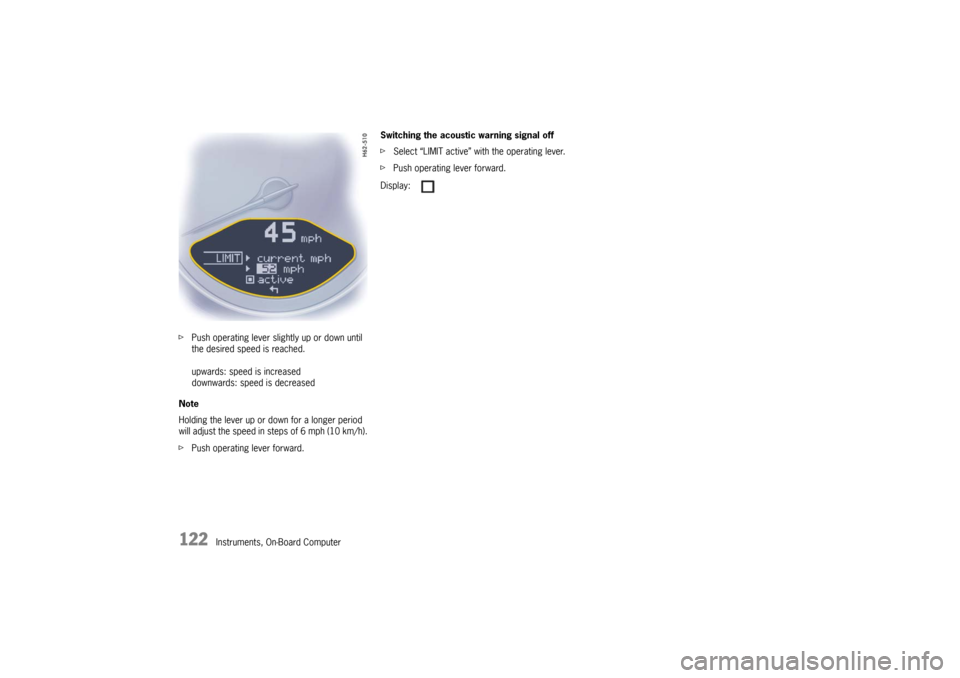
Instruments, On-Board Computer fPush operating lever slightly up or down until
the desired speed is reached.
upwards: speed is increased
downwards: speed is decreased
Note
Holding the lever up or down for a longer period
will adjust the speed in steps of 6 mph (10 km/h).
fPush operating lever forward.Switching the acoustic warning signal off
fSelect “LIMIT active” with the operating lever.
fPush operating lever forward.
Display:
10_GT3_21.book Seite 122 Donnerstag, 4. Juni 2009 12:48 12
Page 140 of 251
Instruments, On-Board Computer
139
Tire pressure warnings
The tire pressure warning light on the instrument
panel and a corresponding message on the on-
board computer warn about loss of pressure in
two stages, depending on the amount of pressure
loss.
Driving with insufficient tire pressure reduces the
road safety of the vehicle and destroys the tire and
wheel.
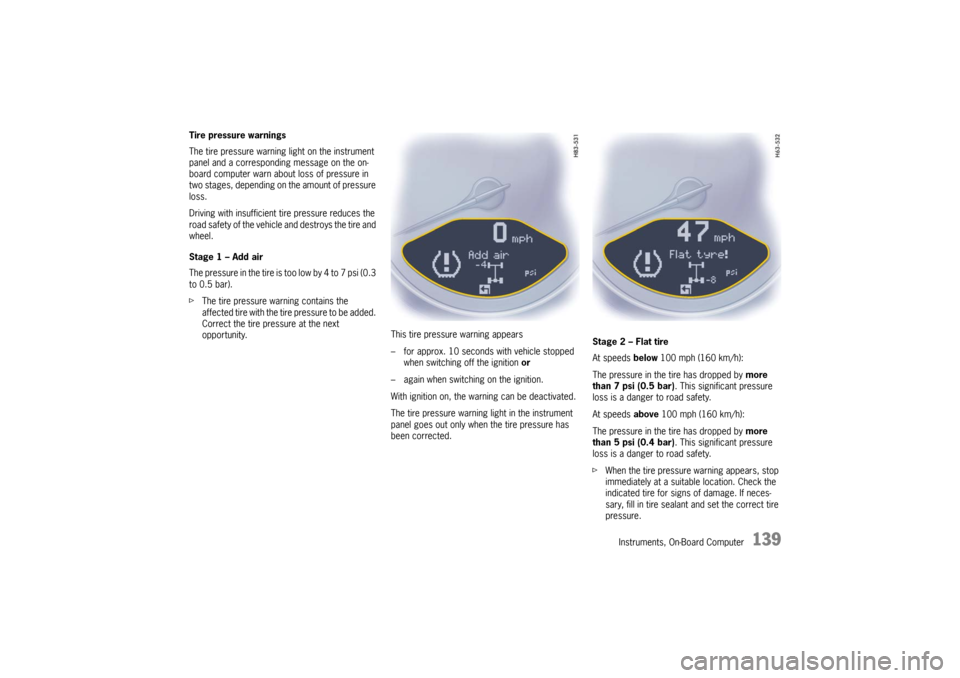
Stage 1 – Add air
The pressure in the tire is too low by 4 to 7 psi (0.3
to 0.5 bar).
fThe tire pressure warning contains the
affected tire with the tire pressure to be added.
Correct the tire pressure at the next
opportunity. This tire pressure warning appears
– for approx. 10 seconds with vehicle stopped
when switching off the ignition or
– again when switching on the ignition.
With ignition on, the warning can be deactivated.
The tire pressure warning light in the instrument
panel goes out only when the tire pressure has
been corrected.Stage 2 – Flat tire
At speeds below 100 mph (160 km/h):
The pressure in the tire has dropped by more
than 7 psi (0.5 bar). This significant pressure
loss is a danger to road safety.
At speeds above 100 mph (160 km/h):
The pressure in the tire has dropped by more
than 5 psi (0.4 bar). This significant pressure
loss is a danger to road safety.
fWhen the tire pressure warning appears, stop
immediately at a suitable location. Check the
indicated tire for signs of damage. If neces-
sary, fill in tire sealant and set the correct tire
pressure.
10_GT3_21.book Seite 139 Donnerstag, 4. Juni 2009 12:48 12
Page 141 of 251

140
Instruments, On-Board Computer This tire pressure warning also appears when
driving and can be acknowledged.
The tire pressure warning light on the instrument
panel goes out only when the tire pressure has
been corrected.
System learningThe Tire Pressure Monitoring begins to “learn” the
wheels after a wheel change, wheel transmitter
replacement or update of the tire settings. During
this process, the Tire Pressure Monitoring recog-
nizes the tires and their locations.
The on-board computer displayes the message
“TPM is learning, monitoring not act.”.
The Tire Pressure Monitoring requires a certain
amount of time to learn the wheels. During this
time, the current tire pressures are not available
on the on-board-computer:
– The tire pressure warning light remains lit until
all wheels have been learned.
– The display of the tire pressure function of the
on-board computer shows lines.
– The required pressures for cold tires at 68 °F
(20 °C) are indicated in the Info pressure
display in the tire pressure menu.
Position and pressure information is displayed as
soon as the Tire Pressure Monitoring has
assigned the wheels identified as belonging to the
vehicle to the correct wheel positions.The wheel learning process takes place
exclusively when the vehicle is being driven
(vehicle speed above 16 mph (25 km/h)).
fCheck the tire pressure for all wheels on the
“Info pressure” display.
fCorrect the tire pressure to the required
pressure if necessary.
Changing a wheel and replacing tiresfNew wheels must be fitted with radio transmit-
ters for the Tire Pressure Monitoring.
Before tires are changed, the battery charge
state of the wheel transmitters should be
checked at an authorized Porsche dealer.
fSwitch the ignition off when changing a wheel.
The tire settings on the on-board computer must
be updated after changing a wheel.
If the tire settings are not updated, the message
“Wheel change? Input new TPM settings!” is
displayed on the on-board computer.
fUpdate the on-board computer settings when
the vehicle is stationary the next time.
10_GT3_21.book Seite 140 Donnerstag, 4. Juni 2009 12:48 12
Page 142 of 251

Instruments, On-Board Computer
141
Warning!
Your vehicle has also been equipped with a Tire
Pressure Monitoring (TPM) malfunction indicator
when the system is not operating properly.
The TPM malfunction indicator is combined with a
low tire pressure telltale.
When the system detects a malfunction, the
telltale will flash for approx. one minute and then
remain continuously illuminated. This sequence
will continue upon subsequent vehicle start-ups as
long as the malfunction exists.
When the malfunction indicator is illuminated, the
system may not be able to detect or signal low tire
pressure as intended.
TPM malfuntions may occur for a variety of
reasons, including the installation of replacement
or alternate tires or wheels on the vehicle that
prevent the TPM from functioning properly.
Always check the TPM malfunction telltale after
replacing one or more tires or wheels on your
vehicle to ensure that the replacement or alter-
nate tires and wheels allow the TPM to continue to
function properly.The warning light in the speedometer lights up:
– When a loss in pressure has been detected.
– When learning newly mounted wheels/wheel
sensors, as long as the vehicle’s own wheels
have not yet been recognized.
In the event of a defect in Tire Pressure Monitoring
or a temporary fault, the warning light in the
speedometer flashes for approx. one minute and
then remains continuously illuminated.
The tire pressure warning light in the instrument
panel goes out only when the cause of the fault
has been rectified.
Partial monitoringMonitoring of the other wheels is continued if there
is a fault in one or two wheel transmitters.
– The tire pressure warning light lights up.
– The message “TPM partial monitoring” is
displayed on the on-board computer.
– No tire pressures are displayed on the on-
board computer for wheels with faulty wheel
transmitters.
No monitoringIn the event of faults the Tire Pressure Monitoring
cannot monitor the tire pressure.
The warning light on the instrument panel flashes
for approx. one minute and then remains conti-
nuously illuminated and a corresponding message
appears on the on-board computer.
Monitoring is not active when:
– the Tire Pressure Monitoring is faulty,
– wheel transmitters for the Tire Pressure
Monitoring are missing,
– during the learning phase after the tire settings
have been updated,
– after a wheel change without updating the tire
settings,
– more than four wheel transmitters are
detected,
– there is external interference by other radio
sources, e.g. wireless headphones,
– tire temperatures are too high.
fPlease see the chapter “WARNINGS ON THE
INSTRUMENT PANEL AND THE ON-BOARD
COMPUTER” on Page 148.
Warning light
10_GT3_21.book Seite 141 Donnerstag, 4. Juni 2009 12:48 12
Page 147 of 251
146
Instruments, On-Board Computer Display
(Select central line of the on-board
computer)
–Change display
Audio information (set radio station)
Range on remaining fuel
Empty
–Te l e p h o n e I n f o
When Telephone information is active,
incoming telephone calls are displayed on the
on-board computer.
Navigation
– Integrated in the BC
(Navigation instructions can be recalled on the
on-board computer display)
– When turning off
(Navigation instructions are only shown before
changing direction)
Basic setting
– Restore the basic setting of the on-board
computer
Language
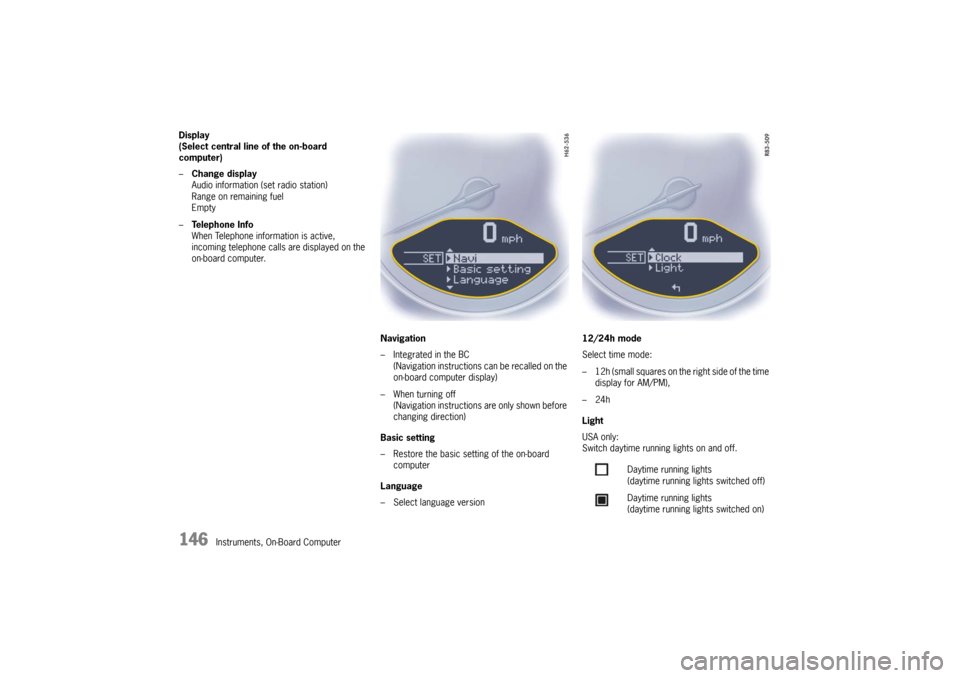
– Select language version12/24h mode
Select time mode:
– 12h (small squares on the right side of the time
display for AM/PM),
–24h
Light
USA only:
Switch daytime running lights on and off.
Daytime running lights
(daytime running lights switched off)
Daytime running lights
(daytime running lights switched on)
10_GT3_21.book Seite 146 Donnerstag, 4. Juni 2009 12:48 12
Page 150 of 251

Warnings
149
Lights on Low beam/side marker lamps on
Parking light on Left/right parking light on
Check left/right dipped beam (low
beam)
also applies to:
high beam, side indicator light,
reversing lightThe reported light is faulty. Check bulb.
Have the fault remedied at an authorized Porsche dealer.
Daytime
driving lights offDaytime running lights switch off when the engine is shut off. Switch on lights if necessary.
Dynamic
cornering light
failureDynamic cornering light faulty.
Have the fault remedied at an authorized Porsche dealer.
Headlight beam
adjustment faultyHave the fault remedied at an authorized Porsche dealer.
Front lid not closed Close luggage compartment lid properly.
Rear lid not closed Close engine compartment lid properly.
Rain sensor faulty Have the fault remedied at an authorized Porsche dealer.
Refill washer fluid
LIMIT
Cannot be accepted
with vehicle stoppedThe current speed can only be accepted for the acoustic warning signal when the vehicle is in motion.
LIMIT
30Selected speed limit (e.g. 30 mph) for the acoustic warning signal has been exceeded.
Adjust your speed if necessary.
Instrument
panelOn-board
computerText display on on-board
computerMeaning/measure
10_GT3_21.book Seite 149 Donnerstag, 4. Juni 2009 12:48 12
Page 151 of 251

150
Warnings
Fuel gauge warning
lightConsider remaining range Refuel at next opportunity.
Check engine oil level Start engine oil level measurement in the on-board computer.
Engine oil pressure too low Stop immediately at a suitable place, measure oil level with the on-board computer and, if necessary,
add engine oil.
Warning light
Temperature gaugeEngine temperature too high Switch engine off and let it cool.
Check coolant level and, if necessary, add coolant.
Temperature gauge
warning light flashesCheck coolant level Switch engine off and let it cool.
Check coolant level and, if necessary, add coolant.
Check engine
visit workshopStop immediately at a suitable place and check tank cap for proper fastening. If the tank cap was
fastened correctly, consult your authorized Porsche dealer.
Reduced engine power Consult your authorized Porsche dealer.
Temperature gauge
warning light flashesFailure of
engine compartment blowerConsult your authorized Porsche dealer.
Warning Battery/generator Stop at a safe place and switch the engine off. Do not continue driving.
Have the fault remedied at an authorized Porsche dealer.
Failure
oil pressure
indicatorHave the fault remedied at an authorized Porsche dealer.
Failure
oil level
indicatorHave the fault remedied at an authorized Porsche dealer.
Oil temperature
indicator faultyHave the fault remedied at an authorized Porsche dealer.Instrument
panelOn-board
computerText display on on-board
computerMeaning/measure
10_GT3_21.book Seite 150 Donnerstag, 4. Juni 2009 12:48 12
Page 156 of 251
Shifting Gears
155
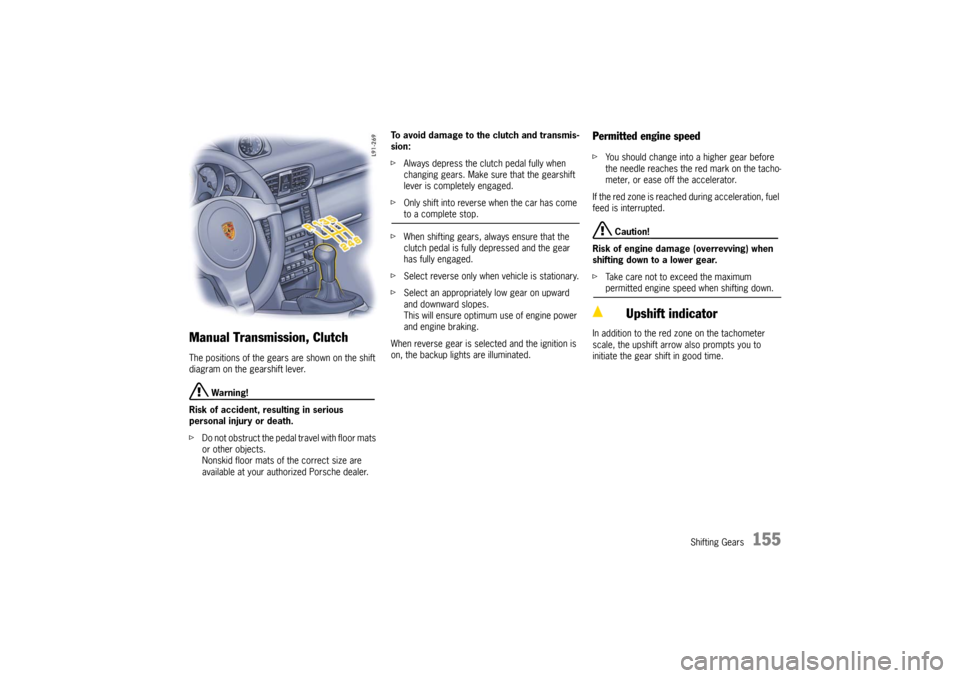
Manual Transmission, ClutchThe positions of the gears are shown on the shift
diagram on the gearshift lever.
Warning!
Risk of accident, resulting in serious
personal injury or death.
fDo not obstruct the pedal travel with floor mats
or other objects.
Nonskid floor mats of the correct size are
available at your authorized Porsche dealer.To avoid damage to the clutch and transmis-
sion:
fAlways depress the clutch pedal fully when
changing gears. Make sure that the gearshift
lever is completely engaged.
fOnly shift into reverse when the car has come
to a complete stop.
fWhen shifting gears, always ensure that the
clutch pedal is fully depressed and the gear
has fully engaged.
fSelect reverse only when vehicle is stationary.
fSelect an appropriately low gear on upward
and downward slopes.
This will ensure optimum use of engine power
and engine braking.
When reverse gear is selected and the ignition is
on, the backup lights are illuminated.
Permitted engine speedfYou should change into a higher gear before
the needle reaches the red mark on the tacho-
meter, or ease off the accelerator.
If the red zone is reached during acceleration, fuel
feed is interrupted.
Caution!
Risk of engine damage (overrevving) when
shifting down to a lower gear.
fTake care not to exceed the maximum permitted engine speed when shifting down.
In addition to the red zone on the tachometer
scale, the upshift arrow also prompts you to
initiate the gear shift in good time.
Upshift indicator
10_GT3_21.book Seite 155 Donnerstag, 4. Juni 2009 12:48 12
Page 160 of 251

Maintenance, Car Care
159
Engine-compartment blower, radiator fan The radiator and radiator fan are in the front of the
car.
The engine-compartment blower is mounted on
the engine compartment lid.
Warning!
Risk of injury.
After the engine is switched off, the engine-
compartment temperature is monitored for
approx. 30 minutes.
During this period, and depending on tempe-
rature, the engine-compartment blower may
continue to run or start to run.
fCarry out work in these areas only with the
engine off, the ignition off, and exercise
extreme caution.
Risk of injury. The radiator fan in the front
end of the car may be operating or unexpec-
tedly start operating when the engine is
switched on.
fCarry out work in these areas only with the engine switched off.
Engine Oil It is important to perform oil changes regularly in
accordance with the intervals specified in the
“Maintenance” booklet.Engine oil consumption It is normal for your engine to consume oil.
The rate of oil consumption depends on the quality
and viscosity of oil, the speed at which the engine
is operated, the climate, road conditions as well
as the amount of dilution and oxidation of the
lubricant.
If the vehicle is used for repeated short trips, and
consumes a normal amount of oil, the engine oil
measurement may not show any drop in the oil
level at all, even after 600 miles (1,000 km) or
more. This is because the oil is gradually
becoming diluted with fuel or moisture, making it
appear that the oil level has not changed.
The diluting ingredients evaporate out when the
vehicle is driven at high speeds, as on an
expressway, making it then appear that oil is
excessively consumed after driving at high
speeds.
If the conditions you drive your vehicle in are
dusty, humid, or hot, the frequency of the oil
change intervals should be greater. If the vehicle is driven at a high rate of speed,
climatic conditions are warm, and the load is high,
the oil should be checked more frequently, as
driving conditions will determine the rate of oil
consumption.
– The engine in your vehicle depends on oil to
lubricate and cool all of its moving parts.
Therefore, the engine oil should be checked
regularly and kept at the required level.
– Make it a habit to have the engine oil level
checked at every refueling.
– The oil pressure warning light is not an oil level
indicator.
The oil pressure warning light indicates serious
engine damage may be occuring when lit, if
engine rpm is above idle speed.
10_GT3_21.book Seite 159 Donnerstag, 4. Juni 2009 12:48 12