light PORSCHE 911 GT3 2010 5.G Manual Online
[x] Cancel search | Manufacturer: PORSCHE, Model Year: 2010, Model line: 911 GT3, Model: PORSCHE 911 GT3 2010 5.GPages: 251, PDF Size: 14.33 MB
Page 162 of 251
Maintenance, Car Care
161
Warning!
Risk of burning from hot parts in engine
compartment. Risk of injury by rotating
parts. The engine compartment blower on
the engine compartment lid can start up
even with engine off.
fExercise extrem caution when working in the
engine compartment.
fTop off engine oil only with the engine off.
Engine oil is hazardous to your health and
may be fatal if swallowed.
fKeep engine oil out of children’s reach.
Used engine oil contains chemicals that have
caused cancer in laboratory animals.
fAlways protect your skin by washing thoroughly with soap and water.
Note
The Check Engine warning light may light up if the
cap of the oil filler opening is opened while the
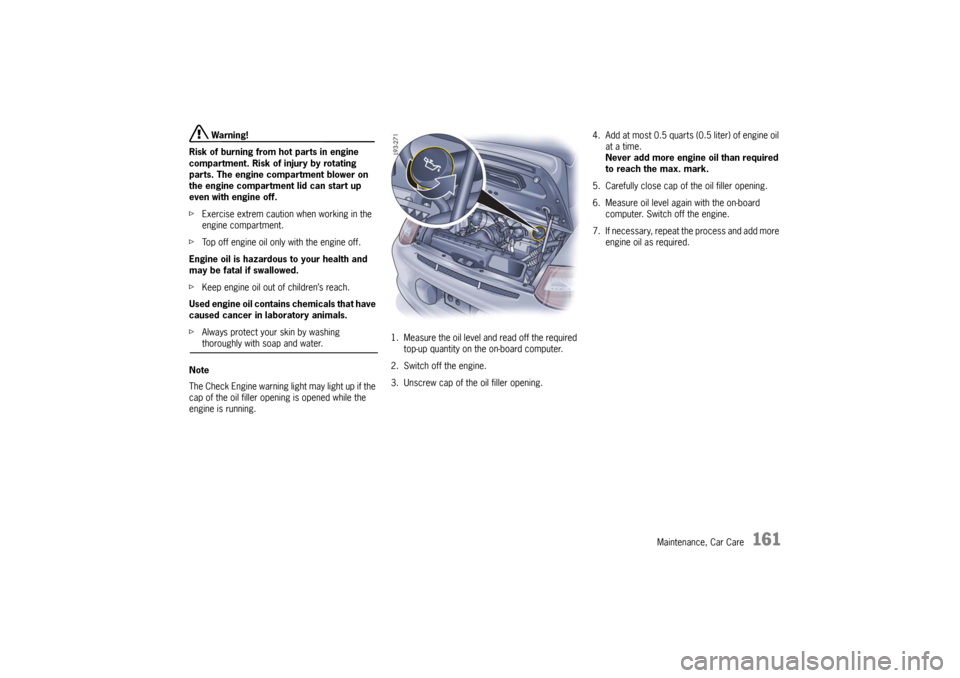
engine is running.1. Measure the oil level and read off the required
top-up quantity on the on-board computer.
2. Switch off the engine.
3. Unscrew cap of the oil filler opening.4. Add at most 0.5 quarts (0.5 liter) of engine oil
at a time.
Never add more engine oil than required
to reach the max. mark.
5. Carefully close cap of the oil filler opening.
6. Measure oil level again with the on-board
computer. Switch off the engine.
7. If necessary, repeat the process and add more
engine oil as required.
10_GT3_21.book Seite 161 Donnerstag, 4. Juni 2009 12:48 12
Page 163 of 251
162
Maintenance, Car Care
Brake Fluid LevelfPlease see the chapter “EXERCISE EXTREME
CAUTION WHEN WORKING ON YOUR VEHICLE”
on Page 157.
fUse only new (unused) Original Porsche
brake fluid.
Warning!
Brake fluid is hazardous to your health, and
may cause death if swallowed.
Brake fluid also attacks paintwork.
fKeep brake fluid out of children’s reach.
fTake care while topping off brake fluid not to
soil the luggage compartment or items of luggage.
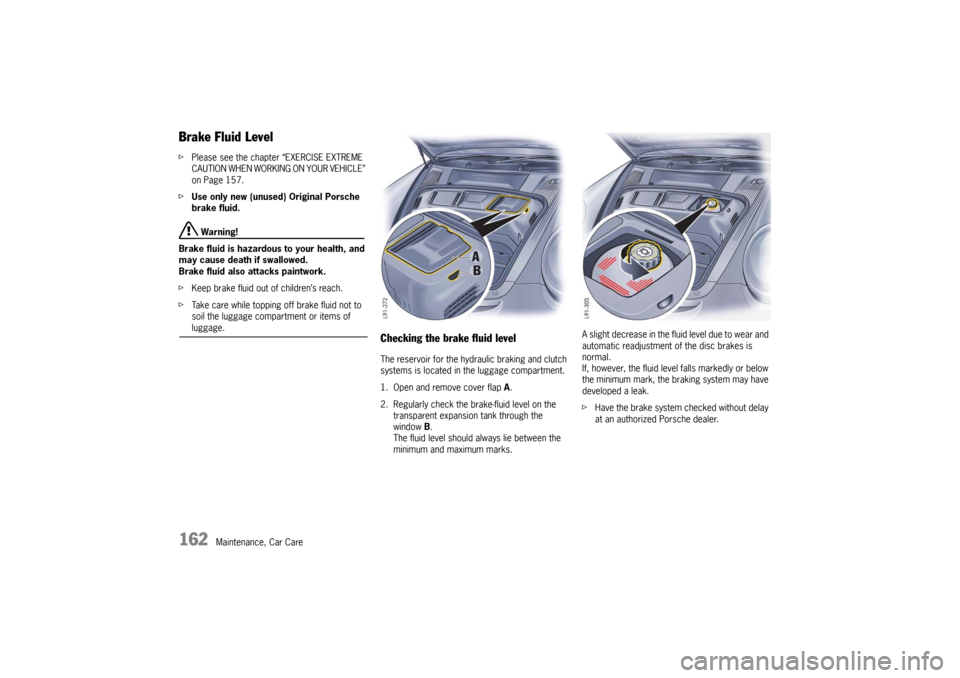
Checking the brake fluid levelThe reservoir for the hydraulic braking and clutch
systems is located in the luggage compartment.
1. Open and remove cover flap A.
2. Regularly check the brake-fluid level on the
transparent expansion tank through the
window B.
The fluid level should always lie between the
minimum and maximum marks.A slight decrease in the fluid level due to wear and
automatic readjustment of the disc brakes is
normal.
If, however, the fluid level falls markedly or below
the minimum mark, the braking system may have
developed a leak.
fHave the brake system checked without delay
at an authorized Porsche dealer.
10_GT3_21.book Seite 162 Donnerstag, 4. Juni 2009 12:48 12
Page 164 of 251

Maintenance, Car Care
163
Changing the brake fluid Brake fluid absorbs moisture from the air over
time. This accumulation of water lowers the
boiling point and, under certain operating condi-
tions, can affect the braking performance.
Therefore have the brake fluid changed in accor-
dance with the change intervals stated in the
brochure “Maintenance”. – The warning lights on the instrument panel and
on the on-board computer indicate an insuffi-
cient brake fluid level.
– If the warning light lights up on the instrument
panel and the warning message appears on
the on-board computer in combination with a
larger pedal travel, a brake circuit may have
failed.
If the warning lights should light up when
driving:
fStop immediately in a suitable place.
fDo not continue driving.
Consult an authorized Porsche dealer.
Warning light USA
Warning light Canada
10_GT3_21.book Seite 163 Donnerstag, 4. Juni 2009 12:48 12
Page 166 of 251
Maintenance, Car Care
165
Fuel
Warning!
Fuel is highly flammable and harmful to
health.
fFire, open flame and smoking are prohibited
when handling fuel.
fAvoid contact with skin or clothing.
fDo not inhale fuel vapors.
To prevent damage to the emission control
system and engine:
fNever drive the tank completely out of fuel.
fAvoid high cornering speeds after the warning lights have come on.
fPlease see the chapter “FUEL ECONOMY” on
Page 164.
Please see the chapter “EMISSION CONTROL
SYSTEM” on Page 168.
Please see the chapter “LEVEL GAUGE” on
Page 113.
Check engine warning light If the warning lights in the instrument panel and on-
board computer come on and remain on while
driving, it suggests:
– a potential engine control problem and the
need for system service or
– an improperly fastened tank cap or – refueling with engine running.
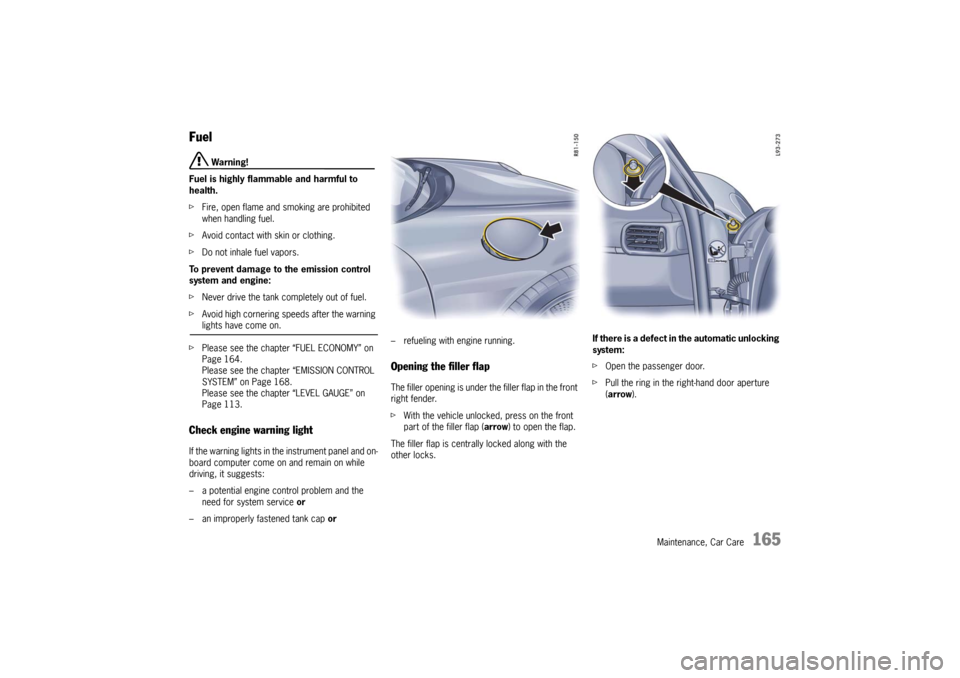
Opening the filler flapThe filler opening is under the filler flap in the front
right fender.
fWith the vehicle unlocked, press on the front
part of the filler flap (arrow) to open the flap.
The filler flap is centrally locked along with the
other locks. If there is a defect in the automatic unlocking
system:
fOpen the passenger door.
fPull the ring in the right-hand door aperture
(arrow).
10_GT3_21.book Seite 165 Donnerstag, 4. Juni 2009 12:48 12
Page 171 of 251
170
Maintenance, Car Care
Washer FluidCapacityfPlease see the chapter “CAPACITIES” on
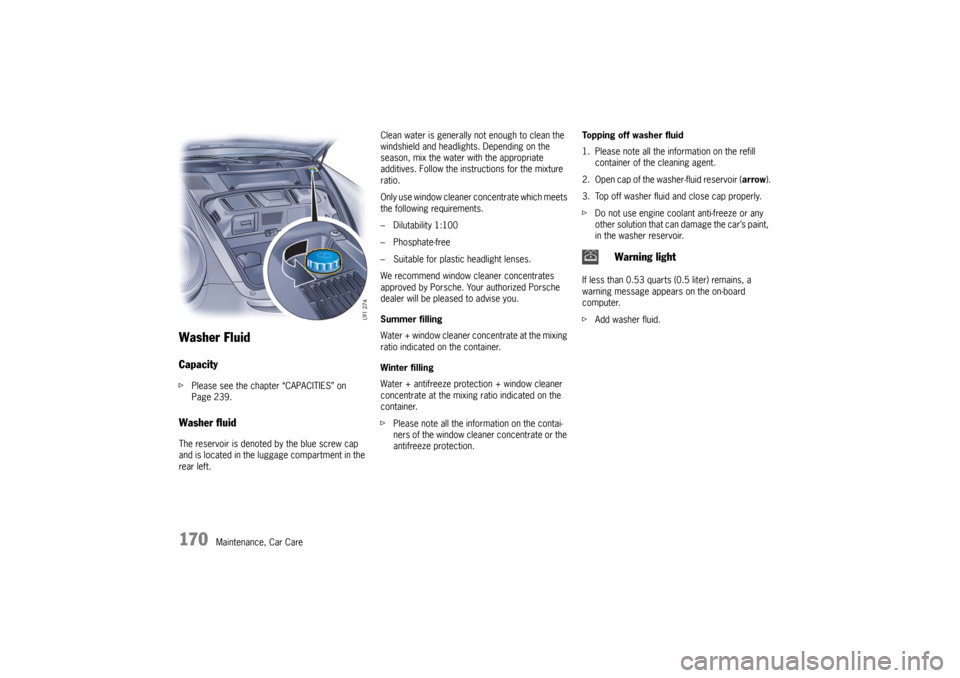
Page 239.Washer fluidThe reservoir is denoted by the blue screw cap
and is located in the luggage compartment in the
rear left.Clean water is generally not enough to clean the
windshield and headlights. Depending on the
season, mix the water with the appropriate
additives. Follow the instructions for the mixture
ratio.
Only use window cleaner concentrate which meets
the following requirements.
– Dilutability 1:100
– Phosphate-free
– Suitable for plastic headlight lenses.
We recommend window cleaner concentrates
approved by Porsche. Your authorized Porsche
dealer will be pleased to advise you.
Summer filling
Water + window cleaner concentrate at the mixing
ratio indicated on the container.
Winter filling
Water + antifreeze protection + window cleaner
concentrate at the mixing ratio indicated on the
container.
fPlease note all the information on the contai-
ners of the window cleaner concentrate or the
antifreeze protection.Topping off washer fluid
1. Please note all the information on the refill
container of the cleaning agent.
2. Open cap of the washer-fluid reservoir (arrow).
3. Top off washer fluid and close cap properly.
fDo not use engine coolant anti-freeze or any
other solution that can damage the car’s paint,
in the washer reservoir.
If less than 0.53 quarts (0.5 liter) remains, a
warning message appears on the on-board
computer.
fAdd washer fluid.
Warning light
10_GT3_21.book Seite 170 Donnerstag, 4. Juni 2009 12:48 12
Page 176 of 251

Maintenance, Car Care
175
Decals
Caution!
Risk of damage due to separation of the
decal films when using high-pressure
cleaning equipment or steam cleaners.
fDo not use high-pressure cleaning equipment or steam cleaners to clean decal films.
Washing The best method of protecting your car from the
damaging effects of the environment is frequent
washing and the application of a preservative. The
underside of your vehicle should also be
thoroughly washed for cinders, salt or sanding at
winter’s end.
The longer salt, road dust and industrial dust,
dead insects, bird droppings or substances from
trees (resin, pollen) are allowed to remain on the
bodywork, the more serious is their harmful
effect.
New cars should be washed carefully with plenty
of clear water to protect the new paint work. Dark
paint finishes show up the smallest of surface
damage (e.g., scratches) more readily than lighter
colors. Dark colors are also more susceptible to
scratching because of the composition of their
pigments and require particularly careful paint
care.
fDo not wash your car in bright sunlight or while
the bodywork is still hot.
fWhen washing by hand, use abundant water, a
soft sponge or wash brush, and Porsche car
shampoo.
fBegin by spraying the body thoroughly with
water to rinse away loose dirt.
fAfter washing, rinse the car with plenty of
water and then dry with a chamois leather.
Do not use the same chamois leather for
drying as you use for cleaning the windshield
and windows.
Warning!
Moisture which gets on to the brakes during
a car wash can reduce braking efficiency or
make the brakes pull unevenly which could
increase the danger of an accident, causing
serious personal injuries or death.
fAfter washing the car, test the brakes and
steering and briefly brake the discs dry.
When doing this, take care not to hamper other
road users behind you (traffic conditions permitting). Automatic car washes
fPlease see the chapter “WIPER BLADES” on
Page 173.
Optional add-on parts or parts which project
beyond the contours of the vehicle may be
damaged by design features (e.g. brushes) of
automatic car washes.
The following parts are particularly
susceptible to damage:
– Windshield wipers (always switch them off to
prevent them wiping unintentionally in intermit-
tent or sensor operation)
– External antennas (always unscrew)
– Rear spoiler
– Wheels (the wider the rim and the lower the tire
height, the greater the risk of damage)
– High-gloss wheels (to prevent these from
getting scratched, do not clean with the wheel-
cleaning brushes of the car wash).
fPlease consult the operator before using
automatic car washes.
fWash and dry by hand all points not reached by
a car wash, such as door and lid seams or
door sills.
10_GT3_21.book Seite 175 Donnerstag, 4. Juni 2009 12:48 12
Page 177 of 251

176
Maintenance, Car Care Note
Automatic car washes spray water at odd angles
and high pressures, which are not seen in normal
driving. Therefore, water can sometimes find its
way into the passengers compartment during or
shortly after the car wash.
Door lock fTo prevent the door lock from freezing during
the cold season, the lock cylinder should be
covered during a wash.
fShould the lock freeze, use an ordinary de-icer.
In many cases, a well warmed key can help.
Never use excessive force.Paint fNever rub a dusty car with a dry cloth since
dust particles are abrasive and could dull and
damage the surface finish.
The paintwork of your car is exposed to all types
of mechanical and chemical conditions, particu-
larly climatic ones such as bright sunlight, rain,
frost and snow. Ultraviolet light, rapid changes in
temperature, rain, snow, industrial dust and
chemical deposits constantly attack the paint
which is only able to withstand such exposure in
the long term if it is given regular care and atten-
tion.
fDo not apply silicone polishes to the windshield
or windows. fDo not treat matt-painted components with
preservatives or polishes as this will spoil the
matte effect.
Preservation
The paint surface becomes dull over time due to
weathering. It is therefore necessary to preserve
the paint regularly.
This keeps the paint shiny and elastic. Dirt is
prevented from adhering to the paint surface and
industrial dust is prevented from penetrating the
paint.
Provided it is washed and treated with preserva-
tive regularly, the brand new finish of your car will
be retained for years to come.
fApply paint preservative after the car wash and
polish it dry to obtain a bright finish.
Polishing
Do not resort to using Porsche polish until it
becomes evident that the normal preservatives no
longer produce the desired finish.
Spots and stains
fRemove tar stains, grease, oil spots and dead
insects as soon as possible with Insect
Remover. They can cause discoloration if
allowed to remain on the paintwork.
fWash the affected area immediately after
treating it.Minor paint damage
fHave minor paint damage, such as scratches,
scores or chips caused by flying stones,
repaired immediately by your authorized
Porsche dealer before corrosion sets in.
However, if there are already traces of corrosion,
they must first be removed carefully and
thoroughly. Coat the area with a rust-proofing
primer and finish off with a top coat. The paint
code and color number are found on the data bank
in the Maintenance booklet. 10_GT3_21.book Seite 176 Donnerstag, 4. Juni 2009 12:48 12
Page 178 of 251

Maintenance, Car Care
177
Engine compartment The engine compartment and the surface of the
engine are treated with a corrosion-inhibitor at the
factory.
If degreasing solvents are used to clean the
engine compartment or the engine is washed
down, the process almost invariably removes the
corrosion-inhibiting coating. It is then absolutely
necessary to have a durable preservative applied
to all surfaces, body seams, joints and assemblies
in the engine compartment. This also applies
when corrosion-inhibitor parts are replaced.
Caution!
Risk of damage to the alternator.
fDo not point the cleaning jet directly at the alternator, or cover the alternator.
Effective corrosion-proofing is particularly impor-
tant during the cold weather season. If your car is
driven frequently in areas where salt has been
spread on the roads, the whole engine compart-
ment should be cleaned thoroughly after the
winter to prevent salt from causing any lasting
damage. A full under-body wash should also be
performed at the same time.
Windows The road dust which settles on the windshield and
windows contains particles of tire rubber and oil
residue. The interior trim and upholstery release
particles, particularly in strong sunlight, which
collect on the insides of the windows. These
deposits are augmented by impurities in the air
which enters the car through the fresh air vents.
fClean all windows regularly, inside and outside,
with Porsche window cleaner.
fIf you use a chamois leather for the windows,
do not use it for paintwork as it will otherwise
pick up a certain amount of preservative or
polish and could smear the windows and thus
impair vision.
fRemove dead insects with Porsche insect
remover.
Note
Door windows feature a water-repellent (hydro-
phobic) coating which prevents soiling of the
windows.
This coating is subject to natural wear and can be
renewed.
fConsult an authorized Porsche dealer.
Wiper blades Wiper blades that are in perfect condition are vital
for a clear view.
fReplace the wiper blades twice per year
(before and after the cold season) or whenever
wiper performance deteriorates.
fPeriodically clean the wiper blades with
Porsche window cleaner, especially after the
vehicle has been washed in a car wash.
If they are very dirty (e.g. with insect remains),
they can be cleaned with a sponge or cloth.
If the wiper blades rub or squeak, this can be as a
result of the following:
– If the vehicle is washed in an automatic car
wash, residues may adhere to the windshield.
These wax residues can be removed only by
using window cleaner concentrate.
– The wiper blades may be damaged or worn.
fReplace damaged wiper blades as soon as
possible.
Please see the chapter “WIPER BLADES” on
Page 173.
fPlease see the chapter “WASHER FLUID” on
Page 170.
fPlease contact your authorized Porsche dealer
for further information.
10_GT3_21.book Seite 177 Donnerstag, 4. Juni 2009 12:48 12
Page 179 of 251

178
Maintenance, Car Care
Undercoating As it is not possible to exclude the risk of damage
to this protective coating in day to day driving, it
is advisable to have the underside of the car
inspected at certain intervals – preferably before
the start of winter and again in spring – and the
undercoating restored as necessary.
Your authorized Porsche dealer is familiar with the
bodyseal treatment procedures and has the
necessary equipment for applying factory
approved materials. We recommend that you
entrust them with such work and inspections.
Unlike conventional spray oils, undercoating and
rust-proofing compounds based on bitumen or
wax do not attack the sound-proofing materials
applied at the factory.
Warning!
Danger of fire resulting in serious personal
injury or death.
fDo not apply additional undercoating or rust-
proofing on or near the exhaust manifold,
exhaust pipes, catalytic converters or heat
shields. During driving the substance used for undercoating could overheat and ignite.
fBefore applying fresh underseal, carefully
remove any deposits of dirt and grease. Once
it has dried, the new undercoating compound
forms a tough protective coating which
provides efficient rust-proofing of the floor
panels and components. fAlways apply a fresh coating of suitable preser-
vative to unprotected areas after cleaning the
underside of the body, the transmission, the
engine or carrying out repairs to under-body,
engine or transmission components.
Effective rust-proofing is particularly important
during the cold weather season. If your car is
driven frequently in areas where salt has been
spread on the roads, the whole engine compart-
ment should be cleaned thoroughly after the
winter to prevent salt from causing any lasting
damage. A full under-body wash should also be
performed at the same time.
Stainless steel exhaust tailpipesStainless steel exhaust tailpipes can discolor due
to soiling, strong heat, and combustion residues.
The original polish can be achieved again using
commercially available metal polishing paste or
metal polish.
Light alloy wheels fPlease see the chapter “WASHING” on
Page 175.
Warning!
Danger of accident resulting in serious
personal injury or death if cleaning agents
(e.g. wheel cleaning agents) come into
contact with the brake discs.
The resulting film on the brake discs can
impair braking performance.
fMake sure that no cleaning agent comes into
contact with the brake discs.
fIf cleaning agent has come into contact with
the brake discs, thoroughly clean the brake
discs with a strong jet of water.
fPaying attention to any road users behind you,
dry the brake discs by applying the brakes at short intervals.
Pitting may occur if metallic particles which cause
contact corrosion (e.g. brass or copper in brake
dust) are allowed to remain on the aluminum for
too long.
fIf possible, wash the wheels with a sponge or
wash brush about every two weeks. In areas
where salt is spread on winter roads or there is
a lot of airborne industrial dust, it is best to
clean the wheels weekly.
10_GT3_21.book Seite 178 Donnerstag, 4. Juni 2009 12:48 12
Page 180 of 251

Maintenance, Car Care
179
The Porsche Light Alloy Wheel Cleaner
(ph-value 9.5) can be used for this
purpose.
If the ph-value of the detergent is incor-
rect, the protective coating on the wheels
will be destroyed.
Polishes which dissolve oxides, such as those
frequently used for other metals, or abrasive
tools or agents are unsuitable because they
break down the oxide film of the protective
coating and will cause discoloration of the
wheel.
fEvery three months, after cleaning, coat the
wheels with a car wax or non-corrosive grease
(vaseline).
Using a clean cloth thoroughly rub the grease
into the surface.
Door, roof, lid and window seals fWash dirt (e.g. abrasion, dust, road salts) from
all seals regularly using warm soapy water. Do
not use any chemical cleaning agents or
solvents.
When there is a frost hazard, the outer door seals
and the front and rear lid seals can be protected
against freezing into place by a suitable care
product.
In order to prevent damage to the anti-
friction coating, the inner door seals must
not be treated with care products.
Headlights, lights, interior and exterior
plastic parts, adhesive filmsfUse only clean water and a little dishwashing
detergent to clean light lenses, plastic
headlight lenses, plastic parts and surfaces.
Do not clean when dry.
Use a soft sponge or a soft, lint-free cloth.
Gently wipe the surface without applying too
much pressure.
The Porsche inside window cleaner is also
suitable for cleaning plastic surfaces.
Follow the cleaning instructions on the
container.
Never use other chemical cleaners or
solvents.
fRinse cleaned surfaces with clear water.Leather Characteristics and special features
The natural surface markings of leather, e.g.
creases, healed scars, insect sting marks, struc-
tural differences and slight variations in shade and
grain add to the attractiveness of the natural
leather product.
A special mention must be made here of natural
leather.
For natural leather, carefully selected hides of the
highest quality are used. It is not covered comple-
tely with dye on production.
“Nature’s signature” is therefore easily recogniz-
able.This fine material is distinguished by an outstan-
ding seating comfort, special suppleness and a
typical patina.
Leather care and treatment
fClean all types of leather regularly to remove
fine dust using a soft, damp, white woollen
cloth or a commercially available microfiber
cloth.
fRemove heavy contamination with Porsche
leather cleaner.
Please always follow the instructions for use
given on the containers.
Caustic cleaners and hard cleaning objects
must not be used.
Perforated leather must under no circum-
stances get wet on its reverse side.
Once cleaned, leather (particularly the heavily
stressed leather seats) must be treated only with
Porsche leather care liquid.
10_GT3_21.book Seite 179 Donnerstag, 4. Juni 2009 12:48 12