light PORSCHE 911 GT3 2010 5.G Owners Manual
[x] Cancel search | Manufacturer: PORSCHE, Model Year: 2010, Model line: 911 GT3, Model: PORSCHE 911 GT3 2010 5.GPages: 251, PDF Size: 14.33 MB
Page 181 of 251

180
Maintenance, Car Care
Cleaning airbags covers
Danger!
Risk of danger of serious personal injury or
death if the airbag system is impaired by
improper cleaning work.
fDo not make any modifications whatsoever on
individual components such as the padded
covers of the steering wheel, passenger side
instrument panel, the front seats and the door
linings.
fLet your authorized Porsche dealer clean these components.
Fabric, upholstery, carpets and
floor-mats fUse only a vacuum cleaner or a medium stiff
brush.
fRemove stains and spots with Porsche stain
remover.
The Porsche range of accessories includes
nonskid floor-mats to protect the carpets in
summer and winter.
Warning!
Risk of an accident resulting in serious
personal injury or death.
fAlways check the movement of the pedals
before driving and make sure that they are not
obstructed by a floor-mat or any other object.
fSecure the floor-mat to prevent it from sliding
into positions that could interfere with the safe
operation of your vehicle - do not install them
loosely in the vehicle.
Your Porsche dealer will be glad to offer you nonskid floor-mats of the correct size.
Alcantara fDo not use a leather care product to clean
Alcantara.
For regular care it is sufficient to clean the cover
with a soft brush.
Heavy abrasion or rubbing when cleaning causes
a lasting change in the surface.
Cleaning when lightly soiled
fWet a soft cloth with water or a neutral soap
solution and wipe off the dirt.
Cleaning when heavily soiled
fWet a soft cloth with lukewarm water or
thinned white spirit and dab the dirt from the
outside in. Safety belts If it becomes necessary to clean the belts, you
can use any mild washing agent.
Allow the belts to dry prior to retracting, but avoid
direct sunlight.
fOnly use suitable cleaners.
If unsuitable cleaners are used or any attempt
is made to dye or bleach the belts, the
webbing may be weakened and thus constitute
a safety risk.
10_GT3_21.book Seite 180 Donnerstag, 4. Juni 2009 12:48 12
Page 182 of 251

Maintenance, Car Care
181
Storing your Porsche If you intend to store your Porsche for a prolonged
period, please consult your authorized Porsche
dealer. The staff will be glad to advise you on the
most suitable and necessary methods.
fClean your vehicle thoroughly inside and
outside.
Clean the engine compartment.
The under carriage and chassis components
should be free of dirt and salt deposits.
fFill up the fuel tank.
fChange the oil and oil filter, and run the engine
for several minutes.
fIncrease the tire pressure to 58 psi (4 bar).
It is not recommended to lift the vehicle, due to
the possibility of corrosion on shock absorber
piston shafts.
The vehicle should be moved slightly, approxi-
mately every four weeks, to prevent flat spot
on the tires. Climate control
The air conditioning system should be in good
working condition and fully charged.
Windshield/Headlight washer
fCheck and correct antifreeze/cleaning solution
level as necessary.
Electrical system
fRemove the battery from the vehicle and store
it in a cool dry place, not on a cement floor.
When the battery is disconnected, the
alarm system is deactivated.
fRecharge the battery every 3 months. If the
battery remains in the vehicle with the cables
connected, it is necessary to check, remove
and recharge the battery every 2-3 weeks.
Do not fast charge the battery.
fPlease see the chapter “BATTERY” on
Page 211.Vehicle interior
The interior must be dry, especially in the area of
the floor carpets. The use of drying agents (Silica-
Gel) is recommended in vehicles with leather
interior and in areas with high humidity. The
recommended amount is 3 fabric bags of 1.1 lbs.
(500 grams) each placed on the floor carpets.
Windows, doors and lids must be closed. The air
vents should be opened.
10_GT3_21.book Seite 181 Donnerstag, 4. Juni 2009 12:48 12
Page 183 of 251
182
Practical Tips, Emergency Service
Practical Tips, Emergency ServiceExercise Extreme Caution when Working
on your Vehicle ........................................... 183
Tires/Wheels .............................................. 184
Loading Information .................................... 195
Wheels with Central Locking ........................ 197
Central Bolts .............................................. 197
Changing a Wheel ....................................... 198
Checking Tire Pressure with a
Pressure Gauge .......................................... 203
Flat Tire ..................................................... 203
Lifting the Vehicle with a Lifting Platform or
Garage Lift ................................................. 206
Electrical System ........................................ 207
Battery....................................................... 211
Replacing the remote-control battery ............ 216
Emergency Starting with Jumper Cables ....... 217
Bulb chart .................................................. 219
Lights, Replacing Bulbs ............................... 219
Headlights .................................................. 220
License Plate Light...................................... 227
Front Side Lights, Front Turn Signal Lights,
Daytime Running Lights, Tail Lights and
Additional Brake Light ................................. 227
Adjusting Headlights.................................... 228
Towing ....................................................... 230
10_GT3_21.book Seite 182 Donnerstag, 4. Juni 2009 12:48 12
Page 186 of 251

Practical Tips, Emergency Service
185
Treadwear
The treadwear grade is a comparative rating
based on the wear rate of the tire when tested
under controlled conditions on a specific govern-
ment test course.
For example, a tire graded 150 would wear one
and a half (1-1/2) times as well on the government
course as a tire graded 100.
The relative performance of tires depends upon
the actual conditions of their use, however, and
may depart significantly from the norm due to var-
iations in driving habits, service practices and dif-
ferences in road characteristics and climate.
Traction AA, A, B, C
The traction grades, from highest to lowest, are
AA, A, B, and C and they represent the tire’s ability
to stop on wet pavement as measured under
controlled conditions on specified government
test surfaces of asphalt and concrete.
A tire marked C may have poor traction perfor-
mance.
Warning!
The traction grade assigned to this is based on
braking (straight-ahead) traction tests and does
not include cornering (turned) traction, accelera-
tion, hydroplaning or peak traction characteris-
tics. Temperature A, B, C
The temperature grades are A (the highest), B and
C, representing the tire’s resistance to the genera-
tion of heat and its ability to dissipate heat when
tested under controlled conditions on a specified
indoor laboratory test wheel.
Sustained high temperatures can cause the
material of the tire to degenerate and reduce tire
life, and excessive temperature can lead to
sudden tire failure.
The grade C corresponds to a level of perfor-
mance which all passenger car tires must meet
under the Federal Motor Vehicle Safety Standard
No. 109.
Grades B and A represent higher levels of perfor-
mance on the laboratory test wheel than the
minimum required by law.
Warning!
The temperature grade for this tire is established
for a tire that is properly inflated and not
overloaded.
Excessive speed, underinflation, or excessive
loading, either separately or in combination, can
cause heat buildup and possible tire failure, resul-
ting in serious personal injury or death.
Tire pressures
Warning!
Incorrect tire pressure causes increased tire
wear and adversely affects road handling.
This could lead to tire failure, resulting in loss
of control, leading to serious personal injury
or death.
fAlways use an accurate tire pressure gauge
when checking inflation pressures.
fDo not exceed the maximum tire pressure
listed on the tire sidewall.
Please see the chapter “TIRE PRESSURE
PLATE” on Page 235.
fCold tire inflation pressure means: all tires
must be cold, ambient temperature maximum
(68 °F/20 °C)
, when adjusting the inflation
pressure.
Avoid sunlight striking the tires before measu-
ring cold pressures, since the pressures would
rise from temperature influence.
fValve caps protect the valve from dust and dirt,
and thus from leakage.
Always screw caps tightly down.
Replace missing caps immediately.
fUse only plastic valve caps.
fDo not use commercially available sealant or
tire inflating bottles. Only use Porsche approved tire sealant.
10_GT3_21.book Seite 185 Donnerstag, 4. Juni 2009 12:48 12
Page 195 of 251

194
Practical Tips, Emergency Service E Maximum Load rating
The maximum load in kilograms and pounds can
be carried by the tire. If you replace tires always
use a tire that has the same maximum load rating
as the factory installed tire.
FRadial
The identification indicates if the tire has radial
structure.
G Term of tubeless or tube tire
Identification for tubeless tires.
Speed code letterThe speed code letter indicates the maximum
permissible speed for the tire.
This code letter is shown on the tire sidewall.Tip on driving
Tires with a maximum speed rating that is lower
than the specified maximum vehicle speed may be
mounted only if they bear an M+S identification on
the tire sidewall.
fPlease note that in addition to the winter tires,
all-season and all-terrain tires are also subject
to speed limits and bear this identification.
Inscription on light alloy wheelsMaintenance note
fProtect the valve inserts against soiling with
valve caps.
Use only plastic valve caps.
Soiled valve inserts can cause a gradual loss
of air.
Note on operation
fThe rim width in inches A and the rim offset F
are visible from the outside.
The information is provided on the rear of the
spokes. The rim width and rim offset are also
visible close to the tire valve in some cases.
A- Rim width in inches
B- Rim-flange contour code letter
C- Symbol for drop-center rim
D- Rim diameter in inches
E-Double hump
F- Rim offset in mm
T= up to 118 mph (190 km/h)
H= up to 131 mph (210 km/h)
V= up to 150 mph (240 km/h)
W= up to 167 mph (270 km/h)
Y= up to 186 mph (300 km/h)
(Y)= up to 186 mph (300 km/h) in accordance
with Y-tires. Speeds in excess of
186 mph (300 km/h) are possible with
a maximum load rating of 85 %
(confirmation of tire manufacturer in excess
of 186 mph (300 km/h) required).
10_GT3_21.book Seite 194 Donnerstag, 4. Juni 2009 12:48 12
Page 202 of 251
Practical Tips, Emergency Service
201
9. Insert the central bolt into the socket (until it
engages), fit the central bolt at right angles to
the wheel hub and screw it on without tilting.
10.Tighten the central bolt once to at least
370 ftlb. (500 Nm) using a suitable torque
wrench and then loosen again slightly (by
approx. 1/4 turn).
11.Tighten the central bolt to 370 ftlb.
(500 Nm).
Prevent the wheel from turning by getting
a second person to press the brake pedal.
If you do not have a suitable torque wrench
in a breakdown situation, the emergency
procedure for securing the central bolt must
be performed.
Please see the chapter “EMERGENCY PROCE-
DURE FOR SECURING CENTRAL BOLT” on
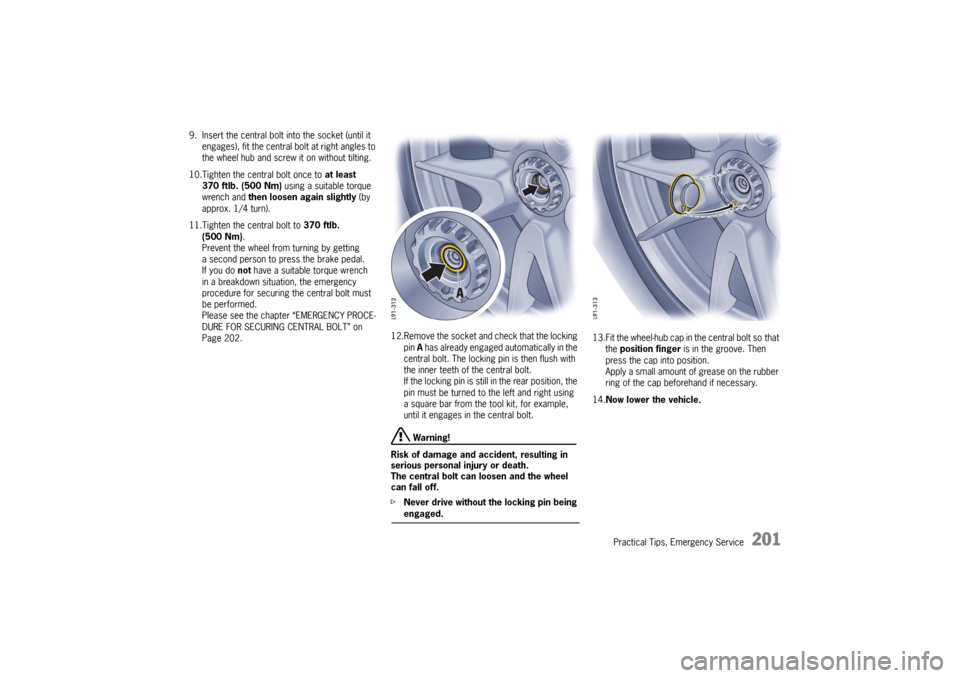
Page 202.12.Remove the socket and check that the locking
pin A has already engaged automatically in the
central bolt. The locking pin is then flush with
the inner teeth of the central bolt.
If the locking pin is still in the rear position, the
pin must be turned to the left and right using
a square bar from the tool kit, for example,
until it engages in the central bolt.
Warning!
Risk of damage and accident, resulting in
serious personal injury or death.
The central bolt can loosen and the wheel
can fall off.
fNever drive without the locking pin being engaged. 13.Fit the wheel-hub cap in the central bolt so that
the position finger is in the groove. Then
press the cap into position.
Apply a small amount of grease on the rubber
ring of the cap beforehand if necessary.
14.Now lower the vehicle.
10_GT3_21.book Seite 201 Donnerstag, 4. Juni 2009 12:48 12
Page 203 of 251
202
Practical Tips, Emergency Service
Caution!
Using wheel cleaning agents:
Wheel cleaning agents can bleach the
anodised surface of the central bolt.
fOnly use wheel cleaning agents approved
by Porsche and use these sparingly and in accordance with instructions for use.
Emergency procedure for securing
central boltIf, in the event of a breakdown, no suitable torque
wrench is available for tightening the central bolt
to the high tightening torque, the emergency
procedure for securing the central bolt must be
performed.
fThe central bolt must always be fitted using
the original tool (stored in the luggage
compartment).
1.Tighten the central bolt with great force
using a long lever and loosen again
slightly (by approx. 1/4 turn).
Tighten the central bolt to precisely 74 ftlb.
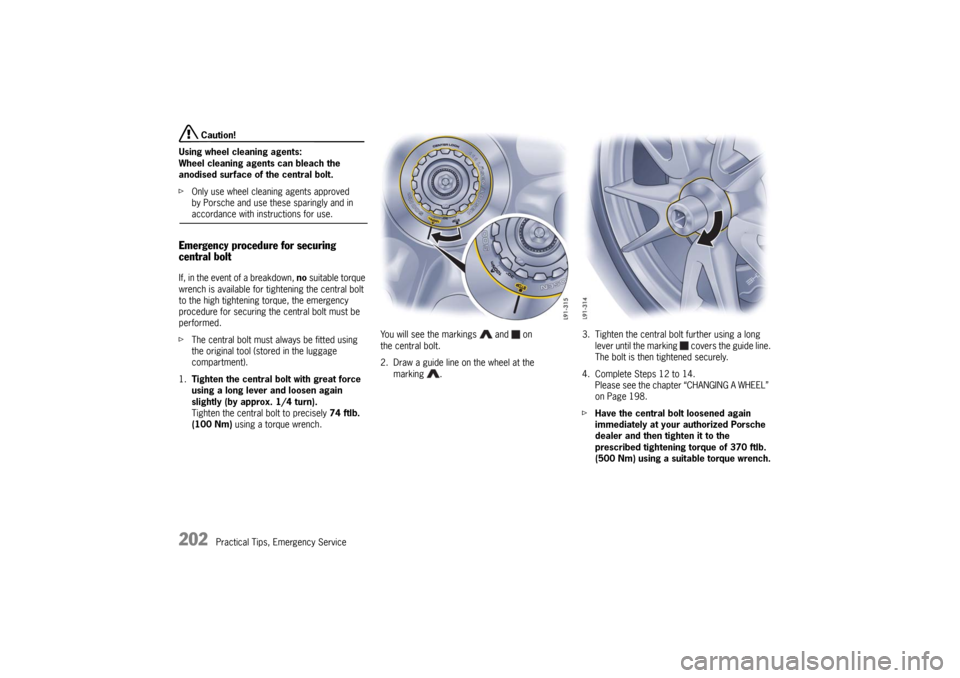
(100 Nm) using a torque wrench.You will see the markings and on
the central bolt.
2. Draw a guide line on the wheel at the
marking .3. Tighten the central bolt further using a long
lever until the marking covers the guide line.
The bolt is then tightened securely.
4. Complete Steps 12 to 14.
Please see the chapter “CHANGING A WHEEL”
on Page 198.
fHave the central bolt loosened again
immediately at your authorized Porsche
dealer and then tighten it to the
prescribed tightening torque of 370 ftlb.
(500 Nm) using a suitable torque wrench.10_GT3_21.book Seite 202 Donnerstag, 4. Juni 2009 12:48 12
Page 206 of 251
Practical Tips, Emergency Service
205
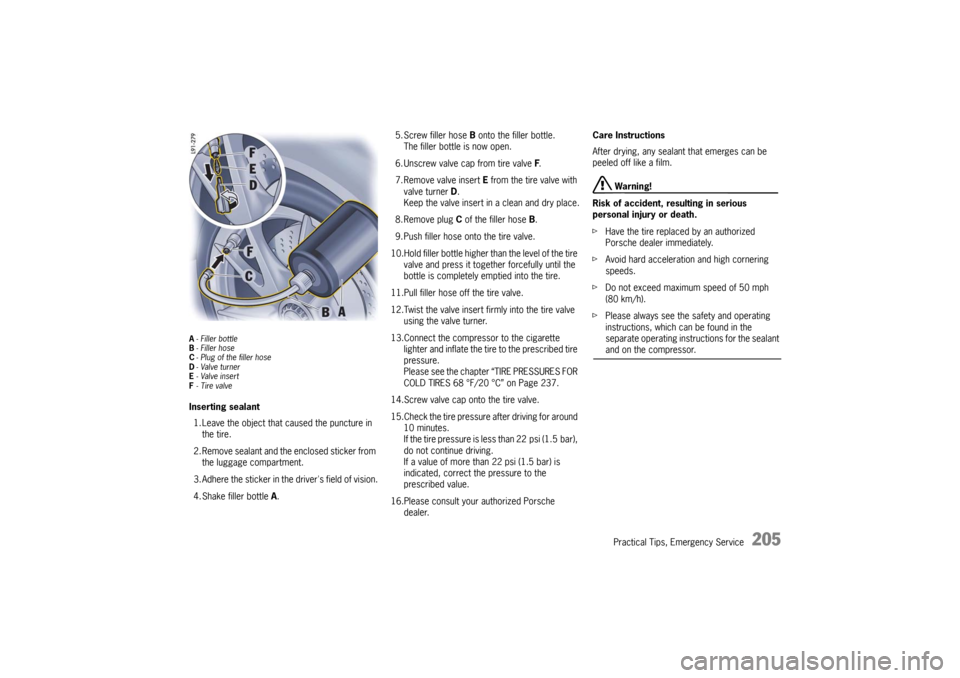
A- Filler bottle
B- Filler hose
C- Plug of the filler hose
D-Valve turner
E-Valve insert
F- Tire valveInserting sealant
1. Leave the object that caused the puncture in
the tire.
2. Remove sealant and the enclosed sticker from
the luggage compartment.
3. Adhere the sticker in the driver's field of vision.
4. Shake filler bottle A.5. Screw filler hose B onto the filler bottle.
The filler bottle is now open.
6. Unscrew valve cap from tire valve F.
7. Remove valve insert E from the tire valve with
valve turner D.
Keep the valve insert in a clean and dry place.
8. Remove plug C of the filler hose B.
9. Push filler hose onto the tire valve.
10.Hold filler bottle higher than the level of the tire
valve and press it together forcefully until the
bottle is completely emptied into the tire.
11.Pull filler hose off the tire valve.
12.Twist the valve insert firmly into the tire valve
using the valve turner.
13.Connect the compressor to the cigarette
lighter and inflate the tire to the prescribed tire
pressure.
Please see the chapter “TIRE PRESSURES FOR
COLD TIRES 68 °F/20 °C” on Page 237.
14.Screw valve cap onto the tire valve.
15.Check the tire pressure after driving for around
10 minutes.
If the tire pressure is less than 22 psi (1.5 bar),
do not continue driving.
If a value of more than 22 psi (1.5 bar) is
indicated, correct the pressure to the
prescribed value.
16.Please consult your authorized Porsche
dealer.Care Instructions
After drying, any sealant that emerges can be
peeled off like a film.
Warning!
Risk of accident, resulting in serious
personal injury or death.
fHave the tire replaced by an authorized
Porsche dealer immediately.
fAvoid hard acceleration and high cornering
speeds.
fDo not exceed maximum speed of 50 mph
(80 km/h).
fPlease always see the safety and operating
instructions, which can be found in the
separate operating instructions for the sealant and on the compressor.
10_GT3_21.book Seite 205 Donnerstag, 4. Juni 2009 12:48 12
Page 208 of 251
Practical Tips, Emergency Service
207
Electrical System In order to avoid damage and faults in electrical or
electronic systems, electrical accessories should
be installed at your authorized Porsche dealer.
fOnly use accessories authorized by Porsche.
Warning!
Risk of short circuit and fire, resulting in
serious personal injury or death.
Replacing fuses or relays with the engine
running or the ignition on could cause
electrical shock.
fDisconnect the negative terminal on the
battery during all work on the electrical
system.
Please see the chapter “BATTERY” on Page 211.
RelaysDefective relays should be changed only by an
authorized workshop.
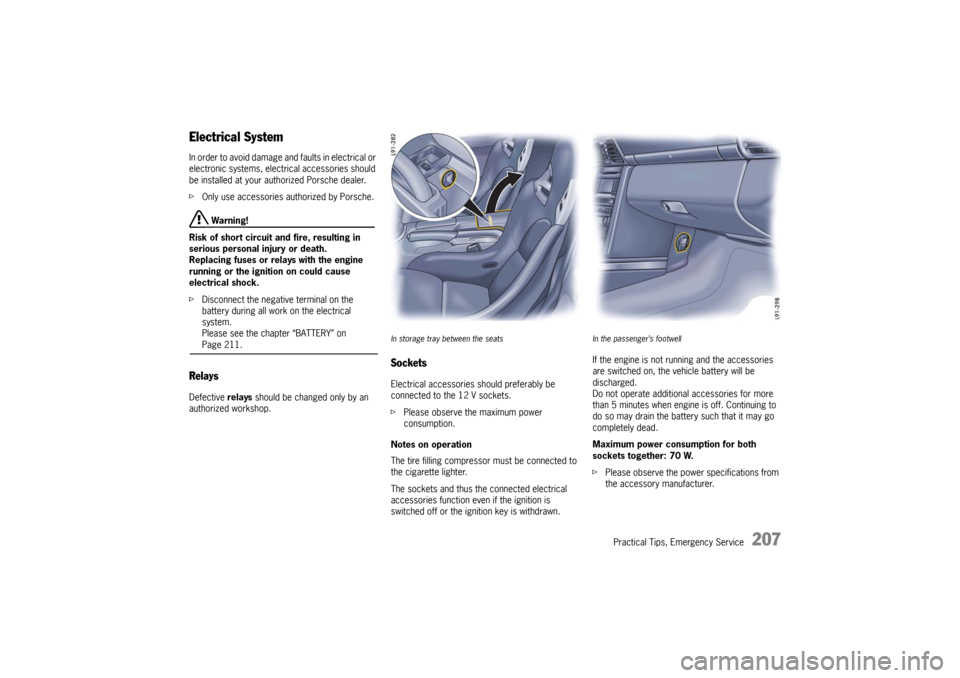
In storage tray between the seatsSocketsElectrical accessories should preferably be
connected to the 12 V sockets.
fPlease observe the maximum power
consumption.
Notes on operation
The tire filling compressor must be connected to
the cigarette lighter.
The sockets and thus the connected electrical
accessories function even if the ignition is
switched off or the ignition key is withdrawn.
In the passenger’s footwellIf the engine is not running and the accessories
are switched on, the vehicle battery will be
discharged.
Do not operate additional accessories for more
than 5 minutes when engine is off. Continuing to
do so may drain the battery such that it may go
completely dead.
Maximum power consumption for both
sockets together: 70 W.
fPlease observe the power specifications from
the accessory manufacturer.
10_GT3_21.book Seite 207 Donnerstag, 4. Juni 2009 12:48 12
Page 209 of 251

208
Practical Tips, Emergency Service
Alarm system, central lockingThe status of the central locking and alarm system
is not changed by disconnecting the battery.
When the battery is disconnected, the alarm
system ceases to function.Central locking overload protectionIf the central locking system is operated more
than ten times within a minute, further operation is
blocked for 30 seconds.
Load switch-off after 2 hours or 7 daysIf the ignition key is removed, loads which are
switched on or are in standby mode (such as the
luggage compartment light, interior light and
radio) are automatically switched off after approx.
2hours.
If the vehicle is not started or unlocked with the
remote control within 7days, the remote control
standby function is switched off (to save the
vehicle battery).
1. In this case, unlock the driver’s door with the
key at the door lock.
Leave the door closed in order to prevent the
alarm system from being triggered.
2. Press button 1 on the remote control.
The remote control is now activated again.
10_GT3_21.book Seite 208 Donnerstag, 4. Juni 2009 12:48 12