instrument panel PORSCHE 911 GT3 2010 5.G Owners Manual
[x] Cancel search | Manufacturer: PORSCHE, Model Year: 2010, Model line: 911 GT3, Model: PORSCHE 911 GT3 2010 5.GPages: 251, PDF Size: 14.33 MB
Page 10 of 251
Table of Contents
9 Table of Contents
Engine Exhaust ............................................... 8
Dear Porsche Owner ..................................... 11
Before driving off... ....................................... 11
In the driver’s seat... ..................................... 12
On the road... ............................................... 12
Break in hints for the first
2,000 miles/3,000 kilometers ....................... 13
Never invite car theft! .................................... 17
Keys ............................................................ 18
Key with Radio Remote Control ...................... 19
Doors .......................................................... 21
Central Locking ............................................ 22
Alarm System,
Passenger Compartment Monitoring .............. 26
Power Windows ............................................ 28
Door mirrors ................................................ 30
Inside mirror ................................................. 31
Automatic Anti-Glare Interior Mirror and Door
Mirror .......................................................... 31
Rear Window Defogger, Door Mirror Heating ... 32
Seat Adjustment and Head Restraints ............. 33
Heated Seats ............................................... 36
Steering Wheel Adjustment ............................ 36
Sun Visors.................................................... 37
Safety Belts.................................................. 38
Airbag Systems ............................................ 41
Child Restraint Systems ................................ 47
LATCH System
Child seat bracket on the passenger’s seat ..... 51
Child Restraint Anchorages ............................ 52
Clutch Pedal ................................................. 53
Parking Brake ............................................... 53Brakes ......................................................... 54
ABS Brake System
(Antilock Brake System)................................. 57
Porsche Stability Management (PSM).............. 59
Sport mode .................................................. 62
Porsche Active Suspension Management
(PASM) ......................................................... 63
Dynamic Engine Mounting (PADM) .................. 63
Front Axle Lift System ................................... 64
Interior Lights ............................................... 66
Ignition/Starter Switch with
anti-theft Steering Lock ................................. 67
Starting Procedures ...................................... 70
Stopping Engine ........................................... 71
Emergency Flasher Switch............................. 72
Light Switch ................................................. 73
Dynamic Cornering Light ............................... 74
Individual Light Functions ............................... 74
Welcome Home Lighting ................................ 74
Automatic Headlight Beam Adjustment ........... 74
Turn Signal / Headlight Dimmer /
Parking light / Flasher Lever .......................... 75
Windshield Wiper / Washer Lever ................... 76
Automatic Speed Control ............................... 78
Cupholder .................................................... 80
Ashtray ........................................................ 81
Cigarette Lighter........................................... 82
Storage in the Passenger Compartment ......... 83
Luggage Compartment Lid and Engine
Compartment Lid .......................................... 85
Luggage Compartment ................................. 86
Trunk Entrapment ......................................... 88Porsche Communication Management (PCM)... 89
Car Telephone and Aftermarket Alarms........... 91
iPod, USB and AUX ....................................... 93
Fire Extinguisher ........................................... 94
HomeLink ..................................................... 95
Automatic Air Conditioning System .................98
Central and Side Vents ................................ 101
Fresh-air Intake ........................................... 101
Heated Rear Window/Door Mirror Heating..... 102
Instrument Panel USA Models ...................... 104
Instrument Panel Canada Models.................. 106
Engine Oil Temperature ............................... 108
Automatic Speed Control Indicator light ........ 108
Instrument Illumination................................. 108
Trip Odometer ............................................ 109
Speedometer ............................................. 110
Changing over between Miles / Kilometers.... 110
Tachometer ................................................ 111
Turn Signal Indicator Light ........................... 111
High Beam Indicator Light ............................ 111
Upshift indicator.......................................... 111
Cooling System .......................................... 112
Fuel ........................................................... 113
Clock .........................................................114
Outside Temperature................................... 114
Engine Oil Pressure ..................................... 115
Check Engine (Emission Control) .................. 116
On-Board Computer (BC)............................. 117
Warnings on the instrument panel and the
on-board computer...................................... 148
Manual Transmission, Clutch ........................ 155
Upshift indicator.......................................... 155
10_GT3_21.book Seite 9 Donnerstag, 4. Juni 2009 12:48 12
Page 40 of 251
Operation, Safety
39
An audio-visual warning system is intercon-
nected with the driver’s safety belt.
Every time the ignition is turned on, the gong will
sound for about 6 seconds to remind driver and
passenger to buckle up.
In addition, the gong will sound for approx.
90 seconds if vehicle speed exceeds 15 mph/
24 km/h.
The safety belt warning lights in the instrument
panel and on-board computer will go off as soon
as the driver has buckled up.
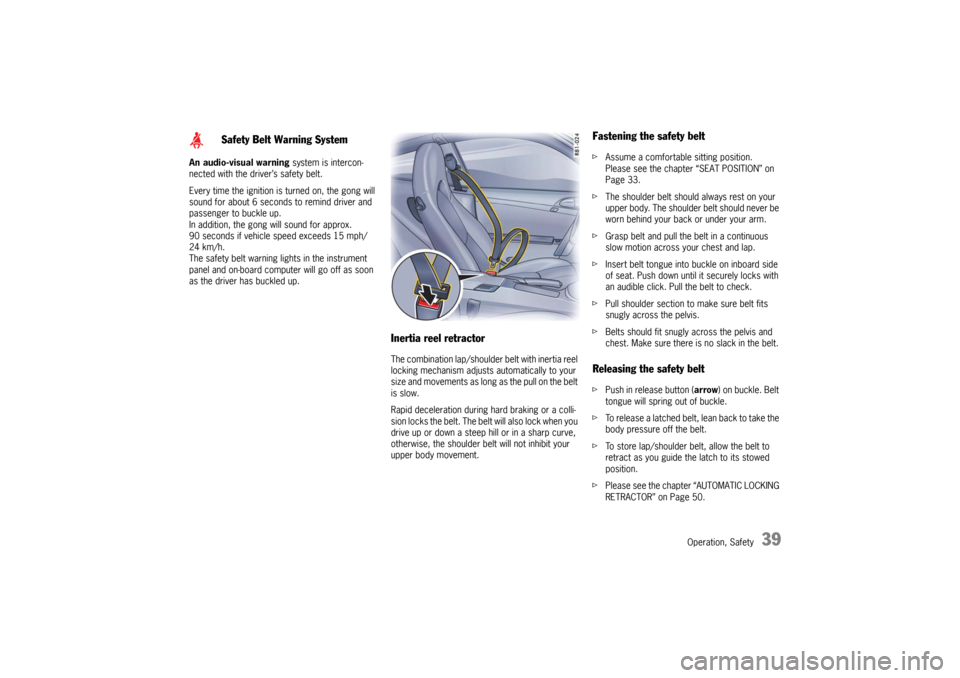
Inertia reel retractor The combination lap/shoulder belt with inertia reel
locking mechanism adjusts automatically to your
size and movements as long as the pull on the belt
is slow.
Rapid deceleration during hard braking or a colli-
sion locks the belt. The belt will also lock when you
drive up or down a steep hill or in a sharp curve,
otherwise, the shoulder belt will not inhibit your
upper body movement.
Fastening the safety beltfAssume a comfortable sitting position.
Please see the chapter “SEAT POSITION” on
Page 33.
fThe shoulder belt should always rest on your
upper body. The shoulder belt should never be
worn behind your back or under your arm.
fGrasp belt and pull the belt in a continuous
slow motion across your chest and lap.
fInsert belt tongue into buckle on inboard side
of seat. Push down until it securely locks with
an audible click. Pull the belt to check.
fPull shoulder section to make sure belt fits
snugly across the pelvis.
fBelts should fit snugly across the pelvis and
chest. Make sure there is no slack in the belt. Releasing the safety beltfPush in release button (arrow) on buckle. Belt
tongue will spring out of buckle.
fTo release a latched belt, lean back to take the
body pressure off the belt.
fTo store lap/shoulder belt, allow the belt to
retract as you guide the latch to its stowed
position.
fPlease see the chapter “AUTOMATIC LOCKING
RETRACTOR” on Page 50.
Safety Belt Warning System
10_GT3_21.book Seite 39 Donnerstag, 4. Juni 2009 12:48 12
Page 44 of 251

Operation, Safety
43
Seat adjustment for the passenger's seat
Danger!
Safety belts only offer protection when the
backrest is upright and the belts are properly
positioned on the body. Improperly positi-
oned safety belts can cause serious personal
injury or death in an accident.
fDo not operate the car with the driver or
passenger backrests excessively reclined.
fPorsche recommends the use of L.A.T.C.H.
(Lower Anchorage and Tether for Children)
equipped Porsche child seat.
Do not install a child restraint system in
the Sports bucket seat.
The Sports bucket seat cannot be equipped with the LATCH system.
If the seat is in an extreme position (e.g., the
backrest is in contact with the engine compart-
ment wall), the backrest can warp. Warping of the
backrest can lead to malfunctions.
fCorrect the seat adjustment.
Ensure that the seat is not jammed and is self-
supporting.
Ensure that the backrest is in the upright
position.fDo not transport a load and objects behind and
under the passenger's seat.
If the load or objects are under the seat, it can
cause malfunctions.
If the weight on the passenger's seat is reduced
significantly, e.g., by supporting weight on the
armrest, the passenger's airbag can be switched
off.
fSelect an upright seat position, and do not
support weight on the armrests or lean out of
the window.
Always keep feet in the footwell while driving.
Do not put feet on the dashboard or the seat
area. Do not lean against the inside of the door
or outside the window while the vehicle is
moving.
If the passenger's seat is warped significantly, a
message is displayed on the on-board computer:
fCorrect the seat adjustment.
fPlease see the chapter “WARNINGS ON THE
INSTRUMENT PANEL AND THE ON-BOARD
COMPUTER” on Page 148.
Vehicle modifications to accommodate
persons with disabilities
Because modifications to your vehicle could
compromise your advanced airbag system,
please call 1-800-PORSCHE prior to having your
vehicle modified.Automatic deactivation of the front
passenger’s airbags
Danger!
The use of a child restraint system in the
passenger’s seat can result in serious
personal injury or death to the child from an
airbag deployment.
fPlease see the chapter “PASSENGER AIRBAG
OFF INDICATOR LAMP DOES NOT LIGHT UP”
on Page 44.
fBefore transporting a child on the passenger’s
seat:
Please see the chapter “CHILD RESTRAINT
SYSTEMS” on Page 47.
fDo not install a child restraint system in the Sports bucket seat.
– When an up to one-year old child is seated
in the child restraint system, the front airbag is
automatically deactivated on the passenger’s
side.
– When an adult is seated in the front seat, the
front airbag remains active on the passenger‘s
side.
10_GT3_21.book Seite 43 Donnerstag, 4. Juni 2009 12:48 12
Page 46 of 251

Operation, Safety
45
Note
The key switch for switching off the passenger’s
airbag in combination with the LATCH attachment
bracket are not installed at the factory. They can
be retrofitted.
fPlease see your authorized Porsche dealer.
Faults are indicated by a warning light in the instru-
ment panel and a message on the on-board
computer.
fPlease see the chapter “WARNINGS ON THE
INSTRUMENT PANEL AND THE ON-BOARD
COMPUTER” on Page 148.
fIn the following cases you should immedi-
ately consult an authorized Porsche
dealer in order to assure the airbag
system is functioning properly:
– If the warning light does not light up when the
ignition key is inserted or
– If the warning light does not go out once the
engine is running or
– If the warning light appears while driving.
Airbag maintenanceIn order to ensure long-term functioning, the
airbag system must be inspected by an authorized
Porsche dealer at the intervals recommended in
your Maintenance Booklet.
Important information
If you sell your Porsche, notify the purchaser that
the vehicle is equipped with airbags, and refer
them to the chapter, “Airbag Systems“, in the
Owner's Manual (safety and disposal rules).
Further information on the airbag system can be
found on stickers attached to the sun visors.
For special recommendations on the use of child
restraints:
fPlease see the chapter “CHILD RESTRAINT
SYSTEMS” on Page 47.
Warning light and warning
message
10_GT3_21.book Seite 45 Donnerstag, 4. Juni 2009 12:48 12
Page 54 of 251
Operation, Safety
53
Clutch Pedal The clutch pedal must be depressed fully
before the starter will engage.
Warning!
Risk of an accident, resulting in serious
personal injury or death.
fAlways check the movement of the clutch
pedal before driving and make sure that it is
not obstructed by a floor mat or any other
object.
fSecure the floor mat to prevent it from sliding
into positions that could interfere with the safe
operation of your vehicle.
Your Porsche dealer will be glad to offer you
nonskid floor mats of the correct size.
To avoid damage to the clutch and transmis-
sion:
fAlways depress the clutch pedal fully when
changing gears.
fDo not hold the car on a steep grade with the clutch pedal partially depressed.
Should the free travel of the clutch pedal suddenly
become larger, it could mean a malfunction of the
clutch.
fSee your Porsche dealer for correction.
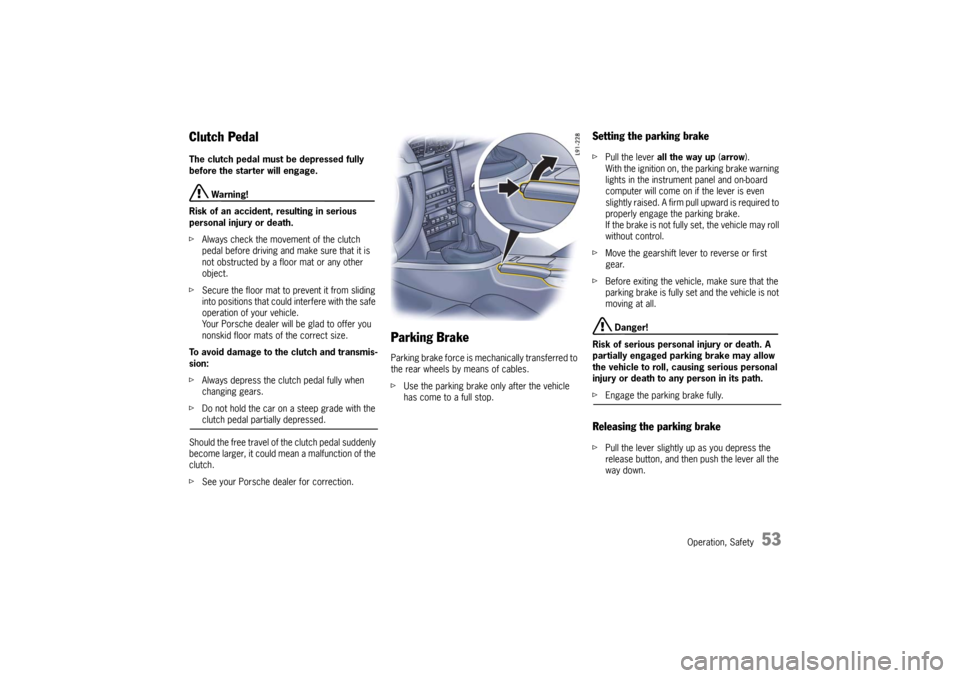
Parking Brake Parking brake force is mechanically transferred to
the rear wheels by means of cables.
fUse the parking brake only after the vehicle
has come to a full stop.
Setting the parking brake fPull the lever all the way up (arrow).
With the ignition on, the parking brake warning
lights in the instrument panel and on-board
computer will come on if the lever is even
slightly raised. A firm pull upward is required to
properly engage the parking brake.
If the brake is not fully set, the vehicle may roll
without control.
fMove the gearshift lever to reverse or first
gear.
fBefore exiting the vehicle, make sure that the
parking brake is fully set and the vehicle is not
moving at all.
Danger!
Risk of serious personal injury or death. A
partially engaged parking brake may allow
the vehicle to roll, causing serious personal
injury or death to any person in its path.
fEngage the parking brake fully.Releasing the parking brakefPull the lever slightly up as you depress the
release button, and then push the lever all the
way down.
10_GT3_21.book Seite 53 Donnerstag, 4. Juni 2009 12:48 12
Page 55 of 251
54
Operation, Safety The warning lights in the instrument panel and on-
board computer will go out after the parking brake
is fully released.
The warning lights are not an indicator that the
parking brake is fully set; it is only intended to be
a warning to release the parking brake before
driving the car. Caution!
A partially engaged brake will overheat the
rear brakes, reduce their effectiveness and
cause excessive wear.
fRelease the parking brake fully.
fWhen parking your car, always set the parking
brake by pulling all the way up on the lever.
fMove the gearshift lever to reverse or first
gear.
fOn hills also turn the front wheels towards the
curb.
Brakes fMake it a habit to check the operation of your
brakes before driving.
Keep in mind that the braking distance increases
very rapidly as the speed increases. At 60 mph or
100 km/h, for example, it is not twice but four
times longer than 30 mph or 50 km/h. Tire
traction is also less effective when the roads are
wet or slippery.
fTherefore, always maintain a safe distance
from the car in front of you.
Vehicles without Porsche Ceramic Compo-
site Brake (PCCB)
Even though the brake discs consist of alloyed
grey cast iron, they will unavoidably start to
corrode if your car is parked for an extended
period. The brakes will tend to “rub” as a result.
The nature, extent and effects of corrosion
depend on the amount of time the vehicle was
parked, whether granular or liquid road salt was
spread and whether grease-dissolving agents
were used in car washes.
If the braking comfort is noticeably impaired, we
recommend having the brake system checked by
experts at an authorized Porsche dealer.
Brake system function Your Porsche is equipped with a power assisted
hydraulic dual circuit brake system with disc
brakes at the front and rear.
Both circuits function independently. One brake
circuit operates the front and the other operates
the rear.
If one brake circuit has failed, the other will still
operate. However, you will notice an increased
pedal travel when you apply the brakes.
Failure of one brake circuit will cause the stopping
distance to increase.
Warning!
Risk of an accident, resulting in serious
personal injury or death.
In the unlikely event of hydraulic failure of
one brake circuit:
fPush the brake pedal down firmly and hold it in
that position.
A mechanical linkage activates the second
circuit, and you will be able to bring the vehicle
to a stop.
fAfter bringing your vehicle to a complete stop,
avoid driving the vehicle and instead have it
towed to the nearest authorized Porsche dealer for repair.
Parking brake warning light USA
Parking brake warning light
Canada
10_GT3_21.book Seite 54 Donnerstag, 4. Juni 2009 12:48 12
Page 56 of 251

Operation, Safety
55
Brake system warning light
You can check the functionality of the brake
system warning light by switching the ignition to
the “On” position and verifying that the warning
light illuminates.
If the warning lights in the instrument panel and on-
board computer go on while driving, the brake
fluid level may be too low, or (if the brake pedal
travel has increased) one of the two brake circuits
may have failed.
A greater braking pressure will be required,
stopping distances will be longer and the braking
behavior will change, particularly in curves.
With correctly adjusted brakes, and a correctly
working brake system, the pedal travel to the
point of brake actuation should be 1-3/16 in. to
1-9/16 in. or 30 to 40 mm.
Whenever the brake pedal travel exceeds this
distance, have the brake system checked.
Brake pedal
Warning!
Risk of an accident, resulting in serious
personal injury or death.
Any obstruction of the brake pedal could
increase the stopping distance.
fAlways check the movement of the brake pedal
before driving and make sure that it is not
obstructed by a floor mat or any other object.
fSecure the floor mat to prevent it from sliding
into positions that could interfere with the safe
operation of your vehicle.
Your Porsche dealer will be glad to offer you nonskid floor mats of the correct size.
Note
In case one of the two brake circuits fails, incre-
ased pedal travel is required to bring your vehicle
to a full stop.
Warning!
To avoid overheating and premature wear of
the brakes:
fBefore descending a steep grade, reduce
speed and shift the transmission into a lower
gear to control speed.
fDo not “ride the brakes” by resting your foot on
the pedal when not intending to apply brake
pressure.
fDo not hold the pedal down too long or too
often.
This could cause the brakes to get hot and not function properly.
Brake warning light USA
Brake warning light Canada
10_GT3_21.book Seite 55 Donnerstag, 4. Juni 2009 12:48 12
Page 57 of 251

56
Operation, Safety
Brake booster The brake booster assists braking only when
the engine is running.
When the car is moving while the engine is not
running, or if the brake booster is defective, more
pressure on the brake pedal is required to bring
the car to a stop.
If this happens, ABS and PSM will also not
operate.
Moisture or road salt on brakes affects braking.
Brakes will dry after a few cautious brake applica-
tions.
Warning!
Risk of an accident, resulting in serious
personal injury or death.
Driving through water may reduce the
traction.
Moisture on brakes from road water, car
wash, or coating of road salt may affect
braking efficiency.
fCautiously apply brakes to test brakes after exposure to road water, etc.
Brake wear Your car has excellent brakes, but they are still
subject to wear. The rate at which they wear
depends on how the brakes are used.
fHave the brake system inspected at the
intervals recommended in your Maintenance
Booklet.
Brake system warning light
You can check the functionality of the brake
system warning light by switching the ignition to
the “On” position and verifying that the warning
light illuminates.
If the warning lights in the instrument panel and on-
board computer stay on when the engine is
running or come on while driving, the brake pads
are worn excessively.
fDo not continue to operate the vehicle.
Have your authorized Porsche dealer inspect
or replace the brake pads.
Brake pads Wear on the brake pads and brake discs depends
to a great extent on the driving style and the condi-
tions of use and therefore cannot be expressed in
actual miles on the road.
The high-performance brake system is designed
for optimal braking effect at all speeds and tempe-
ratures.
Certain speeds, braking forces and ambient
conditions (such as temperature and humidity)
therefore might cause “brake noises”. This also
applies after completion of the breaking-in period
required for the new brake components.
New brake pads or linings
New brake pads and brake discs have to be
“broken in”, and therefore only attain optimal
friction when the car has covered several hundred
miles or km.
The slightly reduced braking ability must be
compensated for by pressing the brake pedal
harder. This also applies whenever the brake pads
and brake discs are replaced.
Warning light USA
Warning light Canada
10_GT3_21.book Seite 56 Donnerstag, 4. Juni 2009 12:48 12
Page 59 of 251

58
Operation, Safety When the ignition is switched on the ABS warning
light will light up while the system is electronically
interrogated and goes out when the engine is
started if the check is not yet complete.
If the ABS warning lamp fails to go out, this
indicates that ABS has been deactivated due to a
fault. If the warning lights in the instrument panel
and on-board computer light up while you are
driving, this indicates that a fault has occurred. In
both cases, normal braking, as in vehicles without
ABS, is still retained.
The ABS system should, however, be examined at
an authorized Porsche dealer immediately to
prevent the occurrence of further faults.
fIf the ABS system becomes inoperative, take
your vehicle to your authorized Porsche dealer
immediately.
Warning!
Risk of an accident, resulting in serious
personal injury or death.
The control unit of the ABS brake system is
set for standard tire size. If non-standard
tires are installed, the control unit may misin-
terpret the speed of the vehicle, because of
the variant data it receives from the sensors
on the axles.
fUse only tire makes and types tested by Porsche.
Warning light USA
Warning light Canada
10_GT3_21.book Seite 58 Donnerstag, 4. Juni 2009 12:48 12
Page 60 of 251

Operation, Safety
59
Porsche Stability Management
(PSM)PSM is an active control system for stabilization of
the vehicle during extreme driving maneuvers.
Warning!
Risk of an accident, resulting in serious
personal injury or death.
The increased control that is provided should
not induce you to take greater risks with your
safety. The limits dictated by the laws of
physics cannot be overcome, even with PSM.
The risk of accidents due to inappropriate
speed cannot be reduced, even by PSM.
The driver bears the responsibility for all
driving maneuvers.
fAdapt your driving style to the prevailing road
and weather conditions.
fObey all traffic laws.
Sensors at the wheels, brakes, steering system
and engine continuously measure:
–Speed
– Direction of travel (steering angle)
– Lateral acceleration
– Rate of turn about the vertical axis
– Longitudinal accelerationPSM uses these values to determine the direction
of travel indicated by the driver.
PSM intervenes and helps to correct the course if
the actual direction of motion deviates from the
chosen course (steering-wheel position):
It brakes individual wheels as needed. In addition,
the engine power may be manipulated in order to
stabilize the vehicle.
The events below inform the driver of PSM control
operations and warn him/her to adapt his/her
driving style to the road conditions:
– The multifunctional information light on the
instrument panel flashes.
– Hydraulic noises can be heard.
– The vehicle decelerates and steering-wheel
forces are altered as PSM controls the brakes.
– Reduced engine power.
– The brake pedal pulsates and its position is
changed during braking.
In order to achieve full vehicle deceleration,
foot pressure must be increased after the
brake pedal has begun vibrating.
Advantages of PSM– Improved traction and lane-holding ability in all
driving situations – even on road surfaces with
varying friction.
– The system compensates for undesired lateral
vehicle reactions when the driver releases the
accelerator pedal or brakes when cornering.
This compensation functions up to the
maximum lateral acceleration.
– PSM actively helps stabilize the vehicle as
required during dynamic driving maneuvers
(e.g. rapid steering movements, during lane
changes or on alternating bends).
– Improved braking stability in curves and on
different or varying road surfaces.
10_GT3_21.book Seite 59 Donnerstag, 4. Juni 2009 12:48 12