ESP PORSCHE 911 TURBO 2014 6.G User Guide
[x] Cancel search | Manufacturer: PORSCHE, Model Year: 2014, Model line: 911 TURBO, Model: PORSCHE 911 TURBO 2014 6.GPages: 300, PDF Size: 10.61 MB
Page 41 of 300
Seats, Mirrors and Steering Wheel 39
fSit back as far from the dashboard or steering wheel as is practical, while still maintaining full vehicle control.fAlways hold the steering wheel by the outer rim. Never rest your hands on the center of the steering wheel where the airbag module is located.fAlways keep feet in the footwell while driving. Do not put feet on the dashboard or the seat area. Do not lean against the inside of the door or outside the window while the vehicle is moving.
Objects and load have to be stored securely to keep from causing injury.fDo not transport heavy objects on or in front of the passenger seat. These could impair the function of the airbags, the safety belts, and occupant sensing.fDo not hang objects (e.g., jackets, coats, coat hangers) over the backrest.fObjects must not protrude out of the door storage compartment.fDo not add any additional coverings or stickers to the steering wheel or in the area of the passenger airbag, side airbags, knee airbags, and head airbags. Doing so may adversely affect the functioning of the airbag system or cause harm to the occupants if the airbag system should deploy.Do not use protective seat covers.
fNo objects should be placed over or near the airbag on the instrument panel, because any such objects could cause harm if the vehicle is in a crash severe enough to cause the airbag to inflate.fGive your passenger all of the information in this chapter.
A modified airbag system cannot offer protection. They may not trigger or could trigger in an uncontrolled way. An uncontrolled triggering of the airbag system can result in serious personal injury or death.fDo not modify the seat coverings, since such changes can block the seat-mounted side airbag. Do not attach additional cushions, protective coverings, or pillows to the seats. Do not affix things to the seats or cover them with other materials. Do not cover the back of the backrest. Do not make changes to the seats, the cushion or foam, the occupant sensor, and to the seat base frame.fNo changes must be made to the wiring or components of the airbag system. Doing so may disable the airbag system or cause inadvertent inflation.fDo not install any wiring for electrical accessory equipment in the vicinity of the airbag wiring harnesses. Doing so may disable the airbag system or cause inadvertent inflation.
fIf the warning light comes on, the airbag system should be repaired immediately by your authorized Porsche dealer.fUsing accessories not approved by Porsche can cause the occupant sensing to be impaired.fDo not squeeze objects, such as the fire extinguisher, or first aid kit under the seat.fOnly have seats removed and installed by an authorized Porsche dealer so that occupant sensing components will not be damaged.
Information
Airbag components (e.g. steering wheel, door lining, seats) may be disassembled only by an authorized Porsche dealer.fWhen disposing of a used airbag unit, our safety instructions must be followed. These instructions can be obtained at any authorized Porsche dealer.
Function of the airbag system
Airbags are a supplemental safety system. Your primary protection comes from your safety belts.
The front airbags are triggered during a frontal collision of sufficient force and direction.In the event of a side impact of corresponding force, the side airbag on the impact side is triggered.
Safe Storage of ObjectsDANGERh
Modification to Airbag SystemDANGERh
14_991_Turbo_21.book Seite 39 Mittwoch, 9. April 2014 2:19 14
Page 42 of 300
40 Seats, Mirrors and Steering Wheel
The inflation process generates the amount of gas required to fill the airbags at the necessary pressure in fractions of a second.
Airbags help to protect the head and body, while simultaneously damping the motion of the driver and passenger in the impact direction in the event of a frontal impact or side impact.
In order to help provide protection in severe collisions which can cause death and serious injury, airbags must inflate extremely rapidly. Such high speed inflation has a negative but unavoidable side effect, which is that it can and does cause injuries, including facial and arm abrasions, bruising and broken bones. You can help minimize such injuries by always wearing your safety belts.
There are many types of accidents in which airbags are not expected to deploy. These include accidents where the airbags would provide no benefit, such as a rear impact against your vehicle. Other accidents where the airbags are designed not to deploy are those where the risk of injury from the airbag deployment could exceed any protective benefits, such as in low speed accidents or higher speed accidents where the vehicle decelerates over a longer time. Since airbag deployment does not occur in all accidents, this further emphasizes the need for you and your passengers to always wear safety belts.
Your Porsche vehicle is equipped with electronically controlled systems that help to ensure your vehicle operates properly. These systems monitor the operation of various systems and electronically store information that is useful to service technicians when they need to diagnose and repair these systems.
Your vehicle is equipped with crash-sensing and diagnostic devices that may record information at the time of a collision, including whether the airbag and seatbelt pretensioners deployed and whether the safety belt was in use.
To retrieve this information, special equipment is needed and access to the vehicle or feature that stores that data is required. Some states only allow access to such information under restricted circumstances, including: – In response to a request of police or other government office; or – with the consent of the registered owner, or if the vehicle is leased, with the lessee, or – through a discovery process in litigation; or as otherwise permitted or required by law.
Your rights with respect to the information discussed above may vary from state to state. Check your state law for further information.
Advanced airbag
Your vehicle is equipped with occupant sensing for the passenger's seat in accordance with U.S. Federal Motor Vehicle Safety Standard 208. Depending on the weight, body positioning and shape acting on the passenger's seat, the passenger’s airbag will automatically be switched on and off.
Depending on the angle and force of impact, the passenger's airbag which is switched-on will be triggered during a collision.
Precondition for switching the passenger's airbag on and off, depending on weight, body positioning and shape:– Ignition is switched on.
Improper seating can unintentionally impair operation of occupant sensing of the passenger’s airbag.
If the weight of an adult on the passenger's seat is not properly maintained, the passenger's airbag may be switched off.fSelect an upright seat position, and do not support weight on the armrests or center console, or lean out of the window while driving. Always keep feet positioned on the floor in the footwell while driving. Do not put feet on the dashboard or the seat area.
Improper Front Passenger Seating
WARNINGh
14_991_Turbo_21.book Seite 40 Mittwoch, 9. April 2014 2:19 14
Page 50 of 300
48 Seats, Mirrors and Steering Wheel
Roll-Over Protection
On the Cabriolet, a roll-over protection system installed behind the rear seats is extended within fractions of a second in the event of an accident. This generates a loud noise. If necessary, the seat-belt tensioners for the front seats will be activated.fPlease see the chapter “SAFETY-BELT PRETENSIONER” on page 37.
The roll-over protection system consists of two extendable assemblies which, together with the windshield frame, ensure sufficient headroom for all occupants if the vehicle rolls over.
Risk of damage to the convertible top and roll-over protection when opening and closing the convertible top.
Extended roll-over protection will obstruct the movement of the convertible top.fDo not open or close the convertible top with the roll-over protection extended.
A roll-over protection system that has been tampered with or obstructed in its movement may malfunction, resulting in serious or fatal injury.
A roll-over protection system that has been tampered with does not offer any protection. It may be triggered inadvertently, or not respond when needed. fDo not modify the wiring or components of the roll-over protection system.fKeep body parts and objects out of the area of movement of the extendable assemblies.fDo not open the covers of the extendable assemblies.fMake sure that no water or cleaning agents get into the roll-over protection system when cleaning the vehicle.
fIf the roll-over protection system is in any way faulty, please contact an authorized Porsche dealer to do this work.
Information
If the roll-over protection is triggered when the convertible top is closed, the rear window is destroyed.
Airbag Warning light
If the roll-over protection system is faulty, the airbag warning light on the instrument cluster will light up. Extension of the extendable assemblies is not ensured.fHave the fault repaired immediately at an authorized Porsche dealer.
Triggered roll-over protection system
fNever press the extendable assemblies back into the original position.fPlease contact an authorized Porsche dealer.
NOTICE
DANGERh
14_991_Turbo_21.book Seite 48 Mittwoch, 9. April 2014 2:19 14
Page 57 of 300
Air Conditioning 55
Automatically Controlled 2-zone
Air Conditioning
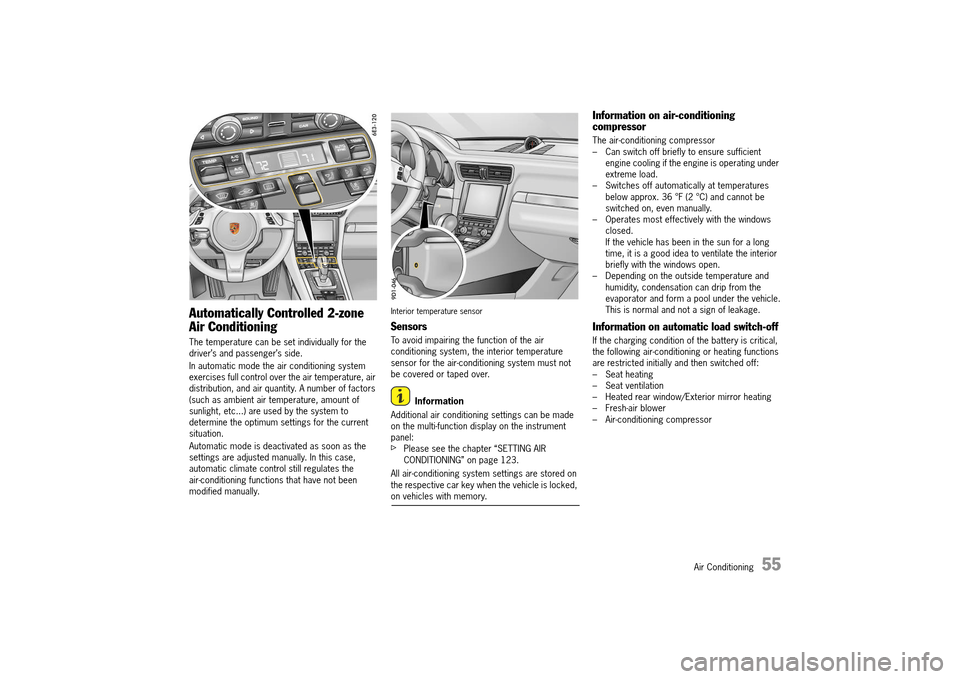
The temperature can be set individually for the driver’s and passenger’s side.
In automatic mode the air conditioning system exercises full control over the air temperature, air distribution, and air quantity. A number of factors (such as ambient air temperature, amount of sunlight, etc...) are used by the system to determine the optimum settings for the current situation.
Automatic mode is deactivated as soon as the settings are adjusted manually. In this case, automatic climate control still regulates the air-conditioning functions that have not been modified manually.
Interior temperature sensor
Sensors
To avoid impairing the function of the air conditioning system, the interior temperature sensor for the air-conditioning system must not be covered or taped over.
Information
Additional air conditioning settings can be made on the multi-function display on the instrument panel:fPlease see the chapter “SETTING AIR CONDITIONING” on page 123.
All air-conditioning system settings are stored on the respective car key when the vehicle is locked, on vehicles with memory.
Information on air-conditioning compressor
The air-conditioning compressor – Can switch off briefly to ensure sufficient engine cooling if the engine is operating under extreme load.– Switches off automatically at temperatures below approx. 36 °F (2 °C) and cannot be switched on, even manually.– Operates most effectively with the windows closed.If the vehicle has been in the sun for a long time, it is a good idea to ventilate the interior briefly with the windows open.– Depending on the outside temperature and humidity, condensation can drip from the evaporator and form a pool under the vehicle.This is normal and not a sign of leakage.
Information on automatic load switch-off
If the charging condition of the battery is critical, the following air-conditioning or heating functions are restricted initially and then switched off:– Seat heating– Seat ventilation– Heated rear window/Exterior mirror heating– Fresh-air blower– Air-conditioning compressor
14_991_Turbo_21.book Seite 55 Mittwoch, 9. April 2014 2:19 14
Page 81 of 300
Lights, Turn Signals and Windshield Wipers 79
Information
If the ignition key is removed and the door is opened while the lights are on, an audible signal (gong) warns of possible battery discharge.– In some countries, differences are possible due to legal requirements.
The vehicle’s exterior lights can mist up due to temperature and humidity. This misting will dry off after a sufficient distance has been driven.
Low beam/driving light
If the light switch is set to the position , the low beam is switched on automatically in the following situations:– Dusk– Darkness– Driving through tunnels– Rain– Highway driving (on vehicles with Porsche Dynamic Light System PDLS)
When the low beam is switched on, the indicator light on the speedometer lights up.
Information
Fog is not automatically recognized.fIn the event of fog, the driving light must be switched on manually.
Daytime driving lights
If the light switch is set to position (light off), the daytime driving lights come on automatically when the ignition is switched on.
If the light switch is set to position , the daytime driving lights come on automatically in bright conditions and when the ignition is switched on.
The daytime driving lights are not active when the light switch is set to position (low beam/driving light).
Automatic driving light assistant
The automatic driving light assistant is a comfort function. The driving light (low beam) is switched on and off automatically depending on the ambient brightness.
The automatic driving light assistant also controls the daytime driving lights, low beam, Automatic Coming Home lights and the equipment-dependent dynamic cornering light.
The automatic driving light assistant is activated when the light switch is set to the position .
Despite possible support by the driving light assistant, it is the responsibility of the driver to switch on the driving light using the conventional light switch in accordance with the relevant national regulations.
Activating the headlights using the driving light assistant therefore does not absolve the driver of responsibility for correct operation of the driving light.
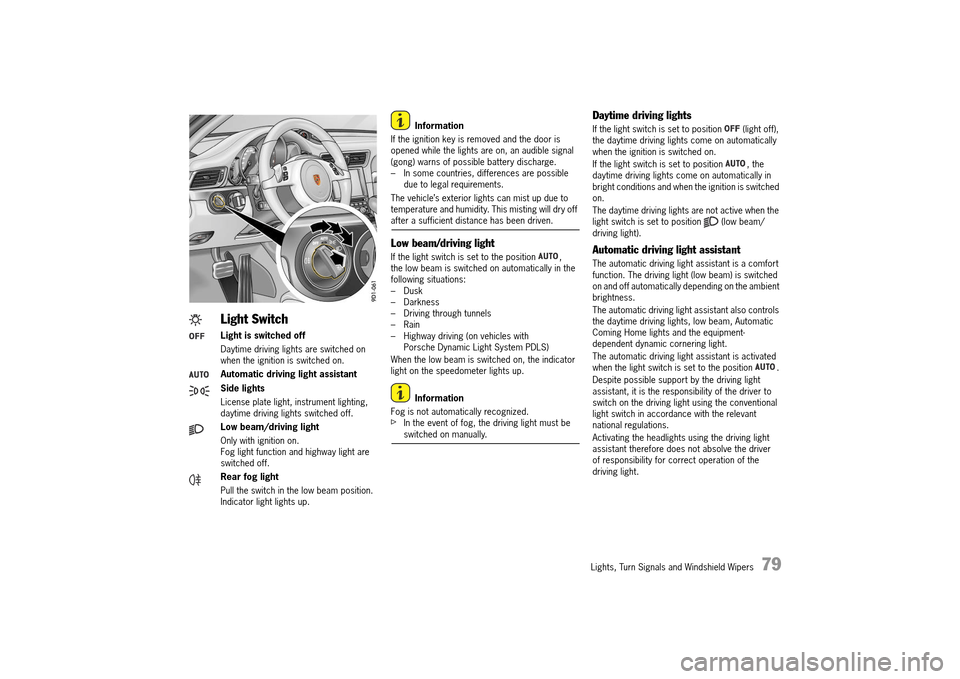
Light Switch
Light is switched off
Daytime driving lights are switched on when the ignition is switched on.
Automatic driving light assistant
Side lights
License plate light, instrument lighting, daytime driving lights switched off.
Low beam/driving light
Only with ignition on. Fog light function and highway light are switched off.
Rear fog light
Pull the switch in the low beam position. Indicator light lights up.
14_991_Turbo_21.book Seite 79 Mittwoch, 9. April 2014 2:19 14
Page 83 of 300
Lights, Turn Signals and Windshield Wipers 81
Porsche Dynamic Light System Plus (PDLS Plus)
High Beam Assistant
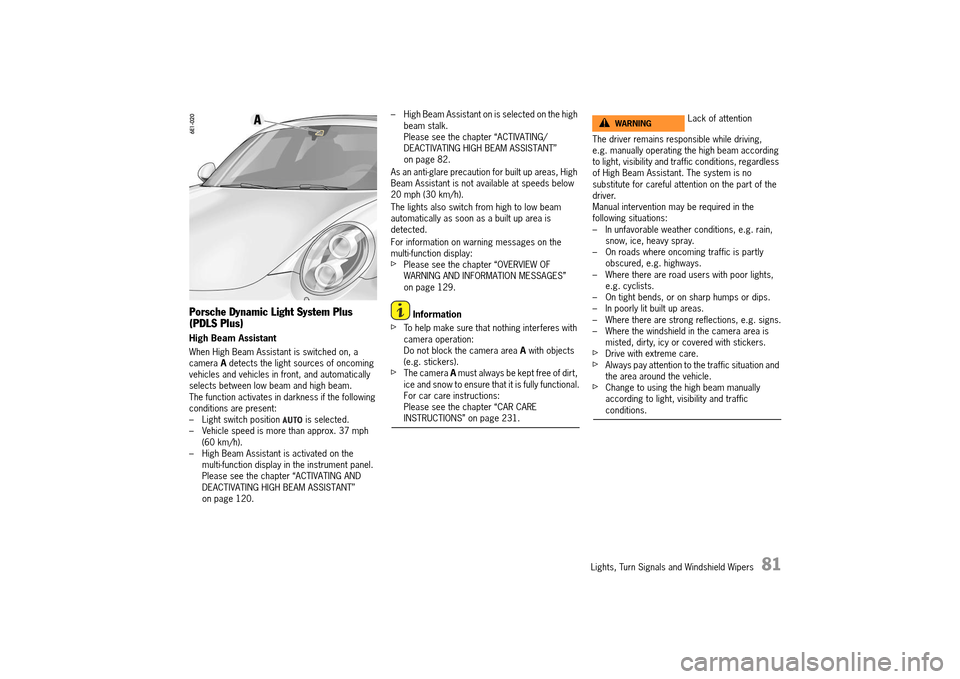
When High Beam Assistant is switched on, a camera A detects the light sources of oncoming vehicles and vehicles in front, and automatically selects between low beam and high beam.The function activates in darkness if the following conditions are present:– Light switch position is selected.– Vehicle speed is more than approx. 37 mph (60 km/h).– High Beam Assistant is activated on the multi-function display in the instrument panel.Please see the chapter “ACTIVATING AND DEACTIVATING HIGH BEAM ASSISTANT” on page 120.
– High Beam Assistant on is selected on the high beam stalk.Please see the chapter “ACTIVATING/DEACTIVATING HIGH BEAM ASSISTANT” on page 82.
As an anti-glare precaution for built up areas, High Beam Assistant is not available at speeds below 20 mph (30 km/h).
The lights also switch from high to low beam automatically as soon as a built up area is detected.
For information on warning messages on the multi-function display:fPlease see the chapter “OVERVIEW OF WARNING AND INFORMATION MESSAGES” on page 129.
Information
fTo help make sure that nothing interferes with camera operation:Do not block the camera area A with objects (e.g. stickers).fThe camera A must always be kept free of dirt, ice and snow to ensure that it is fully functional.For car care instructions: Please see the chapter “CAR CARE INSTRUCTIONS” on page 231.
The driver remains responsible while driving, e.g. manually operating the high beam according to light, visibility and traffic conditions, regardless of High Beam Assistant. The system is no substitute for careful attention on the part of the driver.Manual intervention may be required in the following situations:– In unfavorable weather conditions, e.g. rain, snow, ice, heavy spray.– On roads where oncoming traffic is partly obscured, e.g. highways.– Where there are road users with poor lights, e.g. cyclists.– On tight bends, or on sharp humps or dips.– In poorly lit built up areas.– Where there are strong reflections, e.g. signs.– Where the windshield in the camera area is misted, dirty, icy or covered with stickers.fDrive with extreme care.fAlways pay attention to the traffic situation and the area around the vehicle.fChange to using the high beam manually according to light, visibility and traffic conditions.
Lack of attentionWARNINGh
14_991_Turbo_21.book Seite 81 Mittwoch, 9. April 2014 2:19 14
Page 90 of 300
88 Lights, Turn Signals and Windshield Wipers
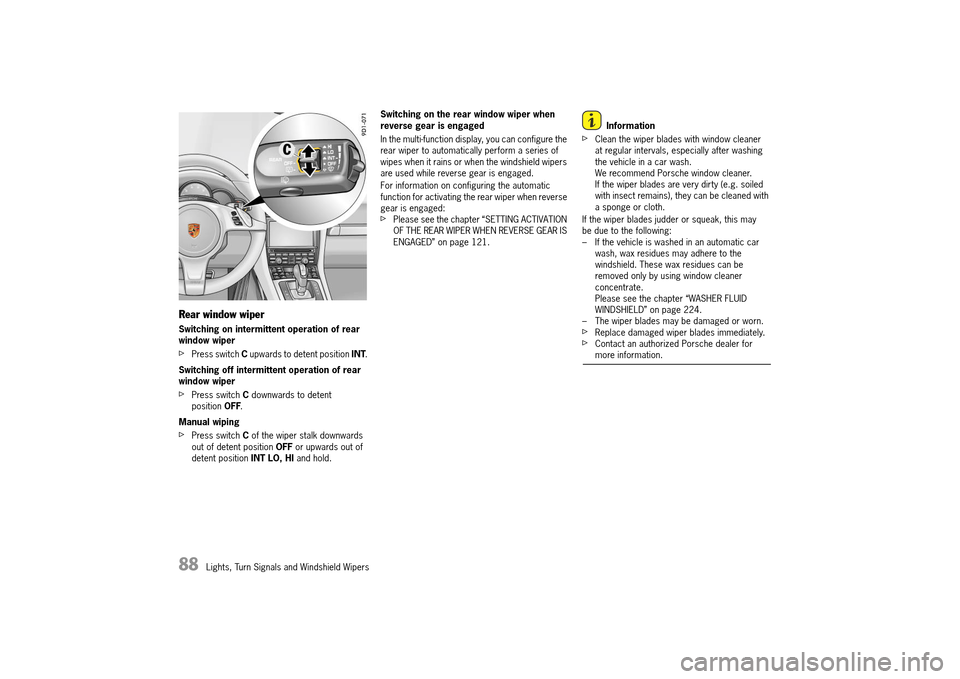
Rear window wiper
Switching on intermittent operation of rear window wiper
fPress switch C upwards to detent position INT.
Switching off intermittent operation of rear window wiper
fPress switch C downwards to detent position OFF.
Manual wiping
fPress switch C of the wiper stalk downwards out of detent position OFF or upwards out of detent position INT LO, HI and hold.
Switching on the rear window wiper when reverse gear is engaged
In the multi-function display, you can configure the rear wiper to automatically perform a series of wipes when it rains or when the windshield wipers are used while reverse gear is engaged.
For information on configuring the automatic function for activating the rear wiper when reverse gear is engaged:fPlease see the chapter “SETTING ACTIVATION OF THE REAR WIPER WHEN REVERSE GEAR IS ENGAGED” on page 121.
Information
fClean the wiper blades with window cleaner at regular intervals, especially after washing the vehicle in a car wash.We recommend Porsche window cleaner. If the wiper blades are very dirty (e.g. soiled with insect remains), they can be cleaned with a sponge or cloth.
If the wiper blades judder or squeak, this may be due to the following:– If the vehicle is washed in an automatic car wash, wax residues may adhere to the windshield. These wax residues can be removed only by using window cleaner concentrate.Please see the chapter “WASHER FLUID WINDSHIELD” on page 224.– The wiper blades may be damaged or worn.fReplace damaged wiper blades immediately.fContact an authorized Porsche dealer for more information.
14_991_Turbo_21.book Seite 88 Mittwoch, 9. April 2014 2:19 14
Page 96 of 300
94 Instrument Panel and Multi-Function Display
K – PDK indicator for selector-lever position
When the engine is running, the selector-lever position is indicated in gates D or M.
Warning messages
If the selector lever is between two positions
– Effects: The corresponding selector-lever position in the instrument panel flashes and the warning “ Engage gear selector properly” appears on the multi-function display.– Action required:Operate the footbrake and engage the selector lever properly.
If there is a fault in the transmission – Depending on priority, either the “ Transm. fault Poss. no R gear Drive on poss. ” warning or the warning “ Transm. failure Park vehicle safely ” will appear on the multi- function display.
Transm. fault Poss. no R gear Drive on poss.
– Effects: Restricted gearshift comfort,reverse gear may not function.fAction required:Have the fault corrected immediately at an authorized Porsche dealer.
Transm. failure Park vehicle safely
– Effect: Vehicle can be driven only until it comes to a stop. – Action required:It is not possible to continue driving. Stop the vehicle immediately in a suitable place. Have the fault corrected at an authorized Porsche dealer. If the vehicle has to be towed:Please see the chapter “TOWING” on page 278.
Warning “ Drive temperature too high Reduce load ” – Effects:“Warning jerks” can be felt when driving off and the engine power may be restricted.– Action required:Do not hold the vehicle with the accelerator on a hill, for example. Hold the vehicle with the brake. Reduce engine load. Stop the vehicle in a suitable place if possible. Allow the engine to run in selector-lever position P or N until the warning disappears.fPlease see the chapter “LIMP-HOME MODE” on page 178.
Porsche Doppelkupplung
When the engine is running, the display shows the currently engaged gear.
L – Fuel gauge
The fuel gauge displays the contents of the tank when the ignition is on.
For information on fuel quality and refill capacities:fPlease see the chapter “FILLING CAPACITIES” on page 289.
For information on fuel and refueling:fPlease see the chapter “FUEL” on page 227.
If the vehicle’s inclination changes (e.g. uphill/ downhill driving), minor deviations in the gauge may occur.
Fuel reserve warning
If less than approximately 3.2 U.S. gallons (12 liters) remains in the tank, the warning light on the multi-function display lights up when the ignition is switched on or the engine is running. fRefuel at the next opportunity.
A shortage of fuel may damage the emission control system. fNever drive the tank dry.fIf the warning lights have come on, do not take bends at high speed.
For information on the emission control system:fPlease see the chapter “EMISSION CONTROL SYSTEM” on page 225.
NOTICE
14_991_Turbo_21.book Seite 94 Mittwoch, 9. April 2014 2:19 14
Page 107 of 300
Instrument Panel and Multi-Function Display 105
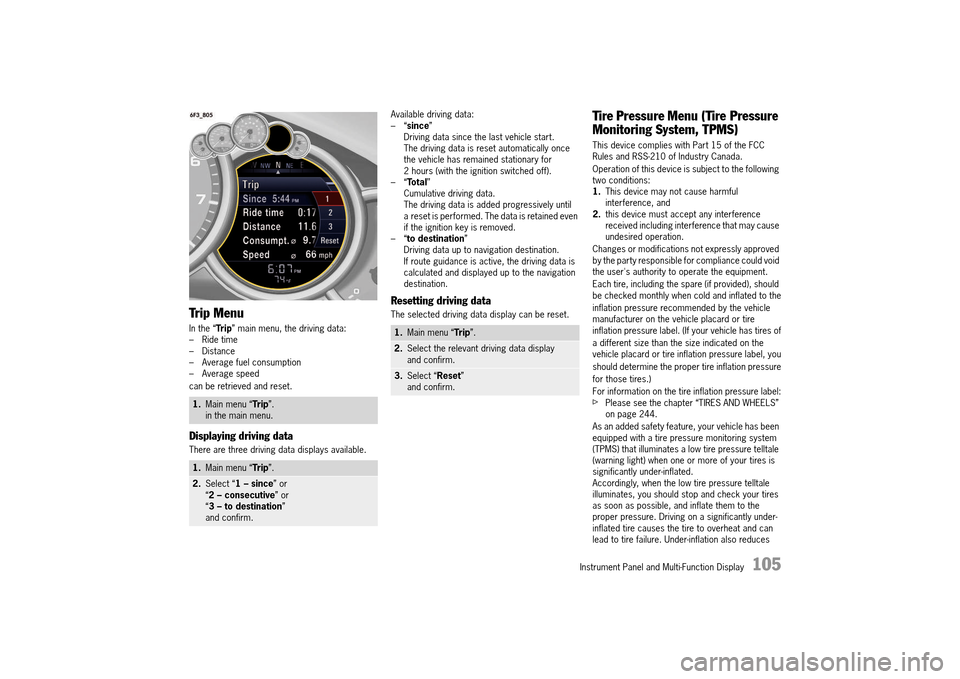
Trip Menu
In the “Trip” main menu, the driving data: – Ride time– Distance– Average fuel consumption– Average speed
can be retrieved and reset.
Displaying driving data
There are three driving data displays available.
Available driving data: –“ since” Driving data since the last vehicle start.The driving data is reset automatically once the vehicle has remained stationary for 2 hours (with the ignition switched off).–“ Total” Cumulative driving data.The driving data is added progressively until a reset is performed. The data is retained even if the ignition key is removed.–“ to destination” Driving data up to navigation destination.If route guidance is active, the driving data is calculated and displayed up to the navigation destination.
Resetting driving data
The selected driving data display can be reset.
Tire Pressure Menu (Tire Pressure
Monitoring System, TPMS)
This device complies with Part 15 of the FCC Rules and RSS-210 of Industry Canada.
Operation of this device is subject to the following two conditions:1. This device may not cause harmful interference, and2. this device must accept any interference received including interference that may cause undesired operation.
Changes or modifications not expressly approved by the party responsible for compliance could void the user's authority to operate the equipment.
Each tire, including the spare (if provided), should be checked monthly when cold and inflated to the
inflation pressure recommended by the vehicle manufacturer on the vehicle placard or tire inflation pressure label. (If your vehicle has tires of
a different size than the size indicated on the vehicle placard or tire inflation pressure label, you
should determine the proper tire inflation pressure
for those tires.)
For information on the tire inflation pressure label:fPlease see the chapter “TIRES AND WHEELS” on page 244.
As an added safety feature, your vehicle has been equipped with a tire pressure monitoring system (TPMS) that illuminates a low tire pressure telltale (warning light) when one or more of your tires is significantly under-inflated.Accordingly, when the low tire pressure telltale illuminates, you should stop and check your tires as soon as possible, and inflate them to the proper pressure. Driving on a significantly under-inflated tire causes the tire to overheat and can lead to tire failure. Under-inflation also reduces
1. Main menu “Trip”. in the main menu.
1. Main menu “Trip”.
2.Select “1 – since” or “ 2 – consecutive” or “ 3 – to destination” and confirm.
1. Main menu “Trip”.
2.Select the relevant driving data display and confirm.
3. Select “Reset” and confirm.
14_991_Turbo_21.book Seite 105 Mittwoch, 9. April 2014 2:19 14
Page 108 of 300
106 Instrument Panel and Multi-Function Display
fuel efficiency and tire tread life, and may affect the vehicle’s handling and stopping ability.
The display as well as the settings for the Tire Pressure Monitoring System take place on the multi-function display.
However, the tire pressure must still be set manually on the wheel.fPlease see the chapter “TIRE PRESSURE FOR COLD TIRES (68 °F/ 20 °C)” on page 287.
Driving the vehicle with low tire pressure increases the risk of a tire failure and resulting loss of control. Furthermore, low tire pressure increases rate of wear of the affected tires.Please note that the Tire Pressure Monitoring System is not a substitute for proper tire maintenance, and it is the driver's responsibility to maintain correct tire pressure, even if under-inflation has not reached the level to trigger illumination of Tire Pressure Monitoring System low tire pressure telltale. Low tire pressure reduces the road safety of the vehicle and destroys the tire and wheel.
Tire Pressure Monitoring System gives a warning about a pressure drop caused by natural diffusion as well as about a gradual loss of pressure caused by foreign objects.Tire Pressure Monitoring cannot warn you about tire damage that occurs suddenly (e.g. flat tire due to abrupt external effects).fWhen a red tire pressure warning appears, stop immediately in a suitable place and check the tires for damage. If necessary, remedy the damage with a tire sealant.fDo not by any means continue to drive with defective tires.
fSealing the tire with tire sealant is only an emergency repair so you can drive to the nearest specialist workshop.The maximum permitted speed is 50 mph (80 km/h) .fDo not drive with tires in which the tire pressure drops again very quickly. In case of doubt, have tires checked by a specialist workshop.fDefective tires must be replaced immediately at an authorized Porsche dealer.Tires must never be repaired under any circumstances.fIf Tire Pressure Monitoring System is defective (e.g. defective wheel transmitter), contact an authorized Porsche dealer immediately and have the damage repaired. The tire pressure will not be monitored at all or will be monitored only partially when Tire Pressure Monitoring System is defective.
For information on warning messages on the multi- purpose display:fPlease see the chapter “OVERVIEW OF WARNING AND INFORMATION MESSAGES” on page 129.fIncomplete entries or selection of the wrong tires on the multi-purpose display affect the accuracy of warnings and messages.The settings in the tire pressure menu must be updated following a wheel change or changes in vehicle loading.fUse only the pressure differences shown in the “ Fill info” display in the Tire pressure menu or from the corresponding tire pressure warning when correcting the tire pressure.fTires can lose air over time without a tire defect being present. A tire pressure warning
will then appear on the multi-purpose display.Check the tire pressure at the next opportunity.
Warning light
Your vehicle has also been equipped with a TPMS malfunction indicator to indicate when the system is not operating properly.The TPMS malfunction indicator is combined with the low tire pressure telltale.When the system detects a malfunction, the telltale will flash for approximately one minute and then remain continuously illuminated. This sequence will continue upon subsequent vehicle start-ups as long as the malfunction exists.When the malfunction indicator is illuminated, the system may not be able to detect or signal low tire pressure as intended.TPMS malfunctions may occur for a variety of reasons, including the installation of replacement or alternate tires or wheels on the vehicle that prevent the TPMS from functioning properly.fAlways check the TPMS malfunction telltale after replacing one or more tires or wheels on your vehicle to ensure that the replacement or alternate tires and wheels allow the TPMS to continue to function properly.
Maintaining Tire Pressure
WARNINGh
Attention to TPMS Malfunction Indicator
WARNINGh
14_991_Turbo_21.book Seite 106 Mittwoch, 9. April 2014 2:19 14