light PORSCHE 911 TURBO 2014 6.G Manual Online
[x] Cancel search | Manufacturer: PORSCHE, Model Year: 2014, Model line: 911 TURBO, Model: PORSCHE 911 TURBO 2014 6.GPages: 300, PDF Size: 10.61 MB
Page 153 of 300
Driving and Driving Safety 151
Auto Start Stop function display
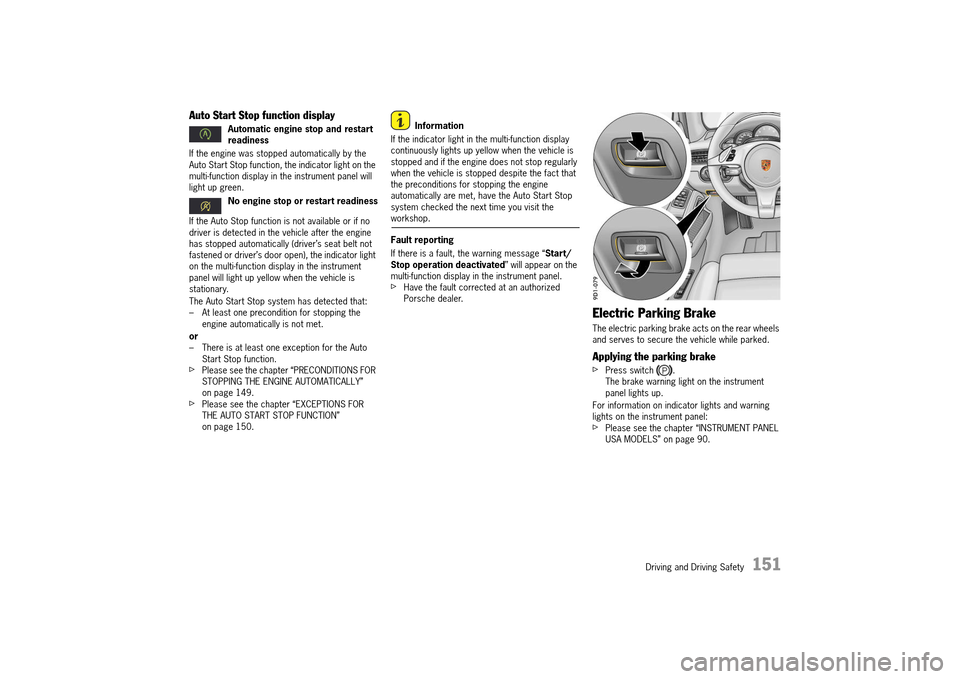
If the engine was stopped automatically by the Auto Start Stop function, the indicator light on the multi-function display in the instrument panel will light up green.
If the Auto Stop function is not available or if no driver is detected in the vehicle after the engine has stopped automatically (driver’s seat belt not fastened or driver’s door open), the indicator light on the multi-function display in the instrument panel will light up yellow when the vehicle is stationary.
The Auto Start Stop system has detected that: – At least one precondition for stopping the engine automatically is not met.
or – There is at least one exception for the Auto Start Stop function.fPlease see the chapter “PRECONDITIONS FOR STOPPING THE ENGINE AUTOMATICALLY” on page 149.fPlease see the chapter “EXCEPTIONS FOR THE AUTO START STOP FUNCTION” on page 150.
Information
If the indicator light in the multi-function display continuously lights up yellow when the vehicle is stopped and if the engine does not stop regularly when the vehicle is stopped despite the fact that the preconditions for stopping the engine automatically are met, have the Auto Start Stop system checked the next time you visit the workshop.
Fault reporting
If there is a fault, the warning message “ Start/ Stop operation deactivated ” will appear on the multi-function display in the instrument panel.fHave the fault corrected at an authorized Porsche dealer.
Electric Parking Brake
The electric parking brake acts on the rear wheels and serves to secure the vehicle while parked.
Applying the parking brake
fPress switch .The brake warning light on the instrument panel lights up.
For information on indicator lights and warning lights on the instrument panel: fPlease see the chapter “INSTRUMENT PANEL USA MODELS” on page 90.
Automatic engine stop and restart readiness
No engine stop or restart readiness
14_991_Turbo_21.book Seite 151 Mittwoch, 9. April 2014 2:19 14
Page 154 of 300
152 Driving and Driving Safety
Releasing the parking brake
The electric parking brake can only be released when the ignition is switched on.1. Press the brake pedal. 2. Pull switch . The brake warning light on the instrument panel goes out.
Automatic electric parking brake release when driver’s intention to drive off is detected
If the engine is running, the driver’s door is closed and the driver’s safety belt is fastened, it is still possible to drive off normally even though the parking brake is on.The electric parking brake detects the driver’s intention to drive off and releases automatically.The warning light on the instrument panel goes out.
If the driver’s door is not closed or the driver’s safety belt is not fastened, the electric parking brake will not be released automatically when the driver attempts to drive off.The message “ Release parking brake” appears on the multi-function display in the instrument panel. The brake warning light on the instrument panel and the indicator light on the switch start to flash.
For information on warning messages on the multi-function display: fPlease see the chapter “OVERVIEW OF WARNING AND INFORMATION MESSAGES” on page 129.
Engaging the electric parking brake automatically
The electric parking brake engages if PDK selector-lever position D, R or M is selected when the vehicle is stationary and the driver’s door is opened. The brake warning light on the instrument panel and the indicator light on the switch light up. For information on warning messages on the multi-function display: fPlease see the chapter “OVERVIEW OF WARNING AND INFORMATION MESSAGES” on page 129.
Emergency braking function
If the vehicle cannot be stopped by conventional braking, you can decelerate sharply and stop the vehicle using the electric parking brake.fPress switch and keep it pressed.The message “ Emergency braking” appears on the multi-function display in the instrument panel. The brake warning light on the instrument panel and the indicator light on the switch start to flash.The emergency braking function is deactivated when you release the switch.
Emergency braking takes place with very high braking power. The following traffic may be endangered.fOnly use the emergency braking function in an emergency situation.fDo not use the emergency braking function to stop the vehicle when driving normally.
Brake warning light USA
Brake warning light Canada
If the electric parking brake could not be applied fully when the vehicle is stopped, the brake warning light on the instrument panel starts to flash.
For information on warning messages on the multi- function display: fPlease see the chapter “OVERVIEW OF WARNING AND INFORMATION MESSAGES” on page 129.
Brakes
fMake it a habit to check the operation of your brakes before driving.
Keep in mind that the braking distance increases very rapidly as the speed increases. At 60 mph (100 km/h), for example, it is not twice but four times longer than 30 mph (50 km/h). Tire traction is also less effective when the roads are wet or slippery.fTherefore, always maintain a safe distance from the car in front of you.
Severe decelerationWARNINGh
14_991_Turbo_21.book Seite 152 Mittwoch, 9. April 2014 2:19 14
Page 155 of 300
Driving and Driving Safety 153
Vehicles without Porsche Ceramic Composite Brake (PCCB)
Even though the brake disks consist of alloyed gray cast iron, they will unavoidably start to corrode if your car is parked for an extended period. The brakes will tend to “rub” as a result.The nature, extent and effects of corrosion depend on the amount of time the vehicle was parked, whether road salt or grit was spread and whether grease-dissolving agents were used in car washes.
If the braking comfort is noticeably impaired, we recommend having the brake system checked by experts at an authorized Porsche dealer.
Brake system function
Your Porsche is equipped with a power assisted hydraulic dual circuit brake system with disk brakes at the front and rear. Both circuits function independently. One brake circuit operates the front left and rear right wheel and the other operates the front right and rear left wheel.
If one brake circuit has failed, the other will still operate. However, you will notice an increased pedal travel when you apply the brakes. Failure of one brake circuit will cause the stopping distance to increase.
Your vehicle is equipped with an emergency function in the extreme event of a complete hydraulic failure of the brake system. If your brake pedal goes all the way to the floor, do not pump the brakes. fPush the brake pedal down firmly and hold it in that position. A mechanical linkage activates the second circuit, and you will be able to bring the vehicle to a stop.fAfter bringing your vehicle to a complete stop, avoid driving the vehicle and instead have it towed to the nearest authorized Porsche dealer for repair.
Brake system warning light
You can check the functionality of the brake system warning light by switching the ignition to the “On” position (position 1) and verifying that the warning light illuminates.
Brake warning light USA
Brake warning light Canada
The warning light in the instrument panel lights up. A message will be displayed on the multi-purpose display of the instrument panel if the brake fluid level is too low, or (if the brake pedal travel has increased) one of the two brake circuits has failed.
A greater braking pressure will be required, stopping distances will be longer and the braking behavior will change, particularly in curves.
With correctly adjusted brakes and a correctly working brake system, the pedal travel to the point of brake application should be 1-3/16 in. to 1-9/16 in. (30 to 40 mm). Whenever the brake pedal travel exceeds this value, have the brake system checked.
Brake pedal
Unsuitable or incorrectly fixed floor mats or objects can reduce the travel of the brake pedal or prevent you applying the brake pedal.fAlways check the movement of the brake pedal before driving and make sure that it is not obstructed by a floor mat or any other object.fSecure the floor mat to prevent it from sliding into positions that could interfere with the safe operation of your vehicle.Your authorized Porsche dealer will be glad to offer you floor mats of the correct size including a securing possibility.
Information
In case one of the two brake circuits fails, increased pedal travel is required to bring your vehicle to a full stop.
Brake Hydraulic Failure Recovery
WARNINGh
Obstruction of Brake Pedal
WARNINGh
14_991_Turbo_21.book Seite 153 Mittwoch, 9. April 2014 2:19 14
Page 156 of 300
154 Driving and Driving Safety
fBefore descending a steep grade, reduce speed and shift the transmission into a lower gear to control speed. fDo not “ride the brakes” by resting your foot on the pedal when not intending to apply brake pressure.fDo not hold the pedal down too long or too often. This could cause the brakes to overheat and lose braking power.
Brake booster
The brake booster assists braking only when the engine is running.
When the car is moving while the engine is not running, or if the brake booster is defective, more pressure on the brake pedal is required to bring the car to a stop.
Moisture, road salt or grit on brakes affects braking. Brakes will dry after a few cautious brake applications.
Driving through water may reduce the traction. Moisture on brakes from road water, car wash, or a coating of road salt or grit may affect braking efficiency.fCautiously apply brakes to test and dry the brakes after exposure to road water, etc.
The brake booster is ready for operation only while the engine is running. If the engine is switched off or there is a defect in the brake booster, much greater force has to be applied to the pedal when braking. fVehicles with defective brakes must not be towed and must be transported on a flat bed.
For information on towing:fPlease see the chapter “TOWING” on page 278.
Brake wear
Your car has excellent brakes, but they are still subject to wear. The rate at which they wear depends on how the brakes are used.fHave the brake system inspected at the intervals recommended in your Maintenance Booklet.
Brake system warning light
You can check the functionality of the brake system warning light by switching the ignition to the “On” position (position 1) and verifying that the warning light illuminates.
A warning message will be displayed on the multi- purpose display of the instrument panel if the brake pads are worn, excessively.fDo not continue to operate the vehicle.Have your authorized Porsche dealer inspect or replace the brake pads.
For information on warning messages on the multi-purpose display:fPlease see the chapter “OVERVIEW OF WARNING AND INFORMATION MESSAGES” on page 129.
Brake pads and brake disks
Wear on the brake pads and brake disks depends to a great extent on the driving style and the conditions of use and therefore cannot be expressed in actual miles on the road.
The high-performance brake system is designed for optimal braking effect at all speeds and temperatures.
Certain speeds, braking forces and ambient conditions (e.g. temperature and humidity) can therefore cause the brakes to “squeal”.
Unsuitable or incorrectly installed floor mats or objects can obstruct the movement of the brake pedal or prevent application of the brake pedal.fDo not obstruct the pedal travel with floor mats or other objects.
Riding the Brakes
Wet Brakes
WARNINGh
WARNINGh
Loss of Braking PowerWARNINGhBrake wear warning message USA
Brake wear warning message Canada
Obstructed Brake PedalWARNINGh
14_991_Turbo_21.book Seite 154 Mittwoch, 9. April 2014 2:19 14
Page 157 of 300
Driving and Driving Safety 155
In heavy rain, while driving through water or after leaving a car wash, the braking action may be delayed and increased pressure may be required.fFor this reason, keep further back from the vehicle in front and “dry” the brakes by applying them at intervals. Make sure that the traffic behind you is not affected.
After a long drive over salted or gritted roads, a coating may form on the brake disks and pads that significantly reduces friction and therefore also braking effect.fEven though the brake disks consist of alloyed gray cast iron, they will unavoidably start to corrode if your vehicle is parked for an extended period. The brakes will tend to “rub” as a result.The nature, extent and effects of corrosion depend on the amount of time the vehicle was parked, whether road salt or grit was spread and whether grease-dissolving agents were used in car washes (not on vehicles with Porsche Ceramic Composite Brake).To prevent corrosion of the brake disks, “brake them dry” before parking the vehicle (not on vehicles with Porsche Ceramic Composite Brake).If braking comfort is noticeably impaired, we recommend that you have the brake system checked by experts at an authorized Porsche dealer.
fTo relieve the brake system on downhill stretches, change down to a lower gear in good time (engine braking).If engine braking is insufficient on steep stretches, operate the footbrake at intervals. Avoid continuous braking as it overheats the brakes and reduces the braking effect.
For information on brake fluid and checking the brake fluid level:fPlease see the chapter “BRAKE FLUID” on page 243.
New brake pads or linings
New brake pads have to be “broken in”, and therefore only attain optimal friction when the car has covered several hundred miles or km.The slightly reduced braking ability must be compensated for by pressing the brake pedal harder. This applies whenever the brake pads and/or brake disks are replaced.
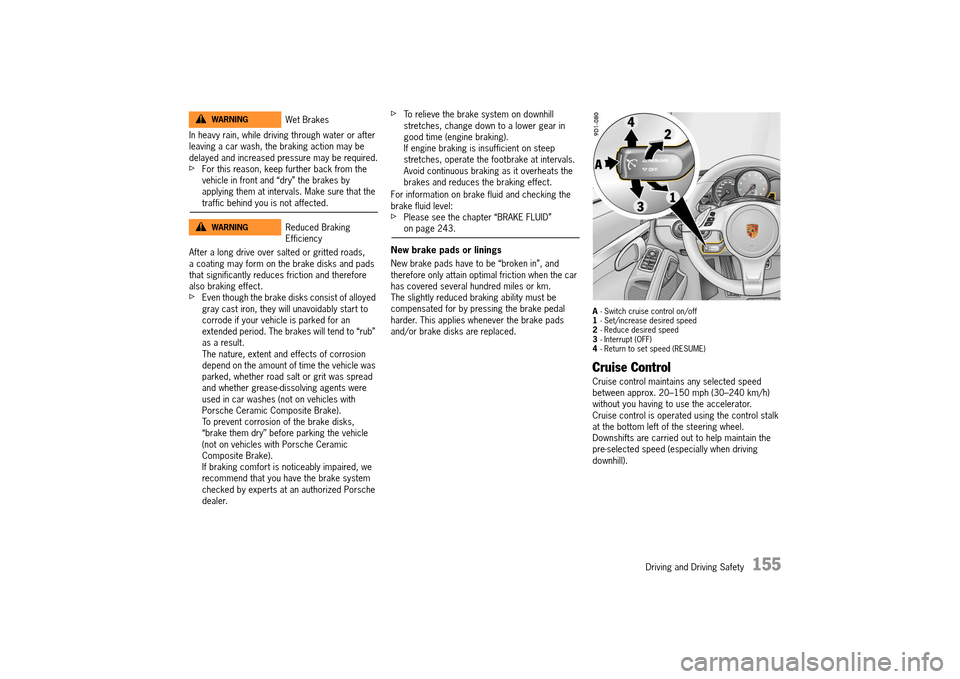
A - Switch cruise control on/off 1 - Set/increase desired speed 2 - Reduce desired speed 3 - Interrupt (OFF) 4 - Return to set speed (RESUME)
Cruise Control
Cruise control maintains any selected speed between approx. 20–150 mph (30–240 km/h) without you having to use the accelerator.Cruise control is operated using the control stalk at the bottom left of the steering wheel.Downshifts are carried out to help maintain the pre-selected speed (especially when driving downhill).
Wet Brakes
Reduced Braking Efficiency
WARNINGh
WARNINGh
14_991_Turbo_21.book Seite 155 Mittwoch, 9. April 2014 2:19 14
Page 165 of 300
Driving and Driving Safety 163
Information
The distance depends on the driving speed. The slower the vehicle is traveling, the shorter the distance and the faster the vehicle is traveling, the longer the distance.
Increasing the desired distance
fPress the rocker switch Z upwards. The desired distance is increased.More orange segments are shown in the desired distance display A.
Reducing the desired distance
fPress the rocker switch Z downwards. The desired distance is reduced.Fewer orange segments are shown in the desired distance display A.
Display showing distance from vehicle in front
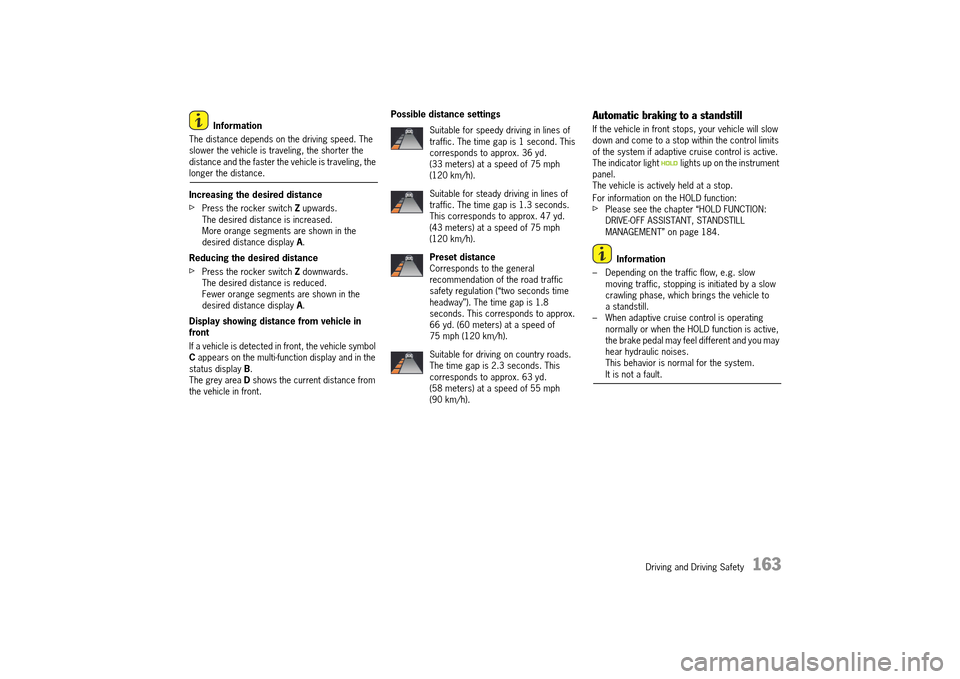
If a vehicle is detected in front, the vehicle symbol C appears on the multi-function display and in the status display B. The grey area D shows the current distance from the vehicle in front.
Possible distance settingsAutomatic braking to a standstill
If the vehicle in front stops, your vehicle will slow down and come to a stop within the control limits of the system if adaptive cruise control is active.The indicator light lights up on the instrument panel.The vehicle is actively held at a stop.
For information on the HOLD function:fPlease see the chapter “HOLD FUNCTION: DRIVE-OFF ASSISTANT, STANDSTILL MANAGEMENT” on page 184.
Information
– Depending on the traffic flow, e.g. slow moving traffic, stopping is initiated by a slow crawling phase, which brings the vehicle to a standstill.– When adaptive cruise control is operating normally or when the HOLD function is active, the brake pedal may feel different and you may hear hydraulic noises.This behavior is normal for the system. It is not a fault.
Suitable for speedy driving in lines of traffic. The time gap is 1 second. This corresponds to approx. 36 yd. (33 meters) at a speed of 75 mph (120 km/h).
Suitable for steady driving in lines of traffic. The time gap is 1.3 seconds. This corresponds to approx. 47 yd. (43 meters) at a speed of 75 mph (120 km/h).
Preset distance Corresponds to the general recommendation of the road traffic safety regulation (“two seconds time headway”). The time gap is 1.8 seconds. This corresponds to approx. 66 yd. (60 meters) at a speed of 75 mph (120 km/h).
Suitable for driving on country roads. The time gap is 2.3 seconds. This corresponds to approx. 63 yd. (58 meters) at a speed of 55 mph (90 km/h).
14_991_Turbo_21.book Seite 163 Mittwoch, 9. April 2014 2:19 14
Page 171 of 300
Driving and Driving Safety 169
Static and fluttering
When the line-of-sight link between a transmitter and vehicle is blocked by large buildings or mountains, the radio sound may be accompanied with static or fluttering because of the characteristic of FM.
In a similar effect, a fluttering noise is sometimes heard when driving along a tree-lined road.
This static and fluttering can be reduced by adjusting the tone control for greater bass response until the disturbance has passed.
Multipath
Because of the reflecting characteristics of FM, direct and reflected signals may reach the antenna at the same time (multipath) and cancel each other out. As a vehicle moves through these electronic dead spots, the listener may hear a momentary flutter or loss of reception.
Station swapping
When two FM stations are close to each other, and an electronic dead spot, such as static or multipath area, interrupts the original signal, sometimes the stronger second signal will be selected automatically until the original one returns. This swapping can also occur as you drive away from the selected station and approach another station of a stronger signal.
Compact disk player
To avoid damage to compact disk player and disks.fUse only compact disks labeled as shown, having no dirt, damage or warpage.
fNever attempt to disassemble or oil any part of the player unit. Do not insert any object other than a disk into the slot. Remember there are no user-serviceable parts inside the compact disk player.fDo not allow the disk to sustain any fingerprints, scrapes or stickers on the surfaces. This may cause poor sound quality.Hold the disk only on the edge or center hole.fWhen not in use, take the disk out of the player, put the disk back into its case and store it away from dust, heat, damp and direct sunlight.Leaving the disk on the dashboard in the sun can damage the disk.fIf the disk gets dirty, clean the disk by wiping the surfaces from the center to the outside in a radial direction with a soft cloth. Do not use a conventional record cleaner or anti-static record preservative. Disk cleaners are available in audio stores.
Car Telephone and Aftermarket Alarms
Important legal and safety information regarding the use of cellular telephones
Some jurisdictions may prohibit the use of cellular telephones while driving a vehicle. Check the laws and regulations on the use of cellular telephones in the areas where you drive.
Looking away from the road or turning your attention away from your driving to operate a cell phone will sooner or later cause an accident. fDo not attempt to operate a hand-held cell phone while you are driving. Safety is more important than a phone call.
fLearn to operate the hands-free phone, if it is available, before you start driving. Then make use of the hands-free phone at all times.
It is essential to observe the telephone manufacturer’s instructions before operating the telephone.
Any portable telephone or radio transmitter which is used in a Porsche must be properly installed in accordance with the technical requirements of Porsche.
The transmission power must not exceed 10 W.
The devices must possess a type approval for your vehicle and have an “e” symbol.
If you should require equipment with transmission power values greater than 10 W, please consult your authorized Porsche dealer for this purpose. They are familiar with the technical requirements for installing devices of this kind.
The antennas for all radios and telephones with a transmitting antenna must be externally mounted.
The improper installation of radios or telephones or use of a radio or telephone with a transmitting antenna inside the car may cause the warning lights to come on.
Improper installation of such equipment can create a discharged battery or excessive current draw from added equipment.
NOTICE
Cell Phone UseDANGERh
14_991_Turbo_21.book Seite 169 Mittwoch, 9. April 2014 2:19 14
Page 174 of 300
172 Driving and Driving Safety
Porsche Doppelkupplung (PDK)
Porsche Doppelkupplung (PDK) is a seven-speed transmission with an automatic and a manual selection mode.
In automatic selection mode (selector-lever position D), gear changing is automatic. You can change temporarily from automatic to manual mode using the shift buttons on the steering wheel.
In manual selection mode (selector-lever position M), you change gear using the shift buttons or shift paddles on the steering wheel or with the PDK selector lever.
You can change between selector-lever positions D and M as you wish while driving.
Information
fTake care not to operate the shift buttons on the steering wheel inadvertently in either automatic or manual mode, thereby triggering undesired gear changes.
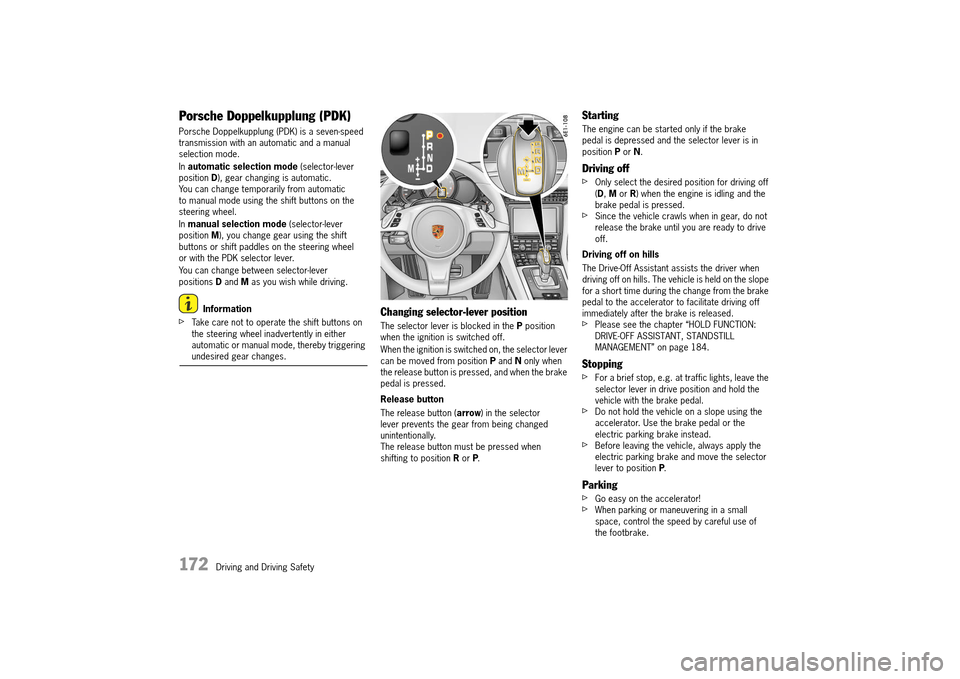
Changing selector-lever position
The selector lever is blocked in the P position when the ignition is switched off.
When the ignition is switched on, the selector lever can be moved from position P and N only when the release button is pressed, and when the brake pedal is pressed.
Release button
The release button ( arrow) in the selector lever prevents the gear from being changed unintentionally.The release button must be pressed when shifting to position R or P.
Starting
The engine can be started only if the brake pedal is depressed and the selector lever is in position P or N.
Driving off
fOnly select the desired position for driving off ( D, M or R) when the engine is idling and the brake pedal is pressed.fSince the vehicle crawls when in gear, do not release the brake until you are ready to drive off.
Driving off on hills
The Drive-Off Assistant assists the driver when driving off on hills. The vehicle is held on the slope for a short time during the change from the brake pedal to the accelerator to facilitate driving off immediately after the brake is released.fPlease see the chapter “HOLD FUNCTION: DRIVE-OFF ASSISTANT, STANDSTILL MANAGEMENT” on page 184.
Stopping
fFor a brief stop, e.g. at traffic lights, leave the selector lever in drive position and hold the vehicle with the brake pedal.fDo not hold the vehicle on a slope using the accelerator. Use the brake pedal or the electric parking brake instead.fBefore leaving the vehicle, always apply the electric parking brake and move the selector lever to position P.
Parking
fGo easy on the accelerator!fWhen parking or maneuvering in a small space, control the speed by careful use of the footbrake.
14_991_Turbo_21.book Seite 172 Mittwoch, 9. April 2014 2:19 14
Page 176 of 300
174 Driving and Driving Safety
Selector-lever Positions
P – Parking lock
fEngage parking lock only when the vehicle is stationary.If selector-lever position P is flashing in the instrument panel, the parking lock is not engaged. The vehicle can roll away.Shift again from selector-lever position R to P.fActivate the electric parking brake and then engage the parking lock.If selector-lever position P is flashing in the instrument panel, the parking lock is not engaged. The vehicle can roll away.Shift again from selector-lever position R to P.
Vehicles without Porsche Entry & Drive: The ignition key can only be removed in selector- lever position P.
R – Reverse gear
fSelect only if the vehicle is stationary and the brake is applied.
N – Neutral
Selector-lever position N must be selected for towing or in car washes, for example.fOnly select the desired position for driving off ( D, M or R) when the engine is idling and the brake pedal is pressed.
D – Automatic selection mode
Select position D for “normal” driving. The gears are shifted automatically according to the accelerator position and speed.
Depending on the way the vehicle is driven (economical, comfortable or sporty driving style) and on the resistance (e.g. uphill), the gear-changing points are shifted towards higher or lower engine-speed ranges.The accelerator position, driving speed, engine speed, longitudinal and lateral acceleration and the road profile all have an influence on the gear-changing characteristic.
Unwanted upshifts, e.g. when entering bends, are prevented by swiftly releasing the accelerator pedal.
Depending on lateral acceleration, upshifts on bends are not made until the engine-speed limit is reached.
When you brake, and depending on the amount of deceleration, the PDK transmission changes down earlier.For subsequent cornering, the correct gear is engaged when pressure is applied to the brakes before the bend. The bend is taken in the right gear, and when you accelerate out of the bend you do not have to change down.
With a sporty driving style, downshifts are already initiated when the brake pedal is touched lightly. This further enhances a dynamic driving style.
The PDK transmission temporarily changes to the sportiest gear-changing map, i.e. to the highest possible gear-changing points, if the accelerator pedal is pressed quickly. The transmission accordingly shifts down immediately by one or two gears (temporary downshift).
The transmission no longer selects 7th gear at very high driving speeds.
However, if necessary, the gear can be selected manually.
Upshifts and downshifts are avoided as far as possible when PSM is active. In the case of high wheel slip when PSM is switched off, upshifts are prevented until slip is no longer detected.
Driving in coasting mode
Through attentive driving, fuel can be saved in coasting mode. The vehicle rolls with the engine disengaged and at idle speed without engine braking effect.
Preconditions for automatic coasting mode – Driving in selector lever position D – Coasting mode is switched on.Indicator light on the button is off.– Sport and Sport Plus modes are switched off– PSM is active– Cruise control is not active– Engine, transmission and battery are at operating temperature– Calm/economic driving style– Slight uphill or slight downhill gradientsfSlowly take your foot off the accelerator.
The engine is disengaged and runs at idle speed. The vehicle rolls with no engine braking effect. Coasting mode is recognizable by the idle speed indicated on the tachometer.
Information
In the case of a sporty driving or when swiftly releasing the accelerator pedal, coasting mode is suppressed to allow targeted use of the engine braking effect. On more pronounced uphill gradients, “coasting” is also prevented as the coasting phases are very short due to the gradient and no significant fuel savings can be achieved. On more pronounced downhill gradients, coasting
14_991_Turbo_21.book Seite 174 Mittwoch, 9. April 2014 2:19 14
Page 177 of 300
Driving and Driving Safety 175
is suppressed because here, the vehicle does not slow down, despite the engine overrun torque and no fuel is consumed in this driving situation due to utilization of the overrun shut-off.
Ending coasting mode/utilizing engine braking effect
fPress the accelerator or brake pedalor Operate a shift paddle or a shift button or Shift gear using the selector lever.
Initiating coasting mode manually
– Driving in selector lever position D or driving in selector lever position M
When coasting mode is suppressed, e.g. in the case of sporty driving, sudden release of the accelerator pedal or excessively low engine temperature, coasting mode can be initiated manually.fTake your foot off the accelerator pedal and shift past the highest possible gear with the shift paddle, one of the shift buttons, or with the selector lever.
Switching coasting mode on and off using the Auto Start Stop button
Switching off
fPress button . The indicator light on the button lights up.Coasting mode is switched off and automatic stopping of the engine is suppressed.
Switching on
fPress button . The indicator light on the button goes out.Coasting mode is switched on and the engine is automatically stopped when the vehicle stops.
“Sport” mode activated
The PDK transmission switches to a sporty gear- changing map and shortens the shifting times.A sporty driving style is recognized more quickly and the gear-changing speeds are adapted to driving performance.
Braking downshifts are initiated earlier. Downshifts occur for small decelerations, even at higher revs.
“Sport Plus” mode activated
In “Sport Plus” mode, the PDK transmission changes to a shift program designed for driving on race circuits. 7th gear is not selected.The gear-changing performance is enhanced significantly again compared with “Sport” mode.fPlease see the chapter ““SPORT” AND “SPORT PLUS” MODE” on page 188.
Driving off with Launch Control
Launch Control allows you to achieve maximum acceleration from standstill.
Launch Control is designed to be used in a controlled environment on closed circuit driving courses where no vehicle cross traffic or pedestrian traffic is present.fUse Launch Control only if conditions permit it to be applied in a safe manner.fDo not use Launch Control if there is a possibility it could endanger other persons.Such a possibility exists if you cannot see that you have a clear road with no possibility of cross traffic in your intended direction of driving.
Information
Stress on components increases dramatically when starting with maximum acceleration in comparison with normal driving off.
Preconditions: – Launch Control should only be used when the engine has reached operating temperature.–“ Sport Plus” mode must be switched on (indicator light on the button comes on and SPORT PLUS appears on the digital speedometer or on the steering wheel).1. Press the brake with your left foot. 2. Quickly press the accelerator down fully (kickdown activated) and hold it.The engine speed will level off at around 5,500 rpm.“ Launch Control activated” is displayed on the multi-function display.Depending on equipment, the “LAUNCH CONTROL” logo appears on the steering wheel.3. Release the brake within a few seconds.
Remaining stationary for a long time with LAUNCH CONTROL can lead to overloading of the transmission.To protect the transmission, the engine power is then reduced and the LAUNCH CONTROL process is cancelled.
In order to drive off, the accelerator must first be fully released.
Endangering Other Road Users
WARNINGh
14_991_Turbo_21.book Seite 175 Mittwoch, 9. April 2014 2:19 14