winter PORSCHE 911 TURBO 2014 6.G Owners Manual
[x] Cancel search | Manufacturer: PORSCHE, Model Year: 2014, Model line: 911 TURBO, Model: PORSCHE 911 TURBO 2014 6.GPages: 300, PDF Size: 10.61 MB
Page 111 of 300
Instrument Panel and Multi-Function Display 109
Selecting tire type in the TPMS menu (type and size of fitted tire)
Exceeding the maximum tire speed could result in a tire burst, causing loss of control of the vehicle.fAlways observe the permissible maximum speed of the respective tire.fPorsche recommends obeying all traffic laws at all times to maintain the safety of yourself and all vehicle occupants.
Incomplete entries or selection of the wrong tires on the multi-function display affect correct indication of warnings and messages.fThe settings must be updated in the “ Tire pressure ” menu after changing a wheel, filling with tire sealant or adding air (after previous warning “ Check tires”). Please see the chapter “RED WARNING – “CHECK TIRES”” on page 112.
The new tire type and tire size must be selected even if the settings for the new set of wheels are the same as for the old wheels.
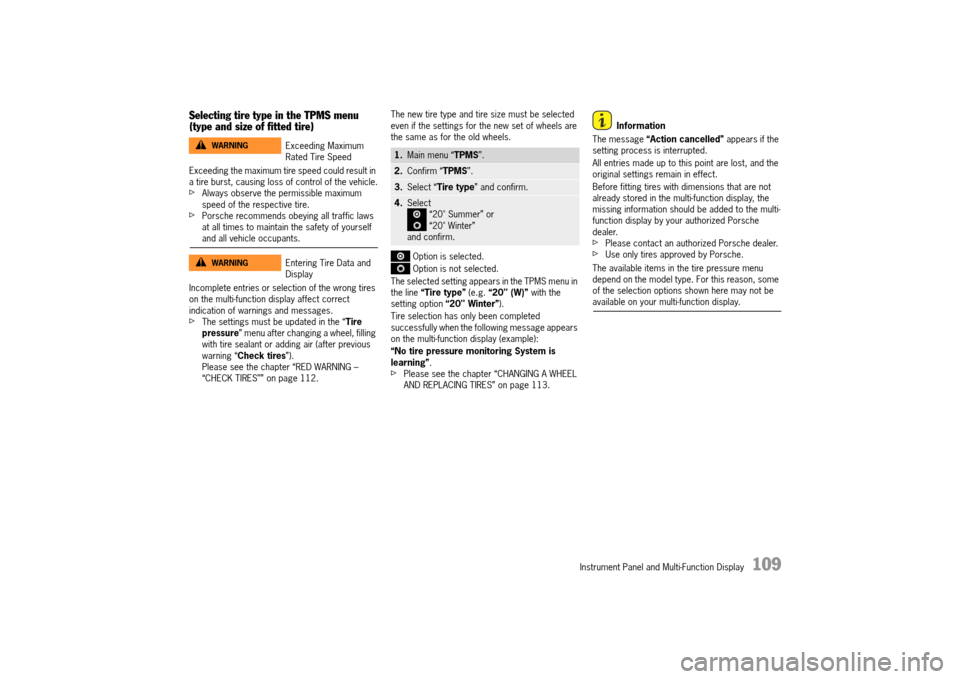
Option is selected.
Option is not selected.
The selected setting appears in the TPMS menu in the line “Tire type” (e.g. “20" (W)” with the setting option “20" Winter”).
Tire selection has only been completed successfully when the following message appears on the multi-function display (example):
“No tire pressure monitoring System is learning” .fPlease see the chapter “CHANGING A WHEEL AND REPLACING TIRES” on page 113.
Information
The message “Action cancelled” appears if the setting process is interrupted.
All entries made up to this point are lost, and the original settings remain in effect.
Before fitting tires with dimensions that are not already stored in the multi-function display, the missing information should be added to the multi-function display by your authorized Porsche dealer.fPlease contact an authorized Porsche dealer.fUse only tires approved by Porsche.
The available items in the tire pressure menu depend on the model type. For this reason, some of the selection options shown here may not be available on your multi-function display.
Exceeding Maximum Rated Tire Speed
Entering Tire Data and Display
WARNINGh
WARNINGh
1. Main menu “TPMS”.
2.Confirm “TPMS”.
3.Select “Tire type” and confirm.
4.Select “20" Summer” or “20" Winter” and confirm.
14_991_Turbo_21.book Seite 109 Mittwoch, 9. April 2014 2:19 14
Page 210 of 300
208 Parking
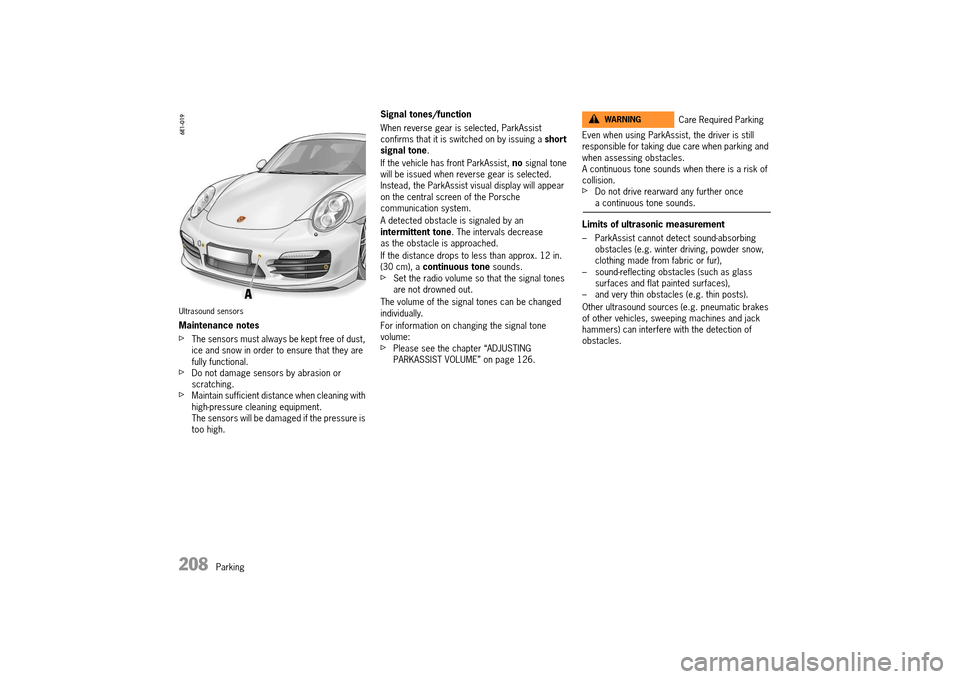
Ultrasound sensors
Maintenance notes
fThe sensors must always be kept free of dust, ice and snow in order to ensure that they are fully functional.fDo not damage sensors by abrasion or scratching.fMaintain sufficient distance when cleaning with high-pressure cleaning equipment.The sensors will be damaged if the pressure is too high.
Signal tones/function
When reverse gear is selected, ParkAssist confirms that it is switched on by issuing a short signal tone .
If the vehicle has front ParkAssist, no signal tone will be issued when reverse gear is selected.Instead, the ParkAssist visual display will appear on the central screen of the Porsche communication system.
A detected obstacle is signaled by an intermittent tone . The intervals decrease as the obstacle is approached.
If the distance drops to less than approx. 12 in. (30 cm), a continuous tone sounds.fSet the radio volume so that the signal tones are not drowned out.
The volume of the signal tones can be changed individually.
For information on changing the signal tone volume:fPlease see the chapter “ADJUSTING PARKASSIST VOLUME” on page 126.
Even when using ParkAssist, the driver is still responsible for taking due care when parking and when assessing obstacles.A continuous tone sounds when there is a risk of collision.fDo not drive rearward any further once a continuous tone sounds.
Limits of ultrasonic measurement
– ParkAssist cannot detect sound-absorbing obstacles (e.g. winter driving, powder snow, clothing made from fabric or fur),– sound-reflecting obstacles (such as glass surfaces and flat painted surfaces),– and very thin obstacles (e.g. thin posts).
Other ultrasound sources (e.g. pneumatic brakes of other vehicles, sweeping machines and jack hammers) can interfere with the detection of obstacles.
Care Required ParkingWARNINGh
14_991_Turbo_21.book Seite 208 Mittwoch, 9. April 2014 2:19 14
Page 224 of 300
222 Maintenance and Car Care
Checking Engine Oil Level
fCheck the oil level on the multi-function display at regular intervals before refueling.fPlease see the chapter “DISPLAY AND MEASUREMENT OF THE ENGINE OIL LEVEL” on page 101.
Engine oil is hazardous to your health and may be fatal if swallowed.fKeep engine oil out of children's reach.
Used engine oil contains chemicals that have caused cancer in laboratory animals.fAlways protect your skin by washing thoroughly with soap and water.
If you suspect an oil leak in the engine have your authorized Porsche dealer check it out immediately.
Top-up quantity
The difference between the minimum and maximum marks on the segment display is approx. 1.8 quarts (1.7 liters).fNever add more engine oil than required to reach the maximum mark.
If the oil level is too low, this is indicated by the oil-warning light on the multi-function display.fAdd engine oil immediately.fPlease see the chapter “OVERVIEW OF WARNING AND INFORMATION MESSAGES” on page 129.
Measuring the oil level after topping up engine oil or opening the engine compartment lid
The oil level can be checked after waiting for approx. 1 minute with the vehicle parked on a level surface and the engine at operating temperature.
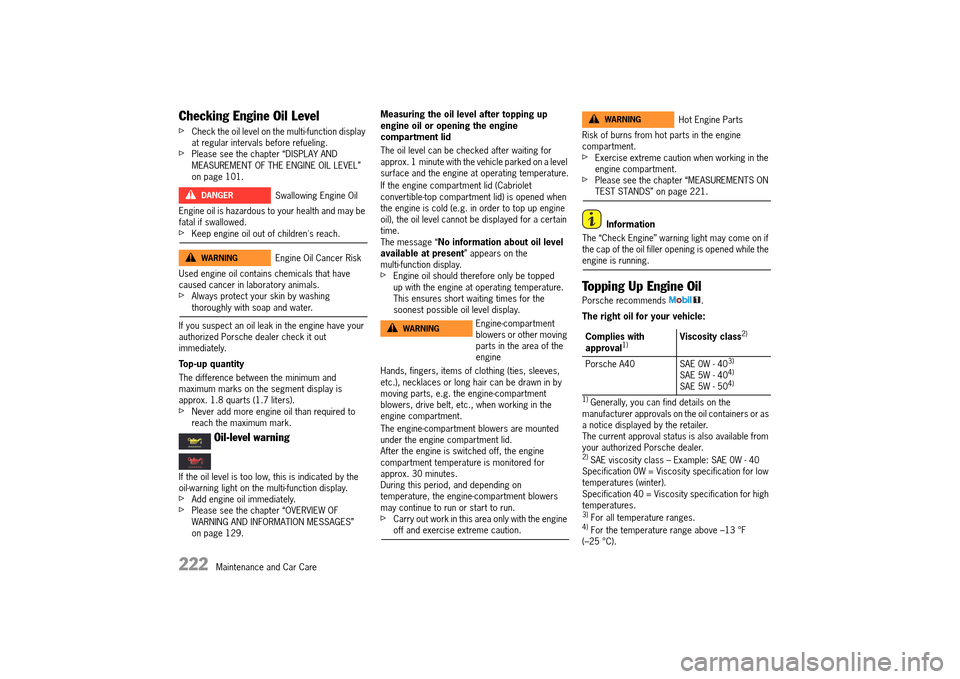
If the engine compartment lid (Cabriolet convertible-top compartment lid) is opened when the engine is cold (e.g. in order to top up engine oil), the oil level cannot be displayed for a certain time.The message “ No information about oil level available at present ” appears on the multi-function display.fEngine oil should therefore only be topped up with the engine at operating temperature. This ensures short waiting times for the soonest possible oil level display.
Hands, fingers, items of clothing (ties, sleeves, etc.), necklaces or long hair can be drawn in by moving parts, e.g. the engine-compartment blowers, drive belt, etc., when working in the engine compartment.
The engine-compartment blowers are mounted under the engine compartment lid.After the engine is switched off, the engine compartment temperature is monitored for approx. 30 minutes.During this period, and depending on temperature, the engine-compartment blowers may continue to run or start to run.fCarry out work in this area only with the engine off and exercise extreme caution.
Risk of burns from hot parts in the engine compartment.fExercise extreme caution when working in the engine compartment.fPlease see the chapter “MEASUREMENTS ON TEST STANDS” on page 221.
Information
The “Check Engine” warning light may come on if the cap of the oil filler opening is opened while the engine is running.
Topping Up Engine Oil
Porsche recommends .
The right oil for your vehicle:
1) Generally, you can find details on the manufacturer approvals on the oil containers or as a notice displayed by the retailer.The current approval status is also available from your authorized Porsche dealer.2) SAE viscosity class – Example: SAE 0W - 40 Specification 0W = Viscosity specification for low temperatures (winter).Specification 40 = Viscosity specification for high temperatures.3) For all temperature ranges.4) For the temperature range above –13 °F(–25 °C).
Swallowing Engine Oil
Engine Oil Cancer Risk
Oil-level warning
DANGERh
WARNINGh
Engine-compartment blowers or other moving parts in the area of the engine
WARNINGh
Hot Engine Parts
Complies with approval1)Viscosity class2)
Porsche A40 SAE 0W - 403)
SAE 5W - 404)
SAE 5W - 504)
WARNINGh
14_991_Turbo_21.book Seite 222 Mittwoch, 9. April 2014 2:19 14
Page 226 of 300
224 Maintenance and Car Care
Washer Fluid windshield
Observe the following points:fDepending on the season, mix the water with the appropriate additives (window cleaner concentrate, antifreeze) in the correct mixture ratio.
Summer filling with water + window cleaner concentrate in the mixture ratio specified on the container.
Winter filling with water + antifreeze + window cleaner concentrate in the mixture ratio specified on the container.
Always follow all the instructions on the containers of the additives used.
fOnly use window cleaner concentrate that meets the following requirements:– Dilutability 1:100,– Phosphate-free,– Suitable for plastic headlight lenses.
We recommend window cleaner concentrates approved by Porsche. Your authorized Porsche dealer will be pleased to advise you.
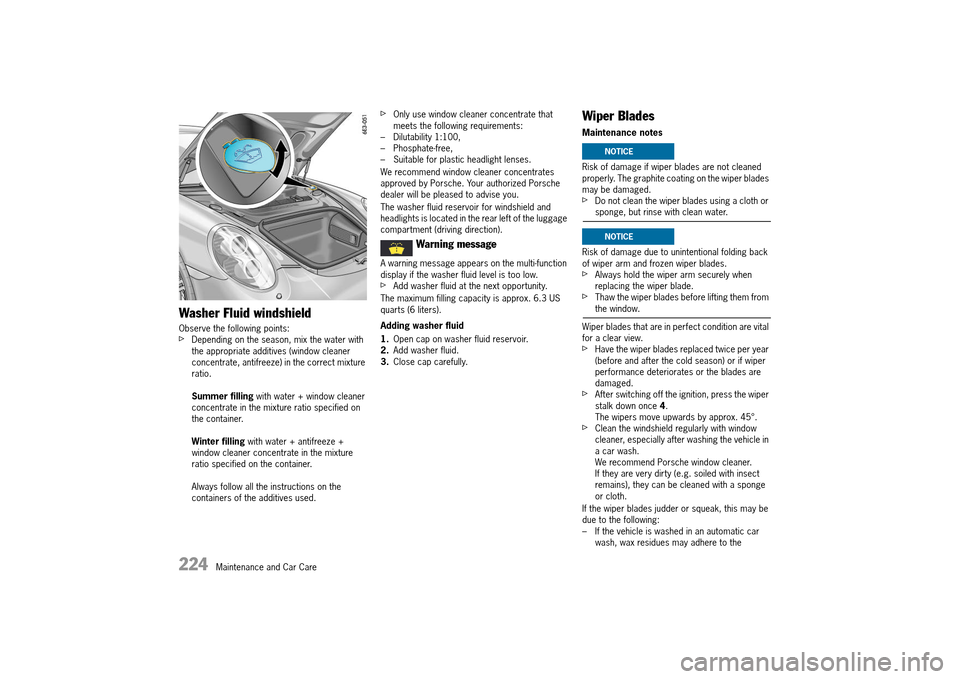
The washer fluid reservoir for windshield and headlights is located in the rear left of the luggage compartment (driving direction).
A warning message appears on the multi-function display if the washer fluid level is too low.fAdd washer fluid at the next opportunity.
The maximum filling capacity is approx. 6.3 US quarts (6 liters).
Adding washer fluid
1. Open cap on washer fluid reservoir. 2. Add washer fluid. 3. Close cap carefully.
Wiper Blades
Maintenance notes
Risk of damage if wiper blades are not cleaned properly. The graphite coating on the wiper blades may be damaged.fDo not clean the wiper blades using a cloth or sponge, but rinse with clean water.
Risk of damage due to unintentional folding back of wiper arm and frozen wiper blades.fAlways hold the wiper arm securely when replacing the wiper blade.fThaw the wiper blades before lifting them from the window.
Wiper blades that are in perfect condition are vital for a clear view.fHave the wiper blades replaced twice per year (before and after the cold season) or if wiper performance deteriorates or the blades are damaged.fAfter switching off the ignition, press the wiper stalk down once 4. The wipers move upwards by approx. 45°.fClean the windshield regularly with window cleaner, especially after washing the vehicle in a car wash.We recommend Porsche window cleaner. If they are very dirty (e.g. soiled with insect remains), they can be cleaned with a sponge or cloth.
If the wiper blades judder or squeak, this may be due to the following:– If the vehicle is washed in an automatic car wash, wax residues may adhere to the
Warning message
NOTICE
NOTICE
14_991_Turbo_21.book Seite 224 Mittwoch, 9. April 2014 2:19 14
Page 237 of 300
Maintenance and Car Care 235
Repairing the underbody protection
The underside of your car is durably protected against chemical and mechanical influences.
As it is not possible to exclude the risk of damage to this protective coating in day to day driving, it is advisable to have the underside of the car inspected at certain intervals - preferably before the start of winter and again in spring - and the undercoating restored as necessary.
Your authorized Porsche dealer is familiar with the bodyseal treatment procedures and has the necessary equipment for applying factory approved materials. We recommend that you entrust them with such work and inspections.
Unlike conventional spray oils, undercoating and rust-proofing compounds based on bitumen or wax do not attack the sound-proofing materials applied at the factory.
The exhaust system becomes very hot when the engine is running. Flammable material close to the exhaust system could ignite. Additional undercoating or rust protection agents on or near the exhaust system can become too hot when driving and ignite.fDo not apply additional undercoating or rust-proofing on or near the exhaust manifold, exhaust pipes, catalytic converters or heat shields. During driving the substance used for undercoating could overheat and ignite.
fBefore applying fresh underseal, carefully remove deposits or dirt and grease. Once it has dried, the new undercoating compound forms a tough protective coating which provides efficient rust-proofing of the floor panels and components.
fAlways apply a fresh coating of suitable preservative to unprotect areas after cleaning the underside of the body, the transmission, the engine or carrying out repairs to under-body, engine or transmission components.
Effective rust-proofing is particularly important during the cold weather season. If your car is driven frequently in areas where salt has been spread on the roads, the whole engine compartment should be cleaned thoroughly after the winter to prevent salt from causing any lasting damage. A full under-body wash should also be performed at the same time.
Cleaning headlights, lights, interior and exterior plastic components, adhesive foils, reversing camera and radar sensor for adaptive cruise control
Observe the following points: fUse only clean water and a little dishwashing liquid or interior window cleaner to clean headlights, lights, plastic components and surfaces.Use a soft sponge or a soft, lint-free cloth.fDo not spray water or interior window cleaner directly onto the plastic components in the passenger compartment, but first onto a sponge or cloth. Cleaning agents may, for example, enter controls or switches and cause damage.
Information
An interior window cleaner can also be used to clean plastic surfaces (always read the cleaning instructions on the container).We recommend Porsche interior window cleaner.fGently wipe the surface without applying too much pressure.fDo not clean when dry.
fNever use other chemical cleaners or solvents.fRinse cleaned surfaces with clear water.
Alloy wheels
Metal particles (e.g. brass or copper in brake dust) must not remain too long on alloy wheels.Contact corrosion can cause pitting.
Information
Cleaners with an oxide-removing effect or wrong pH value, as are commonly used for other metals, as well as mechanical tools and products, will damage the oxide layer and are therefore unsuitable.fUse only cleaners for alloy wheels (pH value 9.5). Products with the wrong pH value can destroy the protective layer on the wheels . We recommend Porsche cleaner for alloy rims.fIf possible, wash the wheels every two weeks with a sponge or washing brush. If the wheels are exposed to road salt, grit or industrial dust, weekly cleaning is necessary.fEvery three months, after cleaning, grease the wheels with car wax or an acid-free grease (e.g. Vaseline).Rub the grease in well with a soft cloth.fPlease see the chapter “CLEANING IN CAR WASHES” on page 233.
Exhaust System Fire Risk
WARNINGh
14_991_Turbo_21.book Seite 235 Mittwoch, 9. April 2014 2:19 14
Page 250 of 300
248 Minor Repairs
Tire life
Tire life depends on various factors, i.e., road surfaces, traffic and weather conditions, driving habits, type of tires and tire care.fInspect your tires for wear and damage before driving off. If you notice uneven or substantial wear, wheels might need alignment or tires should be balanced or replaced.
Tire wear
The original equipment tires on your Porsche have built-in tire wear indicators. They are molded into the bottom of the tread grooves and will appear as approximately 1/2 in. (12 mm) bands when the tire tread depth is down to 1/16 of an in (1.6 mm).
When the indicators appear in two or more adjacent grooves, it is time to replace the tires. We recommend, however, that you do not let the tires wear down to this extent. Worn tires cannot grip the road surface properly and are even less effective on wet roads.
In the United States, state laws may govern the minimum tread depth permissible. Follow all such laws.
Driving on worn tires can result in loss of control of the vehicle and could cause serious personal injuries or death.fDo not drive with worn tires or tires showing cuts or bruises as they may lead to sudden deflation and loss of control which could cause severe personal injury.fSpecialized high performance tires on high performance sports cars exhibit more wear than those on a family sedan, or even a high performance sedan. Therefore, it is important to check your tire
pressure and condition at least every two weeks.
fIf you notice that tires are wearing unevenly, consult your authorized Porsche dealer.
Uneven wear may not always be due to improper wheel alignment. It can be the result of individual driving habits such as cornering at high speeds. If the tire pressure is not checked and adjusted regularly, abnormal tire wear can also occur.
Tire care
fAvoid damaging tires and wheel rims.fIf you must drive over a curb or other obstacle, drive slowly and at an obtuse angle.fCheck tires for uneven wear and damage before driving off.fRemove embedded material.fReplace worn or damaged tires immediately.fKeep oil, fuel, brake fluid, etc. away from tires.fReplace missing valve stem caps.fKeep tires inflated correctly.fWash tires when washing the vehicle. Also clean inner side of wheels.fDo not use abrasive cleaners when washing the wheels.fCheck wheel rims for corrosion.fRemove road salt, if driving in winter.
Tire damage, puncture
fPlease see the chapter “HIGH-PRESSURE CLEANING EQUIPMENT, STEAM CLEANERS” on page 232.
Driving the vehicle with low tire pressure increases risk of a tire failure and resulting loss of control. Furthermore, low tire pressure increases the rate of wear of the affected tires.fCheck tires – including sidewalls – regularly for foreign bodies, nicks, cuts, cracks and bulges.fAfter driving off road, examine tires for signs of damage such as cuts, tears, bulges or foreign objects stuck in the tread. Replace a damaged tire if necessary.fCross curb edges slowly and at right angles if possible. Avoid driving over steep or sharp curbs.fIn cases of doubt, have the wheel (particularly the inner side) checked by an authorized Porsche dealer.
In case of tire damage, where it is uncertain whether there is a break in the ply with all its consequences or tire damage caused by thermal or mechanical overloading due to loss of pressure or any other prior damage, we recommend that the tire be replaced for safety reasons.
If one faulty tire is replaced it should be noted that the difference in tread depth on one axle must not exceed 30%. Handling inconsistencies may result.fRecommendation: Replace both tires on one axle so that no handling inconsistencies may result due to different tread depths.fPerform a visual inspection if necessary.
Excessively-worn TiresDANGERh
Damaged Tire CheckDANGERh
14_991_Turbo_21.book Seite 248 Mittwoch, 9. April 2014 2:19 14
Page 252 of 300
250 Minor Repairs
Wheel alignment, wheel balancing
As a precaution, have wheels with summer tires balanced in the spring, and those with mud and snow tires before winter. Unbalanced wheels may affect car handling and tire life.Only the specified weights may be used for wheel balancing.
Self-adhesive weights must not come into contact with cleaning agents, since they could drop off.Uneven tread wear indicates wheel imbalance. In this event, the vehicle should be checked at an authorized Porsche dealer.
If, during a trip, uneven running or vibrations occur that could be caused by damage to tires or the car, the speed must be reduced immediately, but without braking sharply. If you continue your trip without having the cause of the fault remedied, you might lose control of your vehicle.fStop the vehicle and check the tires.fIf no cause for the fault can be found, drive carefully to the nearest authorized Porsche dealer.
The summer tires of your Sports Car have been specially developed and adapted for high performance. At low outside temperatures (<15°C (60°F)), the tire characteristics change. This can result in noises occurring when parking or maneuvering at low outside temperatures.
Wheels with Tire Pressure Monitoring System (TPMS) sensors
Before changing wheels, make sure that the wheels are compatible with your vehicle’s TPMS.fCheck this with your authorized Porsche dealer.
Removing and storing tires
fAfter changing, adjust tire pressure and torque wheel bolts diagonally. Please see the chapter “CHANGING WHEELS” on page 254.fStore tires in a cool and dry place. Rotate periodically to avoid flat spots.fDo not store summer tires or park vehicles fitted with summer tires at ambient temperatures below 5 °F (-15 °C).fAvoid contact with fuel, oil and grease.
Tires must always remain on the same side of the vehicle.When wheels are removed, the direction of rotation and position of each wheel should be marked.
Example
FR (front right), FL, RR and RL.
Wheels must always be fitted in accordance with their marking.
The perception that tire durability and performance are not affected by storage and age is unfounded. Chemical additives, which make the rubber elastic, lose their effectiveness over the course of time and the rubber becomes brittle and cracks.
Therefore, the tires should be inspected from time to time.
Information
Under no circumstances should tires older than 6 years be used on your Porsche.
The age of the tire can be obtained from the “DOT” code number. If, for example, the last four numbers read 1213, then the tire was produced in the 12th week of 2013.
Snow tires
The installation of Porsche approved snow tires is recommended.
Use Porsche approved snow tires for grip on snow and ice. Summer performance tires are not suitable for usage in cold, snowy, or icy conditions.Check with your local Motor Vehicle Bureau for possible restrictions.
High-Speed tire Vibration
DANGERh
14_991_Turbo_21.book Seite 250 Mittwoch, 9. April 2014 2:19 14
Page 274 of 300
272 Minor Repairs
Risk of damage to the fabric, metal or paint from battery acid or electrolyte.fDo not allow battery acid to come in contact with fabric or painted surfaces.fSpilled electrolyte must be rinsed off at once with a solution of baking soda and water to neutralize the acid.
Charge state
A well-charged battery prevents starting problems and has a longer service life.
In order to avoid unintentional battery discharge:
fSwitch off unnecessary electrical loads in city traffic, on short trips or in a line of traffic.fAlways remove the ignition key when leaving the vehicle orswitch off the ignition on vehicles with Porsche Entry & Drive.fAvoid using the Porsche Communication Management system and the audio system when the engine is not running.fPlease see the chapter “CHARGING THE BATTERY” on page 274.
Information
In the cold season in particular or if the vehicle is used primarily for short distances, it may be necessary to recharge the battery from time to time.
Battery care
fEnsure that battery is securely mounted.fKeep battery surface clean and dry.fKeep terminals and connections clean. Corrosion can be prevented by coating the terminals and connections with petroleum jelly or silicone spray.fEnsure that terminal clamps and the vent hose are firmly secured.
Winter driving
The ability of the battery to deliver and store power decreases at low outside temperatures. Moreover, the battery is more heavily loaded in the winter months, e.g. by the heated rear window, the more frequent use of additional lights, the blower and the windshield wipers, etc.fHave the battery checked before the start of winter.
Information
Keep the battery fully charged to prevent it from freezing.
A discharged battery can already freeze at –5 ºC, but a fully charged one only freezes at –40 ºC. fIf the battery is frozen, thaw it out before connecting jump leads.
Laying up the vehicle
If the vehicle is left for long periods in the garage or workshop, the doors and lids should be closed.fRemove the ignition key or disconnect the battery if necessary.
Information
fWhen the battery is disconnected, the alarm system ceases to function.
If the vehicle was locked before the battery was disconnected, the alarm will be triggered when the battery is reconnected.To deactivate the alarm system: fLock the vehicle and unlock it again.
Alarm system, central locking
fThe status of the central locking and alarm system does not change when you disconnect the battery.
Information
Even if you put your vehicle out of operation, the battery still discharges.fThe battery must be charged, i.e. connected to a charger, approximately every 6 weeks in order to preserve battery function.fStore a battery that has been removed in a dark, cool place that is not exposed to frost.
Replacing the battery
The battery is subject to normal wear: its service life depends heavily on the care you give it, climatic conditions and the conditions of use (distances, loads).
It is not possible to use the details on the battery case to determine a comparable battery that meets all the specific requirements of Porsche.fHave the battery removed and installed only by your authorized Porsche dealer.fOnly use an original Porsche battery, with the correct part number, as a replacement. Only this battery meets the specific requirements of the vehicle.
NOTICE
14_991_Turbo_21.book Seite 272 Mittwoch, 9. April 2014 2:19 14
Page 288 of 300
286 Tire Pressure and Technical Data
Wheels, Tires
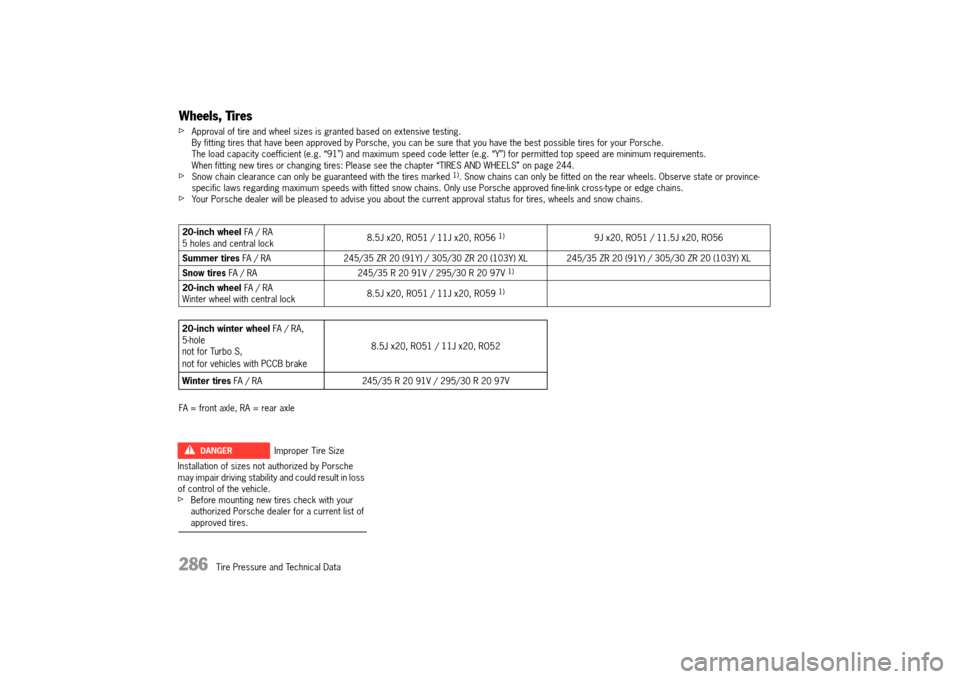
fApproval of tire and wheel sizes is granted based on extensive testing. By fitting tires that have been approved by Porsche, you can be sure that you have the best possible tires for your Porsche.The load capacity coefficient (e.g. “91”) and maximum speed code letter (e.g. “Y”) for permitted top speed are minimum requirements. When fitting new tires or changing tires: Please see the chapter “TIRES AND WHEELS” on page 244.fSnow chain clearance can only be guaranteed with the tires marked 1). Snow chains can only be fitted on the rear wheels. Observe state or province-specific laws regarding maximum speeds with fitted snow chains. Only use Porsche approved fine-link cross-type or edge chains.fYour Porsche dealer will be pleased to advise you about the current approval status for tires, wheels and snow chains.
FA = front axle, RA = rear axle
20-inch wheel FA / RA5 holes and central lock8.5J x20, RO51 / 11J x20, RO56 1)9J x20, RO51 / 11.5J x20, RO56
Summer tires FA / RA245/35 ZR 20 (91Y) / 305/30 ZR 20 (103Y) XL 245/35 ZR 20 (91Y) / 305/30 ZR 20 (103Y) XL
Snow tires FA / RA245/35 R 20 91V / 295/30 R 20 97V 1)
20-inch wheel FA / RA Winter wheel with central lock8.5J x20, RO51 / 11J x20, RO59 1)
20-inch winter wheel FA / RA, 5-holenot for Turbo S,
not for vehicles with PCCB brake
8.5J x20, RO51 / 11J x20, RO52
Winter tires FA / RA245/35 R 20 91V / 295/30 R 20 97V
Installation of sizes not authorized by Porsche may impair driving stability and could result in loss of control of the vehicle.fBefore mounting new tires check with your authorized Porsche dealer for a current list of approved tires.
Improper Tire SizeDANGERh
Reifendruck_TechnischeDaten.fm Seite 286 Mittwoch, 9. April 2014 3:12 15
Page 293 of 300
Index 291
Changing in car key ..........................................275 Charging..........................................................274Emergency starting with jumper cables ..............273General information ..........................................271Installation position ...........................................271Procedure after connection ...............................273Replacing ........................................................272Vehicle electrical system warning ........................95Winter driving...................................................272Before driving off .............................................................5BeltsCare instructions ..............................................237Fastening ..........................................................37Opening belt buckle ............................................38Safety-belt pretensioners, functional description ...37Warning light on the tachometer ..........................37 Brake booster .............................................................154Brake disks .....................................................................3Brake fluid ......................................................................3 Changing .........................................................243Warning light on speedometer ...........................243Brake pads .....................................................................3Breaking in new brake pads ..................................6Warning message, brakes.................................154Brake pedal ................................................................153Brake wear Warning message.............................................154 BrakesApplying/releasing parking brake.......................151Brake pad warning message .............................154Brake pedal .....................................................153Brake wear warning message ...........................154Break in new brake pads.......................................6Footbrake ........................................................152Test stand ...............................................221, 241Break in hints ..................................................................6Breaking inEngine .................................................................6Engine oil and fuel consumption during break-in period .....................................................6Hints ...................................................................6New brake pads and brake disks ...........................6New tires .............................................................6Brief overviewOpening and locking the vehicle from outside .......19
CCabrioletClosing convertible top .......................................69Convertible top care .........................................233Emergency operation .........................................70
Engine compartment lid ..................................... 26 Opening convertible top ..................................... 68Roll-over protection ............................................ 48Car careAirbags ........................................................... 237Alcantara ........................................................ 237Alloy wheels .................................................... 235Fabric linings ................................................... 237Headlights, plastic components, adhesive foils... 235Leather ........................................................... 236Leather care for seats with seat ventilation ........ 236Paint ............................................................... 234Safety belts ..................................................... 237Seals .............................................................. 236Underbody protection ...................................... 235Use of high-pressure cleaning equipment ........... 232Washing the vehicle, instructions....................... 232Wheel attachment faces ................................... 257Wheel bolts ..................................................... 257Windows ......................................................... 234Car key (remote control)Changing battery ............................................. 275Emergency operation of key/control unit in ignition lock....................................................... 28Locking vehicle door .......................................... 22Unlocking vehicle door ....................................... 21 Car Telephone............................................................. 169Care instructions Airbags ........................................................... 237Alcantara ........................................................ 237Alloy wheels .................................................... 235Car washing .................................................... 232Carpet ............................................................ 236Fabric linings ................................................... 237Headlights, plastic components, adhesive foils... 235Leather ........................................................... 236Leather care for seats with seat ventilation ........ 236Mats ............................................................... 236Paint ............................................................... 234Radar sensor................................................... 235Safety belts ..................................................... 237Seals .............................................................. 236Ultrasound sensors, ParkAssist......................... 235Underbody protection ...................................... 235Use of high-pressure cleaning equipment ........... 232Wheel attachment faces ................................... 257Wheel bolts ..................................................... 257Windows ......................................................... 234Carpet, care instructions ............................................. 236Catalytic converter ...................................................... 226Emission control (Check Engine) ......................... 95
Center armrest Opening front oddments tray .............................194Central bolt tightening torque (wheels) ...........................262Central locking ......................................................23, 258Emergency operation in the event of a fault ..........29Locking vehicle door with car key (remote control) .................................................22Locking vehicle door with Porsche Entry & Drive...22Opening and locking vehicle door from inside .......23Unlocking vehicle door with car key(remote control) .................................................21Unlocking vehicle door with Porsche Entry & Drive ........................................21 Central locking system Functional description .........................................18Changing button assignment on multi-function steering wheel..........................................................................127Changing car key (remote control) battery .....................275Changing wheels .........................................................254Chassis control systemsOverview (PTM, PSM, PASM, PDCC, PTV Plus) ....179Chassis number, position .............................................284Chassis setupFunctional description .......................................185Selecting .........................................................186Check Engine (emission control) Functional description .........................................95Warning light ......................................................95 Checking pressure .......................................................256Child restraint anchorages..............................................47Child restraint systemInstalling with LATCH system ...............................46LATCH restraint system ......................................46Child seatInstalling with LATCH system ...............................46LATCH restraint system ......................................46Prescribed installation direction (depending onweight of child)...................................................43 Child seat bracket .........................................................46Chrono .......................................................................114Cigarette Lighter .........................................................196Cleaning the air deflector ...............................................67Clock ..................................................................114, 124Closing Locking vehicle door from inside .........................23Persons/animals remaining in the vehicle .............22Vehicle door with car key (remote control) ............22Vehicle door with Porsche Entry & Drive (keyless) .22Closing convertible top ..................................................69Coasting .....................................................................150Coasting mode ................................................174
14_991_Turbo_21.book Seite 291 Mittwoch, 9. April 2014 2:19 14