battery PORSCHE 944 1987 1.G User Guide
[x] Cancel search | Manufacturer: PORSCHE, Model Year: 1987, Model line: 944, Model: PORSCHE 944 1987 1.GPages: 66, PDF Size: 3.3 MB
Page 47 of 66
must be charged at least every 6 weeks. A
discharged battery allows rapid formation of
sulfates, leading to premature deterioration of
the plates.
WARNING
Charge battery in a well ventilated area.
Keep away from open flame or electrical
spark. Do not smoke. Hydrogen gas
generated by the battery is explosive.
Electrolyte fluid that may spill during charging should be washed off with a solution of warm water and baking soda to neutralize the acid. If you get electrolyte in your eyes or on your
skin, immediately rinse with cold water for
several minutes and call a doctor.
Never charge a frozen battery. It may
explode because of gas trapped in the ice.
Allow a frozen battery to thaw out first. Never use a fast charger as a booster to start the engine. This may seriously damage the
vehicle's electrical system and the charger.
Fast charging a battery is dangerous and
should only be attempted by a competent
mechanic with the proper equipment.
Slow battery charging
WARNING
Heed all warnings and follow instructions
that come with your battery charger.
Disconnect battery cables and remove the
battery.
All vent caps should be open. If fluid level is low, it should be topped up to the full mark in
each cell.
Connect charger cables.
Charger cables must be connected
POSITIVE (+) to POSITIVE (+) and
NEGATIVE (-) to NEGATIVE (-).
Do not connect or disconnect charger cables while charger is operating. Switch on charger. Normally, a battery should be charged at no
more than 10 percent of its rated capacity.
Rated capacity of the battery in your vehicle
is listed on the battery housing.
After charging, turn off charger and disconnect charger cables. Tighten the vent caps and reinstall battery.
91
Emergency Starting with Jumper Cables
WARNING
Improper use of booster battery to start a
vehicle may cause an explosion.
Lead-acid batteries generate explosive
gases. Keep sparks, flame and lighted
cigarettes away from batteries.
Do not charge a frozen battery, thaw it out
first. Gas trapped in the ice may cause an
explosion.
No attempt should be made to jump start any vehicle with a low electrolyte level in the
battery.
Check electrolyte level of each cell. If
necessary, fill with distilled water to just
above plates.
Make sure the voltage of both batteries is the same. The capacity (Ah) of the booster battery
should not be lower than that of the
discharged battery.
Vehicle with discharged battery: turn off
lights and accessories, remove key, move
lever to N or P and set parking brake.
Vehicle with booster battery should not be
running. Disconnect ground cable.
Remove vent caps from booster battery and
discharged battery. Preferably lay a cloth
over open vents to reduce explosion hazard.
How to use jumper cables WARNING
To avoid serious personal injury and damage to the vehicle, heed all warnings
and instructions of the jumper cable
manufacturer. The jumper cables must be long enough so that neither vehicles nor cables touch
another.
Improper hook-up of jumper cables can
ruin the alternator.
Always connect POSITIVE (+) to POSITIVE
(+), and NEGATIVE (-) to ground on engine
block.
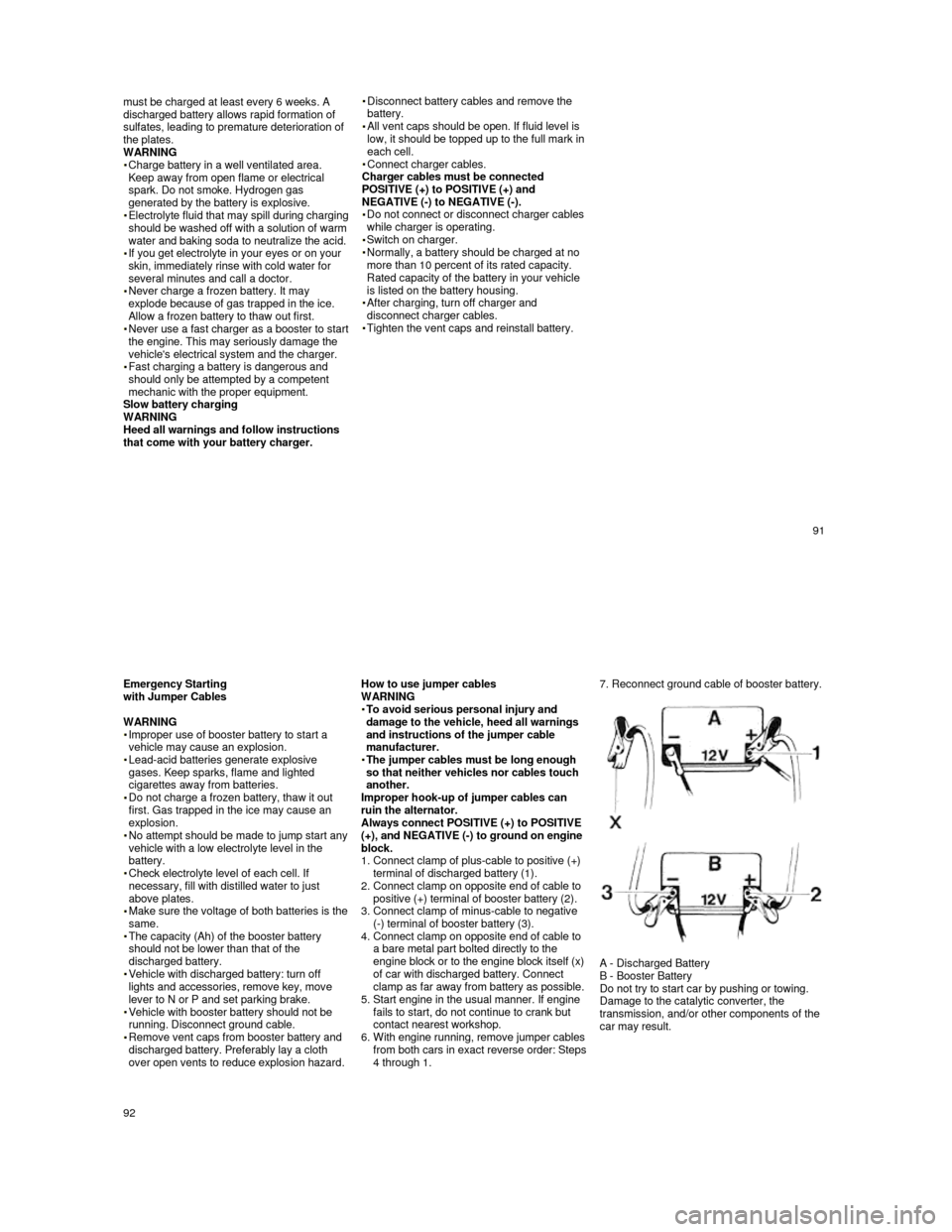
1. Connect clamp of plus-cable to positive (+) terminal of discharged battery (1).
2.
Connect clamp on opposite end of cable to
positive (+) terminal of booster battery (2).
3.
Connect clamp of minus-cable to negative
(-) terminal of booster battery (3).
4.
Connect clamp on opposite end of cable to
a bare metal part bolted directly to the
engine block or to the engine block itself (x)
of car with discharged battery. Connect
clamp as far away from battery as possible.
5. Start engine in the usual manner. If engine
fails to start, do not continue to crank but
contact nearest workshop.
6.
With engine running, remove jumper cables from both cars in exact reverse order: Steps 4 through 1.
7. Reconnect ground cable of booster battery.
A - Discharged Battery
B - Booster Battery
Do not try to start car by pushing or towing.
Damage to the catalytic converter, the
transmission, and/or other components of the
car may result.
92
Page 54 of 66

Technical Data
105
Engine 944 Number of cylinders
4
Bore 3.94 in. / 100 mm
Stroke 3.11 in. / 78.9 mm
Displacement 151 cu. in. / 2479 cm
3
Compression ratio 9.7:1
SAE net-power 147 hp/ 110 kW at 5800 rpm
SAE net-torque 140 ft lb / 190 Nm at 3000 rpm
Output per liter 59,3 SAE net-hp / 44,4 SAE net-kW
Max. permissible rpm 6500
Fuel octane rating Unleaded fuel only 91 RON (87 CLC or AKI ((R+M)/2) rating on fuel pump s in U.S.A.)
Spark plugs Bosch WR 7 DC or
Champion RN 9 YC
Electrode gap 0.028 + 0.004 in. / 0.7 + 0.1 mm
Battery capacity 12 volts, 63 Ah
Alternator output 1610W/115A
Firing order 1-3-4-2
Ignition timing Self-adjusting DME (Digital-Motor-E lectronic)
Ignition Transistorized ignition system with breake r less distributor
Belt for alternator Polyrib K6 1000 Lw
Belt for servo pump 9.5 x 950 LA
Valve clearance Hydraulic valve clearance compensat ion
106
Page 55 of 66

Engine 944 S Number of cylinders
4
Bore 3.94 in. / 100 mm
Stroke 3.11 in. / 78.9 mm
Displacement 151 cu. in. / 2479 cm
3
Compression ratio 10.9:1
SAE net-power 188 hp/ 140 kW at 6000 rpm
SAE net-torque 170 ft lb / 230 Nm at 4300 rpm
Output per liter 75,8 SAE net-hp / 56,5 SAE net-kW
Max. permissible rpm 6800
Fuel octane rating Unleaded fuel only 95 RON (90 CLC or AKI ((R+M)/2) rating on fuel pump s in U.S.A.)
Spark plugs Bosch WR 7 DC
Electrode gap 0.028 + 0.004 in. / 0.7 + 0.1 mm
Battery capacity 12 volts, 63 Ah
Alternator output 1610W/115A
Firing order 1-3-4-2
Ignition timing Self-adjusting DME (Digital-Motor-E lectronic)
Ignition Transistorized ignition system with breake r less distributor
Belt for alternator Polyrib K6 1000 Lw
Belt for servo pump 9.5 x 950 LA
Valve clearance Hydraulic valve clearance compensat ion
107
Engine 944 Turbo
Number of cylinders
4
Bore 3.94 in. / 100 mm
Stroke 3.11 in. / 78.9 mm
Displacement 151 cu. in. / 2479 cm
3
Compression ratio 8.0:1
SAE net-power 217 hp/ 162 kW at 5800 rpm
SAE net-torque 243 ft lb / 330 Nm at 3500 rpm
Output per liter 87,5 SAE net-hp / 65,3 SAE net-kW
Max. permissible rpm 6500
Fuel octane rating Unleaded fuel only 90 RON (90 CLC or AKI ((R+M)/2) rating on fuel pump s in U.S.A.)
Spark plugs Bosch WR 7 DC
Electrode gap 0.028 + 0.004 in. / 0.7 + 0.1 mm
Battery capacity 12 volts, 63 Ah
Alternator output 1610W/115A
Firing order 1-3-4-2
Ignition timing Self-adjusting DME (Digital-Motor-E lectronic)
Ignition Transistorized ignition system with breake r less distributor
Belt for alternator Polyrib K6 1000 Lw
Belt for servo pump 9.5 x 950 LA
Valve clearance Hydraulic valve clearance compensat ion
108
Page 65 of 66
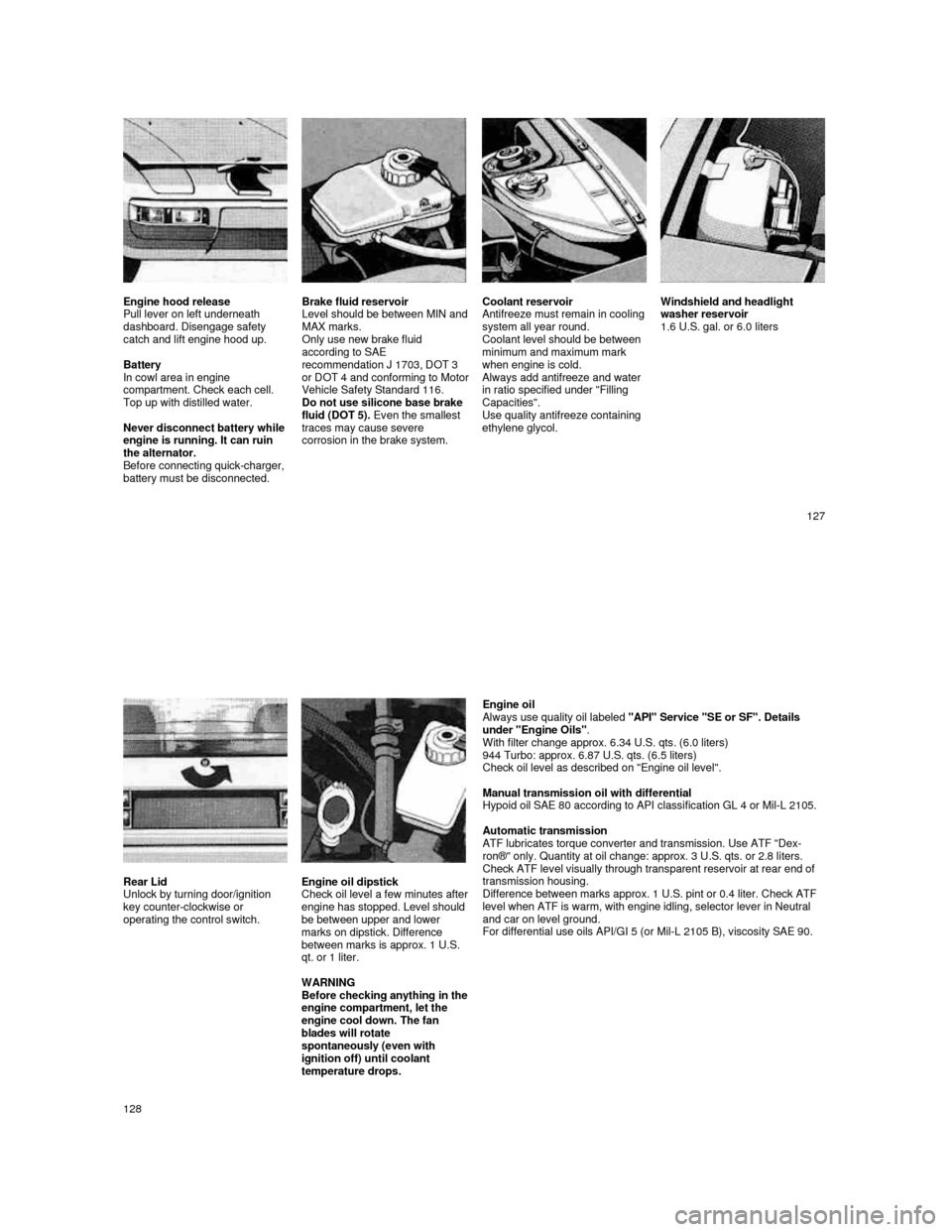
Engine hood release
Pull lever on left underneath
dashboard. Disengage safety
catch and lift engine hood up.
Battery
In cowl area in engine
compartment. Check each cell.
Top up with distilled water.
Never disconnect battery while
engine is running. It can ruin
the alternator.
Before connecting quick-charger,
battery must be disconnected. Brake fluid reservoir
Level should be between MIN and MAX marks.
Only use new brake fluid
according to SAE
recommendation J 1703, DOT 3
or DOT 4 and conforming to Motor Vehicle Safety Standard 116.
Do not use silicone base brake
fluid (DOT 5). Even the smallest
traces may cause severe
corrosion in the brake system.
Coolant reservoir
Antifreeze must remain in cooling
system all year round.
Coolant level should be between
minimum and maximum mark
when engine is cold. Always add antifreeze and water in ratio specified under "Filling
Capacities".
Use quality antifreeze containing
ethylene glycol.
Windshield and headlight
washer reservoir
1.6 U.S. gal. or 6.0 liters
127
Rear Lid
Unlock by turning door/ignition
key counter-clockwise or
operating the control switch.
Engine oil dipstick
Check oil level a few minutes after engine has stopped. Level should
be between upper and lower
marks on dipstick. Difference
between marks is approx. 1 U.S.
qt. or 1 liter.
WARNING
Before checking anything in
the engine compartment, let the
engine cool down. The fan
blades will rotate
spontaneously (even with
ignition off) until coolant
temperature drops.
Engine oil Always use quality oil labeled "API" Service "SE or SF". Details
under "Engine Oils" .
With filter change approx. 6.34 U.S. qts. (6.0 lite rs)
944 Turbo: approx. 6.87 U.S. qts. (6.5 liters)
Check oil level as described on "Engine oil level".
Manual transmission oil with differential
Hypoid oil SAE 80 according to API classification G L 4 or Mil-L 2105.
Automatic transmission
ATF lubricates torque converter and transmission. U se ATF "Dex-
ron®" only. Quantity at oil change: approx. 3 U.S. qts. or 2.8 liters.
Check ATF level visually through transparent reserv oir at rear end of
transmission housing.
Difference between marks approx. 1 U.S. pint or 0.4 liter. Check ATF
level when ATF is warm, with engine idling, selecto r lever in Neutral
and car on level ground.
For differential use oils API/GI 5 (or Mil-L 2105 B ), viscosity SAE 90.
128