warning light PORSCHE BOXSTER 2005 2.G Owner's Manual
[x] Cancel search | Manufacturer: PORSCHE, Model Year: 2005, Model line: BOXSTER, Model: PORSCHE BOXSTER 2005 2.GPages: 276, PDF Size: 4.05 MB
Page 56 of 276

56
Controls, Instruments
Operation of the ABS system A wheel speed sensor is mounted to each of the
four wheels. If wheel lock-up of either of the front
wheels or the rear wheels is sensed during bra-
king, the brake pressure is adjusted automatically
until the wheel no longer slips. The brake pressure
is regulated for each front wheel individually and
for both of the rear wheels together.
On a road surface which is slippery on only one si-
de, the rear wheel which is braking on the slippery
surface determines the brake pressure which will
be applied equally to both rear wheels. This ensu-
res that directional stability is maintained. Howe-
ver, if braking forces approach the wheel lock-up
point for all wheels (panic braking) the ABS system
will intervene to provide a rapid rythmic braking.
The proper operation of ABS is perceived by the
driver as a pulsating brake pedal in conjunction
with audible noise and perhaps some vibration.
fIf you experience these sensations while dri-
ving or a road surface with questionable trac-
tion, reduce vehicle speed appropriate for the
prevailing road conditions.
The functional readiness of all the main electrical
components of the ABS is checked by an electro-
nic monitoring system both before and while you
drive. When the ignition is switched on the ABS warning
light will light up while the system is electronically
interrogated and goes out when the engine is star-
ted if the check is not yet complete.
If the ABS warning lamp fails to go out, this indica-
tes that ABS has been deactivated due to a fault.
If the warning lights in the instrument panel and on-
board computer light up while you are driving, this
indicates that a fault has occurred. In both cases,
normal braking, as in vehicles without ABS, is still
retained.
The ABS system should, however, be examined at
an authorized Porsche dealer immediately to pre-
vent the occurrence of further faults.
fIf the ABS system becomes inoperative, take
your vehicle to your authorized Porsche dealer
immediately.
Warning!
The control unit of the ABS brake system is
set for standard tire size. If non-standard ti-
res are installed, the control unit may misin-
terpret the speed of the vehicle, because of
the variant data it receives from the sensors
on the axles.
fUse only tire makes and types tested by Porsche.
Warning light USA
Warning light Canada
Page 58 of 276

58
Controls, Instruments
Porsche Stability Management
(PSM)PSM is an active control system for stabilisation of
the vehicle during extreme driving manoeuvres.
Warning!
The increased control that is provided should
not induce you to take greater risks with your
safety. The limits dictated by the laws of phy-
sics cannot be overcome, even with PSM.
The risk of accidents due to inappropriate
speed cannot be reduced, even by PSM.
The driver bears the responsibility for all dri-
ving maneuvers.
fAdapt your driving style to the prevailing road
and weather conditions.
fObey all traffic laws. Advantages of PSM – Superior traction and lane-holding ability in all
driving situations – even on road surfaces with
varying friction.
– PSM actively stabilizes the vehicle during dyna-
mic driving maneuvres (e.g. rapid steering mo-
vements, during lane changes or on alterna-
ting curves).
– Improved braking stability in curves and on dif-
ferent or varying road surfaces.
Readiness for operationPSM is switched on automatically every time you
start the engine. FunctionSensors at the wheels, brakes, steering system
and engine continuously measure:
– Speed
– Direction of travel (steering angle)
– Lateral acceleration
– Rate of turn about the vertical axis
PSM uses these values to determine the direction
of travel desired by the driver.
PSM intervenes and corrects the course if the
actual direction of motion deviates from the
desired course (steering-wheel position):
It brakes individual wheels as needed. In addition,
the engine power may be manipulated in order to
stabilise the vehicle. The events below inform the driver of PSM control
operations and warn him to adapt his driving style
to the road conditions:
– The multi-functional information light on the
instrument panel flashes.
– Hydraulic noises can be heard.
– The vehicle decelerates and steering-wheel
forces are altered as the PSM controls the
brakes.
– Reduced engine power.
– The brake pedal pulsates and its position is
changed during braking.
However, it is possible at any time to achieve
full vehicle deceleration by increasing the foot
pressure slightly.
Page 62 of 276

62
Controls, Instruments
Retractable Spoiler The spoiler reduces air resistance and, particu-
larly at high speeds, reduces rear axle lift. Automatic controlThe spoiler extends at approx. 75 mph
(120 km/h) and retracts at approx. 50 mph
(80 km/h).
If automatic control fails, the warning light lights
up and the spoiler must be extended manually
before driving.
Warning!
Risk of accident. If the spoiler cannot be
extended, driving stability will be adversely
affected by increased rear axle lift.
fAdapt your driving style and speed to the
changed driving conditions.
fHave the fault remedied as soon as possible.
Please go to a qualified specialist workshop.
We recommend a Porsche dealer for this work
as they have trained workshop personnel and
the necessary parts and tools.
Risk of injury during manual retraction or ex-
tension of the spoiler with the vehicle statio-
nary.
fMake sure that no persons or objects are
within the range of movement of the spoiler.
Risk of damage, if the vehicle is pushed
using the spoiler.
fDo not push the vehicle at the spoiler.The warning light lights up for a lamp check when
the ignition is switched on.
The warning lights in the instrument panel and in
the on-board computer come on if the spoiler
does not extend or does not reach its final position
at more than 75 mph (120 km/h).
Warning light
Page 70 of 276

70
Controls, Instruments
Starting Procedures fPlease observe the chapter “IMMOBILIZER” on
Page 17.
fPlease observe the chapter “EMISSION CONT-
ROL SYSTEM” on Page 182.
Warning!
Serious injury may result if you are involved
in a collision without having fastened the
safety belts.
fFasten safety belts before driving away. Before starting the engine fApply the handbrake.
fManual transmission:
Move the gearshift lever into neutral.
The clutch pedal must be depressed fully
before the starter will engage.
fTiptronic:
Move the selector lever to P or N.
Temperature sensors on the engine automatically
provide the correct fuel/air mixture required for
starting.
Therefore, it is not necessary to depress the
accelerator pedal while starting a cold or a
warm engine.
Starting the enginefTurn ignition key to ignition lock position 2.
fAs soon as the engine starts, release the igni-
tion key.
The first operation of the starter is ended auto-
matically when the engine starts.
If the engine does not start, subsequent starter
operations will not be ended automatically.
If the engine fails to start after 10 or 15 seconds
of cranking:
fWait about 10 seconds before engaging the
starter again.
fWhen starting the engine, be ready to drive im-
mediately.
Drive vehicle at moderate speeds and avoid
engine speeds above 4,200 rpm during the
first 5 minutes.
fDo not let the engine idle to warm up.
Danger!
Engine exhaust fumes have many compon-
ents which you can smell. They also contain
carbon monoxide (CO), which is a colorless
and odorless gas.
Carbon monoxide can cause unconscious-
ness and even death if inhaled.
fNever start or let the engine run in an enc-
losed, unventilated area.
It is not recommended to sit in your car for pro-
longed periods with the engine on and the car
not moving.
An unattended vehicle with a running engine
is potentially hazardous.
If warning lights should come on to indicate
improper operation, they would go un-
noticed.
fNever leave the engine idling unattended.
Danger of fire.
fDo not park or operate the vehicle in areas
where the hot exhaust system may come in
contact with dry grass, brush, fuel spill or
other flammable material.
fIf your car catches on fire for any reason, call
the fire department.
Do not endanger your life by attempting to put out the fire.
Page 73 of 276

Controls, Instruments
73
Instrument Panel USA Models Also refer to the corresponding chapter in
the Owner’s Manual.
1 Speedometer with analogue display
2 Turn signal indicator light, left
3 Tachometer
4 High beam indicator light
5 Turn signal indicator light, right
6 ABS warning light
7 Cooling system
Temperature gauge, warning light
8Fuel
Level gauge, warning light
9 Adjusting button for instrument illumination
and trip counter
10 Odometer and daily trip mileage display
11 Automatic speed control indicator light
12 Light sensor for instrument illumination13 Airbag warning light
14 Emission control warning light (Check Engine)
15 Central warning light
16 On-board computer display
17 Porsche Stability Management
Multifunctional PSM light
18 Brake warning light
19 Safety belt warning light
20 Tiptronic indicator
21 Clock and outside temperature display
22 Adjustment button for clockWhen the ignition is switched on, the warning
lights light up for a lamp check.
Note
Warnings that have been given are stored in the
appropriate control unit memory and can be read
out at an authorized Porsche dealer.
This information can help to warn you about situa-
tions which may be hazardous to you or your car.
Page 75 of 276

Controls, Instruments
75
Instrument Panel Canada Models Also refer to the corresponding chapter in
the Owner’s Manual.
1 Speedometer with analogue display
2 Turn signal indicator light, left
3 Tachometer
4 High beam indicator light
5 Turn signal indicator light, right
6 ABS warning light
7 Cooling system
Temperature gauge, warning light
8Fuel
Level gauge, warning light
9 Adjusting button for instrument illumination
and trip counter
10 Odometer and daily trip mileage display
11 Automatic speed control indicator light
12 Light sensor for instrument illumination13 Airbag warning light
14 Emission control warning light (Check Engine)
15 Central warning light
16 On-board computer display
17 Porsche Stability Management
Multifunctional PSM light
18 Brake warning light
19 Safety belt warning light
20 Tiptronic indicator
21 Clock and outside temperature display
22 Adjustment button for clockWhen the ignition is switched on, the warning
lights light up for a lamp check.
Note
Warnings that have been given are stored in the
appropriate control unit memory and can be read
out at an authorized Porsche dealer.
This information can help to warn you about situa-
tions which may be hazardous to you or your car.
Page 76 of 276
76
Controls, Instruments
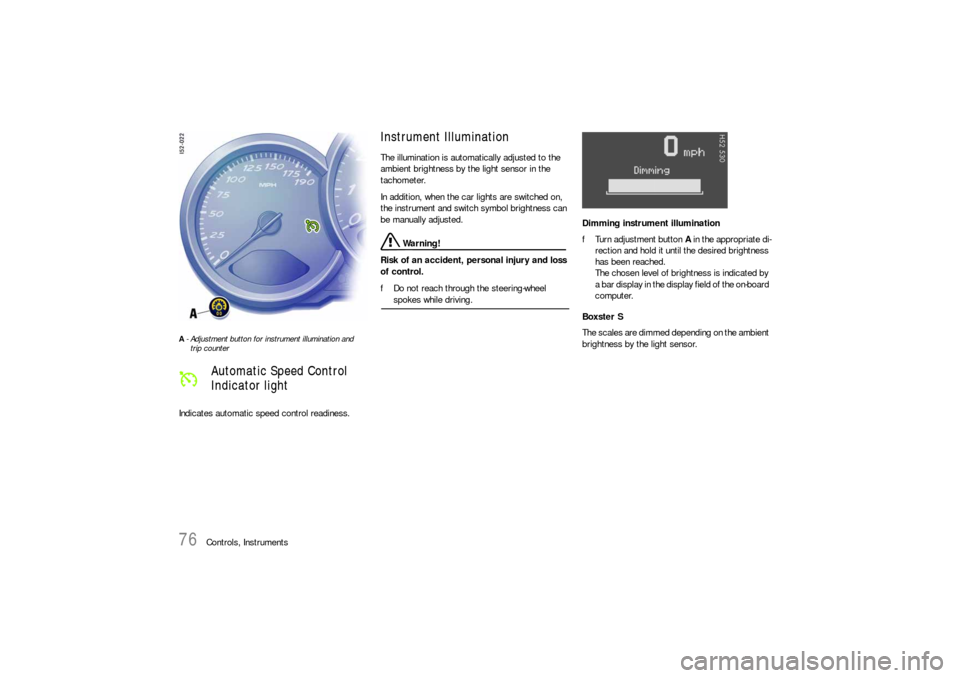
A- Adjustment button for instrument illumination and
trip counter Indicates automatic speed control readiness.
Instrument Illumination The illumination is automatically adjusted to the
ambient brightness by the light sensor in the
tachometer.
In addition, when the car lights are switched on,
the instrument and switch symbol brightness can
be manually adjusted.
Warning!
Risk of an accident, personal injury and loss
of control.
fDo not reach through the steering-wheel spokes while driving.
Automatic Speed Control
Indicator light
Dimming instrument illumination
fTurn adjustment button A in the appropriate di-
rection and hold it until the desired brightness
has been reached.
The chosen level of brightness is indicated by
a bar display in the display field of the on-board
computer.
Boxster S
The scales are dimmed depending on the ambient
brightness by the light sensor.
Page 80 of 276
80
Controls, Instruments
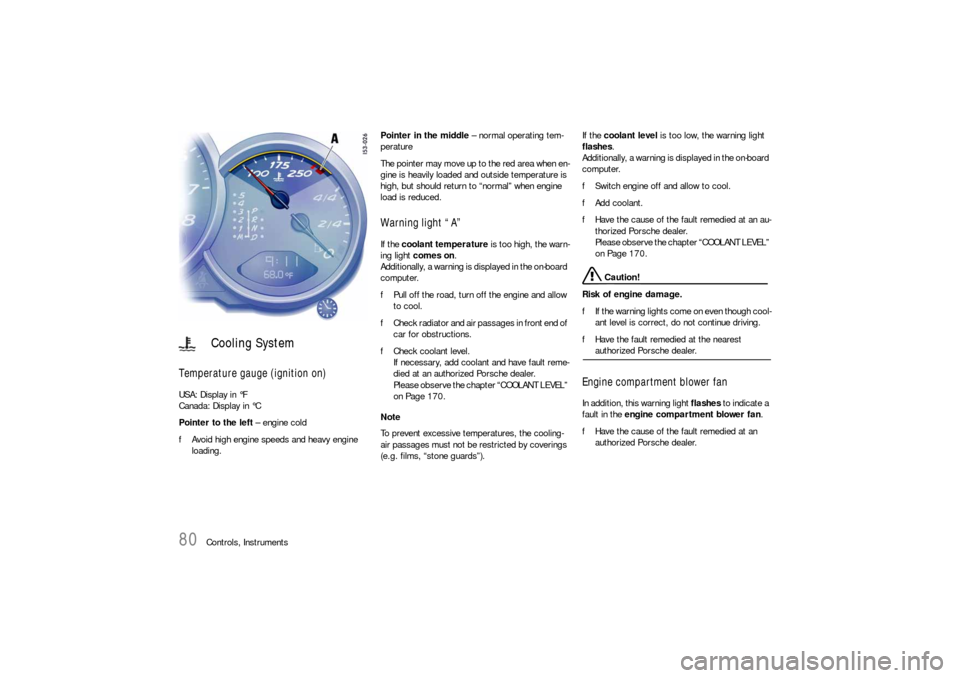
Temperature gauge (ignition on) USA: Display in °F
Canada: Display in °C
Pointer to the left – engine cold
fAvoid high engine speeds and heavy engine
loading. Pointer in the middle – normal operating tem-
perature
The pointer may move up to the red area when en-
gine is heavily loaded and outside temperature is
high, but should return to “normal” when engine
load is reduced.
Warning light “A” If the coolant temperature is too high, the warn-
ing light comes on.
Additionally, a warning is displayed in the on-board
computer.
fPull off the road, turn off the engine and allow
to cool.
fCheck radiator and air passages in front end of
car for obstructions.
fCheck coolant level.
If necessary, add coolant and have fault reme-
died at an authorized Porsche dealer.
Please observe the chapter “COOLANT LEVEL”
on Page 170.
Note
To prevent excessive temperatures, the cooling-
air passages must not be restricted by coverings
(e.g. films, “stone guards”). If the coolant level is too low, the warning light
flashes.
Additionally, a warning is displayed in the on-board
computer.
fSwitch engine off and allow to cool.
fAdd coolant.
fHave the cause of the fault remedied at an au-
thorized Porsche dealer.
Please observe the chapter “COOLANT LEVEL”
on Page 170.
Caution!
Risk of engine damage.
fIf the warning lights come on even though cool-
ant level is correct, do not continue driving.
fHave the fault remedied at the nearest authorized Porsche dealer.
Engine compartment blower fan In addition, this warning light flashes to indicate a
fault in the engine compartment blower fan.
fHave the cause of the fault remedied at an
authorized Porsche dealer.
Cooling System
Page 82 of 276
82
Controls, Instruments
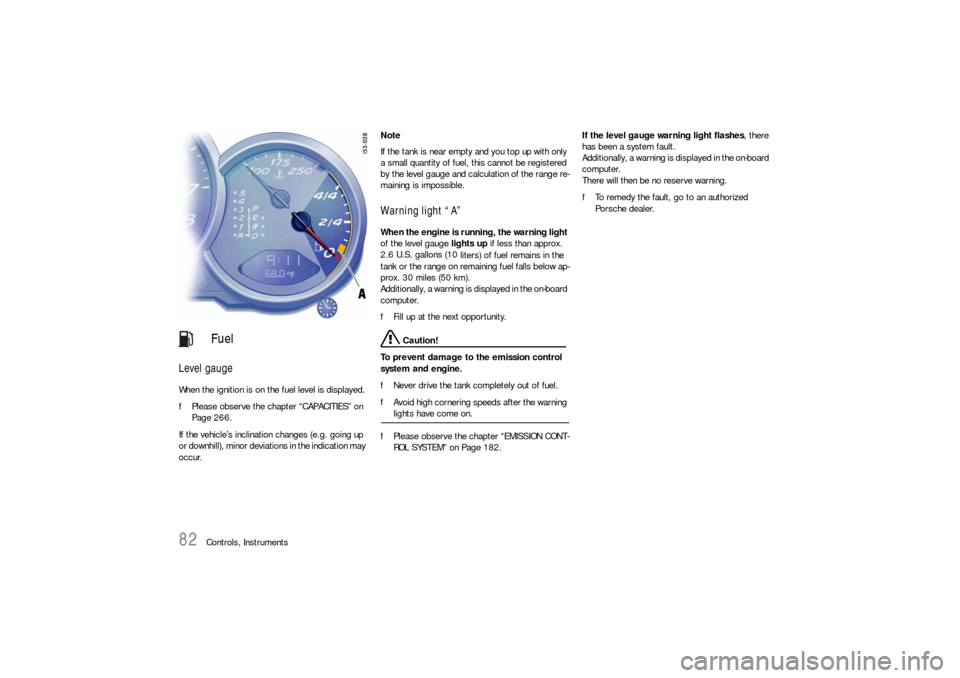
Level gauge
When the ignition is on the fuel level is displayed.
fPlease observe the chapter “CAPACITIES” on
Page 266.
If the vehicle’s inclination changes (e.g. going up
or downhill), minor deviations in the indication may
occur. Note
If the tank is near empty and you top up with only
a small quantity of fuel, this cannot be registered
by the level gauge and calculation of the range re-
maining is impossible.
Warning light “A” When the engine is running, the warning light
of the level gauge lights up if less than approx.
2.6 U.S. gallons (10
liters) of fuel remains in the
tank or the range on remaining fuel falls below ap-
prox. 30 miles (50 km).
Additionally, a warning is displayed in the on-board
computer.
fFill up at the next opportunity.
Caution!
To prevent damage to the emission control
system and engine.
fNever drive the tank completely out of fuel.
fAvoid high cornering speeds after the warning lights have come on.
fPlease observe the chapter “EMISSION CONT-
ROL SYSTEM” on Page 182.If the level gauge warning light flashes, there
has been a system fault.
Additionally, a warning is displayed in the on-board
computer.
There will then be no reserve warning.
fTo remedy the fault, go to an authorized
Porsche dealer.
Fuel
Page 84 of 276
84
Controls, Instruments If the battery voltage drops abruptly, a warning
m e s s a g e w i l l b e d i s p l a y e d b y t h e o n - b o a rd c o m p u -
ter.
If the warning is displayed by the on-board
computer while the engine is running or while
driving:
fStop the car in a safe place and stop the
engine.
Possible causes
– Defect in the battery charging system.
– Broken drive belt. Warning!
Risk of an accident and risk of engine dam-
age.
A broken drive belt means there is no power
assistance to the steering (more effort is re-
quired to steer) and coolant pump function
will stop.
fDo not continue driving.
fHave the fault remedied at the nearest author-ized Porsche dealer. The warning light in the instrument panel comes
on when the ignition is first turned on and remains
on briefly as a bulb check. If the light does not
come on, have the bulb replaced promptly.
If the warning lights in the instrument panel and on-
board computer come on and remain on while
driving, it suggests:
– a potential engine control problem and the
need for system service or
– an improperly fastened tank cap or
– refuelling with engine running.
Although the vehicle is usually driveable and will
not require towing, see your dealer for service as
soon as possible.
Caution!
If the Check engine light in the instrument
panel is flashing, severe catalytic converter
damage and power loss will soon occur.
Prolonged driving with the Check engine light
on could cause damage to the emission con-
trol system. It also could affect fuel economy
and driveability.
fHave the fault remedied at the nearest author-ized Porsche dealer immediately.
Battery
Check Engine
Warning Light