engine PORSCHE BOXSTER 2005 2.G Repair Manual
[x] Cancel search | Manufacturer: PORSCHE, Model Year: 2005, Model line: BOXSTER, Model: PORSCHE BOXSTER 2005 2.GPages: 276, PDF Size: 4.05 MB
Page 168 of 276

168
Maintenance, Car Care
Exercise Extreme Caution when
Working on your Vehicle
Danger!
Ignoring the following instructions may cau-
se serious personal injury or death.
fThe engine compartment of any motor vehicle
is a potentially hazardous area. If you are not
fully familiar with proper repair procedures, do
not attempt the adjustments described on the
following pages.
This caution applies to the entire vehicle.
fO n l y w o r k o n y o u r v e h i c l e o u t d o o r s o r i n a w e l l
ventilated area.
fEnsure that there are no open flames in the
area of your vehicle at any time when fuel fu-
mes might be present. Be especially cautious
of such devices such as hot water heaters
which ignite a flame intermittently.
fBefore working on any part in the engine com-
partment, turn the engine off and let it cool
down sufficiently. Hot engine compartment
components can burn skin on contact.
fBe alert and cautious around engine at all ti-
mes while the engine is running.
If work has to be performed with the engine
running, always set the parking brake, and
make sure the shift lever is in neutral or the se-
lector lever is in position P or N. fIn particular, be very careful to ensure that
items of clothing (ties, shirt, sleeves etc.), je-
welry, long hair, hand or fingers cannot get
caught in the engine-compartment blower, fan,
belts or other moving parts.
The radiator and radiator fans are in the front
of the car.
The fans can start or continue running as a
function of temperature, even with the engine
switched off.
Carry out work in these areas only with the en-
gine off and exercise extreme caution.
fYour Porsche is equipped with an electronic ig-
nition system. When the ignition is on, high vol-
tage is present in all wires connected with the
ignition system; therefore, exercise extreme
caution when working on any part of the engine
while the ignition is on or the engine is running.
fAlways support your car with safety stands if it
is necessary to work under the car. The jack
supplied with the car is not adequate for this
purpose.
fWhen working under the car without safety
stands but with the wheels on the ground,
make sure the car is on level ground, the
wheels are blocked, and that the engine can-
not be started.
Remove the ignition key. fDo not smoke or allow an open flame around
the battery or fuel.
Keep a fire extinguisher in close reach.
fIncomplete or improper servicing may cause
problems in the operation of the car. If in doubt
about any servicing, have it done by your au-
thorized Porsche dealer.
Improper maintenance during the warranty pe-
riod may affect your Porsche warranty cove-
rage.
fSupplies of fluids, e.g. engine oil, brake fluid or
coolant, are hazardous to your health.
Keep these fluids out of children’s reach and
dispose of them in accordance with the appro-
priate regulations.
fSome countries require additional tools and
special spare parts to be carried.
Please make enquiries before driving abroad.
Power measurements Power measurements on dynamometers are not
approved by Porsche.
Page 170 of 276
170
Maintenance, Car Care
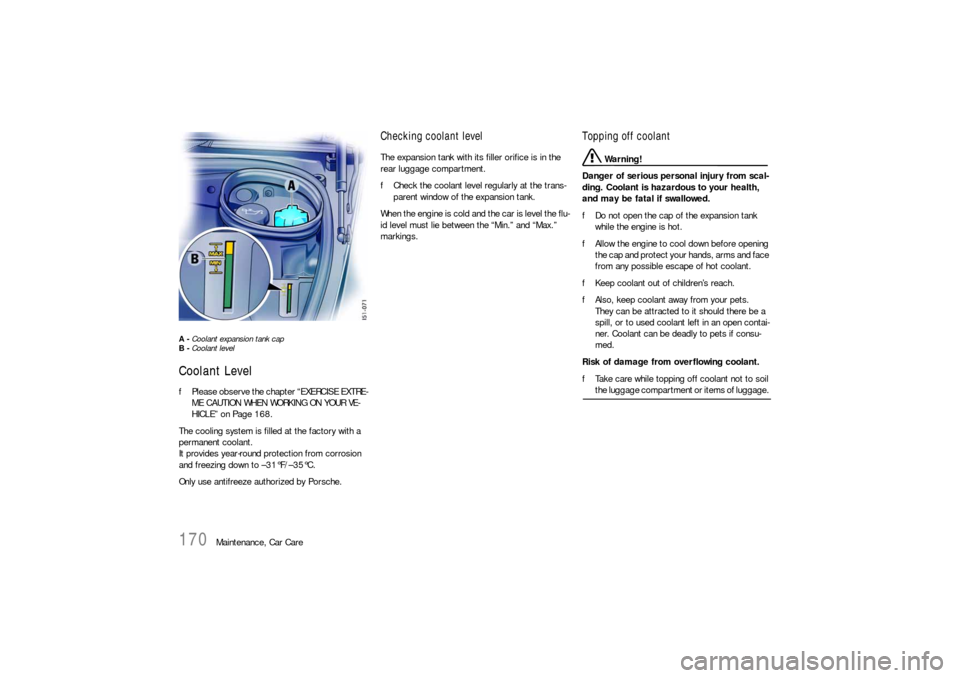
A - Coolant expansion tank cap
B - Coolant level Coolant Level fPlease observe the chapter “EXERCISE EXTRE-
ME CAUTION WHEN WORKING ON YOUR VE-
HICLE” on Page 168.
The cooling system is filled at the factory with a
permanent coolant.
It provides year-round protection from corrosion
and freezing down to –31°F/–35°C.
Only use antifreeze authorized by Porsche.
Checking coolant level The expansion tank with its filler orifice is in the
rear luggage compartment.
fCheck the coolant level regularly at the trans-
parent window of the expansion tank.
When the engine is cold and the car is level the flu-
id level must lie between the “Min.” and “Max.”
markings.
Topping off coolant
Warning!
Danger of serious personal injury from scal-
ding. Coolant is hazardous to your health,
and may be fatal if swallowed.
fDo not open the cap of the expansion tank
while the engine is hot.
fAllow the engine to cool down before opening
the cap and protect your hands, arms and face
from any possible escape of hot coolant.
fKeep coolant out of children’s reach.
fAlso, keep coolant away from your pets.
They can be attracted to it should there be a
spill, or to used coolant left in an open contai-
ner. Coolant can be deadly to pets if consu-
med.
Risk of damage from overflowing coolant.
fTake care while topping off coolant not to soil the luggage compartment or items of luggage.
Page 171 of 276

Maintenance, Car Care
171
1. Switch engine off and let it cool.
Please observe the chapter “COOLING SYS-
TEM” on Page 80.
2. Cover the expansion tank cap with a thick rag.
Open cap slowly and carefully and allow over-
pressure to escape.
Then unscrew cap completely.
3. Only add a mixture of antifreeze and water in
equal parts, and do not exceed the “Max.”
mark.
Antifreeze in coolant:
50% gives protection down to –31°F/–35°C
60% gives protection down to –58°F/–50°C
4. Screw cap firmly on.
If in an emergency pure water has been added, the
mix ratio must be corrected at an authorized
Porsche dealer.
Marked loss of coolant indicates leakage in the
cooling system.
The cause should immediately be remedied at an
authorized Porsche dealer.
Radiator fansThe radiator and radiator fans are in the front of
the vehicle.
Warning!
Risk of injury. The fans can start running as
a function of temperature, even with the
engine switched off.
fExercise extreme caution when working in the area of the radiator fans.
Page 172 of 276

172
Maintenance, Car Care
Engine Oil Engine oil consumption
It is normal for your engine to consume oil.
The rate of oil consumption depends on the quality
and viscosity of oil, the speed at which the engine
is operated, the climate, road conditions as well
as the amount of dilution and oxidation of the lub-
ricant.
If the vehicle is used for repeated short trips, and
consumes a normal amount of oil, the engine oil
measurement may not show any drop in the oil le-
vel at all, even after 600 miles (1000 km) or more.
This is because the oil is gradually becoming dilut-
ed with fuel or moisture, making it appear that the
oil level has not changed.
The diluting ingredients evaporate out when the
vehicle is driven at high speeds, as on an express-
way, making it then appear that oil is excessively
consumed after driving at high speeds.
If the conditions you drive your vehicle in are dus-
ty, humid, or hot, the frequency of the oil change
intervals should be greater. If the vehicle is driven at a high rate of speed, cli-
matic conditions are warm, and the load is high,
the oil should be checked more frequently, as dri-
ving conditions will determine the rate of oil con-
sumption.
– The engine in your vehicle depends on oil to lu-
bricate and cool all of its moving parts.
Therefore, the engine oil should be checked re-
gularly and kept at the required level.
– Make it a habit to have the engine oil level che-
cked with every fuel filling.
– The oil pressure warning light is not an oil level
indicator.
The oil pressure warning light indicates serious
engine damage may be occuring when lit, if en-
gine rpm is above idle speed.
Page 173 of 276
Maintenance, Car Care
173
Engine Oil Level fPlease observe the chapter “EXERCISE EXTRE-
ME CAUTION WHEN WORKING ON YOUR VE-
HICLE” on Page 168.
fRegularly check the oil level using the on-board
computer after the vehicle is refuelled.
Please observe the chapter “OIL DISPLAY AND
MEASUREMENT OF THE ENGINE OIL LEVEL”
on Page 97.
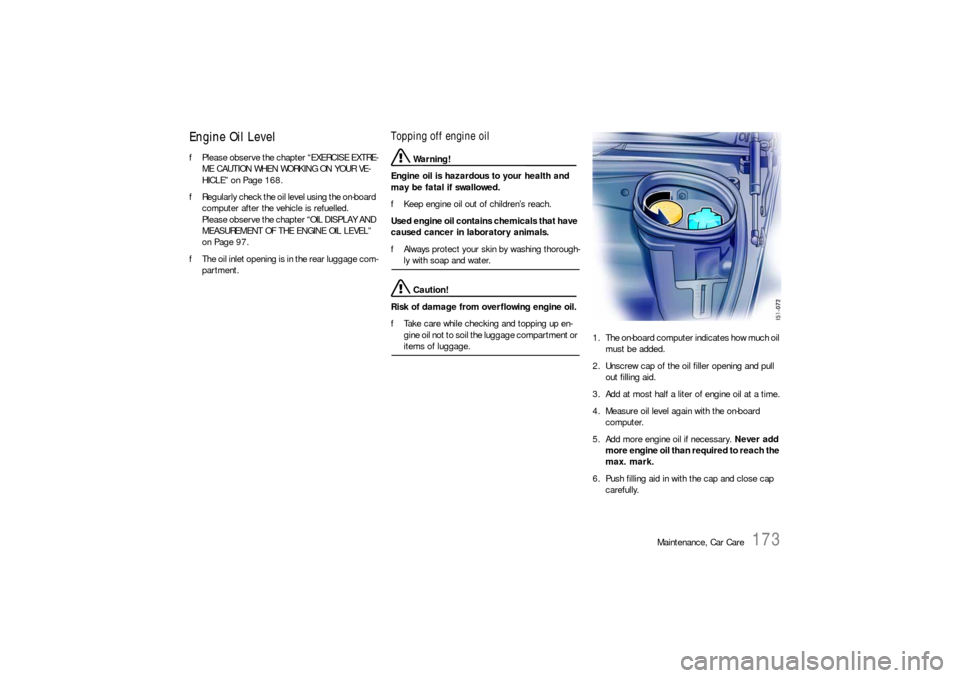
fThe oil inlet opening is in the rear luggage com-
partment.
Topping off engine oil
Warning!
Engine oil is hazardous to your health and
may be fatal if swallowed.
fKeep engine oil out of children’s reach.
Used engine oil contains chemicals that have
caused cancer in laboratory animals.
fAlways protect your skin by washing thorough-ly with soap and water. Caution!
Risk of damage from overflowing engine oil.
fTake care while checking and topping up en-
gine oil not to soil the luggage compartment or items of luggage. 1. The on-board computer indicates how much oil
must be added.
2. Unscrew cap of the oil filler opening and pull
out filling aid.
3. Add at most half a liter of engine oil at a time.
4. Measure oil level again with the on-board
computer.
5. Add more engine oil if necessary. Never add
more engine oil than required to reach the
max. mark.
6. Push filling aid in with the cap and close cap
carefully.
Page 174 of 276

174
Maintenance, Car Care
Engine Oil RecommendationRecommended oil viscosity ranges dependent on ambient temperatures
fUse only engine oils approved by Porsche.
If in doubt ask your authorized Porsche dealer for Porsche tested and approved all-season oils. Ambient temperature
seasonalSAE Viscosity Range
engine oils
generally above –13°F/–25 °CSAE 0W-40, 5W-40, 5W-50
approved by Porsche
generally below –13°F/–25 °C SAE 0W-40 approved by Porsche
Page 177 of 276

Maintenance, Car Care
177
Fuel Economy Fuel economy will vary depending on where,
when and how you drive, optional equipment
installed, and the general condition of your
car.
A car tuned to specifications and correctly
maintained, will help you to achieve optimal
fuel economy.
fHave your vehicle tuned to specifications.
Air cleaner should be dirt free to allow proper
engine “breathing”.
Battery should be fully charged.
Wheels should be properly aligned.
Tires should be inflated at correct pressure.
fAlways monitor your fuel consumption.
fDrive smoothly, avoid abrupt changes in speed
as much as possible.
fAvoid jack rabbit starts and sudden stops.
fDo not drive longer than necessary in the lower
gears. Shifting into a higher gear early without
lugging the engine will help save fuel.
fProlonged “warm up” idling wastes gas. Start
the vehicle just before you are ready to drive.
Accelerate slowly and smoothly.
fSwitch off the engine if stationary for longer
periods (traffic lights, jams, level crossings). fAny additional weight carried in the vehicle re-
duces fuel economy. Always keep cargo to a
minimum and remove all unnecessary items.
fOrganize your trips to take in several errands
in one trip.
fAll electrical accessories contribute to increa-
sed fuel consumption.
fOnly switch on the air conditioning when neces-
sary.
The EPA estimated m.p.g. is to be used for
comparison purposes, actual mileage may
be different from the estimated m.p.g., de-
pending on your driving speed, weather con-
ditions and trip length. Your actual highway
mileage will probably be less than the esti-
mated m.p.g.
fPlease observe all local and national speed li-
mits.
Operating Your Porsche in other
Countries Government regulations in the United States and
Canada require that automobiles meet specific
emission regulations and safety standards. There-
fore, cars built for the U.S. and Canada differ from
vehicles sold in other countries.
If you plan to take your Porsche outside the conti-
nental limits of the United States or Canada, there
is the possibility that
– unleaded fuel may not be available;
– unleaded fuel may have a considerably lower
octane rating. Excessive engine knock and se-
rious damage to both engine and catalytic con-
verters could result;
– service may be inadequate due to lack of pro-
per service facilities, tools or diagnostic equip-
ment;
– replacement parts may not be available or very
difficult to get.
Porsche cannot be responsible for the me-
chanical damage that could result because
of inadequate fuel, service or parts availabi-
lity.
If you purchased your Porsche abroad and want to
bring it back home, be sure to find out about ship-
ping and forwarding requirements, as well as cur-
rent import and customs regulations.
Page 178 of 276
178
Maintenance, Car Care
Fuel
Warning!
Fuel is highly flammable and harmful to
health.
fFire, open flame and smoking are prohibited
when handling fuel.
fAvoid contact with skin or clothing.
fDo not inhale fuel vapors.
To prevent damage to the emission control
system and engine:
fNever drive the tank completely out of fuel.
fAvoid high cornering speeds after the warning lights have come on.
fPlease observe the chapter “FUEL ECONOMY”
on Page 177.
fPlease observe the chapter “EMISSION CONT-
ROL SYSTEM” on Page 182.
fPlease observe the chapter “FUEL” on Page
82.
Check engine warning light
If the warning lights in the instrument panel and on-
board computer come on and remain on while
driving, it suggests:
– an improperly fastened tank cap or
– refuelling with engine running.
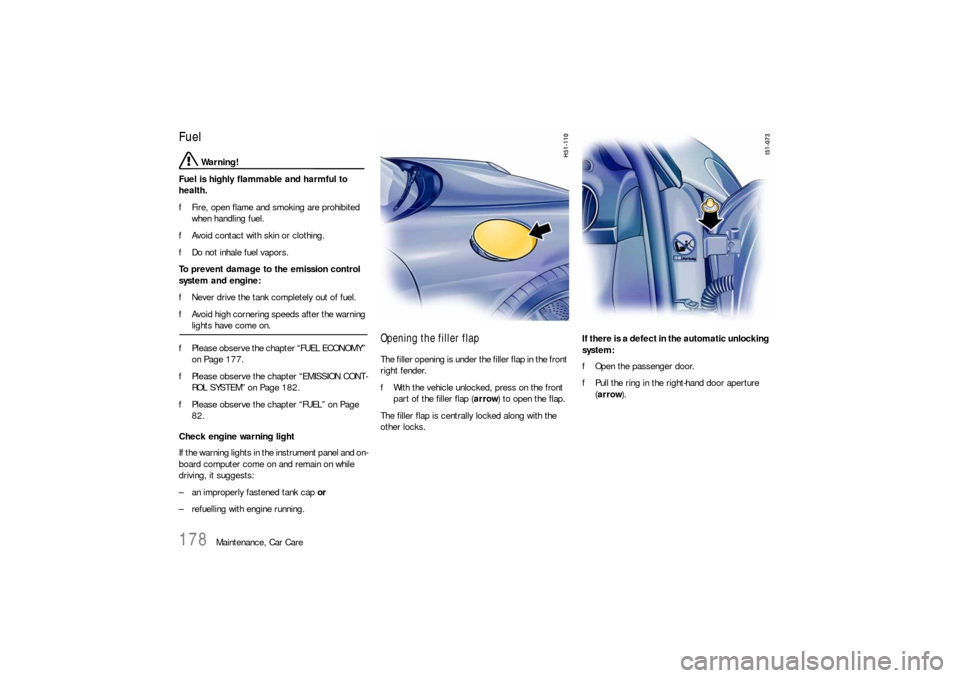
Opening the filler flap The filler opening is under the filler flap in the front
right fender.
fWith the vehicle unlocked, press on the front
part of the filler flap (arrow) to open the flap.
The filler flap is centrally locked along with the
other locks. If there is a defect in the automatic unlocking
system:
fOpen the passenger door.
fPull the ring in the right-hand door aperture
(arrow).
Page 179 of 276
Maintenance, Car Care
179
Refuelling Fuel tank capacity is listed under “Capacities”.
Porsche does not recommend the use of fuel ad-
ditives.
Fuel is highly flammable and harmful to
health.
fPlease observe the chapter “CAPACITIES” on
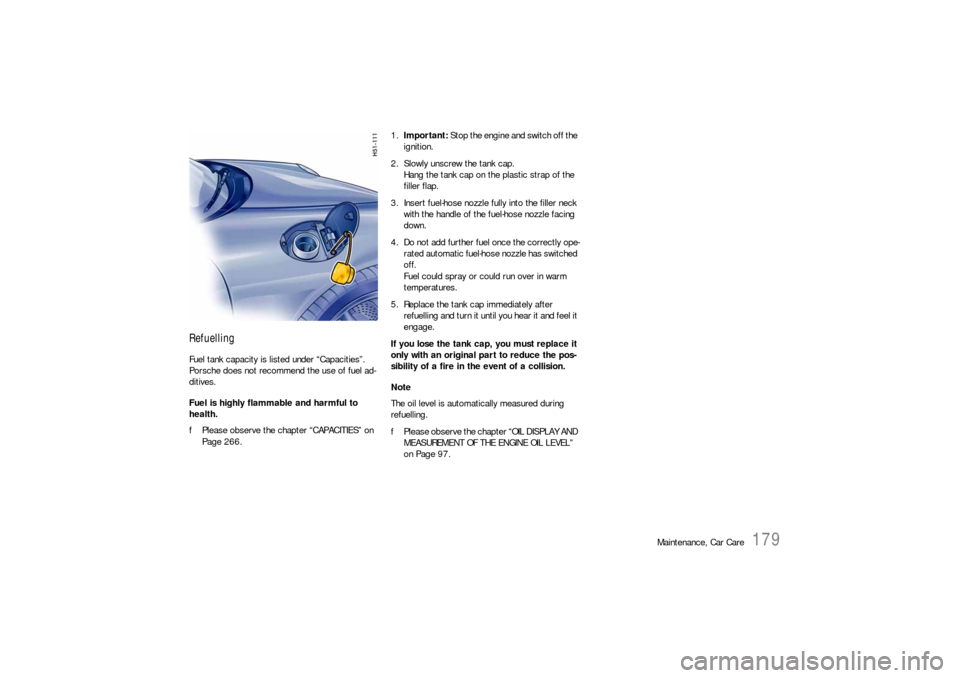
Page 266.1.Important: Stop the engine and switch off the
ignition.
2. Slowly unscrew the tank cap.
Hang the tank cap on the plastic strap of the
filler flap.
3. Insert fuel-hose nozzle fully into the filler neck
with the handle of the fuel-hose nozzle facing
down.
4. Do not add further fuel once the correctly ope-
rated automatic fuel-hose nozzle has switched
off.
Fuel could spray or could run over in warm
temperatures.
5. Replace the tank cap immediately after
refuelling and turn it until you hear it and feel it
engage.
If you lose the tank cap, you must replace it
only with an original part to reduce the pos-
sibility of a fire in the event of a collision.
Note
The oil level is automatically measured during
refuelling.
fPlease observe the chapter “OIL DISPLAY AND
MEASUREMENT OF THE ENGINE OIL LEVEL”
on Page 97.
Page 180 of 276

180
Maintenance, Car Care
Fuel Recommendations Your Porsche is equipped with catalytic conver-
ters and must use UNLEADED FUEL ONLY.
Your engine is designed to provide optimum per-
formance and fuel economy using unleaded premi-
um fuel with an octane rating of 98 RON
(93
CLC or AKI). Porsche therefore recom-
mends the use of these fuels in your vehicle.
Porsche also recognizes that these fuels may not
always be available. Be assured that your vehicle
will operate properly on unleaded premium fuels
with octane numbers of at least 95
RON
(90 CLC or AKI), since the engine’s ”Electronic
Oktane™ knock control“ will adapt the ignition ti-
ming, if necessary.
T h e u s e o f U N L E A D E D F U E L O N LY i s c r i t i c a l l y
important to the life of the catalytic conver-
ters. Deposits from leaded fuels will ruin the
converters and make it ineffective as an
emission control device.
Cars with catalytic converters have a smaller fuel
tank opening, and gas station pumps have smaller
nozzles. This will prevent accidental pumping of
leaded fuel into cars with catalytic converters. Unleaded fuels may not be available outside the
continental U.S. and Canada. Therefore, we re-
commend you do not take your car to areas or
countries where unleaded fuel may not be availab-
le.
Octane ratings Octane rating indicates a fuel’s ability to resist de-
tonation. Therefore, buying the correct octane gas
is important to prevent engine ”damage“.
The RON octane rating is based on the research
method. The CLC (U.S. Cost of Living Council oc-
tane rating) or AKI (antiknock index) octane rating
usually displayed on U.S. fuel pumps is calculated
as research octane number plus motor octane
number, divided by 2, that is written as:
The CLC or AKI octane rating is usually lower than
the RON rating:
For example: 95 RON equals 90 CLC or AKI.
Fuels containing alcohol and ether Some areas of the U.S. require oxygenated fuels
during certain portions of the year. Oxygenated fu-
els are fuels which contain alcohols (such as me-
thanol or ethanol) or ether (such as MTBE).
Under normal conditions, the amount of these
compounds in the fuel will not affect driveability.
You may use oxygenated fuels in your Porsche,
provided the octane requirements for your vehicle
are met. We recommend, however, to change to a
different fuel or station if any of the following pro-
blems occur with your vehicle:
– Deterioration of driveability and performance.
– Substantially reduced fuel economy.
– Vapor lock and non-start problems, especially
at high altitude or at high temperature.
– Engine malfunction or stalling. RON MON+
2 ---------------------------------------------------- o rRM+
2 ------------------------