engine PORSCHE BOXSTER 2005 2.G Manual PDF
[x] Cancel search | Manufacturer: PORSCHE, Model Year: 2005, Model line: BOXSTER, Model: PORSCHE BOXSTER 2005 2.GPages: 276, PDF Size: 4.05 MB
Page 181 of 276

Maintenance, Car Care
181
Fuels containing MMT Some North American fuels contain an octane en-
hancing additive called methylcyclopentadienyl
manganese tricarbonyl (MMT).
If such fuels are used, your emission control sys-
tem performance may be negatively affected.
The check engine warning light on your instrument
panel may turn on.
If this occurs, Porsche recommends you stop
using fuels containing MMT.
Portable Fuel Containers
Danger!
Portable fuel containers, full or partially em-
pty, may leak causing an explosion, or result
in fire in case of an accident.
fNever carry additional fuel in portable contai-ners in your vehicle.
Page 182 of 276

182
Maintenance, Car Care
Emission Control System In the interest of clean air Pollution of our environment has become a pro-
blem that is of increasing concern to all of us. We
urge you to join us in our efforts for cleaner air in
controlling the pollutants emitted from the auto-
mobile.
Porsche has developed an emission control sys-
tem that controls or reduces those parts of the
emission that can be harmful to our environment.
Your Porsche is equipped with such a system.
Porsche warrants the Emission Control System in
your new car under the terms and conditions set
forth in the Warranty Booklet.
You, as the owner of the vehicle, have the
responsibility to provide regular maintenance ser-
vice for the vehicle and to keep a record of all
maintenance work performed. To facilitate record
keeping, have the service performed by authori-
zed Porsche dealers. They have Porsche trained
technicians and special tools to provide fast and
efficient service.
To assure efficient operation of the
Emission Control System fHave your vehicle maintained properly and in
accordance with the recommendations descri-
bed in your Maintenance Booklet.
Lack of proper maintenance, as well as impro-
per use of the vehicle, will impair the function
of the emission control system and could lead
to damage.
fDo not alter or remove any component of the
emission control system.
fDo not alter or remove any device, such as
heat shields, switches, ignition wires, valves,
etc., which are designed to protect your vehic-
le’s emission control system.
In addition to serious engine damage, this can
result in a fire if excess raw fuel reaches the ex-
haust system.
fDo not continue to operate your vehicle if you
detect engine misfire or other unusual opera-
ting conditions.
Parking
Warning!
Danger of fire.
fDo not park or operate the vehicle in areas
where the hot exhaust system may come in
contact with dry grass, brush, fuel spill or
other flammable material.
fIf your car catches on fire for any reason, call
the fire department.
Do not endanger your life by attempting to put out the fire.
Undercoating
Danger!
Danger of fire and serious personal injuries
or death.
fDo not apply additional undercoating or rust-
proofing on or near the exhaust manifold, ex-
haust pipes, catalytic converters or heat
shields. During driving the substance used for undercoating could overheat and ignite.
Page 183 of 276

Maintenance, Car Care
183
How Emission Control Works When an automobile engine is running, it uses en-
ergy generated through the combustion of a mix-
ture of air and fuel. Depending on whether a car is
driven fast or slowly or whether the engine is cold
or hot, some of the fuel (hydrocarbons) may not
be burned completely, but may be discharged into
the engine crankcase or exhaust system. Addito-
nal hydrocarbons may enter the atmosphere th-
rough evaporation of fuel from the fuel tank. These
hydrocarbons (HC), when released into the air,
contribute to undesirable pollution.
In addition, carbon monoxide (CO) and oxides of
nitrogen (NOx) contribute to engine emissions.
They, too, are formed during the combustion pro-
cess and discharged into the exhaust system.
To reduce these pollutants, your Porsche is equip-
ped with a precisely calibrated fuel injection sys-
tem to assure a finely balanced air/fuel mixture un-
der all operating conditions.
Oxygen sensor The oxygen sensor, installed in the exhaust pipe
continuously senses the oxygen content of the ex-
haust and signals the information to an electronic
control unit. The control unit corrects the air/fuel
ratio, so the engine always receives an accurately
metered air/fuel mixture. Crankcase ventilation Through crankcase ventilation, undesirable emis-
sions from the engine crankcase are not permit-
ted to reach the outside atmosphere. These emis-
sions are recirculated from the crankcase to the
air intake system. From here the emissions mix
with the intake air and are later burned in the engi-
ne. Catalytic converters The catalytic converters are efficient ”clean-up“
devices built into the exhaust system of the vehic-
le. The catalytic converters burn the undesirable
pollutants in the exhaust gas before it is released
into the atmosphere.
The exclusive use of unleaded fuel is critical-
ly important for the life of the catalytic con-
verters. Therefore, only unleaded fuel must
be used. The catalytic converters will be damaged by:
– push or tow starting the vehicle,
– misfiring of the engine,
– turning off the ignition while the vehicle is mo-
ving or
– driving until the fuel tank is completely empty,
– by other unusual operating conditions.
fDo not continue to operate your vehicle under
these conditions, since raw fuel might reach
the catalytic converters. This could result in
overheating of the converters. Federal law pro-
hibits use of leaded fuel in this car.
Page 184 of 276
184
Maintenance, Car Care
Fuel Evaporation Control Fuel tank venting The evaporation chamber and the carbon canister
prevent fuel from escaping to the atmosphere at
extreme high outside temperatures, when driving
abruptly around curves and when the car is parked
at an incline or in any other nonlevel position. Vapor control system and storage When the fuel tank is filled, vapors are collected in
the evaporation chamber by a vent line leading the
vapors to the carbon canister where they are
stored as long as the engine does not run. Purge system When the engine is running, the fuel vapors from
the canister will be mixed with fresh air from the
ambient air of the canister. This mixture will be di-
rected to the intake air housing by the tank vent
line, mixed with the intake air and burned during
normal combustion.
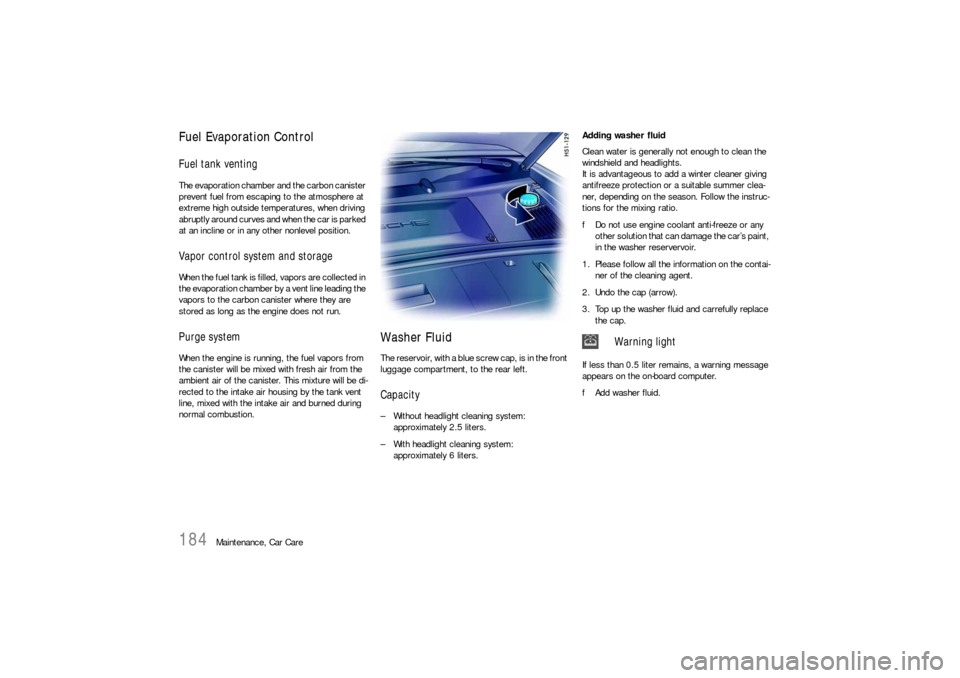
Washer Fluid The reservoir, with a blue screw cap, is in the front
luggage compartment, to the rear left. Capacity – Without headlight cleaning system:
approximately 2.5 liters.
– With headlight cleaning system:
approximately 6 liters. Adding washer fluid
Clean water is generally not enough to clean the
windshield and headlights.
It is advantageous to add a winter cleaner giving
antifreeze protection or a suitable summer clea-
ner, depending on the season. Follow the instruc-
tions for the mixing ratio.
fDo not use engine coolant anti-freeze or any
other solution that can damage the car’s paint,
in the washer reservervoir.
1. Please follow all the information on the contai-
ner of the cleaning agent.
2. Undo the cap (arrow).
3. Top up the washer fluid and carrefully replace
the cap.
If less than 0.5 liter remains, a warning message
appears on the on-board computer.
fAdd washer fluid.
Warning light
Page 185 of 276
Maintenance, Car Care
185
Opening Engine Compartment Lid Moving convertible top to service position 1. Open or close the convertible top far enough
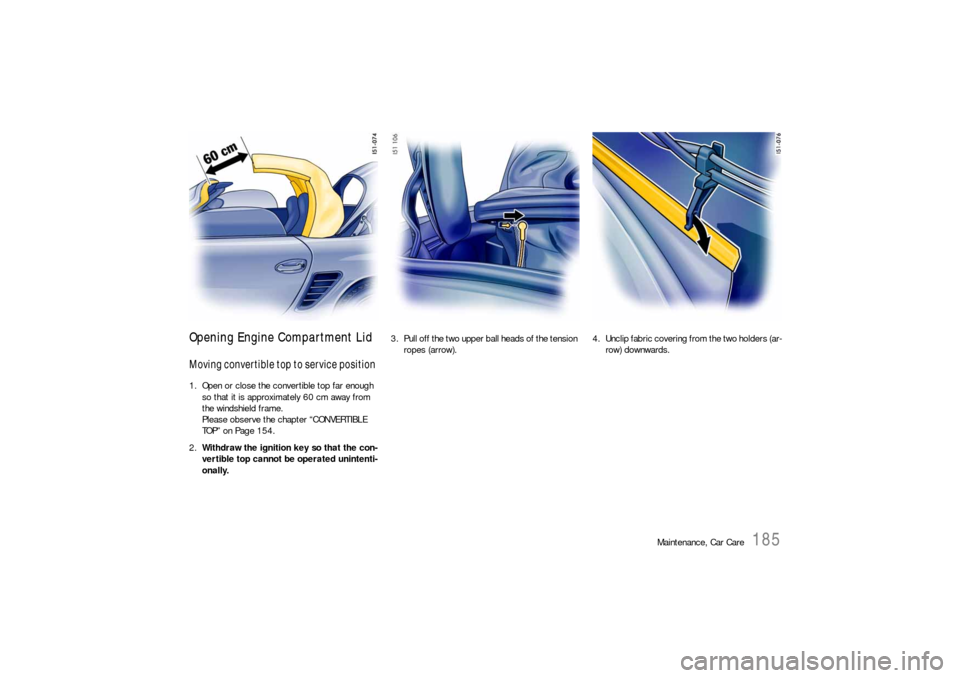
so that it is approximately 60 cm away from
the windshield frame.
Please observe the chapter “CONVERTIBLE
TOP” on Page 154.
2.Withdraw the ignition key so that the con-
vertible top cannot be operated unintenti-
onally. 3. Pull off the two upper ball heads of the tension
ropes (arrow).4. Unclip fabric covering from the two holders (ar-
row) downwards.
Page 188 of 276
188
Maintenance, Car Care
Removing engine compartment lid 1. Withdraw the ignition key so that the convertib-
le top cannot be operated unintentionally.
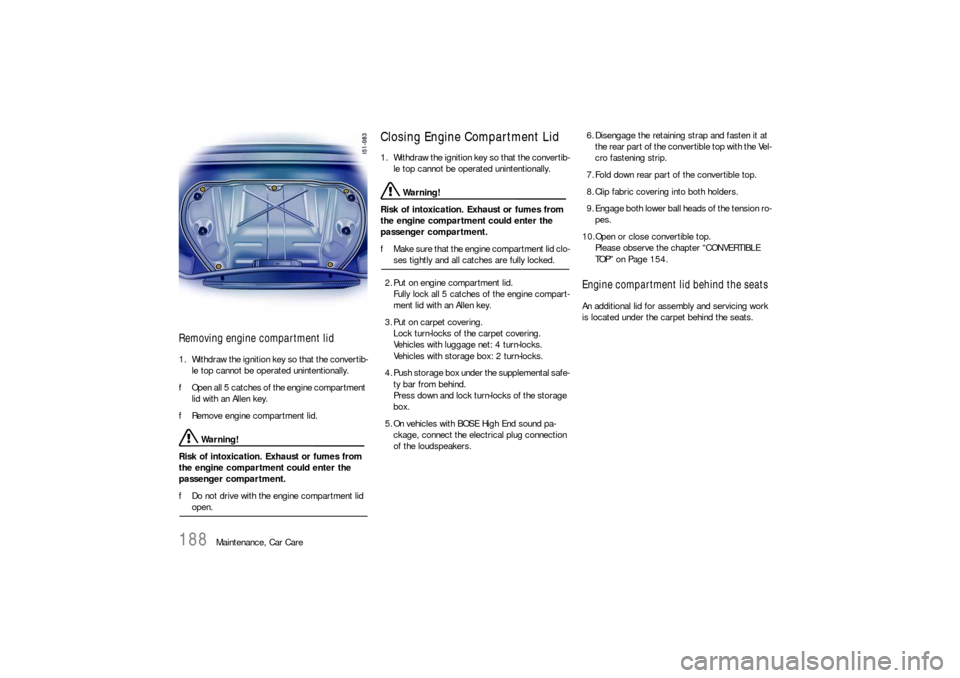
fOpen all 5 catches of the engine compartment
lid with an Allen key.
fRemove engine compartment lid.
Warning!
Risk of intoxication. Exhaust or fumes from
the engine compartment could enter the
passenger compartment.
fDo not drive with the engine compartment lid open.
Closing Engine Compartment Lid 1. Withdraw the ignition key so that the convertib-
le top cannot be operated unintentionally.
Warning!
Risk of intoxication. Exhaust or fumes from
the engine compartment could enter the
passenger compartment.
fMake sure that the engine compartment lid clo-ses tightly and all catches are fully locked.
2. Put on engine compartment lid.
Fully lock all 5 catches of the engine compart-
ment lid with an Allen key.
3. Put on carpet covering.
Lock turn-locks of the carpet covering.
Vehicles with luggage net: 4 turn-locks.
Vehicles with storage box: 2 turn-locks.
4. Push storage box under the supplemental safe-
ty bar from behind.
Press down and lock turn-locks of the storage
box.
5. On vehicles with BOSE High End sound pa-
ckage, connect the electrical plug connection
of the loudspeakers. 6. Disengage the retaining strap and fasten it at
t h e re a r p a r t o f th e c onvertible top with the Vel-
cro fastening strip.
7. Fold down rear part of the convertible top.
8. Clip fabric covering into both holders.
9. Engage both lower ball heads of the tension ro-
pes.
10.Open or close convertible top.
Please observe the chapter “CONVERTIBLE
TOP” on Page 154.
Engine compartment lid behind the seats An additional lid for assembly and servicing work
is located under the carpet behind the seats.
Page 189 of 276
Maintenance, Car Care
189
Power Steering
Warning!
Risk of accident.
When the engine is stopped (e.g. when on
tow) or the power steering has failed there is
no steering assistance.
Therefore, substantially more force will have
to be exerted in order to steer.
fExercise great care when being towed.
fHave the fault remedied at your nearest autho-rized Porsche dealer. Note
The flow noise heard at full steering lock is design-
related and does not indicate a defect in the stee-
ring system.
Checking hydraulic fluid fPlease observe the chapter “EXERCISE EXTRE-
ME CAUTION WHEN WORKING ON YOUR VE-
HICLE” on Page 168.
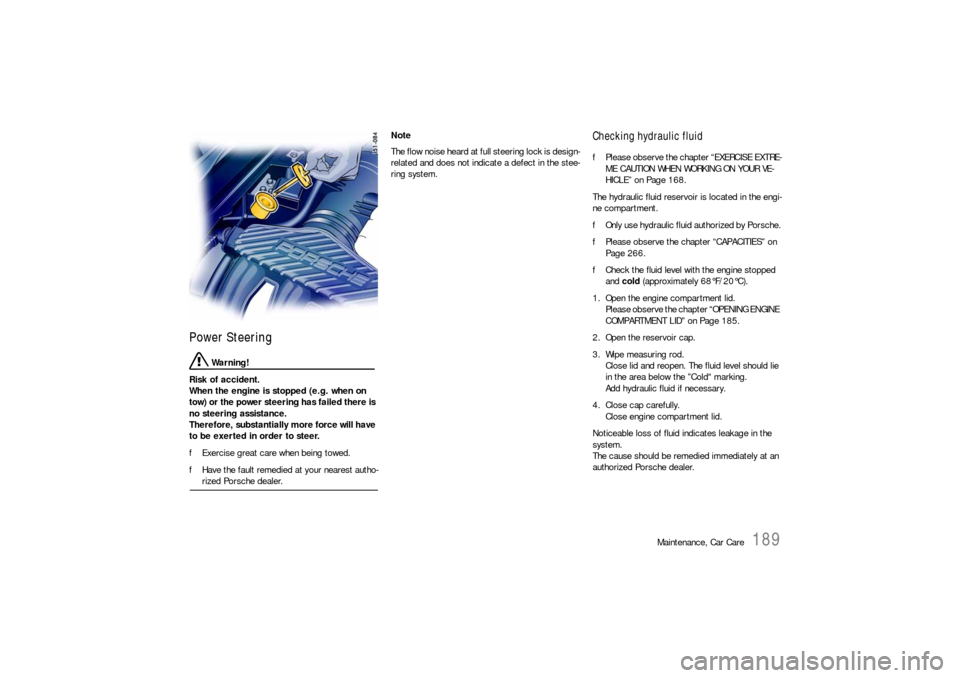
The hydraulic fluid reservoir is located in the engi-
ne compartment.
fOnly use hydraulic fluid authorized by Porsche.
fPlease observe the chapter “CAPACITIES” on
Page 266.
fCheck the fluid level with the engine stopped
and cold (approximately 68°F/20°C).
1. Open the engine compartment lid.
Please observe the chapter “OPENING ENGINE
COMPARTMENT LID” on Page 185.
2. Open the reservoir cap.
3. Wipe measuring rod.
Close lid and reopen. The fluid level should lie
in the area below the ”Cold“ marking.
Add hydraulic fluid if necessary.
4. Close cap carefully.
Close engine compartment lid.
Noticeable loss of fluid indicates leakage in the
system.
The cause should be remedied immediately at an
authorized Porsche dealer.
Page 190 of 276

190
Maintenance, Car Care
Air Filter The air filter is on the left-hand side of the engine
compartment.
A dirty air filter not only reduces engine perfor-
mance, but can lead to premature engine wear.
Regular filter replacement is part of the routine
maintenance service.
fIn dusty conditions, check the filter element
more frequently and replace if necessary. Combination filterThe fresh air passing through the combination
filter into the passenger compartment is virtually
free of dust, pollen, and unpleasant odours.
fIf the outside air is polluted by exhaust fumes,
press the circulating-air button.
A dirty filter can be the cause of reduced air
throughput:
fHave the filter replaced by an authorized
Porsche dealer.
Regular filter replacement is part of servicing.
Automatic Transmission Fluid The torque converter and the transmission are lu-
bricated with Automatic Transmission Fluid (ATF).
The final drive requires transmission oil.
fPlease observe the chapter “CAPACITIES” on
Page 266.
Do not tow the car or run the engine without ATF
in the transmission. The automatic transmission
may be damaged by even a tiny speck of dirt, only
a clean funnel or spout must be used when adding
AT F.
The ATF and transmission oil has to be checked
and changed at the intervals listed in your Mainte-
nance Schedule.
We recommend that you have the ATF and trans-
mission oil changed at your Porsche dealer, who
has the required lubricants and the necessary fil-
ling equipment.
If you suspect an oil leak in the transmission, have
your authorized Porsche dealer check it out imme-
diately.
Manual Transmission Oil The transmission oil has to be checked and chan-
ged at the intervals listed in your Maintenance
Schedule.
fPlease observe the chapter “CAPACITIES” on
Page 266.
We recommend that you have the transmission oil
changed at your Porsche dealer, who has the re-
quired lubricants and the necessary filling equip-
ment.
If you suspect an oil leak in the transmission, have
your authorized Porsche dealer check it out imme-
diately.
Page 196 of 276

196
Maintenance, Car Care
Cleaning and preserving engine
compartment The engine compartment and the surface of the
engine are treated with a corrosion-inhibitor at the
factory.
If degreasing solvents are used to clean the engi-
ne compartment or the engine is washed down,
the process almost invariably removes the corro-
sion-inhibiting coating. It is then absolutely neces-
sary to have a durable preservative applied to all
surfaces, body seams, joints and assemblies in
the engine compartment. This also applies when
corrosion-inhibitor parts are replaced.
Caution!
Risk of damage to the alternator.
fDo not point the cleaning jet directly at the al-ternator, or cover the alternator.
Effective corrosion-proofing is particularly impor-
tant during the cold weather season. If your car is
driven frequently in areas where salt has been
spread on the roads, the whole engine compart-
ment should be cleaned thoroughly after the win-
ter to prevent salt from causing any lasting dama-
ge. A full under-body wash should also be perfor-
med at the same time.
Windows The road dust which settles on the windshield and
windows contains particles of tire rubber and oil
residue. The interior trim and upholstery release
particles, particularly in strong sunlight, which col-
lect on the insides of the windows. These deposits
are augmented by impurities in the air which en-
ters the car through the fresh air vents.
fClean all windows regularly, inside and outside,
with Porsche window cleaner.
fIf you use a chamois leather for the windows,
do not use it for paintwork as it will otherwise
pick up a certain amount of preservative or po-
lish and could smear the windows and thus im-
pair vision.
fRemove dead insects with the Porsche insect
remover.
Note
Door windows feature a water-repellent (hydropho-
bic) coating which prevents soiling of the windows.
This coating is subject to natural wear and can be
renewed.
fConsult an authorized Porsche dealer.
Wiper blades Wiper blades that are in perfekt condition are vital
for a clear view.
fReplace the wiper blades twice per year (be-
fore and after the cold season) or whenever wi-
per performance deteriorates.
fPeriodically clean the wiper blades with
Porsche window cleaner, especially after the
vehicle has been washed in a car wash.
If they are very dirty (e.g. with insect remains),
they can be cleaned with a sponge or cloth. Undercoating The underside of your car is durably protected
against chemical and mechanical influences.
As it is not possible to exclude the risk of damage
to this protective coating in day to day driving, it
is advisable to have the underside of the car in-
spected at certain intervals - preferably before the
start of winter and again in spring - and the under-
coating restored as necessary.
Your authorized Porsche dealer is familiar with the
bodyseal treatment procedures and has the ne-
cessary equipment for applying factory approved
materials. We recommend that you entrust them
with such work and inspections.
Unlike conventional spray oils, undercoating and
rust-proofing compounds based on bitumen or
wax do not attack the sound-proofing materials ap-
plied at the factory.
Page 197 of 276

Maintenance, Car Care
197
Warning!
Danger of fire and serious personal injuries.
fDo not apply additional undercoating or rust-
proofing on or near the exhaust manifold, ex-
haust pipes, catalytic converters or heat
shields. During driving the substance used for undercoating could overheat and ignite.
fBefore applying fresh underseal, carefully re-
move deposits or dirt and grease. Once it has
dried, the new undercoating compound forms
a tough protective coating which provides effi-
cient rust-proofing of the floor panels and com-
ponents.
fAlways apply a fresh coating of suitable preser-
vative to unprotected areas after cleaning the
underside of the body, the transmission, the
engine or carrying out repairs to under-body,
engine or transmission components.
Effective rust-proofing is particularly important du-
ring the cold weather season. If your car is driven
frequently in areas where salt has been spread on
the roads, the whole engine compartment should
be cleaned thoroughly after the winter to prevent
salt from causing any lasting damage. A full under-
body wash should also be performed at the same
time.
Door, roof, lid and window seals fWash dirt (e.g. abrasion, dust, road salts) from
all seals regularly using warm soapy water. Do
not use any chemical cleaning agents or sol-
vents.
When there is a frost hazard, the outer door seals
and the front and rear lid seals can be protected
against freezing into place by a suitable care pro-
duct.
In order to prevent damage to the anti-fric-
tion coating, the inner door seals, the con-
vertible top seals and hardtop seals must not
be treated with care products.
Headlights, lights, interior and exterior
plastic parts fUse only clean water and a little dishwashing
detergent to clean light lenses, plastic head-
light lenses, plastic parts and surfaces.
Do not clean when dry.
Use a soft sponge or a soft, lint-free cloth.
Gently wipe the surface without applying too
much pressure.
The Porsche inside window cleaner is also sui-
table for cleaning plastic surfaces. Follow the
cleaning instructions on the container.
Never use other chemical cleaners or
solvents.
fRinse cleaned surfaces with clear water.