engine PORSCHE BOXSTER 2005 2.G Manual Online
[x] Cancel search | Manufacturer: PORSCHE, Model Year: 2005, Model line: BOXSTER, Model: PORSCHE BOXSTER 2005 2.GPages: 276, PDF Size: 4.05 MB
Page 200 of 276

200
Maintenance, Car Care
Storing your Porsche If you intend to store your Porsche for a prolonged
period, please consult your authorized Porsche
dealer. The staff will be glad to advise you on the
most suitable and necessary methods.
fClean your vehicle thoroughly inside and out-
side.
Clean the engine compartment.
The under carriage and chassis components
should be free of dirt and salt deposits.
fFill up the fuel tank.
fChange the oil and oil filter, and run the engine
for several minutes.
fIncrease the tire pressure to 58 psi (4 bar).
It is not recommended to lift the vehicle, due to
the possibility of corrosion on shock absorber
piston shafts.
The vehicle should be moved slightly, approxi-
mately every four weeks, to prevent flat spot
on the tires. Climate control
The air conditioning system should be in good wor-
king condition and fully charged.
Windshield/Headlight washer
fCheck and correct antifreeze/cleaning solution
level as necessary.
Electrical system
fRemove the battery from the vehicle and store
it in a cool dry place, not on a cement floor.
When the battery is disconnected, the
alarm system is deactivated.
fRecharge the battery every 3 months. If the
battery remains in the vehicle with the cables
connected, it is necessary to check, remove
and recharge the battery every 2-3 weeks.
Do not fast charge the battery.
fPlease observe the chapter “BULB CHART” on
Page 239. Vehicle interior
The interior must be dry, especially in the area of
the floor carpets. The use of drying agents (Silica-
Gel) is recommended in vehicles with leather inte-
rior and in areas with high humidity. The recom-
mended amount is 3 fabric bags of 1.1 lbs. (500
grams) each placed on the floor carpets.
Windows, doors, lids and top must be closed. The
air vents should be opened.
Page 202 of 276

202
Practical Tips, Emergency Service
Exercise Extreme Caution when
Working on your Vehicle
Danger!
Ignoring the following instructions may cau-
se serious personal injury or death.
fThe engine compartment of any motor vehicle
is a potentially hazardous area. If you are not
fully familiar with proper repair procedures, do
not attempt the adjustments described on the
following pages.
This caution applies to the entire vehicle.
fO n l y w o r k o n y o u r v e h i c l e o u t d o o r s o r i n a w e l l
ventilated area.
fEnsure that there are no open flames in the
area of your vehicle at any time when fuel
fumes might be present. Be especially cau-
tious of such devices such as hot water hea-
ters which ignite a flame intermittently.
fBefore working on any part in the engine com-
partment, turn the engine off and let it cool
down sufficiently. Hot engine compartment
components can burn skin on contact.
fBe alert and cautious around engine at all
times while the engine is running.
If work has to be performed with the engine
running, always set the parking brake, and
make sure the shift lever is in neutral or the se-
lector lever is in position P.fIn particular, be very careful to ensure that
items of clothing (ties, shirt, sleeves etc.), je-
welry, long hair, hand or fingers cannot get
caught in the engine-compartment blower, fan,
belts or other moving parts.
The radiator and radiator fans are in the front
of the car.
The fans can start or continue running as a
function of temperature, even with the engine
switched off.
Carry out work in these areas only with the en-
gine off and exercise extreme caution.
fYour Porsche is equipped with an electronic ig-
nition system. When the ignition is on, high vol-
tage is present in all wires connected with the
ignition system; therefore, exercise extreme
caution when working on any part of the engine
while the ignition is on or the engine is running.
fAlways support your car with safety stands if it
is necessary to work under the car. The jack
supplied with the car is not adequate for this
purpose.
fWhen working under the car without safety
stands but with the wheels on the ground,
make sure the car is on level ground, the
wheels are blocked, and that the engine can-
not be started.
Remove the ignition key.fDo not smoke or allow an open flame around
the battery or fuel.
Keep a fire extinguisher in close reach.
fIncomplete or improper servicing may cause
problems in the operation of the car. If in doubt
about any servicing, have it done by your au-
thorized Porsche dealer.
Improper maintenance during the warranty pe-
riod may affect your Porsche warranty cover-
age.
fSupplies of fluids, e.g. engine oil, brake fluid or
coolant, are hazardous to your health.
Keep these fluids out of children’s reach and
dispose of them in accordance with the appro-
priate regulations.
fSome countries require additional tools and
special spare parts to be carried.
Please make enquiries before driving abroad.
Page 218 of 276
218
Practical Tips, Emergency Service
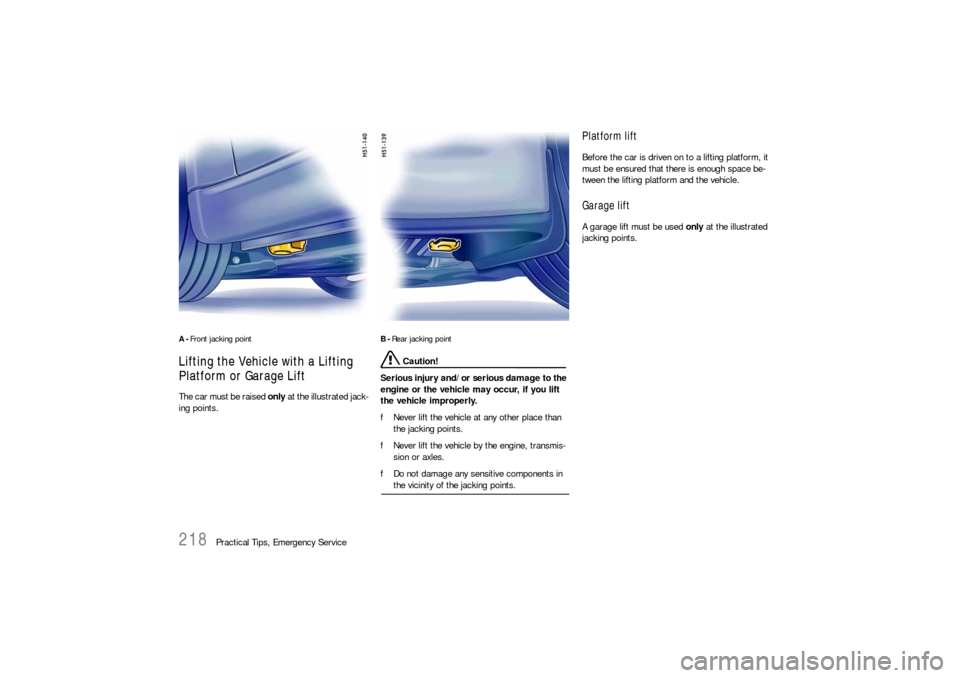
A-Front jacking pointLifting the Vehicle with a Lifting
Platform or Garage Lift The car must be raised only at the illustrated jack-
ing points.
B-Rear jacking point
Caution!
Serious injury and/or serious damage to the
engine or the vehicle may occur, if you lift
the vehicle improperly.
fNever lift the vehicle at any other place than
the jacking points.
fNever lift the vehicle by the engine, transmis-
sion or axles.
fDo not damage any sensitive components in the vicinity of the jacking points.
Platform lift Before the car is driven on to a lifting platform, it
must be ensured that there is enough space be-
tween the lifting platform and the vehicle. Garage lift A garage lift must be used only at the illustrated
jacking points.
Page 226 of 276

226
Practical Tips, Emergency Service
Electrical System In order to avoid damage and faults in electrical or
electronic systems, electrical accessories should
be installed at your authorized Porsche dealer.
fOnly use accessories authorized by Porsche.
Warning!
Risk of short circuit and fire.
Replacing fuses or relays with the engine
running or the ignition on could cause elec-
trical shock.
fDisconnected the battery during all work on
the electrical system.
Please observe the chapter “BATTERY” on Page 229.
Relays Defective relays should be changed only by an
authorized workshop.
Alarm system, central locking The status of the central locking and alarm system
is not changed by disconnecting the battery.
When the battery is disconnected, the alarm sys-
tem ceases to function. Overload protection If the central locking system is operated more
than ten times within a minute, further operation is
blocked for 30 seconds.
Load switch-off after 2 hours or 7 daysIf the ignition key is removed, loads which are
switched on or are in standby mode (such as the
luggage compartment light, interior light and
radio) are automatically switched off after approx.
2hours.
If the vehicle is not started or unlocked with the
remote control within 7days, the remote control
standby function is switched off (to save the
vehicle battery).
1. In this case, unlock the driver's door with the
key at the door lock.
Leave the door closed in order to prevent the
alarm system from being triggered.
2. Press button 1 on the remote control.
The remote control is now activated again.
Page 228 of 276
228
Practical Tips, Emergency Service
Emergency unlocking of the front luggage
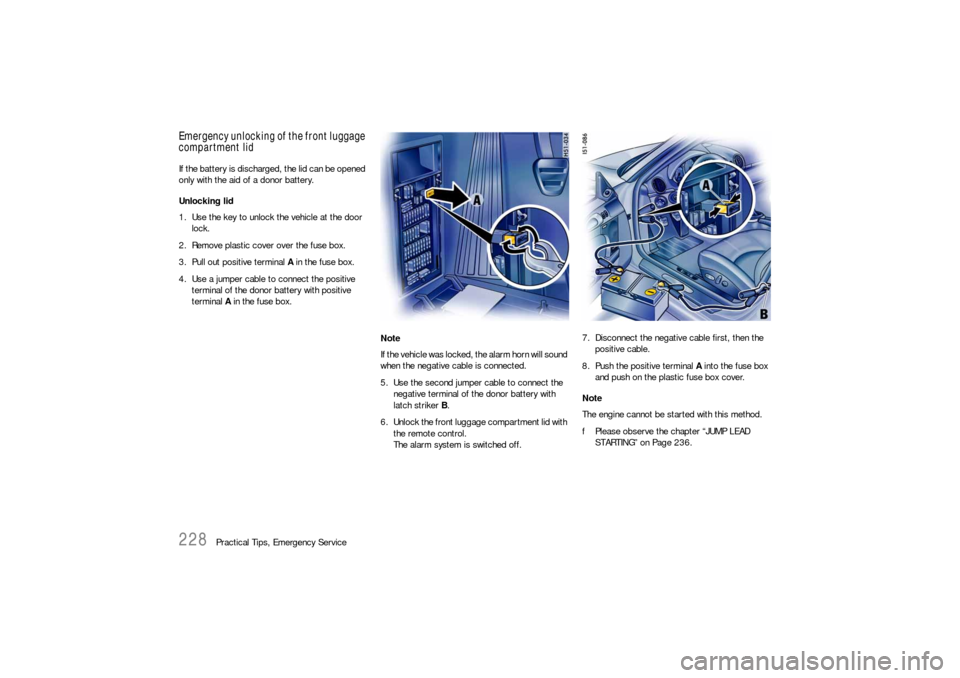
compartment lidIf the battery is discharged, the lid can be opened
only with the aid of a donor battery.
Unlocking lid
1. Use the key to unlock the vehicle at the door
lock.
2. Remove plastic cover over the fuse box.
3. Pull out positive terminal A in the fuse box.
4. Use a jumper cable to connect the positive
terminal of the donor battery with positive
terminal A in the fuse box.
Note
If the vehicle was locked, the alarm horn will sound
when the negative cable is connected.
5. Use the second jumper cable to connect the
negative terminal of the donor battery with
latch striker B.
6. Unlock the front luggage compartment lid with
the remote control.
The alarm system is switched off.7. Disconnect the negative cable first, then the
positive cable.
8. Push the positive terminal A into the fuse box
and push on the plastic fuse box cover.
Note
The engine cannot be started with this method.
fPlease observe the chapter “JUMP LEAD
STARTING” on Page 236.
Page 230 of 276

230
Practical Tips, Emergency Service
Charge stateA well-charged battery prevents starting problems
and has a longer useful life.
Traffic density, speed limits, requirements
regarding noise, exhaust gas and fuel consump-
tion reduce the engine speed and, hence, the
generator output.
However, the large number of electrical loads has
markedly increased the demand for electrical
power.
In order to avoid unintended battery
discharge
fSwitch off unnecessary electrical loads in city
traffic, on short trips and in queues.
fAlways withdraw the ignition key when leaving
the vehicle.
fAvoid frequent operation of the convertible top
and operation of the Porsche Communication
Management system when the engine is not
running.
Battery carefKeep battery surface clean and dry.
fEnsure that cell plugs and terminal clamps are
firmly secured.
Checking acid level
The acid level should be more frequently checked
by a qualified specialist workshop during the
summer months and in predominantly warm
countries.
Charging the battery
Your Porsche partner will be pleased to advise you
about a suitable charger.
1. Always observe the instructions of the charger
manufacturer.
Depending on the type of charger, the battery
may have to be disconnected. Extremely
important: disconnect the negative cable first,
and then the positive cable – danger of short
circuit!
Reconnection must be carried out in reverse
order.
2. Before charging, cold batteries must be
warmed up indoors.
3. Frozen batteries must not be charged. They
must be replaced with a new battery.
4. When charging, ensure adequate ventilation. 5. Connect charger to the battery.
Only plug into the mains and switch the
charger on when it has been correctly
connected up.
Warning!
Hydrogen gas generated by the battery
could cause an explosion, resulting in severe
personal injuries.
fCharge battery in a well ventilated area.
fNever charge a frozen battery. It may explode
because of gas trapped in the ice. Allow a fro-
zen battery to thaw out first.
fIf you get electrolyte, which is an acid, in your
eyes or on your skin, immediately rinse with
cold water for several minutes and call a doc-tor.
Page 232 of 276

232
Practical Tips, Emergency Service
Putting vehicle into operationAfter the battery is connected or after an exhaus-
tively discharged battery is charged, the multi-
functional PSM light lights up on the instrument
panel and a message appears on the on-board
computer to indicate a fault.
This fault can be remedied with a few simple
steps:
1. Start the engine.
2. With the vehicle stationary, perform a few
steering movements to the left and right and
then drive a short distance in a straight line
until the multifunctinal PSM light goes out and
the message on the on-board computer
disappears.
3. If the warnings do not disappear, then:
Drive carefully to the nearest qualified
specialist workshop.
Have the fault remedied.
4. After the warnings disappear, stop the vehicle
in a suitable place.
5. Perform adaptation of the power windows:
Please observe the chapter “STORING END
POSITION OF THE WINDOWS” on Page 29.Ignition key/ignition lock
fDo not insert the ignition key into the ignition
lock if the vehicle battery is discharged.
The ignition key can no longer be removed.
The key cannot be removed until the vehicle elec-
trical system is supplied with power again.
fPlease observe the chapter “EMERGENCY UN-
LOCKING OF THE FRONT LUGGAGE COMPART-
MENT LID” on Page 228.
6. Please observe the chapter “JUMP LEAD
STARTING” on Page 236.
Page 233 of 276
Practical Tips, Emergency Service
233
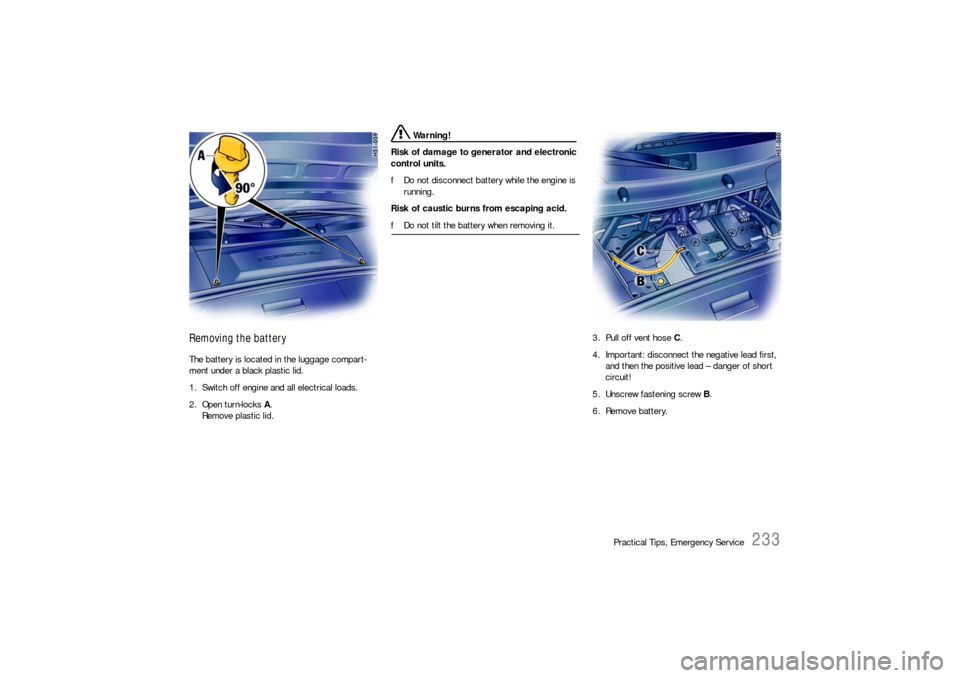
Removing the batteryThe battery is located in the luggage compart-
ment under a black plastic lid.
1. Switch off engine and all electrical loads.
2. Open turn-locks A.
Remove plastic lid.
Warning!
Risk of damage to generator and electronic
control units.
fDo not disconnect battery while the engine is
running.
Risk of caustic burns from escaping acid.
fDo not tilt the battery when removing it.
3. Pull off vent hose C.
4. Important: disconnect the negative lead first,
and then the positive lead – danger of short
circuit!
5. Unscrew fastening screw B.
6. Remove battery.
Page 236 of 276

236
Practical Tips, Emergency Service
Jump lead startingfPlease observe the chapter “EMERGENCY
UNLOCKING OF THE FRONT LUGGAGE
COMPARTMENT LID” on Page 228.
fPlease observe the chapter “BATTERY” on
Page 229.
If the battery is flat, the battery of another vehicle
can be used to start the car with the aid of jump
leads.
Both batteries must be 12 volt types. The
capacity (Ampere hours, Ah) of the donor battery
must not be substantially less than that of the
discharged battery.
The discharged battery must be correctly
connected to the vehicle’s electrical system.
Warning!
Risk of damage and injury due to short
circuit.
fUse only standard jump leads with sufficient
cross section and completely insulated
clamps.
Follow the jump lead manufacturer’s instruc-
tions.
fRoute the jump leads so that they cannot be
caught by moving parts in the engine compart-
ment.
The vehicles must not be in contact, otherwise
current might flow as soon as the positive
terminals are connected.
fCarefully ensure that conductive jewellery
(rings, chains, watch straps) do not come into
contact with live parts of the vehicle.
Danger of caustic burns.
fDo not lean over the battery.
Danger of gas explosion.
fKeep sources of ignition, e.g. naked flame,
burning cigarettes or sparks due to cable
contact, away from the battery.
fBefore connecting jump leads, it is essential to thaw out a frozen battery.
Connecting jump leadsAlways observe the sequence below:
1. Connect the red positive lead to the positive
terminal of the discharged battery first, then
connect it to the positive terminal of the donor
battery.
2. First connect the black negative cable to the
negative terminal of the donor battery, then
connect it to a suitable grounding point on the
vehicle with the discharged battery.
This grounding point must lie as far as possible
from the battery.
For example, a solid metal part or the engine
block are suitable grounding points.
If no suitable grounding points are to be found
on either vehicle, the negative cable must
carefully be connected directly to the negative
terminal of the battery.
If a suitable grounding point is to be found only
on the donor vehicle, the negative cable must
first be connected to the terminal of the
discharged battery, then to the grounding point
of the donor vehicle.
Page 237 of 276

Practical Tips, Emergency Service
237
3. Run the engine of the donor car at a higher
speed.
4. Start the engine.
An attempted start using jump leads should
not last more than 15 seconds. Then allow a
waiting period of at least one minute.
5.Note
Before disconnecting the jump leads, electrical
loads such as the heated rear window and the
heating fan blower should be switched on (the
vehicle’s lights must not be switched on). This
reduces voltage peaks which may occur when
disconnecting the jump leads.
With the engine running, remove both jump
leads in reverse order.