ignition PORSCHE BOXSTER 2005 2.G Repair Manual
[x] Cancel search | Manufacturer: PORSCHE, Model Year: 2005, Model line: BOXSTER, Model: PORSCHE BOXSTER 2005 2.GPages: 276, PDF Size: 4.05 MB
Page 149 of 276

Shifting Gear
149
Selector Lever Positions P – Parking lock fSelect only when car has been stopped.
fEngage parking lock after applying the hand-
brake and release it before releasing the hand-
brake.
The ignition key can be withdrawn only in
selector lever position P. R – Reverse fSelect only when car has been stopped and
the brake is applied. N – Neutral Selector lever position N must be selected for to-
wing or in car washes, for example.
fSelect the desired position for moving off (D,
M or R) only when the engine is idling and while
depressing the brake pedal.
fSelect position N while driving only if the car
is threatening to skid in slippery conditions.
Otherwise N should not be selected when dri-
ving.
D – Automatic selection mode fSelect position D for “normal” driving. The ge-
ars are shifted automatically according to the
accelerator position and speed.
Depending on the way the vehicle is driven and on
the resistance (e.g. uphill), the gear-changing
points are shifted towards higher or lower engine-
speed ranges.
The accelerator position, driving speed, engine
speed, longitudinal and lateral acceleration and
the road profile all have an influence on the gear-
changing characteristic.
Unwanted upward shifts, e.g. before bends, are
prevented by swiftly releasing the accelerator pe-
dal.
Depending on lateral acceleration, upward shifts
on bends are not made until the engine-speed limit
is reached.
Under braking, and depending on the amount of
deceleration, the Tiptronic shifts down earlier.
For subsequent cornering, the right gear is enga-
ged when pressure is applied to the brakes before
the bend.
The bend is taken in the right gear, and when you
accelerate out of the bend you do not have to shift
down. Driving off
In 2nd gear, the vehicle drives off with the throttle
only slightly open.
Drive off in 1st gear with the throttle open wider
or when the engine is cold.
Page 154 of 276

154
Mobile Roofs
Convertible Top Brief operating instructions can be found on the
back side of the driver’s sun visor.
fPlease observe the chapter “CAR CARE IN-
STRUCTIONS” on Page 191.
Warning!
When opening or closing the convertible top,
serious personal injury may occur if a per-
son’s body parts are near or in the way of the
convertible top mechanism’s moving parts.
fMake absolutely sure that nobody can be inju-
red by the convertible-top mechanism or the convertible-top compartment lid. Do not operate convertible top:
– At temperatures below 32°F/0°C.
– When one side of the car is on a curb, a hoist
or a jack.
– When items of luggage or other objects hinder
the convertible top movement or are in abrasi-
ve contact with the convertible top or rear win-
dow.
Items of luggage or objects on the luggage
tray above the engine compartment lid must
be put in the storage box or be secured under
the net to prevent their sliding out.
– Drive only with the convertible top fully open or
closed.
fAvoid frequent operation of the convertible top
with the engine off; the vehicle battery would
be unintentionally discharged rapidly.
fThe convertible top must be operated only
when the car is stationary. Make sure there is
sufficient clearance above the convertible top
(e.g. in the garage).
fTo prevent damp stains and abrasions, only
open the convertible top in a dry, clean state.
fPark your car in the shade whenever possible,
as the fabric, rubber material and color can be
harmed by long exposure to sunlight.
Door windows If the door windows are closed, they will automati-
cally be lowered a few centimeters before the con-
vertible top is opened or closed.
The door windows close automatically when the
convertible top is locked with the latching lever on
the windshield frame. Conditions for operating the convertible
top – The ignition must be switched on
(engine running or off).
– Maximum speed 30 mph (50 km/h)
The opening/closing process of the convert-
ible top will be interrupted if the maximum
speed is exceeded.
fReduce speed.
Press button again.
The opening/closing process is ended.
Page 157 of 276

Mobile Roofs
157
Locking the convertible topfSwivel latching lever B to the front until it is felt
to engage.
The locking hook must engage in the
receptacle on the windshield frame C.
Note
If the convertible top has been opened for a longer
period, it could be necessary to assist the locking
hook engage C.
fWith the vehicle stationary, press and hold the
button for convertible top operation and pull
the convertible top to the windshield using the
handle recess D.
Emergency operation fBefore performing emergency operation, ple-
ase check:
Was the ignition switched on and the handbra-
ke applied?
Are the electrical fuses defective?
Please observe the chapter “ELECTRICAL SYS-
TEM” on Page 226.
Warning!
There is a danger of injury and risk of dama-
ge during emergency operation.
There is a danger of crushing or pinching
body parts at all moveable convertible top
parts which could cause serious personal in-
jury.
fTake great care when performing emergency
operation.
fDo not operate the convertible top during and
after emergency operation.
fLever off joint rods only with the greatest care.
fIf the convertible top is not in the rearward final
position, the convertible-top compartment lid
or the convertible top could fall down when the
joint rods are levered off.
For this reason, hold convertible top or conver-
tible-top compartment lid firmly before levering
off the second joint rod.
fDuring emergency operation, ensure that the paint is not damaged.
Page 158 of 276
158
Mobile Roofs 1. Remove the ignition key so that the convertible
top is not operated unintentionally.
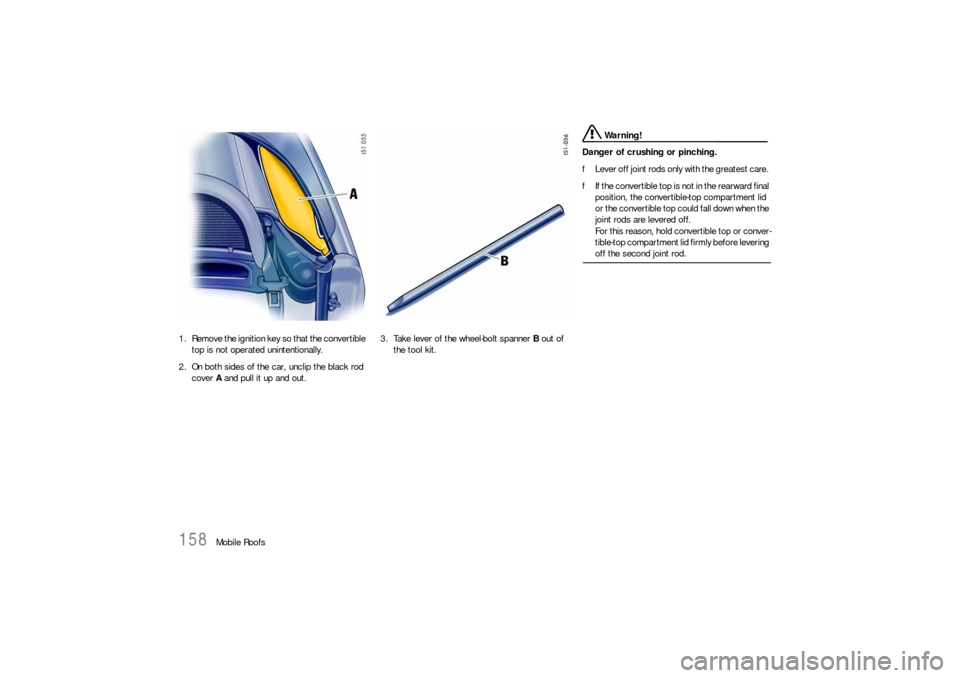
2. On both sides of the car, unclip the black rod
cover A and pull it up and out. 3. Take lever of the wheel-bolt spanner B out of
the tool kit.
Warning!
Danger of crushing or pinching.
fLever off joint rods only with the greatest care.
fIf the convertible top is not in the rearward final
position, the convertible-top compartment lid
or the convertible top could fall down when the
joint rods are levered off.
For this reason, hold convertible top or conver-
tible-top compartment lid firmly before levering off the second joint rod.
Page 168 of 276

168
Maintenance, Car Care
Exercise Extreme Caution when
Working on your Vehicle
Danger!
Ignoring the following instructions may cau-
se serious personal injury or death.
fThe engine compartment of any motor vehicle
is a potentially hazardous area. If you are not
fully familiar with proper repair procedures, do
not attempt the adjustments described on the
following pages.
This caution applies to the entire vehicle.
fO n l y w o r k o n y o u r v e h i c l e o u t d o o r s o r i n a w e l l
ventilated area.
fEnsure that there are no open flames in the
area of your vehicle at any time when fuel fu-
mes might be present. Be especially cautious
of such devices such as hot water heaters
which ignite a flame intermittently.
fBefore working on any part in the engine com-
partment, turn the engine off and let it cool
down sufficiently. Hot engine compartment
components can burn skin on contact.
fBe alert and cautious around engine at all ti-
mes while the engine is running.
If work has to be performed with the engine
running, always set the parking brake, and
make sure the shift lever is in neutral or the se-
lector lever is in position P or N. fIn particular, be very careful to ensure that
items of clothing (ties, shirt, sleeves etc.), je-
welry, long hair, hand or fingers cannot get
caught in the engine-compartment blower, fan,
belts or other moving parts.
The radiator and radiator fans are in the front
of the car.
The fans can start or continue running as a
function of temperature, even with the engine
switched off.
Carry out work in these areas only with the en-
gine off and exercise extreme caution.
fYour Porsche is equipped with an electronic ig-
nition system. When the ignition is on, high vol-
tage is present in all wires connected with the
ignition system; therefore, exercise extreme
caution when working on any part of the engine
while the ignition is on or the engine is running.
fAlways support your car with safety stands if it
is necessary to work under the car. The jack
supplied with the car is not adequate for this
purpose.
fWhen working under the car without safety
stands but with the wheels on the ground,
make sure the car is on level ground, the
wheels are blocked, and that the engine can-
not be started.
Remove the ignition key. fDo not smoke or allow an open flame around
the battery or fuel.
Keep a fire extinguisher in close reach.
fIncomplete or improper servicing may cause
problems in the operation of the car. If in doubt
about any servicing, have it done by your au-
thorized Porsche dealer.
Improper maintenance during the warranty pe-
riod may affect your Porsche warranty cove-
rage.
fSupplies of fluids, e.g. engine oil, brake fluid or
coolant, are hazardous to your health.
Keep these fluids out of children’s reach and
dispose of them in accordance with the appro-
priate regulations.
fSome countries require additional tools and
special spare parts to be carried.
Please make enquiries before driving abroad.
Power measurements Power measurements on dynamometers are not
approved by Porsche.
Page 169 of 276
Maintenance, Car Care
169
Wiper BladesfWhen wiper performance deteriorates, replace
the wipers.
fPlease observe the chapter “CAR CARE IN-
STRUCTIONS” on Page 191.
Caution!
Risk of damage if the wiper arm accidentally
falls back on to the window.
fAlways hold the wiper arm securely when re-
placing the wiper blade.
Risk of damage if wiper blades that are fro-
zen in place are loosened improperly.
fThaw the wiper blades before loosening them.
Maintenance note
If the wiper blades rub or squeak, this can be as a
result of the following:
– If the vehicle is washed in an automatic car
wash, residues may adhere to the windshield.
These residues can only be removed using a
special cleaning solution.
Please contact your authorized Porsche dealer
for further information.
– The wiper blades may be damaged.
fReplace damaged wiper blades as soon as
possible.
Changing windshield wiper blades
Caution!
Risk of damage.
If a wiper blade is not changed properly, it
can come loose when the car is moving.
fCheck whether the wiper blade is seated
securely.
The wiper blade must engage the wiper arm properly.
1. Apply the handbrake.
2. Switch the wipers off (position 0) and remove
the ignition key.
3. Fold windshield wiper arm away from the
windshield.
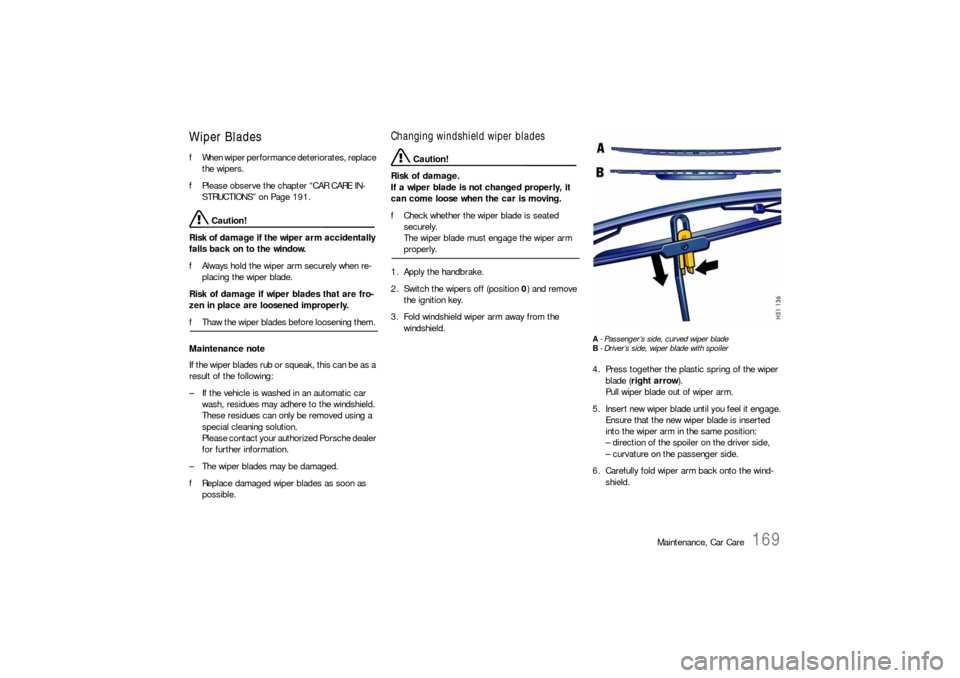
A- Passenger’s side, curved wiper blade
B- Driver’s side, wiper blade with spoiler4. Press together the plastic spring of the wiper
blade (right arrow).
Pull wiper blade out of wiper arm.
5. Insert new wiper blade until you feel it engage.
Ensure that the new wiper blade is inserted
into the wiper arm in the same position:
– direction of the spoiler on the driver side,
– curvature on the passenger side.
6. Carefully fold wiper arm back onto the wind-
shield.
Page 179 of 276

Maintenance, Car Care
179
Refuelling Fuel tank capacity is listed under “Capacities”.
Porsche does not recommend the use of fuel ad-
ditives.
Fuel is highly flammable and harmful to
health.
fPlease observe the chapter “CAPACITIES” on
Page 266.1.Important: Stop the engine and switch off the
ignition.
2. Slowly unscrew the tank cap.
Hang the tank cap on the plastic strap of the
filler flap.
3. Insert fuel-hose nozzle fully into the filler neck
with the handle of the fuel-hose nozzle facing
down.
4. Do not add further fuel once the correctly ope-
rated automatic fuel-hose nozzle has switched
off.
Fuel could spray or could run over in warm
temperatures.
5. Replace the tank cap immediately after
refuelling and turn it until you hear it and feel it
engage.
If you lose the tank cap, you must replace it
only with an original part to reduce the pos-
sibility of a fire in the event of a collision.
Note
The oil level is automatically measured during
refuelling.
fPlease observe the chapter “OIL DISPLAY AND
MEASUREMENT OF THE ENGINE OIL LEVEL”
on Page 97.
Page 180 of 276

180
Maintenance, Car Care
Fuel Recommendations Your Porsche is equipped with catalytic conver-
ters and must use UNLEADED FUEL ONLY.
Your engine is designed to provide optimum per-
formance and fuel economy using unleaded premi-
um fuel with an octane rating of 98 RON
(93
CLC or AKI). Porsche therefore recom-
mends the use of these fuels in your vehicle.
Porsche also recognizes that these fuels may not
always be available. Be assured that your vehicle
will operate properly on unleaded premium fuels
with octane numbers of at least 95
RON
(90 CLC or AKI), since the engine’s ”Electronic
Oktane™ knock control“ will adapt the ignition ti-
ming, if necessary.
T h e u s e o f U N L E A D E D F U E L O N LY i s c r i t i c a l l y
important to the life of the catalytic conver-
ters. Deposits from leaded fuels will ruin the
converters and make it ineffective as an
emission control device.
Cars with catalytic converters have a smaller fuel
tank opening, and gas station pumps have smaller
nozzles. This will prevent accidental pumping of
leaded fuel into cars with catalytic converters. Unleaded fuels may not be available outside the
continental U.S. and Canada. Therefore, we re-
commend you do not take your car to areas or
countries where unleaded fuel may not be availab-
le.
Octane ratings Octane rating indicates a fuel’s ability to resist de-
tonation. Therefore, buying the correct octane gas
is important to prevent engine ”damage“.
The RON octane rating is based on the research
method. The CLC (U.S. Cost of Living Council oc-
tane rating) or AKI (antiknock index) octane rating
usually displayed on U.S. fuel pumps is calculated
as research octane number plus motor octane
number, divided by 2, that is written as:
The CLC or AKI octane rating is usually lower than
the RON rating:
For example: 95 RON equals 90 CLC or AKI.
Fuels containing alcohol and ether Some areas of the U.S. require oxygenated fuels
during certain portions of the year. Oxygenated fu-
els are fuels which contain alcohols (such as me-
thanol or ethanol) or ether (such as MTBE).
Under normal conditions, the amount of these
compounds in the fuel will not affect driveability.
You may use oxygenated fuels in your Porsche,
provided the octane requirements for your vehicle
are met. We recommend, however, to change to a
different fuel or station if any of the following pro-
blems occur with your vehicle:
– Deterioration of driveability and performance.
– Substantially reduced fuel economy.
– Vapor lock and non-start problems, especially
at high altitude or at high temperature.
– Engine malfunction or stalling. RON MON+
2 ---------------------------------------------------- o rRM+
2 ------------------------
Page 182 of 276

182
Maintenance, Car Care
Emission Control System In the interest of clean air Pollution of our environment has become a pro-
blem that is of increasing concern to all of us. We
urge you to join us in our efforts for cleaner air in
controlling the pollutants emitted from the auto-
mobile.
Porsche has developed an emission control sys-
tem that controls or reduces those parts of the
emission that can be harmful to our environment.
Your Porsche is equipped with such a system.
Porsche warrants the Emission Control System in
your new car under the terms and conditions set
forth in the Warranty Booklet.
You, as the owner of the vehicle, have the
responsibility to provide regular maintenance ser-
vice for the vehicle and to keep a record of all
maintenance work performed. To facilitate record
keeping, have the service performed by authori-
zed Porsche dealers. They have Porsche trained
technicians and special tools to provide fast and
efficient service.
To assure efficient operation of the
Emission Control System fHave your vehicle maintained properly and in
accordance with the recommendations descri-
bed in your Maintenance Booklet.
Lack of proper maintenance, as well as impro-
per use of the vehicle, will impair the function
of the emission control system and could lead
to damage.
fDo not alter or remove any component of the
emission control system.
fDo not alter or remove any device, such as
heat shields, switches, ignition wires, valves,
etc., which are designed to protect your vehic-
le’s emission control system.
In addition to serious engine damage, this can
result in a fire if excess raw fuel reaches the ex-
haust system.
fDo not continue to operate your vehicle if you
detect engine misfire or other unusual opera-
ting conditions.
Parking
Warning!
Danger of fire.
fDo not park or operate the vehicle in areas
where the hot exhaust system may come in
contact with dry grass, brush, fuel spill or
other flammable material.
fIf your car catches on fire for any reason, call
the fire department.
Do not endanger your life by attempting to put out the fire.
Undercoating
Danger!
Danger of fire and serious personal injuries
or death.
fDo not apply additional undercoating or rust-
proofing on or near the exhaust manifold, ex-
haust pipes, catalytic converters or heat
shields. During driving the substance used for undercoating could overheat and ignite.
Page 183 of 276

Maintenance, Car Care
183
How Emission Control Works When an automobile engine is running, it uses en-
ergy generated through the combustion of a mix-
ture of air and fuel. Depending on whether a car is
driven fast or slowly or whether the engine is cold
or hot, some of the fuel (hydrocarbons) may not
be burned completely, but may be discharged into
the engine crankcase or exhaust system. Addito-
nal hydrocarbons may enter the atmosphere th-
rough evaporation of fuel from the fuel tank. These
hydrocarbons (HC), when released into the air,
contribute to undesirable pollution.
In addition, carbon monoxide (CO) and oxides of
nitrogen (NOx) contribute to engine emissions.
They, too, are formed during the combustion pro-
cess and discharged into the exhaust system.
To reduce these pollutants, your Porsche is equip-
ped with a precisely calibrated fuel injection sys-
tem to assure a finely balanced air/fuel mixture un-
der all operating conditions.
Oxygen sensor The oxygen sensor, installed in the exhaust pipe
continuously senses the oxygen content of the ex-
haust and signals the information to an electronic
control unit. The control unit corrects the air/fuel
ratio, so the engine always receives an accurately
metered air/fuel mixture. Crankcase ventilation Through crankcase ventilation, undesirable emis-
sions from the engine crankcase are not permit-
ted to reach the outside atmosphere. These emis-
sions are recirculated from the crankcase to the
air intake system. From here the emissions mix
with the intake air and are later burned in the engi-
ne. Catalytic converters The catalytic converters are efficient ”clean-up“
devices built into the exhaust system of the vehic-
le. The catalytic converters burn the undesirable
pollutants in the exhaust gas before it is released
into the atmosphere.
The exclusive use of unleaded fuel is critical-
ly important for the life of the catalytic con-
verters. Therefore, only unleaded fuel must
be used. The catalytic converters will be damaged by:
– push or tow starting the vehicle,
– misfiring of the engine,
– turning off the ignition while the vehicle is mo-
ving or
– driving until the fuel tank is completely empty,
– by other unusual operating conditions.
fDo not continue to operate your vehicle under
these conditions, since raw fuel might reach
the catalytic converters. This could result in
overheating of the converters. Federal law pro-
hibits use of leaded fuel in this car.