ignition PORSCHE BOXSTER 2005 2.G Owner's Manual
[x] Cancel search | Manufacturer: PORSCHE, Model Year: 2005, Model line: BOXSTER, Model: PORSCHE BOXSTER 2005 2.GPages: 276, PDF Size: 4.05 MB
Page 50 of 276

50
Controls, Instruments fDo not add any additional coverings or stickers
to the steering wheel or in the area of the pas-
senger airbag and side airbags. Doing so may
adversely affect the functioning of the airbag
system or cause harm to the occupants if the
airbag system should deploy.
fDo not undertake any wiring for electrical ac-
cessory equipment in the vicinity of the airbag
wiring harnesses. Doing so may disable the air-
bag system or cause inflation.
fIf the warning light comes on, the airbag sys-
tem should be repaired immediately by your
authorized Porsche dealer.
Note
Airbag components (e.g. steering wheel, door
trim, seats) may be disassembled only by an au-
thorized Porsche dealer.
When disposing of a used airbag unit, our safety
instructions must be followed. These instructions
can be obtained at any authorized Porsche dealer.Faults are indicated by a warning light in the instru-
ment panel and a message on the on-board com-
puter.
fIn the following cases you should immedi-
ately consult an authorized Porsche deal-
er in order to assure the airbag system is
functioning properly:
– If the warning light does not light up when the
ignition is switched on or
– if the warning light does not go out once the
engine is running or
– if the warning light appears while driving.
fPlease observe the chapter “WARNINGS ON
THE INSTRUMENT PANEL AND THE ON-
BOARD COMPUTER” on Page 102.
Warning light “PASSENGER AIRBAG OFF”fPlease observe the chapter “KEY-OPERATED
AIRBAG DEACTIVATION DEVICE” on Page 48.
Airbag maintenanceIn order to ensure long-term functioning, the air-
bag system must be inspected by an authorized
Porsche dealer at the intervals recommended in
your Maintenance booklet.
Important information
If you sell your Porsche, notify the purchaser that
the vehicle is equipped with airbags, and refer
them to the chapter, “Airbag Systems”, in the own-
er’s manual (safety and disposal rules).
Further information on the airbag system can be
found on labels on the sun visors, as well as on all
airbag components.
fFor special recommendations on the use of
child restraints:
Please observe the chapter “CHILD RES-
TRAINT SYSTEMS” on Page 45.
Warning light and warning
message
Page 51 of 276
Controls, Instruments
51
Clutch Pedal The clutch pedal must be depressed fully be-
fore the starter will engage.
Warning!
Risk of an accident.
fAlways check the movement of the clutch pe-
dal before driving and make sure that it is not
obstructed by a floor mat or any other object.
fSecure the floor mat to prevent it from sliding
into positions that could interfere with the safe
operation of your vehicle.
Your Porsche dealer will be glad to offer you
nonskid floor mats of the correct size.
To avoid damage to the clutch and transmis-
sion:
fAlways depress the clutch pedal fully when
changing gears.
fDo not hold the car on a steep grade with the clutch pedal partially depressed.
Should the free travel of the clutch pedal suddenly
become larger, it could mean a malfunction of the
clutch.
fSee your Porsche dealer for correction.
Parking Brake Parking brake force is mechanically transferred to
the rear wheels by means of cables.
fUse the parking brake only after the vehicle
has come to a full stop.
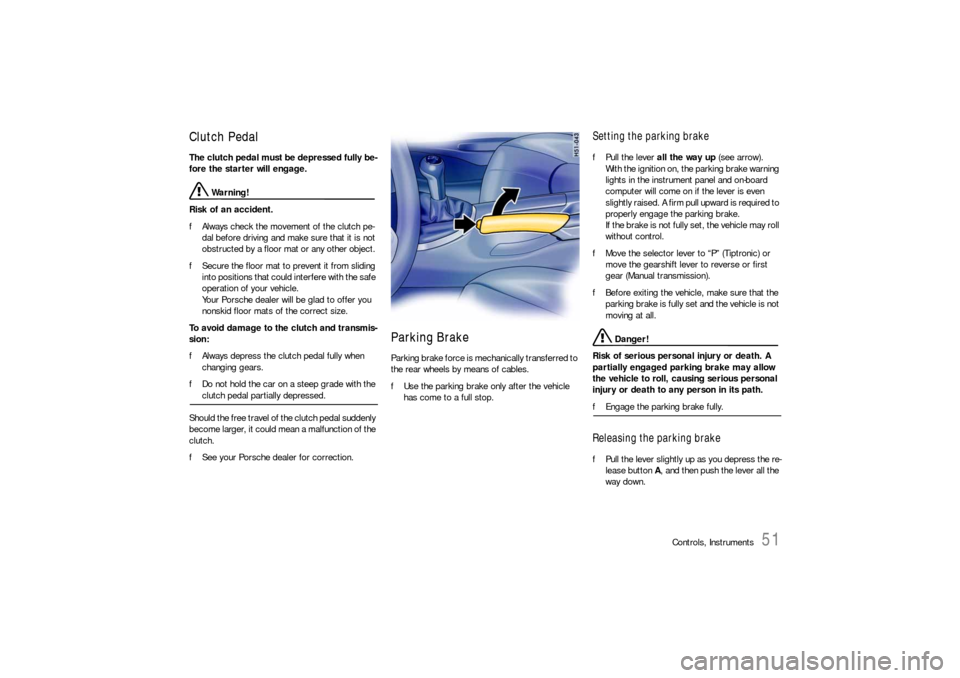
Setting the parking brake fPull the lever all the way up (see arrow).
With the ignition on, the parking brake warning
lights in the instrument panel and on-board
computer will come on if the lever is even
slightly raised. A firm pull upward is required to
properly engage the parking brake.
If the brake is not fully set, the vehicle may roll
without control.
fMove the selector lever to “P” (Tiptronic) or
move the gearshift lever to reverse or first
gear (Manual transmission).
fBefore exiting the vehicle, make sure that the
parking brake is fully set and the vehicle is not
moving at all.
Danger!
Risk of serious personal injury or death. A
partially engaged parking brake may allow
the vehicle to roll, causing serious personal
injury or death to any person in its path.
fEngage the parking brake fully.Releasing the parking brake fPull the lever slightly up as you depress the re-
lease button A, and then push the lever all the
way down.
Page 56 of 276

56
Controls, Instruments
Operation of the ABS system A wheel speed sensor is mounted to each of the
four wheels. If wheel lock-up of either of the front
wheels or the rear wheels is sensed during bra-
king, the brake pressure is adjusted automatically
until the wheel no longer slips. The brake pressure
is regulated for each front wheel individually and
for both of the rear wheels together.
On a road surface which is slippery on only one si-
de, the rear wheel which is braking on the slippery
surface determines the brake pressure which will
be applied equally to both rear wheels. This ensu-
res that directional stability is maintained. Howe-
ver, if braking forces approach the wheel lock-up
point for all wheels (panic braking) the ABS system
will intervene to provide a rapid rythmic braking.
The proper operation of ABS is perceived by the
driver as a pulsating brake pedal in conjunction
with audible noise and perhaps some vibration.
fIf you experience these sensations while dri-
ving or a road surface with questionable trac-
tion, reduce vehicle speed appropriate for the
prevailing road conditions.
The functional readiness of all the main electrical
components of the ABS is checked by an electro-
nic monitoring system both before and while you
drive. When the ignition is switched on the ABS warning
light will light up while the system is electronically
interrogated and goes out when the engine is star-
ted if the check is not yet complete.
If the ABS warning lamp fails to go out, this indica-
tes that ABS has been deactivated due to a fault.
If the warning lights in the instrument panel and on-
board computer light up while you are driving, this
indicates that a fault has occurred. In both cases,
normal braking, as in vehicles without ABS, is still
retained.
The ABS system should, however, be examined at
an authorized Porsche dealer immediately to pre-
vent the occurrence of further faults.
fIf the ABS system becomes inoperative, take
your vehicle to your authorized Porsche dealer
immediately.
Warning!
The control unit of the ABS brake system is
set for standard tire size. If non-standard ti-
res are installed, the control unit may misin-
terpret the speed of the vehicle, because of
the variant data it receives from the sensors
on the axles.
fUse only tire makes and types tested by Porsche.
Warning light USA
Warning light Canada
Page 57 of 276
Controls, Instruments
57
Sport ModeA sportier car set-up is obtained when Sport mode
is switched on. Interventions by the Porsche
control systems are intentionally shifted towards
greater agility and driving performance.
– PASM (Porsche Active Suspension Manage-
ment) is automatically changed to Sport mode,
resulting in a stiffer suspension setup.
– PSM (Porsche Stability Management) control is
sporty. PSM interventions take place later than
in Normal model. The driver can manoeuvre
the vehicle with greater agility at its perform-
ance limits, without having to dispense with the
assistance of PSM in emergency situations.
– The electronic accelerator pedal reacts
sooner, and the engine is more responsive to
throttle inputs. When Sport mode is switched
on, this function is activated only after the
driver has floored the accelerator pedal or
released it briefly.
– The rpm limiter characteristic is “harder”, i.e.
the engine is immediately throttled when the
performance limits are reached.
fPlease observe the appropriate chapters of
this Manual.
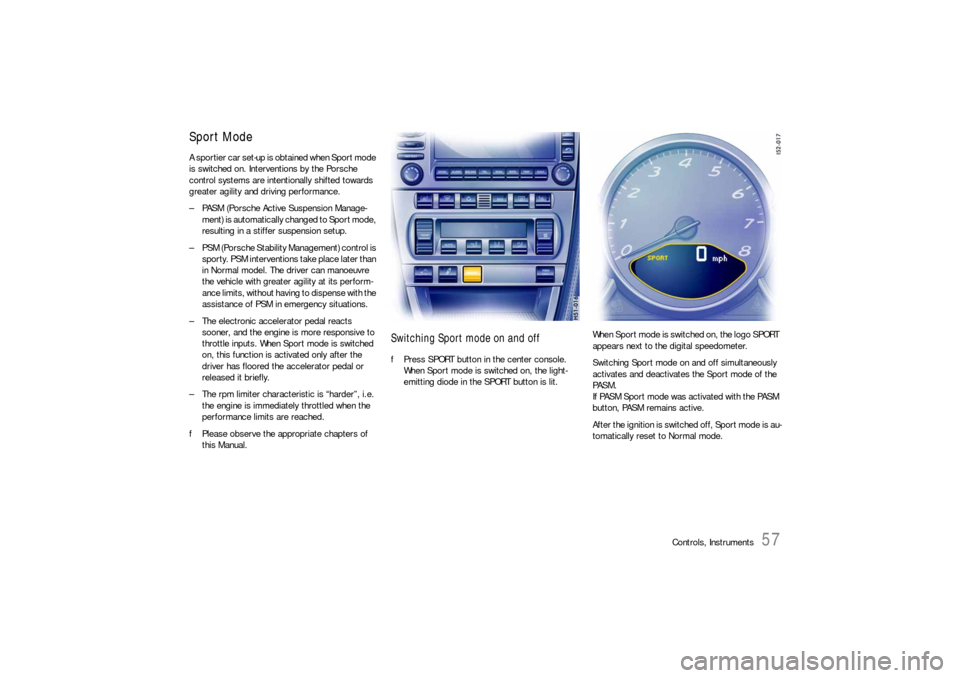
Switching Sport mode on and offfPress SPORT button in the center console.
When Sport mode is switched on, the light-
emitting diode in the SPORT button is lit.When Sport mode is switched on, the logo SPORT
appears next to the digital speedometer.
Switching Sport mode on and off simultaneously
activates and deactivates the Sport mode of the
PA S M .
If PASM Sport mode was activated with the PASM
button, PASM remains active.
After the ignition is switched off, Sport mode is au-
tomatically reset to Normal mode.
Page 60 of 276

60
Controls, Instruments
Sport modeA sportier car set-up is obtained when Sport mode
is switched on.
PSM interventions are later than in Normal mode;
the vehicle can be manoeuvred with greater agility
at its performance limits, without the need to
dispense with the assistance of PSM in
emergency situations. This helps to achieve
optimal lap times, particularly on race circuits and
a dry road surface.
– The multifunctional light on the instrument
panel lights up for a lamp check when the
ignition is switched on.
– The light indicates a control operation by
flashing, including when PSM is switched off
(brake control in the event of one-sided wheel
spin).
– In conjunction with a message on the on-board
computer, the light indicates that PSM is
switched off.
A gong also sounds.– Faults are displayed by the light in conjunction
with a message on the on-board computer.
PSM is out of order.
fPlease go to a qualified specialist workshop.
We recommend a Porsche partner for this
work as they have trained workshop personnel
and the necessary parts and tools.
fPlease observe the chapter “STORING YOUR
PORSCHE” on Page 200.
TowingfPlease observe the chapter “TOWING” on Page
254.Checks on test standsWhen carrying out brake tests on roller test
stands a maximum testing speed of 5 mph
(8 km/h) must not be exceeded.
Handbrake checks on the roller brake tester
must be performed only with the ignition switched
off.
Multifunctional PSM light
Page 61 of 276
Controls, Instruments
61
The previously selected PASM mode is always
activated after the engine is started.
There is no automatic return to Normal mode after
the ignition is switched off.
PASM makes two running-gear setups available to
the driver: “Normal” and “Sport”.
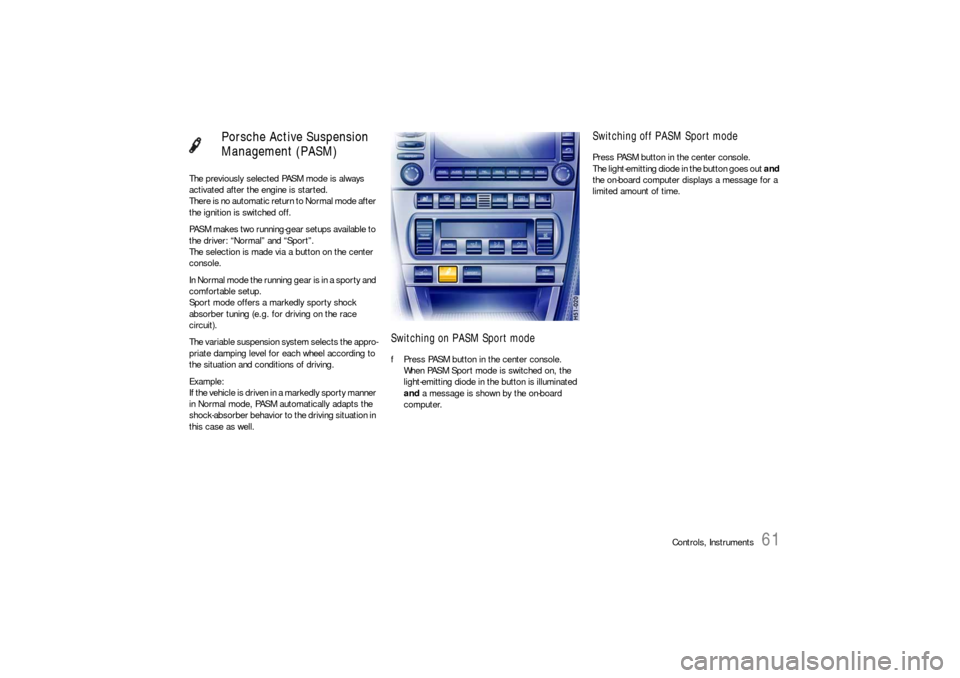
The selection is made via a button on the center
console.
In Normal mode the running gear is in a sporty and
comfortable setup.
Sport mode offers a markedly sporty shock
absorber tuning (e.g. for driving on the race
circuit).
The variable suspension system selects the appro-
priate damping level for each wheel according to
the situation and conditions of driving.
Example:
If the vehicle is driven in a markedly sporty manner
in Normal mode, PASM automatically adapts the
shock-absorber behavior to the driving situation in
this case as well.
Switching on PASM Sport modefPress PASM button in the center console.
When PASM Sport mode is switched on, the
light-emitting diode in the button is illuminated
and a message is shown by the on-board
computer.
Switching off PASM Sport modePress PASM button in the center console.
The light-emitting diode in the button goes out and
the on-board computer displays a message for a
limited amount of time.
Porsche Active Suspension
Management (PASM)
Page 62 of 276

62
Controls, Instruments
Retractable Spoiler The spoiler reduces air resistance and, particu-
larly at high speeds, reduces rear axle lift. Automatic controlThe spoiler extends at approx. 75 mph
(120 km/h) and retracts at approx. 50 mph
(80 km/h).
If automatic control fails, the warning light lights
up and the spoiler must be extended manually
before driving.
Warning!
Risk of accident. If the spoiler cannot be
extended, driving stability will be adversely
affected by increased rear axle lift.
fAdapt your driving style and speed to the
changed driving conditions.
fHave the fault remedied as soon as possible.
Please go to a qualified specialist workshop.
We recommend a Porsche dealer for this work
as they have trained workshop personnel and
the necessary parts and tools.
Risk of injury during manual retraction or ex-
tension of the spoiler with the vehicle statio-
nary.
fMake sure that no persons or objects are
within the range of movement of the spoiler.
Risk of damage, if the vehicle is pushed
using the spoiler.
fDo not push the vehicle at the spoiler.The warning light lights up for a lamp check when
the ignition is switched on.
The warning lights in the instrument panel and in
the on-board computer come on if the spoiler
does not extend or does not reach its final position
at more than 75 mph (120 km/h).
Warning light
Page 63 of 276
Controls, Instruments
63
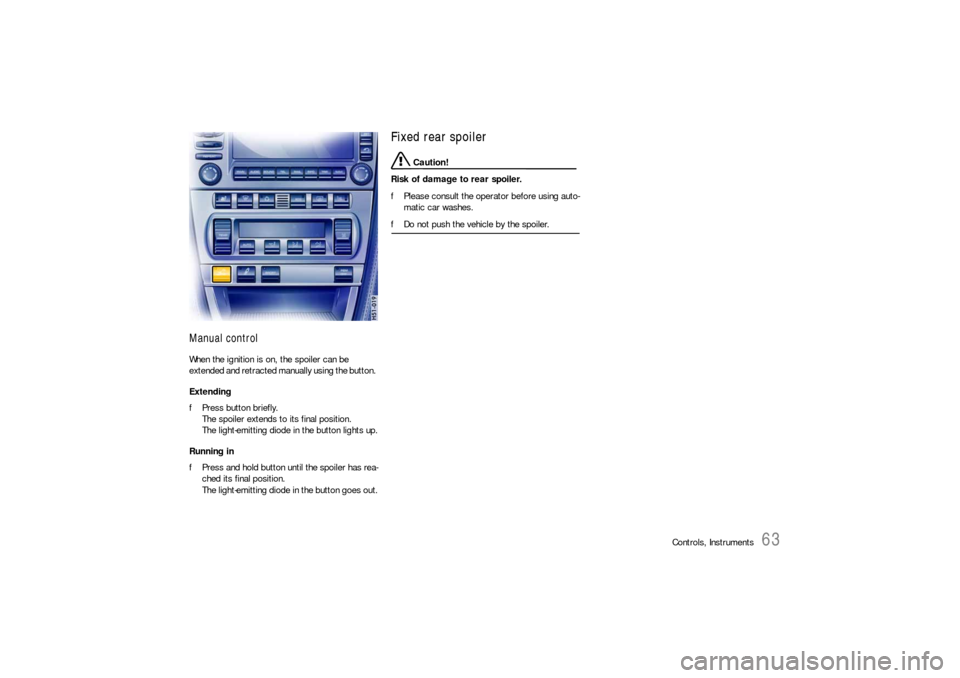
Manual controlWhen the ignition is on, the spoiler can be
extended and retracted manually using the button.
Extending
fPress button briefly.
The spoiler extends to its final position.
The light-emitting diode in the button lights up.
Running in
fPress and hold button until the spoiler has rea-
ched its final position.
The light-emitting diode in the button goes out.
Fixed rear spoiler
Caution!
Risk of damage to rear spoiler.
fPlease consult the operator before using auto-
matic car washes.
fDo not push the vehicle by the spoiler.
Page 66 of 276

66
Controls, Instruments
Operation, Instruments 1 Light switch
2 Turn signals/
headlight dimmer/flasher lever
3 Ignition Lock/locking the steering column
4 Hands-free microphone for telephone
5Horn
6 Windshield wiper/washer lever
7 Porsche Communication Management/Radio
8 Interior temperature sensor, GPS antenna
9 Emergency flasher switch10 Central locking button,
Readiness display for alarm system
11 Cupholder
12 Operating lever for on-board computer
13 Locking lever for steering-wheel adjustment
14 Operating lever for cruise control
15 Control panel for heating, ventilation and air
conditioning system
16 Buttons for rear spoiler,
Porsche Active Suspension Management
(PASM),
Sport Mode,
Porsche Stability Management (PSM)
17 Seat heating, left/right
Page 68 of 276
68
Controls, Instruments
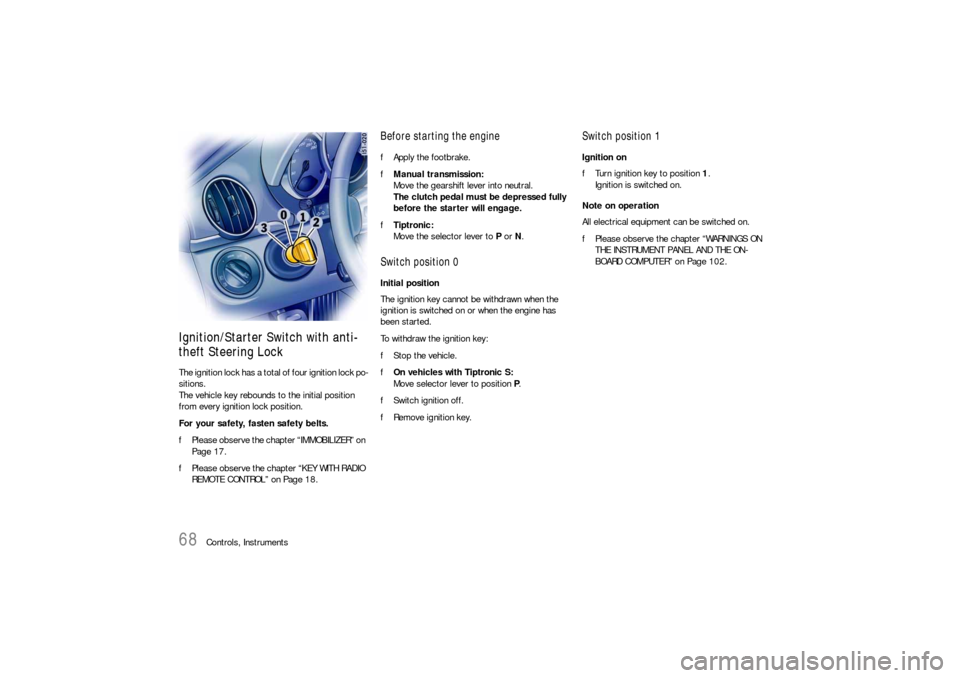
Ignition/Starter Switch with anti-
theft Steering Lock The ignition lock has a total of four ignition lock po-
sitions.
The vehicle key rebounds to the initial position
from every ignition lock position.
For your safety, fasten safety belts.
fPlease observe the chapter “IMMOBILIZER” on
Page 17.
fPlease observe the chapter “KEY WITH RADIO
REMOTE CONTROL” on Page 18.
Before starting the engine fApply the footbrake.
fManual transmission:
Move the gearshift lever into neutral.
The clutch pedal must be depressed fully
before the starter will engage.
fTiptronic:
Move the selector lever to P or N. Switch position 0 Initial position
The ignition key cannot be withdrawn when the
ignition is switched on or when the engine has
been started.
To withdraw the ignition key:
fStop the vehicle.
fOn vehicles with Tiptronic S:
Move selector lever to position P.
fSwitch ignition off.
fRemove ignition key.
Switch position 1 Ignition on
fTurn ignition key to position 1.
Ignition is switched on.
Note on operation
All electrical equipment can be switched on.
fPlease observe the chapter “WARNINGS ON
THE INSTRUMENT PANEL AND THE ON-
BOARD COMPUTER” on Page 102.