lights PORSCHE BOXSTER 2006 2.G Workshop Manual
[x] Cancel search | Manufacturer: PORSCHE, Model Year: 2006, Model line: BOXSTER, Model: PORSCHE BOXSTER 2006 2.GPages: 296, PDF Size: 4.12 MB
Page 215 of 296

Maintenance, Car Care
215
Warning!
Danger of fire and serious personal injuries.
fDo not apply additional undercoating or rust-
proofing on or near the exhaust manifold, ex-
haust pipes, catalytic converters or heat
shields. During driving the substance used for undercoating could overheat and ignite.
fBefore applying fresh underseal, carefully re-
move deposits or dirt and grease. Once it has
dried, the new undercoating compound forms
a tough protective coating which provides effi-
cient rust-proofing of the floor panels and com-
ponents.
fAlways apply a fresh coating of suitable preser-
vative to unprotected areas after cleaning the
underside of the body, the transmission, the
engine or carrying out repairs to under-body,
engine or transmission components.
Effective rust-proofing is particularly important du-
ring the cold weather season. If your car is driven
frequently in areas where salt has been spread on
the roads, the whole engine compartment should
be cleaned thoroughly after the winter to prevent
salt from causing any lasting damage. A full under-
body wash should also be performed at the same
time.
Door, roof, lid and window seals fWash dirt (e.g. abrasion, dust, road salts) from
all seals regularly using warm soapy water. Do
not use any chemical cleaning agents or sol-
vents.
When there is a frost hazard, the outer door seals
and the front and rear lid seals can be protected
against freezing into place by a suitable care pro-
duct.
In order to prevent damage to the anti-fric-
tion coating, the inner door seals, the con-
vertible top seals and hardtop seals must not
be treated with care products. Stainless steel exhaust tailpipesStainless steel exhaust tailpipes can discolour due
to soiling, strong heat, and combustion residues.
The original polish can be achieved again using
commercially available metal polishing paste or
metal polish.
Headlights, lights, interior and exterior
plastic parts fUse only clean water and a little dishwashing
detergent to clean light lenses, plastic head-
light lenses, plastic parts and surfaces.
Do not clean when dry.
Use a soft sponge or a soft, lint-free cloth.
Gently wipe the surface without applying too
much pressure.
The Porsche inside window cleaner is also sui-
table for cleaning plastic surfaces. Follow the
cleaning instructions on the container.
Never use other chemical cleaners or
solvents.
fRinse cleaned surfaces with clear water.
Page 219 of 296

Practical Tips, Emergency Service
219 Practical Tips, Emergency Service
Exercise Extreme Caution when
Working on your Vehicle ............................. 220
Tires/Wheels ............................................ 221
Loading Information ................................... 235
Lifting the Vehicle with a Lifting Platform
or Garage Lift ........................................... 237
Flat Tire .................................................... 238
Wheel Bolts ............................................. 241
Spacers ................................................... 244
Electrical System ..................................... 246
Battery .................................................... 249
Jump lead starting .................................... 256
Replacing bulbs ......................................... 258
Headlights ................................................ 261
Turn signal light ......................................... 265
Side marker light ....................................... 268
Tail light .................................................... 269
Additional brake light ................................. 270
Luggage compartment/footwell lights ......... 270
Interior light .............................................. 271
Adjusting Headlights .................................. 272
Towing ..................................................... 274
Page 251 of 296

Practical Tips, Emergency Service
251
Winter drivingThe capacity and ability of the battery to store
power decreases at low outside temperatures.
Moreover, the battery is more heavily loaded in the
winter months, e.g. by the heated rear window,
the more frequent use of additional lights, the
blower and the windshield wipers, etc.
fHave the battery checked before winter
begins.
Keep the battery well charged to prevent it from
freezing.
A discharged battery can freeze even at
23°F/-5 °
C, but a fully charged one only freezes at
-40°F/-40 °C.
Laying up the vehicleIf the vehicle stands for long periods in the garage
or workshop, the doors and lids should be closed.
fPlease observe the chapter “EMERGENCY
UNLOCKING OF THE FRONT LUGGAGE
COMPARTMENT LID” on Page 248.
fWithdraw the ignition key and, if necessary,
disconnect the battery.
When the battery is disconnected, the
alarm system ceases to function!
Even if you put your vehicle out of operation, the
battery still discharges.
fThe battery must be charged, i.e. connected
to a charger, approximately every 6 weeks in
order to preserve functioning.
Always observe the instructions of the charger
manufacturer.
fStore a battery that has been removed in a
dark, cool place, but not subject to frost.
Replacing the batteryThe battery is subject to normal wear: its service
life depends heavily on the care you give it,
climatic conditions and the conditions of use
(distances, loads).
It is not possible to use the details on the battery
case to determine a comparable battery that
meets all the specific requirements of Porsche.
fUse only a battery that meets the specific
requirements of your vehicle as a replacement.
We recommend that you use an Orignal
Porsche battery.
fPlease observe the disposal instructions for
batteries!
Page 252 of 296

252
Practical Tips, Emergency Service
Putting vehicle into operationAfter the battery is connected or after an exhaus-
tively discharged battery is charged, the multi-
functional PSM light lights up on the instrument
panel and a message appears on the on-board
computer to indicate a fault.
This fault can be remedied with a few simple
steps:
1. Start the engine.
2. With the vehicle stationary, perform a few
steering movements to the left and right and
then drive a short distance in a straight line
until the multifunctinal PSM light goes out and
the message on the on-board computer
disappears.
3. If the warnings do not disappear, then:
Drive carefully to the nearest qualified
specialist workshop.
Have the fault remedied.
4. After the warnings disappear, stop the vehicle
in a suitable place.
5. Perform adaptation of the power windows:
Please observe the chapter “STORING END
POSITION OF THE WINDOWS” on Page 29.Ignition key/ignition lock
fDo not insert the ignition key into the ignition
lock if the vehicle battery is discharged.
The ignition key can no longer be removed.
The key cannot be removed until the vehicle elec-
trical system is supplied with power again.
fPlease observe the chapter “EMERGENCY UN-
LOCKING OF THE FRONT LUGGAGE COMPART-
MENT LID” on Page 248.
6. Please observe the chapter “JUMP LEAD
STARTING” on Page 256.
Page 257 of 296

Practical Tips, Emergency Service
257
3. Run the engine of the donor car at a higher
speed.
4. Start the engine.
An attempted start using jump leads should
not last more than 15 seconds. Then allow a
waiting period of at least one minute.
5.Note
Before disconnecting the jump leads, electrical
loads such as the heated rear window and the
heating fan blower should be switched on (the
vehicle’s lights must not be switched on). This
reduces voltage peaks which may occur when
disconnecting the jump leads.
With the engine running, remove both jump
leads in reverse order.
Page 258 of 296

258
Practical Tips, Emergency Service
Replacing bulbs
Warning!
Risk of short circuit.
fAlways switch off the relevant load when
changing bulbs.
Risk of injury. The Bi-Xenon headlights are
under high voltage when installed.
fExercise extreme caution when working in the
area of the Bi-Xenon headlights.
Risk of damage. Bulbs of a higher wattage
can damage the lamp housing.
fOnly use the bulbs specified in the bulb chart.
fBulbs must be clean and free from grease.
fNever touch bulbs with your bare hands. Use a
cloth or soft paper when replacing bulbs.
fAlways carry spare bulbs with you.
In certain countries, the carrying of spare
bulbs is mandatory.
Caution!
Risk of damage to headlights due to exces-
sive temperatures and abrasion.
fAttach no coverings (e.g. films, “stone
guards”) in the area of the headlights.
fUse soapy water only to clean light lenses and
plastic headlight lenses.
In no case may chemical cleaners or other vol-
atile cleaning fluids be used.
fTo prevent scratches, do not rub with a dry or merely moist cloth, tissue or insect sponges.
Page 260 of 296

260
Practical Tips, Emergency Service
Warning!
Risk of short circuit.
fAlways switch off the relevant load when
changing bulbs.
Risk of injury. The Bi-Xenon headlights are
under high voltage when installed.
fExercise extreme caution when working in the
area of the Bi-Xenon headlights.
Risk of damage. Bulbs of a higher wattage
can damage the lamp housing.
fOnly use the bulbs specified in the bulb chart.
fBulbs must be clean and free from grease.
fNever touch bulbs with your bare hands. Use a
cloth or soft paper when replacing bulbs.
fAlways carry spare bulbs with you.
In certain countries, the carrying of spare
bulbs is mandatory.
Caution!
Risk of damage to headlights due to exces-
sive temperatures and abrasion.
fAttach no coverings (e.g. films, “stone
guards”) in the area of the headlights.
fUse soapy water only to clean light lenses and
plastic headlight lenses.
In no case may chemical cleaners or other vol-
atile cleaning fluids be used.
fTo prevent scratches, do not rub with a dry or merely moist cloth, tissue or insect sponges.
Page 261 of 296
Practical Tips, Emergency Service
261
Headlights
Caution!
Risk of damage to headlights due to abrasion
and excessive temperatures.
fDo not affix any coverings (e.g. “stone guards” or films) in the area of the headlights.
Note
The headlights can mist up depending on the
temperature and humidity.
fTo ensure optimum ventilation, do not cover
the gap between headlight and body
(e.g. “stone guards” or films).
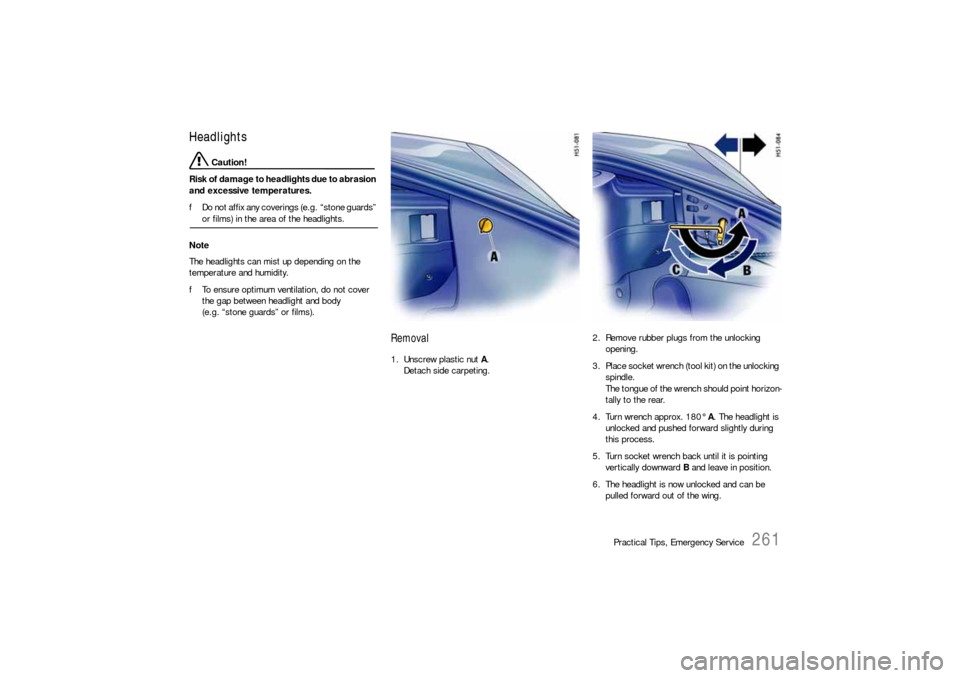
Removal1. Unscrew plastic nut A.
Detach side carpeting.2. Remove rubber plugs from the unlocking
opening.
3. Place socket wrench (tool kit) on the unlocking
spindle.
The tongue of the wrench should point horizon-
tally to the rear.
4. Turn wrench approx. 180° A. The headlight is
unlocked and pushed forward slightly during
this process.
5. Turn socket wrench back until it is pointing
vertically downward B and leave in position.
6. The headlight is now unlocked and can be
pulled forward out of the wing.
Page 262 of 296
262
Practical Tips, Emergency Service
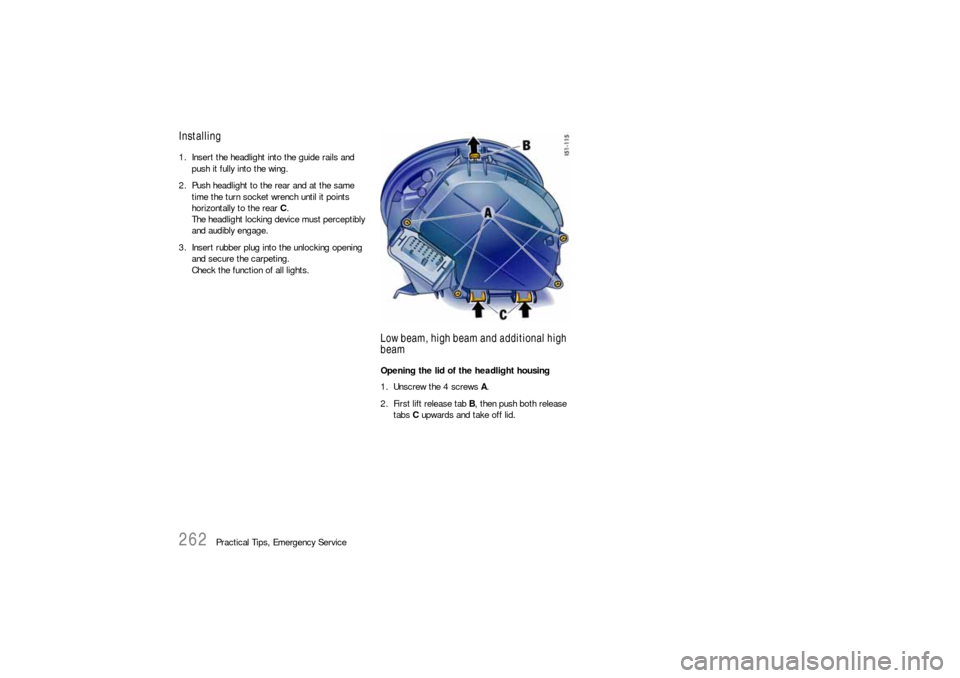
Installing1. Insert the headlight into the guide rails and
push it fully into the wing.
2. Push headlight to the rear and at the same
time the turn socket wrench until it points
horizontally to the rear C.
The headlight locking device must perceptibly
and audibly engage.
3. Insert rubber plug into the unlocking opening
and secure the carpeting.
Check the function of all lights.
Low beam, high beam and additional high
beamOpening the lid of the headlight housing
1. Unscrew the 4 screws A.
2. First lift release tab B, then push both release
tabs C upwards and take off lid.
Page 263 of 296
Practical Tips, Emergency Service
263
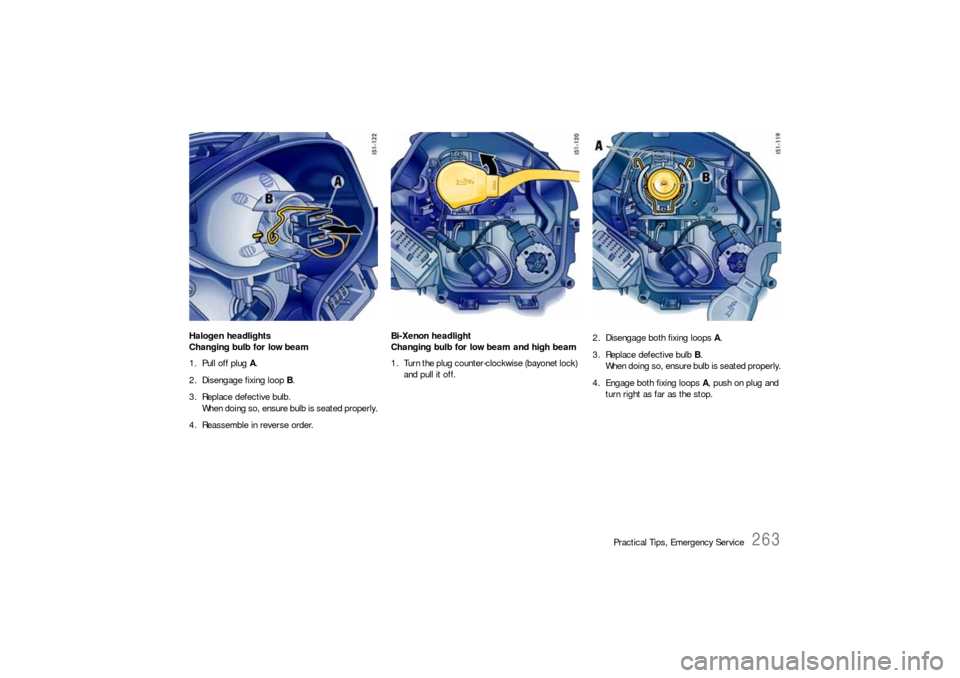
Halogen headlights
Changing bulb for low beam
1. Pull off plug A.
2. Disengage fixing loop B.
3. Replace defective bulb.
When doing so, ensure bulb is seated properly.
4. Reassemble in reverse order.Bi-Xenon headlight
Changing bulb for low beam and high beam
1. Turn the plug counter-clockwise (bayonet lock)
and pull it off.2. Disengage both fixing loops A.
3. Replace defective bulb B.
When doing so, ensure bulb is seated properly.
4. Engage both fixing loops A, push on plug and
turn right as far as the stop.