lock PORSCHE BOXSTER 2009 2.G Owner's Manual
[x] Cancel search | Manufacturer: PORSCHE, Model Year: 2009, Model line: BOXSTER, Model: PORSCHE BOXSTER 2009 2.GPages: 294, PDF Size: 6.89 MB
Page 34 of 294
32
Operation, Safety
Seat Adjustment and Head
Restraints
Warning!
The seat may move unexpectedly if you
attempt to adjust while driving. This could
cause sudden loss of control, resulting in se-
rious personal injury or death.
f Do not adjust seats while the vehicle is in mo-
tion.
The backrest locks must be engaged at all
times while the vehicle is in motion.
Safety belts only offer protection when the
backrest is upright and the belts are properly
positioned on the body.
Improperly positioned sa fety belts or safety
belts worn by passengers in an excessively
reclined position can cause serious personal
injury or death in an accident.
f Do not operate the car with the driver or
passenger backrests excessively reclined
(see “Seat position”).
Risk of injury if persons or animals are in the
movement range of the seat during seat
adjustment.
f Adjust the seat so that no-one is put at risk.
Caution!
Risk of damage to windshield, sun visor, etc.
when the seat is adjusted or folded back or
forward.
f Adjust the seat so that the s e a t b a c k re s t i s n o t in contact with any other object.
The driver and passenger seats provide
integrated head restraints in the backrests. The
head restraints are not adjustable. Warning!
All occupants, including the driver, should not
operate a vehicle or sit in a vehicle's seat until the
head restraints and backrests, respectively, are
placed in their proper posi tions so that the risk of
neck injuries is minimize d in the event of a crash.
For proper positioning of the head restraint, the
seatback's inclination should be adjusted such
that the head restraint is in an upright position.
Driver and passenger should be seated upright
and in the center of their seats.
Seat positionAn ergonomically correct sitting position is
important for safe and fatigue-free driving.
We recommend the following procedure for adjust-
ing the driver’s seat to suit individual
requirements:
1. Vehicles with manual transmission:
Adjust the seat until, with the clutch pedal fully
depressed, your leg remains at a slight angle.
Vehicles with Porsche Doppelkupplung
(PDK):
Adjust the seat until, with your left foot on the
footrest, your left leg remains at a slight angle.
2. Rest your outstretched arm on the steering wheel.
Set the backrest angle (not applicable for
Sports bucket seat) and the steering-wheel
position so that your wr ist rests on the outer
rim of the steering wheel. At the same time,
the shoulders must still be in noticeable
contact with the backrest.
3. Adjust the seat height (not applicable for
Sports bucket seat) to give yourself enough
headroom and a good overview of the vehicle.
4. Electrically adjustable seat: Adjust the seat angle until your thighs rest
lightly on the seat cushion.
Page 35 of 294
Operation, Safety
33
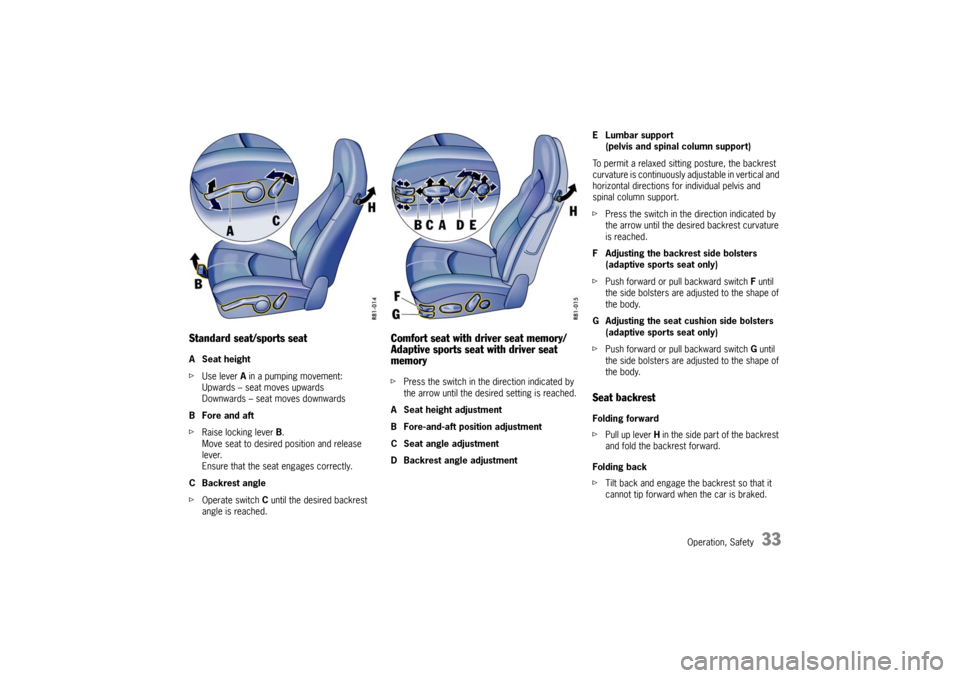
Standard seat/sports seatA Seat height
fUse lever A in a pumping movement:
Upwards – seat moves upwards
Downwards – seat moves downwards
B Fore and aft
f Raise locking lever B.
Move seat to desired position and release
lever.
Ensure that the seat engages correctly.
CBackrest angle
f Operate switch C until the desired backrest
angle is reached.
Comfort seat with driver seat memory/
Adaptive sports seat with driver seat
memoryf Press the switch in the direction indicated by
the arrow until the desired setting is reached.
A Seat height adjustment
B Fore-and-aft position adjustment
C Seat angle adjustment
D Backrest angle adjustment E Lumbar support
(pelvis and spinal column support)
To permit a relaxed sitting posture, the backrest
curvature is continuously adjustable in vertical and
horizontal directions for individual pelvis and
spinal column support.
f Press the switch in the direction indicated by
the arrow until the desired backrest curvature
is reached.
F Adjusting the backrest side bolsters (adaptive sports seat only)
f Push forward or pull backward switch F until
the side bolsters are adjusted to the shape of
the body.
G Adjusting the seat cushion side bolsters (adaptive sports seat only)
f Push forward or pull backward switch G until
the side bolsters are adjusted to the shape of
the body.
Seat backrestFolding forward
f Pull up lever H in the side part of the backrest
and fold the backrest forward.
Folding back
f Tilt back and engage the backrest so that it
cannot tip forward when the car is braked.
Page 36 of 294
34
Operation, Safety
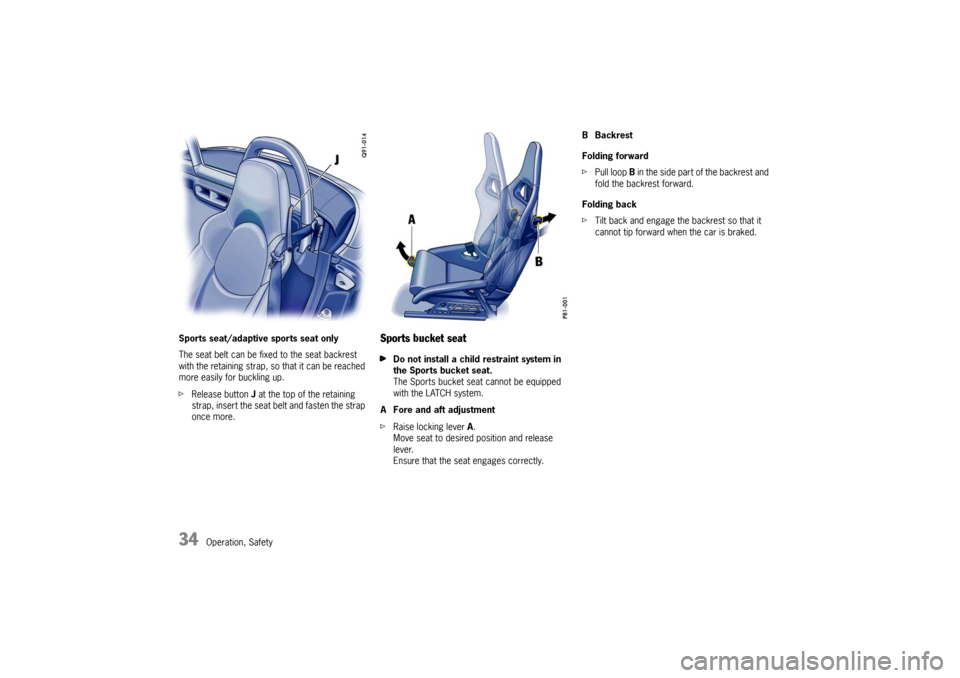
Sports seat/adaptive sports seat only
The seat belt can be fixed to the seat backrest
with the retaining strap, so
that it can be reached
more easily for buckling up.
f Release button J at the top of the retaining
strap, insert the seat be lt and fasten the strap
once more.
Sports bucket seatf Do not install a child restraint system in
the Sports bucket seat.
The Sports bucket seat cannot be equipped
with the LATCH system.
A Fore and aft adjustment
f Raise locking lever A.
Move seat to desired position and release
lever.
Ensure that the seat engages correctly. BBackrest
Folding forward
f
Pull loop B in the side par t of the backrest and
fold the backrest forward.
Folding back
f Tilt back and engage the backrest so that it
cannot tip forward when the car is braked.
Page 38 of 294

36
Operation, Safety
Operating with the remote control of the
vehicle keyEach remote control (up to six) can be assigned an
individual seat and door mirror position.
The stored seat and door mirror position is set au-
tomatically when the vehicle is unlocked using the
corresponding remote control.
Storing seat position
1. Switch the ignition on with the desired car key.Reverse gear must not be engaged.
2. Set the desired seat and door-mirror positions.
3. Keep memory button M depressed and also
press key button 1 until an audible signal
confirms that the position has been stored.
The individual setting is now assigned to this
remote control and to the key button.
It is necessary to wait for at least 15 seconds
between locking and unlocking the door. Storing individual lowered position of the
passenger’s door mirror as a parking aid
Once the driver's seat setting has been stored, an
individual lowered position of the passenger's
door mirror may be stored for driving in reverse:
1. Apply the handbrake.
2. Switch the ignition on
with the desired car key.
3. Engage reverse gear.
4. Select passenger side with mirror switch. The passenger’s mirror swivels downwards.
5. Set passenger’s door mirror to desired final position.
6. Keep memory button M depressed and also
press key button 1 until an audible signal
confirms that the position has been stored.
The individual setting is now assigned to this
remote control and to the key button. Recalling seat position
f
Unlock the locked vehicle or the luggage
compartment with the remote control.
The stored seat position is automatically set.
The seat position assigned to a remote control
can also be recalled with the key button 1 if the
corresponding key was used to switch on the
ignition.
If no seat position has be en assigned to a remote
control, the key button will not work.
Note on operation
Automatic seat adjustment can be interrupted
immediately:
f by switching on the ignition,
f by pressing the central locking button,
f by pressing any memory or seat adjustment
button.
Clearing the stored seat position
1. Switch the ignition on with the desired car key.
2. Press memory button twice and key button 1
once consecutively.
Page 41 of 294
Operation, Safety
39
Adjusting steering wheel height and
longitudinal direction1. Insert ignition key fully into ignition lock.
2. Push the locking lever downwards.
3. Adjust steering wheel to fit the chosen backrest angle and your seat position by
moving the steering wheel up or down and
longitudinally.
4. Swivel locking lever back until you feel it en- gage.
If necessary, move steering wheel slightly lon-
gitudinally.
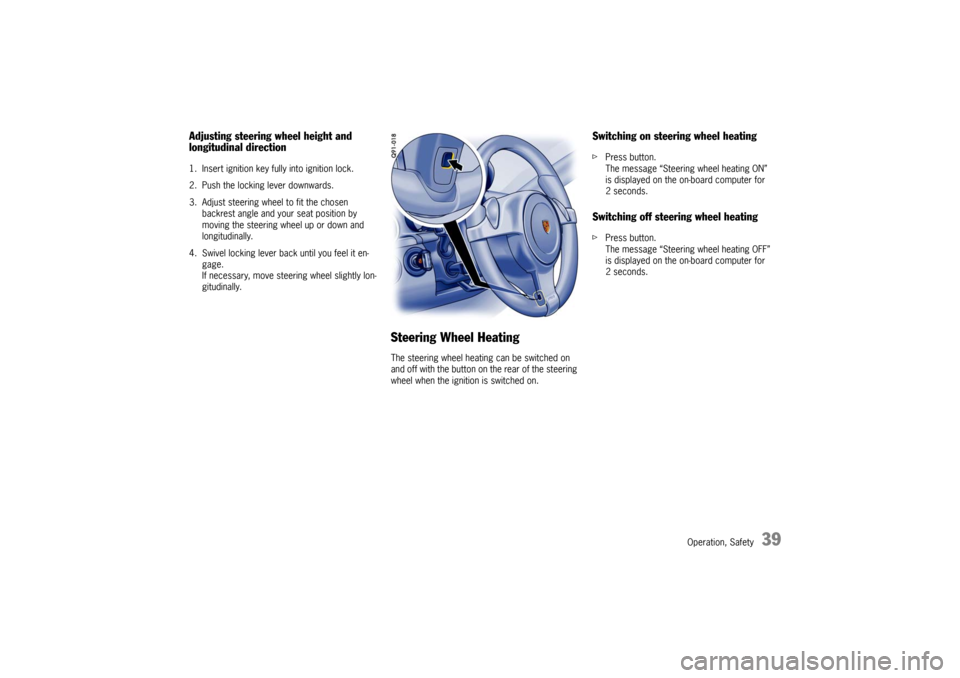
Steering Wheel HeatingThe steering wheel heatin g can be switched on
and off with the button on the rear of the steering
wheel when the ignition is switched on.
Switching on steering wheel heatingf Press button.
The message “Steering wheel heating ON”
is displayed on the on-board computer for
2seconds.Switching off steering wheel heatingfPress button.
The message “Steering wheel heating OFF”
is displayed on the on-board computer for
2seconds.
Page 44 of 294

42
Operation, Safety
Safety Belts
Warning!
Always make sure your and your passenger’s
safety belts are properly fastened while the
vehicle is in motion.
Failure to follow safety belt warnings may re-
sult in serious personal injury or death.
f For your and your passenger’s protection, use
safety belts at all times while the vehicle is in
motion.
f Use appropriate child restraint systems for all
small children.
Proper wearing of safety belts
f S a f e t y b e l t s m u s t b e p o s i t i o n e d o n t h e b o d y a s
to restrain the upper body and lap from sliding
forward. Improperly positioned safety belts
can cause serious personal injury or death in
case of an accident.
f The shoulder belt should always rest on your
upper body. The shoulder belt should never be
worn behind your back or under your arm.
f For maximum effectiveness, the lap belt
should be worn low across the hips.
f Pregnant women should position the belt as
low as possible across the pelvis. Make sure it
is not pressing against the abdomen. f
Belts should not be worn twisted.
f Do not wear belts over rigid or breakable ob-
jects in or on your clothing, such as eye glass-
es, pens, keys, etc. as these may cause injury.
f Several layers of heavy clothing may interfere
with proper positioning of belts.
f Belts must not rub against sharp objects or
damage may occur to the belt.
f Two occupants should never share the same
belt at the same time.
Care and maintenance
f Keep belt buckles free of any obstruction that
may prevent a secure locking.
f Belts that have been subjected to excessive
stretch forces in an accident must be inspect-
ed or replaced to ensure their continued effec-
tiveness in restraining you.
The same applies to belt tensioner systems
which have been triggered.
In addition, the anchor points of the belts
should be checked.
f If safety belts do not work properly, see your
authorized Porsche dealer immediately.
f I f t h e b e l t s s h o w d a m a g e t o w e b b i n g , b i n d i n g s ,
buckles or retractors, they should be replaced
to ensure safe operation.
f Do not modify or disasse mble the safety belts
in your vehicle. f
The belts must be kept clean or the retractors
may not work properly.
Please see the chapter “CAR CARE INSTRUC-
TIONS” on Page 213.
f Never bleach or dye safety belts.
f Do not allow safety belts to retract until they
are completely dry after cleaning or this may
cause damage to the belt.
Belt tensioner Depending on the force of an impact, fastened
safety belts are tightened in an accident.
The belt tensioners are triggered in:
– Front, side and rear impacts of sufficient
severity.
– In cases of vehicle rollover.
Note
The belt-tensioner system can be triggered only
once; the system must be replaced afterward.
If there is a fault in the belt-tensioner system, the
airbag warning light lights up.
Work may be performed on the belt-tensioner sys-
tem only by an authorized Porsche dealer.
Smoke is released when the belt tensioners are
triggered. This does not indicate a fire in the
vehicle.
Page 45 of 294
Operation, Safety
43
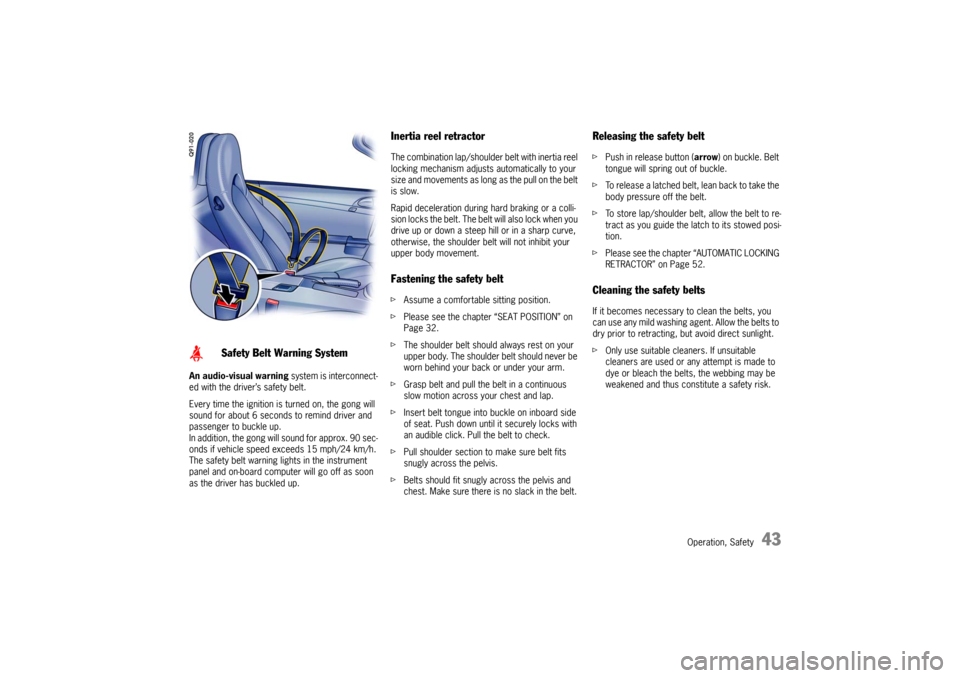
An audio-visual warning system is interconnect-
ed with the driver ’s safety belt.
Every time the ignition is turned on, the gong will
sound for about 6 seconds to remind driver and
passenger to buckle up.
In addition, the gong will sound for approx. 90 sec-
onds if vehicle speed exceeds 15 mph/24 km/h.
The safety belt warning lights in the instrument
panel and on-board computer will go off as soon
as the driver has buckled up.
Inertia reel retractor The combination lap/shoulder belt with inertia reel
locking mechanism adjusts automatically to your
size and movements as long as the pull on the belt
is slow.
Rapid deceleration during hard braking or a colli-
sion locks the belt. The belt will also lock when you
drive up or down a steep hill or in a sharp curve,
otherwise, the shoulder belt will not inhibit your
upper body movement.Fastening the safety beltf Assume a comfortable sitting position.
f Please see the chapter “SEAT POSITION” on
Page 32.
f The shoulder belt should always rest on your
upper body. The shoulder belt should never be
worn behind your back or under your arm.
f Grasp belt and pull the belt in a continuous
slow motion across your chest and lap.
f Insert belt tongue into buckle on inboard side
of seat. Push down until it securely locks with
an audible click. Pull the belt to check.
f Pull shoulder section to make sure belt fits
snugly across the pelvis.
f Belts should fit snugly across the pelvis and
chest. Make sure there is no slack in the belt.
Releasing the safety beltf Push in release button (arrow ) on buckle. Belt
tongue will spring out of buckle.
f To release a latched belt, lean back to take the
body pressure off the belt.
f To store lap/shoulder belt, allow the belt to re-
tract as you guide the latch to its stowed posi-
tion.
f Please see the chapter “AUTOMATIC LOCKING
RETRACTOR” on Page 52.Cleaning the safety beltsIf it becomes necessary to clean the belts, you
can use any mild washing agent. Allow the belts to
dry prior to retracting, but avoid direct sunlight.
f Only use suitable cleaners. If unsuitable
cleaners are used or any attempt is made to
dye or bleach the belt s, the webbing may be
weakened and thus constitute a safety risk.
Safety Belt Warning System
Page 54 of 294
52
Operation, Safety
Child restraint system for up to one-year old
children
– Make sure that the PASSENGER AIRBAG OFF
indicator lamp lights up.
– Adjust the passenger's seat as far away from the airbag as possible. Danger!
Risk of serious personal injury or death due
to the passenger airbag triggering uninten-
tionally.
When the ignition is on and the up to one-
year old child is seated in the child restraint
system on the passenger seat the indicator
lamp ”PASSENGER AIRBAG OFF“ must be on.
If the ”PASSENGER AIRBAG OFF“ indicator
lamp does not light up, it could indicate a
fault in the system.
In this case:
f Do not use a child restraint system on the pas-
senger’s seat.
f On vehicles with key-operated airbag deactiva-
tion device: Switch to position OFF.
f On vehicles without key-operated airbag deac-
tivation device: Do not drive.
f Have the fault remedied at your nearest autho-rized Porsche dealer. Child restraint system fo
r children older than
one year
Your vehicle is equipped with a weight sensing sys-
tem for the passenger's seat in accordance with
U.S. Federal Motor Vehicl e Safety Standard 208.
Depending on the weight acting on the passen-
ger's seat, the passenger's airbag will automati-
cally be switched on or off.
Small adult passengers
Make sure that the PASSENGER AIRBAG OFF indi-
cator lamp does not light up.
Danger!
Risk of serious personal injury or death due
to the passenger airbag not triggering.
When the ignition key is inserted on and the
small adult passenger is seated on the pas-
senger’s seat, the indicator lamp ”PASSEN-
GER AIRBAG OFF“ must be off.
If the ”PASSENGER AIRBAG OFF“ indicator
lamp lights up, it could indicate a fault in the
system.
In this case:
f Do not carry a passenger in the passenger’s
seat.
f Have the fault remedied at the nearest authori-zed Porsche dealer.
Automatic locking retractorfDo not install a child restraint system in
the Sports bucket seat.
The Sports bucket seat cannot be equipped
with the LATCH system.
The safety belt for the passenger is equipped with
an automatic locking retr actor for securing the
child restraint system. When activated, this retrac-
tor allows you to securely fasten the child restraint
system in place so that inadvertent movements
will not occur.
Before transporting a child on the passenger seat:
f Please see the chapter “CHILD RESTRAINT
SYSTEMS” on Page 50.
Danger!
Risk of serious personal injury or death to the
child, when excessive force is acting on the
passenger's seat due to the seat belt.
In such cases, the pass enger's airbag can be
switched on unintentionally.
f After fastening the child restraint system, do
not adjust the seat.
f Check the condition of the passenger’s airbag
shown by the indicator la mp in the central con-sole.
Page 55 of 294

Operation, Safety
53
Activating the automatic locking retractor
1. If a child restraint system must be fastened to the passenger's seat, adjust the passenger's
seat as far away from the airbag as possible.
2. Fasten child seat.
3. Pull the safety belt retractor completely out. At this point the locking mechanism is activated.
4. Insert the safety belt tongue into the buckle
and make certain that it is properly latched.
Make no more adjustments to the seat.
5. Allow the safety belt to retract until it is tight on
the child restraint system. You may further tigh-
ten the belt by pulling on it to allow more of it
to retract.
Make sure that excessive seat belt forces do
not occur by moving the seat with the child
seat installed. Releasing the safety belt
1. Unbuckle the safety belt latch.
2. Then make certain that the
belt has fully retrac-
ted. At this point the automatic locking feature
will be disengaged.
Seek appropriate advice from your authorized
Porsche dealer about the possible installation
of a Porsche child restraint system.
Page 61 of 294

Operation, Safety
59
ABS Brake System
(Antilock Brake System)The ABS system represents a major contribution
to the enhancement of active safety in your vehi-
cle. This system prevents the wheels from locking
in a panic stop on almost all road surfaces.
With the ABS system in your vehicle, the
following areas are enhanced:
Steering, vehicle remains steerable under all
braking forces when ABS is engaged.
Good directional control , no swerving caused
by locking of wheels under braking conditions.
Shorter stopping distance , stopping distances
are usually reduced because controlled braking is
maximized.
Prevention of wheel lock up , no brake- induced
sliding and thus no localized tire wear from emer-
gency braking.
The crucial advantage of the ABS system over a
conventional brake system is in the area of main-
taining directional control and maneuverability of
the car in emergency situations.
Warning!
The increased control that is provided should
not induce you to take greater risks with your
safety. The limits dictated by the laws of
physics cannot be overcome, even with ABS.
The risk of accidents due to inappropriate
speed cannot be reduced, even by the ABS.
The driver bears the responsibility for all
driving maneuvers.
f Adapt your driving style to the prevailing road
and weather conditions.
f Obey all traffic laws.
Other vehicles not equipped with the ABS
system may not be able to maintain control,
especially on wet or poor road surfaces and
thus may be more likely to impact you from
behind.
f To minimize that risk, use your ABS system to
increase your ability to maneuver to avoid dan-
gerous situations and not merely to try to stop in the shortest distance possible.
Operation of the ABS systemA wheel speed sensor is mounted to each of the
four wheels. If wheel lock -up of either of the front
wheels or the rear wheels is sensed during brak-
ing, the brake pressure is adjusted automatically
until the wheel no longer slips.
If braking forces approach the wheel lock-up point
for all wheels (panic brak ing) the ABS system will
intervene to provide a rapid rythmic braking. The
proper operation of ABS is perceived by the driver
as a pulsating brake pedal in conjunction with au-
dible noise and perhaps some vibration.
f If you experience these sensations while driv-
ing or a road surface with questionable trac-
tion, reduce vehicle speed appropriate for the
prevailing road conditions.
f If full braking should be necessary, press the
brake pedal all the wa y down throughout the
entire braking procedure, regardless of the pul-
sating pedal. Do not ease up on pressure ap-
plied to the pedal.
The functional readiness of all the main electrical
components of the ABS is checked by an
electronic monitoring system both before and
while you drive.