weight PORSCHE CAYMAN 2006 1.G User Guide
[x] Cancel search | Manufacturer: PORSCHE, Model Year: 2006, Model line: CAYMAN, Model: PORSCHE CAYMAN 2006 1.GPages: 280, PDF Size: 4.89 MB
Page 221 of 280

Practical Tips, Emergency Service
221
Loading InformationDefinitionsThe Curb weight - actual weight of your vehicle -
vehicle weight including standard and optional
equipment, fluids and emergency tools. This
weight does not include passengers and cargo.
The Gross Vehicle Weight is sum of the curb
weight and the weight of passengers and cargo
combined.
The Gross Vehicle Weight Rating is the maxi-
mum total weight of vehicle, passengers, luggage
and optional equipment.
The Gross Axle Weight Rating is the maximum
load limit for the front or the rear axle. This infor-
mation is located on the safety compliance sticker
located in the driver’s side door jamb.
For determining the compatibility of the tire and
vehicle load capabilities:
fPlease observe the chapter “TIRES, RIMS,
TRACKS” on Page 268.
The load capacity coefficient (e.g. “101”) is a min-
imum requirement.The Gross Combined Weight Rating is the
maximum total weight rating of vehicle, passen-
gers and cargo.
The Vehicle Capacity Weight - Load Limit - is
the maximum total weight limit specified of the
load (passengers and cargo) for the vehicle. This
is the maximum weight of passengers and cargo
that can be loaded into the vehicle. This informa-
tion can be found on the tire pressure plate.
The maximum loaded vehicle weight is the
sum of curb weight, accessory weight, vehicle ca-
pacity weight and production options weight.
The load rating is the maximum load that a tire
is rated to carry for a given inflation pressure.
The maximum load rating is the load rating for
a tire at the maximum permissible inflation pres-
sure.
The cargo capacity is the permissible weight of
cargo, the subtracted weight of passengers from
the load limit.
fNever exceed the permissible limits.
Danger!
Risk of personal injury, loss of control and
damage to vehicle.
fNever exceed the specified axle loads. Over-
loading can shorten the service life of the tires
and car, as well as lead to dangerous vehicle
reactions and long braking distances. Damage
due to overloading is not covered by the vehi-cle warranty.
Page 222 of 280

222
Practical Tips, Emergency Service
Example for determining the combined weight of occu-
pants and cargoVehicle Load CapacityfThe combined weight of occupants and cargo
should never exceed the weight shown on the
tire plate in the vehicle.
Please observe the chapter “VEHICLE IDENTI-
FICATION NUMBER” on Page 264.
fNever exceed the number of passengers
shown on the tire pressure plate in the vehicle.Determining the combined weight of
occupants and cargo:
fAdd the weight of all occupants and then add
the total luggage weight (figure).
Steps for determining correct load limit
1. Locate the statement "The combined weight of
occupants and cargo should never exceed XXX
pounds" on your vehicle’s placard (depending
on the date of manufacture).
2. Determine the combined weight of the driver
and passenger that will be riding in your vehi-
cle.3. Subtract the combined weight of the driver and
passenger from XXX kilograms or XXX pounds.
4. The resulting figure equals the available
amount of cargo and luggage load capacity.
For example, if the "XXX" amount equals 400
lbs. and there will be two - 150 lb passengers
in your vehicle, the amount of available cargo
and luggage load capacity is 100 lbs. (400 -
300 (2 x 150) = 100 lbs.).
5. Determine the combined weight of luggage
and cargo being loaded on the vehicle. That
weight may not safely exceed the available car-
go and luggage load capacity calculated in
Step 4.
Page 258 of 280

258
Practical Tips, Emergency Service
Adjusting Headlights fPlease observe the chapter “REPLACING BUL-
BS” on Page 244.
Adjustment
The adjustment is made with the vehicle ready to
drive and the fuel tank completely filled.
The driver’s seat must be loaded by a person or a
165 lbs. (75 kg) weight and the tire pressures
must meet the prescribed values.
After being loaded, the car must be rolled a few
meters so that the suspension can settle.
For checking the headlight adjustment, the verti-
cal position of the cutoff of the lowbeam (see fig.)
has to be projected on a vertical screen (wall) in
distance of 24.6 ft. (7.5 m) from the front lens of
the headlamp.
The correct position of the cutoff is 2.0 in. (5 cm)
at 24.6 ft. or 7.5 m (0.4°) below a horizontal line,
x in. from ground to the center of the headlamp
lens.
Lateral adjustment of the headlights should be
carried out at a specialist workshop with an optical
adjustment unit. Distance
Visual aim shall be performed at not less than
24.6 ft. (7.5) m (this value is a rounded down con-
version from the 25-foot distance typical of field
aim using a screen). The 24.6 ft. (7.5 m) distance
is measured from the headlamp lens to the view-
ing screen.
Page 264 of 280

264
Vehicle Identification, Technical Data
Vehicle IdentificationWhen ordering spare parts or making inquiries,
please always quote the vehicle identification
number. Vehicle data bankThe vehicle data bank is attached to the inside of
the ”Maintenance“ booklet.
It contains all important data about your car.
Note
This data bank cannot be re-ordered if it is lost or
damaged.
This label contains the following information:
1. Vehicle Identification No.
2. Type/Type description
3. Engine code/Transmission code
4. Paint No./Interior
Vehicle identification number In accordance with Federal Safety Regulations,
the vehicle identification number of your car is lo-
cated at the bottom left of the windshield frame
and can be seen from the outside.
The vehicle identification number is in the front lug-
gage compartment under the battery cover and at
the bottom left behind the windshield.
Removing the battery cover
fPlease observe the chapter “REMOVING THE
BATTERY” on Page 239.
Safety compliance sticker The safety compliance sticker is your assurance
that your new Porsche complies with all applicable
Federal Motor Vehicle Safety Standards which
were in effect at the time the vehicle was manufac-
tured.
The sticker also shows the month and year of pro-
duction and the vehicle identification number of
your car (perforations) as well as the Gross Vehi-
cle Weight Rating and the Gross Axle Weight Rat-
ing.
Page 270 of 280

270
Vehicle Identification, Technical Data
Driving Performance* * At DIN empty weight and half load, without performance-inhibiting extra equipment.Manual transmission Tiptronic S
Maximum speed 171 mph/275 km/h 166 mph/267 km/h
Acceleration 0 – 60 mph 5.1 seconds 5.8 seconds
Acceleration 0 – 100 km/h (62 mph) 5.4 seconds 6.1 seconds
Page 272 of 280

272
Vehicle Identification, Technical Data
Weights
Manual transmission Tiptronic S
Empty weight (depending on equipment) 2954 lbs. to 3153 lbs. 3042 lbs. to 3241 lbs.
1340 kg to 1430 kg 1380 kg to 1470 kg
Maximum gross weight 3594 lbs./1630 kg 3682 lbs./1670 kg
Maximum axle load, front* 1709 lbs./775 kg 1709 lbs./775 kg
Maximum axle load, rear* 2072 lbs./940 kg 2072 lbs./940 kg
Maximum useful load, Roof Transport System** 132lbs./60 kg 132lbs./60 kg
*The maximum gross weight must not be exceeded.
Note: If additional accessories are installed, the useful load will be correspondingly less.
**Use only Original Porsche Roof Transport System
Page 273 of 280

Vehicle Identification, Technical Data
273
Dimensions * At maximum gross weight.PAS M
Length 172.1 in./4372 mm
Width 70.9 in./1801 mm
Width
(with door mirrors) 76.3 in./1937 mm
Height 51.4 in./1305 mm 51.0 in./1296 mm
Wheelbase 95.1 in./2415 mm
Ground clearance* 4.1 in./104 mm 3.9 in./100 mm
Turning circle 36.4 ft./11.1 m
Page 274 of 280
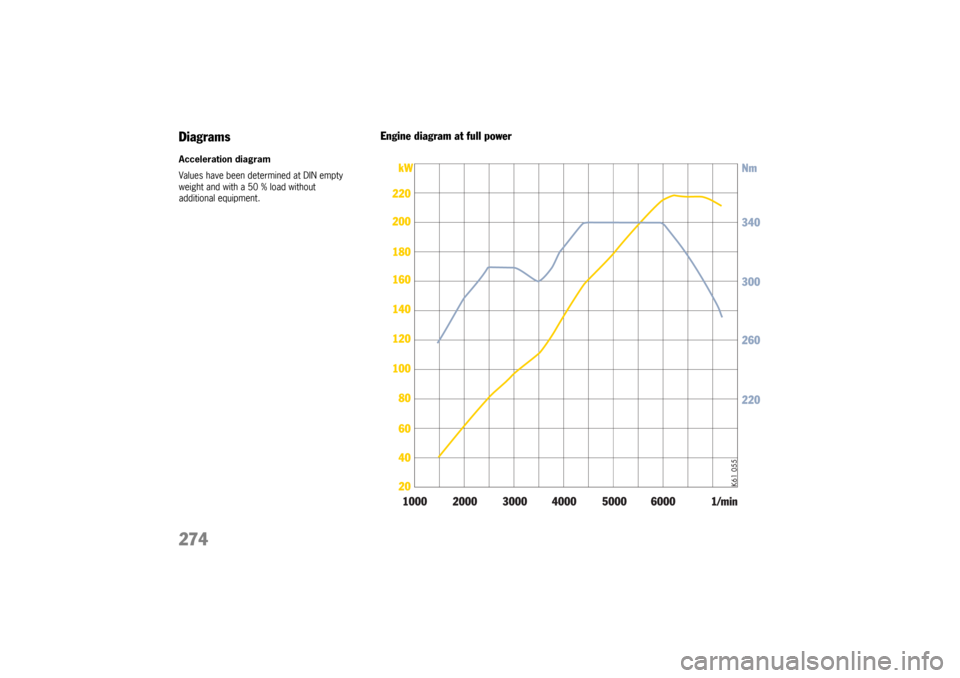
274Diagrams Acceleration diagram
Values have been determined at DIN empty
weight and with a 50 % load without
additional equipment.
Engine diagram at full power
Page 280 of 280

280UUndercoating ............................. 190
, 199
, 200
VValves ........................................................ 215
Vanity mirror................................................. 39
Vehicle
Care .................................................. 195
Data bank........................................... 264
Identifikation number ........................... 264
Laying up the car................................ 237
Putting into operation .......................... 238
Washing ............................................. 195
Ventilation .................................................. 133
Vents .................................................130
, 133
Viscosity, engine oil.................................... 180
WWarning messages ..................................... 114
Washer fluid .......................................192
, 271
Washer lever .............................................. 125
Washing ..................................................... 195
Weights...................................................... 272
Welcome Home Function............................. 123
Wheel ....................................... 201
, 207
, 268
Bolts ............................................17, 227
Changing............................................ 228
Checking pressure..........................5, 227
Inscription .......................................... 219
Loading information............................ 221
Pressure plate .................................... 265
Sidewall ............................................. 219Size ................................................... 219
Tire pressure ................................. 5
, 210
Tire sealant ........................................ 225
Windows ....................................... 23
, 26, 199
Washer nozzles................................... 125
Washer system .......................... 192, 271
Windshield wipers .............................. 125, 173
Replacing ........................................... 173
Winter driving
Battery ............................................... 236
Jump lead starting.............................. 242
Winter operation
Coolant .............................................. 176
Seals ................................................. 200
Snow chains ....................................... 218
Tires .................................................. 217
Washer fluid........................................ 192
Wiper blades....................................... 173