lock PORSCHE CAYMAN 2006 1.G Owner's Manual
[x] Cancel search | Manufacturer: PORSCHE, Model Year: 2006, Model line: CAYMAN, Model: PORSCHE CAYMAN 2006 1.GPages: 280, PDF Size: 4.89 MB
Page 40 of 280

40
Controls, Instruments
Safety Belts
Warning!
Always make sure your and your passenger’s
safety belts are properly fastened while the
vehicle is in motion.
Failure to follow safety belt warnings may re-
sult in serious personal injury or death.
fFor your and your passenger’s protection, use
safety belts at all times while the vehicle is in
motion.
fUse appropriate child restraint systems for all
small children.
Proper wearing of safety belts
fS a f e t y b e l t s m u s t b e p o s i t i o n e d o n t h e b o d y a s
to restrain the upper body and lap from sliding
forward. Improperly positioned safety belts
can cause serious personal injury or death in
case of an accident.
fThe shoulder belt should always rest on your
upper body. The shoulder belt should never be
worn behind your back or under your arm.
fFor maximum effectiveness, the lap belt
should be worn low across the hips.
fPregnant women should position the belt as
low as possible across the pelvis. Make sure it
is not pressing against the abdomen. fBelts should not be worn twisted.
fDo not wear belts over rigid or breakable ob-
jects in or on your clothing, such as eye glass-
es, pens, keys, etc. as these may cause injury.
fSeveral layers of heavy clothing may interfere
with proper positioning of belts.
fBelts must not rub against sharp objects or
damage may occur to the belt.
fTwo occupants should never share the same
belt at the same time.
Care and maintenance
fKeep belt buckles free of any obstruction that
may prevent a secure locking.
fBelts that have been subjected to excessive
stretch forces in an accident must be inspect-
ed or replaced to ensure their continued effec-
tiveness in restraining you.
The same applies to belt tensioner systems
which have been triggered.
In addition, the anchor points of the belts
should be checked.
fIf safety belts do not work properly, see your
authorized Porsche dealer immediately.
fI f t h e b e l t s s h o w d a m a g e t o w e b b i n g , b i n d i n g s ,
buckles or retractors, they should be replaced
to ensure safe operation.
fDo not modify or disassemble the safety belts
in your vehicle.
fThe belts must be kept clean or the retractors may not work properly.
Please observe the chapter “CAR CARE IN-
STRUCTIONS” on Page 195.
fNever bleach or dye safety belts.
fDo not allow safety belts to retract until they
are completely dry after cleaning or this may
cause damage to the belt.
Belt tensioner Depending on the force of an impact, fastened
safety belts are tightened in an accident.
The belt tensioners are triggered by:
– Front, side and rear impacts of sufficient
severity.
Note
The belt tensioner system can be triggered only
once; the system must be replaced afterward.
If there is a fault in the belt-tensioner system, the
airbag warning light lights up.
Work may be performed on the belt-tensioner sys-
tem only by an authorized Porsche dealer.
Smoke is released when the belt tensioners are
triggered. This does not indicate a fire in the
vehicle.
Page 41 of 280
Controls, Instruments
41
An audio-visual warning system is interconnect-
ed with the driver’s safety belt.
Every time the ignition is turned on, the gong will
sound for about 6 seconds to remind driver and
passenger to buckle up.
In addition, the gong will sound for approx. 90 sec-
onds if the vehicle speed exceeds 15 mph
(24 km/h).
The safety belt warning light in the instrument
panel and on-board computer will go off as soon
as the driver has buckled up.
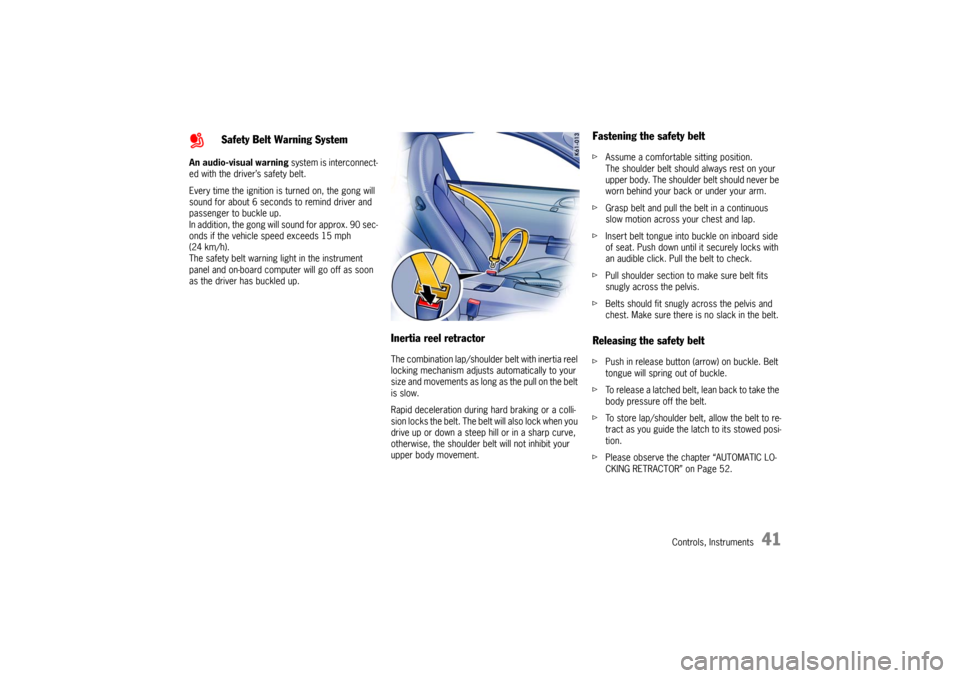
Inertia reel retractor The combination lap/shoulder belt with inertia reel
locking mechanism adjusts automatically to your
size and movements as long as the pull on the belt
is slow.
Rapid deceleration during hard braking or a colli-
sion locks the belt. The belt will also lock when you
drive up or down a steep hill or in a sharp curve,
otherwise, the shoulder belt will not inhibit your
upper body movement.
Fastening the safety beltfAssume a comfortable sitting position.
The shoulder belt should always rest on your
upper body. The shoulder belt should never be
worn behind your back or under your arm.
fGrasp belt and pull the belt in a continuous
slow motion across your chest and lap.
fInsert belt tongue into buckle on inboard side
of seat. Push down until it securely locks with
an audible click. Pull the belt to check.
fPull shoulder section to make sure belt fits
snugly across the pelvis.
fBelts should fit snugly across the pelvis and
chest. Make sure there is no slack in the belt. Releasing the safety beltfPush in release button (arrow) on buckle. Belt
tongue will spring out of buckle.
fTo release a latched belt, lean back to take the
body pressure off the belt.
fTo store lap/shoulder belt, allow the belt to re-
tract as you guide the latch to its stowed posi-
tion.
fPlease observe the chapter “AUTOMATIC LO-
CKING RETRACTOR” on Page 52.
Safety Belt Warning System
Page 52 of 280

52
Controls, Instruments
Automatic locking retractorThe safety belt for the passenger is equipped with
an automatic locking retractor for securing the
child restraint system. When activated, this retrac-
tor allows you to securely fasten the child restraint
system in place so that inadvertent movements
will not occur.
Before transporting a child on the passenger’s
seat:
fPlease observe the chapter “CHILD RES-
TRAINT SYSTEMS” on Page 49.
A- PASSENGER AIRBAG OFF indicator lamp
Danger!
Risk of serious personal injury or death to the
child, when excessive force is acting on the
passenger's seat due to the seat belt.
In such cases, the passenger's airbag can be
switched on unintentionally.
fAfter fastening the child restraint system, do
not adjust the seat.
fCheck the condition of the passenger’s airbag
system shown by the indicator lamp A in the central console.Activating the automatic locking retractor
1. If a child restraint system must be fastened to
the passenger's seat, adjust the passenger's
seat as far away from the airbag as possible.
2. Fasten child seat.
3. Pull the safety belt retractor completely out. At
this point the locking mechanism is activated.
4. Insert the safety belt tongue into the buckle
and make certain that it is properly latched.
Make no more adjustments to the seat.
5. Allow the safety belt to retract until it is tight on
the child restraint system. You may further
tighten the belt by pulling on it to allow more of
it to retract.
Make sure that excessive seat belt forces do
not occur by moving the seat with the child
seat installed.
Releasing the safety belt
1. Unbuckle the safety belt latch.
2. Then make certain that the belt has fully re-
tracted. At this point the automatic locking fea-
ture will be disengaged.
Seek appropriate advice from your authorized
Porsche dealer about the possible installation
of a Porsche child restraint system.
Page 59 of 280

Controls, Instruments
59
ABS Brake System
(Antilock Brake System) The ABS system represents a major contribution
to the enhancement of active safety in your vehi-
cle. This system prevents the wheels from locking
in a panic stop on almost all road surfaces. With the ABS system in your vehicle, the fol-
lowing areas are enhanced:
Steering, vehicle remains steerable under all
braking forces when ABS is engaged.
Good directional control, no swerving caused
by locking of wheels under braking conditions.
Shorter stopping distance, stopping distances
are usually reduced because controlled braking is
maximized.
Prevention of wheel lock up, no brake- induced
sliding and thus no localized tire wear from emer-
gency braking.
The crucial advantage of the ABS system over a
conventional brake system is in the area of main-
taining directional control and maneuverability of
the car in emergency situations during normal driv-
ing, including panic braking in turns.
Warning!
The increased control that is provided should
not induce you to take greater risks with your
safety. The limits dictated by the laws of
physics cannot be overcome, even with ABS.
The risk of accidents due to inappropriate
speed cannot be reduced, even by the ABS.
The driver bears the responsibility for all
driving maneuvers.
fAdapt your driving style to the prevailing road
and weather conditions.
fObey all traffic laws.
Other vehicles not equipped with the ABS
system may not be able to maintain control,
especially on wet or poor road surfaces and
thus may be more likely to impact you from
behind.
fTo minimize that risk, use your ABS system to
increase your ability to maneuver to avoid dan-
gerous situations and not merely to try to stop in the shortest distance possible.
Page 60 of 280

60
Controls, Instruments
Operation of the ABS system A wheel speed sensor is mounted to each of the
four wheels. If wheel lock-up of either of the front
wheels or the rear wheels is sensed during brak-
ing, the brake pressure is adjusted automatically
until the wheel no longer slips. The brake pressure
is regulated for each front wheel individually and
for both of the rear wheels together.
On a road surface which is slippery on only one
side, the rear wheel which is braking on the slip-
pery surface determines the brake pressure which
will be applied equally to both rear wheels. This en-
sures that directional stability is maintained. How-
ever, if braking forces approach the wheel lock-up
point for all wheels (panic braking) the ABS system
will intervene to provide a rapid rhythmic braking.
The proper operation of ABS is perceived by the
driver as a pulsating brake pedal in conjunction
with audible noise and perhaps some vibration.
fIf you experience these sensations while driv-
ing or a road surface with questionable trac-
tion, reduce vehicle speed appropriate for the
prevailing road conditions.
The functional readiness of all the main electrical
components of the ABS is checked by an electron-
ic monitoring system both before and while you
drive. When the ignition is switched on the ABS warning
light will light up while the system is electronically
interrogated and goes out when the engine is
started if the check is not yet complete.
If the ABS warning lamp fails to go out, this indi-
cates that ABS has been deactivated due to a
fault. If the warning lights in the instrument panel
and on-board computer light up while you are driv-
ing, this indicates that a fault has occurred. In both
cases, normal braking, as in vehicles without ABS,
is still retained.
The ABS system should, however, be examined at
an authorized Porsche dealer immediately to pre-
vent the occurrence of further faults.
fIf the ABS system becomes inoperative, take
your vehicle to your authorized Porsche dealer
immediately.
Warning!
The control unit of the ABS brake system is
set for standard tire size. If non-standard
tires are installed, the control unit may mis-
interpret the speed of the vehicle, because of
the variant data it receives from the sensors
on the axles.
fUse only tire makes and types tested by Porsche.
Warning light USA
Warning light Canada
Page 70 of 280
70
Controls, Instruments
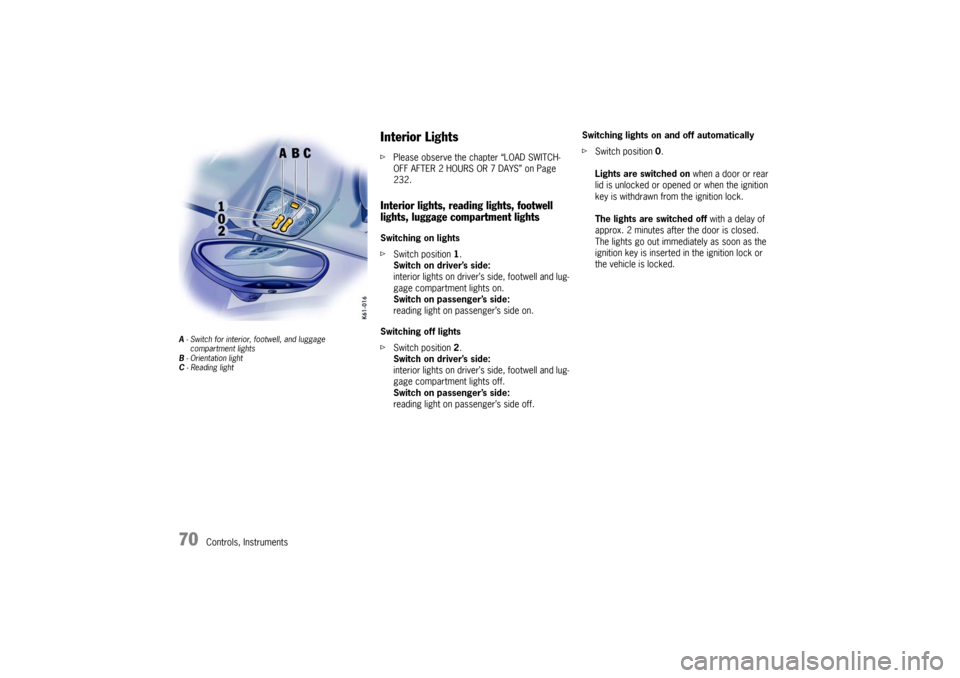
A - Switch for interior, footwell, and luggage
compartment lights
B - Orientation light
C - Reading light
Interior LightsfPlease observe the chapter “LOAD SWITCH-
OFF AFTER 2 HOURS OR 7 DAYS” on Page
232.Interior lights, reading lights, footwell
lights, luggage compartment lightsSwitching on lights
fSwitch position 1.
Switch on driver’s side:
interior lights on driver’s side, footwell and lug-
gage compartment lights on.
Switch on passenger’s side:
reading light on passenger’s side on.
Switching off lights
fSwitch position 2.
Switch on driver’s side:
interior lights on driver’s side, footwell and lug-
gage compartment lights off.
Switch on passenger’s side:
reading light on passenger’s side off.Switching lights on and off automatically
fSwitch position 0.
Lights are switched on when a door or rear
lid is unlocked or opened or when the ignition
key is withdrawn from the ignition lock.
The lights are switched off with a delay of
approx. 2 minutes after the door is closed.
The lights go out immediately as soon as the
ignition key is inserted in the ignition lock or
the vehicle is locked.
Page 72 of 280

72
Controls, Instruments
Operation, Instruments 1 Light switch
2 Turn signals/
headlight dimmer/flasher lever
3 Ignition lock/locking the steering column
4 Hands-free microphone for telephone
5Horn
6 Windshield wiper/washer lever
Rear window wiper
7 Porsche Communication Management/Radio
8 Interior temperature sensor, GPS antenna
9 Emergency flasher switch10 Central locking button,
Readiness display for alarm system
11 Cupholder
12 Operating lever for on-board computer
13 Locking lever for steering-wheel adjustment
14 Operating lever for cruise control
15 Control panel for heating, ventilation and air
conditioning system
16 Buttons for rear spoiler,
Porsche Active Suspension Management
(PASM),
Sport Mode,
Porsche Stability Management (PSM)
17 Seat heating, left/right
Page 74 of 280

74
Controls, Instruments
0- Initial position
1- Ignition on
2-Start engine
3- Ignition offIgnition/Starter Switch with anti-
theft Steering Lock The ignition lock has a total of four ignition lock po-
sitions.
The vehicle key rebounds to the initial position
from every ignition lock position.For your safety, fasten safety belts.
fPlease observe the chapter “IMMOBILIZER” on
Page 17.
fPlease observe the chapter “KEY WITH RADIO
REMOTE CONTROL” on Page 18.
Before starting the engine fApply the footbrake.
fManual transmission:
Move the gearshift lever into neutral.
The clutch pedal must be depressed fully
before the starter will engage.
fTiptronic:
Move the selector lever to P or N. Switch position 0 Initial position
The ignition key cannot be withdrawn when the
ignition is switched on or when the engine has
been started.
To withdraw the ignition key:
fStop the vehicle.
fOn vehicles with Tiptronic S:
Move selector lever to position P.
fSwitch ignition off.
fRemove ignition key.
Switch position 1 Ignition on
fTurn ignition key to position 1.
Ignition is switched on.
Note on operation
All electrical equipment can be switched on.
fPlease observe the chapter “WARNINGS ON
THE INSTRUMENT PANEL AND THE ON-
BOARD COMPUTER” on Page 114.
Page 75 of 280

Controls, Instruments
75
Switch position 2Start engine
fTurn ignition key to ignition lock position 2.
fPlease observe the chapter “STARTING PRO-
CEDURES” on Page 76.Switch position 3Ignition off
fTurn ignition key to ignition lock position 3.
Locking the steering columnAutomatic locking
The steering column is automatically locked when
the ignition key is withdrawn from the ignition lock.
Warning!
Risk of an accident.
The steering wheel will lock and will cause
loss of steering.
fNever remove key from the ignition lock or turn
the key off while the vehicle is moving.
fAlways withdraw the ignition key when leav-ing the vehicle.Automatic unlocking
The steering column is automatically unlocked
when the ignition key is inserted into the ignition
lock.
Note
To avoid battery run-down, always remove the igni-
tion key from the ignition lock.
fPlease observe the chapter “BULB CHART” on
Page 245.
Gong If you leave the key in the ignition/steering lock, a
gong will sound when the driver’s door is opened.
This is a reminder to remove the key.
Page 76 of 280

76
Controls, Instruments
Starting Procedures fPlease observe the chapter “IMMOBILIZER” on
Page 17.
fPlease observe the chapter “EMISSION CONT-
ROL SYSTEM” on Page 190.
Warning!
Serious personal injury or death may result if
you are involved in a collision without having
fastened the safety belts.
fFasten safety belts before driving away. Before starting the engine fApply the handbrake.
fManual transmission:
Move the gearshift lever into neutral.
The clutch pedal must be depressed fully
before the starter will engage.
fTiptronic:
Move the selector lever to P or N.
Temperature sensors on the engine automatically
provide the correct fuel/air mixture required for
starting.
Therefore, it is not necessary to depress the
accelerator pedal while starting a cold or a
warm engine.
Starting the enginefTurn ignition key to ignition lock position 2.
fAs soon as the engine starts, release the igni-
tion key.
The first operation of the starter is ended automat-
ically when the engine starts.
If the engine does not start, subsequent starter
operations will not be ended automatically.
If the engine fails to start after 10 or 15 seconds
of cranking:
fWait about 10 seconds before engaging the
starter again.
fWhen starting the engine, be ready to drive im-
mediately.
Drive vehicle at moderate speeds and avoid
engine speeds above 4,200 rpm during the
first 5 minutes.
fDo not let the engine idle to warm up.
Danger!
Engine exhaust fumes have many compo-
nents which you can smell. They also contain
carbon monoxide (CO), which is a colorless
and odorless gas.
Carbon monoxide can cause unconscious-
ness and even death if inhaled.
fNever start or let the engine run in an en-
closed, unventilated area.
It is not recommended to sit in your car for pro-
longed periods with the engine on and the car
not moving.
An unattended vehicle with a running engine
is potentially hazardous.
If warning lights should come on to indicate
improper operation, they would go unno-
ticed.
fNever leave the engine idling unattended.
Danger of fire.
fDo not park or operate the vehicle in areas
where the hot exhaust system may come in
contact with dry grass, brush, fuel spill or oth-
er flammable material.
fIf your car catches on fire for any reason, call
the fire department.
Do not endanger your life by attempting to put out the fire.